DETERMINATION OF BIOACTIVE COMPOUNDS FROM SEED
COAT OF
Borassus Flabellifer Linn
SEED USING PHYTOCHEMICAL
AND GC-MS ANALYSIS
Muthulakshmi V.*, Shanthi S. and Jayashree Ghosh
Department of Chemistry, Anna Adarsh College for Women, Chennai- 600040,
Tamilnadu, India.
ABSTRACT
The current work deals with the seed coat of Borassus flabellifer Linn seed belonging to the family Areaceae. The present study is undertaken to
explore the potential bioactive compounds present in seed coat of
Borassus flabellifer Linn seed which has been evaluated using phytochemical and GC-MS analysis. The GC-MS analysis revealed the
presence of nearly 60 significant phytochemical components. The
predominant phytochemical components are found to be Naphthalene,
1,3-Dimethyl benzene, Ethyl cyclohexane etc. Many of these compounds show
various medicinal activities like antimicrobial, anti-inflammatory,
antioxidant and antiulcer activities.
KEYWORDS: Borassus flabellifer Linn, Seed coat, phytochemical properties, GC-MS analysis
1. INTRODUCTION
Palmyra Palm botanically known as Borassus Flabellifer Linn belongs to the family Arecaceae. In India it is called the tree with 800 uses.[1] It is a tall tree attaining a height of about 20-30
meters with a straight trunk.[2] The fruits are large and fibrous, containing usually three nuts like
portion each of which encloses a seed.[3] Palmyra Palms are economically useful and widely
cultivated. Palmyra Palm can live for over 100 years.[4] It is popularly known as the primary
source of Toddy this is used as a beverage in tropical Asia. Leaves are used for making mats,
baskets, hats, umbrellas and base of young leaf stalks is used for straining the toddy and for
making torches. Borassus Flabellifer Linn contains gums, albuminoids, fats and the fresh pulp is
Volume 7, Issue 7, 196-204. Conference Article ISSN 2277– 7105
Article Received on 12 Feb. 2018,
Revised on 03 Mar. 2018, Accepted on 25 Mar. 2018,
DOI: 10.20959/wjpr20187-11602
*Corresponding Author
Muthulakshmi V. Department of Chemistry,
Anna Adarsh College for
Women, Chennai- 600040,
reportedly rich in vitamin A and C.[5] The fresh sap is a good source of vitamin B complex.[6] The
Medicinal plant.
Borassus Flabellifer Linn has been used as
Wound healing, antidote, antidiabetic, analgesic, antipyretic and anti-inflammatory.
The Leaves have antioxidant, antibacterial and anti inflammatory activities, Shoot have cytotoxic
and antidiabetic activities, flowers have anti-inflammatory activity, Root have antidiabetic activity,
Seed and Seed coat have antioxidant, antibacterial, anti-inflammatory properties. Herbal medicines
produced with palm sugar are used for treating typhoid, cold, cough, high blood pressure and
asthma. These plants are also used in the preparation of health drinks, jellies etc. so the whole
plant is used to cure many diseases and disorders.[7]
Various applications of different parts of Borassus Flabellifer Linn plant kindle the interest, so the current study is focused on the bioactive compounds present in the seed coat of Borassus Flabellifer Linn seedby GC-MS and phytochemical analysis.
The phytochemicals are naturally occurring compounds in the medicinal plants that have defense
mechanism and protect from various diseases. The Phytochemicals are very important in medicine
and constitute most of the valuable drugs.[8] These biochemicals are often useful to traditional
medicine system.
2. MATERIALS AND METHODS
2.1 Plant Material Collection
Borassus Flabellifer Linn tender seeds were collected from Local market, Chennai, Tamilnadu. It was peeled and the seed coat was washed with distilled water and then dried under shade. The
dried seed coat were powdered and stored in the air tight container and this is used for the
extraction.
2.2 Preparation of Plant Extract
About 5g of the powdered samples was soaked in the conical flask containing 500ml of
2.3 Preliminary Phytochemical Screening
The phytoconstituents present in the aqueous and methanol extract of Seed coat of Borassus Flabellifer Linn seedwere determined qualitatively. For the determination of the phytochemicals, qualitative analysis is done by using the following tests.
a) Test for Flavonoids
To 1ml of the extract added to Zn metal and 2 drops of concentrated sulphuric acid and heated
red coloured solution shows the presence of flavonoids.
b) Test for Tannins
About 2ml of the extract was added to a few drops of 10% ferric chloride solution the occurrence
of blackish blue colour shows the presence of tannins.
c) Test for Proteins
To 3ml of the extract added 2 drops of 25% NaOH, followed by 2 drops of copper sulphate
solution and then heated violet coloured solution shows the presence of proteins.
d) Test for Saponins
To 2ml of the extract added 80% sulphuric acid, formation of deep yellow coloured solution
shows the presence of Saponins.
e) Test for Alkaloids
To 2ml of the extract added potassium bismuth iodide, formation of orange brown precipitate
shows the presence of alkaloids.
f) Test for Carbohydrate
To 2ml of the extract added 2 drops of alcoholic solution of α-naphthol and 2 drops of
concentrated sulphuric acid formation of violet ring shows the presence of carbohydrate.
g) Test for Phenolic compounds
To 3ml of the extract added 4 drops of neutral ferric chloride solution formation of bluish black
h) Test for Terpenoids
To 2ml of the extract added 2drops of acetic acid and concentrated sulphuric acid bluish green
colour shows the presence of terpenoids.
i) Test for Glycosides
To 2ml of the extract added 2 drops of dilute sulphuric acid, 1ml of sodium nitroprusside and 2ml
of NaOH formation of red colour shows the presence of Glycosides.
The phytochemical analysis has shown the presence of flavonoids, tannins, saponins, alkaloids,
carbohydrates, phenolic compounds, terpenoids and glycosides.
2.4 GC-MS Analysis
GC-MS analysis of the methanol extract of seed coat of Borassus Flabellifer Linn seed was
carried out using a (GC-MS model schimadzu, Japan, GC-2010, GCMS-QP-2010 Plus). The
column oven temperature is found to be 60°C and the injection temperature is 250°C. The
pressure is at about 56.7kPa.The total flow of the sample is about 20.8 ml/min and the column
flow is 0.99ml/min. The linear velocity is 36.3 cm/sec. Source temperature and Interface
temperature: 210°C and 240°C.
Library
NIST 2005 Sample injected: 0.1ml.
3. RESULTS AND DISCUSSION
Plant based drugs remain an important source of therapeutic agents because of the availability,
relatively cheaper cost and non-toxic nature when compared to modern medicines.[9]
The preliminary phytochemical screening Tests may be useful in the detection of the certain
bioactive components and subsequently leads to the drug delivery and development. The
Table 1: Phytochemical Analysis of Seed coat of Borassus Flabellifer Linn seed.
S.No. Chemical Tests Water Extract Methanol Extract
1 Flavonoids + +
2 Tannins + +
3 Proteins + +
4 Saponins + +
5 Alkaloids + +
6 Carbohydrates + +
7 Phenolic compound + +
8 Terpenoids + +
9 Glycosides + +
The phytocomponents present in the methanol extract of seed coat of Borassus Flabellifer Linn seed was detected by GC-MS analysis. GC-MS is one of the best techniques to identify the
constituents of long chain and branched hydrocarbons, alcohols, acids, esters etc[10]. The GC-MS
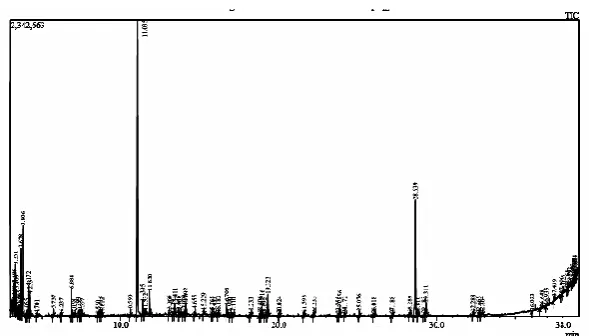
chromatogram of the methanolic extract of seed coat of Borassus Flabellifer Linn Seedis shown in (Figure 1).
From the result, the phytochemical components present are listed in Table 2.
GC-MS chromatogram of the methanolic extract of seed coat of Borassus Flabellifer Linn
seed (Figure 1).
[image:5.595.151.446.407.575.2]
Table 2: GC-MS Analysis of methanolic extract of Seed coat of Borassus Flabellifer Linn
seed.
S.No. Name Of The Compound
Retention Time (min)
Molecular Formula
Molecular weight
PeakArea (%)
1 2,4-Dimethyl heptane 3.108 C9H20 128 0.85
3 2-Propyl-1-pentanol 3.289 C8H18O 130 2.61
4 Ethyl cyclohexane 3.350 C8H16 112 3.46
5 1,1,4-Trimethyl cyclohexane 3.400 C9H18 126 2.11
6 trans-2,4-Dimethylthiane,
S,S-dioxide 3.514 C17H14O2S 162 0.27 7 2,3-Dimethyl heptane 3.565 C9H20 128 0.63
8 7-Methylene-tridecane 3.608 C14H28 196 0.40
9 Ethyl benzene 3.678 C8H10 106 5.38
10 1,3-Dimethyl benzene 3.806 C8H10 106 9.36
11 1-Ethyl,2-Methyl cyclopentane 4.055 C8H16 112 0.33
12 Nonane 4.233 C9H20 128 1.53
13 3-Hexen-1-ol-benzoate(Z) 4.701 C13H16O2 204 0.18
14 Benzenamine 5.737 C6H7N 93 0.74
15 2-Ethyl Hexan-1-ol 6.884 C8H18O 130 2.25
16 Benezenemethanol 7.058 C7H8O 108 0.27
17 1-Methyl-2-pyrrolidinone 7.299 C5H9NO 99 0.73
18 3-Methyl-1-hexene 7.433 C7H14 98 0.20
19 2,3,4-Trimethyl hexane 7.557 C9H20 128 0.42
20 2-cyclopentene-1-carboxylic
acid 8.550 C9H14O2 154 0.19
21 Decane 8.715 C10H22 142 0.44
22 Nonal 8.812 C8H16 142 0.31
23 Octane 10.590 C8H16 114 0.33
24 Naphthalene 11.035 C8H16 128 26.94
25 Undecane 11.395 C8H16 156 1.19
26 Decanal 11.532 C8H16 156 0.40
27 2,4-Dimethyl benzaldehyde 11.830 C8H16 134 2.23
28 2-Ethyl hexyl chloroacetate 13.292 C10H19ClO2 206 0.19
29 6-Ethyl-2-methyl octane 13.411 C11H24 156 0.84
30 3-Bromodecane 13.998 C10H21Br 220 0.38
31 Decyloxyamine 14.092 C10H23NO 173 0.86
32 3,3-Dimethyl hexane 14.655 C8H18 114 0.29
33 1,1,6,6-Tetramethyl spiro
[4,4] nonane 15.229 C13H24 180 0.36
34 1,1'-Biphenyl 16.183 C12H20 154 0.24
35 Tetradecane 16.708 C14H30 198 0.87
36 2-Bromononane 16.900 C9H19Br 206 0.17
37 Docosane 17.110 C22H46 310 0.17
38 3-Ethyl-4-methyl heptane 18.233 C10H22 142 0.24
39 Sulfurous acid, hexyl octyl
ester 18.916 C14H30O3S 278 0.96
40 2-Propyldecal-1-Ol 19.092 C13H28O 200 0.25
46 Pentadecanal 24.172 C15H30O 226 0.16
47 Hexadecanoic acid 25.076 C16H32O2 256 0.52
48 Di-isodecylphthalate 27.188 C28H46O4 446 0.23
49
Benzenepropanoicacid, 3,5- bis(1,1-dimethylethyl)-4-hydroxy-methylester
28.639 C18H28O3 292 12.04
50 Acetic acid, bicyclo
[2,2,1]hept-2-en-7-ylidene 28.810 C9H10O2 150 0.20
51 Phthalic acid, cyclo butyl
tridecyl ester 29.183 C25H38O4 402 0.29 52 n-Hexadecanoic acid 29.311 C16H32O2 256 1.68
53 Z-4-Decanal 32.288 C10H18O 154 0.28
54 Octylformate 32.864 C9H18O2 158 0.18
55 Dodecamethyl pentasiloxane 36.033 C12H36O4 384 0.35
56 Silikonfett 36.648 - 9999 0.39
57 1,2-Benzene dicarboxylic acid 37.439 C24H38O4 390 0.56
58 5-O-Hexyl-D-Galactitol 37.900 C12H26O6 266 0.20
59
3-Ethoxy-1,1,1,5,5,5-hexamethyl-3-(trimethyl siloxy) trisiloxane
38.268 C11H32O4Si4 340 0.16
60 Cyclotetrasiloxane,
octamethyl 38.874 C8H24O4Si4 296 0.43
The GC-MS analysis of seed coat of Borassus Flabellifer Linn seedshows 60 phytocomponents. The predominant components are found to be Naphthalene, Benzenepropanoicacid 3, 5 - bis (1,
1-dimethylethyl)-4-hydroxy-methylester, 1,3 - Dimethyl benzene, Ethyl cyclohexane, Ethyl benzene.
The structures of these molecules are given in Table-3.
Due to the presence of above mentioned compounds in the methanolic extract of seed coat of
Borassus flabellifer linn seed can be used in various medicinal applications.
Table 3:
S. No.
COMPOUND STRUCTURE
1 Naphthalene
2
3 1,3-Dimethyl benzene
4 Ethyl benzene
5 Ethyl cyclohexane.
4. CONCLUSION
The methanolic extract of seed coat of Borassus flabellifer linn seed posses various potent bioactive compounds. This study reveals the phytochemical and GC-MS analysis of seed coat of
Borassus flabellifer linn seed. The antimicrobial, antioxidant and
Anti-inflammatory properties have been already reported. So it is recommended as drug formation
in pharmaceutical industries. Further studies are needed to explore the potential biological
activities of seed coat of Borassus flabellifer linn seed.
5. REFERENCES
1. Syed Zeenat Shaheen, Krishna B, Kandukuri vasu,Singara chary M.A. antimicrobial activity of
the fruit extracts of coccinia indica. African journal of biotechnology, 2009; 8(24): 7073-7076.
2. The Wealth of India. A dictionary of Indian raw materials and Industrial products, publications
and information directorate CSIR, Newdelhi, 187-198.
3. Van Rheedede’s hortus malabarus, English ed., 1: 23-24.
4. '' Kew world checklist of selected plant families'' retrieved; 18 January 2016.
5. Nadkarni, Indian Materia Medica,(popular praashan, Bombay); 2002; 209-210.
6. Morton JF. Notes on distribution, propagation and products of Borassus palms (Arecaceae).
Econ Bot, 42: 420-421.
7. Morton JF. Notes on distribution propagation and products of Borassus palms (Arecaceae).
Econ Bot, 42(3): 420-441.
10.Nostro A, Germano MP, Dangelo V, Marino A, Cannatelli MA. Extraction methods and
bioautography for evaluation of medicinal plant antimicrobial activity. Lett Appl Microbiol,