A study of inventory classification in healthcare logistics
using system dynamics modelling.
AL-QATAWNEH, Lina Khalil.
Available from Sheffield Hallam University Research Archive (SHURA) at:
http://shura.shu.ac.uk/19256/
This document is the author deposited version. You are advised to consult the publisher's version if you wish to cite from it.
Published version
AL-QATAWNEH, Lina Khalil. (2006). A study of inventory classification in healthcare logistics using system dynamics modelling. Doctoral, Sheffield Hallam University (United Kingdom)..
Copyright and re-use policy
See http://shura.shu.ac.uk/information.html
Aasens oenire o<am(juo Sheffield S1 1WB 1 0 1 8 3 5 3 6 2 3
Fines are charged at 50p per hour
0 * SEP 200?
ProQuest Number: 10694136
All rights reserved
INFORMATION TO ALL USERS
The quality of this reproduction is dependent upon the quality of the copy submitted.
In the unlikely event that the author did not send a com plete manuscript and there are missing pages, these will be noted. Also, if material had to be removed,
a note will indicate the deletion.
uest
ProQuest 10694136
Published by ProQuest LLC(2017). Copyright of the Dissertation is held by the Author.
All rights reserved.
This work is protected against unauthorized copying under Title 17, United States C ode Microform Edition © ProQuest LLC.
ProQuest LLC.
789 East Eisenhower Parkway P.O. Box 1346
A Study of Inventory Classification in Healthcare Logistics
Using System Dynamics Modelling
Lina Khalil Al-Qatawneh
A thesis submitted in partial fulfilment of the requirements of
Sheffield Hallam University
for the degree of Doctor of Philosophy
Abstract
One of the key challenges for a modem day health care provider is to dispense high quality of medical care while limiting or even reducing the health care expenditures. This research work endeavours to meet this challenge through effective management of hospitals logistics systems. The aim of this research work is to provide a structured mechanism for modelling and analysing health care logistics to be able to understand its dynamic behaviour and effectively manage its logistical activities on the basis of the model. In order to achieve the research objectives, this research uses system dynamics as the main medium of analysis, and in particular, employs an integrated system dynamics framework which has been used previously for manufacturing industry supply chain designs and tests the feasibility of the framework for analysing and modelling health care logistics. This is ascertained by developing and incorporating a decision making metrics in the system dynamics model based on item criticality, usage, and value to optimise overall logistics costs.
System Dynamics methodology is employed at first to develop a model for existing inventory control decisions, and subsequently to produce two alternative approaches
based on traditional (.R, s, S) inventory control approach and Continuous Replenishment
Inventory and Order Based Production Control CR(IOBPCS) approach. These approaches are tested for two case hospitals, namely: Children’s National Medical Center (CNMC) USA, and Derbyshire Royal Infirmary (DRI) UK. The dynamic analysis for each case revealed problems in terms of multistage inventories and order batching, which could lead to demand amplification causing a detrimental effect on the inventory management throughout the supply chain. Accordingly, the simulations results produced for the two cases are benchmarked using alternative strategies in terms of lower inventory cost, and robustness to meet the unpredictable demand arising from a large number of items.
Overall, this research work has enhanced the understanding of hospitals logistics systems by building qualitative and quantitative models. More specifically, this research work has illustrated the applicability of the integrated system dynamics framework in analysing and modelling hospitals logistics systems and inventory control decisions. One particular contribution of this study is introducing inventory classification based on the criticality of items for patient needs which is more suited for health care situations rather purely cost based policies prevalent in other manufacturing and service chains. Therefore, this work has rigorously tested a multi-criteria based inventory classification method that takes into account the criticality of use, cost, and usage value of items for optimising overall inventory cost while maintaining the required patient care/service level. Future studies may be conducted to further evaluate the trade-offs in between different logistics decision making (such as, inventory control, service level, purchasing, transportation and warehousing) in order to design a set of “best practice” simulation models to optimise the overall dynamic behaviour for health care supply chains.
Acknowledgements
In carrying out this study, I have received considerable help from several individuals and organisations to whom I extend my thanks. First, I would like to acknowledge the considerable help, advice and guidance I have received during my study for this degree from my supervisory team: Dr. Khalid Hafeez, Dr. Ian Morrey, Dr. Mike Hubbard, and Dr. Zain Tahboub. A special acknowledgement and thank you to Dr. Khalid Hafeez, whose knowledge, suggestions, guidance and constructive advice have provided much insight.
I would like to thank Mr. Tony Kamillo (Supplies Manager at Derbyshire Royal Infirmary) and Mr. Leland Kuhn (Materials Management Director at Children’s National Medical Center) for their help, cooperation and valuable data used in conducting the two case studies in this thesis. Also, I would like to thank all members of Sheffield Hallam University for providing me with the databases, resources and facilities needed to finish this thesis.
My family and friends deserve my uttermost gratitude and appreciation. First, I would like to thank my mother and father for their love and care all these years. Secondly, I would like to thank my mother and father in law as well as my sister in law for their support and taking care of my children when I was away. Finally, and most importantly, my deepest appreciation to my beloved husband Mustafa and my three wonderful sons Yousef, Ahmad and Ibraheem for their continuing love, encouragement, and support in completing this thesis. It is to them that I rightly dedicate this thesis.
1 U (/(V X J f
Table of Contents
Abstract...I Acknowledgements...II Table of Contents... Ill
List of Figures... VII
List of Tables...XIII
Chapter One: Introduction... 1
1.1 The Research Issues...1
1.2 The Research Background and Context... 2
1.3 Aims and Objectives...3
1.4 Research Questions...4
1.5 Structure of the Thesis...5
1.6 Summary...6
Chapter Two: Literature Review...7
2.1 Introduction...7
2.2 Logistics and Supply Chain Management... 7
2.3 Health Care Logistics... 11
2.4 Modelling Health Care Logistics... 16
2.5 Quantitative Techniques Used to Analyse Problems Associated with Logistical Activities...18
2.6 System Dynamics Methodology... 24
2.7 The Role of System Dynamics in Improving Logistics Chain Dynamics 27 2.8 Inventory classification...30
2.9 Summary... 31
Chapter Three: Modelling Health Care Logistics Using System Dynamics...34
3.1 Introduction...34
3.2 Conceptual Modelling of a Hospital Logistics System...34
3.2.1 Hospital service level decisions...38
3.2.2 Hospital inventory control decisions... 39
3.3 Quantitative Modelling of a Hospital Logistics System... 39
3.4 Modelling a Hospital Logistics System that is Using a Traditional (R, s, S) Inventory Control Approach...40
3.4.1 Conceptual model of a hospital logistics system that is using a traditional (.R, s, S) inventory control approach... 40
3.4.2 Simulation model and dynamic analysis of a hospital logistics system that is using a traditional (R, s, S) inventory control approach... 43
3.5 Modelling a Hospital Logistics System that is Using Continuous Replenishment (CR) Approach...52
3.5.1 Conceptual model of a hospital logistics system that is using CR(IOBPCS) inventory control approach...53
3.5.2 Simulation model and dynamic analysis of a hospital logistics system that is using CR(IOBPCS) inventory control approach... 56
3.6 Comparison Between (R, s, S) and CR(IOBPCS) Inventory Control Approaches... 62
3.7 Summary...63
Chapter Four: Logistics System Redesign of Two Case Hospitals Using an Integrated System Dynamics Framework...65
4.1 Introduction...65
4.2 Research Methods... 66
4.2.1 The research sites...66
4.2.2 Data collection and analysis...67
4.2.3 An integrated system dynamics framework for supply chain design 68 4.2.3.1 The qualitative phase...68
4.2.3.2 The quantitative phase...69
4.3 Case Study One: Children’s National Medical Center...70
4.3.1 Qualitative analysis of the CNMC logistics system...71
4.3.1.1 Input-output analysis (10A )... 73
4.3.1.2 Classification of items...74
4.3.1.3 Material, information, and cash flows for stock items... 75
4.3.1.4 Material, information, and cash flows for non-stock items...77
4.3.1.5 Purchasing, warehousing, and transportation decisions... 77
4.3.1.6 Inventory control and service level decisions...79
4.3.3 Computer simulation model of the CNMC logistics system... 82
4.3.4 Dynamic analysis... 85
4.3.5 Redesigning the CNMC logistics system... 91
4.3.5.1 Average stock, number of orders, and inventory cost for each operating strategy...101
4.3.5.2 Comparison of the five operating strategies in terms of average stock, number of orders, and inventory cost... 102
4.3.5.3 The % changes in average stock, number of orders, and inventory cost when changing from “current situation” operating strategy to the CR(IOBPCS) (eliminate) operating strategy...103
4.3.6 Inventory classification... 104
4.4 Case Study Two: Derbyshire Royal Infirmary...I l l 4.4.1 Qualitative analysis of the DRI logistics system... 113
4.4.1.1 Input-output analysis (10A )... 113
4.4.1.2 Classification of items...113
4.4.1.3 Material, information and cash flows... 114
4.4.1.4 Purchasing, warehousing, and transportation decisions... 117
4.4.1.5 Inventory control and service level decisions...117
4.4.2 Conceptual model of the DRI logistics system...119
4.4.3 Computer simulation model of the DRI logistics system...119
4.4.4 Dynamic analysis...122
4.4.5 Redesigning the DRI logistics system... 125
4.4.5.1 Average stock, number of orders, and inventory cost for each operating strategy...130
4.4.5.2 Comparison of the three operating strategies in terms of average stock, number of orders, and inventory cost...131
4.4.5.3 The % changes in average stock, number of orders, and inventory cost when changing from “current situation” operating strategy to the CR(IOBPCS) operating strategy...132
4.4.6 Inventory classification...134
4.5 Discussion...137
Chapter Five: Conclusions and Future Research Work... 143
5.1 Introduction...143
5.3 Evaluation of the Research Methodology...145
5.4 Limitations of the Research Work... 147
5.5 Future Research W ork... 148
References... 149
Appendices Appendix A: System Dynamics...1
Appendix B: The ithink Analyst Software...5
Appendix C: Conceptual and Simulation Models of a Hospital Logistics System that is Using a Traditional (R,s,S) Inventory Control Approach... 11
Appendix D: Conceptual and Simulation Models of a Hospital Logistics System that is Using CR(IOBPCS) Inventory Control Approach...16
Appendix E: Criterion for Optimising the Values of the Design Parameters (Ta / Tp) and (Ti / Tp) in a CR(IOBPCS) Model... 20
Appendix F: Computer Simulation Model of the CNMC Logistics System... 26
Appendix G: Simulation Results of Redesigning the CNMC Logistics System.... 29
Appendix H: Computer Simulation Model of the DRI Logistics System...51
Appendix I: Simulation Results of Redesigning the DRI Logistics System... 52
juidi uj i' i%ur co
List of Figures
Figure 2.1: A typical supply chain...8 Figure 2.2: A typical health care supply chain... 11 Figure 2.3: The overall interfaces and interrelationships in a health care supply chain. 13
Figure 2.4: An integrated system dynamics framework for supply chain design 28
Figure 3.1: A high level stock-flow diagram for three-echelon health care supply chain ...35 Figure 3.2: Stock-flow diagram of a hospital logistics system...36
Figure 3.3: Stock-flow diagram of a hospital logistics system that is using the (.R, s, S)
inventory control approach...41 Figure 3.4: Dynamic behaviour of a hospital logistics system that is using the (.R, s, S)
inventory control approach for the example item defined in Table 3.2...45
Figure 3.5: Dynamic behaviour of a hospital logistics system that is using the (R, s, S)
inventory control approach for the item of scenario 1 defined in Table 3.3... 48
Figure 3.6: Dynamic behaviour of a hospital logistics system that is using the (R, s, S)
inventory control approach for the item of scenario 2 defined in Table 3.3... 49
Figure 3.7: Dynamic behaviour of a hospital logistics system that is using the (R, s, S)
inventory control approach for the item of scenario 3 defined in Table 3.3... 50 Figure 3.8: The stock-flow diagram of a hospital logistics system that is using CR(IOBPCS) inventory control approach... 54 Figure 3.9: Dynamic behaviour of a hospital logistics system that is using the
CR(IOBPCS) inventory control approach for the item of scenario 1 defined in Table 3.5...58 Figure 3.10: Dynamic behaviour of a hospital logistics system that is using the
CR(IOBPCS) inventory control approach for the item of scenario 2 defined in Table 3 .5 ...59 Figure 3.11: Dynamic behaviour of a hospital logistics system that is using the
CR(IOBPCS) inventory control approach for the item of scenario 3 defined in Table 3 .5...60
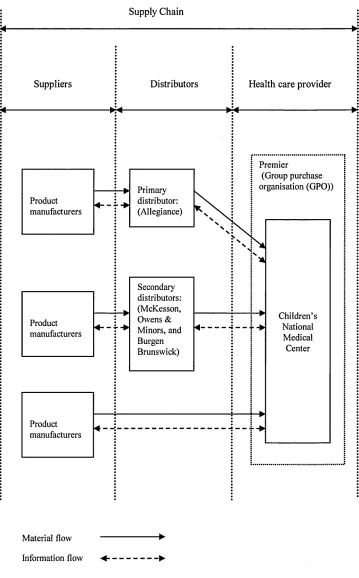
Figure 4.1: The overall material and information flow in the CNMC supply chain 72
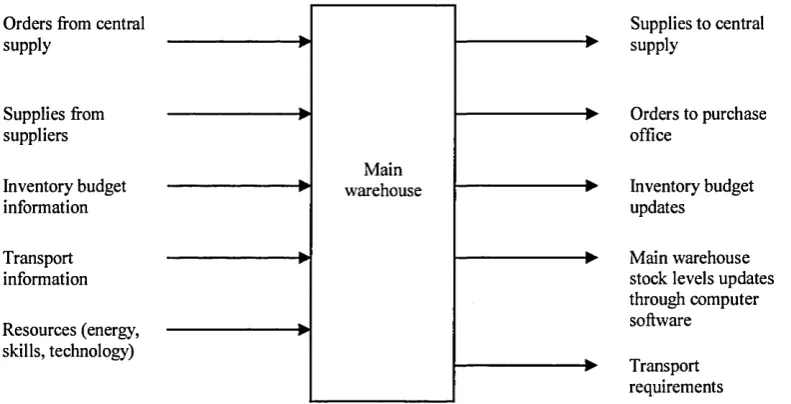
Figure 4.2: Percentage breakdown of suppliers shares for the CNMC... 73 Figure 4.3: Input-output analysis of the central supply at the CNMC...73
L,im u) r i g u r e z
Figure 4.4: Input-output analysis of the main warehouse at the CNMC...74 Figure 4.5: Material, information, and cash flows for stock items (CNMC case study) 76 Figure 4.6: Material, information, and cash flows for non-stock items (CNMC case
study)... 78
Figure 4.7: Causal-loop diagram of the CNMC logistics system for stock items 83
Figure 4.8: The stock-flow diagram of the CNMC logistics system for stock items 84 Figure 4.9: The dynamic behaviour of the CNMC logistics system for the example item: scalpel sterile disposable (see Table 4.3)...87 Figure 4.10: The dynamic behaviour of the CNMC logistics system for the example item: container specimen sterile (see Table 4.3)... 88 Figure 4.11: The dynamic behaviour of the CNMC logistics system for the example item: oxygenator membrane (see Table 4.3)...89 Figure 4.12: The dynamic behaviour of the CNMC logistics system for the example item: bottle aerobic fan (see Table 4.3)...90 Figure 4.13: The stock-flow diagram of the CNMC logistics system for the “current situation” operating strategy (see Table 4.4)...93
Figure 4.14: The stock-flow diagram of the CNMC logistics system for the (R,s,S)
operating strategy (see Table 4.4)...94 Figure 4.15: The stock-flow diagram of the CNMC logistics system for the (i?,s,iS)(eliminate) operating strategy (see Table 4.4)... 95 Figure 4.16: The stock-flow diagram of the CNMC logistics system for the CR(IOBPCS) operating strategy (see Table 4.4)... 96 Figure 4.17: The stock-flow diagram of the CNMC logistics system for the CR(IOBPCS) (eliminate) operating strategy (see Table 4.4)...97
Figure 4.18: Matrix of different combinations of Item Unit Cost, Average Demand, and
Standard Deviation o f Demand to represent a wide range of different items used by the CNMC... 99 Figure 4.19: The % decrease in average stock, the % increase in number of orders, and
the % savings in inventory cost when CNMC changes its logistics operating strategy from “current situation” to the CR(IOBPCS) (eliminate)... 105 Figure 4.20: A multi-criteria inventory classification matrix... 106 Figure 4.21: Example of graphical results from the application of the ABC inventory classification method...108 Figure 4.22: Proposed inventory classification for the CNMC... 108
U ) r i % u r c j
Figure 4.23: The % decrease in average stock, the % increase in number of orders, and the % savings in inventory cost when the value of the Service Level Factor (k)
changes from 1 to 0.9 and from 1 to 0.8 for the CR(IOBPCS) (eliminate) strategy 110
Figure 4.24: The overall material and information flow in the DRI supply chain 112
Figure 4.25: Input-output analysis of the DRI supplies department...114 Figure 4.26: Material, information, and cash flows for stock items, non-stock items, and pharmaceutical products (DRI case study)...115
Figure 4.27: Causal-loop diagram of the DRI logistics system for stock items 120
Figure 4.28: The overall stock-flow diagram of the DRI logistics system for stock items 121 Figure 4.29: The dynamic behaviour of the DRI logistics system for the example item: Catheter central venous blister tray (see Table 4.7)... 123 Figure 4.30: The dynamic behaviour of the DRI logistics system for the example item: Catheter suction straight tip (see Table 4.7)...124 Figure 4.31: The stock-flow diagram of the DRI logistics system when using the “current situation” operating strategy (see Table 4.8)... 127
Figure 4.32: The stock-flow diagram of the DRI logistics system when using the (R,s,S)
operating strategy (see Table 4.8)...128 Figure 4.33: The stock-flow diagram of the DRI logistics system when using the CR(IOBPCS) operating strategy (see Table 4.8)...129
Figure 4.34: The % decrease in average stock, the % increase in number of orders, and
the % savings in inventory cost when the DRI changes its logistics operating
strategy from “current situation” to the CR(IOBPCS) operating strategy 133
Figure 4.35: Proposed inventory classification for the D RI... 134
Figure 4.36: The % decrease in average stock, the % increase in number of orders, and
the % savings in inventory cost when the value of the Service Level Factor (k) changes from 1 to 0.9 and from 1 to 0.8 for the CR(IOBPCS) operating strategy ...136
Appendices
Figure A. 1: Example of a simple stock and flow structure... 2 Figure A. 2: Simple system dynamics stock-flow structure of a closed system with a
positive feedback loop...3
L,im u) r i g u r e s
Figure A. 3: Simple system dynamics stock-flow structure of a closed system with a
negative feedback loop... 4
Figure B. 1: An Overview of the Operating Environment... 6
Figure B. 2: Ghosting as an Antidote to Spaghetti... 9
Figure E. 1: Dynamic-behaviour measurements selected for system optimisation...21
Figure E. 2: The investigation of the dynamic behaviour of Hospital Stock and Order Rate for seven different combinations of (Ta and T,)...22
Figure E. 3: The investigation of the dynamic behaviour of Hospital Stock and Order Rate for the four combinations of (Ta and T,) that will be assessed using the criterion in Figure E .l... 23 Figure G. 1: Average stock, number of orders, and inventory cost for the “current situation” operating strategy...
Figure G. 2: Average stock, number of orders, and inventory cost for the (R,s,S)
operating strategy... Figure G. 3: Average stock, number of orders, and inventory cost for the (i?,s,S)(eliminate) operating strategy... Figure G. 4: Average stock, number of orders, and inventory cost for the CR(IOBPCS) operating strategy... Figure G. 5: Average stock, number of orders, and inventory cost for the CR(IOBPCS) (eliminate) operating strategy... Figure G. 6: Comparison of the five operating strategies in terms of average stock,
number of orders, and inventory cost when Average Demand = 1 item/day...
Figure G. 7: Comparison of the five operating strategies in terms of average stock,
number of orders, and inventory cost when Average Demand = 10 items/day...
Figure G. 8: Comparison of the five operating strategies in terms of average stock,
number of orders, and inventory cost when Average Demand = 20 items/day...
Figure G. 9: Comparison of the five operating strategies in terms of average stock,
number of orders, and inventory cost when Average Demand = 30 items/day...
Figure G. 10: Comparison of the five operating strategies in terms of average stock,
number of orders, and inventory cost when Average Demand = 40 items/day...
Figure G. 11: Comparison of the five operating strategies in terms of average stock,
number of orders, and inventory cost when Average Demand =50 items/day...
Figure G. 12: Comparison of the five operating strategies in terms of average stock,
number of orders, and inventory cost when Average Demand = 60 items/day...
30
31
32
33
34
38
39
,40
,41
,42
.43
.44
IJ J 1
Figure G. 13: Comparison of the five operating strategies in terms of average stock,
number of orders, and inventory cost when Average Demand = 70 items/day... 45
Figure G. 14: Comparison of the five operating strategies in terms of average stock,
number of orders, and inventory cost when Average Demand = 80 items/day... 46
Figure G. 15: Comparison of the five operating strategies in terms of average stock,
number of orders, and inventory cost when Average Demand = 90 items/day... 47
Figure G. 16: Comparison of the five operating strategies in terms of average stock,
number of orders, and inventory cost when Average Demand = 100 items/day...48
Figure I. 1: Average stock, number of orders, and inventory cost for the “current situation” operating strategy... 53
Figure I. 2: Average stock, number of orders, and inventory cost for the (R,s,S)
operating strategy...54 Figure I. 3: Average stock, number of orders, and inventory cost for the CR(IOBPCS)
operating strategy...55 Figure I. 4: Comparison of the three operating strategies in terms of average stock,
number of orders, and inventory cost when Average Demand = 1 item/day...60
Figure I. 5: Comparison of the three operating strategies in terms of average stock,
number of orders, and inventory cost when Average Demand =10 item/day... 61
Figure I. 6: Comparison of the three operating strategies in terms of average stock,
number of orders, and inventory cost when Average Demand =20 item/day... 62
Figure I. 7: Comparison of the three operating strategies in terms of average stock,
number of orders, and inventory cost when Average Demand =30 item/day... 63
Figure I. 8: Comparison of the three operating strategies in terms of average stock,
number of orders, and inventory cost when Average Demand = 40 item/day... 64
Figure I. 9: Comparison of the three operating strategies in terms of average stock,
number of orders, and inventory cost when Average Demand = 50 item/day... 65
Figure I. 10: Comparison of the three operating strategies in terms of average stock,
number of orders, and inventory cost when Average Demand = 60 item/day... 66
Figure I. 11: Comparison of the three operating strategies in terms of average stock,
number of orders, and inventory cost when Average Demand = 70 item/day... 67
Figure I. 12: Comparison of the three operating strategies in terms of average stock,
number of orders, and inventory cost when Average Demand = 80 item/day... 68
Figure I. 13: Comparison of the three operating strategies in terms of average stock,
number of orders, and inventory cost when Average Demand =90 item/day... 69
KJJ X (CNf WO
Figure I. 14: Comparison of the three operating strategies in terms of average stock,
number of orders, and inventory cost when Average Demand =100 item/day 70
LjI O I U) 1 u u i e a
List of Tables
Table 2.1: Logistics activities... 9 Table 3.1: An explanation of the (.R, s, 5) inventory control approach...42 Table 3.2: Definition of the variables used in the simulation model of the (.R, s, S)
inventory control approach for the example item... 44 Table 3.3: Definition of the variables used in the simulation model of the (R, s, S)
inventory control approach for the three test scenarios... 47 Table 3.4: An explanation of the CR(IOBPCS) inventory control approach...55 Table 3.5: Definition of the variables used in the simulation model of the CR(IOBPCS)
inventory control approach for the three test scenarios... 57
Table 3.6: Comparison between (.R, s, S) and CR(IOBPCS) inventory control
approaches... 62 Table 4.1: CNMC inventory control and service level decisions for wards and departments stocks...80 Table 4.2: CNMC inventory control and service level decisions for central supply and main warehouse stocks... 81 Table 4.3: The variables that are used in the simulation process for the example stock
items...86 Table 4.4: Summary of the current operating strategy of the CNMC logistics system and the proposed operating strategies for redesigning the CNMC logistics system 92 Table 4.5: Overall dynamic behaviour for the five operating strategies... 101 Table 4.6: Inventory control and service level decisions for stock items... 118 Table 4.7: The variables that are used in the simulation model...122 Table 4.8: Summary of the current operating strategy of the DRI logistics system and
the proposed operating strategies for redesigning the DRI logistics system 126
Table 4.9: Overall dynamic behaviour for the three operating strategies... 131
Appendices
Table C. 1: The equations that make up the simulation model of the hospital logistics system that is using a traditional (.R,s,S) inventory control approach... 15 Table D. 1: The equations that make up the simulation model of the hospital logistics
system that is using CR(IOBPCS) inventory control approach...19
I// ±
Table E. 1: Summary of the results of the dynamic-behaviour measurements as taken
from Figure E.3... 24
Table E. 2: Summary of the effect of increasing Ta and 71, on the dynamic-behaviour measurements...25 Table F. 1: The equations that make up the computer simulation model of the CNMC logistics system...27 Table H. 1: The equations that make up the computer simulation model of the DRI
logistics system...51
Chapter One: Introduction
1.1 The Research Issues
This research work investigates the issue of logistics management in health care and how to effectively manage hospitals logistics systems as an attempt to contain cost without sacrificing the quality of health care. This research work argues that an effective management of hospitals logistics systems should be based on a clear understanding of the interconnectivity in between logistical activities in a hospital logistics system and which demands trade-offs considerations between various logistical decisions. This research work argues that this understanding is achieved through modelling hospitals logistics systems and analysing their dynamic behaviour. In addition, this research work argues that an effective management of hospital logistics addresses the conflicting objectives of minimizing logistics-related cost while simultaneously reducing the incidence of stockouts, especially for critical items. Therefore, this research work focuses in the assessment of the dynamic behaviour of health care logistics on two main variables: logistics cost and service level. Furthermore, this research work investigates a number of strategies to improve the dynamic behaviour of hospitals logistics systems in terms of performance and cost. As part of this investigation, this research work assesses the role of inventory classification when incorporated into the redesigning strategies of health care logistics. This research work argues that a distinctive feature of health care logistics is the criticality of items used by hospitals and the life threatening situations that could happen due to the unavailability of these items. Therefore, this research work studies the impact of using a multi-criteria inventory classification method that takes into account the criticality, cost, and usage value of items on logistics cost reduction.
The remaining of this chapter is organised as follows. Section 1.2 presents a brief background concerning the issues that are raised in this research work and the context of this research. Section 1.3 discusses the overall aims and objectives of this research work. The research questions are given in section 1.4. Finally, section 1.5 gives an overview of the structure of this thesis and section 1.6 summarises this chapter.
1.2 The Research Background and Context
Offering health care and developing health services are fundamental national duties. Most of the population in the developed countries are covered against medical cost by one of the following three models: National Health Service (NHS), Social Insurance (SI), and Private Insurance (PI). Irrespective of the economic and health care structure, a major concern with health care is its growing cost. The latest OECD Health data (2005) shows that the highest health care spending as a percent of gross domestic product (GDP) between the thirty OECD countries amounts 15 % in the United States
followed by 11.5 % in Switzerland, 11.1 % in Germany, 10.5 % in Iceland, 10.3 % in
Norway, and 10.1 % in France. This rise in the health care expenditure may be
attributed to factors including population aging, population increase, widening range of treatment available, level of technology used, and intensive labour requirements
(Docteur and Oxley, 2003; Mehrotra et al., 2003). Therefore, providing a high quality
of medical care at a reduced cost has become a top priority for many governments in the world.
Although personnel, nursing and physician pay is the single largest expense in any hospital, costs related to inventory, logistics, and administration processes are nevertheless significant and are steadily rising. In some cases, it is estimated that approximately 30-40 % of hospital spending is invested in various logistical activities (Sheyer, 1995; Poulin, 2003). Logistic related costs are often ignored whenever governments or other organizations examine the economics of health care service delivery. Rather than introducing efficiencies in logistics and supply processes, health care service providers usually look at cutting suppliers’ margins or reducing the price of standard medical products whenever faced with budget cuts.
Although, there is an established work in the literature that has provided insights concerning health care logistics, the focus of these studies was directed toward qualitative process improvements. There are few studies that have quantitatively analysed problems associated with logistical activities within the context of health care, and most of which have focused on only one particular logistical activity, mainly inventory control. Therefore, one can argue that considering the effect of the interrelated decisions that are applied for managing the logistics system within the context of health care and understanding the dynamic nature of health care logistics to aid in the whole logistics system design are still to be explored. In this research work, the modelling and analysis of health care logistics are expected to be more useful to this context. Since the health care industry started to realise the important role logistics management can play to contain cost without sacrificing the quality of health care, the assessment of the dynamic behaviour of health care logistics in terms of performance and cost increases the importance of this research work to this context.
Moreover, the distinctive feature of health care logistics concerning the criticality of items and the life threatening situations that could happen due to the unavailability of these items may require different redesigning strategies than those used to improve the dynamic behaviour of other industries logistics systems. Therefore, investigating redesigning strategies that takes into consideration the criticality of items adds to the importance of this research work to this context.
1.3 Aims and Objectives
The overall aim of this research work is to understand the dynamic behaviour of health care logistics systems to effectively manage their logistical activities. Among the objectives of this research work is first to provide a structured mechanism for modelling and analysing health care logistics to be able to understand its dynamic behaviour and effectively manage its logistical activities on the basis of the model. The second objective of this research work is the application of modelling system dynamics for health care logistics that incorporates service and cost dimensions. This research work will focus in the assessment of the dynamic behaviour of health care logistics on two main variables: logistics cost and service level. The third objective is redesigning health care logistics to improve its dynamic behaviour in terms of performance and cost,
i r i i r u u i A i s i i u r i
taking into consideration the distinctive feature of health care logistics concerning the criticality of items. The attainment of these objectives will enable the achievement of the overall aim of this research work.
1.4 Research Questions
From the literature review, it was apparent that there is a gap in understanding the dynamic nature of health care logistics systems as a comprehensive whole and in considering the effect of the interrelated decisions that are applied for managing logistics systems in health care, which formed the overall aim of this research work and its main question. To enable the achievement of this aim, the following research questions were developed based on a comprehensive and critical review of the available literature:
• Is the integrated system dynamics framework for supply chain design applicable in the health care industry?
• Does the integrated system dynamics framework provide a structured mechanism for analysing and modelling health care logistics systems and their dynamic behaviour?
• Does the analysis and evaluation of the effects of the different logistics decisions on the dynamic behaviour of health care logistics reveal any problematic behaviour?
• How to quantify in terms of cost the relative improvements of redesign strategies in health care logistics?
• What is the role of inventory classification when incorporated into the redesigning strategies of health care logistics?
I f l i t U L t M L s l i L / r i
• What is the impact of using a multi-criteria inventory classification method that
takes into account the criticality, cost, and usage value of items on logistics cost reduction?
1.5 Structure of the Thesis
The rest of the thesis is organised in four chapters. The main aim of Chapter Two is to review the available literature to identify existing gaps in the body of knowledge developed during previous work and then to develop, based on these gaps, the research questions that specify exactly what is going to be investigated in this research work.
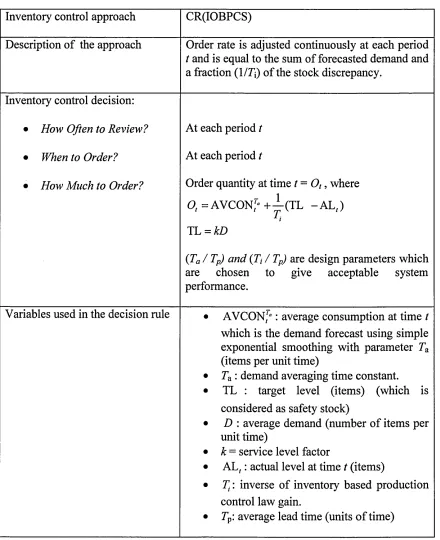
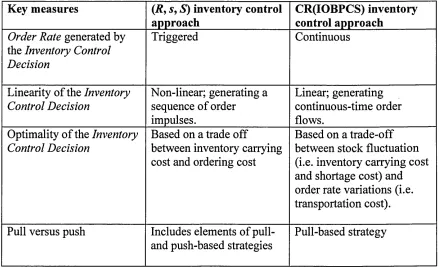
The main aim of Chapter Three is to explain how to develop conceptual and quantitative models of hospitals logistics systems using System Dynamics methodology. This chapter first explains the development of a general conceptual model of a hospital logistics system. Then, this chapter describes the conceptual model development, simulation model development and dynamic analysis of two specific hospital logistics systems: one using a traditional (R, s, S) inventory control approach and the other using continuous replenishment (CR).
The main aim of Chapter Four is to answer the research questions through conducting two case studies. This chapter begins by discussing the research methods. This is followed by demonstrating the implementation of the various stages of an integrated system dynamics framework proposed to be used for logistics system redesign of two case hospitals: Children’s National Medical Center (CNMC) in the United States of America (USA), and Derbyshire Royal Infirmary (DRI) in the United Kingdom (UK). This chapter concludes with a discussion of how, through conducting the two case studies in this chapter, this author answered the research questions that were developed in Chapter Two.
The main aim of Chapter Five is to identify the main contribution of this research work to the body of knowledge. This chapter also evaluates the research methodology and highlights the main limitations of this research work. The chapter ends by giving suggestions for future research.
± r t i f
1.6 Summary
This chapter began by discussing the issues that are raised and investigated in this research work. This was followed by presenting a brief background concerning these issues and the context of this research work. This chapter then provided the overall aim and objectives of this research work as well as the research questions. This chapter concluded by giving an organisation structure for the rest of the thesis.
Chapter Two: Literature Review
2.1 Introduction
This chapter first gives an overview of the relevant literature on logistics and supply chain management and then -more specifically- on health care logistics to identify its main characteristics and features and what is distinctive about it. This chapter then provides a comprehensive and critical review of the available literature on modelling health care logistics to identify existing gaps that will provide an overall aim for this research work. This is followed by a critical review of the different modelling techniques that have been used to analyse problems associated with logistical activities to choose the appropriate approach that is useful for solving the main question of this research work. A brief discussion of the chosen approach is then provided, followed by a critical review of the literature on the role of using this approach in the field of logistics management. The research questions that specify exactly what is going to be investigated in this research work are developed in this chapter based on the identified gaps in the literature.
2.2 Logistics and Supply Chain Management
Production facilities Material
suppliers Distributionservices Customers
---► Material flow
<■---Information flow
Figure 2.1: A typical supply chain
Over the last two decades, a number of related fields have contributed to the explosion of SCM literature (Chen and Paulraj, 2004) such as purchasing and supply, logistics and transportation, operations management, marketing, organizational theory, management information systems, and strategic management. Bechtel and Jayaram (1997) and Otto and Kotzab (2003) provided an extensive retrospective review of the literature and research on SCM. According to Gunasekaran (2004), there is a gap that exists between practice and theory, which needs to be addressed with a view to enhancing the application of SCM in real life environments and through further theoretical developments in the field. He argues that there are only a limited number of models and application frameworks that are available in the literature to give a comprehensive analysis of an integrated SCM system.
According to Lambert (2004) there is a great deal of confusion regarding exactly what supply chain management involves and that many use supply chain management as a synonym for logistics. In order to develop a common view of the field, the Global Supply Chain Forum was established. The forum is a group of non-competing firms and academic researchers who, working together, developed the following definition of SCM:
Supply Chain Management is the integration o f key business processes from end user through original suppliers that provides products, services, and information that add value for customers and other stakeholders.
k/f x rKL/
In October 1998, the Council of Logistics Management (CLM) has announced a modified definition of logistics based on the understanding of SCM that has been re conceptualised from integrating logistics across the supply chain to integrating and managing key business processes across the supply chain. The CLM defines logistics as:
Logistics is that part o f the supply chain process that plans, implements, and controls the efficient, effective flow and storage o f goods, services, and related information from the point-of-origin to the point-of-consumption in order to
meet customers ’ requirements.
This author agrees with the above distinction between logistics and SCM, and considers that SCM embraces all business processes -not just logistics- cutting across all organisations within the supply chain. From that understanding, in this research work, this author will focus on logistics as part of SCM, specifically, on analysing and managing hospitals logistics systems.
Each echelon in the supply chain has its own logistics system. Each logistics system is associated with its own logistics activities. A comprehensive list of these activities is
provided by Coyle et al. (1996) as shown in Table 2.1. However, each echelon may not
place responsibility for all of these activities within their logistics system. For example, this research, with case studies included in the thesis, suggests that hospitals usually do not include production planning in their logistics systems. However, production planning is one of the main logistics activities for product manufacturers.
Table 2.1: Logistics activities
• Traffic and Transportation • Production planning
• Warehouse and storage • Purchasing
• Industrial packaging • Customer service levels
• Materials handling • Plant and warehouse site location
• Inventory control • Return goods handling
• Order fulfilment • Parts and service support
• Demand forecasting • Salvage and scrap disposal
Source: Coyle et al. (1996)
Each of the indicated logistics activities demands some kind of decision making. For example, decisions related to warehousing (Ballou, 1992; Bowersox and Closs, 1996) include: how many warehouses, where to locate the warehouse, what size the warehouse should be, and so on. Such decision making has pros and cons. For example, a faster transport system would permit the holding of lower inventories and use less warehousing space. Also, the interconnectivity in between logistics systems demands that the decision maker evaluates various economic trade-offs. For example, adding a warehouse means adding related fixed and variable costs. However, this may reduce the overall transportation cost.
Logistics also has important relationships with other operational systems such as: manufacturing, marketing, finance, and other key business processes. In the case of marketing, logistics must ensure that the customers requirements as identified by the marketing system are available when and where desired by customers. Similarly, with regards to manufacturing, a long production run means more products, therefore requiring larger warehouse space to maintain a high level of inventory.
In summary, in any supply chain, interrelationships exist between:
• Different echelons within the supply chain. • Sub-systems in each echelon.
• Different logistics activities.
Therefore, to optimize costs in supply chains, the following optimisation and trade-offs need to be considered:
a) the cost of each logistics activity individually; and/or b) the trade-off between various logistics activities; and/or c) the trade-off between sub-systems; and/or
d) the trade-off between different echelons in a supply chain.
In practice, these trade-offs are driven by the overall supply chain as well as business strategy. Therefore, this author would like to define supply chain management (SCM) as follows:
Supply chain management is about managing and coordinating all trade-off relationships that could exist in a supply chain in a way that optimises the overall supply chain cost while maintaining a high customer service level.
2.3 Health Care Logistics
The research in this thesis represents the view that a typical health care supply chain consists of three echelons: health care provider, distributor, and product manufacturer, which are linked together via information, material, and cash flows as shown in Figure 2.2. Information and cash would flow in both directions, whereas, materials would usually flow in one direction -except in the case of reverse logistics1. As shown in Figure 2.2, the health care provider orders its supplies -medical and non-medical products- either directly from product manufacturers, or from distributors who in turn order their supplies from product manufacturers.
Product
manufacturer Distributor
Product manufacturer
Health care provider
---► Material flow
[image:29.612.76.458.384.692.2]<■---► Information flow ^---Cash flow
Figure 2.2: A typical health care supply chain
Based on the literature review of logistics systems that is discussed briefly in section 2.2, a holistic view of a health care supply chain was drawn as illustrated in Figure 2.3, showing interrelationships between different echelons within the supply chain, sub systems in each echelon, and different logistics activities.
A literature review of health care supply chains revealed that they are complex supply chains due to the wide product range, the criticality of and the perceived need to supply very high level of services for most items, and the high value of products involved (Beier, 1995). The wide variability in product ranges is often the result of too much differentiation among the available products. This usually tends to occur due to the subjective decision making of persons involved (e.g. physicians who have significant technical knowledge of what the products are supposed to do) (Neumann, 2003). In many industries, fluctuations in demand can be linked to specific factors that can be controlled to some extent. However, health care organisations have very little control over the demand for supplies (Smith, 1999). In this author’s view, this is due to the fact that the health care industry is unique in terms of the large volume of diverse support services required to deliver the end product which is patient care.
Like its counterparts, the health care industry is beginning to look into effective supply chain management (SCM) as an answer to its quest for reducing costs. Hospitals are taking advantage of the latest tools available on the market including: implementation of the Universal Product Number (UPN) (DeJohn, 1997), bar coding (Moynihan, 1998), automated data capture and electronic data interchange (EDI) (Moynihan, 1997).
There have been some global initiatives to enhance the benefits of SCM, for example, Efficient Healthcare Consumer Response (EHCR). In 1996, the EHCR initiative was launched by a consortium of health care industry associations and health care supply chain participants in response to intensifying pressure to reduce health care costs while enhancing the quality and efficiency of care (CSC, 1996). The goal of EHCR is to streamline the health care products supply chain by improving efficiency and eliminating waste at every step of the chain. EHCR has three foundation strategies that are based upon: efficient product movement, efficient order management and efficient information sharing. The key enablers of these strategies are product identification through bar coding, continuous replenishment, and activity based costing.
g
fe
Ua
u
9
■+■*
w
9
9
9
W
9
-a
o
i.
P
lh
u
©
u
©
9
A
h.
2
c
.2
t
S
[image:31.612.93.737.67.460.2]In health care, usually the management of logistics activities within hospitals is discussed under the broad heading of materials management. One of the classical definitions of materials management in hospitals comes from Arnold Reisman (1981, p432) who defines it as:
A term used to describe the grouping o f management functions related to the complete cycle o f material flow, from the requisitioning, purchase, and internal control o f materials; to the planning and control o f work in process; to the warehousing, shipping, distribution, and/or disposal after use o f a product.
The logistics department - also named as the materials management department or the supply department - is the focal point of a hospital’s logistics activities. It has direct responsibility for managing the functions of purchasing, inventory control, warehousing, and transportation (Henning, 1986; Scheyer, 1995; Poulin, 2003).
In recent years, health care strategies are directed toward identifying the logistics solutions that will lead to increases in overall customer service levels and reductions in total health care cost. This led to the application of time-based logistics strategies including: just-in-time (JIT) (North, 1994; Heinbuch, 1995; Whitson, 1997), stockless
inventory (Wilson et al., 1992; Rivard-Royer et al., 2002), vendor-managed inventory
(Haavik, 2000), third-party logistics (Kontzer, 2003), time-phased order points (Spedding, 1998), reverse logistics (Ritchie et al., 2000), and efficient healthcare consumer response (EHCR) (CSC, 1996). All of these time-based logistics strategies which Kotzab (1999) refers to as IT-driven logistics strategies employing EDI, barcode and scanning technology are pursuing the following objectives (La Londe and Masters,
1994; Aptel and Pourjalali, 2001):
a) Reduction of cycle time. b) Reduction of inventories.
c) Avoiding duplications of logistics costs. d) Increasing customer service.
In this author’s view, in a hospital setting, these objectives lead to conflicts within concerned parties. Health providers (e.g. physicians, nurses, and laboratory technicians) are generally quite intolerant of shortages or stockouts, however, they are relatively less
sensitive to costs. Whereas, hospital administrators are concerned with decreasing the total cost, while increasing hospital service level.
There are a variety of ways by which hospital service level is measured (Morey et a l,
1994; Huamg and Lee, 1996; Pina and Torres, 1996; Mittler, 1998). These measures are a reflection of how hospitals insure for each patient the availability of:
a) Excellent medical and nursing staff. b) High standard medical technology. c) Short queues and waiting time. d) High hotel services.
e) Availability of medical and non-medical products.
This research work is concerned exclusively with the availability of medical and non medical products. However, there are implied benefits of this associated with short queues and waiting time and high hotel services.
Based on the literature review, the following points summarise the main characteristics and features of health care logistics:
I. Hospitals generally think of their offerings as services rather than products. The core service is inpatient care.
II. Hospitals when providing their main product - inpatient care - need tangible medical and non-medical products.
III. Hospitals maintain a large number of different products. This wide variability of product types is caused by the diverse health services the hospital offers to patients and the role of physicians in choosing these products.
IV. The large diversity of patients’ needs, combined with the physicians’ preferences of the way to treat their patients makes the demand for products unpredictable and uncontrollable.
V. In hospitals, products are ranged between high-critical to low-critical item. High- critical items are either essential for the work carried out and/or have no immediate alternative. While, medium-critical items are important for the work, but may have acceptable alternatives, or other sizes may be used in the event of stock-out. Low-critical items are unlikely to affect the well being of patients other than causing minor inconvenience.
VI. The unavailability of critical items could lead to life threatening situations.
VII. Although critical items constitute a small number of items, the majority of the total inventory investment is in critical items (around 60%) (Nicholson et a l, 2004). This is because critical items are usually extremely expensive, have a short shelf-life, and/or require expensive storage facilities on site.
Other industries logistics systems may have the same above characteristics and features of health care logistics, except for one. The criticality of certain items used by hospitals and the life threatening situations that could happen due to the unavailability of these items is a distinctive feature of health care logistics. This feature is what makes health care logistics distinct and different from other industries logistics systems. Therefore, this feature will be one of the main concerns of this research work when modelling and analysing health care logistics systems.
2.4 Modelling Health Care Logistics
Beier (1995), applied an economic order quantity (EOQ) analysis to questionnaire data in order to draw a comparison with current inventory management practices in hospital pharmacies. The results of the comparison suggest that the average pharmacy has the potential for savings in inventory related costs. However, Beier assumes too much homogeneity in the inventory items analysed. The application of an EOQ model over a broad spectrum of inventory items can be questioned.
Dellaert and Poel (1996), suggested an inventory control model by extending an EOQ
model to a so-called (R,s,c,S) model, in which the values of the control parameters s, c,
and S are determined in a very intuitive way. They compared various cost components
and service levels through a simulation study. The comparison showed a decrease in the cost in combination with an increase in the service rate for the proposed new rule. They also showed that the performance of the new rule was comparable to that of a rule in which the control parameters were determined in a more sophisticated way.
Banerjea-Brodeur et al (1998) presented an application of a routing model. Their study
aimed at improving the linen delivery operations in a hospital by reassessing the quantities of linen to be delivered and by redesigning the delivery schedule using a tabu search heuristic algorithm.
In a more recent study, Nicholson et al (2004) have compared inventory policies,
inventory costs, and service levels in an in-house three-echelon distribution network vs. an outsourced two-echelon distribution network for non-critical inventory items. They have found that the recent trend of outsourcing to distribute non-critical medical supplies directly to the hospital departments using the two-echelon network resulted not only in inventory cost savings but also did not compromise the quality of care as reflected in the service levels.
Most of the studies mentioned above focused on only one particular logistical activity - inventory control. They addressed some specific scenarios of inventory policies, but failed to consider explicit interrelations among the hospital logistical activities in an overall supply chain context. Answers to all questions related to the planning and control of all logistical activities in a hospital logistics system can not be provided by inventory control models alone. The interconnectivity in between logistical activities in a hospital logistics system -as explained in section 2.2 and section 2.3 - demands that
K ^ f l L t LS l Z ' l ± wV KJ 141 141 W- l i t V IV the decision maker considers the trade-offs between various logistical activities. Therefore, focusing on only one particular logistical activity is too restrictive to be very useful in understanding the dynamic nature of health care logistics which will help in giving a comprehensive treatment to the entire health care logistics system. The literature review of modelling health care logistics showed that there is a gap in understanding the dynamic nature of health care logistics systems as a comprehensive whole and in considering the effect of the interrelated decisions that are applied for managing logistics systems in health care. This gap has directed the focus of this research work towards analysing and modelling health care logistics to be able to understand its dynamic behaviour and effectively manage its logistical activities on the basis of the model. The main question of this research work is:
How can an understanding o f the dynamic behaviour of hospitals logistics systems through modelling and analysis help hospitals to effectively manage their logistical activities?
There is an agreement in the literature that an effective management of hospital logistics addresses the conflicting objectives of minimizing logistics-related cost while simultaneously reducing the incidence of stock-outs, especially for critical items. In health care, as explained in section 2.3, the availability of medical and non-medical products is a measure of hospital service level. Therefore, one of the objectives of this research work is the application of modelling system dynamics for health care logistics that incorporates service and cost dimensions. This research work will focus in the assessment of the dynamic behaviour of health care logistics on two main variables: logistics cost and service level.
2.5 Quantitative Techniques Used to Analyse Problems
Associated with Logistical Activities
Logistics - not specifically for health care - and issues associated with logistical activities have received great attention in the literature. The areas of logistics receiving attention by researchers can be classified as warehousing and facility location, inventory control, transportation/routing and scheduling, demand forecasting, production
K ^ riu p ier 1 w u L , i i e r u i u r e i \ e v i t z w
planning, and logistics systems design. The last of these classifications, which is an organised attempt to consider the previously mentioned classifications as a comprehensive whole, is most relevant to the main objective of this research work. The following is a brief discussion of some examples from the literature for the most popular quantitative techniques that have been used to analyse problems associated with logistical activities, including: optimisation models, queuing models, simulation models, and heuristic models.
• Optimisation models: The Concise Oxford Dictionary of Mathematics defines optimisation as:
“The process o f finding the best possible solution to a problem. In mathematics this often consists o f maximizing or minimizing the value o f a certain function, perhaps subject to given constraints. ”
The optimisation models in use today incorporate such techniques as mathematical programming (linear, integer, dynamic, mixed-integer linear, etc.), enumeration, sequencing, and the use of calculus (Ballou, 1992). In logistics, optimisation techniques have been applied to problems associated with facility location, inventory control, routing, scheduling, and supplier selection. Some examples from
literature are: Ahn et al. (1994) formulated a mathematical model to minimize the
sum of inventory holding costs at the depot and the inventory and transportation costs in the parts manufacturer on JIT production systems, Speranza and Ukovich (1994) developed some optimisation models for the minimization of transportation and inventory costs on single links of logistics networks, Bertazzi and Speranza (1999) proposed a mixed integer linear programming model to deal with the problem of minimizing the sum of the inventory and transportation costs in the multi-product logistics network with one origin, Leung et al. (2002) proposed an optimisation model which can effectively find an optimal transportation strategy in terms of optimal delivery routes and optimal vehicle fleet composition, Hwang (2002) developed a two-step approach of logistics system design which optimises the performance of logistics system subject to required service levels both in the number of warehouses/distribution centres and vehicle routing schedule, and
Fleischmann and Kuik (2003) considered a stochastic inventory model encompassing random item returns.
• Queuing Models: Queuing theory is the branch of operations research concerned with waiting line (delay/congestion). In logistics, queuing models have been developed to aid management decisions concerning arrival schedules, speed of service facilities, the number of facilities and their location (Haley and Krishnan,
1995). Some examples from literature are: Kim and Tang (1997) developed a queuing model of a pull-based production control system for a single-stage facility, Elwany and Baddan (1998) modelled the job-shop as a single server queue and provided a procedure for calculating the sensitivity of the production lead time to the average job processing time for a single machine problem under general priority rule using simulation, and Souza et al (2001) modelled a production process for
studying the focused factory using multi-class GI/G/c queuing models.
• Simulation models: A simulation model creates an approximate (mathematical) model of some system and runs it for a simulated length of time in an attempt to predict aspects of the dynamic behaviour of that system. In other words, simulation models are “what if ’ tools (Ganeshan and Harrison, 1995) that predict how systems might behave in the future under assumed conditions. There are many different simulation techniques, including: stochastic modelling, system dynamics, discrete simulation, and role-playing games (Sterman, 1991). In logistics, simulation techniques have been applied to problems associated with demand and sales planning, inventory planning, distribution and transportation planning, and production planning and scheduling (Terzi and Cavalieri, 2004), as well as in logistics systems design (Mentzer and Schuster, 1982). Some examples from literature are: Alstrom and Madsen (1992) developed a simulation model to simulate a number of different inventory control systems under different assumptions, Ruiz- Torres and Tyworth (1997) studied basic scheduling rules and existing
routing/transportation alternatives using a simulation model, Perea et al (2000)
proposed a framework to model the flow of information and material within the supply chain and uses them to capture its dynamic behaviour, Persson and Olhager (2002) evaluated alternative supply chain designs by developing a simulation model
1 V V U J j l l & f LilL if C l.VZ'Vl&VV
application of discrete-event simulation to study logistics activities in a chemical
plant, Lai et al (2003) built an integrated framework model of JIT and Kanban
using a system dynamics tool.
• Heuristic models: A heuristic model usually do not have a precise mathematical form but can be a rule of thumb or an educated guess that reduces or limits the search for solutions in domains that are difficult and poorly understood (Ballou, 1989). In logistics, problems associated with distribution and logistics network design have been approached by a variety of heuristic methods. The grid technique is a well-known heuristic approach used to determine a least-cost facility location
for companies with multiple markets and multiple supply points (Coyle et a l,
1996). Some examples from literature are: Kim (1995) developed a heuristic inventory model for determining the ordering schedule in which the demand rate is changing linearly with time and the decay is assumed to be a constant rate of the on- hand inventory, Randhawa and Rai (1995) developed a linear programming optimisation model to determine production goals in glass fibre manufacturing industry and then used the output of that model in a heuristic model to incorporated system-specific constraints in developing processing sequences, Chiu (1995)
constructed a heuristic (R, T) model to deal with the problem of determining a best
order-up-to-level and review interval policy for a fixed-life perishable product under
the assumption that the lead time is positive, Korupolu et al (2000) performed an
analysis of a local search heuristic for several NP-hard facility locations problems, and Levin and Ben-Israel (2004) presented a heuristic method for solving large- scale multi-facility location problems.
Model-based analysis of logistics systems ranges from specific problem types to overall
system design. According to Slats et al (1995), most of the logistics models in use are
based on optimisation and simulation. Each of the following authors addresses a particular approach to logistics modelling and discusses its advantages, disadvantages, and appropriate applications: Powers (1989) addresses the optimisation modelling technique, Ballou (1989) addresses the heuristic modelling technique, and Bowersox and Closs (1989) addresses the simulation modelling technique. Each article is a strong advocate for that particular approach and compares the three approaches from that
perspective. Also, Sterman (1991) in his article “A skeptic's guide to computer models”
K ^ riu p itr 1 w u j b i i a r u i u r n r e v i e w
provides a comprehensive study of the distinction between optimisation and simulation models in terms of the characteristics and capabilities of the two types of models, their fundamental assumptions, their advantages and disadvantages, and uses and misuses. The following limitations of optimisation models and simulation models are summarised from Sterman’s comparison.
The problems and limitations that many of the optimisation models have can be summarised as follows:
1. One of the difficulties with optimisation models is the problem of specifying the objective function; the goal that the model user is trying to reach.
2. Linearity is one of the problems that can seriously undermine the verisimilitude of optimisation models. One of the simplifications that modellers commonly introduce into their optimisation models is that the relationships in the system are linear. However, there are techniques available for solving certain non-linear optimisation problems.
3. Another problem in optimisation models is lack of feedback. Some models do not reflect the fact that complex systems in the real world are highly interconnected, and having a high degree of feedback among sectors. In theory, feedback can be incorporated into optimisation models, but the resulting complexity and non-linearity usually render the problem insoluble.
4. Another problem is lack of dynamics. Many optimisation models are static. They determine the optimal solution for a particular moment in time without regard for how the optimal state is reached or h