1 | P a g e
Adaptive Kriging with biased randomisation for
reliability analysis of complex limit state functions
Abstract: The present paper researches an innovative approach in the application of meta-modelling for reliability analysis. It consists in the usage of a priori knowledge about the problem being analysed in order to improve the meta-modelling numerical efficiency, in the present case, when calculating the probability of failure.
A kriging model is applied to surrogate the failure surface. Its implementation uses an iterative active learning procedure that progressively improves the accuracy of the surrogate prediction of failure. The uncertainty characteristics of the Kriging model are applied in order to establish a notion of improvement in the surrogate characterization of the failure surface. A biased randomisation is applied in order to improve the active learning algorithm. Biased randomisation consists in weighting the search function such that the algorithm prioritizes points in the Design of Experiments that are more important for the problem analysed. Such approach is of high interest for highly non-linear failure functions that may enclose multiple regions in the space of variables that contribute to failure. Since meta-modelling reduces the number of evaluations of the limit-state function, the approach is also of relevance for complex problems that are costly to evaluate.
Two examples of application are presented to ilustrate the usage of biased randomisation in the active Kriging approaches. The results show that the number of evaluations of the limit-state function, and consequently the numerical effort demanded for analysis, can be reduced with the approach implemented. It is shown that simple a priori information about the limit-state function and problem analysed may be applied to improve the numerical efficiency of the reliability analysis with active learning techniques.
1
Introduction
The usage of Kriging models for reliability analysis has gained particular notoriety in recent years. Kriging models allow for an efficient estimation of the probability of failure for complex systems by approximating their performance function. These models are therefore applied as surrogates of the evaluation function that defines the failure threshold, the limit state function.
The present work discusses the application of active Kriging (AK) models using biased randomisation. The idea of biased randomisation involves introducing a small modification in
the constructive behaviour that provides a certain degree of randomness while maintaining the logic behind the heuristic [1]. It consists in using implicit random information to con-duct the search of the design of experiments in heuristic prob-lems. Its main application is to randomise the response of de-terministic algorithms. Nonetheless, it is shown in the present work that it can be also used to prioritize the search of partic-ular areas of the design of experiments accordingly to the user knowledge about the problem in-hand, improving the ef-ficiency of established learning procedures that use AK.
In order to present how the usage of this a priori knowledge through biased randomisation may be implemented to im-prove the efficiency of established learning algorithms, the following paper is organised as follows: Section 2 gives a brief overview of the active Kriging procedures and method-ology presented; Section 3 presents two examples of applica-tion of the premises discussed; and Secapplica-tion 4 presents the main conclusions of the work developed.
2
Kriging modelling in reliability and structural
analysis
2.1
Previous works
The limit state function that defines the problem of reliability, 𝑔(𝑥), evaluates the response of a structure or system to a set of 𝑥 input conditions, with these 𝑥 input conditions being stochastic or not. If these are stochastic, 𝑔(𝑥) is expected to be of challenging evaluation. In particular, if the cost of evaluating 𝑔(𝑥) is large, its probabilitic characterization may become cumbersome.
Reliability analysis is fundamentally a problem of classifica-tion that addresses this complexity, where for each 𝑥 = [𝑥1, … 𝑥𝑛]
𝐼𝐹(𝑥) = {
0, 𝑔(𝑥) ≥ 0 1, 𝑔(𝑥) < 0
is a binary classification that defines failure (𝐼𝐹= 1) or
non-failure (𝐼𝐹= 0) of 𝑔(𝑥).
2 | P a g e The works that use Kriging pursuit to facilitate this
classifi-cation procedure by using it as a meta-model. Kriging mod-els, in addition to reducing the cost of the reliability analysis by surrogating 𝑔(𝑥), have gained relevant interest in the field of reliability analysis due to their capability to perform as self-improving functions. Because the Kriging models have the capability to surrogate the limit-state function and at the same time enclose a measure of uncertainty in the approxi-mation, they have been widely applied in active learning AK procedures.
The AK models apply the surrogate combined with sampling methodologies. Being the more common the Monte Carlo Sampling (MCS).
One of the pioneer works that combines AK with MCS for reliability analysis was presented in [2], where the idea of us-ing the meta-model as a self-improvus-ing function is widely discussed and one of the most frequently applied active learn-ing strategies introduced. It uses an Expected Feasibility Function (EFF) to select new iterations to improve the Kriging model.
Other widely used learning function was introduced in [3], the U learning function, which directly relates to the proba-bility of having misclassified points in the surrogate model approximation and allows for a measure of improvement and convergence of the meta-modelling approach.
Since the establishment of these early works on reliability analysis, Kriging models have been extensively used in struc-tural engineering problems [4] [5], and more specifically re-liability problems [6] [7] [8] [9] [10].
2.2
Reliability analysis with Kriging models
It was mentioned that the motivation for using Kriging mod-els for reliability analysis is to avoid the costly evaluation of 𝑔(𝑥), by creating a surrogate such that 𝐺(𝑥) == 𝑔(𝑥), in other words, so that 𝐺(𝑥) provides a good approximation of 𝑔(𝑥). The Kriging model is defined by,
𝐺(𝑥) = 𝑓(𝜷𝑝; 𝑥) + 𝑍(𝑥)
where 𝑓(𝜷𝒑; 𝑥) is a deterministic function defined by a
regression model with 𝑝 (𝑝 ∈ ℕ+) basis functions, and 𝑍(𝑥)
a Gaussian stochastic process with zero mean. These models are defined using a likelihood search on a set of 𝜽 hyperparameters. A set of support points is required to define 𝐺(𝑥), and these are designated as the Design of Experiments (DoE). Every prediction of 𝐺(𝑥) at a generic 𝑥 point is defined by a mean value 𝜇(𝑥) and a standard deviation 𝜎(𝑥), which is a measure of uncertainty in the approximation. A more extensive description of the Kriging models theory and their definition is found in [11].
With 𝐺(𝑥) the evaluation of the failure probability, 𝑃𝑓, is
possible at virtually no cost. If 𝐺(𝑥) predicts accurately 𝑔(𝑥), then an accurate description of 𝑃𝑓 is given by
𝑃𝑓∗= ∑𝐼𝐹 𝑁𝑀𝐶𝑆
=𝑛𝐺(𝑥)<0 𝑁𝑀𝐶𝑆
with 𝑁𝑀𝐶𝑆 being the sample size used to estimate 𝑃𝑓. 𝑛𝐺(𝑥)<0is the number of surrogate sample points with
negative performance function. As it is assumed that 𝑃𝑓∗ is
expected to approximate (after convergence) well 𝑃𝑓, no
distinction will be made between the two.
In order to define an active learning procedure a search function (𝑆(𝑥)) is required. It defines the new DoE points to improve the meta-modelling approximation. Multiple functions and algorithms have been presented before, e.g., [2] [3] [7]. The mentioned U and EFF functions are of particular interest in this context. These two have set the early benchmarks for the AK methods, and are still widely applied.
In the present work, for the reference ilustrative examples, the U function will be considered. The U function has captivated relevant interest in the AK field due to its simplicity and efficiency. It is a 𝑆(𝑥) that evaluates the probability of having misclassified points using
𝑆(𝑥) = 𝑈(𝑥) =|𝜇(𝑥)| 𝜎(𝑥)
a ratio of the 𝜇(𝑥) and 𝜎(𝑥), which is related to the probability of misclassifying a point. The next point in the AK procedure is the one that minimizes 𝑈(𝑥).
2.3
Biased randomisation
The concept of biased randomisation involves the introduction of a bias in the search algorithm, or more specifically in the search function. The bias function 𝑏(𝑥) is applied jointly with 𝑆(𝑥) to originate 𝑆∗(𝑥)
𝑆∗(𝑥) = 𝑆(𝑥)𝑏(𝑥)
𝑆∗(𝑥) is the biased search function that encloses the
additional consideration given by 𝑏(𝑥), and that will define new selections to enrich the DoE.
The bias may be related to a priori knowledge the user may have about the reliability problem, and hence, is denominated as such.
3 | P a g e problem of fatigue design by using a bias that relates to the
frequency of the most damaging operational states.
For instance, in the problem of reliability it may of interest to focus on the points that are expected to enclose more contribution to the probability of failure. Such accountace may be characterized by the density function of the input variables 𝑥 (𝑓(𝑥)).
Two ilustrative examples for the application of biased randomisation are presented. For the two performance function studied the same correlation function, a Gaussian correlation function, and polynomial approximation, ordinary kriging, was applied.
3
Examples of application
3.1
A simple two dimensional non-linear example
The first representative example used considers a non-linear performance function applied previously in [12].
𝑔(𝑥) = 0.5 − (𝑥1− 2)2− 1.5(𝑥2− 5)3− 3 𝑥1, 𝑥2∈ ℝ
A 𝑏(𝑥) function that relates to the joint probability density of the domain space 𝑥 considered, and weighted by the proba-bility of misclassification, is applied in both the examples presented.
𝑏(𝑥) = 1 − 𝑓(𝑥)𝜙(−𝑈(𝑥)) 𝑥 ∈ℝ
While the normalised joint density function 𝑓(𝑥) (with 𝑓(𝑥) normalised using the mean value density) prioritizes the selection of new DoE points that have larger probability of occurring, the misclassification gurantees that the influence of 𝑏(𝑥) is not too significantly close to the origin. The density function is related to the influence of the point for eventual errors in the estimation of the 𝑃𝑓. 𝜙 represents the
standard normal cumulative density function. To some extent the generation of the candidate samples considers in an im-plicit way 𝑓(𝑥), however, it is not evaluated directly in the selection procedure. The misclassification probability is also implicit in U. An alternative to considering the misclassifica-tion probability would be to consider only the relevant can-didates, e.g., with probability of misclassification above a certain threshold. 𝜙(−𝑈) should be defined such that 𝑏(𝑥) varies between 0 and 1. It is important to note in regard of 𝑏(𝑥) definition that the search function is a problem of minimum.
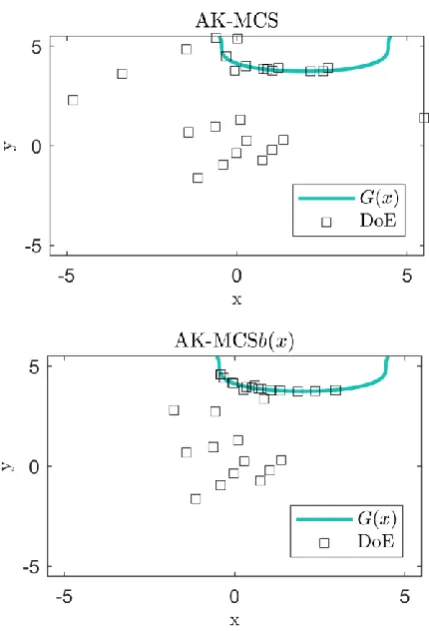
Two comparative DoEs generated by active learning for the example considered are presented in Figure 1.
[image:3.595.310.525.84.400.2]It is possible to infer that the biased randomised search prior-itizes the selection of points that are close to the origin and close to the region of 𝑔(𝑥) = 0. These are the points that are expected to contribute the most for an accurate 𝑃𝑓 prediction.
Fig. 1 Performance function prediction using 20 iterations, for the cases of AK-MCS and with the introduction of 𝑏(𝑥).
Notwithstanding the fact that 𝑏(𝑥) is contributing to priori-tize relevant points in the DoE, the benefit of 𝑏(𝑥) is mar-ginal in regard of the number of performance function eval-uations and convergence, Table 1. The convergence to the reference 𝑃𝑓 is slightly improved for the biased function,
nonetheless, the number of iterations required to establish an accurate surrogate in the present example is relatively low for both the cases, and, the effect of using 𝑏(𝑥) is not very pro-nounced.
4 | P a g e Table 1 Average convergence to the probability after 10 iterations applied to the
AK-MCS, biased randomised AK-MCS (AK-MCS𝑏(𝑥)), and considering a Euclidean penalty function when starting from the same DoE for the example of a two-dimen-sional non-linear function, and using 10 different initial DoE of 10 points.
Method 𝑵̅𝒊𝒕𝒆𝒓𝒂𝒕𝒊𝒐𝒏 CoV (𝑵̅ ) 𝑷̅̅̅̅ 𝒇
MCS 107 - 2.86 × 10⁻⁵
AK-MCS 10+10 0.106 2.91 × 10⁻⁵
AK-MCS𝒃(𝒙) 10+10 0. 065 2.84 × 10⁻⁵
AK-MCS𝒃(𝒙)
𝒅(𝒙) 10+10 0.042 2.87 × 10 −5
Further application of a penalty Euclidean function (𝑑(𝑥)) slightly improves the convergence in relation to AK-MCS𝑏(𝑥), for the same number of iterations.
The application of 𝑏(𝑥), as presented, contributed to improve the convergence of the AK approach for the same number of iterations. The improvement in computation in the present case was only marginal. The discussion presented was of in-terest to highlight how the 𝑏(𝑥) definition may vary, even within the same problem, and how the discussion of it may lead to further improvement. Nevertheless, the direct benefit of using 𝑏(𝑥) is more evident in the following example, the highly non-linear Rastrigin function.
3.2
The modified Rastrigin function
The modified Rastrigin function [13] has been widely studied in the literature as a reference case of complexity for the adaptive Kriging methodologies. Its function is given by
𝑔(𝑥) = 10 − ∑ (𝑥𝑖2− 5 cos(2𝜋𝑥𝑖)) 𝑖=1,2
, 𝑥𝑖∈ ℝ
which is characterized for being highly non-linear and challenging to characterize with meta-modelling techniques.
This function is of particular interest due to its multiple failure regions in the space 𝑥. In its evaluation, if one of the failure regions near the origin of the density function is missed in the search and prediction, the estimated probability of failure is expected to enclose a significant error of estimation.
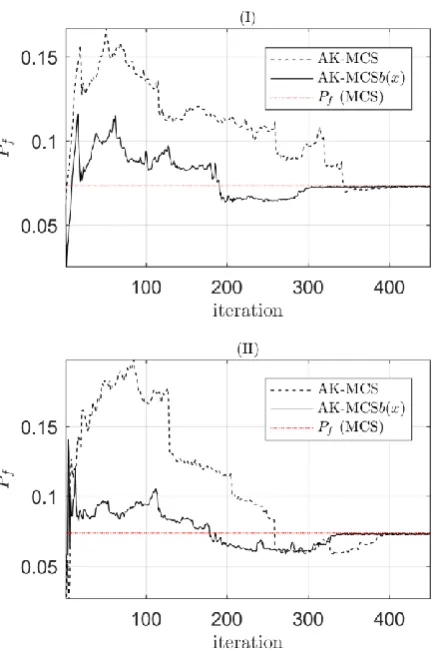
Figure 2 presents the convergence of the active learning to the reference probability of failure calculated. In both cases the same initial DoE of 10 points is considered. Consideration of 𝑏(𝑥) contributes to improve the efficiency of the learning procedure. In both cases, 𝑏(𝑥) enables a faster convergence to the reference value of 𝑃𝑓.
Fig. 2 Examples of convergence to the probability of failure of the modified Rastrigin function introducing a bias in the U search function. I and II are two distinct initial DoE that are used in the U computations for both the cases of MCS and AK-MCS𝑏(𝑥). The reference probability is evaluated using MCS with a sample size of 106.
[image:4.595.55.292.119.267.2]Averaged results for the convergence of the AK with biased randomisation, when compared with original search that does not use bias, are presented in Table 2.
Table 2 Average convergence to the probability of failure for the AK-MCS and biased randomised AK-MCS (AK-MCS𝑏(𝑥)) when starting from the same DoE for the ex-ample of the modified Rastrigin function.
Method 𝑵̅𝒊𝒕𝒆𝒓𝒂𝒕𝒊𝒐𝒏 CoV (𝑵̅ ) 𝑷̅̅̅̅ (𝑪𝒐𝑽)𝒇
MCS 106 - 7.34 × 10⁻²
AK-MCS 10 + 383.2 0.060 7.34 × 10⁻²
AK-MCS𝒃(𝒙)
10 + 324.0 0.046 7.33 × 10⁻²
[image:4.595.307.547.577.700.2]5 | P a g e reduction of 60 iterations was achieved, which is of
[image:5.595.304.534.111.256.2]significance in the particular cases where the performance function may be costly to evaluate (e.g. dependence on finite-element-models).
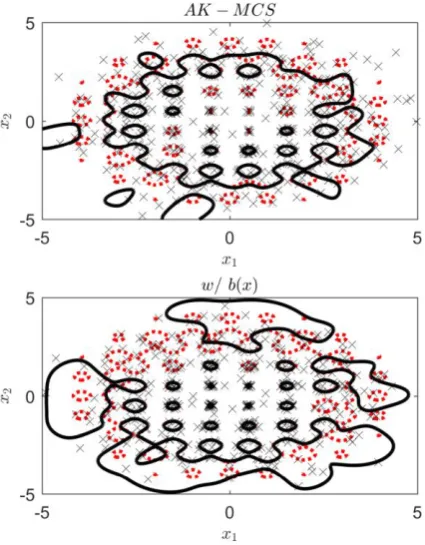
Figure 3 presents the results for the DoE of the active learning procedure in the Rastrigin function after 250 new iterations were performed. The usage of 𝑏(𝑥) foments the selection of points close to the origin of the DoE that are of major importance to an accurate evaluation of 𝑃𝑓. This selection
behaviour can be identified in the circular central regions. The AK-MCS, after 250 iterations, has not correctly characterized almost half of these regions, whereas the AK-MCS with 𝑏(𝑥) already has characterized most of them.
Fig. 3 Rastrigin function after 250 iterations, for the cases of AK-MCS and with the introduction of 𝑏(𝑥). Trimmed (red) lines represent 𝑔(𝑥), black lines 𝐺(𝑥) and the (x) markers the points in the DoE of the surrogate.
Up to this points, no discussion was introduce in regard of the stopping criteria required to stop the active learning pro-cedure. Most of the focus was directed to the discussion of biased randomisation in the AK implementation.
In the example presented the convergence criterion considered in order to stop the iterating scheme used the weight of new iterations in the calculated of 𝑃𝑓, similar to what was introduced in [7]. This criteria was used to characterize the values of convergence in Table 2. To infer on further stability of the results a computational budget of 450 points was also considered in Section 3.2. Figure 4 presents an example of stopping criteria evaluations for the case of the Rastrigin function. It considers the amount of misclassified probability of failure left to address as a
[image:5.595.60.273.252.525.2]function of the current estimate of 𝐺(𝑥) at iteration 𝑖.
Fig. 4 Active learning stopping criteria results for the cases of AK-MCS and with the introduction of 𝑏(𝑥).𝜁 represents the threshold error in 𝑃𝑓, in the present case a
value of 0.025 was applied as a reference.
[3] proposed a stopping criteria that considers a limit of confidence for the classification of 𝐺(𝑥), which was shown before to be very conservative [14]. In the present case the interest was to converge the probability of failure within a specified range of error.
4
Conclusions
The present work discussed the usage of biased randomisation in the reliability assessment using active Kriging procedures. Biased randomisation enables the usage of a priori knowledge about the problem in-hand in order to improve the performance of the active learning. In the present case the usage of biased randomisation enabled the prioritisation of points in the active learning procedure that are expected to contribute more to the accuracy of the reliability estimations. Such prioritisation is of relevance for the case of complex performance functions, for which the search algorithm should prioritize areas of the design of experiments that comprise large contributions to the characterization of the probability of failure.
The active learning with biased randomization was researched for two limit-state functions. It was shown that the usage of a biased randomization improved the efficiency of analysing moderately and highly complex performance functions.
6 | P a g e
Bibliography
[1] A. GRASAS, A. A. F. J. JUAN, J. DE ARMAS AND H. RAMALHINHO, “Biased randomization of heuristics using skewed probability distributions: a survey and some applications,” Computers & Industrial Engineering, vol. 110, pp. 216-228, 2017.
[2] B. J. BICHON, M. S. ELDRED, L. P. SWILER, S. MAHADEVAN AND J. M. MCFARLAND, “Efficient global reliability analysis for nonlinear implicit performance,” AIAA journal 46(10), p. 2459–2468., 2008.
[3] B. ECHARD, N. GAYTON AND M. LEMAIRE, “Akmcs: an active learning reliability method combining kriging and monte carlo simulation,” Structural Safety 33(2),
pp. 145-154, 2011.
[4] R. TEIXEIRA, A. O'CONNOR, M. NOGAL, J. NICHOLS AND M. SPRING, “Structural probabilistic assessment of offshore wind turbine operation fatigue based on Kriging interpolation,” in European Safety and Reliability Conference (ESREL2017), Portoroz. Slovenia, 2017.
[5] R. TEIXEIRA, A. O'CONNOR AND M. NOGAL, “Convergence analysis for offshore wind turbine operational fatigue reliability analysis,” in IALCCE, Ghent, Belgium, 2018.
[6] B. ECHARD, N. AND GAYTON AND A. BIGNONNET, “A reliability analysis method for fatigue design,”
International journal of fatigue, pp. 292--300, 2014.
[7] Z. SUN, J. WANG, R. LI AND C. TONG, “LIF: A new Kriging based learning function and its application to structural reliability analysis,” Reliability Engineering & System Safety, vol. 157, pp. 152-165, 2017.
[8] N. LELIEVRE, P. BEAUREPAIRE, C. MATTRAND AND N. GAYTON, “K-MCSi: A Kriging-based method to deal with small failure probabilities and time-consuming models,” Structural Safety, vol. 73, pp. 1-11, 2018.
[9] R. TEIXEIRA, M. NOGAL, A. O’CONNOR, J.NICHOLS AND A. DUMAS, “Stress-cycle fatigue design with Kriging applied to offshore wind turbines,”
International Journal of Fatigue, pp. 454-467, 2019.
[10] R. TEIXEIRA, A. O'CONNOR AND M. NOGAL, “Fatigue reliability using a multiple surface approach,” in 13th International Conference on Applications of Statistics and Probability in Civil Engineering, ICASP13, Seoul, South Korea, 2019.
[11] C. E. RASMUSSEN, Gaussian processes in machine learning, Berlin, Heidelberg: Summer School on Machine Learning, 2003.
[12] B. ECHARD, N. GAYTON, M. LEMAIRE AND N. RELUN, “A combined importance sampling and kriging reliability method for small failure probabilities,” Reliability Engineering & System Safety 111, pp. 232-240, 2013.
[13] A. TÖRN AND A. ZILINSKAS, “Global optimization. Lect Notes Comput Sci,” 1989:350.
[14] B. GASPAR, A. P. TEIXEIRA AND C. GUEDES SOARES, “A study on a stopping criterion for active refinement algorithms in Kriging surrogate models”.
[15] X. ZHANG, L. WANGA AND J. SØRENSEN, “REIF: A novel active-learning function toward adaptive Kriging surrogate,” Reliability Engineering and System Safety,
vol. 185, pp. 440-454, 2019.
Authors
Dr. Rui Teixeira
Dep. of Civil, Structural and Environmental Eng., Trinity College Dublin, Dublin, Ireland
Prof. Dr. Alan O’Connor
Dep. of Civil, Structural and Environmental Eng., Trinity College Dublin, Dublin, Ireland
Dr. Maria Nogal
Dep. of Civil, Structural and Environmental Eng., Trinity College Dublin, Dublin, Ireland