Acta Cryst.(2001). E57, m357±m358 DOI: 10.1107/S1600536801011916 Tae Ho Kimet al. [Cs2I2(C12H24O6)2]C8H10
m357
metal-organic papers
Acta Crystallographica Section E
Structure Reports
Online ISSN 1600-5368
The sandwich dimeric form of a Cs
Icomplex of
18-crown-6 with bridging iodide ions
Tae Ho Kim, Ki-Min Park, Shim Sung Lee, Jae Sang Kim and Jineun Kim*
Department of Chemistry and Research Institute of Natural Sciences, Gyeongsang National University, Chinju 660-701, South Korea
Correspondence e-mail: [email protected]
Key indicators
Single-crystal X-ray study
T= 298 K
Mean(C±C) = 0.006 AÊ
Rfactor = 0.028
wRfactor = 0.075
Data-to-parameter ratio = 23.8
For details of how these key indicators were automatically derived from the article, see http://journals.iucr.org/e.
#2001 International Union of Crystallography Printed in Great Britain ± all rights reserved
The sandwich dimeric structure of di- -iodo-bis[(1,4,7,10,-13,16-hexaoxacyclooctadecane)caesium(I)] p-xylene solvate, [Cs2I2(C12H24O6)2]C8H10, has been characterized by X-ray
crystallography. The complex adopts an encapsulate of a molecular dimeric array [Cs(18-crown-6)(-I)]2C8H10. Two
Cs(18-crown-6)+ moieties are doubly linked by two iodide
ions. The molecule has crystallographic 2/m(C2h) symmetry.
Comment
The chemistry of macrocyclic complexes of alkali metal cations has developed intensively since the end of the 19600s
because of the strong complexing properties of crown ethers. In this case, the complementarity of the macrocyclic cavity and the cation substrate determines the type of complex (Dietrich
et al., 1993). A caesium ion is too large for the 18-crown-6 cavity, thus giving a sandwich dimer complex bridged by SCNÿ
anions (Dobler & Phizackerley, 1974) or water molecules (Rusanova et al., 1999). We report here the sandwich dimer structure of the title compound (I) with bridging iodide ions.
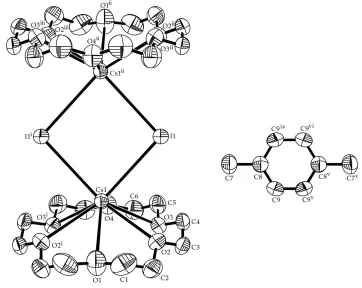
The title compound adopts a molecular dimeric array consisting of two [Cs(18-crown-6)]+units linkedviatwo iodide
ions as shown in Fig. 1. Two caesium cations are positioned on a mirror plane and two iodide ions are located on a twofold symmetry axis perpendicular to the mirror plane. The asym-metric unit, therefore, consists of a quarter of Cs2
(18-crown-6)2I2.
Important bond distances and angles are presented in Table 1. The caesium ion adopts eightfold coordination. The bond distances between Cs and O atoms in the crown ether span a range of 3.050 (3)±3.320 (3) AÊ and the average distance is 3.198 AÊ. The caesium ion is located 1.520 (2) AÊ above the mean O plane of the crown ring, which has a mean deviation of 0.22 AÊ. This value is slightly larger than those reported previously for the related complexes, 1.44 AÊ in [Cs2
(18-crown-6)2(SCN)2] (Dobler & Phizackerley, 1974) and 1.48 AÊ in
[Cs2(18-crown-6)2(H2O)2] (Rusanova etal., 1999). The
dihe-dral angle between the plane consisting of two caesium and two iodide ions and the mean O plane of the crown ether is 76.75 (4).
Thep-xylene molecules are packed in the voids between the dimer complexes. The centre of p-xylene is located on a position of 2/m symmetry. We also determined the crystal structure of Cs2(18-crown-6)2I2toluene. The structure is
nearly identical to that of the title compound. The toluene molecule is also located at a special position of 2/msymmetry in the C2/munit cell, so that the non-centrosymmetric toluene molecules are disordered over the inversion centre to give an image like thep-xylene molecule.
Experimental
Equimolar amounts of caesium iodide and 18-crown-6 were dissolved in anhydrous methanol followed by addition of p-xylene. Slow evaporation in a calcium chloride desiccator yielded crystals suitable for X-ray analysis.
Crystal data
[Cs2I2(C12H24O6)2]C8H10
Mr= 1154.40
Monoclinic,C2=m a= 15.4360 (10) AÊ
b= 17.4317 (11) AÊ
c= 8.1756 (5) AÊ = 91.195 (1)
V= 2199.4 (2) AÊ3
Z= 2
Dx= 1.743 Mg mÿ3
MoKradiation Cell parameters from 7131
re¯ections = 1.8±28.3 = 3.11 mmÿ1
T= 298 (2) K Plate, colourless 0.500.250.15 mm
Data collection
CCD area-detector diffractometer 'and!scans
Absorption correction: multiscan (XPREP, Siemens, 1996)
Tmin= 0.386,Tmax= 0.627
7131 measured re¯ections 2742 independent re¯ections
2385 re¯ections withI> 2(I)
Rint= 0.037
max= 28.3
h=ÿ18!19
k=ÿ23!16
l=ÿ10!10
Re®nement
Re®nement onF2
R[F2> 2(F2)] = 0.028
wR(F2) = 0.075
S= 1.09 2742 re¯ections 115 parameters
H-atom parameters constrained
w= 1/[2(F
o2) + (0.0345P)2
+ 2.9180P]
whereP= (Fo2+ 2Fc2)/3
(/)max< 0.001
max= 1.20 e AÊÿ3
min=ÿ1.08 e AÊÿ3
Table 1
Selected geometric parameters (AÊ,).
Cs1ÐO4 3.050 (3)
Cs1ÐO2 3.159 (2)
Cs1ÐO1 3.178 (4)
Cs1ÐO3 3.320 (3)
Cs1ÐC5 3.793 (4)
Cs1ÐI1 3.8940 (3)
I1ÐCs1ÐI1i 84.929 (10) Cs1ÐI1ÐCs1ii 95.071 (10)
Symmetry codes: (i)x;ÿy;z; (ii)ÿx;y;1ÿz.
The CÐH atoms were added at their calculated positions (U= 1.2 times that of the corresponding C atom) and re®ned using a riding model.
Data collection: SMART (Siemens, 1996); cell re®nement: SMART; data reduction:SAINT(Siemens, 1996); program(s) used to solve structure: SHELXTL (Siemens, 1996); program(s) used to re®ne structure: SHELXTL; molecular graphics:SHELXTL; soft-ware used to prepare material for publication:SHELXTL.
Support from the Korea Research Foundation (Project No. 99±005±D00004) is gratefully acknowledged. The authors wish to thank the Central Laboratory, Gyeongsang National University for provision of a Bruker SMART CCD diffract-ometer, and Jae Sung Seo for his technical support.
References
Dietrich, B., Viout, P. & Lehn, J.-M. (1993).Macrocyclic Chemistry, Aspect of Organic and Inorganic Supramolecular Chemistry, Part II. New York: VCH. Dobler, M. & Phizackerley, R. P. (1974).Acta Cryst.B30, 2748±2750. Rusanova, J., Squattrito, P. J., Domasevitch, K. V. & Kokozay, V. N. (1999).Z.
Naturforsch. Teil B,54, 389±393.
Siemens (1996). SMART, SAINT (Version 4.0), XPREPand SHELXTL
(Version 5.03). Siemens Analytical X-ray Instruments Inc., Madison, Wisconsin, USA.
Figure 1
supporting information
sup-1
Acta Cryst. (2001). E57, m357–m358
supporting information
Acta Cryst. (2001). E57, m357–m358 [doi:10.1107/S1600536801011916]
The sandwich dimeric form of a Cs
Icomplex of 18-crown-6 with bridging
iodide ions
Tae Ho Kim, Ki-Min Park, Shim Sung Lee, Jae Sang Kim and Jineun Kim
S1. Comment
The chemistry of macrocyclic complexes of alkali metal cations has developed intensively since the end of the 1960's
because of the strong complexing properties of crown ethers. In this case, the complementarity of the macrocyclic cavity
and the cation substrate determines the type of complex (Dietrich et al., 1993). A caesium ion is too large for the
18-crown-6 cavity, thus giving a sandwich dimer complex bridged by SCN- anions (Dobler & Phizackerley, 1974) or water
molecules (Rusanova et al., 1999). We report here the sandwich dimer structure of the title compound (I) with bridging
iodide ions.
The title compound adopts a molecular dimeric array consisting of two [Cs(18-crown-6)]+ units linked via two iodide
ions as shown in Figure 1. Two caesium cations are positioned on a mirror plane and two iodide ions are located on a
twofold symmetry axis perpendicular to the mirror plane. The asymmetric unit, therefore, consists of a quarter of Cs2
(18-crown-6)2I2.
Important bond distances and angles are presented in Table 1. The caesium ion adopts eightfold coordination. The bond
distances between Cs and O atoms in the crown ether span a range of 3.050 (3)–3.320 (3) Å and the average distance is
3.198 Å. The caesium ion is located 1.520 (2) Å above the mean O plane of the crown ring, which has a mean deviation
of 0.22 Å. This value is slightly larger than those reported previously for the related complexes, 1.44 Å in [Cs2
(18-crown-6)2(SCN)2] (Dobler & Phizackerley, 1974) and 1.48 Å in [Cs2(18-crown-6)2(H2O)2] (Rusanova et al., 1999). The
dihedral angle between the plane consisting of two caesium and two iodide ions and the mean O plane of the crown ether
is 76.75 (4)°.
The p-xylene molecules are packed in the voids between the dimer complexes. The centre of p-xylene is located on a
position of 2/m symmetry. We also determined the crystal structure of Cs2(18-crown-6)2I2.toluene. The structure is nearly
identical to that of the title compound. The toluene molecule is also located at a special position of 2/m symmetry in the
C2/m unit cell, so that the non-centrosymmetric toluene molecules are disordered over the inversion centre to give an
image like the p-xylene molecule.
S2. Experimental
Equimolar amounts of caesium iodide and 18-crown-6 were dissolved in anhydrous methanol followed by addition of p
-xylene. Slow evaporation in a calcium chloride desiccator yielded crystals suitable for X-ray analysis.
S3. Refinement
The C—H atoms were added at their calculated positions (U = 1.2 times that of the corresponding C atom) and refined
Figure 1
The structure of the title compound with the atom-numbering scheme. The displacement ellipsoids are drawn at the 50%
probability level. All H atoms have been omitted for clarity. [Symmetry codes: (i) x, -y, z; (ii) -x, y, 1 - z; (iii) -x, -y, 1 - z;
(iv) -x, y, -z; (v) x, 1 - y, z; (vi) -x, 1 - y, -z]
di-µ-iodo-bis(1,4,7,10,13,16-hexaoxacyclooctadecanecaesium(I)) p-xylene solvate
Crystal data
C24H48Cs2I2O12·C8H10
Mr = 1154.40
Monoclinic, C2/m a = 15.436 (1) Å b = 17.4317 (11) Å c = 8.1756 (5) Å β = 91.195 (1)° V = 2199.4 (2) Å3
Z = 2
F(000) = 1124 Dx = 1.743 Mg m−3
Mo Kα radiation, λ = 0.71073 Å Cell parameters from 7131 reflections θ = 1.8–28.3°
µ = 3.11 mm−1
T = 298 K Plate, colourless 0.50 × 0.25 × 0.15 mm
Data collection CCD area-detector
diffractometer
Radiation source: fine-focus sealed tube Graphite monochromator
φ and ω scans
Absorption correction: multi-scan (XPREP, Siemens, 1996) Tmin = 0.386, Tmax = 0.627
7131 measured reflections 2742 independent reflections 2385 reflections with I > 2σ(I) Rint = 0.037
θmax = 28.3°, θmin = 1.8°
supporting information
sup-3
Acta Cryst. (2001). E57, m357–m358 Refinement
Refinement on F2
Least-squares matrix: full R[F2 > 2σ(F2)] = 0.028
wR(F2) = 0.075
S = 1.09 2742 reflections 115 parameters 0 restraints
Primary atom site location: structure-invariant direct methods
Secondary atom site location: difference Fourier map
Hydrogen site location: inferred from neighbouring sites
H-atom parameters constrained w = 1/[σ2(F
o2) + (0.0345P)2 + 2.918P]
where P = (Fo2 + 2Fc2)/3
(Δ/σ)max < 0.001
Δρmax = 1.20 e Å−3
Δρmin = −1.08 e Å−3
Special details
Geometry. All e.s.d.'s (except the e.s.d. in the dihedral angle between two l.s. planes) are estimated using the full covariance matrix. The cell e.s.d.'s are taken into account individually in the estimation of e.s.d.'s in distances, angles and torsion angles; correlations between e.s.d.'s in cell parameters are only used when they are defined by crystal symmetry. An approximate (isotropic) treatment of cell e.s.d.'s is used for estimating e.s.d.'s involving l.s. planes.
Refinement. Refinement of F2 against ALL reflections. The weighted R-factor wR and goodness of fit S are based on F2,
conventional R-factors R are based on F, with F set to zero for negative F2. The threshold expression of F2 > σ(F2) is used
only for calculating R-factors(gt) etc. and is not relevant to the choice of reflections for refinement. R-factors based on F2
are statistically about twice as large as those based on F, and R- factors based on ALL data will be even larger.
Fractional atomic coordinates and isotropic or equivalent isotropic displacement parameters (Å2)
x y z Uiso*/Ueq Occ. (<1)
Cs1 0.170972 (16) 0.0000 0.36783 (3) 0.04777 (9)
I1 0.0000 0.150813 (17) 0.5000 0.05492 (10)
O1 0.3636 (3) 0.0000 0.5128 (6) 0.0904 (13)
O2 0.29407 (16) 0.14338 (15) 0.4161 (4) 0.0693 (7) O3 0.20804 (17) 0.14078 (15) 0.1049 (3) 0.0672 (6)
O4 0.1305 (2) 0.0000 0.0011 (4) 0.0645 (9)
C1 0.3762 (3) 0.0690 (3) 0.6022 (6) 0.0924 (15)
H1A 0.4309 0.0667 0.6626 0.111*
H1B 0.3302 0.0750 0.6801 0.111*
C2 0.3764 (3) 0.1343 (3) 0.4910 (6) 0.0806 (12)
H2A 0.3918 0.1805 0.5511 0.097*
H2B 0.4194 0.1263 0.4078 0.097*
C3 0.2924 (3) 0.2057 (2) 0.3048 (5) 0.0711 (10)
H3A 0.3405 0.2014 0.2308 0.085*
H3B 0.2986 0.2536 0.3645 0.085*
C4 0.2104 (3) 0.2058 (2) 0.2110 (5) 0.0711 (10)
H4A 0.1621 0.2037 0.2850 0.085*
H4B 0.2054 0.2525 0.1471 0.085*
C5 0.1301 (3) 0.1360 (2) 0.0124 (5) 0.0774 (11)
H5A 0.1225 0.1821 −0.0530 0.093*
H5B 0.0814 0.1318 0.0850 0.093*
C6 0.1333 (3) 0.0680 (3) −0.0955 (5) 0.0792 (12)
H6A 0.0845 0.0688 −0.1721 0.095*
H6B 0.1862 0.0688 −0.1575 0.095*
H7A 0.0556 0.3145 −0.0330 0.115* 0.50
H7B −0.0440 0.3145 −0.0750 0.115* 0.50
H7C −0.0116 0.3145 0.1080 0.115* 0.50
C8 0.0000 0.4192 (3) 0.0000 0.0596 (11)
C9 0.0726 (2) 0.4604 (2) −0.0427 (4) 0.0598 (8)
H9 0.1225 0.4342 −0.0720 0.072*
Atomic displacement parameters (Å2)
U11 U22 U33 U12 U13 U23
Cs1 0.04634 (15) 0.04223 (14) 0.05461 (16) 0.000 −0.00198 (10) 0.000 I1 0.04822 (16) 0.04972 (17) 0.0672 (2) 0.000 0.00949 (13) 0.000 O1 0.100 (3) 0.073 (3) 0.097 (3) 0.000 −0.046 (3) 0.000 O2 0.0538 (13) 0.0588 (14) 0.0953 (19) −0.0105 (11) 0.0046 (13) −0.0034 (13) O3 0.0611 (14) 0.0547 (13) 0.0859 (18) 0.0076 (11) 0.0078 (13) 0.0026 (12) O4 0.079 (2) 0.066 (2) 0.0484 (17) 0.000 −0.0109 (16) 0.000 C1 0.077 (3) 0.122 (4) 0.077 (3) −0.026 (3) −0.025 (2) −0.004 (3) C2 0.062 (2) 0.071 (2) 0.108 (3) −0.015 (2) −0.006 (2) −0.025 (2) C3 0.072 (2) 0.0459 (18) 0.097 (3) −0.0115 (16) 0.027 (2) −0.0073 (18) C4 0.077 (2) 0.0413 (16) 0.096 (3) 0.0063 (16) 0.029 (2) 0.0049 (17) C5 0.081 (3) 0.068 (2) 0.083 (3) 0.017 (2) −0.001 (2) 0.027 (2) C6 0.083 (3) 0.094 (3) 0.060 (2) 0.009 (2) −0.0113 (19) 0.019 (2) C7 0.112 (5) 0.059 (3) 0.118 (5) 0.000 0.035 (4) 0.000 C8 0.068 (3) 0.060 (3) 0.051 (2) 0.000 0.005 (2) 0.000 C9 0.0523 (17) 0.072 (2) 0.0554 (17) 0.0096 (15) 0.0059 (14) −0.0001 (15)
Geometric parameters (Å, º)
Cs1—O4 3.050 (3) O1—C1i 1.418 (5)
Cs1—O2 3.159 (2) O2—C2 1.408 (5)
Cs1—O2i 3.159 (2) O2—C3 1.417 (5)
Cs1—O1 3.178 (4) O3—C5 1.410 (5)
Cs1—O3i 3.320 (3) O3—C4 1.427 (5)
Cs1—O3 3.320 (3) O4—C6i 1.425 (4)
Cs1—C5i 3.793 (4) O4—C6 1.425 (4)
Cs1—C5 3.793 (4) C1—C2 1.457 (7)
Cs1—C1 3.860 (4) C3—C4 1.466 (6)
Cs1—C1i 3.860 (4) C5—C6 1.480 (6)
Cs1—C4i 3.862 (4) C7—C8 1.504 (8)
Cs1—C4 3.862 (4) C8—C9 1.382 (4)
Cs1—I1 3.8940 (3) C8—C9ii 1.382 (4)
O1—C1 1.418 (5) C9—C9iii 1.381 (8)
O4—Cs1—O2 103.47 (7) O1—Cs1—C4i 88.35 (8)
O4—Cs1—O2i 103.47 (7) O3i—Cs1—C4i 21.24 (8)
O2—Cs1—O2i 104.57 (10) O3—Cs1—C4i 116.18 (8)
O4—Cs1—O1 122.51 (12) C5i—Cs1—C4i 35.89 (10)
supporting information
sup-5
Acta Cryst. (2001). E57, m357–m358
O2i—Cs1—O1 52.97 (5) C1—Cs1—C4i 108.71 (11)
O4—Cs1—O3i 52.99 (6) C1i—Cs1—C4i 75.05 (11)
O2—Cs1—O3i 123.66 (7) O4—Cs1—C4 72.78 (7)
O2i—Cs1—O3i 52.03 (7) O2—Cs1—C4 37.64 (9)
O1—Cs1—O3i 93.95 (8) O2i—Cs1—C4 132.66 (8)
O4—Cs1—O3 52.99 (6) O1—Cs1—C4 88.35 (8)
O2—Cs1—O3 52.03 (7) O3i—Cs1—C4 116.18 (8)
O2i—Cs1—O3 123.66 (7) O3—Cs1—C4 21.24 (8)
O1—Cs1—O3 93.95 (8) C5i—Cs1—C4 110.55 (10)
O3i—Cs1—O3 95.33 (9) C5—Cs1—C4 35.89 (10)
O4—Cs1—C5i 38.69 (7) C1—Cs1—C4 75.05 (11)
O2—Cs1—C5i 132.85 (9) C1i—Cs1—C4 108.71 (11)
O2i—Cs1—C5i 72.00 (9) C4i—Cs1—C4 136.51 (12)
O1—Cs1—C5i 115.15 (10) I1—Cs1—I1i 84.929 (10)
O3i—Cs1—C5i 21.57 (8) Cs1—I1—Cs1iv 95.071 (10)
O3—Cs1—C5i 89.67 (9) C1—O1—C1i 116.0 (5)
O4—Cs1—C5 38.69 (7) C1—O1—Cs1 108.0 (3)
O2—Cs1—C5 72.00 (9) C1i—O1—Cs1 108.0 (3)
O2i—Cs1—C5 132.85 (9) C2—O2—C3 111.7 (3)
O1—Cs1—C5 115.15 (10) C2—O2—Cs1 120.0 (2)
O3i—Cs1—C5 89.67 (9) C3—O2—Cs1 121.6 (2)
O3—Cs1—C5 21.57 (8) C5—O3—C4 112.5 (3)
C5i—Cs1—C5 77.38 (15) C5—O3—Cs1 98.5 (2)
O4—Cs1—C1 129.57 (10) C4—O3—Cs1 101.3 (2)
O2—Cs1—C1 37.47 (10) C6i—O4—C6 112.5 (4)
O2i—Cs1—C1 72.50 (10) C6i—O4—Cs1 122.5 (2)
O1—Cs1—C1 20.45 (10) C6—O4—Cs1 122.5 (2)
O3i—Cs1—C1 113.64 (10) O1—C1—C2 110.1 (4)
O3—Cs1—C1 86.58 (9) O1—C1—Cs1 51.5 (2)
C5i—Cs1—C1 134.16 (11) C2—C1—Cs1 86.9 (2)
C5—Cs1—C1 107.89 (11) O2—C2—C1 110.2 (3)
O4—Cs1—C1i 129.57 (10) O2—C3—C4 109.9 (3)
O2—Cs1—C1i 72.50 (10) O3—C4—C3 109.2 (3)
O2i—Cs1—C1i 37.47 (10) O3—C4—Cs1 57.45 (17)
O1—Cs1—C1i 20.45 (10) C3—C4—Cs1 88.1 (2)
O3i—Cs1—C1i 86.58 (9) O3—C5—C6 109.1 (3)
O3—Cs1—C1i 113.64 (10) O3—C5—Cs1 59.96 (17)
C5i—Cs1—C1i 107.89 (11) C6—C5—Cs1 87.0 (2)
C5—Cs1—C1i 134.16 (11) O4—C6—C5 109.6 (3)
C1—Cs1—C1i 36.30 (17) C9—C8—C9ii 117.4 (5)
O4—Cs1—C4i 72.78 (7) C9—C8—C7 121.3 (2)
O2—Cs1—C4i 132.66 (8) C9ii—C8—C7 121.3 (2)
O2i—Cs1—C4i 37.64 (9) C9iii—C9—C8 121.3 (2)