Atomic data from the IRON Project. I. Electron-impact
scattering of Fe17+ using <I>R</I>-matrix theory with
intermediate coupling
WITTHOEFT, M. C., BADNELL, N. R., BERRINGTON, K. A., PELAN, J. C.
and ZANNA, G. del
Available from Sheffield Hallam University Research Archive (SHURA) at:
http://shura.shu.ac.uk/895/
This document is the author deposited version. You are advised to consult the
publisher's version if you wish to cite from it.
Published version
WITTHOEFT, M. C., BADNELL, N. R., BERRINGTON, K. A., PELAN, J. C. and
ZANNA, G. del (2005). Atomic data from the IRON Project. I. Electron-impact
scattering of Fe17+ using <I>R</I>-matrix theory with intermediate coupling.
Astronomy and astrophysics, 446, 361-366.
Copyright and re-use policy
See
http://shura.shu.ac.uk/information.html
Sheffield Hallam University Research Archive
Astronomy & Astrophysicsmanuscript no. fe17+ February 15, 2005 (DOI: will be inserted by hand later)
Atomic Data from the IRON Project
I. Electron-impact scattering of Fe
17+using
R
-matrix
theory with intermediate coupling
M. C. Witthoeft
1, N. R. Badnell
1, K. A. Berrington
2, J. C. Pelan, and G. del Zanna
31
Department of Physics, University of Strathclyde, Glasgow G4 0NG, UK
2
School of Science and Mathematics, Sheffield Hallam University, Sheffield, S1 1WB, UK
3
Department of Applied Mathematics and Theoretical Physics, The Centre for Mathematical Sciences, Wilberforce Road, Cambridge CB3 0WA, Cambridge, UK
Received ¡date¿ / Accepted ¡date¿
Abstract. We present results for electron-impact excitation of F-like Fe calculated usingR-matrix theory with an intermediate-coupling frame transformation (ICFT) to obtain level-resolved collision strengths. Two such calculations are performed, the first expands the target using 2p5, 2s2p6, 2p43l, 2s2p53l, and 2p63lconfigurations while the second calculation includes the 2p4
4l, 2s2p5
4l, and 2p6
4l configurations as well. The effect of the additional structure in the latter calculation on then= 3 resonances is explored and emission of a low density Fe17+
plasma is modeled using ADAS to explore the net effect of the differences.
1. Introduction
This work is a continuation of research done as part of the IRON Project (Hummer et al., 1993) whose goal is to provide accurate atomic data for astrophysically rele-vant elements using the most sophisticated computational methods to date. The focus of this work is the calculation of all fine-structure collision strengths of electron-impact
excitation of Fe17+
for single-promotion transitions from
the ground level up to then= 4 levels and all transitions
between them. An investigation is made examining the difference between this calculation and a smaller
calcula-tion which only considers excited states withn≤3. These
studies consist of direct comparisons of collision strengths and effective collision strengths as well as emission spec-tra from the ADAS suite of collisional-radiative modeling codes (http://adas.phys.strath.ac.uk).
Previous works on this ion consist of distorted wave calculations by Mann (1983) and Cornille et al. (1992), a relativistic distorted wave of Sampson et al. (1991), and
a non-relativistic R-matrix calculation of Mohan et al.
(1987) which included the 2s2
2p5
, 2s2p6
, and 2s2
2p4
3l
terms. A previous IRON Project report, IP XXVIII
(Berrington et al., 1998), examined, using R-matrix
the-ory, just the fine structure transition of the ground term,
2
P3/2 →2 P1/2, for several F-like ions including Fe using
the same target expansion as the present (n = 3)-state
calculation.
The rest of this paper is organized as follows. In Sec. II, the details of the present calculations will be discussed including a comparison of our target structure with other calculations and experimental results. In Sec. III, the
re-sults of bothR-matrix calculations are presented and
dis-cussed. Finally, in Sec. IV, we provide a brief conclusion.
2. Calculation
As mentioned before, two R-matrix calculations are
per-formed for this report. The intermediate-coupling frame transformation (ICFT) method of Griffin et al. (1998) us-ing multi-channel quantum defect theory (MQDT) is
uti-lized to enable us to perform much of the calculation inLS
coupling. The advantage of this approach is realized in the
diagonalization time of the (N+ 1)-electron Hamiltonian
whose size is determined by the number ofLS terms and
not the larger number ofjKlevels. In the smaller (n=
3)-state calculation we include the 2s2
2p5
, 2s2p6
, 2s2
2p4
3l,
2s2p5
3l, and 2p6
3l terms; a total of 52 terms containing
113 fine-structure levels. The second calculation is an
ex-tension of the first adding the 2s2
2p4
4l, 2s2p5
4l, and 2p6
4l
terms to the target expansion. This results in a total of 124 terms and 279 levels.
The target structure and resulting wave functions are calculated using AUTOSTRUCTURE (see Badnell, 1986)
where a radial scaling parameter, λnl, of each orbital is
2 M. C. Witthoeft et al.: Atomic Data from the IRON Project
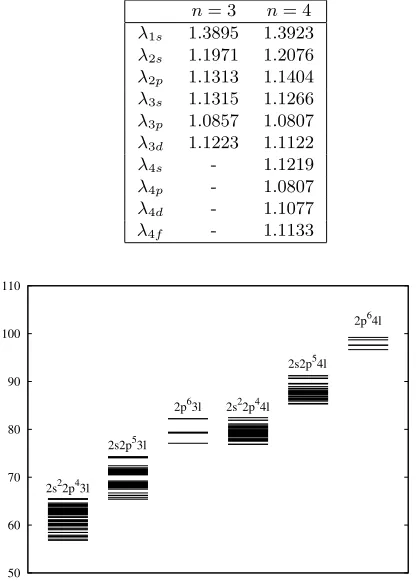
Table 1.Radial scaling factors used in AUTOSTRUCTURE to minimize the total energy of thenlorbital wave functions.
n= 3 n= 4
λ1s 1.3895 1.3923
λ2s 1.1971 1.2076
λ2p 1.1313 1.1404
λ3s 1.1315 1.1266
λ3p 1.0857 1.0807
λ3d 1.1223 1.1122
λ4s - 1.1219
λ4p - 1.0807
λ4d - 1.1077
λ4f - 1.1133
50 60 70 80 90 100 110
2s22p43l 2s2p53l
2p63l 2s22p44l 2s2p54l
2p64l
Fig. 1.Energy levels in Ry for both then= 3 (left) andn= 4 (right) structure calculations from AUTOSTRUCTURE.
given in Table I. Then= 3 energy levels are not changed
significantly by the addition of the n = 4 levels in the
larger calculation. The reason for this is demonstrated in
Figure 1 where the energy levels for the n = 4
calcula-tion are displayed. The only overlap between the n = 3
and n = 4 levels is between the 2p63
l and 2s22
p44
l els. Since only two-electron transitions connect these lev-els, this overlap does not have a significant effect on the energy levels. In Table II are listed the energies of the
lowest 66 levels from the n = 4 calculation compared to
those listed on the NIST website (Corliss & Sugar, 1982; http://physics.nist.gov). Since the level energies of the
n = 3 calculation are within 0.1% of the n = 4
calcu-lation they are not shown. With the exception of the first two excited states, which disagree by 2% and 1% respec-tively, all our level energies agree with the measurements of Corliss & Sugar to within 0.5%. We shall subsequently refer to levels using the energy ordered index given in this table.
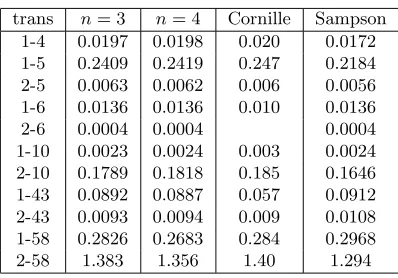
As a final test of the structure, we compare our os-cillator strengths with previous calculations. In Table III
are listed the oscillator strengths for both ourn= 3 and
n= 4-state calculations with a SUPERSTRUCTURE
cal-culation of Cornille et al. (1992) and the relativistic atomic structure calculation by Sampson et al. (1991). There is generally good agreement between all the calculations.
Both the n= 3 and n = 4 R-matrix calculations
clude the mass-velocity and Darwin corrections and in-clude a total of 20 continuum terms per channel. A
full-exchange calculation is performed forJ ≤10 and a
non-exchange calculation then provides the contribution up to
J = 38 and a further top-up is done using the Burgess sum
rule (see Burgess, 1974). In the outer region, we calculate the collision strengths up to an electron-impact energy of
200 Ry on a energy mesh with a spacing of 10−5z2Ry in
regions with strong resonance contributions, a spacing of
10−4z2Ry was used for the region between then= 2 and
n= 3 resonances, and a spacing of 10−3z2Ry was used for
high energies outside the resonance region. Although this energy spacing does not resolve all resonances, the more than 15 000 energy points used are believed to to suffi-ciently sample the small width resonances as discussed by Badnell & Griffin (2001).
Effective collision strengths at high temperatures are obtained for dipole and Born allowed transitions by interpolation between the R-matrix calculation at 200 Ry and an infinte energy point calculated by AUTOSTRUCTURE.
3. Results
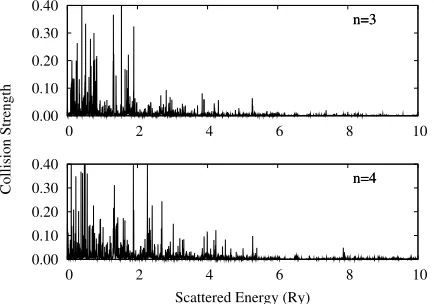
Overall, the differences between the n = 3 and n = 4
calculations are small. In Fig. 2, we compare the colli-sion strength of both calculations for the 1-4 transition.
While the n= 3 calculation shows stronger resonant
en-hancement for scattered electron energies below 3 Ry, the differences are not excessive. We also observe that the
ad-ditional n= 4 resonances for energies larger than 10 Ry
are small and not likely to have a large effect on the ef-fective collision strength. Similar features are seen for the 2-4 transition in Fig. 3.
To get a better measure of the resonant enhancement, we plot in Figures 4 and 5 the effective collision strengths for the 1-4 and 2-4 transitions respectively. Also included
in these figures is a reduced n = 3 R-matrix calculation
by Mohan et al. (1987) where the 2s2p53
land 2p63
lterms
are not included in the target expansion. In Fig. 4, there
is about a 10% difference between the present n= 3 and
n= 4 calculations while the Mohan et al. calculation is a
factor of four smaller at low temperatures and only coming within a factor of two at the highest temperatures shown. We see a similar disagreement between the Mohan et al. results and the present calculation in Fig. 5 for the 2-4 transition. In this case, however, the collision strength of
the n = 4 calculation is about 50% higher than that of
the n= 3 calculation at low temperatures, although the
absolute difference for this weak transition is about the same as in the 1-4 transition. Again, the effective collision strength from the Mohan et al. calculation is much smaller at low temperatures and coming into decent agreement at the end of the plotted temperature range. The difference
between the Mohan et al. calculation and ourn= 3
calcu-lation demonstrates the importance of the 2s2p53
l terms
on transitions involving the 2s22
p43
Table 2.Lowest 66 energy levels in Ry forn= 4 calculation compared to experimental measurements of Corliss & Sugar (1982) (see http://physics.nist.gov).
i Level Present NIST i Level Present NIST i Level Present NIST
1 2p5 2
P3o/2 0.0 0.0 23 2p
43
p2
So1/2 60.309 45 2p 43
d4
F7/2 63.111
2 2p5 2
P1o/2 0.955 0.935 24 2p 4
3p2
D3o/2 60.356 46 2p 4
3d2
D3/2 63.140
3 2s2p6 2
S1/2 9.830 9.702 25 2p 4
3p2
F5o/2 60.693 47 2p 4
3d4
P5/2 63.297 62.911
4 2p43s4P5/2 56.798 56.699 26 2p 4
3p2F7o/2 60.878 48 2p 4
3d2P3/2 63.418 63.308
5 2p43s2P3/2 57.052 56.937 27 2p 4
3p2D3o/2 61.016 49 2p 4
3d2D5/2 63.516 63.401
6 2p43
s4
P1/2 57.492 57.503 28 2p 43
p2
D5o/2 61.126 50 2p 43
d2
G7/2 63.787
7 2p43
s4
P3/2 57.664 57.573 29 2p 43
p2
P3o/2 61.590 51 2p 43
d2
G9/2 63.825
8 2p4
3s2
P1/2 57.899 57.798 30 2p 4
3p2
P1o/2 61.758 52 2p 4
3d2
F5/2 64.052
9 2p4
3s2
D5/2 58.444 31 2p 4
3d4
D5/2 62.114 53 2p 4
3d2
S1/2 64.056 63.919
10 2p43s2D3/2 58.478 58.355 32 2p 4
3d4D7/2 62.127 54 2p 4
3d2F7/2 64.156
11 2p4
3p4
P3o/2 59.019 33 2p 4
3d4
D3/2 62.157 55 2p 4
3d2
P3/2 64.280 64.139
12 2p4
3p4
P5o/2 59.053 34 2p 4
3d4
D1/2 62.247 56 2p 4
3d2
D5/2 64.335 64.160
13 2p43p4P1o/2 59.296 35 2p 4
3p2P3o/2 62.335 57 2p 4
3d2D3/2 64.558 64.391
14 2p43p4D7o/2 59.350 36 2p 4
3d4F9/2 62.356 58 2p 4
3d2P1/2 64.623 64.465
15 2p43
p2
D5o/2 59.365 37 2p 43
d2
F7/2 62.452 59 2p43d2D5/2 65.356 65.305
16 2p43
s2
S1/2 59.807 59.917 38 2p 43
p2
P1o/2 62.542 60 2s2p 53
s4
P5o/2 65.396
17 2p4
3p4
D1o/2 59.810 39 2p 4
3d4
P1/2 62.597 62.497 61 2p 4
3d2
D3/2 65.542 65.468
18 2p4
3p4
D3o/2 59.840 40 2p 4
3d4
P3/2 62.734 62.626 62 2s2p 5
3s4
P3o/2 65.726
19 2p43p2P1o/2 59.844 41 2p 4
3d2F5/2 62.816 63 2s2p 5
3s4P1o/2 66.140
20 2p43p2P3o/2 59.980 42 2p 4
3d2P1/2 62.957 64 2s2p 5
3s2P3o/2 66.221
21 2p43p4D5o/2 60.124 43 2p 4
3d4F3/2 62.989 65 2s2p 5
3s2P1o/2 66.709
22 2p43
p4
So3/2 60.157 44 2p 43
d4
F5/2 63.012 66 2s2p53p4S3/2 67.505
Table 3. Comparison of various calculated gf-values for present calculations with Cornille et al. (1992) and Sampson et al. (1991).
trans n= 3 n= 4 Cornille Sampson 1-4 0.0197 0.0198 0.020 0.0172 1-5 0.2409 0.2419 0.247 0.2184 2-5 0.0063 0.0062 0.006 0.0056 1-6 0.0136 0.0136 0.010 0.0136 2-6 0.0004 0.0004 0.0004 1-10 0.0023 0.0024 0.003 0.0024 2-10 0.1789 0.1818 0.185 0.1646 1-43 0.0892 0.0887 0.057 0.0912 2-43 0.0093 0.0094 0.009 0.0108 1-58 0.2826 0.2683 0.284 0.2968 2-58 1.383 1.356 1.40 1.294
The 1-4 and 2-4 transition comparisons are typical of the rest of the transitions with few exceptions. In some
cases, particularly for very weak transitions, the n = 4
resonant enhancement can dominate over the n = 3
res-onances. To illustrate this scenario, we show, in Fig. 6, a comparison of the 2-66 collision strength for both
calcu-lations Here we see, not only the strong, extended n= 4
resonant features in the larger calculation, but then= 4
calculation also has much stronger enhancement of the
n = 3 resonance contribution. Although not shown, the
n = 4 effective collision strength is a factor of 3 larger
than then= 3 calculation at logT = 6.2 and is twice as
large for logT = 7.0.
Using the ADAS suite of collisional-radiative modeling codes, we now explore how the differences seen between
the two calculations effect the prediction of observed
ra-diative emission of a low density Fe17+plasma. At an
elec-tron temperature of 550 eV, the primary and secondary
emission peaks are at 14.2 and 16.0 ˚A respectively. Both of
these peaks are due ton= 3 levels exclusively. The largest
emission peak in the region where there are both n = 3
andn= 4 levels, occurring at 13.4 ˚A, is 15 times smaller
than the primary peak. In Figures 7, 8 and 9, we show the emission spectra for these three peaks. In addition to the spectra for the present calculations, we show the spectrum
from a modifiedn= 4 plane-wave Born calculation and a
hybrid spectrum which supplements the presentn= 3R
-matrix with then= 4 data from the modified plane-wave
Born calculation. The modified plane-wave Born calcula-tion is a standard plane-wave Born calculacalcula-tion (Burgess et al., 1997) which has been modified as to have a non-zero collision strength at threshold (see Cowan, p. 569). Starting with the primary peak in Fig. 7, we see that the
peak from the n = 4 calculation is about 25% smaller
than for then= 3 calculation. Then= 4 modified
plane-wave Born calculation severely overestimates the present
n = 4 calculation and the hybrid result closely matches
then= 3R-matrix calculation. In Fig. 8, we find that the
n = 4 peak is larger by about 35% over then= 3 peak.
Again, the modified plane-wave Born calculation misses
the mark having only half the intensity of the n = 4
R-matrix result. The hybrid result is found to improve
slightly over the n = 3 R-matrix calculation but is still
15% lower than the n = 4 spectra. Finally, in Fig. 9, we
examine the largest peak in the region where both the
[image:4.595.67.266.402.541.2]4 M. C. Witthoeft et al.: Atomic Data from the IRON Project
0.0 0.2 0.4 0.6 0.8 1.0
0 5 10 15 20
Collision Strength
Scattered Energy (Ry)
n=4 n=3
0.0 0.2 0.4 0.6 0.8 1.0
0 5 10 15 20
[image:5.595.46.264.52.206.2]n=4 n=3
Fig. 2.Collision strengths versus scattered electron energy for the n = 3 (top) and n = 4 (bottom) calculations of the 1-4 transition.
0.00 0.10 0.20 0.30 0.40
0 2 4 6 8 10
Collision Strength
Scattered Energy (Ry) n=4 n=3
0.00 0.10 0.20 0.30 0.40
0 2 4 6 8 10
[image:5.595.309.518.52.206.2]n=4 n=3
Fig. 3.Collision strengths versus scattered electron energy for the n = 3 (top) and n = 4 (bottom) calculations of the 2-4 transition.
hybrid spectrum does a good job reproducing then = 4
R-matrix spectrum. The modified plane-wave Born
calcu-lation is too high while the n = 3 R-matrix calculation
is smaller than the n = 4 calculation. Taking all these
results into account, it appears that although the n = 4
plane-wave Born is a poor approximation for these spectra
at all wavelengths, the smallern= 3R-matrix calculation
supplemented by then= 4 Born calculation does perform
well in the region where bothn= 3 andn= 4 resonances
exist and does no worse than the n= 3 R-matrix
calcu-lation alone where there is only emission from then= 3
resonances. By extension, we would expect similar results
from a hybrid data set composed of the n= 4R-matrix
calculation and an n = 5 modified plane-wave Born
cal-culation, although this would need to be investigated.
4. Summary
TwoR-matrix calculations in intermediate coupling were
performed for electron-impact exctitation of Fe17+. The
effective collision strengths of then= 4 calculation have
been archived for all 38 781 transitions, expanding on
0.00 0.01 0.02 0.03 0.04 0.05
6.2 6.4 6.6 6.8 7.0
Eff. Collision Strength
log T
[image:5.595.47.264.262.414.2]1-4
Fig. 4.Effective collision strengths of the 1-4 transition com-paring the present n= 3 calculation (solid),n= 4 calculation (dashed) and an n= 3 R-matrix calculation by Mohan et al. (1987).
0.000 0.002 0.004 0.006 0.008 0.010
6.2 6.4 6.6 6.8 7.0
Eff. Collision Strength
log T
2-4
Fig. 5.Effective collision strengths of the 2-4 transition com-paring the present n= 3 calculation (solid),n= 4 calculation (dashed) and an n= 3 R-matrix calculation by Mohan et al. (1987).
the work done in IP XXVIII (Berrington et al., 1998). Differences of 10-20% in the effective collision strengths
between the smaller n = 3 calculation and the extended
n = 4 calculation persist for the majority of the
transi-tions. The addition of the 2s2p53
l and 2p63
l terms in the
presentn= 3R-matrix calculation are found to have
sig-nificant effects on the collision strengths to the 2s22
p43
l
levels when compared the the R-matrix calculation of
Mohan et al. (1987). The ADAS suite of collisional ra-diative modeling codes were used to obtain spectra from
a low-density Fe17+
plasma at an electron temperature of 550 eV. The differences found in the collision strengths
between the twoR-matrix calculations translate to the
in-tensity peaks of the emission spectra. The spectrum from a modified plane-wave Born calculation performs poorly at all wavelengths investigated but a hybrid spectrum
com-posed of then= 3R-matrix calculation supplemented by
the n= 4 modified plane-wave Born calculation is found
[image:5.595.306.518.276.430.2]0.000 0.010 0.020 0.030 0.040
0 5 10 15 20
Collision Strength
Scattered Energy (Ry) n=4 n=3
0.000 0.010 0.020 0.030 0.040
0 5 10 15 20
[image:6.595.47.264.51.206.2]n=4 n=3
Fig. 6.Collision strengths versus scattered electron energy for the n= 3 (top) andn= 4 (bottom) calculations of the 2-66 transition.
0.0 10.0 20.0 30.0 40.0 50.0 60.0 70.0 80.0
14.0 14.2 14.4 14.6 14.8 15.0
Intensity (Arbitrary Units)
Wavelength (Angstroms) n=3 n=4 mod. Born hybrid
Fig. 7. Radiative emission from a collisional radiative model (ADAS) in the low denisty limit at an electron temperature of 550 eV for a wavelength range of 14.0 to 14.6 ˚A. Then= 3 calculation is the dotted curve,n = 4 is the solid curve, the dashed curve shows the modified plane-wave Born calculation from AUTOSTRUCTURE, and the hybridR-matrix/Born re-sult is shown as the dot-dash curve.
alone, especially in regions where both n= 3 and n= 4
resonances contribute.
Acknowledgements. One of us (MCW) would like to thank Allan Whiteford for his help in running the ADAS colli-sional radiative modeling codes. This work has been funded by PPARC grant PPA/G/S2003/00055.
References
ADAS web page: http://adas.phys.strath.ac.uk
Badnell, N. R. 1986, J. Phys. B: At. Mol. Phys., 19, 3827 Badnell, N. R. & Griffin, D. C. 2001, J. Phys. B: At. Mol. Opt.
Phys., 34, 681
Berrington, K. A., Saraph, H. E., Tully, J. A. 1998, A&AS, 129, 161 (IP XXVIII)
Burgess, A. 1974, J. Phys. B: At. Mol. Phys., 7, L364 Burgess, A., Chidichimo, M. C., Tully, J. A. 1997 J. Phys. B:
At. Mol. Opt. Phys., 30, 33
Corliss, C. & Sugar, J. 1982, J. Phys. Chem. Ref. Data, 11, 135
0.0 5.0 10.0 15.0 20.0 25.0 30.0 35.0 40.0 45.0
15.6 15.8 16.0 16.2 16.4
Intensity (Arbitrary Units)
Wavelength (Angstroms) n=3
[image:6.595.310.525.52.206.2]n=4 mod. Born hybrid
Fig. 8. Radiative emission from a collisional radiative model (ADAS) in the low denisty limit at an electron temperature of 550 eV for a wavelength range of 15.5 to 16.4 ˚A. Then= 3 calculation is the dotted curve, n= 4 is the solid curve, the dashed curve shows the modified plane-wave Born calculation from AUTOSTRUCTURE, and the hybridR-matrix/Born re-sult is shown as the dot-dash curve.
0.0 0.5 1.0 1.5 2.0 2.5 3.0 3.5 4.0 4.5
12.6 12.8 13.0 13.2 13.4 13.6 13.8 14.0
Intensity (Arbitrary Units)
Wavelength (Angstroms) n=3
n=4 mod. Born hybrid
Fig. 9. Radiative emission from a collisional radiative model (ADAS) in the low denisty limit at an electron temperature of 550 eV for a wavelength range of 12.5 to 14.0 ˚A. Then= 3 calculation is the dotted curve, n= 4 is the solid curve, the dashed curve shows the modified plane-wave Born calculation from AUTOSTRUCTURE, and the hybridR-matrix/Born re-sult is shown as the dot-dash curve.
Cornille, M., Dubau, J., Loulergue, M., Bely-Dubau, F., Faucher, P. 1992, A&A, 259, 669
Cowan, R. D. 1981, The Theory of Atomic Structure and Spectra, (California: University of California Press), 569 Griffin, D. C., Badnell, N. R., Pindzola, M. S. 1998 J. Phys.
B: At. Mol. Opt. Phys., 31, 3713
Hummer, D. G., Berrington, K. A., Eissner, W., et al. 1993, A&A, 279, 298
Mann, J. B. 1983, At. Data Nuc. Data Tables, 29, 407 Mohan, M., Baluja, K. L., Hibbert, A., Berrington, K. A. 1987,
J. Phys. B: At. Mol. Phys., 20, 6319 NIST web page: http://physics.nist.gov
[image:6.595.46.265.260.414.2] [image:6.595.306.522.305.458.2]