Abstract—Given the high probability of disruptions, reactive scheduling has been thoroughly studied in the production scheduling environment. It’s not uncommon that resources break down during production, or that they are not available at all. Also, activities might last longer or even shorter than expected and regardless of the difficulties encountered production will almost certainly be required to meet the levels planned. On the other hand, the literature regarding reactive scheduling in the Multi-Mode Resource Constrained Project Scheduling Problem (MRCPSP) is very scant with only two previous studies found. In this study we first compare the development of a project with the production of a single unit in mass production. Later on, based on the proposed analogy we develop an integrative scheduling framework that includes uncertainty from the very beginning using the experience and methodologies developed in the production scheduling environment and apply it to the MRCPSP. The purpose of this framework is to be used on further empirical research
Index Terms— Reactive scheduling; Proactive scheduling; Project Scheduling; Project Management
I. INTRODUCTION
roject execution has a direct impact on firm performance and companies collectively invest countless man-hours on careful project planning. However, the initial planning and feasibility evaluations are performed before the project is even proposed for approval; then, during the formal planning stage, further assumptions are made about possible future conditions in which the project will be developed. At this time, a baseline or predictive schedule is usually generated with the assumed resource availability and some considerations for uncertain events. And even though this schedule is based on assumptions about the future, it carries great importance in that it allows for the allocation of resources [1, 2]; serves as basis for planning external activities [3] such as material procurement, maintenance planning, and subcontracting; and serves as a means to project cash flows and a measure for the efficiency of the management team as well as the actual project executioners
Manuscript received December 22, 2016.
Angela Hsiang-Ling Chen is with Department of Marketing and Distribution Management, Nanya Institute of Technology, Chungli, Taiwan corresponding author e-mail: [email protected])
Yun-Chia Liang, Department of Industrial Engineering and Management, Innovation Center for Big Data and Digital Convergence, Yuan Ze University, Chungli, Taiwan (email: [email protected])
Jose David Padilla, Department of Industrial Engineering and Management, Yuan Ze University, Chungli, Taiwan (email: [email protected])
[4]. Nevertheless, even after all the planning is completed project execution will undoubtedly be subject to uncertainty. Turner [5, 6] and Turner and Müller [7], define a project as “a temporary organization to which resources are assigned to undertake a unique, novel and transient endeavor managing the inherent uncertainty and need for integration in order to deliver beneficial objectives of change”. However, despite the amount of effort and significant advances accomplished, projects are still being affected because of disrupted schedules.
On the other hand, disruptions within the production scheduling environment seem to be more efficiently managed. Probably because although their impact may be lower when contrasted with that of a project, their probability of occurrence is much higher and this, in turn, has led to much more studies in this area. Using this vantage point, in this study we intend to develop a reactive scheduling framework for the MRCPSP by integrating some of the reactive measures found in production scheduling with a proactive scheduling method we have developed previously. The remainder of this paper is organized as follows: Section 2 reviews approaches used to handle uncertainty and disruptions in production scheduling. In Section 3 we present our framework using the concepts introduced in Section 2 and investigate the feasibility of applying these concepts to the MRCPSP. Finally, Section 4 presents our conclusions and directions for future research.
II. UNCERTAINTYANDDISRUPTIONMANAGEMENTIN PRODUCTIONSCHEDULING
In this section we introduce some of the commonly used approaches to handle uncertainty and react to disruptions in the production scheduling environment. These methods will later, in Section 4, be integrated into a scheduling framework for the MRCPSP
A. Stochastic Scheduling
Stochastic project scheduling views scheduling as a multi-stage decision process which requires making dynamic scheduling decisions at stochastic decision points corresponding to the start of the project and the completion of activities based on the observed past, along with a priori knowledge about the activity processing time distributions [4]. A dynamic scheduling procedure determines the beginning of each activity over time and the key objective is to minimize the makespan through the application of scheduling policies. Stochastic scheduling is especially
An Experimental Reactive Scheduling
Framework for the Multi-Mode Resource
Constrained Project Scheduling Problem
Angela Hsiang-Ling Chen, Yun-Chia Liang, Jose David Padilla
useful in areas such as power system demands where variations are high ([8]; [9] as well as network controlled systems which use this model to open and close the required communication throughout the network [10] and even in defensive surveillance of public areas exposed to adversarial attacks [11].
B. Rolling Horizon, Decomposition and Hierarchy
In the production industry, parameters interact in real time and have a severe effect on the production schedule as well as on future planning. However, one of the biggest challenges when integrating planning and scheduling is dealing with different time scales, including long periods (1-month horizon) for planning and short periods (12 hours) for scheduling. One approach to deal with different time scales is to use a rolling horizon where only a subset of the planning periods include the detailed scheduling decisions with shorter time increments. In this approach, the first planning period is often a detailed scheduling model while the future planning periods include only planning decisions. An example of integrated planning-scheduling can be found in Samà, D’Ariano [12] who use it to address the real-time problem of scheduling aircrafts in a terminal control area, Palma-Behnke, Benavides [13], propose a novel energy management system (EMS) based on a rolling horizon (RH) strategy for a renewable-based micro-grid. And more recently, it was applied in production planning by Lin and Uzsoy [14].
A second approach for integrating different time scales is the decomposition of the horizon into two levels: a higher level for planning which passes information to a more detailed model for scheduling. Meyr and Mann [15] use decomposition to solve the General Lot sizing and Scheduling Problem for Parallel production Lines; Ghaddar, Naoum-Sawaya [16] present a Mixed-Integer Non-linear Programming (MINLP) formulation of the optimal pump scheduling problem and solve it using decomposition; and Blom, Pearce [17] consider the multiple-time-period, short-term production scheduling problem for a network of multiple open-pit mines and ports.
And lastly, taking decomposition as basis, another approach for reactive scheduling is hierarchical scheduling. One of the first examples of this was presented by Prosser [18] where he used a three-level hierarchy scheduling agent. Recent application include Chen et al. [19, 20], where they try to minimize makespan by using semi-online hierarchical scheduling problems on two identical machines and Bhattacharya, Culler [21] seeks to allocate resource for diverse datacenter workloads by using multi-resource hierarchical schedulers.
C. Knowledge Based Systems
Manufacturing processes are often highly complex and are frequently hampered by the unavailability of required resources. However, reactive scheduling essentially reduces to quick logical thinking, taking into account a series of parameters when evaluating different scenarios and selecting a scenario in which the performance goals or the best possible solution is achieved. Using this premise and taking advantage of advances in personal computing, O’Kane [22] proposes the creation of an expert system (ES) or knowledge based system (KBS) combined with a
simulator-based advisor in a Flexible Manufacturing System (FMS). Nonetheless, one of the biggest drawbacks of this technology is the amount and/or quality of the rules required at the outset, which ultimately limits the speed at which the system can learn. A recent example of the use of a KBS can be found in Motawa and Almarshad [23], where they apply it to develop an integrated system to capture information and knowledge of building maintenance operations when/after maintenance is carried out to understand how a building is deteriorating and to support preventive/corrective maintenance decisions.
D. Sensitivity Analysis
One of the less-frequently used approaches for reactive scheduling involves trying to answer “what if…” type questions. In Sensitivity Analysis (SA), the researchers try to answer questions such as: What is the effect of every parameter on the objective function? Which are the parameters that affect the schedule the most? What is the limit for a given parameter while still ensuring schedule feasibility? Research is still scarce in this area; however, if reliable global indicators and thresholds for a schedule could be determined, this would help management predict when a change in the current schedule would become absolutely necessary without risking the project objective.
Recent applications of SA in scheduling include one performed by Maqsood, Noor [24] which uses use SA to determine the best possible parameter combination to achieve optimal or near optimal solutions for the job shop scheduling problem. Thiele, Kurth [25], where the objective was to determine their simulation model’s robustness to be further used in applications. And in Muzhikyan, Farid [26], SA was used to study power grid imbalances in terms of five independent variables. However, Hall and Posner [27] point out a number of issues associated with the application of sensitivity analysis in scheduling problems, including: the applicability of SA to special classes of scheduling problems; the efficiency of SA approaches when simultaneous parameter changes occur; the selection of a schedule with minimum sensitivity; and the computational complexity of answering SA questions for intractable scheduling problems.
E. Proactive-Reactive Scheduling
The purpose of scheduling is to optimally allocate limited resources to processing tasks over time. However, as aforementioned, uncertainty is ever present and one of the most common solutions to managing uncertainty is to create
proactive baseline schedules capable of handling certain
variation. Nevertheless, one of the biggest limitations of such schedules is that they rely on parameters that are not exactly known and this exposes them to disruptions. Therefore, a reactive schedule revises the baseline schedules in the case of a severe disruption. Here we first discuss some methodologies used to generate proactive baseline schedules and then how reactive scheduling is applied.
1) Fuzzy Numbers
considers random parameters as fuzzy numbers, and constraints are treated as fuzzy sets [28]. Fuzzy set theory is used when solving parallel machine scheduling in Torabi, Sahebjamnia [29] as well as in Yeh, Lai [30]. Bakry, Moselhi [31] uses fuzzy set theory to model uncertainties associated with different input parameters for optimized scheduling of repetitive construction projects under uncertainty. Fuzzy activity durations and lead times in procurement scheduling are used in [32] and recently Xu, Ma [33], [34] used the fuzzy set theory to solve the flexible job shop scheduling problem and project scheduling problem.
2) Robust Optimization and Robust Scheduling
The basic idea of robust optimization is that by reformulating the original problem, or by solving a sequence of problems, we may find a solution which is robust to the uncertainty in the data. A solution to an optimization is considered to be solution robust if it remains close to the optimum for all scenarios, and model robust if it remains feasible for most scenarios. Applying this concept into scheduling produces “schedule robustness”, introduced by Al-Fawzan and Haouari [35] and defined as “the ability (of a schedule) to cope with small increases in the time duration of some activities that may result from incontrollable factors.” Because of the importance of a baseline schedule and the inherent presence of uncertainty in production, an increasing number of researchers have been focusing on the creation of robust baseline schedules.
Among the first efforts to produce robust schedules and one of the most popular approaches was Critical Chain Scheduling/Buffer Management (CC/BM) – the direct application of the Theory of Constraints (TOC) to project management [36]. More recently, Chen, Liang [37] used an entropy function to determine the upper bound of a project’s makespan. Rezaeian, Soleimani [38] solve the MRCPSP as a bi-objective problem, optimized robustness and makespan. Meanwhile, Lamas and Demeulemeester [39] define a new robustness measure and introduce a branch-and-cut method to solve a sample average approximation of the RCPSP.
3) Reactive Scheduling
Reactive scheduling focuses on repairing the schedule, accounting for disruptive incidents. There are two main strategies to which reactive scheduling respond: one, the quick restoration of the schedule through what is generally called schedule repairing actions or right shift rules, which moves forward in time all the activities that are affected by the disruption (Sadeh, Otsuka [40]; Smith [41]). However, the actions which follow this strategy usually lead to poor results because they do not consider the re-sequencing of activities but merely push them until the resources become available.
The second strategy involves the re-sequencing of the affected activities, possibly all of them. The actions under this strategy are known as rescheduling and although the solved model has some differences with the original, it is very similar to the generation of a new baseline schedule. As such, it may use any performance measure used by the baseline schedule or any other deterministic baseline schedule. Among these measures we find some within the
minimum perturbation strategy, which seeks to produce a new schedule that deviates as little as possible from the original schedule. Examples of this strategy can be found Calhoun, Deckro [42], and Alagöz and Azizoglu [43].
A different advent within reactive scheduling considers the manual changes made by management to the execution of a project or contingent scheduling. To assist in this decision, group sequence can be proposed, a totally or partially ordered set of groups of operations, and consider all the schedules obtained by an arbitrary choice of the ordering of the operations inside each group. This provides the decision maker with several feasible schedules, making it possible to react to disruptions by switching among solutions without incurring any loss in performance. Examples of this methodology are presented in Briand, Despontin [44], and Mauguière, Billaut [45]. Finally,
activity crashing is a form of reactive scheduling which can
be applied to some or perhaps all activities. This is the execution of activities with an increase in the amount of resources used in order to accelerate the completion of such activities. Although the current trend in scheduling is proactive scheduling, recent examples of reactive scheduling can be found in Quesnel, Lèbre [46] and [47].
As aforementioned, the model solved for the proactive baseline schedule can very well be used for the reactive schedule. However, there are some issues that need to be considered. First of all, after a disruption, timely decisions need to be made, usually resulting in a tradeoff between making well-considered decisions and speeding up the recovery process. Second, new constraints may emerge. For example, if a resource breaks down, executing activities in the preselected modes may no longer be feasible. Also, new modes may become available. And finally, the objective function solved could be the same as the original, but it could also change to a different measure (for example, minimizing the total cost of the deviation) or it could become a multi-objective optimization problem. The reactive scheduling model must include all these considerations to apply a re-scheduling policy.
III. ANINTEGRATIVEFRAMEWORK
A. Why do we need it?
will have; and both phases are executed during the planning stages. Therefore, the output of this procedure is still only a baseline schedule for the project and does not consider repairs if disruptions were to occur during the actual execution.
B. The Framework
The lack of a methodology that follows through the project leaves us with the need to define a framework that guides practitioners not only through the initial baseline schedule generation but also through the execution of the project. Also, given that PMI procedures rely mainly on expert’s judgment and in contrast there are already tested procedures within the production scheduling environment, we use these to create our integrative framework. Granted, there is a significant difference between projects and mass production. The Project Management Institute defines a project as “a temporary endeavor undertaken to create a unique product, service or result”. This means that it has a defined beginning and end in time, and therefore defined scope and resources. Also, it is unique in that a specific set of operations are designed to accomplish a singular goal or “beneficial objectives of change” as stated by Turner [5, 6] and Turner and Müller [7].
Even so, suppose that we consider only one of the units being produced at the time. This single unit will have a start and completion time; it will require specific resources; the activities required to produce it must follow precedents; and in the end it will be one unit meaning that it will be, even if only for a while, a unique result. Using this reasoning, we could consider mass production as a project that is being repeated indefinitely and this is a key point to applying mass production’s reactive scheduling methods to MRCPSP in our framework. Keeping this in mind, we now present the main contribution of this research: a framework to create a baseline schedule and handle disruptions in the MRCPSP based on the methods applied in the production schedule environment.
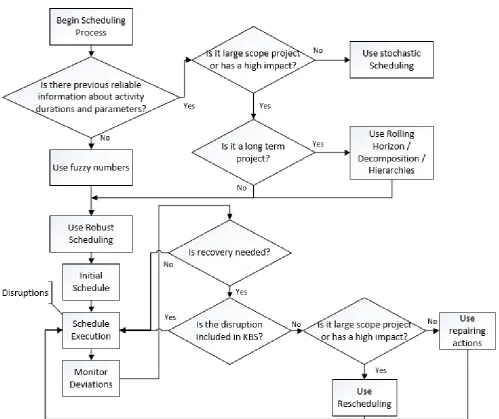
Let’s analyze the decision made in this framework. As shown in Fig. 1, the framework begins by asking if there is reliable information about the parameters and activity durations; the purpose is to reduce the degree of uncertainty coming from known sources. The second decision point is regarding the scope and impact of the project. If a company has high investment in a project or is expecting a crucial result from it, a detailed plan should be required.
Furthermore, if they expect it to last for a long period of time, they should plan in advance and schedule for shorter terms. In this way, they can get more current information as time passes and plan accordingly, therefore reducing the need for reactive measures and keeping the executed schedule closer to the baseline schedule. However, if the project is expected to be executed in a short time or if its success is not decisive for a company’s growth then it can be planned as it goes, as it can make full use of the opportunities arising but without the risk of putting the company in danger.
If there is no information regarding the parameters or activity durations, a safer choice would be the use of fuzzy numbers as it allows for scheduling uncertainty. After this, a robust scheduling procedure should be used to create the
baseline schedule. For this, we recommend the methodology developed in Chen, Liang [37]. Recall that the purpose of these schedules is to be capable of absorbing some of the variation without risking the success of the project. The schedule execution should be monitored at all times and if deviations are larger than expected the manager should decide if recovery actions are needed. Supposing that we count with a reliable knowledge base system (KBS), the system could handle some of the events, but if we don’t, then the manager should decide again if the project has a high impact or large scope. If not, repairing actions can be applied, such as the right shift rule. However, if the project does have high impact or large scope, management will want to consider rescheduling in order to minimize the deviation of the project and reduce its overall cost.
Throughout the framework, the main objective is to reduce the need for reactive measures and their inherent cost. For this, we need to look for reliable information, wait until a schedule is absolutely necessary and finally create a robust schedule. First, we want to create a schedule that can include as much as the expected variation as possible so as to avoid major changes during execution. However, if the schedule is disrupted and reactive measures are needed, we want to reduce their cost and overall impact. The most inexpensive way could be to simply right-shift the activities until the required resources become available. But if the cost of right- shifting is high, or if the project is crucial to the company, then we need to reschedule with a multi-objective optimization in mind.
IV. CONCLUSIONS
Fig. 1. Baseline Scheduling and Disruption Handling Framework
REFERENCES
[1] Aytug, H., et al., Executing production schedules in the face of uncertainties: A review and some future directions. European Journal of Operational Research, 2005. 161(1): p. 86–110.
[2] Mehta, S.V. and R.M. Uzsoy, Predictable scheduling of a job shop subject to breakdowns. IEEE Transactions on Robotics and Automation, 1998. 14(3): p. 365–378.
[3] Wu, S.D., R.H. Storer, and P.C. Chang, One machine rescheduling heuristics with efficiency and stability as criteria. Computers and Operations Research, 1993. 20: p. 1-14.
[4] Herroelen, W. and R. Leus, Project scheduling under uncertainty— survey and research potentials. European Journal of Operational Research, 2005. 165(2): p. 289–306.
[5] Turner, J.R., The Handbook of Project Based Management. 1993, London: McGraw-Hill.
[6] Turner, J.R., The Handbook of Project Based Management. 2 ed. 1999, London: McGraw-Hill.
[7] Turner, J.R. and R. Müller, On the nature of the project as a temporary organization. International Journal of Project Management, 2003. 21: p. 1-8.
[8] Ju, L., et al., A bi-level stochastic scheduling optimization model for a virtual power plant connected to a wind–photovoltaic–energy storage
system considering the uncertainty and demand response. Applied Energy, 2016. 171: p. 184-199.
[9] Wu, H., et al., Chance-Constrained Day-Ahead Scheduling in Stochastic Power System Operation. IEEE Transactions on Power Systems, 2014. 29(4): p. 1583-1591.
[10] Liu, K., E. Fridman, and K.H. Johansson, Networked Control With Stochastic Scheduling. IEEE Transactions on Automatic Control, 2015. 60(11): p. 3071-3076.
[11] James, T., Control of multiclass queueing systems with abandonments and adversarial customers, in Faculty of Science and Technology. 2016, Lancaster University: Lancaster, UK. p. 232.
[12] Samà, M., A. D’Ariano, and D. Pacciarelli, Rolling horizon approach for aircraft scheduling in the terminal control area of busy airports.
Transportation Research Part E: Logistics and Transportation Review, 2013. 60: p. 140-155.
[13] Palma-Behnke, R., et al., A Microgrid Energy Management System Based on the Rolling Horizon Strategy. IEEE Transactions on Smart Grid, 2013. 4(2): p. 996-1006.
[14] Lin, P.-C. and R. Uzsoy, Chance-constrained formulations in rolling horizon production planning: an experimental study. International Journal of Production Research, 2016: p. 1-16.
[15] Meyr, H. and M. Mann, A decomposition approach for the General Lotsizing and Scheduling Problem for Parallel production Lines.
[16] Ghaddar, B., et al., A Lagrangian decomposition approach for the pump scheduling problem in water networks. European Journal of Operational Research, 2015. 241(2): p. 490-501.
[17] Blom, M.L., A.R. Pearce, and P.J. Stuckey, A Decomposition-Based Algorithm for the Scheduling of Open-Pit Networks over Multiple Time Periods. Management Science, 2016.
[18] Prosser, P. A Reactive Scheduling Agent. in Eleventh International Joint Conference on Artificial Intelligence. 1989. California. [19] Chen, X., et al., Semi-online hierarchical scheduling problems with
buffer or rearrangements. Information Processing Letters, 2013.
113(4): p. 127-131.
[20] Chen, X., et al., Online hierarchical scheduling on two machines with known total size of low-hierarchy jobs. International Journal of Computer Mathematics, 2015. 92(5): p. 873-881.
[21] Bhattacharya, A.A., et al., Hierarchical scheduling for diverse datacenter workloads, in Proceedings of the 4th annual Symposium on Cloud Computing. 2013, ACM: Santa Clara, California. p. 1-15. [22] O’Kane, J.F., A knowledge-based system for reactive scheduling
decision-making in FMS. Journal of Intelligent Manufacturing, 2000.
11(5): p. 461–474.
[23] Motawa, I. and A. Almarshad, A knowledge-based BIM system for building maintenance. Automation in Construction, 2013. 29: p. 173-182.
[24] Maqsood, S., et al., Hybrid Genetic Algorithm (GA) for job shop scheduling problems and its sensitivity analysis. International Journal of Intelligent Systems Technologies and Applications, 2012. 11(1-2): p. 49-62.
[25] Thiele, J.C., W. Kurth, and V. Grimm, Facilitating Parameter Estimation and Sensitivity Analysis of Agent-Based Models: A Cookbook Using NetLogo and 'R'. Journal of Artificial Societies and Social Simulation, 2014. 17(3): p. 11.
[26] Muzhikyan, A., A.M. Farid, and K. Youcef-Toumi, An Enterprise Control Assessment Method for Variable Energy Resource-Induced Power System Imbalances—Part II: Parametric Sensitivity Analysis. IEEE Transactions on Industrial Electronics, 2015. 62(4): p. 2459-2467.
[27] Hall, N.G. and M.E. Posner, Sensitivity analysis for scheduling problems. Journal of Scheduling, 2004. 7(1): p. 49-83.
[28] Li, Z.K. and M. Ierapetritou, Process scheduling under uncertainty: Review and challenges. Computers & Chemical Engineering, 2008.
32: p. 715–727.
[29] Torabi, S.A., et al., A particle swarm optimization for a fuzzy multi-objective unrelated parallel machines scheduling problem. Applied Soft Computing, 2013. 13(12): p. 4750-4762.
[30] Yeh, W.-C., et al., Parallel-machine scheduling to minimize makespan with fuzzy processing times and learning effects.
Information Sciences, 2014. 269: p. 142-158.
[31] Bakry, I., O. Moselhi, and T. Zayed. Fuzzy dynamic programming for optimized scheduling of repetitive construction projects. in IFSA World Congress and NAFIPS Annual Meeting (IFSA/NAFIPS), 2013 Joint. 2013.
[32] Dixit, V., R.K. Srivastava, and A. Chaudhuri, Procurement scheduling for complex projects with fuzzy activity durations and lead times. Computers & Industrial Engineering, 2014. 76: p. 401-414. [33] Xu, J., Y. Ma, and X. Zehui, A Bilevel Model for Project Scheduling
in a Fuzzy Random Environment. IEEE Transactions on Systems, Man, and Cybernetics, 2015. 45(10): p. 1322-1335.
[34] Xu, Y., et al., An effective teaching–learning-based optimization algorithm for the flexible job-shop scheduling problem with fuzzy processing time. Neurocomputing, 2015. 148: p. 260-268.
[35] Al-Fawzan, M.A. and M. Haouari, A bi-objective model for robust resource-constrained project scheduling. International Journal of Production Economics 2005. 96: p. 175-187.
[36] Goldratt, E., Critical Chain. 1997: The North River Press.
[37] Chen, A.H.L., Y.C. Liang, and J.D. Padilla, An Entropy-Based Upper Bound Methodology for Robust Predictive Multi-Mode RCPSP Schedules. Entropy, 2014. 16: p. 5032–5067.
[38] Rezaeian, J., et al., Using a meta-heuristic algorithm for solving the multi-mode resource-constrained project scheduling problem.
International Journal of Operational Research, 2015. 24(1): p. 1-16. [39] Lamas, P. and E. Demeulemeester, A purely proactive scheduling
procedure for the resource-constrained project scheduling problem with stochastic activity durations. Journal of Scheduling, 2015: p. 1-20.
[40] Sadeh, N., S. Otsuka, and R. Schelback. Predictive and reactive scheduling with the microboss production scheduling and control system. in IJCAI-93 Workshop on Knowledge-Based Production Planning, Scheduling and Control. 1993.
[41] Smith, S.S., Reactive scheduling systems, in Intelligent Scheduling Systems, D.E. Brown, Scherer, W.T. , Editor. 1994, Kluwer.
[42] Calhoun, K.M., et al., Planning and re-planning in project and production planning. Omega, 2002. 30: p. 155–170.
[43] Alagöz, O. and M. Azizoglu, Rescheduling of identical parallel machines under machine eligibility constraints. European Journal of Operational Research, 2003(149): p. 523–532.
[44] Briand, C., E. Despontin, and F. Roubellat, Scheduling with time lags and preferences: A heuristic, in 8th Workshop on Project Management and Scheduling. 2002: Valencia.
[45] Mauguière, P., J.C. Billaut, and C. Artigues, Grouping jobs on a single machine with heads and tails to represent a family of dominant schedules, in 8th Workshop on Project Management and Scheduling. 2002: Valencia.
[46] Quesnel, F., A. Lèbre, and M. Südholt, Cooperative and reactive scheduling in large-scale virtualized platforms with DVMS.
Concurrency and Computation: Practice and Experience, 2013.
25(12): p. 1643-1655.
[47] Nie, L., et al., A GEP-based reactive scheduling policies constructing approach for dynamic flexible job shop scheduling problem with job release dates. Journal of Intelligent Manufacturing, 2013. 24(4): p. 763-774.