Abstract— This article propose an innovative tool based in ludic games oriented to children between 6-8 years old, with gesture recognition technology.
The implementation of these games, help children’s didactic learning, and progress in activities such as coordination, laterality and motor skills and sedentary lifestyle in the most important age for development, are treated.
Finally, the results obtained with the experiment in the target population are been shown.
Index Terms— SDK, XNA, gesture recognition, ludic games,
sedentary lifestyle, Gesture Recognition Sensor (GRS)
I. INTRODUCTION
he gesture recognition sensor (GRS) works with concentration points, where different actions and positions of the object can be determined. They contribute to the development of ludic games, based on technology that promote, conserve and strengthen innate physical activity that children possess from birth.
Wenjung Zeng [1] mentions in his article, the importance of the 3D cameras and how they are creating new opportunities for revolutionizing multimedia information. He also expresses the form in which corporal language is used for video games, saying “the sensor that recognizes gestures allows the computer to directly sense the third dimension (depth) of the players and the surroundings, which makes the job much easier”.
He successfully gather information through greater use of sensors and cameras, use of image recognition, gestures and movements based on the technology it uses.
Anthony Freire is with the Department of Electrical and Electronics, University of the Armed Forces, Quito, Ecuador, e-mail:
Vinicio Pazmiño is with the Department of Electrical and Electronics, University of the Armed Forces, Quito, Ecuador, e-mail:
Danni De la Cruz is with the Department of Electrical and Electronics, University of the Armed Forces, Quito, Ecuador, e-mail: [email protected]. Johanna Tobar is with the Department of Energy Sciences and Mechanics, University of the Armed Forces, Quito, Ecuador, e-mail:
Paul Mejía is with the Department of Electrical and Electronics, University of the Armed Forces, Quito, Ecuador, e-mail: [email protected].
As is mentioned in G Tao’s article [2], the GRS follows the position of the skeleton-programmed in its libraries of development (SDK). In this way, there is a wide panorama of use through gesture and movement recognition, and any application can be configured and setup to focus on the human skeleton.
Kourosh Khoshelham [3] develops more profound concepts relating to GRS cameras and sensors, its impact causes in the development of countless applications and its mathematical model for the better understanding of this technology.
The 2012 investigation of David De La Fuente Garrido [4] demonstrates the great importance that this gesture recognition technology that Microsoft uses for the development of games for Neuro-rehabilitation for children who have problems with slow learning. Also in this investigation is been mentioned the use of libraries for the development of applications as well as the XNA platform for the programming and the potential this language has. The results demonstrated allow us to have a wide idea of the aspects in which this helps a specific handicap, in which we recognize the importance of these games. Wenbing Zhao also speaks about another type of technology. The GRS have a group of microphones that allow the recognition of instructions using voice. The monitoring of the sensor of the person, who is utilizing it, requires standards for optimal use, the minimum distance that varies from 6.5 to 7.8 feets allow the GRS to capture the entire body of the player and the information from the person’s voice.
The article that Emmanouil Potetsianakis [6] talks about the simplicity of the interaction of the user and the GRS interface, non-tactile control of the applications are acquired through movements and corporal gestures; thanks to this technology, we can battle sedentary behavior that traditional games offer children.
Palou Pere research [7] compares the quality of life between physical activity and sedentary lifestyle that modern children live; we clearly observe how the lack of dynamic games affect the cardiorespiratory health of children.
He mentions that exploring the relation between Quality of Life relating to Health (CVRS), they are important resources for the adaptation of society and healthy development of the child, physically as well as psychological. Due to these
Ludic Tool that Contributes to the Physical and
Motor Development Based on Sensor
Technology for Gesture Recognition
Anthony B. Freire, Vinicio D. Pazmiño, Danni R. De la Cruz, Johanna B. Tobar and Paúl H. Mejia
reasons, it is of paramount importance the contribution of these ludic games and technologies that will help reduce sedentary lifestyles from an early age.
Learning begins at birth and the acquisition of knowledge requires an early start. Which can been done through ways that involve family participation for the basic development in children. The implementation of these ludic games with innovative technology that makes it interest for children’s education.
The education in children been based on the curriculum of early and basic education [8] because they are developed according to the children’s necessity. The use of tools helps in the study fields that the children develop while they are growing up.
Learning in children through the visual-motor development focuses principally on the following study fields:
The relation between the natural and cultural means. Logic-mathematic relations.
Discovering the characteristics of the elements of the natural world explored through the senses.
Understanding the basic notions of quantity facilitating the development of thinking skills.
This type of learning allows the identification of the animal’s characteristics, colors, shapes, outlines and in this way learn to recognize these elements in the atmosphere in a graphic and visual way.
Children respond to visual and ludic methodologies of learning in a better way. This work hopes to provide an innovative didactic tool that contributes to the development of the skills and visual-motor abilities in children between 6-8 years old, through activities and games that involve the total physical movement. In this way, knowledge been obtained and retained through the world that surrounds us. Using new technology that efficiently contributes a decrease in a sedentary lifestyle and an improvement in children’s health.
II. TECHNICAL DESCRIPTION
A. Software Development Kit (SDK)
SDK allows the creation of applications using native methods, and in this way work with physical gesture recognition, allowing for an improvement in the interaction of the program and user [9].
The SDK controls the recognition of the skeletons through the “SkeletonFrameReady”, and the recognition of articulations through the points of focus “joints”. If the sensor does not detect any body, it simply sends the image of depth to the host device, like an Xbox or computer. The software that executes the host device contains the logic to decode the information and recognize the elements in the image with human shape characteristics. To accomplish this objective, the software has been programmed with a wide variety of body shapes, it uses the aligning of diverse parts and movements to identify and monitor them.
B. Methodology
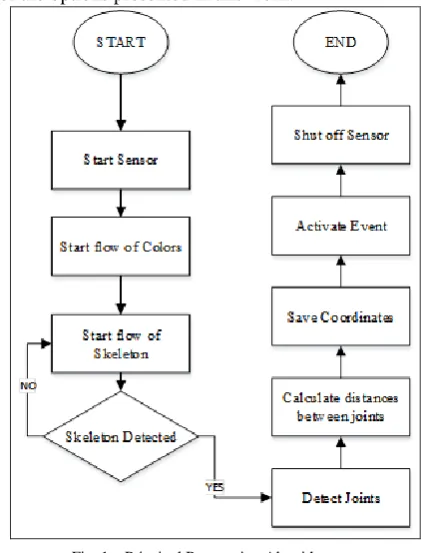
[image:2.595.326.537.87.364.2]In Fig. 1, you can see the flow process that is been used in each of the options presented in this work.
Fig. 1. Principal Programing Algorithm
When starting, the sensor immediately activates the control of color flow and the flow of skeleton information. With the last, it is been hoped that the user will position himself in front of the sensor to recognize the joints and calculate the distances between the points of focus. Afterwards, the coordinates are been registered with each of the points, principally the left and right hand, to execute the predefined event of the action that is being made.
C. Gesture Recognition
As seen in Fig. 2, following the distances and coordinates in (X, Y) of the concentration points of the human body, the recognition of gestures that the body is making is been made for example, lifting a hand.
In this case we can measure the distances that exist between the hands be it the left or right, and the head; and in this way detect if the hand is lifting.
If the distance between the head and the hand is more than fixed value “k”, the same which is defined by the user, the event of the movement of the outward moving hand is made, otherwise if the distance between the head and hand is less than said fixed value, the movement of the hand is inward.
A. Detection of Skeleton
will be established as the principal or closest to the sensor, maintaining at a margin any other skeleton that may be detected.
Fig. 2. Concentration points in human body
B. Position of points of interest
After having the skeleton on screen, the coordinates of point of interest are been shown (hands, feet, head, arms, etc.) to achieve this; we turn to the “JointID”, which uses the “Joints” vector to obtain the elements that we want and to be recognized in a precise way.
The X coordinate must been obtained in any of the joints that are being used, with the use of the “Position.X”, coordinate can be obtained from the point of interest. In the example, the right hand, to later been sampling and work with the data, the types of related events, we work with the Joint and Y-axis coordinates.
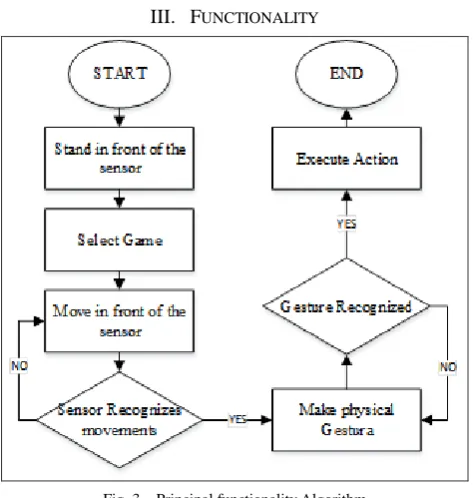
III. FUNCTIONALITY
Fig. 3. Principal functionality Algorithm
The basic function of the applications presented in Fig. 3, which demostrates how to use each action of this tool.
A. Learning the Color
[image:3.595.305.549.201.309.2]This option hopes to teach the user about colors, through object selection. In the interface, we see three different color cups as shown in Fig. 4, each cup must been placed on the plate according to its corresponding color, after each hand movement over the cup we can select the desired cup and allow to move it and take it to its correct position. You can change hands (between the left and right) to play the game, the cup lands on the corresponding plate, and if placed correctly, a confirmation will appear demonstrating its correct place. Besides appearing on the right hand side, the cups change position randomly with each start of the game.
Fig. 4. Learning colors interface
B. Learning the Numbers
In the demonstrated interface, we can see numbers 1 through 5 in Fig. 5, which change positions randomly each time the game is started; the user selects the number, whether it be with the right or left hand, if the hand disappears from the screen, the number disappears from the list as well. The numbers must been selected in numerological order. Each time the hand passes by a certain number, there will be a number that appears on the right side that represents the number of objects where the hand is been currently positioned.
Fig. 5. Learning numbers interface
C. Learning the Figures
[image:3.595.304.550.479.606.2] [image:3.595.51.288.495.744.2]allows free interaction with the interface without the necessity of a control or device.
Fig. 6. Learning figures interface
D. Learning Animals
[image:4.595.302.547.136.399.2]Another important feature of the sensor is its phrase and word recognition, with this we can develop an application that allows identification of animals shown on screen, as seen on Fig. 7. This improves the visual capturing ability of children, as well as contributing to the development of word pronunciation.
Fig. 7. Learning animals interface
E. Avatar
[image:4.595.46.288.321.406.2]With the gesture recognition sensor, there is communication between the game development platform and the user. An avatar is been implemented to recognize the movements of gestures from the user as can be seen in Fig. 8. For increase the child’s attention and make it easy to get up and simulate the movements of a super hero, controlling its movements.
Fig. 8. Avatar
IV. RESULTS OBTAINED
The tests and data transfers will been obtained when children are between 6 and 8 years old, in both genders from a school, located in Ecuador. The applications developed with the gesture recognition sensor allow us to observe the impact of these ludic games on children and to get to know how effective their use can result in the use of new
technology with education and to battle sedentary lifestyle in children.
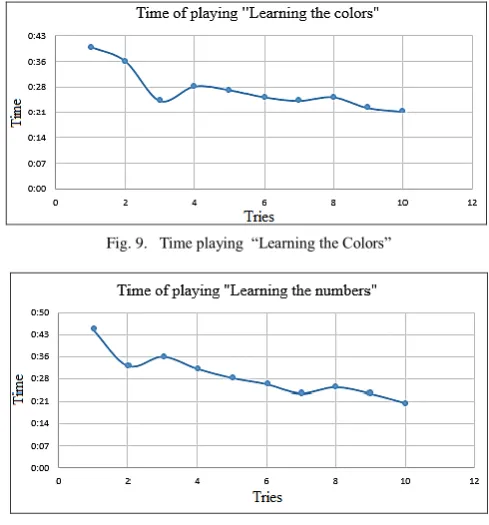
The diagrams shown below demonstrate a satisfactory tendency from the use of these innovative ludic tools to contribute to the recognition, capture and retaining of the knowledge obtained from a traditional standpoint.
Fig. 9. Time playing “Learning the Colors”
Fig. 10.Time playing “Learning the numbers”
In Fig. 9 and 10, we can see that the more one tries, the less time the user takes to respond, we can conclude that repetition is a method that contributes to a better learning.
[image:4.595.47.290.538.666.2]Using the game “Learning figures”, we obtain the following information, which demonstrates each figure and how many tries each had to recognize the outline that is been evaluated.
Table I Tries per game "Learning the Figures"
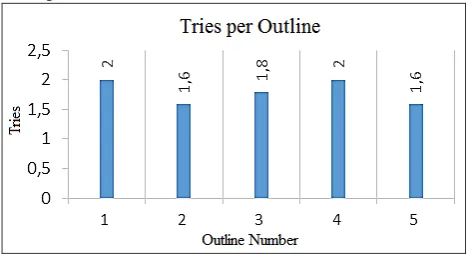
If we determine an average of the number of tries for each one of the outlines, we obtain the following that Fig 11
According to the diagram, we determine that the outlines shown for the game do not present a difficulty, how can see in Fig. 11, at the moment of being selected by the child, the same that can stimulate their visual-motor abilities when recognizing the figure and interacting with the interface to select the correct response.
[image:4.595.310.544.543.608.2]screen in a more dynamic way more than any other videogames.
Fig. 11.Number of tries of the game “Learning the figures”
V. CONCLUSIONS
The gesture recognition sensor is an excellent option when involving didactic games because it is a strong technological tool not only in hardware and in software, thanks to its great versatility to develop applications and programs dedicated to the necessities of the user.
Children will have access to a more representative form of pronunciation, in this case animals, through various visits to the center; we found the need to change speech recognition in the animal game in the following way:
o Before: “TORTUGA” o Now: “TOR TU GA”
In this way, we can improve detection of words that the child is identifying.
Due to the movement detector and gesture recognition being relatively new on market, there can be an implementation of games that are been dedicated to these types of activities, in the case of this Project, ludic games that are oriented towards the development of the physical and emotional abilities of the child.
The mode of play is dynamic, unlike other ludic games currently available, there is diminished sedentary lifestyle and accessibility for the children when are playing and learning at the same time.
Through these games, the way of learning of a child is much more advantageous, as in ages 6 to 8; the activities that involve any movement will help them relating sociably to others as well.
REFERENCES
[1] Wenjun Zeng (2011). Microsoft Kinect Sensor and Its Effect. University of Missouri. Published by the IEEE Computer Society
[2] G Tao, PS Archambault, MF Levin (2013). Evaluation of Skeletal tracking in a virtual Reality Rehabilitation System for Upper Limb Hemiparesis. Interdisciplinary Research Center in Rehabilitation, Laval, Canada.
[3] Kourosh Khoshelham (2012). Accuracy and Resolution of Kinect Depth Data for Indoor Mapping Applications. Faculty of Geo-Information Science and Earth Observation, University of Twente. ISSN 1424-8220
[4] David de la Fuente Garrido (6 june of 2012). Kinect applications for neurorehabilitation. Polytechnic University of Catalonia. Thesis work.
[5] Wenbing Zhao, Deborah D. Espy, M. Ann Reinthal, Hai Feng (2014). A Feasibility Study of Using a Single Kinect Sensor for Rehabilitation Exercises Monitoring: A rule Based Approach. Departament of Electrical and Computer Engineering, Cleveland State University.
[6] Emmanouil Patetsianakis, Emmanouil Ksylakis, Georgios Triantafyllidis (2014). A Kinect- Based Framework for Better User Experience in Real- Time Audiovisual Content Manipulation 2014 International Conference on Telecomunications and Multimedia. Telecom ParisTech, Technological Educational Institute of Crete, Aalborg University.
[7] Palou, Pere. Vidal, Josep. Ponseti, Xavier. Cantallops, Jaume. Borràs, Pere A. (2012).Relations between quality of life, physical activity and cardiorespiratory fitness in sedentary children.
[8] María Cristina Espinoza Salas, Stefanie Naranjo oro Santacruz (2014). Early Education Curriculum. Ministry of Education