A Proposal of Back Propagation Learning for
Secure Multi-Party Computation Methods
Hirofumi Miyajima
†1, Noritaka Shigei
†2, Hiromi Miyajima
†3,
Yohtaro Miyanishi
†4, Shinji Kitagami
†5and Norio Shiratori
†6Abstract—Many studies have been done with the security of cloud computing. Data encryption is one of typical approaches. However, complex computing requirement needs a great deal of time and effort for the system. Therefore, studies on secure sharing and computing methods are desired to avoid secure risks being abused or leaked. The secure multi-party computa-tion (SMC) is one of these methods. So far, some studies have been done with SMC. Specifically, SMC with secure shared data in addition and multiplication forms is proposed and applied to arithmetic operation and simple statistical computation. However, complex calculation processing such as BP (Back Propagation) learning has never proposed yet. In this paper, we propose a learning method for SMC on cloud computing system and prove the validity of it. Further, the performance of the proposed method is shown in numerical simulations.
Index Terms—cloud computing, secure multi-party compu-tation, BP, Perceptron-type learning.
I. INTRODUCTION
Cloud computing is service to provide computing re-sources through the Internet for the unspecified number of individual or a company [1], [2]. The client can realize reduction of the operational cost and the increase and de-crease of resources flexibly without having one’s resources. In addition, the spreading of computing of cloud computing allows use such as big data analysis to analyze enormous information accumulated by the client, and to create market value of data [1]. On the other hand, the client of cloud computing cannot escape from anxiety about the possibility of information being abused or leaked. How can we construct a cloud computing system to avoid the above risk? For this purpose, data encryption has been one of typical approaches [3], [4]. Data encryption is an effective method to protect data from external risk, but the encrypted data must be decrypted to get plain texts when processed in a cloud. Therefore, safe system for distributed processing with secure data attracts attention, and a lot of studies have been done [5], [6]. A method to realize secure computation is secure multi-party method [7]–[11], which is currently applied to certain applications, but for limited function calculations. Further, Miyanishi proposed a simple method to share data
Affiliation: Graduate School of Science and Engineering, Kagoshima University, 1-21-40 Korimoto, Kagoshima 890-0065, Japan
corresponding author to provide email: [email protected] †1email: [email protected]
†2email: [email protected]
†3email: [email protected]
Affiliation: Information Systems Engineering and Management, Inc., Tokyo, Japan
†4email: [email protected]
Affiliation: Waseda University, Tokyo, Japan †5email: [email protected]
Affiliation: Waseda University, Tokyo, Japan †6email: [email protected]
ůŝĞŶƚ
;hƐĞƌͿ
^ĞƌǀĞƌ1
^ĞƌǀĞƌ
k
^ĞƌǀĞƌ
m
ڭ
ůŽƵĚ
[image:1.595.324.530.193.355.2]ڭ
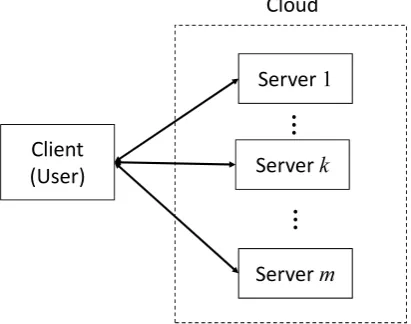
Fig. 1. A configuration of cloud computing system.
and applied to statistical computation [12]. However, com-plex calculation processing such as BP learning has never proposed yet.
In this paper, we propose a learning method for SMC on cloud computing system and prove the validity of it. Further, the performance of the proposed method is shown in numerical simulations. The aim is to realize the learning using secure sharing and computing for data being on cloud system. In Section 2, we explain cloud computing system and how to share the data. Further, Perceptron-type and BP learning are introduced. Though Perceptron-type learning is a special case of BP learning, it is introduce to help understanding the proposed algorithm for BP learning. In Section 3, we propose perceptron and BP learning on cloud computing system and show the validity of the algorithm. Further, numerical simulations are performed to show the performance of the proposed method.
II. PRELIMINARY
A. System configuration of cloud system
ܽሺଵሻǡ ܾሺଵሻ
ܣሺଵሻǡ ܤሺଵሻ
ܽ ൌ ܽሺଵሻ ܽሺଶሻ ܽሺଷሻ
ൌ ܣሺଵሻܣሺଶሻܣሺଷሻ
ܾ ൌ ܾሺଵሻ ܾሺଶሻ ܾሺଷሻ
ൌ ܤሺଵሻܤሺଶሻܤሺଷሻ
ůŽƵĚ
ܽሺଶሻǡ ܾሺଶሻ
ܣሺଶሻǡ ܤሺଶሻ
ܽሺଷሻǡ ܾሺଷሻ
ܣሺଷሻǡ ܤሺଷሻ
^ĞƌǀĞƌ1
^ĞƌǀĞƌ2
[image:2.595.63.275.55.217.2]^ĞƌǀĞƌ3 ůŝĞŶƚ
Fig. 2. The representation of secure shared data.
B. The representation of secure shared data
Let us explain data representation for secure multi-party computation used in this paper [10], [12]. Let a and b be two positive integers andm= 3for the number of servers. First, two integersaandbare shared into three real numbers. Let a=a(1)+a(2)+a(3) andb=b(1)+b(2)+b(3) as addition form and a = A(1)A(2)A(3) andb =B(1)B(2)B(3) as the multiplication form (See Fig.2). Then the following results hold:
1)a+b= (a(1)+b(1)) + (a(2)+b(2)) + (a(3)+b(3)) 2)a−b= (a(1)−b(1)) + (a(2)−b(2)) + (a(3)−b(3)) 3)ab= (A(1)B(1))(A(2)B(2))(A(3)B(3))
4)a/b= (A(1)/B(1))(A(2)/B(2))(A(3)/B(3))
That is, four basic operations of arithmetic (addition, subtraction, multiplication, and division) hold as integration of sub computation by each server. In this case, each server can not know the original dataaandb. Further, let us explain how to compute the sum and average for results processing using shared data in addition form.
In Table I, a and b are original data (marks) and ID is student’s identifier. Let us show a calculation example of shared data as follow [12]:
a=a(1)+a(2) : a(1)=a(r1/10)anda(2)=a(1−r1/10)
b=b(1)+b(2) :b(1)=b(r1/10)andb(2)=b(1−r2/10)
a=A(1)A(2) :A(1) =√a(r1/10)andA(2)=
√
a(10/r1)
b=B(1)B(2) :B(1) =√b(r
2/10)andB(2) =
√
b(10/r2)
Wherer1 andr2 are real random numbers for−9≤r1≤9 and0.2≤r2≤9,r1̸=1,r2̸=1, respectively. For example,a(1) anda(2) for ID=1 are computed asa(1)= 50×(4/10) = 20 and a(2) = 50×(1−4/10) = 30 and data A(1) and A(2) for ID=1 are computed as A(1) = √50×(9/10) = 6.314 and A(2) = √50×(10/9) = 7.856, respectively. Note that Server 1 has all the data in column-wise of a(1),b(1), A(1) andB(1)for each ID and Server 2 has all the data in column-wise of a(2), b(2),A(2) and B(2) for each ID as shown in Fig.2.
Let us explain how to compute the sum and average for subjectAusing dataa. Server 1 and Server 2 compute each sum ofa(1) anda(2). In this case, each sum in column-wise for a(1) and a(2) is -23 and 328, respectively. As a result, the total sum 305 is obtained from 328-23. Likewise, the average 61 is obtained from 65.6-4.6.
ଵ
ெ
ଵ
ெ
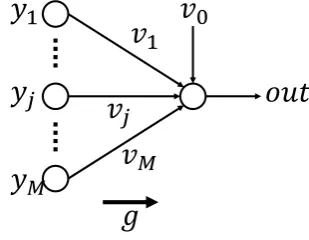
Fig. 3. A neural element.
In the following, we propose a learning method using secure shared data in multiplication form.
C. Perceptron-type learning for a neural element
Perceptron-type learning is a method to adjust the weight parameters to match the output of the neuron and the desired output. Desired output for input are called learning data. In Perceptron-type learning, the weight parameters are updated repeatedly using the difference between the output of the neuron and the desired output until the difference becomes sufficiently small. It is known that the results always converge if the linearly separable condition is satisfied [14]. Let us explain the conventional neuron [14]. Let Zi = {1,− − −, i} for a positive integeri. The output yfor each neuron is given by
u =
M
∑
j=0
vjyj (1)
out = g(u) (2)
whereyj is thej-th input,uis the internal potential of the
neuron,g(u)is the output function, vj is the weight for the
j-th input,v0is the threshold and y0= 1(See Fig. 3). Let the evaluation function for input datay be defined as follows:
E=1
2(g(y)−d(y))
2
, (3)
whered(y)is the desired output for y.
In order to minimize the function E, the weights for the neuron are updated as follows:
△vj =
∂E ∂vj
= (g(y)−d(y))∂g(u)
∂u yj (4) vj(t+ 1) = vj(t) +K△vj(t), (5)
whereK is a learning constant and j∈ZM
In order to consider the simple case, let us assume that
∂g(u)
∂u = 1. As a result, learning formula for Perceptron-type
learning is shown as follows:
vj(t+ 1) = vj(t) +K(g(y)−d(y))yj, (6)
wheret is the number of learning time.
Then, learning algorithm for learning data
[image:2.595.347.502.59.179.2]TABLE I
DATA ONSERVER1ANDSERVER2.
Additional form Multiplication form
ID subject A subject B a b A B
a b r1 a(1) a(2) b(1) b(2) r2 A(1) A(2) B(1) B(2)
1 50 80 4 20 30 32 48 9 6.314 7.856 8.050 9.938
2 40 50 -6 -24 64 -30 80 2 1.265 31.623 1.414 35.355
3 65 30 2 13 52 6 24 0.8 0.645 100.778 0.438 68.465
4 70 62 -8 -56 126 -49.6 111.6 5 4.183 16.733 3.937 15.748
5 80 40 3 24 56 12 28 4 3.578 22.361 2.530 15.811
sum 305 262 -23 328 -29.6 291.6
average 61 52.4 -4.6 65.6 -5.92 58.32
Step1: Given the maximum number of learning tmax. Let
t= 1. The initial assignment of vj(j∈ZM) is set randomly.
Step 2: Letl= 1.
Step 3: Select a data (yl, d(yl)).
Step 4: Compute the output g(yl)for input yl.
Step 5: Compute the error (g(yl)−d(yl)).
Step 6: Compute the updated value△vj(t)using Eq.(4).
Step 7: Update the weight asvj(t+ 1) =vj(t) +K△vj(t).
Step 8: Ifl̸=L, then go to Step 3 withl←l+ 1andt←t+ 1 else go to Step 9.
Step 9: Ift̸=Tmax, then go to Step 2 witht←t+ 1else the
algorithm terminates.
D. BP method for neural networks
Let us consider the case ofninput and one output without loss of generality. Let zl∈JN for l∈Z
L and d : JN→J,
where J = [0,1]. Giving learning data {(zl, d(zl))|l∈ZL},
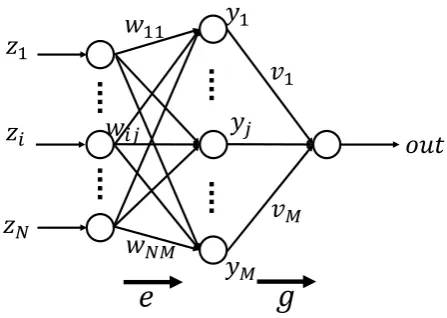
let us determine the three-layered neural network identifying the learning data by BP method [13], [14]. Let h = g◦e : JN→J be the function defined by a neural network. Let the number of elements in second layer be M. Letwj for
j∈ZM andv be weights for the second and output layers,
respectively. Thengandeare defined as follows (See Fig.4):
yj = ej(z) =τ
( N ∑
i=0
wijzi
) ,
z0 = 1,
τ(u) = 1
1 + exp(−u) where
z = (z1,· · ·, zN)∈JN y = (y1,· · ·, yM)∈JM
andw0j means the threshold value.
Further,
g(y) = τ ∑M
j=0
vjyj
,
y0 = 1, wherev0 means the threshold value.
Then, the evaluation function is defined as follow:
E= 1 2L
L
∑
l=1
(
h(zl)−d(zl))2 (7)
ݖ
ଵݖ
ݖ
ேݑݐ
ݓ
ଵଵݓ
ݓ
ேெݕ
ଵݕ
ݕ
ெݒ
ଵ [image:3.595.315.539.196.355.2]ݒ
ெFig. 4. Three-layered neural network
The weightsw andv are updated based on BP method as follow [14]:
△vj=−α1δ1j(zl)ej(zl) (8) △wij =−α2δ1j(zl)zil (9)
(i= 0,· · ·, N, j = 1,· · ·, M) whereα1 andα2 are learning coefficients,
δ1j(z) = (h(z)−d(z))h(z)(1−h(z)) (10)
and
δ2j(z) =δ1jvjej(z)(1−ej(z)). (11)
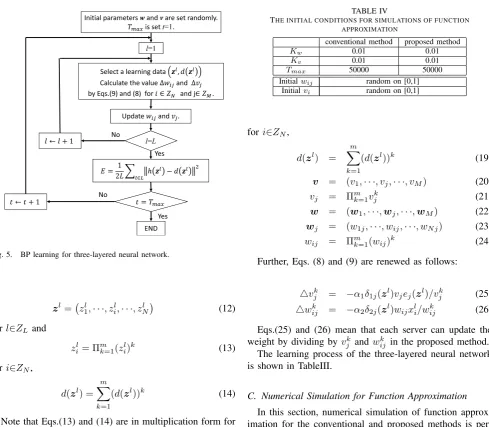
Then, BP learning method is shown in Fig.5 [14].
III. BACK PROPAGATION LEARNING FOR SECURE MULTIPARTY METHOD
A. Perceptron learning for secure shared data
Let us consider a system composed of client and m servers(See Fig.1). In learning on cloud system, learning data and weight parameters are shared to each server in multiplication form. Each server updates shared weight pa-rameters and sends the computation result to the client. The client can get new weight parameters by multiplying the results of m servers. This is verified from Eqs.(15) and (16). The process is iterated until the error (difference) between the output of the neuron and the desired output becomes sufficiently small. The problem is how the weight parameter won the user is updated using the set of learning data shared on each server. The shared representation of learning data
/ŶŝƚŝĂůƉĂƌĂŵĞƚĞƌƐw ĂŶĚv ĂƌĞƐĞƚƌĂŶĚŽŵůLJ͘ ௫ŝƐƐĞƚt=1͘
l=1
^ĞůĞĐƚĂůĞĂƌŶŝŶŐĚĂƚĂ ǡ
ĂůĐƵůĂƚĞƚŚĞǀĂůƵĞοĂŶĚο
ďLJƋƐ͘;ϵͿĂŶĚ;ϴͿĨŽƌ א ே ĂŶĚũא ெ͘
hƉĚĂƚĞĂŶĚ͘
l=L
ൌ2ͳ ݄ െ ଶ א
ൌ ௫
E ՚ ͳ
՚ ͳ
zĞƐ zĞƐ
[image:4.595.56.546.45.472.2]EŽ EŽ
Fig. 5. BP learning for three-layered neural network.
zl=(z1l,· · ·, zil,· · ·, zNl ) (12) for l∈ZL and
zli= Πmk=1(zil)k (13) for i∈ZN,
d(zl) =
m
∑
k=1
(d(zl))k (14)
Note that Eqs.(13) and (14) are in multiplication form for shared data.
In this case, Eqs.(4) and (5) are renewed as follows:
△vkj =
∂E ∂vk j
= (g(z)−d(z))zjvj/vjk (15)
(vkj)(t+ 1) = (v k
j)(t) +K△v k
j(t) (16)
for v= (v1,· · ·, vj,· · ·, vM)andvj = Πmk=1v
k j.
Eq.(16) means that each server can update the weight by dividing byvk
j for the conventional method.
The learning process of the perceptron learning is shown in TableII.
B. BP learning for secure shared data
In this section, we propose a BP learning method for secure multi-party computation as the same method as the section 3.1. The problem is how to the weights {wij} and {vj} are updated using the set of learning data shared on
each server. The shared representation of learning data and parameters are given as follows:
zl=(z1l,· · ·, zil,· · ·, zNl ) (17) for l∈Z0
L,
zli= Π m k=1(z
l i)
k
(18)
TABLE IV
THE INITIAL CONDITIONS FOR SIMULATIONS OF FUNCTION APPROXIMATION
conventional method proposed method
Kw 0.01 0.01
Kv 0.01 0.01
Tmax 50000 50000
Initialwij random on [0,1]
Initialvi random on [0,1]
fori∈ZN,
d(zl) =
m
∑
k=1
(d(zl))k (19)
v = (v1,· · ·, vj,· · ·, vM) (20)
vj = Πmk=1v
k
j (21)
w = (w1,· · ·,wj,· · ·,wM) (22) wj = (w1j,· · ·, wij,· · ·, wN j) (23)
wij = Πmk=1(wij)k (24)
Further, Eqs. (8) and (9) are renewed as follows:
△vkj = −α1δ1j(zl)vjej(zl)/vkj (25) △wijk = −α2δ2j(zl)wijxli/w
k
ij (26)
Eqs.(25) and (26) mean that each server can update the weight by dividing byvk
j andwkij in the proposed method.
The learning process of the three-layered neural network is shown in TableIII.
C. Numerical Simulation for Function Approximation
In this section, numerical simulation of function approx-imation for the conventional and proposed methods is per-formed. The conventional method means the conventional BP method without data division and the proposed method is one with m = 3 and m = 10. In this case, the multiplication form is used as a = A(1)· · ·A(m), where A(k) for 1≤k≤m − 1 is a random number in [0,1] or
[−1,1], and A(m) = a/(A(1)· · ·A(m−1)). This simulation uses three systems specified by the following functions with 4-dimensional input space[0,1]4 (for Eq.(27)) and [−1,1]4 (for Eqs.(28) and (29)). The simulation condition is shown in Table IV. The numbers of learning and test data randomly selected are512and6400, respectively.
y = (2x1+ 4x
2 2+ 0.1)2
37.21 ×
(4 sin(πx3) + 2 cos(πx4) + 6
12
(27)
y = (2x1+ 4x
2 2+ 0.1)2
74.42 +
4 sin(πx3) + 2 cos(πx4) + 6
446.52
(28)
y = (2x1+ 4x
2 2+ 0.1)2
74.42 +
(3e3x3+ 2e−4x4)−0.5−0.077 4.68
[image:4.595.57.280.55.282.2](29)
TABLE II
LEARNING PROCESS OF THEPERCEPTRONLEARNING FORSMC.
Client k-th Server
Initial condition The weightv= (v1,· · ·, vM) {(zl)k|l∈ZL}
is selected randomly, and sendvk
j(vj= Πmk=1vkj)to each server
fork∈Zmandj∈ZM.
Step 1 A numberlis selected {vkj}forj∈ZM
randomly
Step 2 Computeµk
j=vkj(zjl)k
forj∈ZM and
sendµk
j and(d(zl))k
to Client. Step 3 Computeµj= Πmk=1µkj forj∈ZM,
d(zl) =∑m k=1
( d(zl))k
andzjvj= Πmk=1(zjl)kvjk
Step 4 Computeϕ=K(g(∑i=1N µi)−d(zl)
) zjvj
and sendϕto each server
Step 5 Compute△vjk=ϕ/vkj andvkj←vkj+△vjk forj∈ZM and send them to Client
Step 6 Ift̸=Tmaxthen go to Step 2 witht←t+ 1
else the algorithm terminates.
TABLE III
LEARNING PROCESS OFBPFORSMC.
Client k-th Server
Initial condition The weightv= (v1,· · ·, vM) {(zl)k}forl∈ZL
andwj= (w1j,· · ·, wij,· · ·, wN j)forj∈ZM
are selected randomly, vj= Πmk=1vjkandwij= Πmk=1wkij.
Sendvk j andw
k ij
to each server.
Step 1 A numberlis selected {wk
ij, vjk}for∈ZN andj∈ZM
randomly and send it to Server.
Step 2 Computeµk
ij=wkij(zli)k
fori∈ZNandj∈ZM.
Send them to Client Step 3 Computewijzi= Πmk=1µkij,
hj=
∑L i=0wijzi
andyj=e(hj)
Step 4 Sendyk
j fork∈Zm
to each server, whereyj= Πmk=1yjk
Step 5 Computeϕk
j =vjkykj
forj∈ZLand
send it to Client Step 6 Computevjyj= Πmk=1ϕkj,d(zl) =
∑m k=1(d(z
l))k
zl 0=
∑M
j=0vjyjandz l=g(zl
0)
Step 7 Computeϕ1=
(
g(zl)−d(zl))g(zl)(1−g(zl))v jyj
andϕ2=
(
g(zl)−d(zl))g(zl)(1−g(zl))v
jyj(1−yj)wijzli
and send them to each server
Step 8 Computevjk←vkj+K1ϕ1/vkj and
wk
ij←wkij+K2ϕ2/wijk
and send them to Client Step 9 Ift̸=Tmaxthen go to Step 1 witht←t+ 1
TABLE V
RESULT OF SIMULATION OF FUNCTION APPROXIMATION
Eq.(27) Eq.(28) Eq.(29) 0.80 2.06 1.22 conventional 1.00 2.66 1.41
method 121 121 121
0.21 0.52 0.27 proposed method 0.38 1.02 0.41
(m= 3) 333 333 333
0.35 0.44 0.99 proposed method 0.54 0.63 1.63 (m= 10) 1210 1210 1210
of parameters, respectively. The result of simulation is the average value from twenty trials.
The result shows that the accuracy between the conven-tional and the proposed methods is almost same. Further, it is shown that the results for m = 3 and m = 10 is also about the same accuracy.
IV. CONCLUSION
The secure multi-party computation (SMC) is one of se-cure sharing and computing methods. The SMC with sese-cure shared data in addition and multiplication forms is known, but complex computation processing such as BP learning has never proposed yet. In this paper, we proposed a learning method for SMC on cloud computing system and proved the validity of it. Further, the performance of the proposed method was shown in numerical simulations.
In the future work, we consider the improved method to reduce the computation of client and develop AUI (Applica-tion User Interface) for the client.
REFERENCES
[1] C. C. Aggarwal, and P. S. Yu, Privacy-Preserving Data Mining: Models and Algorithms, ISBN 978-0-387-70991-8, Springer-Verlag, 2009. [2] S. Subashini, and V. Kavitha, A survey on security issues in service
delivery models of cloud computing, J. Network and Computer Ap-plications, Vol.34,pp.1-11, 2011.
[3] C. Gentry, Fully Homomorphic Encryption Using Ideal Lattices, STOC2009, pp.169-178, 2009.
[4] HElib, An Implementation of homomorphic encryption, https://github.com/shaih/HElib
[5] A. Shamir, How to share a secret, Comm. ACM, Vol. 22, No. 11, pp. 612-613, 1979.
[6] A. Beimel, Secret-sharing schemes: a survey, in Proc. of the Third international conference on Coding and cryptology (IWCC 11), 2011. [7] R. Canetti, et al., Adaptively secure multi-party computation, STOC’
96, pp. 639-648, 1996.
[8] R. Cramer, et al., General secure multi-party computation from any linear secret-sharing scheme, EUROCRYPT’ 00, 2000.
[9] A. Ben-David, et al., Fair play MP: a system for secure multi-party computation, ACM CCS’ 08, 2008.
[10] K. Chida, et al., A Lightweight Three-Party Secure Function Evalu-ation with Error Detection and Its Experimental Result, IPSJ Journal Vol. 52 No. 9, pp. 2674-2685, Sep. 2011(in Japanese).
[11] O. Catrina, et al., Secure multiparty linear programming using fixed point arithmetic, ESORICS 2010, 2010.
[12] Y. Miyanishi, A. Kanaoka, F. Sato, X. Han, S. Kitagami, Y.Urano, N. Shiratori, New Methods to Ensure Security to Increase User’s Sense of Safety in Cloud Services, Proc. of The 14th IEEE Int. Conference on Scalable Computing and Communications (ScalCom-2014), pp.859-865, Bali, Dec.2014.
[13] H. Miyajima, N. Shigei, H. Miyajima, Performance Comparison of Hybrid Electromagnetism-like Mechanism Algorithms with Descent Method, JAISCR,vol.5, no.4, 2015.