Abstract—Sleep and doze power-saving modes are the common
ways to reduce power consumption of optical network units (ONUs) in Ethernet passive optical network (EPON). The doze mode turns off the ONU transmitter when there is no traffic in the upstream direction while the sleep mode turns off the ONU transmitter and receiver. As the result, the sleep mode is more efficient compared to the doze mode, but it introduces additional complexity of scheduling and signaling, losses the clock synchronization and requires long clock recovery time; furthermore, it requires modified multi-point control protocol (MPCP) and the cooperation of the optical line terminal (OLT) in the downstream direction to queue frames. To improve the energy-saving in the doze mode, a new two-stage mechanism is introduced that the doze sleep duration is extended for longer time with acceptable quality-of-services (QoS) metrics when ONU is idle in the current cycle. By this way the ONU enters the doze mode even in the high load traffic; moreover, the green dynamic bandwidth allocation (GBA) is proposed to calculate the doze sleep duration based on the ONU queue state and incoming traffic ratio. Simulation results show that the proposed mechanism significantly improves the energy-saving in different traffic situations, and also promises the QoS performance.
Index Terms—Energy-saving; EPON; GBA; Doze sleep duration.
I. INTRODUCTION
Recently, researchers have predicted that the energy consumption of information and communication technology (ICT) will increase from 250 GW in 2014 to 430 GW in 2020 because of the ever-increasing number of broadband access network users and data rates [1]. It is worth noting that about 70% of the overall telecom network energy is consumed by network access equipment while its utilization is less than 15% [2]. Hence, any effort to increase energy efficiency of access network not only could significantly alleviate the production of green-house gases but also could reduce overall energy consumption. Among various access networks, passive optical network (PON) is the most energy-efficient access solutions at high access rates [3]. PON is also upgradeable to suit the need for ever increasing speed. Then, it is predicted that the PON will continue to be the most energy-efficient access technology in the future [4]. The Ethernet PON (EPON) is the time division multiple access (TDMA) point-to-multi-point (P2MP) PON AliAkbar Nikoukar is with the Department of Mathematics, College of Science, Yasouj University, Yasouj, 75914-353, Iran.
I-Shyan Hwang ([email protected]) and Andrew Fernando Pakpahan are with the Department of Computer Science and Engineering, Yuan-Ze University, Chung-Li, 32003, Taiwan.
Andrew Tanny Liem is with the Department of Computer Science, Klabat University, Manado, 95371, Indonesia.
without active elements between the source and destination. P2MP is an asymmetrical medium based on a tree topology that the data terminal equipment (DTE) connected to the trunk of the tree which is called optical line terminal (OLT), and the DTEs connected at the branches of the tree are called optical network units (ONUs). The OLT typically is at the service provider side while the ONUs are located at the user premises. In the downstream direction (from the OLT to an ONU), signals transmitted by the OLT pass through a 1:N passive splitter and reach each ONU.
It is estimated that almost 90% of the energy consumption in PON comes from the customer premise equipment (ONU) [5]. The EPON standards (IEEE802.3ah and IEEE802. 3av) have not provided energy-efficient mechanisms for the OLT and ONU devices. However, efforts have been made in designing energy-efficient EPON to which the green DBAs have been developed to support energy-saving [6]. Popular solutions in energy-efficient ONU involve the use of ONU sleep mode, ONU dozing [7] and redesigning new ONU architecture [8]. In sleep mode, the ONU turns off both its transmitter and the receiver; while in doze mode, the transmitter remains on, consuming more power, and thus it needs more consideration in power savings. The scheduling and signaling in sleep mode introduces additional complexity [9], When ONU cannot detect the arrival of downstream traffic, the ONU cannot be accessed by the OLT for link synchronization which causes the upstream data collision between different ONUs [10]. Another problem with sleep mode is that the length of wake-up time from sleep mode is also found to be significantly longer than in doze mode for GPON [11]. This period of wake-up time is mainly determined by the hardware with new ONU architecture; a typical value of wake-up time is between 0.6ms and 14ms that the vast time difference creating a bottleneck that can be causing the delay performance [12]. To avoid the delay problem, it is necessary to use doze mode in which the ONU turns on the optical receiver at all times to minimize the delay [13] that incorporated the use of DBA algorithm, control policy and frame coalescing introduced by [14] in realizing acceptable delay performance as well as achieving the maximum energy saving. Single-thread DBA algorithm is used in which it polled the ONU once per DBA cycle which determines the length of transmission slots for each ONU for the next DBA cycle based on the length or upstream queue size of ONUs. However, sending the ONU to the doze mode or keeping the traffic in the OLT for a significant time increases the delays and consequently, decreases the QoS and QoE metrics, and the study assumes that the ONU has infinite buffer size which is far from the real-world.
Two-phase ONU Doze Mode Energy-saving
Mechanism in EPON
To remedy these problems, a new two-stage energy-saving mechanism is introduced for ONU doze mode with acceptable degree of the QoS/QoE metrics [14] that the doze sleep duration is extended when ONU is idle in the current cycle. This mechanism enable doze mode for high and light loads traffic. The doze sleep duration is a critical value as setting overlong sleep duration decreases the QoS, while short sleep duration increases the ONU power consumption. The challenging issue is how to balance the trade-off between achieving maximum energy saving and guaranteeing QoS. The green DBA (GBA) is introduced to calculate the doze sleep duration, that the light load traffic, the sleep duration is calculated based on ONU’s queue state and incoming traffic rate; and, in the high load traffic, ONU enters the doze mode based on Just In Time scheme [15]. The rest of this paper is organized as follows. Section II describes the proposed two-stage energy-saving mechanism. Section III evaluates and compares the system performance of the proposed scheme. We conclude our work in the Section IV.
II. PROPOSED MECHANISM
Figure 1 shows the ONU state transition diagram that the ONU is transit between the active mode and the doze mode. The ONU is in the steady state when transits between the modes. The total overheads from the active to doze mode or versus depend on the hardware, and it is constant. In this paper, the overhead from active state to doze state is 0.125ms and from doze state to active state is 760ns. The ONU power consumption is 3.85W in the active mode, and 1.7W in the doze mode. The proposed energy saving mechanism is defined two steps based on the current incoming traffic; the first step is defined to specify the acceptable transmitter sleep duration based on the ONU queue state; the second step adopts the benefit of Just In Time mechanism to allow the ONU’s transmitter entering the doze mode in the current cycle after uploading its data. In this step, the ONU remains in the doze mode until the next transmission granted time. By this way, the energy saving will be improved with tolerable QoS metrics. The green dynamic bandwidth allocation (GBA) is proposed to grant the transmission time efficiently, the GBA also, based on the received ONUs reports, decides that the ONU uses the step one or step two in the proposed energy saving mechanism. Before introducing the proposed mechanism, a modified GATE and REPORT messages passing between the ONUs and OLT is proposed as follows.
Green dynamic bandwidth allocation (GBA)
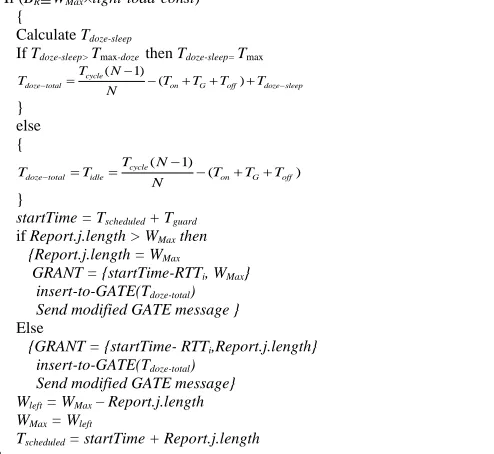
The OLT executes the green DBA (GBA) not only to assign the bandwidth request to each ONU but also to check whether the ONU is in the light load or in the high load traffic to assign stage-one or stage-two to for doze sleep duration in previous sections. The GBA calculates the maximum transmission window WMax based on Eq. (1) that the WMax is assigned based
on the traffic priority (EF, AF and BE). The GBA assigns WMax
to the EF traffic, if the EF report is more than the WMax, the WMax
is assigned to EF; otherwise, the IPACT assigns the EF request and the available remaining bandwidth, Wleft, is assigned to the
AF traffic. If the AF request is greater than W , all remaining
bandwidth is assigned to the AF. If the AF request is less than Wleft the IPACT assigns the AF request and the remaining
bandwidth is assigned to the lowest priority traffic (BE). The pseudo code of the GBA is shown as below.
III. SYSTEM PERFORMANCE
[image:2.612.315.562.245.472.2]The performance of the proposed green dynamical bandwidth allocation (GBA) scheme is compared with the IPACT [16,17,18] in terms of mean packet delay, packet loss, and power utilization, the system model is set up in the OPNET simulator with one OLT and 32 ONUs with uniform traffic environment. The efficient data rate of upstream/downstream direction is 1Gbps. The ONU buffer size is 10Mb. The distance from ONU to OLT is uniform from 10 to 20km. The self-similarity and long-range dependence (LRD) are chosen as the network traffic model for assured-forwarding (AF) and best-effort (BE). High-priority traffic, expedited-forwarding (EF) traffic, is modeled using the Poisson distribution with a fixed packet size (70 bytes), and the high burst AF and BE traffics with a Hurst parameter of 0.7. The packet size is Green DBA (GBA)
RN = 1Gbps
Tscheduled = time for which the upstream channel has been scheduled
RTTi= round-trip time of the ith ONU; i {1,…,N}
Tguard= the guard band interval (constant)
Tcycle=Current cycle time
Tdoze-cycle=Doze cycle time
TG=Doze guard time
Tdoze-cycle=Doze sleep duration
Tdoze-total=Total doze sleep duration
Tidle=ONU transmitter idle time in the current cycle
Ton=Time needed to turn on transmitter
Toff=Time needed to turn off transmitter
WMax= maximum transmission timeslots of ONUi
Report.j.length = j packets (bits) at the ONUi buffer; j∈ {EF,AF,BE}
Wleft = the remaining bandwidth
For every received Report.j.length of ONUi, where j∈{EF,AF,BE}, i∈{1,…,N}
do {
BR = Report.j.length of ONUi, where j∈ {EF,AF,BE}
If (BR≦WMax×light-load-const)
{
Calculate Tdoze-sleep
If Tdoze-sleep> Tmax-doze then Tdoze-sleep= Tmax ( 1)
( )
cycle
doze total on G off doze sleep
T N
T T T T T
N } else { ( 1) ( ) cycle
doze total idle on G off T N
T T T T T
N
}
startTime = Tscheduled + Tguard
if Report.j.length > WMax then
{Report.j.length = WMax
GRANT = {startTime-RTTi, WMax}
insert-to-GATE(Tdoze-total)
Send modified GATE message } Else
{GRANT = {startTime- RTTi,Report.j.length}
insert-to-GATE(Tdoze-total)
Send modified GATE message} Wleft = WMax – Report.j.length
WMax = Wleft
Tscheduled = startTime + Report.j.length
uniformly distributed between 64 and 1518 bytes. The maximum transmission cycle time is 1.5ms. The power consumptions of active mode and doze mode are 3.85W and 1.7W. The overhead time from active to doze mode doze mode is 0.125ms and the overhead time from doze to active mode doze mode is 760ns. The simulation parameters are shown in TABLE I.
Four significant scenarios are designed and analyzed for various EF service, AF service, and BE service proportions to show the effectiveness of the high-priority traffic management. TABLE II shows the traffic proportions in different scenarios. A. Mean Packet Delay
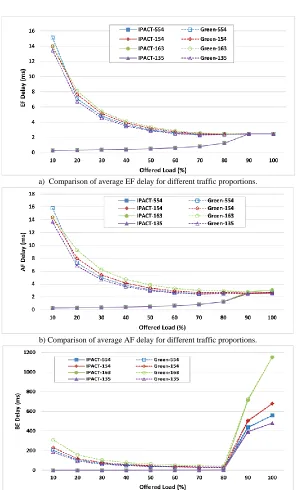
Figure 2 shows the mean packet delay versus the offered load in different scenarios which includes the queuing delay, the polling delay and granting delay. The delay from the beginning of the time-slot until the beginning of frame transmission is queue delay; the polling delay is the time between packet arrival, and the next request sent by the ONU; and the granting delay is the time interval from an ONU’s request for the transmission window until the beginning of time-slot the frame is transmitted.
Figure 2(a) and Figure 2(b) show the packet delay comparison of EF and AF traffics for the GBA and IPACT in different scenarios, respectively. The simulation results show that the packet delays of IPACT are lower than the GBA for the traffic load is below 90%, and the EF delay of the GBA reaches to minimum value and same as the original IPACT when the traffic load is over 90%. The reason is that in the light load traffic, the ONUs remain in the doze mode for longer time accordingly the queuing delay will be increased, and in the high load traffic, the Just In Time scheme is used for energy saving. It is interesting to notice that the Scenario4 (135) outperforms the other three scenarios for EF and AF in the GBA scheme because by increasing the EF traffic ratio the queuing delay and
the polling delay are decreased. Figure 2(c) depicts the BE delay versus the offered load in different scenarios. The BE delay of the GBA is higher than the Original IPACT in the traffic load below 80%. However, the BE delays are the same and increased sharply for both GBA and IPACT when the traffic load is more than 80% due to the DBA cycle time reaching to the maximum value. The reason is that most of the granted time-slot is spent to upload high-priority traffic and BE traffic must be queued.
B. Packet Loss
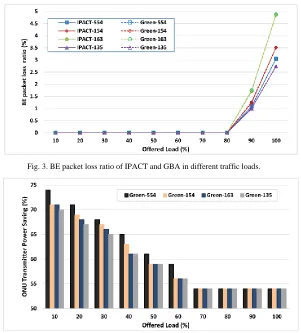
Figure 3 depicts the packet loss versus the offered load in different scenarios. The packet losses for the high-priority traffics (i.e. EF and AF) of the GBA and IPAC are zero in all scenarios. The BE packet losses of IPACT and GBA are all zero under the 80% traffic load in all scenarios, and the BE packet losses of the GBA and IPACT are almost the same in all scenarios when the traffic load is more than 80%. It is noticed that when the ratio of the high priority traffic (summation of EF an AF) increases the BE packet loss is increased because the GBA has to satisfy these traffic first and grants to the BE if still remains available bandwidth.
C. Transmitter Power saving improvement
Figure 4 shows the transmitter power saving versus the offered load in the different scenarios. The transceiver power saving has a decreasing trend from the light load to high load. When the traffic load is increasing, the doze time for ONUs decreases thus the power saving also decreases. When the EF traffic ratio increases, the power-saving is decreased. The energy-saving can be achieved 74% in the high load traffic, and 54% in the high load traffic, respectively.
IV. CONCLUSION
In this paper, we have proposed a two-stage energy-saving mechanism for doze mode to prolong the doze duration when it is idle, especially for the traffic load is light. The main factors to calculate doze duration is based on the current ONU queue state, incoming traffic ratio and the ONU idle time. The objective of this mechanism puts ONU in the doze mode for longer time with acceptable QoS metrics. The Tmax-doze is the maximum
doze duration parameter which setting overlong value decreases the QoS, and short doze duration decreases the ONU power-saving. Moreover, the GBA is designed to determine the doze mode, assign bandwidth efficiently and grant the bandwidth and the doze duration to the ONUs. Simulation results show that the proposed GBA can significantly reduce transmitter power consumption with acceptable QoS metrics. The power saving of the GBA increases 74% and 54% when traffic load is from the light load to the heavy load, respectively. For future work, we will try to optimize the doze duration parameters such as light-load-const, Tmax-doze and queues
threshold to maximize power saving without sacrificing QoE/QoS performance.
TABLE I. SIMULATION PARAMETERS
Parameters Value
Number of ONUs (N) 32
Up/Down link capacity (RN) 1Gbps
OLT-ONU distance 10-20km Overhead time from active to doze mode (Toff) 0.125ms
Overhead time from doze to active mode (Ton) 760s
ONU active mode power consumption 3.85W ONU doze mode power consumption 1.7W
ONU buffer size 10Mb
Maximum transmission cycle time (TMax-Cycle) 1.5ms
DBA Guard time (Tguard) 5s
Doze guard time(TG) 2s
DBA Computation time 10s Control message length 64byte
light-load-const 0.7
Tmax-doze 15ms
TABLE II.
Doze mode (1.7 W) Active mode
(3.85 W)
760 ns
[image:4.612.158.454.198.688.2]0.125 ms
Fig. 1. ONU state transition diagram.
a) Comparison of average EF delay for different traffic proportions.
b) Comparison of average AF delay for different traffic proportions.
Fig. 3. BE packet loss ratio of IPACT and GBA in different traffic loads.
Fig. 4. Energy saving of GBA in different traffic loads.
REFERENCES
[1] M. Pickavet, W. Vereecken, S. Demeyer, P. Audenaert, B. Vermeulen, C. Develder, D. Colle, B. Dhoedt and P. Demeester, “Worldwide energy needs for ICT: The rise of power-aware networking,” in Conf. Advanced Networks and Telecommunication Systems, pp. 1-3, Dec. 2008. [2] S.H.S. Newas, A. Cuevas, G.M. Lee, N, Crespi and J.K. Choy,
“Improving energy saving in time-division multiplexing passive optical networks,” IEEE Internet Computing, vol. 17, no.1, pp. 23-31, 2013. [3] J. Zhang, M.T. Hosseinabadi, N. Ansari, “Standards-compliant EPON
sleep control for energy efficiency: design and analysis,” IEEE/OSA Journal of Optical Communications and Networking, vol. 5, no. 7, pp. 677-685, May 2013.
[4] M. Mahloo, J. Chen and L. Wosinska, “PON versus AON: which is the best solution to offload core network by peer-to-peer traffic localization,” Optical Switching and Networking, vol. 15, pp. 1-9, Jan. 2015. [5] D. Suvakovic, H. Chow, N.P. Anthapadmanabhan, D.T.v. Veen, A.J.v.
Wijngararden, T. Ayhan, C.v. Prate, G. Torf, X. Yin and P. Vetter, “A low-energy rate-adaptive bit-interleaved passive optical network,” IEEE Journal on Selected Areas in Communication, vol. 32. no. 8, pp. 1552-1565, Aug. 2014.
[6] A. Dixit, B. Lannoo, D. Colle, M. Pickavet and P. Demeester, “Energy efficiency dynamic bandwidth allocation for Ethernet passive optical networks: overview, challenges, and solutions,” Optical Switching and Networking, vol. 18, part 2, pp. 169-179, Nov. 2015.
[7] “GPON power conservation,” ITU-T Rec. G. Sup. 45, 2009.
[8] L. Shi, B. Mukherjee and S.S. Lee, “Energy-efficient PON with sleep-mode ONU: progress, challenges, and solutions,” IEEE Network, vol. 26, issue 2, pp. 36-41, 2012.
[9] J. Lie, K.L. Lee, C.A. Chan, N.P. Anthapadmanabhan, N. Dinh and P. Vetter, “Dynamic power management at the access node and customer premises in point-to-point and time-division optical access,” IEEE Journal on Selected Areas in Communication, vol. 32, no.8, pp. 1757-1584, Aug. 2014.
[10] S.W. Wong, L. Valcanrenshi, S.H. Yen, D.R. Campelo, S. Yamashita, and L. Kazovsky, “Sleep mode for energy saving PONs: advantages and drawbacks,” in Proc. IEEE GLOBECOM Workshops, Honolulu, HI, USA, Dec. 2009, pp. 1-6.
[11] B. Skubic and D.H. Ericsson, “Evaluation of ONU power saving modes for gigabit capable passive optical networks,” IEEE Network, vol. 25, issue 2, pp. 20-24, Feb. 2011.
[12] L. Shi, B. Mukherjee and S.S. Lee, “Energy-efficient PON with sleep-mode ONU: progress, challenges, and solutions,” IEEE Network, vol. 26, issue 2, pp. 36-41, 2012.
[13] S. Herreria-Alonso, M. Rodriguez-Perez, M. Fernandez-Veiga and Candido Lopez-Garzia, “On the use of the doze mode to reduce power consumption in EPON systems,” IEEE/OSA Journal of Lightwave Technology, vol. 32, issue 2, pp. 285-292, Jan. 15 2014.
[14] S. Herrer´ıa-Alonso, M. Rodr´ıguez-P´erez, M. Fern´andez-Veiga, and C. L´opez-Garc´ıa, “Bounded energy consumption with dynamic packet coalescing,” in 17th European Conference on Networks and Optical
Communications, Jun. 2012, pp. 1-5.
[15] A.R. Dhaini, P.H. Ho and G. Shen, “Toward green next-generation passive optical networks,” IEEE Communications Magazine, vol. 49, issue 11, pp. 94-101, Nov. 2011.
[16] G. Kramer, B. Mukherjee and G. Pesavento, “Interleaved polling with adaptive cycle time (IPACT): a dynamic bandwidth distribution scheme in an optical access network,” Photonic Network Communications, vol. 4, issue 1, pp. 89-107, Jan. 2002.
[17] A. Nikoukar, I.S. Hwang, C.J. Wang, M.S. Ab-Rahman and A.T. Liem, “A SIEPON based Transmitter Sleep Mode Energy-Efficient Mechanism in EPON”, Optical Fiber Technology, vol. 23, pp. 78-89, June 2015. [18] A. Nikoukar, I.S. Hwang, A.T. Liem and C.J. Wang, “QoS-Aware