FURTHER EXPERIENCES IN CDIO IMPLEMENTATION
K. Kelly, G. Lyons, G. Bennett, E. Killen
Department of Mechanical and Manufacturing Engineering, School of Engineering, Trinity College Dublin, Dublin 2. Ireland ABSTRACT
The CDIO (Conceive, Design, Implement and Operate) philosophy has become an increasingly influential engineering education paradigm championed by a range of leading engineering educational institutes worldwide. A previous paper by the authors [1] reported on first experiences in introducing a number of CDIO initiatives into an engineering undergraduate program. This paper explores the success of these initiatives a year later, at which stage the influence of the changes can be evaluated through (hopefully increased!) student aptitude and interest. Follow-on initiatives in a number of areas are also discussed.
KEYWORDS: Education, Design, CDIO, Systematic Design Techniques, Redesign
1. INTRODUCTION
In early 2000 a group of four universities applied to the Knut and Alice Wallenberg Foundation of Sweden to fund a bold venture that would reshape engineering education in the USA and Europe. This new model, called CDIO (Conceive-Design-Implement-Operate) [2] was to remove the failures previously described and provide future generations of engineers with the knowledge, skills and attitudes required to assume leadership roles in the twenty first century. Since 2000 CDIO membership has spread across all continents with some 30 participating institutions. The stated goals of the CDIO initiative are to develop:
• a deep working knowledge of technical fundamentals.
• a refined ability to discover knowledge, solve problems, think about systems, and master other personal and professional attributes.
• an advanced ability to communicate and work in multidisciplinary teams.
• skills to conceive, design, implement, & operate systems in an enterprise & societal context.
The CDIO belief is that graduating engineers should appreciate engineering processes, be able to contribute to the development of engineering products, and to do so while working in engineering organizations. The additional implicit expectation is that, as university graduates & young adults, engineering graduates should be developing as whole, mature, and thoughtful individuals. Thus CDIO has the same goals as ABET [3] (the American organisation; Accreditation Board for Engineering and Technology) and Engineers Ireland [4] and so the publications of all three give much guidance on the methods whereby Irish teaching institutions may achieve the improvements to engineering education required for EI for our student base.
2. PREVIOUS INITIATIVES
2.1 Review of Work Done
A previous paper [1] by the authors reported on new initiatives introduced in this area. They are briefly summarised below:
from teamwork to fostering a class spirit, to exploring the students understanding of engineering, manufacturing and design, to presentation and communication skills. The exercise culminated in the students making a series of oral and written presentations outlining their ideas on the design and manufacture of some everyday items. Feedback from members of staff was given, both on the communication and the technical aspects.
First Year Laboratory Program – A new program was introduced using Lego Mindstorms ™ as a teaching tool. Students, in small groups, engaged in three two-part laboratories, culminating in the design, implementation and operation of hardware and software to measure the surface area and volume of a large box. Each lab consists of a first part where the concepts are introduced and the students are encouraged to discuss ideas and brainstorm various plans to achieve the overall laboratory goal. They are given feedback as and when they request it, before completing the implementation/operation phase of the laboratory a week later. Implicitly and explicitly they encounter the concepts of range, sensitivity, accuracy, repeatability of sensors as well as basic data handling, error analysis and report writing.
Second Year Design Exercises – After an exposure to the formalism of engineering drawing (both manual & CAD) the students begin a period of study in the techniques of engineering design. To facilitate this there are some formal lectures interspersed with classroom exercises in aspects of design, peer-to-peer discussions and within class ‘mind games’ in design. These last two aspects are liked by the students as they encourage informal question and answer sessions during which much is learned. Some of the classroom exercises are scored and this gives the student an understanding of how well they are progressing in the topic. At a formal level two very different major design exercises are undertaken by the second year students. In the 1st exercise the students are asked to design the manufacturing processes for a specific product. The student group is split into teams of four members each with a team ‘leader’. Teams use brainstorming, group discussion and various research methods to find solutions and select the optimal process. This exercise encourages them to understand the indissoluble link between an artefact, its design, its materials of construction, and its manufacture. Oral presentations are given by the teams and each team produces a final written report on their work. The design of some device using
systematic design techniques,[5] forms the basis of the second exercise. Here the student is asked to produce three ‘concept variants’ of the solution, then to grade them and select the ‘best’ variant. The selected variant is then subjected to the process of embodiment design. A formal design portfolio and report is submitted by each student. Both the foregoing projects are marked and form the principal element of marking for the topic.
2.2 Assessment of Success
Many of the goals from the initiatives reported on above are ‘soft’ and therefore difficult to assess quantitatively, especially with a small sample of students However student feedback via questionnaires was overwhelmingly positive, which at least provides some encouragement! A close examination of the results indicate that students were most positive about the increased enjoyment they experienced and most sceptical (although still neutral/marginally positive at worst) about the amount they had learnt. It is somewhat moot as to whether students perceive a negative correlation between the two – i.e. something which is fun cannot be beneficial and vice versa.
next year, at which stage any increased learning benefits from the programme last year should be in evidence. Both effects are analysed in the sections below.
3. FOLLOW-ON WORK
3.1 B.Sc. Design Programme
The whole ethos of the programme is to foster in the student that most important aspect of thought – divergent thinking, and to harness this within the constraints of engineering science.
Second Year Design; Excluding the requirements in learning for the graphics module of the second year course, the defined learning outcomes are that the student should understand and be able to use techniques for;
Group based thought generation processes.
Specification processes
Conceptual design processes
Embodiment design
Costing
Communication of their thoughts on design and manufacturing processes.
Whilst much of this was being achieved it was felt that students did not fully appreciate some of the realities of design. The inescapable, and at times most annoying, connection between design, materials of construction, and manufacturing processes was still not being brought sufficiently to their attention. With this in mind, in this academic year, a further exercise in design was introduced. This required the student to design the manufacturing process/es for a product on the basis of a given specification. For the assignment the class was split into teams of four, each with a team leader. The teams used brainstorming, individual research and argument to arrive at an answer. Students learned to research and to prepare their contributions such that they could put forward a coherent and scientifically/technically relevant way of solving the problem. In final debate each team had resolve the problem in a way that met the specification and complied with, costs, product numbers, and tolerances. Each team made an oral presentation of their work to an examining ‘board’ of academics and a final written report was completed. The assignment was enjoyed by the students (see later) and it is hoped that it will predispose them well to the elements of the ‘Redesign’ module of the third year course, see reference [1].
Third Year Design: The third year course has been reported on in [1]. Because the course was so well received by the 2006/7 student cohort little change was made to its content. However, on foot of anecdotal evidence, the timing of the major exercises was altered. This meant that lecture modules were also shifted. This was well received by the students and the data form a questionnaire goes to reinforce our earlier report [1].
Overall we feel, and have some evidence to support the contention, that the exercises in Introduction to Manufacturing (Year 1) better predispose the student to take on the complexities of design theory during second year. We have hopes that the newly introduced Group Design exercise in second year will have the same positive effect on the student as they tackle their Redesign work in third year. This remains to be assessed.
3.2 B.A.I. Design Programme
initial objectives were to improve basic interpersonal communication skills, presentation skills, and to stress to the students the fact that Engineering Design in Industry is not a pursuit to be executed in isolation but in fact necessitates team activity. As further group exercises were carried out, additional goals were to introduce the students to common Design Process skills such as “Brainstorming” and to demonstrate that as interpersonal groupwork skills are improved, that there is benefit to receiving input from a number of team members, with their differing strengths, over producing a piece of work individually.
The first exercise was carried out on the first day. The class was divided into groups of six students, randomly chosen, from which they would choose a spokesperson. The groups had ten minutes in which to compile two lists, each to answer the questions “For an Engineer what are the Industry Requirements?” and “As an Engineer what are your Responsibilities?”. Once completed, the spokesperson stood up and introduced themselves, their group and their answers. The rest of the class gave them a “High” or “Low” mark, under the following headings, Content, Demeanour (Look/Attitude), Communication, Ethics and Teamwork.
The second exercise was carried out after some introductory lectures explaining a typical formal Design Process followed in industry. These lectures developed the path from a “need” or “opportunity” in the Market Place through to Specification, the various Design stages, Manufacture and back to the Market Place with Field Testing, Service, Customer Training, Reliability analysis etc. The exercise was to, again in their prescribed groups, use Brainstorming techniques to define a Market Brief for a Bicycle Stand and to produce three concept variants.
3.3 B.Sc. Experimental Programme
Minor modifications were made to the first year laboratory exercises. These centred on providing more support/reference documentation for the students to use in between sessions and the formalising of a feedback structure within the laboratories – where the students could present concepts to the demonstrator and receive constructive criticism as to their likely efficacy.
With regard to the second year laboratories, it was decided to replace two of the existing laboratories with new labs based on the use of LEGO mindstorms with LabView software. The goal was to introduce the students to industry standard data acquisition software and methodology, but to bridge the gap between the ‘fun LEGO labs’ that they experienced in first year and ‘real engineering labs’. The primary learning objectives were defined as follows:
Competency in data acquisition and manipulation in a virtual instrument (LabView™), and
An understanding of how dataflow control structures work (‘while’ loops, case structures etc.) in LabView™.
Several concept variants were considered when designing a suitable laboratory. These included:
An obstacle avoider
A line follower
An object retriever
A maze navigator
A map plotter
A speed trap
The students have already been introduced to LEGO Mindstorms through the first year laboratory programme and have been given a day long course in using LabView for data acquisition (at the start of the second year). After introducing the goals of this laboratory programme, the students were given a revision ‘primer’ covering both the use of LabView and the LEGO Mindstorms system. The LabView revision focussed on the NXT toolbox (an add-in from National Instruments allowing direct communication to and from the LEGO NXT brick, while the LEGO revision focussed on the various sensors and their properties and principles of operation. The students are encouraged to consider intermediate (with regard to the final laboratory outcome) goals in this first session, such as matching suitable VI indicators to sensor type – e.g. a touch sensor will require a Boolean indicator, while a light sensor will require a percentage indicator etc. They are encouraged to consider the lessons learnt in first year with regard to the sensor accuracy and range. Having considered matching sensors to appropriate indicators and taking readings, the students are then encouraged to consider the various mathematical operators and comparison functions to enable the signals to be processed and decisions made. After reaching this stage the students are encouraged to combine what they have learnt into concepts for a speed trap, and refine these concepts through demonstrator feedback.
In the second part of the two-part laboratory the students implement the designs they have created in the first part. This involves creation of the VI (they are encouraged to design pseudo-code first), building a simple buggy/vehicle and set-up and connection of the appropriate sensors. The design is then tested, usually requiring several iterations and adjustments, before final results are taken and a report produced.
4. FIRST ASSESSMENT OF NEW INITIATIVES
4.1 B.Sc. Design Programme
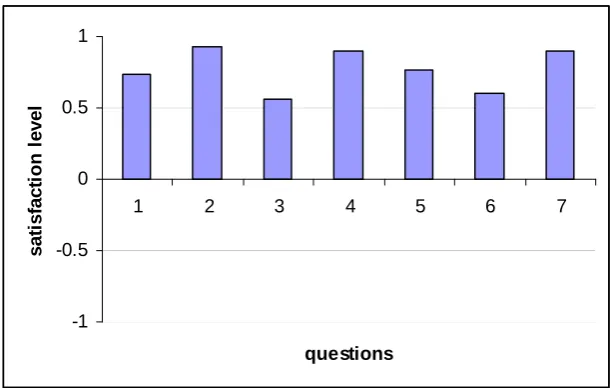
To assess the perceived value of the various modules and exercises (Engineering Graphics, Design, Group Design Exercise, Systematic Design Exercise) the second year students completed a questionnaire. The questionnaire was comprehensive (39 questions, 5 levels of answer) and assessed; appropriateness of subject, lecturers teaching skills, intellectual stimulation, encouragement of independent thought, etc. There are too many topics to expand on here; suffice it to say that the response was very positive and most encouraging. Eighty percent of the students responded however, overall student numbers are small and so we must not get too excited by these data. With regard to the design of a manufacturing process exercise the answers to some seven of the questions asked serves to illustrate the students’ responses.
The topics examined were;
1. I now understand the value & function of the design process (-1; not at all: +1;very well) 2. Working in teams was (-1;of on value: +1; an integral part of the process)
3. Project brought me in contact with a real world problem (-1 not at all: +1; yes & made me think)
4. Project will help me improve my team skills (-1; not at all: +1; yes & made me see value of team work)
5. Oral presentation helped improve communication skills (-1; not at all: +1 yes )
-1 -0.5 0 0.5 1
1 2 3 4 5 6 7
questions
sati
s
fact
io
n
l
[image:6.595.151.457.80.274.2]evel
Figure 1. Responses to ‘Design a Manufacturing Process’ Questionnaire
We see from figure 1, that all responses are significantly positive. In fact no student gave a zero level or negative response to any of the questions posed. Particularly encouraging are the facts that for question 6 no student responded with less than ‘educational’ and for question 7 no answer was less than ‘yes’. Obviously some tweaking of this exercise is needed for the future, but there is no doubt as to its place in the course or to its value.
4.2 B.A.I. Design Programme
The results from these simple trial exercises were positive both from the perspective of student performance as well as their enjoyment. The outputs from the first exercise were multifaceted. With regard to the content, it was clear, that after two years into their degree programme, many students did not know what skills or responsibilities would be required of them in Industry. Compiling and comparing the lists allowed the students, in addition to improving communication skills, to reflect on their chosen career and on the importance of developing their “soft skills” over the rest of the degree programme. With regard to the oral presentation of results, as the class of students gave immediate feedback through the high/low mark along with verbal discussion, there was a stark improvement between the presentations given by the first spokesperson compared with that of the last.
In the second exercise, by specifying their own the “Market Briefs” the students were encouraged to think about the end user and thus narrow down the design. Would the solution be “cheap and cheerful” e.g. galvanised steel of simple manufacturing, or high spec. with “Added Value”, e.g. credit card billing stands, with secure locks to facilitate eco-friendly bike-share schemes? Would their customer be looking for an architectural design piece or an ad-hoc solution to satisfy a student union requirement? Would the customer have limited funds, or, by being aware of government policies on sustainability could a product be designed for a cash rich local city council with a “green budget” to spend. Once the students had set their own constraints, they were given free reign to be innovative in a way that brainstorming allows but also to apply their engineering judgement to reduce their ideas to realisable concept variants.
amount of time for each exercise per lecture slot. The activities took place in a formal tiered lecture theatre. To overcome this groupwork unfriendly environment, the groups of six were formed with three students turning in their seats to face three students behind them. An empty seat/row was left between groups. This re-enforced the grouping and allowed the lecturer, to move amongst the groups to encourage discussion.
4.3 B.Sc. Experimental Programme
In order to assess the laboratories, the students were asked to fill in anonymous questionnaires, the results of which are presented below. A standard five-point scale (+2, being very positive, to -2, being very negative) was used.
4.3.1 First Year Results The questions asked were: (a) Teamwork
(b) How to design an experiment (c) Sources of experimental error (d) Dealing with errors
(e) Usefulness of report templates
(f) Perceived benefit across degree programme
(g) Enjoyment
(h) Intellectually challenging/stimulating (i) Amount learnt
Student Opinions
0 0.2 0.4 0.6 0.8 1 1.2 1.4 1.6 1.8 2
a b c d e f g h i
Question
S
c
o
re (
m
ax 2)
2007
2008
Figure 2. Student Opinion on LEGO Labs
The results from the questionnaires issued in both 2007 and 2008 are shown in figure 2, for comparison (n=40 total). There are no significant changes in student response in most areas, with two exceptions. The two major weaknesses identified in the first efforts in 2007 were with regard to the amount the students felt they learned. A conscious effort was made in 2008 to better contextualise the experiments so that perceived benefits should be more apparent. This appears to have worked!
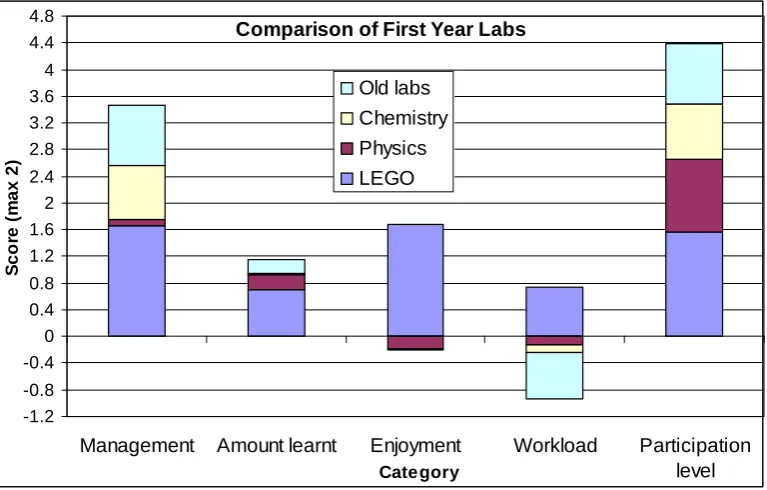
across all labs, while the individual contributions (LEGO, Physics, Chemistry etc) to this average are represented by the proportion of the bar shaded in the relevant colour. Those labs receiving at least one negative mark (all responses being scaled from -2 to +2 as before) have a minimum value of less than zero.
Comparison of First Year Labs
-1.2 -0.8 -0.4 0 0.4 0.8 1.2 1.6 2 2.4 2.8 3.2 3.6 4 4.4 4.8
Management Amount learnt Enjoyment Workload Participation level Category
S
c
o
re (m
a
x
2)
[image:8.595.114.498.151.396.2]Old labs Chemistry Physics LEGO
Figure 3. Comparison with other Labs
An analysis of the results indicates that greater satisfaction is reported for these LEGO labs than for any of the other labs in the programme, with the only positive scores for enjoyment and workload being reported for the LEGO labs. Interestingly, in terms of absolute time commitment, the LEGO labs are on a par with several of the other labs, but there appears to be a negative mental correlation between enjoyment and workload – i.e. students don’t perceive the workload as onerous if they are having fun! This inference was reinforced on a practical level by the difficulty in getting the students to conclude experimenting with the LEGO at the conclusion of each session, so that the demonstrator could go home!
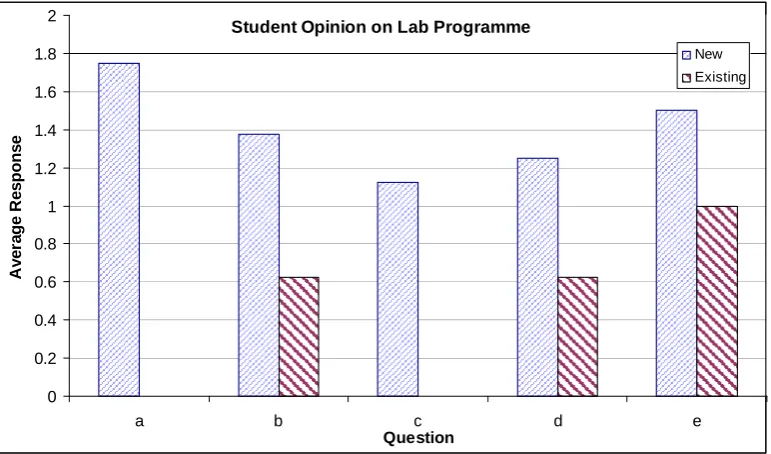
4.3.2 Second Year Results The questions asked were:
a) Do you have an understanding of how data acquisition and control structures work in LabView?
b) How intellectually stimulating/challenging did you find the labs? c) How useful were the labs as an exercise in engineering design? d) How well did you feel the lab programme was managed? e) Did you feel you were able to participate fully in these labs?
Student Opinion on Lab Programme
0 0.2 0.4 0.6 0.8 1 1.2 1.4 1.6 1.8 2
a b c d e
Question
A
v
e
ra
g
e
R
e
s
pons
e
New
[image:9.595.114.500.81.308.2]Existing
Figure 4. Student Opinion on 2nd Year Lab Programme
6. DISCUSSION AND CONCLUSIONS
The work reported in this paper follows directly from the work reported in [1]. The feedback from the students is almost universally positive with respect to the new initiatives introduced, and these initiatives receive very favourable comparison with the students’ experiences in other (non-CDIO) aspects of the programme. Those initiatives now in their second year, i.e. reported on in [1] have received very similar feedback to that reported by the previous cohort of students. Early efforts made to extend some of the exercises into a larger group context were successful and this extension will be continued, and will form the subject of future publications.
7. REFERENCES
[1] Kelly, K., Lyons, C.G., Implementing CDIO: Some Experiences and Results, 24th International Manufacturing Conference, Waterford, 29th-31st August 200, edited by Phelan, J. , 2007
[2] CDIO Standards, available at: http://www.cdio.org/tools/cdio_standards.html, last retrieved April 15th 2008.
[3] ABET, available at: http://www.abet.org/index.shtml, last retrieved April 15th 2008. [4] Engineers Ireland, available at: http://www.iei.ie/, last retrieved April 15th 2008.