Gradient Topologies
Jan Sacha
A thesis submitted to the University of Dublin, Trinity College
in fulllment of the requirements for the degree of
Doctor of Philosophy (Computer Science)
I, the undersigned, declare that this work has not previously been submitted to this or any other
University, and that unless otherwise stated, it is entirely my own work. I agree that Trinity College
Library may lend or copy this thesis upon request.
Jan Sacha
First and foremost, I am very grateful to my supervisors for their mentoring, expertise and support. I would like to thank Jim Dowling, who proposed my research topic and without whom this thesis would never have been written, René Meier, who supervised me in the middle of my studies, and Mads Haahr, who guided me during the dicult time of writing up. A special acknowledgement must be given to Raymond Cunningham, my de facto fourth supervisor, for his great help in my research. I am also grateful to my reviewers, Anthony Rowstron and Ciaran McGoldrick, for their valuable contributions to this work.
Over the course of my studies, I collaborated with a number of colleagues in the Distributed Sys-tems Group (DSG). I would like to especially mention here Bartek Biskupski, Dominik Dahlem, Andy Edmonds, Serena Fritsch, Anthony Harrington, Marcin Karpi«ski, Dave McKitterick, Andronikos Ne-dos, As'ad Salkham, Aline Senart, Kulpreet Singh, Tim Walsh, and Stefan Weber. The DSG has created a phenomenal environment for working, learning and living. I would also like to thank my family, my parents, brother, and ancee Aja, who continuously supported me despite the physical distance between us.
The research described in this thesis was partly funded by the Information Society Technology Programme of the European Union, Microsoft Research Cambridge, and the Irish Council for Science, Engineering and Technology (IRCSET). Their generous support is greatly appreciated.
Jan Sacha
A peer-to-peer system can be dened as an overlay network built by a set of nodes on top of a physical network infrastructure and its operating protocols, such as the Internet. In a peer-to-peer network, each node maintains a limited number of connections with other nodes, called peers, and the graph of peer connections constitutes the overlay's topology. One of the most fundamental properties of existing large-scale peer-to-peer systems is a very high heterogeneity and dynamism of peers participating in the system. Studies show that the distributions of peer characteristics, such as peer session duration, available bandwidth, and storage space, are highly skewed and often heavy-tailed, with small fractions of peers possessing disproportionally large fractions of the total system resources. Such heterogeneity introduces both challenges and opportunities when designing peer-to-peer systems. The use of low-performance or low-stability nodes for maintaining system data or services can easily lead to a poor performance of the entire system, while the placement of critical data and services on the most reliable, high-capacity nodes may improve the overall system stability and performance.
Current state-of-the-art peer-to-peer systems exploit their heterogeneity by introducing two-level hierarchies of peers. High capability peers, so called super-peers, form an independent sub-topology within the existing peer-to-peer network and handle the core system functionality, such as indexing peer data and handling search queries, or relaying trac on behalf of rewalled peers. Ordinary peers connect directly to super-peers and act as their clients. However, many existing systems lack an ecient, decentralised super-peer election algorithm. In many systems, super-peers are selected manually, through an out-of-band mechanism, or are elected using simple local heuristics, which are likely to generate suboptimal super-peer sets. Sophisticated super-peer election algorithms exist, but they are usually highly specic to particular systems and are not easily portable to other application areas.
are located close to each other in terms of overlay hops and form a connected sub-topology. Such high-utility peers can be exploited by higher level applications in a similar fashion to super-peers in traditional two-level hierarchies. Secondly, the information captured in the topology enables a search heuristic, called gradient search, that enables ecient discovery of such high utility peers.
Acknowledgements v
Abstract vi
List of Figures xv
List of Tables xix
Chapter 1 Introduction 1
1.1 Peer-to-Peer Systems . . . 1
1.2 Heterogeneity in Peer-to-Peer Systems . . . 3
1.3 Motivation . . . 6
1.4 This Thesis . . . 8
1.5 Thesis Roadmap . . . 9
Chapter 2 State of the Art 11 2.1 Super-Peer Systems . . . 11
2.1.1 Super-Peer Topologies . . . 12
2.1.2 Super-Peer Election . . . 13
2.2 Simple Approaches to Super-Peer Election . . . 14
2.2.1 OceanStore . . . 14
2.2.2 Brocade . . . 15
2.2.3 Gnutella . . . 16
2.2.4 KaZaA . . . 17
2.2.5 Gnutella 0.6 . . . 17
2.2.6 eDonkey . . . 18
2.2.7 Yang and Garcia-Molina . . . 18
2.2.8 Skype . . . 18
2.2.12 SUPS . . . 21
2.2.13 Schelling Algorithm . . . 21
2.2.14 Discussion . . . 22
2.3 Super-Peer Election in Peer Groups . . . 24
2.3.1 Location-Based Systems . . . 26
2.3.1.1 Crown . . . 27
2.3.1.2 PASS . . . 27
2.3.1.3 PoPCorn . . . 28
2.3.1.4 Wolf and Merz . . . 28
2.3.2 Semantics-Based Systems . . . 29
2.3.2.1 Edutella . . . 30
2.3.2.2 ROSA-P2P . . . 31
2.3.2.3 Qiao et al. . . 32
2.3.3 Grid Systems . . . 33
2.3.3.1 Mastroianni et al. . . 34
2.3.3.2 GLARE . . . 34
2.3.4 Discussion . . . 35
2.4 Super-Peers in Distributed Hash Tables . . . 37
2.4.1 Chord . . . 37
2.4.2 Other DHT Systems . . . 39
2.4.3 SOLE . . . 40
2.4.4 Hierarchical DHT . . . 42
2.4.5 HONet . . . 45
2.4.6 SPChord . . . 46
2.4.7 Structured Superpeers . . . 50
2.4.8 Discussion . . . 51
2.5 Adaptive Super-Peer Election . . . 52
2.5.1 SG-1 . . . 52
2.5.1.1 Newscast . . . 53
2.5.1.2 Client sets . . . 55
2.5.1.3 Discussion . . . 55
2.5.2 SG-2 . . . 58
2.5.2.1 Spherecast . . . 58
2.5.3.1 Workload model . . . 62
2.5.3.2 DLM algorithm . . . 63
2.5.3.3 Discussion . . . 65
2.6 Gradient Topology Approaches . . . 66
2.6.1 Astrolabe . . . 66
2.6.2 Gia . . . 67
2.6.3 Virtual Nodes . . . 67
2.7 Summary . . . 68
Chapter 3 Gradient Topologies 71 3.1 Topology Properties . . . 71
3.1.1 Utility Thresholds . . . 73
3.1.1.1 Top-K Threshold . . . 73
3.1.1.2 Proportional Threshold . . . 74
3.1.1.3 Capacity Threshold . . . 74
3.1.1.4 Clients Threshold . . . 74
3.1.1.5 Load-Based Threshold . . . 75
3.1.1.6 Composite Threshold . . . 75
3.1.2 Super-Peer Utility . . . 75
3.2 Tree-Based Gradient Topologies . . . 76
3.2.1 Peer Degree . . . 77
3.2.2 Topology Diameter . . . 77
3.2.3 Distance to Super-Peer . . . 78
3.3 Sample Applications . . . 79
3.3.1 Storage System . . . 79
3.3.2 Registry Service . . . 81
Chapter 4 Design and Algorithms 83 4.1 Overview . . . 83
4.2 Utility Metrics . . . 84
4.2.1 Network Characteristics . . . 84
4.2.2 Peer Stability . . . 85
4.2.3 Composite Utility . . . 86
4.2.4 Capacity and Load . . . 86
4.3 Neighbour Selection . . . 89
4.3.1 Connection Model . . . 89
4.3.2 Neighbour Subsets . . . 90
4.3.3 Connection Maintenance . . . 91
4.3.4 Random Set . . . 93
4.3.5 Preference-Based Set . . . 94
4.3.5.1 Successor Set . . . 96
4.3.5.2 Predecessor Set . . . 97
4.3.5.3 Tree Set . . . 97
4.4 Aggregation . . . 97
4.4.1 Framework . . . 98
4.4.2 Aggregates . . . 99
4.4.3 Histograms . . . 103
4.4.4 Histogram Interpolation . . . 103
4.4.5 Algorithm . . . 104
4.4.6 Handling Churn . . . 106
4.4.7 Message Loss . . . 107
4.4.8 Increasing Fan-Out . . . 108
4.5 Super-Peer Election . . . 108
4.5.1 Single-Threshold Election . . . 109
4.5.2 Two-Threshold Election . . . 109
4.5.3 Election without Demotion . . . 110
4.5.4 Client-Based Election . . . 112
4.6 Rank Estimation . . . 112
4.6.1 Histogram-Based Method . . . 112
4.6.2 Successor-Based Method . . . 112
4.6.3 Mixed Method . . . 113
4.7 Gradient Search . . . 115
4.7.1 Local Maxima . . . 115
4.8 Bootstrap . . . 116
4.8.1 Bootstrap Nodes . . . 116
5.1.1 Feature Set . . . 120
5.1.2 Analysis . . . 120
5.1.3 Summary . . . 122
5.2 Peer-to-Peer Simulator . . . 122
5.2.1 Existing Simulators . . . 123
5.2.2 Simulation Requirements . . . 125
5.2.3 PlanetLab . . . 126
5.2.4 Simulator Overview . . . 127
5.2.5 Churn Model . . . 127
5.2.6 Network Model . . . 129
5.2.7 Connection Model . . . 130
5.2.8 Scalability . . . 131
5.3 Performance Comparison . . . 132
5.3.1 Compared Systems . . . 132
5.3.2 Comparison Criteria . . . 133
5.3.3 Capacity Maximisation . . . 133
5.3.3.1 Super-Peer Election Error . . . 134
5.3.3.2 Super-Peer Optimality . . . 135
5.3.3.3 Super-Peer Sessions . . . 137
5.3.4 Stability Maximisation . . . 138
5.3.5 Cost . . . 142
5.3.5.1 Peer Degrees . . . 142
5.3.5.2 Messages . . . 144
5.3.6 Summary . . . 148
5.4 Gradient Topology Analysis . . . 149
5.4.1 Degree . . . 149
5.4.2 Parent Ranks . . . 151
5.4.3 Path Lengths . . . 151
5.4.4 Distance to Core . . . 153
5.4.5 Rank Estimation . . . 155
5.4.6 Aggregation . . . 156
5.4.7 Gradient Search . . . 159
5.4.7.1 Overlay Hops . . . 159
5.4.9 Load-Based Election . . . 163
5.4.10 Summary . . . 164
5.5 Simulator Validation . . . 165
5.6 Application Example . . . 167
5.6.1 Traditional DHT Storage System . . . 167
5.6.2 Gradient Topology Storage System . . . 168
5.6.3 Summary . . . 169
Chapter 6 Conclusion 171 6.1 Accomplishments . . . 171
6.2 Future Work . . . 172
6.2.1 Security . . . 173
6.2.2 Multiple Utility Functions . . . 174
6.2.3 Multi-Path Routing . . . 176
6.2.4 Histograms Adaptation . . . 177
6.2.5 Locality-Aware Gradient Topologies . . . 177
6.2.6 Higher-Level Applications . . . 177
2.1 Four variants of super-peer topologies. . . 12
2.2 Schelling algorithm for the generation of hub topologies. . . 22
2.3 Threshold-based super-peer election example. . . 24
2.4 Join procedure at peerpin a group-based system. . . 25
2.5 Sample join scenarios in a group-based system. . . 25
2.6 Sample coordinate space based on two landmark nodes. . . 26
2.7 Sample coordinate space based on term frequencies. . . 29
2.8 Sample coordinate space based on xed-length terms. . . 30
2.9 Sample division of a semantic hierarchy using LBFCA. . . 33
2.10 Sample systems with four peer groups. . . 36
2.11 Sample Chord topology over a 4-bit identier space. . . 38
2.12 Super-peer election in a 4-bit Chord system using SOLE. . . 40
2.13 SOLE super-peer election algorithm. . . 41
2.14 Hierarchical DHT. . . 42
2.15 Super-peer election algorithm in hierarchical DHT systems. . . 44
2.16 Sample SPChord system. . . 46
2.17 SPChord algorithm at peerp. . . 47
2.18 SPChord topology adjustment algorithm at super-peerp. . . 48
2.19 Sample conguration generated by SPChord. . . 48
2.20 Structured Superpeers example. . . 50
2.21 Sample SG-1 super-peer topology. . . 53
2.22 Newscast algorithm at peerpat time t. . . 54
2.23 SG-1 algorithm at peerp. . . 56
2.24 Sample topology generated by SG-2 in a 2-dimensional Euclidean space. . . 59
2.25 SG-2 algorithm. . . 60
3.3 Storage system based on a gradient topology. . . 80
3.4 Registry service built upon a gradient topology. . . 82
4.1 Overview on the main algorithms. . . 84
4.2 Lazy utility evaluation. . . 87
4.3 Neighbour selection framework. . . 91
4.4 Neighbour connect, disconnect, leave and verify procedures. . . 92
4.5 Random set management algorithm. . . 93
4.6 Preference-based neighbour selection algorithm. . . 95
4.7 Aggregation algorithm skeleton. . . 98
4.8 Approximation of the average through aggregation. . . 100
4.9 Approximation of the system size through aggregation. . . 101
4.10 Histogram interpolation. . . 104
4.11 Super-peer election algorithms. . . 109
4.12 Super-peer election using two utility thresholds. . . 110
4.13 Super-peer election with no super-peer demotion. . . 111
4.14 Mixed rank estimation method. . . 114
4.15 Bootstrap process of Peer A. . . 117
5.1 Relative error in the number of elected super-peers. . . 134
5.2 Relative error in the super-peer set capacity. . . 134
5.3 Fraction of optimal super-peers. . . 135
5.4 Fraction of suboptimal super-peers. . . 135
5.5 Average super-peer capacity. . . 136
5.6 Average super-peer session duration. . . 136
5.7 Super-peer leave and demote rates. . . 137
5.8 Super-peer election error. . . 139
5.9 Average super-peer session duration. . . 140
5.10 Super-peer leave and demote rates. . . 141
5.11 Average peer degree. . . 142
5.12 Average peer out-degree. . . 142
5.13 Average peer degree versus peer rank. . . 143
5.14 Average number of messages generated by a peer per time step. . . 145
5.15 Messages generated by a peer per time step as a function of peer rank. . . 145
5.19 Peer degrees in TGTs with dierent branching factors. . . 150
5.20 Peer degree distribution in three variants of gradient topologies. . . 150
5.21 Peer degree distribution in TGTs with dierent utility metrics. . . 151
5.22 Peer degree distribution in TGTs with dierent branching factors. . . 151
5.23 Parent error versus peer rank. . . 152
5.24 Average path lengths in TGT sub-topologies. . . 153
5.25 Average path lengths in tree sub-overlays in TGTs with dierent utility metrics. . . 153
5.26 Distance to the highest-utility peer in TGT sub-topologies. . . 154
5.27 Distance to the highest-utility peer in TGTs with dierent utility metrics. . . 154
5.28 Peer ranks estimated using three dierent methods. . . 155
5.29 Relative estimation error in three rank estimation methods. . . 155
5.30 Rank estimation error with and without churn. . . 156
5.31 Rank estimation error with dierent peer utility metrics. . . 156
5.32 Aggregation error in various system models. . . 157
5.33 Aggregation error versus instance TTL. . . 158
5.34 Aggregation error versus gossip fan-out. . . 158
5.35 Gradient search hop counts in TGTs with variable sizes. . . 159
5.36 Gradient search hop counts in TGTs with dierent branching factors. . . 159
5.37 Message hop counts in TGTs with dierent utility metrics. . . 160
5.38 Message loss rate in TGTs with dierent utility metrics. . . 160
5.39 Average message hop count in GT and TGT. . . 161
5.40 Average message loss rate in GT and TGT. . . 161
5.41 Message loss rate in GT. . . 161
5.42 Total super-peer leave rate as a function of∆. . . 162
5.43 Super-peer leave rate forε= 0.1. . . 162
5.44 Relative error in the number of elected super-peers as a function of∆. . . 163
5.45 Fraction of optimal super-peers as a function of∆. . . 163
5.46 Number of super-peers versus average request probability. . . 164
5.47 Total load and super-peer capacity versus average request probability. . . 164
5.48 Average path lengths in TGT sub-topologies in PeerSim and the custom simulator. . . 166
5.49 Average distance to the highest utility peer in TGT sub-topologies in PeerSim and the custom simulator. . . 166
5.50 Average peer degree versus peer rank in PeerSim and the custom simulator. . . 166
5.53 Average failure rate for gradient search in PeerSim and the custom simulators. . . 167
1.1 Heterogeneity in peer-to-peer systems. . . 5
2.1 Systems covered in the review. . . 14
4.1 Utility metric properties. . . 89
4.2 Aggregation settings. . . 102
5.1 Functional system comparison. . . 120
5.2 Peer-to-peer system simulators. . . 124
5.3 Average round-trip times between machines on the Internet. . . 126
5.4 Median peer session times in P2P systems. . . 127
5.5 Average message loss rate on the Internet. . . 129
Introduction
The purpose of this chapter is to give a general introduction to the area of peer-to-peer system and to the problems discussed in this thesis. It describes briey the history of peer-to-peer systems and discusses the main characteristics found in these systems. It is shown that existing large-scale peer-to-peer systems are highly heterogeneous. This chapter also describes the thesis goals, explains the motivation behind these goals, and outlines the thesis organisation.
1.1 Peer-to-Peer Systems
Peer-to-Peer (P2P) systems belong to the fastest growing applications in the area of distributed com-puting. Within a short number of years, P2P systems gained an extreme popularity, attracted millions of users, entered a number of dierent application areas, and became one of the main contributors of global trac in computer networks.
on some Internet backbone links [57, 87]. Moreover, a number of regional Internet service providers, such as university network operators or national operators, estimate that P2P applications account for approximately 30-70% of total generated trac, and their share is still growing [12, 11, 111, 53].
Freenet [40, 39], which appeared in 1999, was another system that pioneered the development of P2P networks. Freenet was a distributed storage system that allowed for publication, replication, and retrieval of data, while protecting the anonymity of both authors and readers. Along with le sharing and le storage, P2P systems entered a number of other application areas, such as Internet telephony, video conferencing, and multimedia streaming [37, 32, 84, 33, 92, 140, 204]. P2P systems were also used for content distribution [41], for example by the Debian organisation for distributing Linux distribution image les. An extremely large popularity was achieved by Skype [15, 67], an Internet telephony and conferencing application made available in 2003. In 2006, Skype was reported to have 83 million registered users around the world and was used by approximately 3-4 million simultaneous users at any one time [35].
Another initiative that contributed to the development P2P systems was SETI@home [8, 194], a scientic project launched in 1999, whose aim was to exploit unused computing resources, such as CPU idle time, on machines connected to the Internet for running scientic computations, such as analysing radio telescope signals in search of intelligent life outside Earth. Although SETI@home is not generally considered a P2P system, since its nodes communicate with a centralised server rather than with each other, it shares a number of common characteristics with P2P systems, and belongs to a wider class of distributed systems known as Public Resource Computing (PRC) or volunteer computing. Both P2P and PRC systems rely on large and dynamic populations of autonomous nodes that contribute resources to the system.
The SETI@home project received a strong public response, and by 2002, over 3.8 million people reg-istered in the program. This enabled an unprecedented computing power (order of 100 TeraFLOPS), and by 2002 the program performed a total of 1.7e21 oating-point operations, the largest computation on record at that time [8].
As the popularity of P2P grew, P2P systems also became a signicant research area within the greater domain of distributed systems. A number of conferences and scientic journals have been devoted solely to P2P systems and their applications, and a large body of work has been published in the area.
clients, as all nodes participating in the system provide services to each other as peers. Every peer can function as both a client and a server. Some denitions also assume that the responsibilities and capabilities of all peers in a P2P system are identical [162, 44, 176].
Due to the scale and dynamism of a P2P system, it is not feasible for each peer to possess and maintain an accurate model of the entire system. Instead, each peer usually has a knowledge of and communicates with a limited number of other peers, called its neighbours. The connections between neighbouring peers form an overlay network, on top of the physical infrastructure, such as the Internet. This overlay network is used by peers for routing messages and exchanging information. Unlike in wireless networks, where the communication range is limited, the nodes in P2P systems are directly reachable and the overlay structure can be adapted arbitrarily depending of the system needs. The graph of peer connections is called the system topology.
1.2 Heterogeneity in Peer-to-Peer Systems
Contrary to the denitions that assume identical roles and capabilities of all peers in the system, mea-surements show that deployed P2P systems are characterised by a very high diversity of participating peers. The distributions of basic peer characteristics, such as the processing power, storage space, bandwidth, or session duration, are highly skewed and radically dierent from the normal or uniform distributions. In the normal distribution, practically all values are located within several standard deviations from the mean (e.g., 99.7% of all values are within three standard deviations from the mean) and values beyond this range are extremely unlikely. In P2P systems, it has been observed that the characteristics of peers (i.e., storage, bandwidth, etc.) vary by several orders of magnitude between individual peers (see Table 1.1 for a comparison). Furthermore, while a large majority of peers have relatively few resources, small subsets of peers possess signicant fractions of the total system resources. Such distribution is often modelled using the Pareto distribution, also known as the Zipf's law and power law [135, 4], and other heavy-tailed distributions, such as the Weibull and log-normal distributions.
BitTorrent peers stay in the system for longer than one hour after they nished downloading, 3.1% of peers stay on-line for at least 10 hours after downloading, 0.34% of peers stay for more than 100 hours after downloading, and their longest observed session is 83.5 days.
Related to the peer session duration is peer availability, a property dened as the fraction of time a peer spends on-line in the system within a longer period. Measurements indicate that peer availability ranges from almost 0% to 100% between peers, and the availability distribution is highly skewed [173, 18]. The majority of peers have a poor availability, while small subsets of peers stay on-line almost all the time. Furthermore, while some peers frequently join and leave the system over time, other peers connect to the system only once and never come back. For instance, Bhagwan et al. [18] discover that in a two-week trace collected from the Overnet system, on each day, new hosts never seen before in the trace comprise over 20% of the peer population. A number of experiments reveal also diurnal patterns in the peer participation in P2P systems [18, 167, 36, 67, 27].
Bandwidth is another example of an unevenly distributed resource between peers. Although tech-nically bandwidth is a property of a network connection between two machines, in practice the bottle-neck bandwidth between a peer and the rest of the Internet is determined by the peer's direct link to the Internet [97, 167], and hence, is a property of this peer. Saroiu et al. [167] show that the median upstream bottleneck bandwidth of peers in Gnutella is roughly 1Mpbs, while about 22% of peers have a bottleneck bandwidth below 0.1Mbps, 8% of peers have a bottleneck bandwidth above 10Mbps, and the highest observed bandwidth capacities reach 100Mbps. Similarly, Pouwelse et al. [144] show that while the average download speed of a peer in BitTorrent is 240 Kbps, a number of peers download at much higher rates, with a maximum around 4,000 Kbps. A number of other measurements show consistent results [9, 173, 188].
Other peer properties that have been analysed and shown to follow skewed distributions include peers' computing power and available storage space and memory (RAM) [9]. Moreover, it has been shown that a signicant fraction of peers in P2P systems are located behind rewalls or Network Address Translators (NAT) which limit their ability to communicate with other peers [102, 181]. The types of peers' rewalls or NATs add one more dimension to the diversity of peers and hence to the heterogeneity of P2P systems.
Property Measurement Year System Value Range
Session duration
Stutzbach [181] 2005 Gnutella, BitTorrent,Kad 1min 1day Pouwelse [144] 2004 BitTorrent 0.1h 1000h Bustamante [27] 2003 Gnutella 20min 3days Chu [36] 2002 Napster, Gnutella 10min 10,000min Saroiu [167] 2001 Napster, Gnutella 0 720 min
Availability
Kutzner [95] 2004 Overnet 1 192 h*
Bhagwan [18] 2003 Overnet 1 24 h/day
Sen [173] 2001 FastTrack, Gnutella,DirectConnect 0 1440 min/day
Bandwidth
Anderson [9] 2006 SETI@home 20Kbps 8Mbps Pouwelse [144] 2004 BitTorrent 0 4 Mbps Tutschku [188] 2003 eDonkey 100bps 1Mbps Saroiu [167] 2001 Napster, Gnutella 10Kbps 100Mbps Sen [173] 2001 FastTrack, Gnutella,DirectConnect 10KB/s 10MB/s Disk space Anderson [9] 2006 SETI@home 0.1 512 GB
CPU Anderson [9] 2006 SETI@home 0 4,000 Mop/s
Memory Anderson [9] 2006 SETI@home 0.1 512 GB
Shared les
Zhao [208] 2005 Gnutella 10 10,000
Saroiu [167] 2001 Napster, Gnutella 0 10,000
Adar [5] 2000 Gnutella 1 10,000
Downloads Leibowitz [98] 2003 KaZaA 1 1000
(*) within a two-week period
Table 1.1: Heterogeneity in peer-to-peer systems.
more les than all of the other peers combined [167].
The amount of trac generated by individual peers is also extremely variable. Sen et al. [173] analyse network trac in a large Tier 1 Internet provider and show that less than 10% of peer IP addresses contribute around 99% of the total trac volume, and the top 1% of peer addresses transmit 73% of the total trac. A single peer may transmit over 10GB of data during a one day. Similarly, Leibowitz et al. [98] observe that while the majority of KaZaA peers initiate less than 10 downloads during their life time, a number of peers request several hundred les. Such highly active peers, generating relatively large amounts of trac, are often called heavy-hitters.
1.3 Motivation
One of the main challenges in building P2P systems is dealing with the dicult substrate on which these systems are based the heterogeneous and dynamic population of peers discussed in section 1.2. Since the average peer session duration in a P2P system is short, large numbers of peers continuously join and leave the system. This process is often referred to as churn, and the rate of peer arrivals, which is approximately equal to the rate of peer departures in the long run, is also called churn rate [181, 153].
In the presence of high churn, the entries in peers' neighbourhood tables become quickly outdated and may point to peers that no longer participate in the system [93]. This either increases message loss rates, since messages routed using these entries are not delivered, or increases delays in communication, as message failure detection and retransmission is usually slow. In order to keep neighbourhood tables up to date, peers need to frequently exchange messages with their neighbours. However, this increases the overhead related to the overlay network maintenance [113, 100]. For example, it is estimated that in the early versions of Gnutella, keep-alive messages accounted for over 50% of all generated trac [155]. As the churn rate increases, the system also needs to increase the level of data redundancy (e.g., the replication factor) in order to guarantee a certain level of data availability. This again increases the overlay maintenance cost, since more data need to be transferred when peers are joining and leaving the system and more replicas need to be synchronised when updates are issued [17]. Consequently, a number of P2P systems have been shown to perform poorly in the presence of high churn [153].
Furthermore, P2P systems may suer poor performance if they do not address their heterogeneity and do not adapt their structure to the properties of individual peers. The lowest performance peers, with poor processing capacity or insucient network throughput, are likely to become bottlenecks. For example, in August 2000, the entire Gnutella network experienced deteriorated performance, with slow response time and fewer available resources, as it grew to a larger size. This was caused by peers connected by dial-up modems, which became saturated by the increased load and caused network fragmentation. Indirectly, this was caused by Gnutella's lack of ability to control its topology and to adapt it to the capabilities of individual peers [200].
However, the heterogeneity of P2P systems, as well as being a challenge, is also an opportunity that can be exploited. By assigning more responsibilities to stable, high capability peers, a P2P system may improve its overall reliability and performance [167, 110]. The subset containing the most stable peers is less subject to churn, and hence, is more suitable for hosting data or routing trac [181, 27]. Likewise, a set of peers with the largest amount of resources is most suitable for performing resource-intensive tasks, such as handling search queries [34].
called super-peers, act as servers to the other peers. Usually, they form an independent sub-topology within the system overlay and handle the core system functionality. Ordinary peers maintain con-nections to selected super-peers and act as their clients [200]. For example, KaZaA uses super-peers (called supernodes) to index data stored by clients and to handle the search protocol [102]. A similar concept has been employed by Gnutella, where ultrapeers are used for routing search queries [177], and in eDonkey, where eDonkey servers are used by client peers as rendezvous points [188, 75]. In Skype, supernodes are mainly used for relaying messages between peers whose Internet access is re-stricted by a rewall or a Network Address Translator (NAT) [15, 67]. While dierent systems and research documents introduce their own vocabulary for describing peers, they refer in principle to the same general concept of distinguished peers that have higher capabilities and perform more tasks than ordinary peers. For consistency, this thesis uses the term super-peers for describing such distinguished peers, and the terms ordinary peers and clients for the remaining peers. In most contexts, the terms super-peer, ultrapeer, supernode, and superpeer can be treated as synonyms.
There are other approaches to exploiting heterogeneity in P2P systems, in which the system structure is adapted to the properties of participating peers, but no division between super-peers an clients is made. Such approaches include spanning tree and mesh structure optimisations in streaming systems [150, 6, 139, 112, 21, 168], topology and message ow adaptation in Gnutella [110, 34, 27], and the introduction of virtual servers to distributed hash tables [148, 88]. However, these approaches are highly specic to their application areas, and hence are not as universal as the super-peer based approaches.
The design based on super-peers has two main advantages. First, certain system tasks, such as hosting data or services, can be assigned to stable, high-performance peers, i.e., super-peers, in order to improve the overall system reliability and performance. Second, the use of super-peers allows the system to limit the number of participants in certain distributed algorithms, such as search [109, 199, 187, 99], which do not scale well and become too expensive when the system size is large. Thus, the super-peer design can improve the scalability of a P2P system.
However, the use of super-peers introduces a number of new challenges that need to be addressed. In order to elect super-peers, the system needs to decide on how many super-peers are needed and which peers are most appropriate to take the role of super-peers. Furthermore, the system needs to maintain and continuously adjust the super-peer set in response to peer arrivals and departures, changes in the current load and changes in peer capabilities. The system also needs to distribute clients between super-peers and migrate them when super-peers leave or fail. Ideally, the load between super-peers should be balanced to ensure the system's scalability and fault-tolerance. This must all be performed in a dynamic and decentralised manner, with no central coordination or authority.
large-scale P2P systems due to their cost and message overhead. Most of these approaches require strong global consensus between all peers in the system [20] and rely on broadcasting messages between all peers in the system [60, 70]. As such, they can be only applied to small systems (order of thousands of nodes [70]) or smaller subsets of peers within a larger system.
Few existing P2P systems attempt to elect super-peers in an ecient, decentralised way. Many P2P systems rely on manual super-peer selection, through an out-of-band mechanism, or employs simple heuristics, which are likely to generate suboptimal super-peer sets. In some systems, the addresses of super-peers are simply hardcoded into the application. Only few P2P systems attempt to elect optimal super-peers sets according to some metric, but most of these systems are specic to particular applications and their super-peer election mechanisms are not easily portable to other domains.
1.4 This Thesis
This thesis describes a novel approach to dealing with heterogeneity in P2P systems. This approach is based on peer utility metrics and gradient topologies. A utility metric is a function evaluated at each peer locally that reects peer's ability to contribute resources to the system and to provide services to other peers. A utility metric is domain-specic, and captures peer requirements imposed by the higher-level application built on top of the gradient topology.
A gradient topology is a P2P topology where the highest utility peers are clustered in the logical centre of the topology, while peers with lower utility are found at gradually increasing distance from the centre. In contrast to super-peer topologies or hierarchies, where peers are divided into two or more discrete groups, gradient topologies introduce a continuous spectrum of peers, from the highest utility peers in the centre to the lowest utility peers at the periphery.
Gradient topologies have an elementary property that for any given utility threshold, all peers in the system with utility above this threshold are located close to each other, in terms of overlay hops, and form a connected sub-topology within the system overlay. Such high utility peers can be exploited by the system in a similar way as super-peers in traditional two-level hierarchies. Furthermore, high utility peers in gradient topologies can be easily and eciently discovered by lower utility peers using an heuristic called gradient search, which routes messages from outer peers towards the centre of the topology, as in hill climbing and similar techniques based on the notion of gradient.
peers, similar to a hierarchy.
Gradient topologies, together with election algorithms described in this thesis, allow P2P system to select the most suitable peers for performing tasks such as hosting system data, running services, or participating in certain distributed algorithms. By selecting the highest utility peers in the network for these tasks, P2P systems can exploit the heterogeneity in peer populations for improving the overall system stability and performance.
Gradient topologies are domain-independent and can support many dierent classes of P2P appli-cations, such as storage systems, name services, le-sharing appliappli-cations, and semantic registries. As gradient topologies are based on the notion of peer utility rather than peer connection utility, they are not directly applicable to P2P systems that need to adapt their structures to the properties of the underlying low-level network, such as link latencies and link throughputs. Systems that belong to this category, for example multi-media streaming applications, are not addressed in this thesis.
The main contributions of this thesis are: (i) a number of utility metrics for the characterisation of peers in a P2P system, (ii) neighbour selection algorithms that generate and maintain gradient topologies with desired properties, such as a low degree of peers and a low distance between the high-est and the lowhigh-est utility peers, growing logarithmically with the system size, (iii) election algorithms, based on decentralised aggregation techniques and adaptive utility thresholds, which create and man-age close-to-optimal super-peer sets in the gradient topologies and minimise the number of swappings between super-peers and ordinary peers, (iv) routing heuristics that enable high-utility peer discovery in the gradient topologies.
The proposed algorithms have been validated using a custom-built P2P simulator. In a range of experiments, it is shown that gradient topologies, together with aggregation-based election tech-niques, generate better-quality and higher-stability super-peer sets, and have similar maintenance cost, compared with state-of-the-art super-peer systems. Moreover, it is shown that gradient topolo-gies oer more exible and powerful super-peer election mechanisms compared with the existing P2P systems, and thus extend the current state-of-the-art knowledge on super-peers, and more generally, heterogeneity exploitation in P2P systems.
1.5 Thesis Roadmap
The remainder of this thesis is organised as follows.
Chapter 2 reviews a wide range of P2P systems that introduce super-peers, with a particular em-phasis on the super-peer criteria and election mechanisms, highlighting the achievements and limitations of each system.
character-istics.
Chapter 4 presents a collection of utility metrics and algorithms that generate gradient topologies and enable super-peer election and discovery in these topologies.
Chapter 5 evaluates the algorithms introduced in chapter 4 and veries that they construct gies dened in chapter 4. It also compares the functionality and performance of gradient topolo-gies with a number of state-of-the-art super-peer election systems.
State of the Art
This chapter surveys the area of P2P systems that exploit the diversity in peer characteristics. In the large majority of cases, these systems are based on super-peers. For each reviewed system, the super-peer functions, election mechanisms, and topology maintenance algorithms are described, and the advantages and limitations of each proposed approach are discussed. The last section in this survey covers systems that do not use super-peers but are based on alternative principles.
Systems that exploit heterogeneity between peer connections rather than individual peers are not covered in the survey. These systems include in particular streaming and multicasting applications, which optimise dissemination trees, mesh overlays, and other structures based on the latency, band-width, and throughput of connections between peers [150, 6, 139, 112, 21, 168]. Due to the dierent requirements and objectives, these systems cannot be directly compared to the gradient topologies and election strategies described in this thesis.
2.1 Super-Peer Systems
The concept of super-peers has been rst studied by Yang and Garcia-Molina in [200], who divide P2P systems into three categories. In pure P2P systems, such as Freenet and initial versions of Gnutella, all peers have equal roles and responsibilities in all aspects, and the system's functionality is fully decentralised. In hybrid systems, such as Napster, some functionality is handled by a centralised component (e.g., search), but otherwise the system is decentralised (e.g., downloads are performed directly between peers). Super-peer networks, such as KaZaA and early versions of Morpheus, present a cross between pure and hybrid P2P systems.
(a) Classic super-peer
topology (b) Redundant clientconnections (c) Redundant super-peers (d) Embedded super-peer topology
Figure 2.1: Four variants of super-peer topologies.
in pure P2P systems, forming a super-peer overlay that handles the core system functionality, such as search. A super-peer together with the set of its clients is called a cluster, and the cluster size is the number of nodes in the cluster, including the super-peer.
In a sense, the introduction of super-peers enables a trade-o between full decentralisation and partial centralisation in a P2P system. The advantage of super-peer systems over hybrid P2P systems is that they do not have any centralised components. The advantage of super-peer systems over pure P2P systems is that they can exploit the heterogeneity in peers by assigning relevant system functions to high-capability peers and that they reduce the number of participants in expensive algorithms, such as search, by running these algorithms on super-peers only.
2.1.1 Super-Peer Topologies
Super-peer topologies found in the existing P2P systems and literature can be divided into four general types. In classic super-peer topologies, every client is connected to exactly one super-peer, as shown in Figure 2.1(a). These topologies, however, have the drawback that in the case of a super-peer failure, all clients of the failed super-peer become disconnected from the network and isolated.
In order to address this problem, some systems allow clients to maintain connections to multiple super-peers, as shown in 2.1(b). Similarly, for improved system reliability and fault tolerance, Yang and Garcia-Molina [200] introduce ak-redundant super-peer topology, where each super-peer, called a virtual super-peer, is replicated onkphysical peers. Each of thekphysical peers maintains connections to all neighbours of the virtual super-peer (clients and other super-peers) and hosts a full copy of the super-peer data. In this way, a virtual super-peer can tolerate up tok−1peer failures without service disruption. A sample 2-redundant super-peer topology is shown in Figure 2.1(c).
2.1.2 Super-Peer Election
In order to introduce super-peers, a P2P system needs to decide on how many super-peers are desired and which peers are the best candidates for super-peers. These two problems are correlated, as the desired number of super-peers may depend on the properties of available peers. For example, fewer super-peers may be elected if high-capacity candidates are available in the system, while more super-peers may be required if all peers have low capacity.
As the system elects super-peers, it needs to decide on how to connect the super-peers with each other and how to assign clients to super-peers. The connections between super-peers, as well as the super-peer functionality, are usually application-specic. However, the algorithms for super-peer election and client distribution are often application-independent, and given an optimality criteria, can be directly compared with the election algorithms used in gradient topologies. For that reason, a special emphasis is put on the super-peer election mechanisms used in the systems reviewed in this chapter. Systems with the more elaborated super-peer election algorithms are covered in more detail.
The reviewed systems are divided into four loose categories based on the super-peer election mech-anisms. The proposed organisation is not an exhaustive formal taxonomy, and some systems may t in more than one category. The classication is introduced for convenience only.
The rst category, described in section 2.2, comprises systems that do not specify any super-peer election algorithm or have a very simple super-super-peer election approach. This includes manual or centralised super-peer selection, and selection performed locally at each peer based on a static criteria. Many of the rst P2P systems that introduced super-peers belong to this category.
The second class, covered in section 2.3, consists of systems where the population of peers is divided into disjoint groups, and super-peers are elected within each group independently. The groups are usually based on peer properties such as physical location, network proximity, or semantic content.
The third class (section 2.4) contains systems where the super-peer election method is based on a Distributed Hash Table (DHT). The DHTs [179, 149, 162, 46] are a well-known class of P2P systems, with a well-dened functionality (i.e., that of a hash table), which constitutes a coherent subset of P2P systems. Due to the distinctive characteristics of the DHTs, systems that use DHTs for the election of super-peers are considered as a separate class in this review.
Simple Approaches Group-Based DHT-Based Adaptive
2.2.1 OceanStore 2.3.1.1 Crown 2.4.3 SOLE 2.5.1 SG-1
2.2.2 Brocade 2.3.1.2 PASS 2.4.4 Hierarchical DHT 2.5.2 SG-2
2.2.3 Gnutella 2.3.1.3 PoPCorn 2.4.5 HONets 2.5.3 DLM
2.2.4 KaZaA 2.3.1.4 Wolf and Merz 2.4.6 SPChord 2.2.5 Gnutella 0.6 2.3.2.1 Edutella 2.4.7 Mizrak et al. 2.2.6 eDonkey 2.3.2.2 ROSA-P2P
2.2.7 Yang et al. 2.3.2.3 Qiao et al. 2.2.8 Skype 2.3.3.1 Mastroianni et al. 2.2.9 JXTA 2.3.3.2 Glare
2.2.10 LST 2.2.11 SBARC 2.2.11 Zhu et al. 2.2.12 SUPS 2.2.13 Schelling
Table 2.1: Systems covered in the review.
2.2 Simple Approaches to Super-Peer Election
This section reviews P2P systems with the simplest super-peer election and management mechanisms. This category includes systems that do not specify any super-peer election method, or rely on external, out-of-band mechanisms, or leave the super-peer election to higher-level applications; systems where the super-peer sets are hardcoded; systems that use centralised components for handling super-peer management; systems where super-peers are selected manually, either by a global system administrator or by the local user at each peer; systems where super-peers are elected based on xed threshold, such as minimum amount of bandwidth or storage space. A number of research papers reviewed in this section assume that a certain super-peer topology is given and focus on the exploitation of such a topology. The creation and maintenance of the super-peer topology is treated in these papers as a separate research topic. Moreover, a large number of papers specify super-peer election criteria, usually as a combination of peer characteristics such as bandwidth, storage space, or processing power, but do not elaborate on any super-peer election algorithm.
The reviews begin with OceanStore, one of the rst P2P systems that postulated the use of super-peers, and Brocade, a system inspired by OceanStore. Next, the section describes a number of le-sharing systems that rely on super-peers, including KaZaA and Gnutella. Finally, the review covers Skype, an Internet telephony system, and a number of general P2P frameworks and algorithms such as JXTA and the Schelling algorithm.
2.2.1 OceanStore
the world and maintained by multiple independent providers. The nodes in OceanStore are considered unreliable and untrusted, as in P2P systems.
For reliability and performance reasons, data stored in OceanStore is replicated and spread evenly between nodes using a proactive replication algorithm. Every data object has a primary replica, which serialises updates, veries access control credentials, and constructs a dissemination tree between secondary replicas. The primary replicas are hosted on a selected set of nodes, called primary tier or inner ring. These nodes function in OceanStore in a similar way to super-peers in many P2P systems. As stated in [94], the primary tier consists of a small number of replicas located in high-bandwidth, high-connectivity regions of the network. However, OceanStore does not provide any algorithm for the election of nodes in the primary tier. According to the replication protocol specication [62], nodes that participate in the inner ring are selected manually by system operators.
The data placement and discovery in OceanStore is controlled by a variation of the Plaxton algo-rithm [143], which later evolved into the Tapestry [207], one of the rst distributed hash table systems. In this algorithm, every data item, as well as every peer in the system, is assigned a unique identier. Data items are assigned to peers based on their identiers and independently of their physical loca-tions. Peers maintain a system topology and routing tables that enable ecient query routing and data access. Both Tapestry and the original Plaxton algorithm spread data and trac equally between all peers in the system, and treat all peers in the system as if they possessed uniform resources.
2.2.2 Brocade
In order to address peer heterogeneity and to improve routing performance in OceanStore, an extension to Tapestry has been proposed called Brocade [206]. In Brocade, high-capability super-peers, called landmark nodes, are used for routing messages through wide-area networks on behalf of other peers that act as their clients. Landmark nodes maintain a Tapestry network between each other and use the Tapestry routing algorithm. Landmark nodes also maintain lists of their clients.
Brocade elects super-peers from nodes that have signicant processing power, minimal number of IP hops to the wide-area network, and high-bandwidth outgoing links [206]. Amongst the nodes that satisfy these requirements, super-peers are selected by the Internet Service Providers (ISP) in each local network. According to [206], gateways routers or machines close to them are attractive candidates for super-peers. An election algorithm is mentioned, but no details of such an algorithm are provided.
super-peers can intercept messages from all local super-peers. Such a requirement may be a serious obstruction in the system deployment.
The second method relies on the use of predened names in the Domain Name System (DNS) to identify super-peers. Every super-peer, when elected, binds its address to a xed name in the local DNS domain. A client can discover its super-peer by resolving the xed name in its own local DNS domain. If no super-peer is found, the client can become a super-peer itself. However, this approach again requires that at least one super-peer must be created for every local DNS domain in the system, and furthermore, super-peers must be allowed to alter their DNS domains in order to register.
2.2.3 Gnutella
Amongst the rst P2P systems that introduced super-peers were le-sharing applications. In these systems, each peer species a collection of les that it agrees to share with other peers and each peer can download potentially any le made available by other peers in the system. Most le-sharing systems also provide a search facility that allows peers to discover les shared by other peers that satisfy certain search criteria. In Napster, search was provided by a centralised server that kept track of all les hosted by peers in the system. However, most P2P le-sharing systems provide a decentralised search facility. In these systems, a peer performs search by generating a search query. The query is propagated in the overlay, and peers that store les that match the query reply back to the searching peer.
Early le-sharing systems, such as the rst versions of Gnutella, commonly used ooding to prop-agate queries between peers. Other search techniques often used include random walks, Breadth First Search (BFS), Depth First Search (DFS), and iterative deepening [199, 109, 187]. However, these search strategies, sometimes called blind search techniques, have the drawback that they need to dis-seminate search queries potentially to all peers in the system in order to nd matching results. As a consequence, when the size of the system grows and more search queries are generated, an average peer receives more search messages. At certain point, the system does not scale as the search overhead becomes prohibitive.
2.2.4 KaZaA
The scalability problems encountered in Gnutella were solved in KaZaA, the rst P2P le-sharing application that introduced super-peers for handling search [102, 200].
In KaZaA, peers are divided into two classes high-capability super-peers (called supernodes) that handle search, and ordinary peers that act as their clients. Each super-peer maintains an index of all les stored on its clients. The search protocol in KaZaA is called FastTrack. A client performs search by submitting a search query to its super-peer. The super-peers disseminates the query to other super-peers, and as it receives results from other super-peers, it forwards the results to the client.
This design has two advantages over traditional search algorithm for P2P systems. First, it limits the number of peers that participate in the search protocol, as search messages are exchanged between super-peers only. This way, search is quicker, less expensive, and more scalable. Second, it prevents low-capability peers from being overloaded, and further improves search performance, as search is handled by selected, high-capability peers.
However, it is not precisely known how KaZaA elects super-peers, since it is a proprietary appli-cation and its speciappli-cation and source code are not publicly available. Based on reverse engineering, it is believed that peers in KaZaA decide to become super-peers using local knowledge about their own characteristics, such as bandwidth, processing power, unrestricted access to the Internet and availability [102]. Furthermore, becoming a super-peer is voluntary, as each peer has the option to suppress the super-peer functionality.
2.2.5 Gnutella 0.6
As KaZaA became popular and the super-peer approach proved valid, super-peers were also introduced in Gnutella version 0.6 [177]. Like KaZaA, Gnutella 0.6 used super-peers (called ultrapeers) for indexing les stored by clients (called leaves) and for handling search. The introduction of super-peers reduced the load on the lowest-performance super-peers and improves the scalability of the Gnutella network.
Gnutella 0.6 divides leaves into two categories: ultrapeer-capable and ultrapeer-incapable. The distinction is based on minimum performance requirements. The Gnutella 0.6 protocol [177] species that a peer is capable of becoming an ultrapeer if it has a non-rewalled connection to the Internet (allowing incoming TCP connections and UDP packets), minimum of 20 KB/s downstream bandwidth and 10 KB/s upstream bandwidth, an operating system that can handle large numbers of simulta-neously open sockets, such as Linux, Windows 2000/NT/XP and Mac OS/X, and a suciently high uptime.
must connect to an ultrapeer with at least 27 clients (90% of maximum 32). If an ultrapeer-capable leaf connects to an ultrapeer that has fewer than 27 clients, it connects as a leaf; otherwise, it connects an ultrapeer [103].
This way, a new ultrapeer is created when an existing ultrapeer has utilised 90% of its capacity. Generally, ultrapeers are created when new peers are added to the system, and ultrapeers are removed when peers leave the system. Moreover, every Gnutella user can force its peer to act as an ultrapeer or a leaf, disabling the election algorithm.
An interesting feature of the Gnutella 0.6 protocol is that it is backward compatible with earlier versions. For this reason, it is possible for ultrapeers and leaves to coexist in one Gnutella overlay with peers that do not distinguish between super-peers and clients and connect to all of them in the same manner.
2.2.6 eDonkey
eDonkey is another P2P le-sharing application that introduced super-peers, called eDonkey servers, for handling search [188, 75]. eDonkey servers do not share any les and do not initiate downloads, but index les stored on their clients and enable search. Every peer in the eDonkey network is eligible to setup a server, and the decision is made manually by each eDonkey user.
2.2.7 Yang and Garcia-Molina
Yang and Garcia-Molina [200] analyse the performance of super-peer based le-sharing networks and give practical guidelines for designing such networks. They investigate the relationships between the number of super-peers in the network, load on super-peers, and search performance, in order to nd the formula for an optimal system conguration. Their model is specic to le-sharing systems and is not easily generalised to other application areas. Moreover, they do not address the problem of super-peer election and super-peer topology maintenance, as they only analyse static properties of super-peer networks.
2.2.8 Skype
Skype [15, 67] is a P2P telephony system that enables voice communication between users using computers connected through a wide-area network. It uses super-peers (called supernodes) for relaying trac between rewalled peers.
Depending on the type of the calling peer and the callee, four scenarios are possible. If both the caller and the callee are non-rewalled, they can communicate directly. Similarly, if the caller is rewalled but the callee is non-rewalled, the caller can establish a direct connection with the callee. Every rewalled peer, in order to receive phone calls, maintains a permanent connection with a super-peer. If a non-rewalled peer attempts to call a rewalled peer, it rst contacts the super-peer associated with the callee, the super-peer then noties the callee, and the callee initiates a connection to the caller. When the connection has set up, the caller and the callee can communicate directly.
In the last possible scenario, where both the caller and the callee are rewalled, the connection procedure consists of two steps. First, the caller connects to the super-peer of the callee, and syn-chronised by the super-peer, the caller and the callee attempt to establish direct connectivity using STUN [161, 160], a NAT traversal protocol. If this step fails, peers fall back to the TURN protocol [159], where all messages between the caller and the callee are relayed by the super-peer [67].
Although the Skype protocol specication and source-code are not publicly available, it is believed that peers are promoted to super-peers in Skype if they are non-rewalled and have a high amount of bandwidth [67].
2.2.9 JXTA
Juxtapose (JXTA) [65] is a network programming and computing platform, created by Sun Microsys-tems, specically designed to be the foundation for creating P2P systems. JXTA standardises a common set of protocols that allow groups of hosts to establish P2P overlay networks. JXTA can be implemented on top of TCP/IP, HTTP, Bluetooth, HomePNA, and many other transport-layer protocols.
JXTA uses two types of super-peers, called rendezvous peers and relay peers [186].
Rendezvous peers are peers that enable search. They cache so-called advertisement indices, i.e., pointers to client peers that advertise particular resources, and act as directory services. Rendezvous peers also connect to each other and form a semi-structured super-peer network, where each rendezvous peer maintains a loosely-consistent list of all other rendezvous peers in the system. Rendezvous peers forward search queries between each other using a limited-range rendezvous walker algorithm [185].
Relays are used for bridging peers that do not have direct physical connectivity, for example due to rewalls or NAT. Like rendezvous peers, relay peers connect to each other and maintain loosely-consistent lists of all relay peers available in the system. A routing algorithm is used to establish a connection between any two peers in the system through a series of relays.
Furthermore, JXTA uses two sets of peers that act as permanent rendezvous and permanent relays, called seeding rendezvous and seeding relays. The seeding peers are used for bootstrapping peers that join the overlay.
become a rendezvous peer assuming it has the right credentials. Similarly, any peer may become a relay peer assuming it has the right level of credentials and capacity (bandwidth, low churn rate and direct connectivity). It is up to the higher-level application to decide on the minimum capacity and credentials required for rendezvous and relay peers. The JXTA white paper species also that if none of the seeding rendezvous is reachable after a tunable period (5 minutes), the edge [i.e., client] peer will try to become a rendezvous (if it has the right credential) [186]. Seeding rendezvous and seeding relays must be hard-coded in the application.
2.2.10 LST
Kleis et al. [90] propose the use of Lightweight Super-Peer Topologies (LST) for routing in P2P net-works. Their approach is based on Yao-Graphs and the Highways scheme, which allow the construc-tion of Euclidean minimum spanning tree. Such a tree structure can be used for ecient multicasting. LST relies on super-peers, however, Kleis et al. [90] do not specify any super-peer election mechanism. They only mention that a super-peer should have enough resources to serve other peers and should be reliable in the sense that it is not joining and leaving the P2P network frequently. Furthermore, trust and security incentive schemes could be layered in this election process.
2.2.11 SBARC and Zhu et al.
Another example of a P2P system that does not specify any super-peer election algorithm is the Supernode Based Peer-to-Peer File Sharing System (SBARC) [197]. SBARC improves the routing performance in Pastry DHT [162] by routing messages through high-capability super-peers. Xu and Hu describe a routing algorithm and a data caching scheme that take advantage of super-peers, however, they do not elaborate on the super-peer election mechanism. The following paragraph describes their super-peer election criteria.
The basic requirement is a high bandwidth connection. [...] The second criteria is it [i.e., super-peer] must have enough computation power because supernodes need to deal with most system workloads. [...] Third, supernodes can not join/leave system frequently, otherwise its eciency will be greatly reduced. Also it is helpful if supernodes have large amount of storage space. [197]
It is not specied what amount of available bandwidth or computational power or storage space is required for a peers, and no algorithm is given that could calculate such minimum super-peer requirements. Furthermore, it is not explained how to estimate super-peer stability in order to elect super-peers that do not join or leave the system frequently.
on routing strategies and do not describe any super-peer election algorithm. They only specify the following criteria for super-peers: signicant processing power, high bandwidth, high availability, and large amounts of memory and storage space. The details of the super-peer election are not discussed due to space constraints.
2.2.12 SUPS
Scalable Unstructured P2P System (SUPS) [145] is another system that relies on super-peers but does not contain any super-peer election mechanism. The main goal of SUPS is to produce a low-diameter and balanced super-peer topology. A neighbour selection algorithm is shown, inspired by the theory of random graphs, that connects super-peers in such as way that the topology diameter is
Θ(ln N/ln ln N)and the average super-peer degree is minimised, given a system withN super-peers. However, [145] does not address the problem of peer election. It only mentions that super-peers are selected from normal super-peers that have high bandwidth, high computing power, a long resis-tance time, and a low likelihood of failure [...] the detailed choice of super-peer remains as a separate research topic not addressed in this paper.
2.2.13 Schelling Algorithm
Singh and Haahr [176] propose a neighbour selection algorithm, inspired by the Schelling's model, that constructs and maintains hub topologies. A hub topology can be dened as P2P topology, where selected peers, called hubs, are highly connected with each other, while ordinary peers are connected to both hubs and other ordinary peers. Hub topologies are considered more robust than classic super-peer topologies, since in the former, a super-super-peer failure causes an isolation of its clients, while in the latter, ordinary peers are connected to multiple super-peers and can handle hub failures.
The original Schelling's model is a sociological model proposed to explain the existence of segre-gated neighbourhoods in the United States. In this model, each agent denes its satisfaction condition, and changes its neighbourhood whenever the satisfaction condition is not met by performing an adap-tation procedure.
The customised Schelling algorithm that creates hub topologies is shown in Figure 2.2. A hub is satised if it is connected to at least one, but not more than Hmax, other hubs, whereHmax is a
system constant (lines 1-3). If the number of hub neighbours,h, is aboveHmax, the hub drops one
hub connection (lines 5-9). Ifh is zero, the hub connects to another hub discovered by performing a Depth First Search (lines 10-13). An ordinary peer is satised if it is connected to at least one hub (lines 14-17). If this condition is not met, the peer discovers and connects to a hub (lines 23-24). Furthermore, if its number of neighbours is aboveNmax, whereNmax is a system parameter, it
1: satised()
2: h←number of hub neighbours
3: return(0< h < Hmax)
4: adaptation()
5: h←number of hub neighbours
6: if h > Hmax then
7: q←one of hub neighbours
8: disconnectq 9: end if
10: if h= 0then
11: s←search for hubs
12: connectq 13: end if
(a) Hub
14: satised()
15: h←number of hub neighbours
16: return(h >0)
17: adaptation()
18: n←number of neighbours
19: if n > Nmaxthen 20: q←one of neighbours
21: disconnectq 22: end if
23: s←search for hubs
24: connectq
(b) Ordinary Peer
Figure 2.2: Schelling algorithm for the generation of hub topologies.
The algorithm does not determine which peers act as hubs. According to [176], hubs are high-availability and high-capacity peers. They can be be exploited in a similar manner as super-peers in traditional super-peer systems, for example to perform resource-intensive tasks such as maintaining a directory of resources in the network and processing search queries. The main advantage of the Schelling algorithm is its simplicity and robustness. However, it does not address the super-peer election problem.
2.2.14 Discussion
All systems described in this section employ very simple approaches to super-peer election and manage-ment, which are not likely to produce optimal, or close to optimal, system congurations. Centralised approaches introduce reliability and scalability concerns, and are in obvious contradiction with basic principles of P2P systems. Manual super-peer selection is dicult due to the large scale, dynamism, and complexity of P2P systems. A global system administrator is not likely to possess sucient knowledge about the system to select an optimal super-peer set. A local user at each peer is even less likely to obtain such a knowledge about the system.
In many reviewed systems, the super-peer criteria is dened as static threshold, e.g., x >5, such that all peers with property x above the threshold automatically become super-peers and all the remaining peers become clients. This simple approach has the advantage that every peer can make the decision about becoming a super-peer locally, without any communication with other peers. In some cases, the threshold may be directly dened by the requirements of a higher-level application.
However, this approach has a serious drawback. A static threshold does not allow the system to control the number of super-peers in dynamic populations of peers. If peer properties change, the super-peer sets changes accordingly. This can lead to extreme cases, where no super-peers are elected, if all peers fall below the threshold, or where every peer is a super-peer, if all peers are above the threshold.
In many P2P applications, the number of super-peers is critical for the system performance. For example, in le-sharing applications, the number of super-peers must be signicantly smaller than the total number of peers in order to reduce the amount of search trac to an acceptable level. At the same time, the number of super-peers must be large enough to be able to handle the load associated with serving clients. Often, the optimum number of super-peers in the system depends on the current load, e.g., the number of user requests. A static threshold does not allow the system to adapt the size of the super-peer set to the current demand.
Setting a threshold that limits the number of super-peers to a desired level requires a global knowledge of peer characteristics. In many systems, it is assumed that peer properties follow a certain distribution. Such a distribution can be estimated using domain-specic knowledge, or measured experimentally in deployed systems.
However, there are a number of reasons why the distribution of peer characteristics may change. A natural change may occur over time, as new technologies are developed and the Internet evolves. According to the Moore's Law [129], the capabilities of computers, measured as the number of tran-sistors placed on an integrated circuit, is increasing exponentially, doubling approximately every two years. The global network conditions and the general behaviour of users are another two important and unpredictable factors. Peer properties may depend on the time of the day, day of the week, and external events which may generate ash crowds. Peer properties may also change when the system is deployed in a dierent environment, for example in a dierent country, or exposed to a dierent group of users.
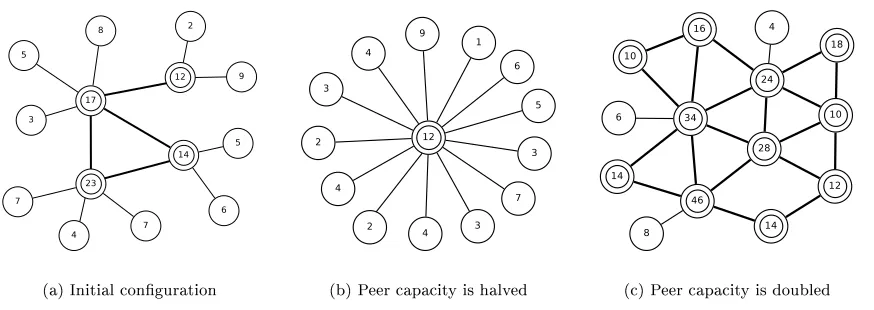
(a) Initial conguration (b) Peer capacity is halved (c) Peer capacity is doubled
Figure 2.3: Threshold-based super-peer election example.
likely to becomes inecient.
To conclude, the systems reviewed in this section clearly show that there are many applications scenarios where the performance and scalability of a P2P network can be signicantly improved by introducing super-peers. Moreover, as the reviewed systems oer relatively simple super-peer election mechanisms, there is a general need for more sophisticated techniques that would allow peers to better control the number of super-peers in the system and to adapt the super-peer set to the changing system conditions. Such approaches to super-peer election are covered in the next three sections.
2.3 Super-Peer Election in Peer Groups
The systems described in this section rely on a common mechanism of peer grouping. In these systems, the population of peers is divided into disjoint groups, based on peer properties such as physical location or data semantics, and a super-peer, or multiple super-peers, are elected within each group independently.
The main advantage of this approach is that the general problem of super-peer election in the system is decomposed into a number of local election subproblems within groups, which are easier to solve since groups are much smaller than the total system size. In the most straight-forward case, the characteristics of all peers in a group are directly compared with the existing super-peer. Furthermore, systems that belong to this class usually impose restrictions on the super-peer topology, such as a certain maximum distance between a super-peer and a client, according to some metric, in order to satisfy application-specic requirements.
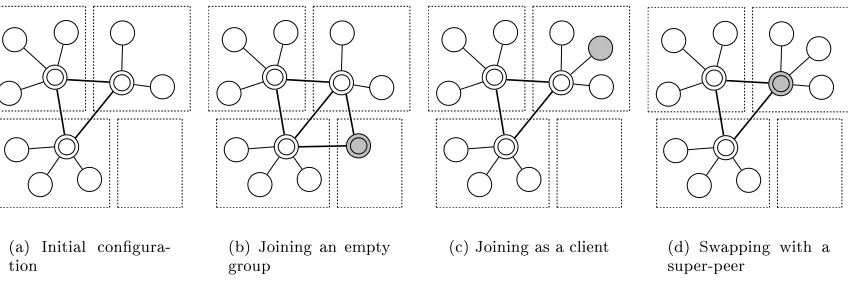
In most approaches, super-peers are created on demand, as peers join the system. The general structure of the join procedure consists of the following steps, as shown in Figure 2.4. First, the joining peer,p, determines the group,g, that it belong to (line 2 in Figure 2.4), and contacts the super-peer,
1: Join():
2: g←group of peerp 3: s←super-peer in groupg 4: if sis nil then
5: become super-peer
6: else
7: if shigher capability than pthen
8: become c