principle of duality and the Hough transform
By A lb er to S. A g u a d o1y, E u g e n i a M o n t ie l2z a n d M a r k S. N ix o n3
1INRIA Rh^one-Alpes, ZIRST, 655 avenue de l’Europe,
38330 Montbonnot Saint-Martin, France
2iMAGIS/GRAVIR-IMAG, BP 35, 38041 Grenoble Cedex 9, France 3Electronics and Computer Science, University of Southampton,
Southampton SO17 1BJ, UK
Received 8 July 1998; revised 19 April 1999; accepted 20 July 1999
This paper shows the relationship between the principle of duality and the Hough transform. We show that the de nition of the Hough transform actually corresponds to an application of the principle of duality. In this interpretation, the general math-ematical concepts of gures and high-dimensional coordinates in projective space are re-expressed in terms of shapes and mappings used for shape extraction in Euclidean space. So far, some works have demonstrated the equivalence between the de nition of several concepts used in pattern matching and the Hough transform. These works have related the Hough transform to particular developments of diverse concepts including template matching, the Radon transform, maximum likelihood estimation and robust statistics. The correspondence between the Hough transform de nition and the principle of duality here developed suggests a more general de nition of the Hough transform with a deeper meaning in pure geometry. This de nition introduces the formalism of projective geometry to shape extraction and analysis and thus the ideas, properties and geometric relationships in the projective space can have an interpretation for the development of pattern matching techniques. We discuss the analogy between the de nition of a gure in geometry and the notion of a shape in the Hough transform, and how this relationship and the generalization of the prin-ciple of duality to high-dimensional spaces, de ned by space coordinates, are related to the extensions of the Hough transform. Parametric forms are used to develop a dual analytic expression of general forms. The intimate relationship between the Hough transform and the principle of duality increases our understanding of the dual nature of pattern matching which can now bene t from established results in projective geometry.
Keywords: duality; Hough transform; computer vision; shap e extraction; pro jective geom etry; pattern matching
y Present address: Department of Electronic and Electrical Engineering, University of Surrey, Guild-ford GU2 5XH, UK.
z Present address: INRIA Rh^one-Alpes, ZIRST, 655 avenue de l’Europe, 38330 Montbonnot Saint-Martin, France.
1. Introduction
In computer vision, perception has traditionally been recognized as a matching process wherein the establishment of corresponding geometric elements (i.e. pix-els, points or curves) between patterns allows us to infer knowledge about a scene and to reason about objects (Julesz 1971; Marr & Nishihara 1978; Pentland 1986). Thereby, the problem of pattern matching has been considered a central topic of research and has motivated the development of many techniques for segmentation, recognition and stereopsis, amongst others. Despite more than 30 years of research, this topic is still a fruitful eld in computer vision and new algorithms, aimed at solving the fundamental problem of matching, continue to be developed.
In the extensive developments in pattern matching, di¬erent techniques have been proposed based on ideas from many scienti c elds. Some approaches have been based on ideas from human vision, while others follow more applied approaches which focus on the quality of the results and computational properties of the algorithms. One technique that has played an important role in the development of pattern matching is the Hough transform (HT). This technique was originally developed to nd bubble tracks rather than shapes in images (Hough 1962) and its potential as a coordinate conversion algorithm capable of line extraction was popularized by Rosenfeld (1969). Since then, the HT has been the subject of extensive research (Illingworth & Kittler 1988; Leavers 1993) which has aimed primarily to increase its generality (the complexity of the shapes that can be extracted) while avoiding the large requirements of time and memory inherent in its implementation.
An important topic of research in the HT has focused on understanding and analysing the nature of its de nition. In this aspect, some works have considered the relationship between the HT and other techniques. Perhaps the most relevant result in this area is the establishment of the equivalence between the HT and template matching (Stockman & Agarwala 1977; Sklansky 1978). This equivalence suggests that the HT can simply be seen as an e¯ cient implementation of a con-volution operation with optimum results in terms of detection error. Accordingly, by recalling the properties of convolution in the frequency domain, the HT can be interpreted as a ltering process. Extensions of the HT, as for example the gen-eralized Hough transform (GHT) (Ballard 1981), have mainly been based on the idea of template matching. The concepts of template matching and convolution have also been used as the base of a formal de nition that suggests that the HT can be related to maximum likelihood estimators (Princenet al. 1992). Other work has shown that the HT is actually a special case of a more general transform devel-oped by Radon in 1917 (Deans 1981). This equivalence provided a formalism that bene ts from previous research in the Radon transform. Other generalizations and extensions of the HT have mainly been based on geometric interpretation, which might suggest that the HT is de ned based on metric properties of shapes such as distances and angles. The inclusion of metric properties in this de nition has pro-vided new ways of using the HT. In a general sense, the HT can also be related to methods of parameter estimation developed in robust statistics (Roth & Levine 1993).
which allows a formal study of the technique and its properties. The main di¯ culty in the second aspect is that the HT seems to have an ambiguous de nition that can be formalized from di¬erent points of view, rather than being de ned by a unique concept. Thus, the HT has been studied as a particular case of other established techniques. Here, we show that in fact the HT implicitly de nes a general concept that can be seen as a convergent point of many techniques used in pattern match-ing. This paper is not aimed to present an algorithm or an application of the HT, but it is aimed to show how the development of the HT has a dual in ideas previ-ously developed in projective geometry. We show that the de nition of the HT in the Euclidean space corresponds to the principle of duality in projective geometry. The correspondence between the de nition of the HT and the principle of duality suggests a more general de nition of the Hough transform with a deeper meaning in pure geometry. This de nition introduces the formalism of projective geometry to shape extraction and analysis and thus the ideas, properties and geometric rela-tionships in the projective space can in®uence the development of pattern matching techniques.
The principle of duality is one of the most important and elegant concepts in geometry. It was rst stated by Gergonne in 1826 and developed in projective geom-etry by Poncelet, Brianchon, Plucker, Grassmann and others during the 18th and 19th centuries (Veblen & Young 1910; Plucker 1865; Tuller 1967). Although the most basic form of this principle, which established certain reciprocity or analogy between the de nition of a point and a line, makes evident the relationship with the HT, the in®uence of the principle of duality in the HT and related techniques has not been recognized. In general, geometric concepts have in®uenced the development of many areas in computer vision. For some concepts such as the use of invariance to recognize three-dimensional models and to derive the geometry of a scene (Mundy & Zisserman 1992), the relationship between geometry and computer vision has been clearly established and some important results developed in computer vision could be traced as the reformulation of established theorems and properties of geometry (Buchanan 1988). However, in other elds of computer vision the relationship with geometry has not been formally established. In particular, in this paper we focus on the relationship between the principle of duality and the de nition of the HT. This relationship not only provides a clearer understanding of the logical foundations of the HT, but also introduces the theorems and analytic methodology of projective geometry to the study of the dual nature of the process of pattern matching. This association extends the generality of the interpretation of the HT.
2. Duality
Geometry studies the properties of interrelated elements or gures in a space. Here, we are interested in the meaning of descriptive relationships and properties when elements are related to points and curves in images. We are particularly interested in the descriptive properties of collinearity and concurrence (Tuller 1967). These properties are de ned by a relationship called incidence, which in its simplest form is applied to a point and a line. When a point and a line are incident, we say that the point lies on the line, or the line contains the point. Likewise, a point and a plane are called incident when a point lies on the plane or the plane contains the point. Collinearity is de ned when points are incident with the same line, while concurrence is de ned when lines are incident with the same points. These relationships can be also established between points in higher dimensions and hyperplanes. The relation-ship between the principle of duality for hyperplanes, and the generalized form of the HT, will be discussed inxx4 and 5.
The relationship of incidence de nes a series of theorems (the propositions of inci-dence) that reveal a certain duality in a plane. This duality requires the assumption that any two lines in a plane can be de ned as concurrent. Thereby, two points always determine a line (i.e. collinear points) and two lines always determine a point (i.e. concurrent lines). As discussed in Baker (1971) the propositions of incidence are not consistent with Euclidean geometry. In the Euclidean space, duality is not com-pletely valid due to the fact that the postulate of parallel lines allows us to de ne two non-concurrent lines. Perhaps this is the reason why duality was not recognized until the development of projective geometry during the 18th and 19th centuries. In this geometry, the concept of parallel lines is removed, so all lines intersect. Parallel lines in the Euclidean plane intersect at in nity in the projective plane. This intersection is named an `ideal’ point and all `ideal’ points form an `ideal’ line. Since all ideal points are included in the projective space, then duality is completely de ned in projective geometry. Although duality is not completely de ned in the Euclidean space, rela-tionships that do not contain ideal points can be represented in the Euclidean space (Baker 1971). Inx2bwe shall show that the reinterpretation of incidence, according to the principle of duality in the Euclidean space, de nes the HT.
(a) The principle of duality
The principle of duality constitutes an important concept for understanding geo-metric relationships in the projective space. In geometry, the main signi cance of this principle is that theorems of points and lines can be proved simultaneously. That is, once a theorem has been proved for points, then a dual theorem for lines can be expressed automatically and vice versa. Here, our main concern centres on showing that the interpretation of the principle of duality has an important role in pattern matching. In order to develop this concept in algebraic terms it is necessary to introduce the analytic geometry of the projective plane. This analytic geometry is developed via homogeneous (or redundant) coordinates. We shall consider homoge-neous coordinates as the result of a transformation or correspondence rule between the Euclidean and projective spaces.
Homogeneous coordinates (Pedoe 1963) provide a mechanism for de ning geomet-ric relationships under projection. In general, these coordinates can be formed by
the three-dimensional projective space will be referred to as Plucker coordinates and they can be mapped into two-dimensional Euclidean space. Coordinates on spaces of higher dimensions will be denoted as Grassmann coordinates. In this section, we limit our study to homogeneous coordinates de ning the points of a three-dimensional projective space. These coordinates de ne the duality between a point and a line.
The central problem of using Euclidean coordinates as an analytical base for pro-jective geometry is that it is not possible to assign coordinates to ideal points. The projective space must include the intersection of two parallel lines as a point, a point which by intuition should be at in nity. Consequently, in order to represent an ana-lytic construction of the projective space, the Euclidean space must be augmented to include points at in nity. One way of augmenting the two-dimensional Euclidean space to avoid the inconsistency in the intersection of two parallel lines is to introduce an extra coordinate. Thus, coordinates in the projective space correspond to triplets of real numbers. In this case, each triplet de nes the homogeneous coordinates of the point. The mapping or correspondence of a point de ned in Euclidean coordinates (x; y) into homogeneous coordinates is de ned as x= (x1; x2; x3) forx1=x,y1=y
andx3= 1. According to this mapping the equation of a line in the Euclidean space
changes from the form U1x+U2y+U3= 0 to the homogeneous form
U1x1+U2x2+U3x3 = 0: (2.1)
In this de nition, since any coordinate proportional to (x1; x2; x3) satis es the
equation of a line, then any triplet of the form (ax1; ax2; ax3), whereais a constant,
can also represent the coordinates of the point (x; y). Thus, two parallel lines in the Euclidean space can be de ned asU1x1+U2x2+U3x3= 0 andU1x1+U2x2+U30x3= 0
forU36=U30. The intersection of these lines (i.e.U1_U2) must satisfy (U3¡ U30)x3= 0,
which implies that points at in nity are of the form (x1; x2;0). The triplet (0;0;0) is
proportional to any triplet (x1; x2; x3) and at the same time it represents a point at
in nity. In order to avoid this ambiguity this point is discarded from the coordinate system. Thus, the projective space consists of all the triplets (x1; x2; x3) for x3 6= 0
and the points at in nity (x1; x2;0). This space provides a model wherein points are
de ned by rays that emanate from the origin. Each point on the ray has coordinates proportional to those of a single Euclidean point. Ideal points are contained in the plane de ned by the coordinates x1 and x2 (i.e. x3 = 0), and the plane for which x3= 1 corresponds to the two-dimensional Euclidean space. A point in the Euclidean
space can be mapped into any of the points that form a ray in the projective space by x1 = ax, x2 = ay, x3 =a, and the points in the space can be mapped back to
the Euclidean space byx=x1=x3 and y=x2=x3.
The introduction of homogeneous coordinates to represent the fundamental ele-ments of geometry reveals a symmetry in the equation of a projective line. This symmetry and the descriptive properties given by the relationship of incidence natu-rally lead to the principle of duality. The form of the projective line in equation (2.1) is symmetric in the sense that any triplet (i.e. (x1; x2; x3)) de nes a point and, at the
same time, a line (i.e. [U1; U2; U3]). That is, equation (2.1) can be seen as the
equa-tion of a point for xed (x1; x2; x3) or as the equation of a line for xed [U1; U2; U3].
Principle 2.1. If we have a plane gure consisting of lines, there exists also a gure consisting of points, such that to any point of the rst gure laying on a line of that gure, there corresponds a line of the second gure passing through a point of this gure, which corresponds to the line of the rst gure.
Principle 2.1 de nes a mapping between the fundamental elements of dual gures. Since these elements are de ned in terms of incidence, then this principle can be interpreted using the properties of collinearity and concurrence. In the next section we discuss the algebraic form of this descriptive part of the principle of duality and its intimate relationship with the HT.
(b) The dual interpretation of a line and the HT
The HT has long been recognized as an original concept that can provide an e¯ cient approach to shape extraction. Nevertheless, as we shall show, its formulation corresponds to geometric concepts that can be de ned according to the principle of duality. Intuitively, we can observe a palpable analogy between the formulation of the HT and the duality of gures de ned in projective geometry. Both the HT and the principle of duality de ne a dual gure by interpreting points as lines and, conversely, lines as points. In this analogy, descriptive properties of collinearity and concurrence can de ne relationships of incidence in the dual interpretation. That is, a set of collinear points in an image form a dual interpretation as a set of concurrent lines, while the intersection point of concurrent lines has a dual interpretation as the line that forms the collinear points in the image. That is, in a dual interpretation a line is de ned as a point of a set of concurrent lines. In the HT, concurrent lines form a peak (i.e. a point) that de nes a point whose dual interpretation corresponds to a line in the image space.
In this analogy between the HT and the principle of duality, the only di¬erence is the generality of the de nitions. While the principle of duality is a general de nition in the projective space, the HT has been developed for shape extraction in the Euclidean space. In the HT, a gure is de ned in the image space and a dual gure is de ned in what has been called the Hough space. The use of these two spaces in the HT results from its algorithmic nature, since dual gures must simultaneously be maintained for processing. Nevertheless, the image space and the Hough space have the same mathematical properties delineated by the Euclidean space. This means that in the HT, shapes and their dual interpretations are de ned in the Euclidean space which seems to be an important di¬erence from the principle of duality that is expressed in the projective space. However, we must recall that the points in the Euclidean space can be mapped into the projective space and vice versa. Thus, it is possible to derive an interpretation of the principle of duality in the Euclidean space as long as we ensure that ideal points are not mapped from the projective space into the Euclidean space (i.e. without contradicting the axiom that establishes that two lines always meet at a point) (Baker 1971). Here, we shall show that the HT is given by this interpretation of the principle of duality.
(a) U (b)
x2
U1
U2 x
[image:7.449.105.348.47.148.2]x1
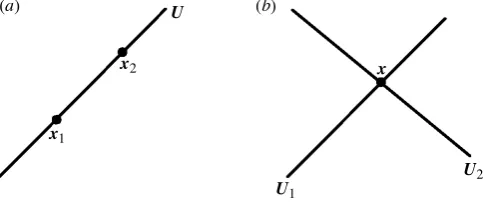
Figure 1. Example of the descriptive relationship de¯ned by the principle of duality: (a) collinear points; (b) concurrent lines.
the dual relationship presented in equation (2.1). Nevertheless, this correspondence is descriptive, which means that the line does not de ne the position of the point and neither does the point de ne the position of the line, but the correspondence only determines the existence of incidences. For example, we can establish the dual of the line U in gure 1a as the point x in gure 1b; however, the position of the point x cannot be determined by the existence of the line U, but it is necessary to consider the descriptive properties given by the concurrence of two linesU1 and
U2 (i.e. by the relationship x = U1 _U2). The duals of the lines U1 and U2 are the collinear points x1 and x2, respectively. The collinearity property of the points x1 and x2 is due to the fact that the lines U1 and U2 de ne a point x that is
dual to the line U. Then, the dual of the linesU1 and U2 must de ne two collinear
points x1 and x2. That is, x =U1_U2 = (U1¤ _U2¤ )¤ = (x1^x2)¤ =U¤ , where _ denotes the meet, ^ denotes the join and the ¤ denotes the dual. This duality between the incidence relationship is a well-known result in projective geometry which, loosely, establishes that concurrence in a gure corresponds to collinearity in its dual. In our notation we have distinguished between points and lines by using lowercase and uppercase; however, mathematically, points and lines are dual and, as such, indistinguishable since points and lines are equally de ned by a triad of coordinates. Thus, for convenience, the notation only speci es whether a point or a line is de ned by the property of collinearity or concurrence.
The point x in gure 1b is de ned as the point of concurrence of the two lines
U1 and U2. If the dual representation of the points x1 = (x1;1; x1;2; x1;3) and x2 = (x2;1; x2;2; x2;3) are the lines U1 = [U1;1; U1;2; U1;3] andU2 = [U2;1; U2;2; U2;3],
respectively, then the relationshipx=U1_U2 is given by the solution of two linear equations. For a point x= (x1; x2; x3) and a line U = [U1; U2; U3], we have
U1;1x1+U1;2x2+U1;3x3= 0; U2;1x1+U2;2x2+U2;3x3 = 0: (2.2)
That is,
x= U1;2 U1;3
U2;2 U2;3 ;
U1;3 U1;1 U2;3 U2;1 ;
U1;1 U1;2
U2;1 U2;2 : (2.3)
We can obtain a dual representation of this point as a line U = (x1^x2) that is
collinear to the points x1 = (x1;1; x1;2; x1;3) and x2 = (x2;1; x2;2; x2;3) by changing
lines by points and points by lines in equation (2.2). That is,
whose solution can be expressed as
U = x1;2 x1;3
x2;2 x2;3 ;
x1;3 x1;1 x2;3 x2;1 ;
x1;1 x1;2
x2;1 x2;2 : (2.5)
Equations (2.3) and (2.5) use the relations of incidence to obtain the coordinates of dual elements of equation (2.1). In pattern matching the HT and related techniques have exploited the dual relationship in equation (2.4) to extract shapes from images. In the HT, if U represents a line in an image, then it can be de ned as the point of concurrence of a set of lines obtained as the dual of collinear points. That is, for a set of image pointsfxjg, the HT de nes the elementU whose points of concurrence correspond to collinear elements in fxjg. Hence, the HT locates a set of lines in images by using the relations of incidence to obtain the coordinates of dual elements. If xi = (xj;1; xj;2; xj;3), then the HT solves for the system of equations of the form
U1xj;1+U2xj;2+U3xj;3 = 0: (2.6)
This system formed by all the pointsfxjgis over-determined. To solve the system we need only two equations. However, in images the setfxjgcontains points due to noise, as well as those from the target shape, so the problem focuses on identifying the best solution for the system of equations. In the HT, the solution is computed by counting the number of times that a lineU is de ned by an equation in the system. That is, the HT searches for the solution that satis es a larger number of equations simultaneously. This strategy is robust and has been demonstrated to have good performance when data is contaminated by noise and/or is occluded. If we consider each line of the form in equation (2.6) for xed xj, then the solution of the system is given by the point Ui, which is a valid solution for the majority of the equations. That is, the HT result is the maximum of the expression
HT(Ui) =
j
D(Ui;xj) (2.7)
for a function
D(Ui;xj) =
1; ifUi;1xj;1+Ui;2xj;2+Ui;3xj;3 = 0;
0; elsewhere: (2.8)
Equation (2.7) provides a computational way of obtaining the solution of equa-tion (2.6) and there exists a direct equivalence between equaequa-tions (2.4) and (2.6). Accordingly, the HT de nition provides a computational approach to obtain the dual elements de ned in projective geometry and what is named the Hough space is actually the dual form of the projective space.
of duality in the projective space to a particular form in the Euclidean space. In general, a parametrization can be de ned by
A1x1+A2x2+A3x3= 0 (2.9)
for a transformation of the form
A1=T1(U1; U2; U3); A2=T2(U1; U2; U3); A3=T3(U1; U2; U3): (2.10)
For example, forA1 =U1=U2,A2= 1 andA3 =U3=U2 and by mapping the point
(x1; x2; x3) into the Euclidean space using the relationshipsx=x1=x3andy=x2=x3
de ned inx2a, we observe that the de nition in equation (2.7) is the same de nition of the Hough transform originally presented in Hough (1962) and Rosenfeld (1969). That is, equation (2.6) becomes
A1x+y+A3= 0: (2.11)
In this de nition, we suppose that points exist at in nity in Euclidean space and these points are obtained whenU2 is zero. Form=¡ A1 andb=¡ A3 this equation
can be written as the general form of the line that is used in the original de nition of the HT (Hough 1962; Rosenfeld 1969). That is,y¡ mx¡ b= 0. Thus equation (2.7) can be rephrased as
HT(m; b) =
j
D(m; b; xj; yj); (2.12)
which corresponds to the de nition of the HT (Princenet al. 1992). Accordingly, the dual point (U1; U2; U3) can be interpreted in the Euclidean space as a point de ned
by the parametersmandb. The lineArelates each dimension of the projective space to the parameters of the general form of the line. Thus, the principle of duality can be interpreted as a mapping between image points and the parameters of a line in such a way that equation (2.6) de nes a set of loci in the parameter space whose intersection or concurrent point de nes the parameters of a line.
Other projections can be used to obtain alternative parametrizations of shapes. These parametrizations have di¬erent properties. For example, the previous para-metrization allows the identi cation of lines in an image with the same slope as collinear points in the dual space (Wahl 1989). The normal parametrization provides a bounded dual space (Duda & Hart 1973) and it provides a symmetric correspon-dence of a gure with itself, thus features in images and dual spaces can easily be related. The normal parametrization is given by
A1 =¡ U1 U2
1 +U22
; A2=¡
U2 U2
1 +U22
; A3= 1: (2.13)
By mapping the point (x1; x2; x3) into the Euclidean space, equation (2.9) becomes
A1x+A2y+ 1 = 0; (2.14)
which corresponds to the normal parametrization cx+dy+ 1 = 0. In this case, c
3. Figures and shapes
(a) Duality of ¯gures and shapes
In the previous discussion, we considered the analytic form of the relationships of incidence in the principle of duality for plane-analytic projective geometry. This allowed us to establish a relationship between the HT and the dual de nition of a line and a point. However, a more general approach, the analysis of images, requires the study of elaborate shapes capable of representing complex world structures. In pattern matching there are two possible ways of representing complex shapes. First, shapes can be de ned as being composed of simple elements and secondly they can be characterized by a more complex equation. In this section we consider the de nition of shapes composed of several elements and its relationship to concepts developed in geometry. The extension of the HT to complex shapes is considered inxx4 and 5.
We can observe an evident relationship between the concept of a shape composed of elements and the concept of a gure developed in projective geometry. However, the properties and studies in both disciplines have as yet been unrelated. The aim of this section is to show the relationship between the concepts of shape and gure. We can relate the concept of shape, used in pattern matching, with the concept of gure used in geometry. Based on this relationship, we can observe that the exten-sions of the HT to polygonal shapes can be related to the de nition of duality of gures in projective geometry. In geometry, a gure is de ned as a set of points, lines and planes in space (Veblen & Young 1910). Since each of these elements has a dual representation, then a whole gure ought to have a dual de nition. Paraphrasing, in a general form the principle of duality establishes an equivalence of gures de ned as a collection of the fundamental geometric elements. That is, for a gureF =fUig
we can de ne the dual of each elementUi by equation (2.1) to obtain another gure f =fxig. Thus, for any gure there exists a corresponding dual gure de ned by the dual of each element that de nes the rst gure. If we consider this general form of duality, then a dual representation of a shape can be obtained by considering that it is composed of a collection of parts. That is, if we relate each part with a geometric element, then the dual of a shape can be de ned as the dual of a gure. If we de ne each straight line forming the sides of a polygon as an element of a shape, then a dual representation can be obtained by considering the dual form of each line. In this way, each side can be mapped into the dual space in a point such that a collection of lines and points de ne the correspondence between a polygon and its dual gure.
(b) One-to-one reciprocity
If a gure is equivalent to a shape, then properties of clusters of elements of gures and shapes must be the same. However, the property of uniqueness seems to be contradictory between the development of the HT and the principle of duality. While a well-known result in projective geometry establishes that the dual of a gure is unique, a well-known result in pattern matching (Rosenfeld & Weiss 1995) shows that the HT of a shape can be non-unique. We discuss the extent to which the one-to-one reciprocity of the principle of duality is congruent with the results derived in the study of the HT.
(a) (b)
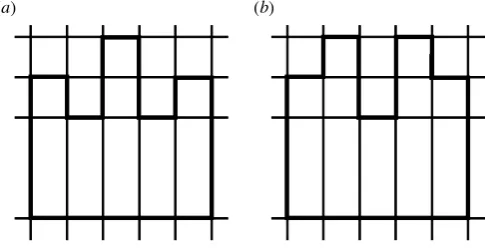
Figure 2. Example of two shapes with the same dual representation.
de nes a unique dual elementU in such a way that U has a unique corresponding element x. In consequence, the correspondence between the collection of elements
F = fUig and f = fxig is one-to-one. That is, every element of a gure F cor-responds to a unique element of f in such a way that every element in f is the correspondent of a unique element of F. This well-known property of dual gures and the fact that the HT de nes the correspondence between gures for lines and points according to the principle of duality, can lead to the assertion that the map-ping obtained by the HT is actually unique. However, research in pattern match-ing has shown that two concave polygons can produce the same cluster pattern in the dual space (Rosenfeld & Weis 1995). This discrepancy would appear to be contradictory to the equivalence between the principle of duality and the HT, but it can be explained by the di¬erence between the interpretation of a gure and a shape.
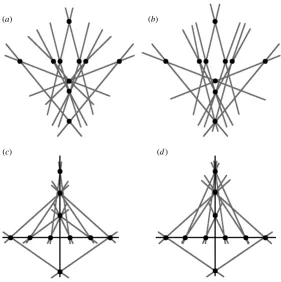
The bold lines in gure 2 show an example of two polygons that have the same arrangement of points in the dual space. In this example a shape is de ned by a collection of lines that delineate the sides of the polygon (non-bold lines in gure 2). We can observe that since both shapes de ne the same lines, then it is evident that the dual gure obtained by applying the dual relationship in equation (2.6) to each line is the same. The dual elements of the lines in gure 2a; b de ne the points in gure 3a; b, respectively. The points in gure 3c; dde ne the dual gure according to the mapping in equation (2.13). It is important to observe that in this example the dual de nition is unique, but the de nition of a gure from a shape is not. Since two di¬erent shapes de ne the same gure, then the mapping produces an ambiguous representation of the polygon. Accordingly, we can argue that the HT, as the principle of duality, de nes a one-to-one mapping between two gures and that the de nition of a polygon as a collection of the lines de ned by its sides does not de ne a unique gure. That is, the de nition of a polygon as a collection of lines is ambiguous and not the mapping de ned by the HT. In more formal terms, we can say that if we de ne two guresF1andF2such that the corresponding dual elements
are equal (i.e.f1=f2), then by the uniqueness property of duality we haveF1=F2.
Thus, if for two di¬erent shapesS1 andS2we de ne the two guresF1=R(S1) and F2=R(S2), whose dual gures aref1=D(F1) and f2 =D(F2), respectively, then if f1=f2 we have R(S1) =R(S2), while the mapping D is unique. This is the case in
(a)
(c)
(b)
[image:12.449.84.366.45.328.2](d)
Figure 3. Dual representation of the shapes in ¯gure 2: (a) slope-intercept parametrization for ¯gure 2a; (b) slope-intercept parametrization for ¯gure 2b; (c) normal parametrization for ¯gure 2a; (d) Normal parametrization for ¯gure 2b.
(a) (b)
(c) +
+
+
+ + ++
+ +
+
++ + + +
+ +
+ +
[image:13.449.68.381.46.383.2]+
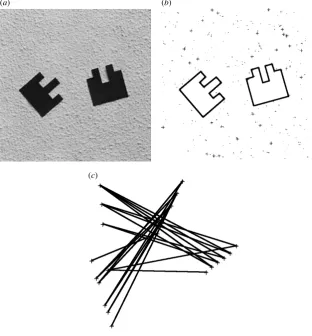
Figure 4. Example of the mapping of dual elements: (a) image; (b) located edges and points; (c) dual space.
collection of edges and corner points obtained by applying local operators (Canny 1983; Harris & Stephens 1988). In this gure, points are indicated by a `+’ symbol to distinguish them from edges. Each element de nes a relationship of the form in equation (2.1) for points and lines. Thus, to obtain the dual representation it is nec-essary to solve for a pair of systems of equations similar to equations (2.2) and (2.4). Figure 4cshows the dual representation of the elements in gure 4b. Each point in gure 4csolves for a large number of equations simultaneously and represents a side of the polygon. We obtained the dual form by eliminating incompatible equations in neighbourhoods that were progressively increased in size. Only compatible solutions were considered in further steps. The points in gure 4cwere obtained by parametriz-ing the solution in the normal form given in equation (2.13). The lines in gure 4c
was de ned. In general, points de ne continuous or discrete curves, and we are inter-ested in identifying a particular arrangement in the primal and dual space. The next two sections consider how points forming curves are mapped in the dual space. This shows the equivalence between the principle of duality and extensions to the HT.
4. Duality in multidimensional projective spaces
(a) Multidimensional coordinates
Research in the HT has extended its de nition to the extraction of shapes repre-sented by quadratic forms such as circles and ellipses (Duda & Hart 1972). In this case the dual form de nes a single point in the dual space. In this section we shall show that these extensions correspond to the principle of duality of geometry for points and lines represented by coordinates with an increased number of dimensions (Grassmann coordinates).
Equation (2.1) establishes the duality between a point and a line for plane analytic projective geometry. In this equation, the parallel postulate is removed by represent-ing points and lines as triplets. To generalize this, it is natural to develop homo-geneous coordinates that remove the parallel postulate for planes or hyperplanes in the Euclidean space. These coordinates are referred to as Grassmann coordinates and represent points and hyperplanes in projective spaces with an arbitrary number of dimensions. For example, four-tuples can represent a point in a four-dimensional projective space. The rst three coordinates are considered to be proportional to the Euclidean space coordinates, while the fourth coordinate de nes the proportionality constant. That is, an ordinary point with Euclidean coordinates pe = (x; y; z) can
be de ned in homogeneous coordinates asph = (x1; x2; x3; x4) forx1=ax,y1=ay, x3 =az and x4 =a. In this case, a point at in nity is distinguished by a value of
zero in the fourth coordinate.
According to this de nition the equation of a plane in the Euclidean space changes from the formU1x+U2y+U3z+U4= 0 to the homogeneous form
U1x1+U2x2+U3x3+U4x4= 0: (4.1)
The symmetry of this equation de nes a dual relationship between a point (x1; x2; x3; x4) and a plane [U1; U2; U3; U4], and it states that a point and a plane can be
described by the same equation. Hence, the terms point and plane are indistinguish-able and we can generalize the principle of duality to de ne a mapping in space coordinates. Thus, by considering the relationships of incidence, we have that the problems of nding the plane through three non-collinear points and nding the intersection of three non-collinear planes are dual. In analytic terms these problems de ne three homogeneous linear equations in four variables (Fishback 1969).
For hyperplanes, equations (2.1) and (4.1) can be generalized to the homogeneous equation
n
k= 1
Ukxk= 0; (4.2)
for the n-tuples (x1; x2; : : : ; xn) and [U1; U2; : : : ; Un]. Since in this generalization
(b) The dual interpretation of a hyperplane and the HT
In the same way that the HT de nes the correspondence between lines and points in the projective plane according to the principle of duality, it is possible to show that the extension of the HT for quadratic equations is a particular form of the generalization of the principle of duality to higher dimensions. The equation of a conic,Ax2+By2+Cxy+Dx+Ey+F = 0, can be expressed in homogeneous form
as
U1x1+U2x2+U3x3+U4x4+U5x5+U6x6= 0; (4.3)
by considering that
x1=ax2; x2 =ay2; x3 =axy; x4=ax; x5 =ay; x6 =a: (4.4)
In an analogous way to the mapping of a point (x; y) on a line into a point in a plane of the projective space by the relationships x1=ax, x2 =ay and x3=a, the
de nitions in equation (4.4) map a point (x; y) in a conic into a point on a hyperplane in the projective space. Thus, all the points that form a conic in the Euclidean plane can be seen as a point or a hyperplane in the six-dimensional projective space.
Equation (4.3) de nes a dual descriptive relationship between a pointx= (x1; x2; : : : ; x6) and the hyperplane U = (U1; U2; : : : ; U6). In order to de ne the positions of
the point and of the hyperplane we can consider the concurrence of ve hyperplanes at one point or the dual de ned by the six coplanar points, that is, by solving simultaneously ve homogeneous linear equations in six variables. If 6k= 1Uj;kxk= 0
is the equation of the jth plane, then a point x is given by
(x1; x2; : : : ; x6) =
U1;2 U1;3 : : : U1;6 U2;2 U2;3 : : : U2;6
..
. ... : : : ...
U6;2 U6;3 : : : U6;6 ;
¡
U1;1 U1;3 : : : U1;6 U2;1 U2;3 : : : U2;6
..
. ... : : : ...
U6;1 U6;3 : : : U6;6 ; : : : ;
U1;1 U1;2 : : : U1;5 U2;1 U2;2 : : : U2;5
..
. ... : : : ...
U6;1 U6;2 : : : U6;5
: (4.5)
The dual solution is given by changing points by hyperplanes and hyperplanes by points. Thus, if 6k= 1Ukxj;k= 0 is the equation of thejth point, then the hyperplane
is given by
[U1; U2; : : : ; U6] =
x1;2 x1;3 : : : x1;6 x2;2 x2;3 : : : x2;6
..
. ... : : : ...
x6;2 x6;3 : : : x6;6 ;
¡
x1;1 x1;3 : : : x1;6 x2;1 x2;3 : : : x2;6
..
. ... : : : ...
x6;1 x6;3 : : : x6;6 ; : : : ;
x1;1 x1;2 : : : x1;5 x2;1 x2;2 : : : x2;5
..
. ... : : : ...
x6;1 x6;2 : : : x6;5
The HT exploits the relationship in equation (4.3) to compute the dual represen-tation of a conic as a point in a hyperplane. A set of image points fxjg de nes a collection of hyperplanes U whose point of concurrence corresponds to the hyper-planes that solve equation (4.3). Thus, the generalization of the HT to conic sections generalizes equation (2.6) to a set of simultaneous equations of the form
U1xj;1+U2xj;2+U3xj;3+U4xj;4+U5xj;5+U6xj;6= 0: (4.7)
As equation (2.6), this equation is over constrained and the HT provides a tech-nique wherein the solution is computed by counting the number of times that a point is de ned by an equation in the system. To de ne the HT according to equa-tion (2.7), it su¯ ces to rewrite equaequa-tion (2.8) in terms of equaequa-tion (4.6) instead of equation (2.6). That is,
D(Ui;xj) =
1; if
6
k= 1
Ui;kxj;k = 0;
0; elsewhere:
(4.8)
Thus, the extension of the HT for conic sections simply de nes a way of computing the correspondence between dual gures in projective spaces of dimension six (or ve in the projection into the Euclidean space). The dual point U corresponds to the parameters that de ne a conic in the Euclidean space, which are de ned by the concurrent relationship of the principle of duality.
5. General forms
(a) Duality of parametric forms
In a further generalization of the relationship between the principle of duality and the HT we can consider forms which are more general than quadratics. In pattern matching, the interest in this generalization has been motivated by the complex appearance of most objects. Since the HT de nes a correspondence between gures according to the principle of duality, then we can show that the analytic de nition of the generalization of the HT to arbitrary shapes corresponds to the computation of the dual form in equation (4.2).
In the previous sections we used the notation fxjg to represent a collection of points. In an alternative way, we can express a collection of points as a parametric functionx(j). Thus, a point in the Euclidean space is de ned by a pair of orthogonal functions of the form x(j) = (x(j); y(j)). In general the sequence of points x(j) de nes a curve and we are interested in the representation of its dual form which corresponds to the generalization of the HT for arbitrary shapes.
Without loss of generality, we can de ne a curve x(j) as a linear combination of basis functions xk(j) and yk(j). That is,
x(j) =
n
k= 1 Ux
kxk(j); y(j) = n
k= 1
Ukyyk(j): (5.1)
Then a homogeneous form ofx(j) is given by
n+ 1
k= 1
Ukxxk(j) = 0;
n+ 1
k= 1
forUx
n+ 1= 1,Uny+ 1= 1,xn+ 1(j) =¡ x(j) andyn+ 1(j) =¡ y(j). In a way analogous
to equation (4.5), we can observe that the set of functionsxk(j) andyk(j) map each
point (x(j); y(j)) that de nes the collection x(j), into the points
(x1(j); x2(j); : : : ; xn+ 1(j)) and (y1(j); y2(j); : : : ; yn+ 1(j))
in a hyperplane in the projective space. According to equation (4.2), the dual of these elements is given by the elements
(U1x(j); U2x(j); : : : ; Unx+ 1(j)) and (U1y(j); U2y(j); : : : ; Uny+ 1(j));
respectively.
Generalizing our previous development, the dual elements can be determined by the concurrence of n hyperplanes de ned by n points (x(j); y(j)). If (x(jm); y(jm))
represents the mth point
[Ux
1; U2x; : : : ; Unx+ 1] =
x2(j1) x3(j1) : : : xn(j1) x2(j2) x3(j2) : : : xn(j2)
..
. ... : : : ...
x2(jn) x3(jn) : : : xn(jn) ;
¡
x1(j1) x3(j1) : : : xn(j1) x1(j2) x3(j2) : : : xn(j2)
..
. ... : : : ...
x1(jn) x3(jn) : : : xn(jn) ; : : : ;
x1(j1) x2(j1) : : : xn¡1(j1) x1(j2) x2(j2) : : : xn¡1(j2)
..
. ... : : : ...
x1(jn) x2(jn) : : : xn¡1(jn)
(5.3)
and [U1y; U2y; : : : ; Uny+ 1] is de ned by a similar expression. For points de ned in images, the system of equations obtained is over-constrained and the HT provides a solution by generalizing the de nition in equation (2.7) according to equation (5.2). That is,
D(Ui;xj) =
1; if
n
k= 1
Ui;kx xk(j) = 0 and n
k= 1
Ui;ky yk(j) = 0;
0; elsewhere;
(5.4)
which corresponds to the dual element of a general curvex(j). That is, a curve is at the same time represented byx(j) and by the dualU that is given by the maximum valueUiin equation (2.7) forD(Ui;xj) de ned in equation (5.4). The HT provides a
computational model for establishing this dual relationship in images. It is important to notice that the dimension of the elements Ui is independent of the form of the
curve x(j) but it depends on the linear combination in equation (5.2). As we shall discuss in the next section, equation (5.1) can be related to the parametrization of the curve obtained by applying a transformation that, in pattern matching, models the appearance of an object in the space.
As an example of the dual de nition of a general form we can consider the curve in gure 5a. The curve is de ned for the point given by 3k= 1Ux
kxk(j) = 0 and 3
k= 1U y
kyk(j) = 0 for the functions x1(j) = 1, x2(j) = cos(j), x3(j) = ¡ x(j), y1(j) = 1, y2(j) = sin(2j) and y3(j) = ¡ y(j) for j 2 [0;2º ). These functions map
the points on the curve into the projective space whose dual is given by [Ux
(a) 3
2
2 3
(b)
2
2
(c)
1
[image:18.449.78.378.47.150.2]1
Figure 5. Example of dual space of a general form: (a) curve; (b) projection [Ux
1=U3x; U1y=U y 3];
(c) projection [U2x=U3x; U2y=U3y].
and [U1y; U2y; U3y]. By the properties of incidence, two equations su¯ ce to determine the dual elements that according to equation (5.3) are given by
[U1x; U2x; U3x] = cos(j1) ¡ x(j1) cos(j2) ¡ x(j2) ;
¡ 1 ¡ x(j1)
1 ¡ x(j2) ;
1 cos(j1)
1 cos(j2) ;
[U1y; U2y; U3y] = sin(2j1) ¡ y(j1) sin(2j2) ¡ y(j2) ;¡
1 ¡ y(j1)
1 ¡ y(j2) ;
1 sin(2j1)
1 sin(2j2) ;
forj1 andj2, any two values that de ne points on the curve. We can notice that in
this parametrization, since x1(j) = 1 and y1(j) = 1, the values of U1x and U1y are
related to the position of the curve. Figure 5b; c shows the projection of the dual space into two Euclidean planes. The point of each plane shows the projection values [Ux
1=U3x; U1y=U3y] and [U2x=U3x; U2y=U3y], respectively. In a parameter space
interpre-tation used by the HT these values represent the location and size of the curve, respectively.
(b) Forms under geometric transformations
In the de nition of the dual element of a general form in equation (5.2), we can identify a set ofn+ 1 functions xk(j) and yk(j) that maps a point in the Euclidean
space into the projective space. The de nition of these functions is of particular interest in pattern matching, since they provide a meaning to the values of Ux k
and Uky related to parameters of the transformation that re®ects the changes of an object in space, hence controlling its appearance. For example, by considering
x1(j) = 1 andy1(j) = 1, then the values of [U1x=Unx+ 1; U1y=Uny+ 1] are directly related
to the position or translation of a curve. This can be explained by considering that equation (5.1) de nes a parametrization of a particular form z(j) = (u(j); v(j)). That is,x(j) =T(z(j)). IfT represents a translation and a change of scale, we have
x(j) =
sx 0 cx
0 sy cy
0 0 1
u(j)
v(j) 1
; (5.5)
where the values (cx; cy) de ne a translation point and (sx; sy) a factor of scale in
two orthogonal directions. The homogeneous form of x(j) in equation (5.2) can be written as
Ux
If we de nex1(j) = 1, y1(j) = 1,x3(j) =¡ x(j) and y3(j) =¡ y(j), then U1x+U2xx2(j) +U3x(¡ x(j)) = 0 and U1y+U
y
2y2(j) +U3y(¡ y(j)) = 0: (5.6)
From this de nition and equation (5.5), we have thatUx
1=U3x =cx, U1y=U3y =cy, Ux
2=U3x =sxandU2y=U3y =sy. Thus, a particular de nition of the mapping functions xk(j) and yk(j) allow us to relate the projection of the dual projective elements directly with the parameters of a transformation. The relationship between the dual form of the projective space and the parameters of a transformation that de ne a shape in pattern matching is evident. In this case the dual form in the projective space can be interpreted as the location and scale parameters of a model shape
z(j) = (u(j); v(j)).
These ideas can be extended to consider other transformations useful in com-puter vision. For example, a linear transformation provides a good approximation of the projection of the silhouette of an object in an image when the object su¬ers a three-dimensional rigid motion. The dual de nition of a primitive under this trans-formation can be obtained by replacing the transtrans-formation in equation (5.5) by a linear transformation. That is,
x(j) =
S1;1 S1;2 cx S2;1 S2;2 cy
0 0 1
u(j)
v(j) 1
: (5.7)
In this case the homogeneous form is given by four terms. That is,
Ux
1x1(j) +U2xx2(j) +U3xx3(j) +U4xx4(j) = 0; U1yy1(j) +U2yy2(j) +U3yy3(j) +U4yy4(j) = 0:
By de ningx1(j) = 1, y1(j) = 1,x4(j) =¡ x(j) andy4(j) =¡ y(j), then we have U1x+U2xx2(j) +U3xx3(j) +U4x(¡ x(j)) = 0;
U1y+U2yy2(j) +U3yy3(j) +U4y(¡ y(j)) = 0:
(5.8)
By comparison of this de nition and equation (5.7), we have that x2(j) = u(j), x3(j) =v(j),y2(j) =u(j) andy3(j) =v(j). Hence the projection of the dual element
is directly related to the transformation. That is,
U1x=U4x =cx; U2x=U4x=S1;1; U3x=U4x =S1;2; U1y=U4y =cy; U2y=U
y
4 =S2;1; U3y=U y
4 =S2;2:
Thus, the dual element of the transformation of a shape under an a¯ ne transforma-tion corresponds to a point in the projective dual space, and the projectransforma-tion of the dual element corresponds to the parameters of the transformation.
In general, the relationship between the parametrization of a form and the pro-jection of the dual element, discussed in this section, is maintained for nonlinear transformations. We can consider the case of a projective transformation that can provide an accurate model of the formation of the silhouette of an object in an image. In this case equation (5.5) is replaced by
x(j) =
S1;1 S1;2 cx S2;1 S2;2 cy S3;1 S3;2 1
u(j)
v(j) 1
and the homogeneous form can be de ned by six terms that de ne the functions
x1(j) = 1; x2(j) =u(j); x3(j) =v(j); x4(j) =¡ x(j)u(j); x5(j) =¡ x(j)v(j); x6(j) =¡ x(j); y1(j) = 1; y2(j) =u(j); y3(j) =v(j); y4(j) =¡ y(j)u(j); y5(j) =¡ y(j)v(j); y6(j) =¡ y(j):
Thus, the projection of the dual element is related to the parameters of the trans-formation by
Ux 1 Ux
6
=cx;
Ux 2 Ux
6
=S1;1;
Ux 3 Ux
6
=S1;2;
Ux 4 Ux
6
=S3;1;
Ux 5 Ux 6
=S3;2; U1y
U6y =cy;
U2y
U6y =S2;1;
U3y
U6y =Sy;2;
U4y
U6y =S3;1;
U5y
U6y =S3;2:
In general, the parametrization in equation (5.2) de nes a hyperplane and a point in the dual projective space, simultaneously. The de nition of the HT in equa-tions (2.7) and (5.4) computes the dual point. As shown in this section, each coor-dinate of the dual space can be related to the parameters of a transformation. In summary, the process of shape extraction de ned in the HT for a general shape obtains the dual point de ned according to the principle of duality.
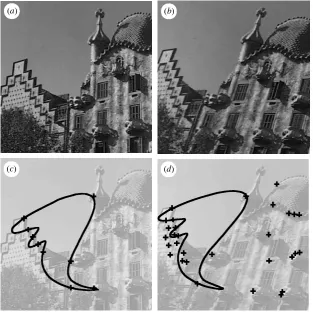
For purposes of illustration, we can consider an example of the use of general forms in images. Figure 6a; b shows two images of the same scene, taken from a di¬erent viewpoint. In this example, duality can be used to de ne a correspondence between the images by considering points represented by a parametric curve. In general, parametric curves have been used to represent consecutive pixels in images; however we can notice that the de nition ofx(j) in equation (5.1) can be used to represent any collection of points. In the example in gure 6, we have used corner points (Harris & Stephens 1988) to determine the parameters of a linear transformation. First, we select a set of landmark points, shown in gure 6c, from the corners extracted from gure 6a. These points are selected by considering a high threshold value and they are used to de ne a parametric curve that can be matched against the corners extracted from gure 6band shown in gure 6d. The curve in gure 6csu¯ ces only to link the points: intermediate points are not necessarily related to image data. Due to the changes in the viewpoint the extracted corners are di¬erent; however, the transformation can be accurately determined by nding the dual point of the curve for the points in gure 6d.
We de ne the functionz(j) = (u(j); v(j)) such that it traces the curve that passes through the landmark points shown in gure 6cwhenj takes integer values between 1 and 9. The functionsu(j) andv(j) were de ned using a Fourier expansion (Aguado et al. 1998) as
u(j) =
4
i= 0
» ixcos(ij2
9º ) +» iysin(ij29º )
for » 0 = (126;0), » 1 = (30:6;¡ 66:5), » 2 = (3:23;¡ 16:94), » 3 = (24:77;5:96), » 4 =
(31:20;¡ 0:69) and
v(j) =
4
i= 0
(a) (b)
[image:21.449.69.383.45.357.2](c) (d)
Figure 6. Example of forms under a geometrical transformation: (a) and (b), scene from di® erent viewpoints; (c) curvez(j); (d) curve de¯ned by max HT(Ui) in equation (2.7).
for ’0 = (149;0), ’1 = (38:7;67:98), ’2 = (45:95;6:72), ’3 = (13:22;¡ 3:65), ’4 = (17:34;6:86). If we consider z(j) in equation (5.8), then the curve in
g-ure 6chas a dual point in the four-dimensional projective space, [Ux
1; U2x; U3x; U4x] and
[U1y; U2y; U3y; U4y]. Thus, each image point (x(j); y(j)) can be mapped into the points (x1; x2; x3; x4) and (y1; y2; y3; y4) according to the de nitions in equation (5.8).
Based on the de nition of the curve z(j) we can obtain the dual of the collection of corner points shown in gure 6d. Then, the dual de nes the parameters in equa-tion (5.7) and represents a linear transformaequa-tion between gure 6a and gure 6b. According to equation (2.7) the dual can be obtained by computing the value that satis es the majority of equations simultaneously. In this example, equation (5.8) de nes nine pairs of equations for each corner point. Thus, we have a system of 270 over-determined equations. In order to compute the maximum number of equa-tions that can be satis ed simultaneously, we have taken groups of three equaequa-tions to compute [Ux
1; U2x; U3x; U4x] and [U1y; U2y; U3y; U4y] in a similar way to the random
168 groups of points were considered. For each group we count how many of the equations satisfy the dual relationship in equation (5.2) and we keep the maximum value. Figure 6d shows the curve obtained by the parameters in equation (2.3) for the dual point de ned by the maximum value. This curve passes through six of the nine landmark points in gure 6c. This shows that the dual point de nes the best- t curve by the relationship between a point and a hyperplane in the projective space, illustrating how the new interpretation can be applied, with success, to real images. The points in gure 6dthrough which the curve does not pass correspond to corner points not extracted from gure 6a.
6. Conclusions and discussion
We have considered the relationship between the HT and the principle of duality. The principle of duality was developed as a purely theoretical idea to explain the-orems in dual projective spaces. The HT was developed as a pragmatic approach aimed at solving the fundamental problem of pattern matching. However, we have shown that there is a strong parallelism and convergence, not only in the basic and simple de nitions but also in the development of ideas, concepts and properties. This relationship suggests a more general de nition of the HT with a deep meaning in pure geometry rather than a simple mapping between coordinates. This de nition is important for three main reasons. Firstly, it recognizes that the principle of duality has an important application in pattern matching. Secondly, it introduces the for-malism of projective geometry to shape extraction and analysis. This increases our understanding of the dual nature of pattern matching, thus techniques can bene t from previous results obtained in projective geometry. Finally, the principle of duality provides a general de nition, wherein the dual form of lines, curves and hyperplanes has a dual interpretation in pattern matching. We have discussed the interpretation of lines and points and we have generalized the ideas to represent hyperplanes and general shapes represented by parametric curves.
prin-ciple of duality. However, the de nition and mathematical properties of the Hough space and the dual projective space are equivalent. Finally, the HT and the principle of duality de ne a one-to-one linear mapping. Dual elements of a gure represent dual elements of a shape. Points, lines and hyperplanes de ne a linear mapping in homogeneous coordinates.
The principle of duality constitutes an important concept for understanding geo-metric relationships in the projective space. The use of duality in the HT can provide a natural de nition from which theorems and properties can be demonstrated. In an integrated approach, the geometric relationships in the projective space and the computational de nition of the HT provide two complementary areas which are both necessary to solve demanding pattern matching applications.
We are very grateful for the comments and suggestions of the (anonymous) referees.
References
Aguado, A. S., Nixon, M. S. & Montiel, M. E. 1998 Parameterising arbitrary shapes via Fourier descriptors for evidence-gathering.CVIU Image Understanding69, 202{221.
Baker, H. F. 1971An introduction to planar geometry with many examples. New York: Chelsea. Ballard, D. H 1981 Generalizing the Hough transform to detect arbitrary shapes.Pattern
Recog-nition13, 111{122.
Buchanan, T. 1988 The twisted cubic and camera calibration.Computer Vision Graphics Image Processing 42, 130{132.
Canny, J. F. 1983 Finding edges and lines in images. Report AI-TR-720, MIT Arti¯ cial Intelli-gence Laboratory.
Deans, S. R. 1981 Hough transform from the radon transform.IEEE Trans. Pattern Analysis Machine Intell.13, 185{188.
Duda, R. O. & Hart, P. E. 1972 Use of the Hough transform to detect lines and curves in pictures.Commun. ACM 13, 11{15.
Duda, R. O. & Hart, P. E. 1973Pattern classi¯cation and scene analysis. Wiley.
Eckhardt, U. & Maderlechner, G. 1990 A general approach for parameterising the Hough trans-form.IEEE 10th Int. Conf. on Pattern Recognition, pp. 623{630. IEEE.
Fishback, W. T. 1969Projective and Euclidean geometry. Wiley.
Fischler, M. A. & Bolles, R. C. 1981 Random sample consensus: a paradigm for model ¯tting with applications to image analysis and automated cartography.Graphics Image Processing 24, 381{395.
Harris, C. & Stephens, M. 1988 A combined corner and edge detector.Proc. Alvey Vision Conf., pp. 147{151. University of Manchester.
Hough, P. V. 1962 Method and means for recognising complex patterns. US Patent no. 3969654. Illingworth, J. & Kittler, J. 1988 A survey of the Hough transform.Computer Vision Graphics
Image Processing48, 87{116.
Julesz, B. 1971Foundations of cyclopean perception. The University of Chicago Press. Leavers, V. F. 1993 Which Hough transform?CVGIP: Image Understanding 58, 250{264.
Marr, D. & Nishihara, K 1978 Representation and recognition of the spatial organization of three-dimensional shapes.Proc. R. Soc. Lond.B200, 269{294.
Mundy, J. L. & Zisserman, A. 1992Geometric invariance in computer vision. MIT Press. Pedoe, D. 1963International series of monographs in pure and applied mathematics. Pergamon. Pentland, A. P. 1986 Perceptual organization and the representation of natural form.Arti¯cial
Intell.28, 293{331.
Princen, J., Illingworth, J. & Kittler, J. 1992 A formal de¯nition of the Hough transform prop-erties and relationships.J. Math. Imaging Vision 1, 153{168.
Rosenfeld, A. 1969Picture processing by computer. Academic.
Rosenfeld, A. & Weiss, I. 1995 A convex polygon is determined by its Hough transform.Pattern Recognition Lett.16, 305{306
Roth, G. & Levine, M. D. 1993 Extracting natural scales using Fourier descriptors. Pattern Recognition26, 1383{1893.
Sklansky, J. 1978 On the Hough technique for curve detection. IEEE Trans. Computers 27, 923{926.
Stahs, T. G. & Wahl, F. M. 1989 Polyhedral object recognition by Hough space analysis. Math-ematical research, vol. 51, pp. 165{172. Berlin: Akademie.
Stockman, G. C. & Agwarwala, A. K. 1977 Equivalence of Hough curve detection to template matching.Commun. ACM 20, 820{822.
Tuller, A. 1967 A modern introduction to geometries. The university series in undergraduate mathematics. Princeton, NJ: Van Nostrand.
Veblen, O. & Young, J. W. 1910Projective geometry, vol. 1. London: Ginn & Company. Wahl, F. M. 1989 Deriving features from Hough space for object recognition and con¯guration
![Figure 5. Example of dual space of a general form: (a) curve; (b) projection [U x1 =U x3 ; U y1 =U y3 ];(c) projection [U x2 =U x3 ; U y2 =U y3 ].](https://thumb-us.123doks.com/thumbv2/123dok_us/1038785.619402/18.449.78.378.47.150/figure-example-dual-space-general-curve-projection-projection.webp)