Accepted Manuscript
A feature model of actor, agent, functional, object, and procedural
programming languages
H.R. Jordan, G. Botterweck, J.H. Noll, A. Butterfield, R.W. Collier
PII:
S0167-6423(14)00050-1
DOI:
10.1016/j.scico.2014.02.009
Reference:
SCICO 1711
To appear in:
Science of Computer Programming
Received date:
9 March 2013
Revised date:
31 January 2014
Accepted date:
5 February 2014
Please cite this article in press as: H.R. Jordan et al., A feature model of actor, agent,
functional, object, and procedural programming languages,
Science of Computer Programming
(2014), http://dx.doi.org/10.1016/j.scico.2014.02.009
Highlights
•
A survey of existing programming language comparisons and comparison techniques.
•
Definitions of actor, agent, functional, object, and procedural programming concepts.
•
A feature model of general-purpose programming languages.
A Feature Model of Actor, Agent, Functional, Object, and Procedural
Programming Languages
H.R. Jordana,∗, G. Botterwecka, J.H. Nolla, A. Butterfieldb, R.W. Collierc
aLero, University of Limerick, Ireland bTrinity College Dublin, Dublin 2, Ireland cUniversity College Dublin, Belfield, Dublin 4, Ireland
Abstract
The number of programming languages is large [1] and steadily increasing [2]. However, little structured information and empirical evidence is available to help software engineers assess the suitability of a language for a particular development project or software architecture.
We argue that these shortages are partly due to a lack of high-level, objective programming language feature assessment criteria: existing advice to practitioners is often based on ill-defined notions of ‘paradigms’[3, p.xiii] and ‘orientation’[4], while researchers lack a shared common basis for generalisation and synthesis of empirical results.
This paper presents a feature model constructed from the programmer’s perspective, which can be used to precisely compare general-purpose programming languages in the actor-oriented, agent-oriented, functional, object-oriented, and procedural categories. The feature model is derived from the existing literature on general concepts of programming, and validated with concrete mappings of well-known languages in each of these categories. The model is intended to act as a tool for both practitioners and researchers, to facilitate both further high-level comparative studies of programming languages, and detailed investigations of feature usage and efficacy in specific development contexts.
Keywords: programming languages, programming language constructs, actor model, agent-oriented
programming, functional programming, object-oriented programming, feature modelling, C, Erlang, Haskell, Jason, Java
1. Introduction
Programming languages are traditionally viewed as belonging to particular paradigms, however the no-tion of a programming paradigm is imprecise [3, p.xiii]. Unlike scientific paradigms[5, p.148], program-ming paradigms are not necessarily incompatible, as demonstrated by the success of dual- and multi-paradigm languages such as Mozart/Oz (http://www.mozart-oz.org), Jason (http://jason.sf.net), and Scala (http://www.scala-lang.org). This paper attempts to identify, define, and organize the central concepts underlying the actor, agent, functional, object, and procedural programming styles, as they are realised in prac-tical programming languages.
This paper has three central aims. Firstly, by mapping existing programming languages to a common feature model, it is hoped that ideas for new language features and new combinations of features will be generated. Secondly, it is hoped that the resulting feature model will serve as a basis for comparison and generalisation in empirical studies of multiple programming languages. Finally, in conjunction with this hoped-for empirical
∗Corresponding author
Email addresses:[email protected](H.R. Jordan),[email protected](G. Botterweck),[email protected]
(J.H. Noll),[email protected](A. Butterfield),[email protected](R.W. Collier)
2 FEATURE MODELLING
evidence, the model should eventually become a useful tool to help software engineers in assessing the suitability of a language for a given development project or software architecture.
With these second and third aims in mind, the languages in this paper were selected as popular examples of their respective ‘paradigms’. Programming language popularity is hard to measure, however we have used the listing at
http://www.tiobe.com/index.php/content/paperinfo/tpci
(accessed February 2013) as a guide. C[6]is probably the most popular procedural programming language. Erlang (http://www.erlang.org)
[7] is a functional language with a rich industrial heritage[8], based on the actor model of concurrency [9, 10]. Haskell (http://www.haskell.org) is a purely-functional language. Jason[11] is an agent-oriented language[12] which implements and extends AgentSpeak(L) [13]. Java (http://www.oracle.com/technetwork/java) is probably the most popular object-oriented programming language.
The reference versions of each programming language considered here are Erlang R13B03, Haskell 2010 (as implemented by the Glasgow Haskell Compiler version 7.0.4), Jason 1.3.4, and Oracle Java 1.7.0.40. Un-fortunately, at the time of writing, many of the most popular C compilers do not fully implement the most recent C standards. In particular, the GCC (http://gcc.gnu.org) and Microsoft Visual Studio (http:
//www.microsoft.com/visualstudio) compilers do not fully implement either C99
[14]or C11[15]. Con-sequently, the reference version of C adopted for this paper is C90[16](also sometimes known as ANSI C or C89), which is supported by the above compilers and is the version discussed in the well-known reference by Kernighan and Ritchie[6]. Due to C’s heritage as a systems programming language, several important features not included in the core language are provided instead by platform libraries which are defined in the separate Portable Operating System Interface (POSIX) standards[17]. As implementations of these libraries are provided ‘out-of-the-box’ on many platforms, we have considered them as part of the C language where appropriate.The remainder of this paper is structured as follows. section 2 introduces feature modelling. section 3 presents some examples of existing feature-based surveys, and provides an overview of comparisons and con-cepts of programming languages. In section 4, a feature model of actor, agent, functional, object, and procedural programming languages is developed from the literature and validated against the languages listed above. sec-tion 5 concludes, discusses the limitasec-tions of the feature model, and suggests several direcsec-tions for further work.
2. Feature Modelling
Feature modelling supports the informal comparison of existing and future systems, by characterising systems and their features as instances of domain concepts [18, ch.4]. Apel and Kästner [19]identify ten different definitions of the termfeature, reflecting the fact that feature modelling can be applied at many stages of the software lifecycle, and at levels of granularity ranging from domain analysis[20]to compile-time configuration of operating systems[21].
Feature modelling is commonly used to manage variability in the context of software product lines[22, 23]. However, the focus of this paper is on the feature-oriented domain analysis of high-level application program-ming languages, with the objective of defining “the features and capabilities of a class of related software sys-tems”[20]. Feature modelling is a creative activity[18, p.85]which is often also iterative and community-driven. Feature-based comparisons incorporate many ideas from earlier classifications and taxonomies, with an added emphasis on optimising models so as to maximize composability, reduce dependencies between features, and thus minimise feature interactions[24]. Feature-based and framework-based comparison studies share sev-eral key characteristics: the central objective of both study types is to integrate selected work within a pre-defined boundary, to produce a single cohesive model[25]. Unlike reviews, which aim to be comprehensive, framework-and feature-based comparisons typically focus on higher-level concepts framework-and the relationships between them.
An abstract model of a product family, such as a feature model, can be assessed either by studying one product instance in its intended context, or by analysing a subset of product instances with respect to the model
[26, p.206]. In this paper, the latter approach is adopted; each product instance is a well-known programming language. When selecting product instances for model assessment, there are two possible strategies. Typically, products describing the extremes are selected; alternatively, product popularity may be used as a selection criterion [26, p.206]. The products selected for inclusion in this study were chosen because they are both popular and widely spaced within the programming languages landscape.
3 RELATED WORK
The termsconcept,characteristic, andfeatureare used in this paper as follows. Aconceptis loosely defined as any idea or principle, often (but not necessarily) based on or utilised in theory. Afeatureis a realisation of a concept within the context of a family of related systems (in this case, programming languages), and afeature
instanceis a realisation of a feature in a specific system (in this case, a particular language). Acharacteristicis
an observable property of a system or feature instance.
3. Related Work
Feature-oriented domain analysis has only recently been applied to the comparison of programming lan-guages[27]. Consequently this section first discusses some examples of feature-based surveys in related areas. Then an overview of the literature on comparisons and concepts of programming languages is presented.
3.1. Feature-Based Surveys
Martin et al.[28]studied distributed computing systems using a taxonomic approach that is very similar to feature modelling. The emphasis of their survey is “breadth rather than depth”, and the focus is on fundamental system features and their possible combinations. However, while some features are illustrated with examples, a complete mapping of a real distributed computing system to the taxonomy was not provided.
Krauter et al.[29]classified grid resource management systems for distributed computing according to 11 functional attributes. Each attribute is structured as a small separate sub-taxonomy, resembling a feature model. Mappings of 15 real resource management systems to this taxonomy demonstrate its applicability, and these mappings were used to identify feature combinations that have received comparatively little attention.
A taxonomic approach was also employed by Meier and Cahill[30] to survey the features of distributed event systems. Pseudocode examples or architectural diagrams illustrate each categorisation decision. Complete mappings of four contrasting systems demonstrate the taxonomy’s wide applicability.
Czarnecki and Helsen[31]surveyed model transformation languages using a feature-based approach. As in this paper, feature modelling was used to survey and organize a domain, rather than a product family from a single vendor; however the scope of the survey also includes proposed and prototype approaches alongside industrial-strength implementations. Due to this wider scope, brief comments on individual languages were provided in place of comprehensive feature mappings.
3.2. Programming Language Comparisons
The Steelman programming language requirements[32]represent an early attempt to identify desirable fea-tures of programming languages in general. These requirements were developed collaboratively and iteratively
[33], and are structured as a hierarchy. Some of the requirements represent objectively detectable features, such as boolean types; however, other requirements such as ‘maintainability’ and ‘simplicity’ are less well defined. By design, the Steelman requirements’ scope only covers imperative languages. Mappings of Ada, C, C++, and Java to the Steelman requirements were later provided by Wheeler[34].
Shaw et al. [35]proposed a general method to compare programming languages based on the idea of a language ‘core’: a subset of features that gives the language its identity and captures its designer’s intent. The method was used to compare Fortran, Jovial, Cobol, and the Ironman programming language requirements (a predecessor of the Steelman requirements discussed above). Unfortunately, the process of identifying each language’s core appears to be partly subjective, as it is based on historical and philosophical considerations. The language cores are compared according to criteria such as control flow, efficiency, and decomposition of large systems.
Wichmann[36]compared Pascal and Ada from the programmer’s perspective, with the objective of illustrat-ing the advantages of Ada for major industrial projects. Facilities discussed include type equivalence of arrays, function overloading, exception handling, concurrency, and packaging. However, the comparison criteria are unstructured, and their definitions are specific to the target languages. In a similar style, Feuer and Gehani[37] compared Pascal with C based on features such as basic and structured types, symbolic constants, assignment and selection statements, and input/output. Unfortunately these features are also not structured into a reusable model.
4 FEATURE MODEL 3.3 Programming Language Concepts
Appelbe and Hansen[38]surveyed the Concurrent Pascal, Pascal Plus, Modula-2, Ada, Mesa, Edison, CLU, PLZ/SYS, and C systems programming languages using a feature-based technique. Part of the survey is organised around high-level feature groups, such as typing, sequential control, concurrency, encapsulation, input/output, and some attributes of modularity; within these groups, further lower-level features are defined. For every surveyed language, each feature is either present or absent, and in some cases examples of feature usage are given. The main drawback of this survey is that declarative languages and language features are not considered. Belkhouche et al.[39]proposed an explicit, systematic method for programming language evaluation, and used this method to compare Ada and Modula-2. According to this method, the features of the evaluated lan-guage should first be enumerated, then each feature should be rated according to a set of seven evaluation criteria. Unfortunately, some of these criteria, such as ‘consistency with commonly-used notations’ and ‘extensi-bility’, are not well defined. The procedure to enumerate the language features is not described, and the example comparison used to illustrate the method is based only on type systems and concurrency.
Appeltauer et al.[40]surveyed context-oriented programming languages and language extensions. A set of core features for context-oriented programming was defined, and implementation approaches for these features were compared; features unique to particular languages were also listed. The information-hiding modularity features of Ada, C++, CLU, Eiffel, Fortran, Modula-2, Oberon, and Simula were compared by Calliss[41].
3.3. Programming Language Concepts
Detailed discussions of the general concepts of programming languages are found in several well-known texts
[42, 43, 3, 44, 45]. A classic overview of some fundamentals is provided by Strachey[46], while a more recent perspective may be found in Van Roy[47]. In specific subject areas, Tratt[48]surveys type system concepts, and Gabbay et al.[49]present the theoretical foundations of logic programming. The concepts of concurrent logic programming are discussed in detail by Shapiro[50].
Dennis et al.[51, 52]adopt a theoretical approach to analyse the concepts underlying agent-oriented pro-gramming. Their framework, based on operational semantics, successfully models the core functionality of the well-known 3APL [53], AgentSpeak[13], and MetateM [54]languages, and leads to the identification and abstract specification of some ‘missing’ modularity features.
Hudak[55]introduces the key features of functional programming languages, and the lambda calculus. A more general theoretical treatment of declarative languages by Hanus[56]describes attempts to unify functional programming with logic languages and the constraint programming paradigm. Armstrong [57]employs an empirical method to discover the fundamental concepts (called ‘quarks’) of object-oriented programming, which are then surveyed.
4. Feature Model
Due to the different terminology used in the actor, agent, functional, object, and procedural programming literature, the domain concepts on which this feature model is based are drawn where possible from the wider lit-erature on computer programming. It must be emphasised that the feature model presented here is neither final nor definitive; it can and should be modified and extended to accommodate new languages and developments.
A programming language may be modelled as one or more feature sets Si, where Si consists of feature instancesI0. . .In. Each feature instanceIi realises, with a concrete syntax and semantics, one of the abstract features described in this section.1 A complex programming language which consists of several interrelated
sub-languages, may be better modelled as a set of feature setsS0. . .Sn.
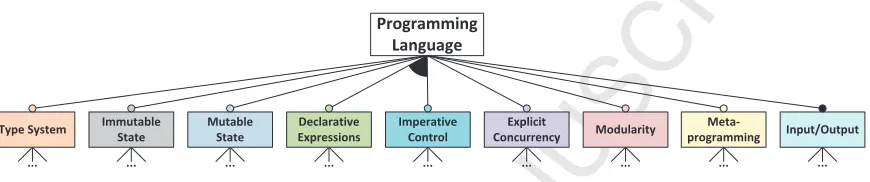
The feature model takes the form of a tree, with nine first-level nodes which are presented here as separate sub-trees. Each node represents either a feature or afeature group- a group of related or conceptually similar features. Features and feature groups are either mandatory (denoted by solid bubbles) or optional (denoted by hollow bubbles). A solid segment joining the connectors of two or more optional nodes indicates that at least one of those nodes must be present.
1A single language may offer multiple realisations of the same abstract feature, usually for reasons outside the scope of this paper - for
example to support backwards compatibility or to provide different performance characteristics.
4 FEATURE MODEL 4.1 Type System
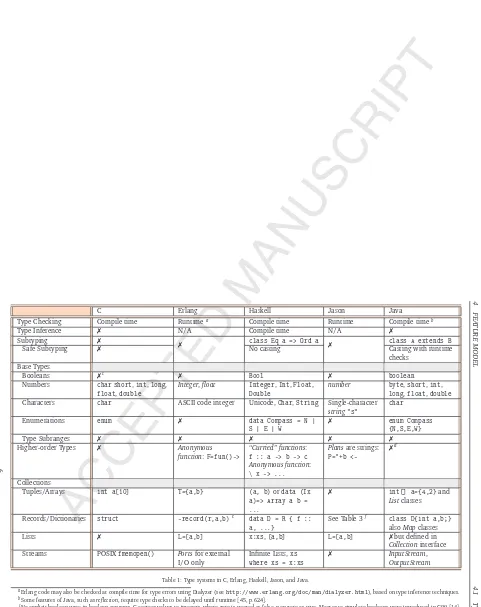
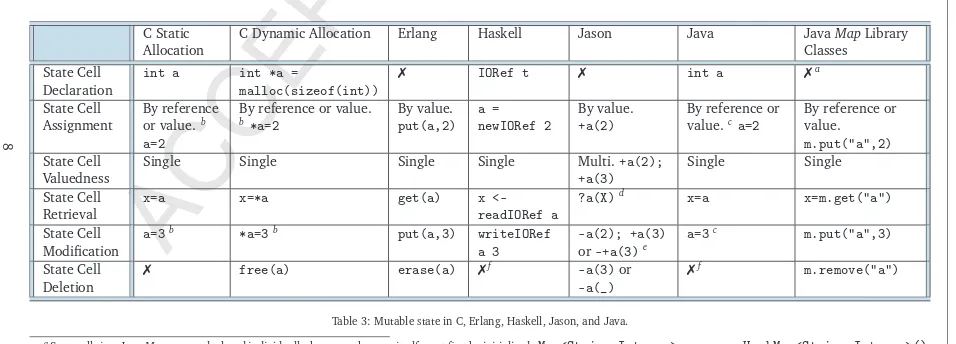
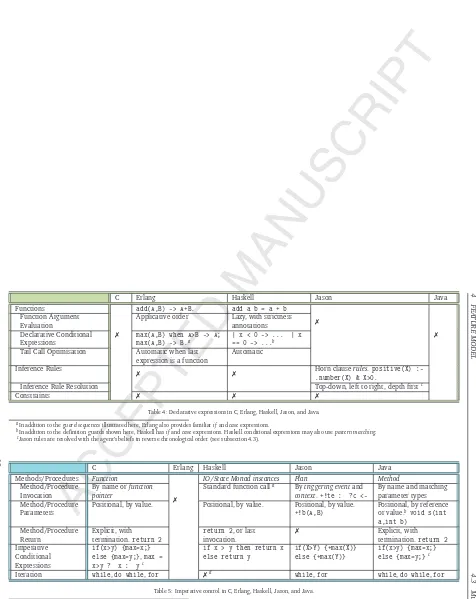
Mappings from the five selected languages to the feature model are described in the accompanying ta-bles. Lack of explicit support for a particular feature or a feature group is indicated by the ‘’ symbol. If a feature is present, amonospace font is used to provide an example of that feature instance where space al-lows. A greyed-out cell indicates a feature group that is present, because one or more features within the group are present. Italics indicate language-specific terminology used in Kernighan and Ritchie [6],
http:
//www.erlang.org/doc,
http://www.haskell.org/onlinereport/haskell2010, Bordini et al.
[11],and
http://download.oracle.com/javase/tutorial. Where a language offers multiple instances of the
same high-level abstract feature, and these instances exhibit significant feature differences at a lower level, these alternatives are presented using additional columns. The colours used in the text, tables, and feature diagrams carry no semantics; their only purpose is to assist in matching related sections, and thereby improve readability.An overview of the feature model is given in Figure 1.
Programming Language
... ... ... ... ... ... ... ...
Input/Output Modularity
Explicit Concurrency Imperative
Control Declarative
Expressions Mutable
State Immutable
State Type System
[image:7.612.92.527.233.324.2]... Meta-programming
Figure 1: Overview of a feature model of actor, agent, functional, object, and procedural programming languages.
4.1. Type System
Type systems serve three related purposes in programming languages: to classify values, to determine their applicable operations, and to inform the compiler how much memory to allocate to store a value of the given type. In the first view, a type is “a constraint which defines the set of valid values which conform to it”[48]. In the second, types are abstract “specifications of functionality”[45, p.723], which define “legal usage contexts for the values they describe”[45, p.620]. An attempt to perform an illegal operation on a value is known as a type error, which may be detected either at compile time or runtime. In a typeless language, “it must be the case that every value can be used in every context”[45, p.622].
Type Checking Type information may be checked for errors at compile time (‘static’ typing), at runtime (‘dy-namic’ typing), or both[45, p.623].
Type Inference The information required for compile-time type checks can either be supplied explicitly by the programmer, or inferred by the compiler or interpreter using type reconstruction techniques[45, ch.13].
Subtyping Subtyping allows two types to be compatible, without being the same[45, ch.12].
Safe Subtyping Under an unsafe type system, the programmer may force (or ‘cast’) values of one type to be considered as conformant with an incompatible type. Type-safe languages either disallow casting, or perform runtime checks to ensure that any casts do not subvert the type system[48].
Base Types Base types represent atomic (indivisible) values, and serve as collection members.
Booleans Boolean types represent true or false.
Numbers Number types represent numbers of specified precision, and can be signed or unsigned[44, p.294].
Characters Character types represent letters in some encoding, such as ASCII or multilingual Unicode
[44, p.295].
FEA
TURE
MODEL
4.1
T
ype
System
C Erlang Haskell Jason Java
Type Checking Compile time Runtimea Compile time Runtime Compile timeb
Type Inference N/A Compile time N/A
Subtyping class Eq a => Ord a
class A extends B
Safe Subtyping No casting Casting with runtime
checks Base Types
Booleans c Bool boolean
Numbers char short,int,long,
float,double
Integer,float Integer,Int,Float,
Double
number byte,short,int,
long,float,double
Characters char ASCII code integer Unicode,Char,String Single-character string"s"
char
Enumerations enum data Compass = N |
S | E | W
enum Compass
{N,S,E,W}
Type Subranges
Higher-order Types Anonymous
function:F=fun()->
“Curried” functions:
f :: a -> b -> c Anonymous function:
\ x -> ...
Plansare strings:
P="+b
d
Collections
Tuples/Arrays int a[10] T={a,b} (a, b)ordata (Ix
a)=> Array a b = ...
int[] a={4,2}and
Listclasses
Records/Dictionaries struct -record(r,a,b)e data D = R { f :: a, ...}
See Table 3f class D{int a,b;} alsoMapclasses
Lists L=[a,b] x:xs,[a,b] L=[a,b] but defined in
Collectioninterface Streams POSIXfmemopen() Portsfor external
I/O only
Infinite Lists,xs where xs = x:xs
InputStream,
[image:8.612.70.551.105.712.2]OutputStream
Table 1: Type systems in C, Erlang, Haskell, Jason, and Java.
aErlang code may also be checked at compile time for type errors using Dialyzer (seehttp://www.erlang.org/doc/man/dialyzer.html), based on type inference techniques. bSome features of Java, such asreflection, require type checks to be delayed until runtime[45, p.624].
cNo explicit boolean type; in boolean contexts, C coerces values to integers, where zero is treated as false, non-zero as true. Macros to simulate booleans were introduced in C99[14]. dThe JavareflectionAPI provides aMethodtype for handling subroutines, however its use has many disadvantages and is officially discouraged.
eErlang records are compiled as tuples; consequently, field names are replaced by integer indices at runtime. A singledictionaryis also available to each Erlang process. fDictionaries can be built usingstructuresin Jason, albeit with little support from the type system.
4 FEATURE MODEL 4.2 Immutable State
Enumerations Enumeration types represent ordered sets of named elements[44, p.297].
Type Subranges Subranges “compose a contiguous subset of the values of some discrete base type”[44, p.298]. The compiler may generate code to dynamically check that subrange values lie within their specified ranges; alternatively, this checking may be performed by the interpreter.
Higher-order Types A language may define higher-order types to represent functions, methods, or proce-dures, allowing them to be “passed as parameters, returned by functions, or stored in variables” [44, p.290]. If higher-order types are true first-class language constructs, new values for those types can be computed at runtime[44, p.508](see subsection 4.8).
Collections Collections are composites formed from one or more base types. In keeping with the above definition of type as usage context, they can be divided according to how individual elements are accessed
[3, p.438].
Tuples/Arrays Tuples or arrays are indexed by integers.
Records/Dictionaries Records or dictionaries are indexed by any literal.
Lists Lists are unindexed, and of finite length.
[image:9.612.82.525.81.521.2]Streams Streams are unindexed and unbounded; they are commonly used for input/output (see sub-section 4.9) and concurrency (see subsub-section 4.6).
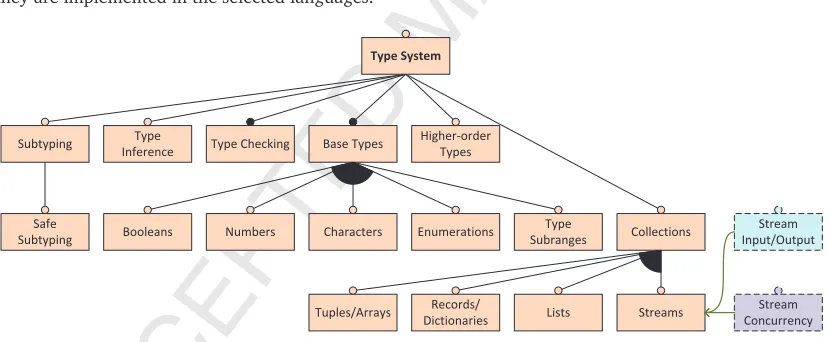
Figure 2 shows these concepts structured as a feature model, and Table 1 gives an overview of these features as they are implemented in the selected languages.
Type Checking Type
Inference Subtyping
Safe Subtyping
Higher-order Types
Booleans Numbers Characters Enumerations Type
Subranges
Type System
Collections
Tuples/Arrays Records/
Dictionaries Lists Streams
Base Types
Stream Concurrency
Stream Input/Output
Figure 2: Type system features, including incoming dependencies from the Explicit Concurrency (see subsection 4.6, Figure 7) and In-put/Output (see subsection 4.9, Figure 10) feature groups.
4.2. Immutable State
A crucial feature of many programming languages is “the possibility of associating values with symbols and later retrieving them”[42, p.8]. This feature category is concerned with symbol-value associations which, once made, cannot be changed.
Constants A constant is defined here as a binding, between a symbol or name and a value, which lasts for the lifetime of the enclosing element.
[image:9.612.100.515.378.549.2]FEA
TURE
MODEL
4.2
Immutable
State
C Erlang Haskell Jason Java
Constants const int c=2a -define(C,2) Everythingb Only inplans.C=2 final int c=2c Single Assignment Only infunctions.
A=2
[image:10.612.73.549.95.690.2]Only inplans.A=2 Only inconstructors.final int a; a=2
Table 2: Immutable state in C, Erlang, Haskell, Jason, and Java.
aConstants in C can also be defined using macros:#define C (2).
bVariation in Haskell arises in two ways: evaluating an expression which transforms its form, but not its value; and state-change that is hidden from view, accessed via a pointer
(IORef) whose own value/address is immutable.
cThe Javafinalkeyword does not protect members of collections and mutable compound types from modification.
C Static Allocation
C Dynamic Allocation Erlang Haskell Jason Java JavaMapLibrary
Classes State Cell
Declaration
int a int *a =
malloc(sizeof(int))
IORef t int a a
State Cell Assignment
By reference or value.b a=2
By reference or value. b*a=2
By value.
put(a,2) a = newIORef 2
By value.
+a(2)
By reference or value.ca=2
By reference or value.
m.put("a",2)
State Cell Valuedness
Single Single Single Single Multi.+a(2);
+a(3)
Single Single
State Cell Retrieval
x=a x=*a get(a) x
<-readIORef a
?a(X)d x=a x=m.get("a")
State Cell Modification
a=3b *a=3b put(a,3) writeIORef
a 3
-a(2); +a(3)
or-+a(3)e
a=3c m.put("a",3)
State Cell Deletion
free(a) erase(a) f -a(3)or
-a(_)
[image:10.612.66.544.502.674.2]f m.remove("a")
Table 3: Mutable state in C, Erlang, Haskell, Jason, and Java.
aState cells in a JavaMapare not declared individually, however the map itself must first be initialised:Map<String,Integer> m = new HashMap<String,Integer>().
SomeMapimplementations (includingHashMap) permit null values; effectively, this allows names in the scope of a map to be declared before use.
bAssignment and modification of state cells in C is by value for primitive types (int,double, etc.). Arrays and structures are member copied on assignment and modification.
Literal values can be multiply assigned to arrays on declaration (int a[2] = {1,2}), but subsequent multiple assignment or modification can only be achieved by copying memory locations, for example usingmemcpy(). Pointers are only shallow copied; afterwards, both source and target pointers will point to the same underlying data.
cAssignment and modification of state cells in Java is by value for primitive types (int,double, etc.) and by reference for instances ofObject.
dThe Jason interpreter attempts to matchtest goalsagainst the agent’sbeliefsin reverse chronological order. Theincludepreprocessor directive (see subsection 4.7) unfortunately
interacts with this feature[58]. If no match is found, a test goal addition event is generated (see subsection 4.5).
eThe Jason-+operator first removes all beliefs that match the given functor, then the new belief is added. fState cells in Haskell and Java are not explicitly deleted, but will be garbage collected.
4 FEATURE MODEL 4.3 Mutable State
Single Assignment A single assignment variable - sometimes known as a ‘declarative variable’ - is initially an unassigned symbol, but once bound “stays bound throughout the computation and is indistinguishable from its value”[3, p.42].
Figure 3 shows these concepts structured as a feature model, and Table 2 gives an overview of these features as they are implemented in the selected languages.
Immutable State
[image:11.612.204.490.174.305.2]Constants Single Assignment
Figure 3: Immutable state features.
4.3. Mutable State
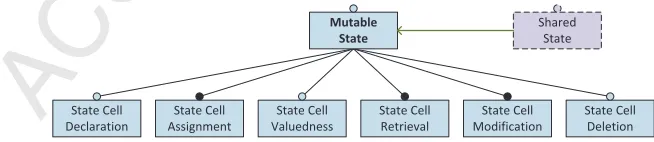
Van Roy and Haridi[3, p.408]define the named state of a computational entity as “a sequence of values in time that contains the intermediate results of a desired computation”. While not all programming languages pro-vide explicit state representation, any entity that is aware of its past must store that knowledge either internally, or externally in the environment[3, p.410].
State Cell Declaration A declaration introduces a state cell name and indicates its scope[44, ch.3]. The declaration may also include type information (see subsection 4.1).
State Cell Assignment Assignment associates a state cell name with a value. Some languages allow assign-ment between two state cells, in which case assignassign-ment may be either by value (the value of the second state cell is copied to the first) or by reference (the first cell is modified to refer to the second)[44, p.225].
State Cell Valuedness A state cell is multivalued if more than one value may be associated with a single name and index. Otherwise it is single valued.
State Cell Retrieval The mechanism by which the value of a state cell is retrieved, given a name.
State Cell Modification A language may provide special constructs to reassign the value of a state cell.
[image:11.612.129.456.569.640.2]State Cell Deletion The mechanism by which a state cell, and its contents, are erased.
Figure 4 shows these concepts structured as a feature model, and Table 3 gives an overview of these features as they are implemented in the selected languages.
Mutable State
State Cell Declaration
State Cell Valuedness
State Cell Deletion State Cell
Assignment
State Cell Retrieval
State Cell Modification
Shared State
Figure 4: Mutable state features, including an incoming dependency from the Explicit Concurrency (see subsection 4.6, Figure 7) feature group.
FEA
TURE
MODEL
4.3
Mutable
State
C Erlang Haskell Jason Java
Functions
add(A,B) -> A+B. add a b = a + b
Function Argument Evaluation
Applicative order Lazy, with strictness annotations Declarative Conditional
Expressions
[image:12.612.72.548.113.712.2]max(A,B) when A>B -> A; max(A,B) -> B.a
| x < 0 -> ... | x == 0 -> ...b
Tail Call Optimisation Automatic when last expression is a function
Automatic
Inference Rules
Horn clause.number(X) & X>0.rules.positive(X)
:-Inference Rule Resolution Top-down, left to right, depth firstc
Constraints
Table 4: Declarative expressions in C, Erlang, Haskell, Jason, and Java.
aIn addition to theguard sequencesillustrated here, Erlang also provides familiarifandcaseexpressions.
bIn addition to the definition guards shown here, Haskell hasifandcaseexpressions. Haskell conditional expressions may also usepattern matching. cJason rules are resolved with the agent’s beliefs in reverse chronological order (see subsection 4.3).
C Erlang Haskell Jason Java
Methods/Procedures Function
IO/State Monad instances Plan Method
Method/Procedure Invocation
By name orfunction pointer
Standard function calla Bytriggering eventand context.+!te : ?c
<-By name and matching parameter types Method/Procedure
Parameters
Positional, by value. Positional, by value. Positional, by value.
+!b(A,B)
Positional, by reference or value.bvoid s(int a,int b)
Method/Procedure Return
Explicit, with termination.return 2
return 2, or last invocation.
Explicit, with
termination.return 2
Imperative Conditional Expressions
if(x>y) {max=x;} else {max=y;},max = x>y ? x : yc
if x > y then return x else return y
if(X>Y) {+max(X)} else {+max(Y)}
if(x>y) {max=x;} else {max=y;}c
Iteration while,do while,for d while,for while,do while,for
Table 5: Imperative control in C, Erlang, Haskell, Jason, and Java.
aHaskell “procedures” are pure Haskell functions whose type belongs to a state mutation monad class, e.g.IO.
bJava method parameters are passed by value for primitive types (int,double, etc.) and by reference for instances ofObject.
cC and Java also offer aswitchstatement, which selects between code fragments based on the value of a single variable, and supportsfall through. dIteration constructs (e.g.while) can be defined in Haskell using recursion and the higher-order features.
4 FEATURE MODEL 4.4 Declarative Expressions
4.4. Declarative Expressions
Finkel and Kamin[43]define declarative programming as a separation of logic and control. The programmer creates the logic component, consisting of declarative expressions, which “specifies what the result of the algo-rithm is to be”[43, p.238]. The control component is partly or wholly provided by the compiler or interpreter.
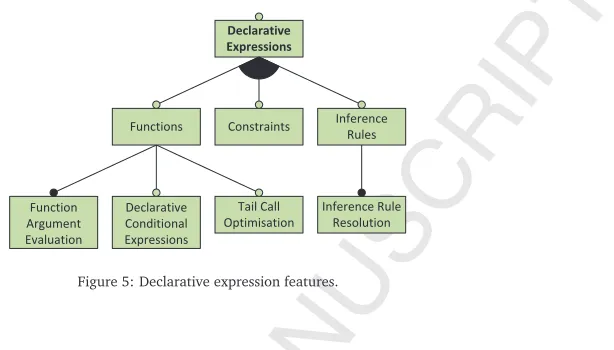
Functions A function is a procedure which computes a mathematical function: two evaluations with the same arguments will always produce the same result[42, p.230]. This property is known as ‘referential transparency’[55, p.362]. A function is distinct from a method or procedure (see subsection 4.5), in that side-effects are not permitted.
Function Argument Evaluation The result of a function can sometimes depend on how its arguments are evaluated. A function may be evaluated in applicative order (evaluate the arguments, then apply the function) or normal order (fully expand the function until only primitive operators remain, then reduce)[42, p.16].2Under normal order evaluation, a function may return a value even if evaluation
of some of its arguments would produce errors or not terminate[42, p.400]. However, implemented naively, normal order evaluation is inefficient and causes unnecessary repeated computations. A third option, lazy evaluation, avoids these recomputations by ensuring that all arguments are evaluated no more than once[55, p.383]. The result of a computation under normal order or lazy evaluation may also depend on the order of function arguments[55, p.390].
Declarative Conditional Expressions Conditional expressions allow discontinuous functions to be de-fined, and are central to an ‘equational reasoning’ programming style[55, p.388]. The predicate-consequent pairs of a conditional may be evaluated in a given order, or the language may insist that the predicates in a conditional are disjoint. A declarative conditional expression is referentially transparent.
Tail Call Optimisation An expression is known as a ‘tail call’ if no computational work is done between the termination of the expression and the termination of its enclosing function[45, p.1044]. A tail recursive language guarantees that recursive tail calls will be optimised to consume no additional memory resources, thus allowing iteration to be efficiently expressed. Tail call optimisation can only be activated in some languages using special syntax[42, p.35].
Inference Rules Inference rules allow new knowledge to be derived from existing facts3. Inference rules
are typically (though not necessarily) expressed as Horn clauses, consisting of an antecedent (potentially containing many terms) and a single-term consequent. Both antecedent and consequent terms may contain variables, thus allowing general relations to be expressed.
Inference Rule Resolution Inference rule resolution is the runtime process by which new knowledge is derived from inference rules: antecedent terms are matched (‘unified’) with facts and the consequents of other inference rules, backtracking on failure, until no unmatched antecedent terms and unbound variables remain. Since multiple solutions may exist to any given knowledge base query, the order in which candidate facts and inference rules are selected determines the order in which solutions are found[43, p.235]. The resolution process is potentially recursive, and therefore must be executed in a defined order over antecedent terms, to prevent accidental non-terminating queries[44, p.554]. Resolution is usually carried out left to right, and either depth first or breadth first.
2Analogously, a function or individual argument may be described as strict or nonstrict. The value of a strict function is only defined if
the values of all its arguments are defined[44, p.523]; if a particular argument is evaluated before the function body is entered, the function is strict in that argument[42, p.400]. While evaluation order is a property of the programming language, some languages place strictness under the programmer’s control, so the former terminology is preferred here.
3A ‘fact’ (in Prolog terminology) is a Horn clause with no antecedent terms and no unbound variables. However, in many newer languages,
facts are instances of mutable state (see subsection 4.3). Efficient resolution in the presence of mutable state requires ‘truth maintenance’ mechanisms to ensure that previously-derived knowledge is only updated when necessary.
4 FEATURE MODEL 4.5 Imperative Control
Constraints A constraint is a mathematical or logical relation between two or more variables, or a restriction on the domain of a variable, that must be satisfied.
Figure 5 shows these concepts structured as a feature model, and Table 4 gives an overview of these features as they are implemented in the selected languages.
Declarative Expressions
Functions Inference
Rules Constraints
Tail Call Optimisation
Inference Rule Resolution Declarative
Conditional Expressions Function
[image:14.612.202.509.164.339.2]Argument Evaluation
Figure 5: Declarative expression features.
4.5. Imperative Control
Imperative control allows the programmer to explicitly specify the execution or evaluation order of state-ments or expressions in time. Programmer-specified statement sequences are central to imperative languages
[44, p.220], and are also required to support structured input/output (see subsection 4.9) in declarative lan-guages[59].
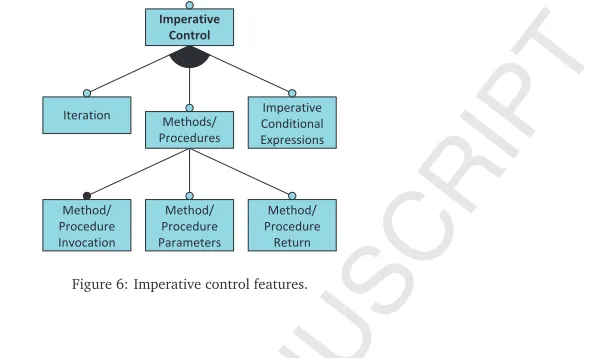
Methods/Procedures A method or procedure encapsulates a sequence of imperative control constructs, so they may be treated as a single unit [44, p.219]. A method or procedure is distinct from a function (see subsection 4.4): a method or procedure may change the state of the program (see subsection 4.3) or its environment (see subsection 4.9) via side effects.
Method/Procedure Invocation The mechanism by which a method or procedure is selected for invoca-tion.
Method/Procedure Parameters A method or procedure may accept input data by declaring formal pa-rameters, which are associated with arguments during invocation. Formal parameters and arguments may be associated by name, or by position[44, p.405]. Parameters may be passed by value (the argument is copied to the corresponding formal parameter) or by reference (the formal parameter is a new name for the corresponding argument)[44, p.395]; reference parameters may be used for output if the argument is mutable.
Return Return values allow a method or procedure to send a result to its invocation context. The return mechanism may be implicit (the result is simply the value of the method or procedure body), or the language may offer a formal ‘result’ parameter or an explicit return statement. Use of the return statement, or assignment of the result parameter, may also immediately terminate the method or procedure[44, p.408].
Imperative Conditional Expressions Conditional expressions allow choices between two or more code frag-ments, depending on runtime conditions[44, p.219]. An imperative conditional expression is not neces-sarily referentially transparent; evaluating the condition may have side effects.
Iteration Iteration allows a code fragment to be executed either a certain number of times, or until a given runtime condition changes[44, p.219].
4 FEATURE MODEL 4.6 Explicit Concurrency
Figure 6 shows these concepts structured as a feature model, and Table 5 gives an overview of these features as they are implemented in the selected languages.
Imperative Control
Iteration Methods/
Procedures
Method/ Procedure
Return Method/
Procedure Parameters Method/
Procedure Invocation
[image:15.612.211.506.138.317.2]Imperative Conditional Expressions
Figure 6: Imperative control features.
4.6. Explicit Concurrency
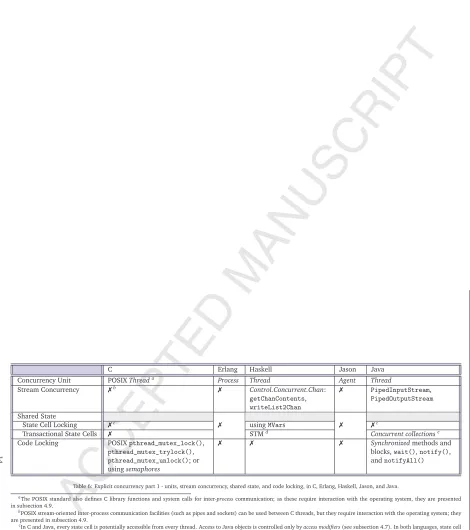
Two activities are concurrent if they can be interleaved in any order or executed in parallel, as determined by the underlying platform according to the number of CPU cores available.4While declarative programs (see
sub-section 4.4) can often be parallelized automatically by the compiler or interpreter, many languages also define features to explicitly support the concurrent execution of programs that rely on mutable state or imperative con-trol. Interaction between explicitly concurrent activities can be supported in several different communication styles[47].
Concurrency Unit A concurrency unit encapsulates a single explicitly-concurrent activity, programmed in ei-ther a declarative or imperative style, togeei-ther with any necessary mutable state (see subsection 4.3).
Stream Concurrency In this communication style, two or more concurrent activities each use one end of a stream[42, ch.3.5](see subsection 4.1) to communicate as producer and consumer[3, ch.4]. The use of a stream guarantees that data is sent and received in the same order.
Shared State In this communication style, concurrent activities communicate by modifying shared data struc-tures.
State Cell Locking A lock or mutex is a low-level synchronization primitive that, when applied to a state cell and acquired by an activity, admits no further operations on that state cell until the lock is released by the same activity[42, p.311].
Transactional State Cells A transactional language offers computations on state cells with guaranteed atomicity (the intermediate steps are never visible to other activities) and isolation (once initiated, the result of the computation is unaffected by other activities)[62].
Code Locking Code locking, or serialization, allows a programmer to define “distinguished sets of procedures such that only one execution of a procedure in each serialized set is permitted to happen at a time”[42, p.304].
4The neutral term ‘activity’ is used here to mean any executable program fragment. The more usual terms ‘process’ and ‘thread’ are
typically defined in terms of operating system concepts, such as memory management and scheduling, which are outside the scope of this paper.
FEA
TURE
MODEL
4.6
Explicit
Concurrency
C Erlang Haskell Jason Java
Concurrency Unit POSIXThreada Process Thread Agent Thread
Stream Concurrency b Control.Concurrent.Chan:
getChanContents,
writeList2Chan
PipedInputStream,
PipedOutputStream
Shared State
State Cell Locking c usingMVars c
Transactional State Cells STMd Concurrent collectionse
Code Locking POSIXpthread_mutex_lock(),
pthread_mutex_trylock(),
pthread_mutex_unlock(); or usingsemaphores
Synchronizedmethods and
[image:16.612.70.540.116.646.2]blocks,wait(),notify(), andnotifyAll()
Table 6: Explicit concurrency part 1 - units, stream concurrency, shared state, and code locking, in C, Erlang, Haskell, Jason, and Java.
aThe POSIX standard also defines C library functions and system calls for inter-processcommunication; as these require interaction with the operating system, they are presented
in subsection 4.9.
bPOSIX stream-oriented inter-process communication facilities (such as pipes and sockets) can be used between C threads, but they require interaction with the operating system; they
are presented in subsection 4.9.
cIn C and Java, every state cell is potentially accessible from every thread. Access to Java objects is controlled only byaccess modifiers(see subsection 4.7). In both languages, state cell
locking can be achieved by disciplined use of code locking primitives; however, a rogue thread that does not observe the locking mechanism can still modify “locked” cells.
dHaskell supports Software Transactional Memory (STM)[60].
eThe Javaatomic variableclasses also provide some common operations (such as integer addition) with transactional characteristics.
4
FEA
TURE
MODEL
4.6
Explicit
Concurrency
C Erlang Haskell Jason Java
Message Passing Concurrency
a b
Message Addressing Direct, bypidor registered name
Via channels orMVars Direct:.sendor channel:.broadcast
Message Sending
Asynchronous Sending Pid ! {c,2} putMVar,writeChanc .send(Ags, Perf, c(2))d
Synchronous Sending e
Remote Invocation .send(Ags, askOne, c(X), Reply)f
Message Receiving
Asynchronous Receiving getMVar,readChan ?c(X)[source(s)]g
Synchronous Receiving receive {c,X} -> do(X) end
e .wait("+c(X) [source(s)]");
!do(X)
[image:17.612.74.541.119.655.2]Implicit Receiving Subject tosocial acceptance[11, p.71]
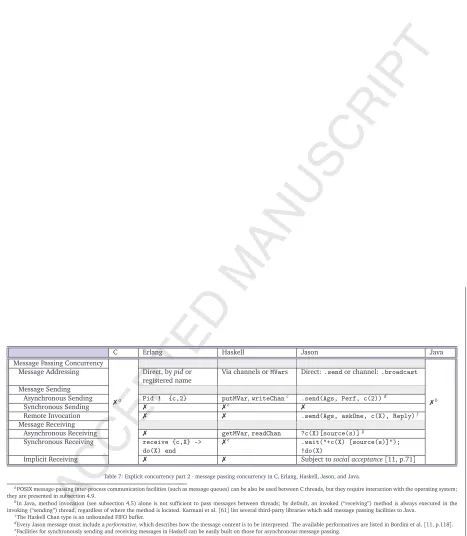
Table 7: Explicit concurrency part 2 - message passing concurrency in C, Erlang, Haskell, Jason, and Java.
aPOSIX message-passing inter-process communication facilities (such as message queues) can be also be used between C threads, but they require interaction with the operating system;
they are presented in subsection 4.9.
bIn Java, method invocation (see subsection 4.5) alone is not sufficient to pass messages between threads; by default, an invoked (“receiving”) method is always executed in the
invoking (“sending”) thread, regardless of where the method is located. Karmani et al.[61]list several third-party libraries which add message passing facilities to Java.
cThe Haskell Chan type is an unbounded FIFO buffer.
dEvery Jason message must include aperformative, which describes how the message content is to be interpreted. The available performatives are listed in Bordini et al.[11, p.118]. eFacilities for synchronously sending and receiving messages in Haskell can be easily built on those for asynchronous message passing.
fThe Jason.sendand.broadcastinternal actions, when used with theaskOne,askAll, andaskHowperformatives, accept a variable parameter which is unified with the
(first) message received in reply.
gExplicit message receipt in Jason is only possible with certain performatives, and relies on theannotationsfeature, which allows the agent to determine the source (self,percept,
or another agent) of each of its beliefs.
4 FEATURE MODEL 4.7 Modularity
Message Passing Concurrency In this communication style, concurrent activities communicate by exchang-ing messages, either synchronously (the activity waits until the message is received), asynchronously (the activity does not wait), or using a combination of modes[47]. A message can be defined as a data transfer between activities, or as a request by the sending activity for some action to be carried out by the receiv-ing activity [57]. The order in which messages are sent is not necessarily preserved by the underlying platform.
Message Addressing A message may be addressed directly to a receiving activity; to a specific port on the receiving activity; or to an independent channel, which may have multiple receiving activities
[44, CD p.263].
Message Sending A message-passing programming language can support any of three main message sending styles:
Asynchronous Sending The sender waits only until the outgoing message has been copied to a safe location[44, CD p.268].
Synchronous Sending The sender waits until its message has been received[44, CD p.268].
Remote Invocation The sender waits until it has received a reply[44, CD p.268].5
Message Receiving A message-passing activity can receive a message in any of three principal ways:
Asynchronous Receiving Also known as ‘polling’, asynchronous receiving allows an activity to test if a message (possibly of a particular type) is available[44, CD p.272].
Synchronous Receiving The receiver waits until a message (possibly of a particular type) is re-ceived.
[image:18.612.93.532.89.477.2]Implicit Receiving Subject to resource limitations, each received message implicitly triggers the creation of a new activity[44, CD p.272], which may parse the message parameters and carry out the requested actions.
Figure 7 shows these concepts structured as a feature model; Table 6 and Table 7 give an overview of these features as they are implemented in the selected languages.
4.7. Modularity
Modularity features allow a system to be divided into “coherent parts that can be separately developed and maintained”[42, p.217], and then optionally reused, both internally and externally, for economic gain[64]. Baldwin and Clark[65]propose a general theory of modularity, based on six operators which concisely describe the possible evolutionary paths for a modular structure.6 For software systems, two of these - splitting and
substitution - appear to require explicit support at the programming language level.7
Modularity Unit A module is a unit to which a responsibility is assigned; it consists of both data structures and the procedures which access and modify them[68].
5Though some modes of message sending can be implemented in terms of the others, as distinct language features their syntax and
performance characteristics can be separately optimised[44, CD p.271].
6An alternative theoretical treatment of modularity is given by Bracha and Lindstrom[66]. In this approach, the modularity features of
real programming languages can be formally described as combinations of six low-level module manipulation operators: merge, restrict, project, select, override, and rename. A comparison of the modularity features of C, Erlang, Haskell, Jason, and Java in terms of these operators is left for future work.
7The other four modular operators are augmenting (adding a new module to an existing system), excluding (removing a module from
an existing system), inversion (making hidden functionality explicitly available as a module), and porting (moving a module to another system)[65, ch.5]. In practical software development, augmenting and excluding are easily supported either by simple condition flags, or by substituting null implementations[67, p.734]. Inversion can usually be implemented by splitting; and though porting has historically been important in language design, it is typically handled in modern languages at the virtual machine level.
4
FEA
TURE
MODEL
4.7
Modularity
C Erlang Haskell Jason Java
Modularity Unit File Module Module Agent Class,package
Module Description Header files Custombehaviours Interfaces
Encapsulation Public unless
static
Private unlessexported All exported if no explicitexport
a Access modifiers:
public,private
Module Splitting
Module Extension #include "mod.c" -include("mod.hrl") {include("mod.asl")} Single inheritance Module
Composition
Classes only, as
private fields Runtime Module
Substitution
Runtime Module Replacement
dlopen(),dlsym(),
dlclose()
On fully qualified function callb
.kill_agentand
.create_agent
With custom
ClassLoaderc
Runtime Module Selection
With function pointers
Modules are first-class constructs
WithSACIorJADE directoriesd
[image:19.612.74.546.111.672.2]By polymorphism
Table 8: Modularity in C, Erlang, Haskell, Jason, and Java.
aBy default, the implicit receive feature (see subsection 4.6) of the Jason interpreter allows an agent to read and modify the belief, goal, and plan base of any other. This behaviour can
be changed by customising the interpreter’ssocAccmethod[11, p.146].
bAn Erlang function call of the formmodule:function()causesmoduleto be replaced.Currentandoldversions of a module can be active simultaneously; an attempt to load a
third version causes the old code to be purged, and any processes still running it to be terminated.
cJava custom class loaders allow classes, but not objects, to be directly replaced at runtime. To achieve runtime replacement of an object, the application must explicitly re-instantiate
that object and discard the old instance for garbage collection.
dThe SACI and JADE platforms provideyellow pagesdirectories, in the form ofdirectory facilitatoragents, which can be used to select at runtime between multiple application agents
offering the same services. However the Jason language itself offers no direct support for service description.
C Erlang Haskell Jason Java
Source Metaprogramming a Write-onlyerl_scan, erl_parse
b Plan library manipulation: .add_plan(P)
c
Abstract Syntax Metaprogramming Write-onlycompile d Read-onlyreflectionAPI
Binary Metaprogramming e
Table 9: Metaprogramming in C, Erlang, Haskell, Jason, and Java.
aC code can be compiled at runtime using 3rd-party libraries such aslibtccandclang, however the ability to manipulate currently-executing C code is platform dependent. bTemplate Haskell can be used forcompile-timemetaprogramming[63].
cJava source code can be compiled at runtime with thejavax.tools.JavaCompilerlibrary, however manipulation of currently-executing source code is not explicitly supported.
Javaannotationscan be used forcompile-timemetaprogramming.
dThehaskell-srcandhaskell-src-extspackages give Haskell programmers access to parsing and compiler representations of programs.
eJava class files (but not objects) can be read and modified at runtime using external libraries such as ASM or the Apache Byte Code Engineering Library. Limited runtime modification
4 FEATURE MODEL 4.7 Modularity
Streams Mutable
State
Concurrency Unit
Message Addressing
Asynchronous
Sending Synchronous Sending
Remote Invocation
Asynchronous Receiving
Synchronous Receiving
Implicit Receiving Code Locking
Transactional State Cells State Cell
Locking Shared State Explicit
Concurrency
Message Passing Concurrency Stream
Concurrency
Message Sending
[image:20.612.119.523.87.314.2]Message Receiving
Figure 7: Explicit concurrency features, including outgoing dependencies on the Type System (see subsection 4.1, Figure 2) and Mutable State (see subsection 4.3, Figure 4) feature groups.
Module Description Separating module descriptions from their implementations allows modules to specify the services they require, without explicitly naming the modules that provide those services.
Encapsulation The general purpose of a module is to “hide some design decision from the rest of the system”
[68]. Some languages provide encapsulation features to enforce this hiding of information.
Module Splitting Features in this category support the splitting of a monolithic software design, or an existing software module, into separate modules.
Module Extension Module extension features allow a programmer to create a new module by adding functionality to an existing module[44, p.468]. The namespaces of both modules are combined in the new module; a language offering this feature must define rules to resolve any name collisions.
Module Composition Composition allows a programmer to encapsulate one or more existing modules within a new module[3, p.411]. Each module retains a separate namespace; the new module medi-ates access to and between the modules it encloses.
Runtime Module Substitution Re-implementing a module is a common activity in software engineering. The alternative module may add functionality, remove existing functionality, repair errors, or implement the same functionality with different non-functional characteristics. Module substitution is a crucial step in the evolution of complex products[65, ch.5]and the development of software product families[67, p.736]. Compile-time substitution can be achieved using techniques which do not require language support, such as binary replacement[67, p.727]; this feature category therefore focuses on runtime module substitution features.
Runtime Module Replacement Runtime module replacement consists of loading a new substitute mod-ule into a running system, and removing the replaced modmod-ule, without restarting.
Runtime Module Selection Runtime module selection allows a program to choose between co-existing implementations of a module, depending on runtime conditions.
4 FEATURE MODEL 4.8 Metaprogramming
Figure 8 shows these concepts structured as a feature model, and Table 8 gives an overview of these features as they are implemented in the selected languages.
Modularity
Modularity Unit
Module Description Encapsulation
Module Splitting
Module Extension
Module
Composition Runtime Module Replacement
Runtime Module Selection Runtime
[image:21.612.178.506.138.313.2]Module Substitution
Figure 8: Modularity features.
4.8. Metaprogramming
Metaprograms analyse, modify, and generate programs[69]. Since compiler construction and static anal-ysis are outside the scope of this paper, this feature category is concerned specifically with reflective metapro-gramming at runtime: programs that analyse, modify, and extend themselves. Metaprometapro-gramming features are categorised here according to the kinds of program artifact on which they operate.
Source Metaprogramming Source metaprogramming allows programs to manipulate plain text representa-tions of their own source code.
Abstract Syntax Metaprogramming Abstract syntax metaprogramming allows programs to read and modify their own partially-compiled source code, which is represented using the programming language’s own data structuring facilities.
Binary Metaprogramming Binary metaprogramming allows programs to operate on their own compiled bi-naries.
Figure 9 shows these concepts structured as a feature model, and Table 9 gives an overview of these features as they are implemented in the selected languages.
Binary Metaprogramming Source
Metaprogramming
Abstract Syntax Metaprogramming
[image:21.612.116.400.498.620.2]Metaprogramming
Figure 9: Metaprogramming features.
4.9. Input/Output
This feature category is concerned with input from, and output to, human users and ‘environments’.8 An
environment mediates access to resources[70] (both hardware and software) and provides the “conditions”
8With the exception of the agent programming community, the subject of input/output receives relatively little attention in the
program-ming language concepts literature. Considering the practical need for modern languages to integrate smoothly with large databases, Internet services, and a wide range of peripheral devices, we find this surprising. Consequently, input/output is included here as a fully-fledged fea-ture category.
FEA
TURE
MODEL
4.9
Input/Output
C Erlang Haskell Jason Java
Stream Input/Output
stdio; POSIXopen(),
read(),write(),close()a
fileandio
modules
System.IOmodulea Systemstreams,java.io
andjava.niopackages Interactive
Input/Output
b Shellread-eval-print
loop
GHCi interpreter, various
GUI librariesc
SwingGUI libraryd
Shared Data POSIXmmap(),munmap();
shm_open(),shm_unlink()
System.Posix.SharedMem
module
Databases POSIXdbmfacility; database librariese
[image:22.612.67.539.112.621.2]odbcmodule Database.HDBCmodule JDBC
Table 10: Input/output part 1 - stream input/output, interactive input/output, and shared data in C, Erlang, Haskell, Jason, and Java.
aIn C, the standard I/O facility or POSIX I/O system calls can be used to read from the environment on platforms that export environment data structures as files. bThere is no native C interpreter; numerous libaries (X, WinAPI, etc.) provide interactive GUI implementation.
cHaskell access to 3rd-party GUI libraries (e.g. Tcl/TK or wxWidgets) is via its Foreign Function Interface (FFI).
dMany additional interaction features for Java, such as the SWT graphical user interface (GUI) library, are provided by third-parties. eThere are numerous non-POSIX C libraries for database access, including ODBC.
4
FEA
TURE
MODEL
4.9
Input/Output
C Erlang Haskell Jason Java
Message Passing Input/Output
System Calls POSIXmq_send(), mq_receive(); sendmsg(), recvmsg()
In C and C++;port driversa
Systemmodule Javaenvironment
actions
Runtime.exec(), JNI, many librariesb
Asynchronous System Calls
POSIX non-blocking mode
Withdriver_async
C function
Polling via
System.IO.hReady
Process p =
exec("cmd")
Synchronous System Calls
POSIX blocking mode
Usingport_command System.IOmodule go(left) go("left")c
Active Sensing POSIXopen() with O_SYNC flagd
Withdriver_output
C function
hSetBuffering e String msg =
prompt("?")
Event Notifications
POSIXsignals As messages to the port owner
System.Posix.Signals module
Individualisedpercepts WatchServiceAPI, JNIcallbacks Asynchronous
Notifications
POSIX
sigpending()
getPendingSignals ?at(X,Y)
[source(percept)]
WatchKey.poll()
Synchronous Notifications
POSIXpause(),
sigsuspend(),
sigwait()
Usingreceive awaitSignal .wait("+at(X,Y) [source(percept)]")
WatchKey.take()
Event Handlers POSIXsigaction() installHandler +at(X,Y)[source
(percept)] <- do(X)
Method calling with
[image:23.612.72.546.104.658.2]JNIEnv
Table 11: Input/output part 2 - message passing input/output in C, Erlang, Haskell, Jason, and Java.
aErlang also provides several other message passing input/output mechanisms, includingC nodes, a Java nodes library calledjinterface, TCP/IP and UDP sockets, and the
newly-developedNatively Implemented Functions (NIFs).
bThe Java Native Interface (JNI) allows Java programs to interact with native code written in C, C++, and Assembly languages. Many other standard and third-party libraries support
high-level interaction between Java programs and specific external systems.
cBefore use, a Java native method must be explicitly loaded withSystem.loadLibraryand declared using thenativekeyword. dThesetvbuf()facility can be used to make a C stream unbuffered, so that output appears at the destination as soon as it is written. eWhile a Jason environment action cannot return a data item to its caller, it may directly change the percepts of any agent[11, p.106].