Original Article
Relevance between
HLA-DP
gene rs2281388
polymorphism and hepatocellular carcinoma risk
Fangfeng Liu1, Jianlu Wang2, Hong Chang1, Jun Lu1, Hongguang Li1
1Department of Hepatobiliary Surgery, Shandong Provincial Hospital Affiliated to Shandong University, 9677
Jingshi Road, Jinan 250021, Shandong, China; 2Department of Hepatobiliary Surgery, Shandong Provincial
Hospital Affiiated to Shandong University, 9677 Jingshi Road, Jinan 250021, Shandong, China
Received January 20, 2015; Accepted March 20, 2015; Epub June 1, 2015; Published June 15, 2015
Abstract: Purpose: We carried out this study to find out the relevance between rs2281388 T/C polymorphism of human leukocyte antigen (HLA) gene and hepatocellular carcinoma (HCC) risk in Chinese Han population. Methods: The method of polymerase chain reaction (PCR) was applied to amplify the genomic DNA. Then the PCR products were sequenced to test the HLA-DP gene rs2281388T/C polymorphism of the case and control groups. Odds ratios (ORs) and 95% confidence interval (95% CIs) were utilized to evaluate the potential correlation between rs2281388 variants and HCC risk. Results: We analyzed the rs2281388 polymorphism distribution among the clinical patho-logical features. The results showed that there existed a significant statistic correlation between rs2281388T/C polymorphism of HLA-DP gene and HBsAg feature, and no significant correlation was found between rs2281388 and other clinical features. Further analysis showed that the TT genotype of rs2281388 was significantly correlated with HCC risk, and the same to T allele, but there was no significant difference of CT genotype distribution in case and control groups. Conclusion: TT genotype and T allele of HLA-DP gene rs2281388 polymorphism may increase the risk of HCC.
Keywords:HLA-DP gene, single nucleotide polymorphism, hepatocellular carcinoma
Introduction
Hepatocellular carcinoma (HCC) is the mainly
primary liver cancer (85%-90%) [1, 2]. China is a high-incidence country of HCC [3], and the
incidence is higher than other countries. HCC seriously affects the individuals’ health, thence many researches have investigated the patho-genesis of it. As we all know, the occurrence of HCC is a complicated biological process, and the pathogenesis has not been totally explained by now. Recent studies demonstrated that the occurrence of HCC was affected by combined effects of many factors, such as cirrhosis ,viral hepatitis and other chemical carcinogen,
envi-ronment and inheritance factors [4-8], and the risk of suffering HCC is mainly determined by genetic background.
Human leukocyte antigen (HLA) complex is the human major histocompatibility complex (MHC). HLA gene is located at 6p21. 31, has
the length of 3600kb, occupies about 0.1% of
the human genome bases, and consists by a
series of related gene sites [9]. As a human genetic marker with high polymorphisms [10, 11], HLA is an important system which controls the body immunity and immune regulation, determines the body histocompatibility and
involves in the differentiation of T-cell.
Researches have proved that HLA, one of the most important areas of genetic predisposition, is related to many diseases. At present, a
num-ber of studies have confirmed that a lot of poly -morphism sites of the gene are linked to the occurrence of many kinds of diseases, includ-ing liver cancer, gastric cancer, breast cancer, hypertension, leukemia, tuberculosis and lung
cancer etc [12-20]. Moreover, a lot of studies
focused on the correlation between HLA
poly-morphisms and hepatitis virus infection [6, 21-24]. According to the reports, rs2281388
polymorphism, which located at the down-stream of HLA-DPB1, has a significant associa
-tion with chronic hepatitis B (CHB) [25], while
Table 1. The relevance between rs2281388T/C and clinical features of
liver cancer
Clinical features n Genotype χ2 P value
CC (n=54) CT+TT(n=85)
Clinical stage I~II 67 29 38 1.071 0.301 III~IV 72 25 47
Differentiated degree high 68 24 44 0.708 0.400 poor 71 30 41
Metastasis yes 77 27 50 1.736 0.188 no 62 29 34
HBsAg positive 71 21 50 5.251 0.022
negative 68 33 35
not observed. So we carried out this study to in-
vestigate the relevance between rs2281388T/C
polymorphism and the occurrence of HCC in northern China, which will help for revealing the pathogenesis of HCC.
Materials and methods
Specimen source
139 HCC patients who have been confirmed by
two pathologists in Shandong Provincial
Hospital, 92 in men and 47 in women. The
mean age of these people is 54.9±14.6. 150 healthy individuals came from the health check-up center, 95 in men and 55 in women, average age of 52.9±14.6, and had no tumor history, hepatitis, cirrhosis and other liver diseases. Clinical features of all participants were detailed in Table 1. All of the research objects belong to Chinese Han population with no blood relationship. All participants signed the written informed consent and provided whole blood
after 12 hours fast. The study was approved by
the Review Boards of Shandong Provincial Hospital, China.
DNA extraction and primer synthesis
2 ml anticoagulant was put in peripheral venous
blood which preserved in -20°C. The whole blood genetic DNA extraction kit was used to extract DNA (Shanghai Xin Ran Biological Technology Co. Limited), according to the man
-ufacturer’s protocol. The primers were designed by Primer Premier 5.0. Upstream primer: 5’-TCT CTG CAA TAC CCT CAA TGA CTG-3’; Downstream primer: 5’-CAA TGG TGA GCA GAC TGC AAA TC-3’. The primers were synthesized by Beijing
Sunbiotech Co. Limited.
1.0 µL of Tag DNA polymerase, and 15 µL of
ddH2O. PCR conditions: 94°C initial
denatura-tion 4 min, 94°C degeneradenatura-tion 30 s, 60°C annealing 30 s, 72°C extension 30 s, 35
circu-lations, and 72°C final elongation 10 min. PCR
products were sequenced by Sangon Biotech (Shanghai, China).
Statistical methods
Chi-square test was utilized to evaluate
Hardy-Weinberg equilibrium (HWE) in genotype
distri-bution of control group. Odds ratios (ORs) and 95% confidence interval (95% CIs) were utilized
to evaluate the potential correlation between rs2281388 variant and HCC risk. All statistical analyses were performed by SPSS 18.0 statis-tical software package (SPSS, Chicago, IL, USA). P-values less than 0.05 were considered
as significant level.
Results
HWE test
The genotype distribution of the HLA-DP poly-morphism site rs2281388 in the healthy
con-trol was accorded with HWE (χ2=0.533,
P=0.465), which showed that the community genetic inheritance of the control samples was balanced and it can represent the general population.
Relationship between rs2281388T/C polymor-phism and the clinical features
According to the analysis of clinical stages, dif-ferentiated degree, metastasis and HBsAg, we found that HBsAg positive HCC patients were more than negative patients in the distribution
Amplification of rs2281388T/C
Polymerase chain reac-tion (PCR) was used to
amplify the rs2281388T/ C polymorphism. The
reaction system of PCR was 25 µL, including 1.5
µL of genome DNA, 0.25
µL of upstream primer, 0.25 µL of downstream primer, 3.0 µL of 10× reaction buffer, 2.5 µL of
of CT and TT genotypes (Table 1). There was a significant statistic correlation between rs228-1388T/C polymorphism of HLA-DP gene and HBsAg feature (P=0.022). No significant rela
-tionship was found between rs2281388T/C
polymorphism and other clinical stages (P> 0.05).
Correlation between rs2281388T/C polymor-phism and HCC risk
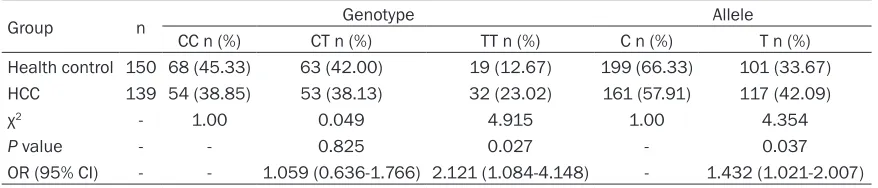
The results indicated that CT genotype exhibit
-ed no significant difference between case and
control groups (P>0.05). In addition, there
existed significant correlation between HCC risk and TT genotype (OR=2.121, 95% CI=
1.084-4.148, P=0.027), and the same to T allele (OR=1.432, 95% CI=1.021-2.007, P=
0.037). Above all, TT genotype and T allele
might increase the risk of HCC (Table 2).
Discussion
HCC is one of the ten malignant tumors
announced by the world health organization (WHO). About 700, 000 new HCC cases occur
and about one million people die of it every
year. More than 50% of the annual newly increased HCC patients appear in China [1, 3].
In recent years, with the development of molec-ular biology, virology and genetics, the occur-rence of HCC is widely regarded as the conse-quence of the long-term effect of various fac-tors. Environment and genetical factors all
involved in the process of HCC [26], such as virus, aflatoxin, alcohol, single nucleotide poly -morphism (SNP), methylation etc. Not everyone who exposed to the carcinogenic factors will suffer the risk of liver cancer, there exists
indi-vidual difference on HCC susceptibility. The
study of HCC susceptibility will contribute to exploring the pathogenesis of HCC.
Amount of studies indicated that the chronic infection of Hepatitis B virus (HBV) is the most dangerous factor that leads to the occurrence
of HCC in China [27], and more than 85% cases
of HBV infection appear to be positive. Chinese population who infected the HBV has a higher risk of HCC. It is concluded that the host’s genetic predisposition plays an important role in the occurrence and development of HCC. As we all know, there is an obvious relationship between HLA complex protein and the immune reaction. Present studies showed that some
HLA polymorphisms might influence the immune reaction of HBV infection [6, 21-24]. So
we speculated that mutations of HLA could down regulate the human immune capacity. As a result, it is easier for HBV to infect the host. In the present study, we provided preliminary
evidence that the HBsAg feature had a signifi
-cant statistic correlation with rs2281388 T/C
polymorphism of HLA-DP gene. But there was
no significant relationship between rs2281388 T/C polymorphism and other clinical stages.
Based on the study, we suggested that the
rs2281388 T/C polymorphism was apparently related to the HCC risk in northern China. The TT genotype and T allele of rs2281388 signifi
-cantly increased the risk of HCC. That is agreed with the research on Graves’ disease [28].
However, Zhang et al. reported that rs2281388
CC genotype significantly decreased HBV per
-sistence, but no significant association with HBV-caused liver cancer [25].
In summary, the TT genotype and T allele of rs2281388 significantly increased the risk of
HCC. But the pathogenic principle of rs2281388 polymorphism in HCC is still unknown.
Therefore, more comprehensive study with large sample size is needed to explore issue.
Well designed research will contribute to sup-Table 2. The comparison between two groups on rs2281388 T/C polymorphism
Group n Genotype Allele
CCn (%) CTn (%) TTn (%) Cn (%) Tn (%) Health control 150 68 (45.33) 63 (42.00) 19 (12.67) 199 (66.33) 101 (33.67) HCC 139 54 (38.85) 53 (38.13) 32 (23.02) 161 (57.91) 117 (42.09) χ2 - 1.00 0.049 4.915 1.00 4.354
[image:3.612.88.527.85.179.2]plying accurate evidence on the pathogenic principle of rs2281388 polymorphism in HCC. Disclosure of conflict of interest
None.
Address correspondence to: Dr. Hongguang Li, Department of Hepatobiliary Surgery, Shandong Provincial Hospital Affiliated to Shandong University, 9677 Jingshi Road, Jinan 250021, Shandong, China. E-mail: [email protected]
References
[1] El-Serag HB and Rudolph KL. Hepatocellular carcinoma: epidemiology and molecular carci-nogenesis. Gastroenterology 2007; 132: 2557-2576.
[2] Liang X, Bi S, Yang W, Wang L, Cui G, Cui F, Zhang Y, Liu J, Gong X, Chen Y, Wang F, Zheng H, Guo J, Jia Z, Ma J, Wang H, Luo H, Li L, Jin S, Hadler SC and Wang Y. Epidemiological sero-survey of hepatitis B in China--declining HBV prevalence due to hepatitis B vaccination. Vaccine 2009; 27: 6550-6557.
[3] Jemal A, Bray F, Center MM, Ferlay J, Ward E and Forman D. Global cancer statistics. CA Cancer J Clin 2011; 61: 69-90.
[4] Constantin CV, Streba CT, Rogoveanu I, Nita-Stefanescu L and Ionescu AG. Cirrhosis and Chronic Viral Hepatitis as Risk Factors for Hepatocellular Carcinoma: Romanian Single-clinic Experience. Maedica (Buchar) 2010; 5: 265-270.
[5] Qian GS, Ross RK, Yu MC, Yuan JM, Gao YT, Henderson BE, Wogan GN and Groopman JD. A follow-up study of urinary markers of aflatox-in exposure and liver cancer risk aflatox-in Shanghai, People’s Republic of China. Cancer Epidemiol Biomarkers Prev 1994; 3: 3-10.
[6] Shaker MK, Abdella HM, Khalifa MO and El Dorry AK. Epidemiological characteristics of hepatocellular carcinoma in Egypt: a retro-spective analysis of 1313 cases. Liver Int 2013; 33: 1601-1606.
[7] Chen X, Wang H, Xie W, Liang R, Wei Z, Zhi L, Zhang X, Hao B, Zhong S, Zhou G, Zhang L, Gao X, Zhu Y and He F. Association of CYP1A2 genetic polymorphisms with hepatocellular carcinoma susceptibility: a case-control study in a high-risk region of China. Pharmacogenet Genomics 2006; 16: 219-227.
[8] Zhang H, Zhai Y, Hu Z, Wu C, Qian J, Jia W, Ma F, Huang W, Yu L, Yue W, Wang Z, Li P, Zhang Y, Liang R, Wei Z, Cui Y, Xie W, Cai M, Yu X, Yuan Y, Xia X, Zhang X, Yang H, Qiu W, Yang J, Gong F, Chen M, Shen H, Lin D, Zeng YX, He F and Zhou G. Genome-wide association study
iden-hepatocellular carcinoma in chronic hepatitis B virus carriers. Nat Genet 2010; 42: 755-758.
[9] Diamantopoulos EJ, Andreadis EA, Va- ssilopoulos CV, Vlachonikolis IG, Tarassi KE, Chatzis NA, Giannakopoulos NS and Pa- pasteriades CA. Association of specific HLA phenotypes with left ventricular mass and ca-rotid intima-media thickness in hypertensives. Am J Hypertens 2001; 14: 632-636.
[10] Fischer GF and Mayr WR. Molecular genetics of the HLA complex. Wien Klin Wochenschr 2001; 113: 814-824.
[11] Tracey MC and Carter JM. Class II HLA allele polymorphism: DRB1, DQB1 and DPB1 alleles and haplotypes in the New Zealand Maori pop-ulation. Tissue Antigens 2006; 68: 297-302. [12] Garcia-Gonzalez IJ, Valle Y, Rivas F,
Figuera-Villanueva LE, Munoz-Valle JF, Flores-Salinas HE, Gutierrez-Amavizca BE, Davalos-Rodriguez NO and Padilla-Gutierrez JR. The 14 bp Del/Ins HLA-G polymorphism is related with high blood pressure in acute coronary syndrome and type 2 diabetes mellitus. Biomed Res Int 2014; 2014: 898159.
[13] Goyette P, Boucher G, Mallon D, Ellinghaus E, Jostins L, Huang H, Ripke S, Gusareva ES, Annese V, Hauser SL, Oksenberg JR, Thomsen I, Leslie S, Daly MJ, Van Steen K, Duerr RH, Barrett JC, McGovern DP, Schumm LP, Traherne JA, Carrington MN, Kosmoliaptsis V, Karlsen TH, Franke A and Rioux JD. High-density map-ping of the MHC identifies a shared role for HLA-DRB1*01:03 in inflammatory bowel dis-eases and heterozygous advantage in ulcer-ative colitis. Nat Genet 2015; 47: 172-9. [14] Lakhanpal M, Singh LC, Rahman T, Sharma J,
Singh MM, Kataki AC, Verma S, Chauhan PS, Singh YM, Wajid S, Kapur S and Saxena S. Contribution of susceptibility locus at HLA class I region and environmental factors to oc-currence of nasopharyngeal cancer in Northeast India. Tumour Biol 2015; 36: 3061-73.
[15] An WX, Fan YX, Liang XH and Liu H. Changes in median ages at death from selected cancer types in relation to HLA-DRB1/DQB1. Asian Pac J Cancer Prev 2014; 15: 4125-4128. [16] Kowalewski DJ, Schuster H, Backert L, Berlin C,
Kahn S, Kanz L, Salih HR, Rammensee HG, Stevanovic S and Stickel JS. HLA ligandome analysis identifies the underlying specificities of spontaneous antileukemia immune re-sponses in chronic lymphocytic leukemia (CLL). Proc Natl Acad Sci U S A 2015; 112: E166-175.
cancer. Asian Pac J Cancer Prev 2013; 14: 7681-7684.
[18] Burmistrova AL, Beliaeva SV, Suslova TA and Bukharin OV. [Comparative characteristics of HLA system gene distribution in patients with lung tuberculosis of the Russian population of Chelyabinsk region]. Zh Mikrobiol Epidemiol Immunobiol 2014; 35-41.
[19] Zhao J, Wang H, Hu W and Jin Y. Effect of HLA-B-associated transcript 3 polymorphisms on lung cancer risk: a meta-analysis. Med Sci Monit 2014; 20: 2461-2465.
[20] Ramos CS, Goncalves AS, Marinho LC, Gomes Avelino MA, Saddi VA, Lopes AC, Simoes RT and Wastowski IJ. Analysis of HLA-G gene poly-morphism and protein expression in invasive breast ductal carcinoma. Hum Immunol 2014; 75: 667-672.
[21] Zhao W, Liu S, Du J, Li C, Dou Q and Shang J. [Clinical significance of DRB1 and HLA-DPB1 gene polymorphisms in cirrhosis pa-tients]. Zhonghua Gan Zang Bing Za Zhi 2014; 22: 744-746.
[22] Tong HV, Thomas Bock C and Velavan TP. Genetic insights on host and hepatitis B virus in liver diseases. Mutat Res Rev Mutat Res 2014; 762C: 65-75.
[23] Su M, Zeng Y, Chen J, Jiang L, Chen T, Liu C, Yang B and Ou Q. [Studies on the association of single nucleotide polymorphisms of HLA-DP and DQ genes with the outcome of chronic hepatitis B virus infection]. Zhonghua Yi Xue Yi Chuan Xue Za Zhi 2014; 31: 765-769.
[24] He D, Tao S, Guo S, Li M, Wu J, Huang H, Guo X, Yan G, Zhu P and Wang Y. Interaction of TLR-IFN and HLA polymorphisms on susceptibility of chronic HBV infection in Southwest Han Chinese. Liver Int 2014; [Epub ahead of print]. [25] Zhang Q, Yin J, Zhang Y, Deng Y, Ji X, Du Y, Pu
R, Han Y, Zhao J, Han X, Zhang H and Cao G. HLA-DP polymorphisms affect the outcomes of chronic hepatitis B virus infections, possibly through interacting with viral mutations. J Virol 2013; 87: 12176-12186.
[26] Buendia MA. Genetics of hepatocellular carci-noma. Semin Cancer Biol 2000; 10: 185-200. [27] Kim MN, Kim BK and Han KH. Hepatocellular
carcinoma in patients with chronic hepatitis C virus infection in the Asia-Pacific region. J Gastroenterol 2013; 48: 681-688.