7
Application Adaptation
RAZVAN POPESCU and ATHANASIOS STAIKOPOULOS, Trinity College Dublin
ANTONIO BROGI, University of Pisa
PENG LIU and SIOBH ´AN CLARKE, Trinity College Dublin
Advances in pervasive technology have made it possible to consider large-scale application types that poten-tially span heterogeneous organizations, technologies, and device types. This class of application will have a multilayer architecture, where each layer is likely to use languages and technologies appropriate to its own concerns. An example application is a geographically large-scale crisis management system. Typically, such applications are required to dynamically adapt their behavior based on current circumstances, with adap-tations potentially affecting all layers of the application. The complexities involved in dynamically adapting multilayer applications will significantly benefit from formal approaches to its specification.
This article presents a new methodology for flexible, multilayer application adaptation, with layer-specific adaptation solution templates bound to application mismatches that are organized into hierarchical tax-onomies. Templates can be linked either through direct invocations or through adaptation events, support-ing flexible cross-layer adaptation. The methodology illustrates the use of different formalisms for different elements of its specification. In particular, we combine semiformal metamodeling techniques for the system model specification with formal Petri nets, which are used to capture template matchmaking using reacha-bility analysis. This work demonstrates how existing formalisms can be used for the specification of a generic adaptation model for pervasive applications.
Categories and Subject Descriptors: D.2.2 [Design Tools and Techniques]: Petri nets
General Terms: Algorithms
Additional Key Words and Phrases: Cross-layer adaptation, multilayer applications, taxonomies of applica-tion mismatches, adaptaapplica-tion templates, matchmaking, context-aware systems, Petri nets
ACM Reference Format:
Popescu, R., Staikopoulos, A., Brogi, A., Liu, P., and Clarke, S. 2012. A formalized, taxonomy-driven approach to cross-layer application adaptation. ACM Trans. Autonom. Adapt. Syst. 7, 1, Article 7 (April 2012), 30 pages. DOI=10.1145/2168260.2168267 http://doi.acm.org/10.1145/2168260.2168267
1. INTRODUCTION
Pervasive computing envisions a seamless and distraction-free environment of dis-tributed and heterogeneous applications and devices that utilize resources in their en-vironment. Devices and applications are context-aware, meaning that they can sense changes to their executing environment and manage information automatically and transparently. Recent technological advances in mobile devices as well as wireless and sensor networks make it possible to construct pragmatic, large-scale applications
Authors’ addresses: R. Popescu (corresponding author) and A. Staikopoulos, School of Computer Science and Statistics, Trinity College Dublin, Dublin, Ireland; email: [email protected]; A. Brogi, Computer Science Department, University of Pisa, Italy; P. Liu and S. Clarke, School of Computer Science and Statistics, Trinity College Dublin, Dublin, Ireland.
Permission to make digital or hard copies of part or all of this work for personal or classroom use is granted without fee provided that copies are not made or distributed for profit or commercial advantage and that copies show this notice on the first page or initial screen of a display along with the full citation. Copyrights for components of this work owned by others than ACM must be honored. Abstracting with credit is permitted. To copy otherwise, to republish, to post on servers, to redistribute to lists, or to use any component of this work in other works requires prior specific permission and/or a fee. Permissions may be requested from Publications Dept., ACM, Inc., 2 Penn Plaza, Suite 701, New York, NY 10121-0701 USA, fax+1 (212) 869-0481, or [email protected].
c
2012 ACM 1556-4665/2012/04-ART7 $10.00
for pervasive computing. Large-scale applications have the potential to span different infrastructures (wireless networks, sensors, services), combine different technologies (e.g., communications, middleware) and device types, to offer an integrated pervasive framework with rich capabilities across many conceptual application layers. A geo-graphically large-scale crisis management system is illustrated in this article, and is an example of such an application type.
The scale and complexity of such application types pose new challenges. In order to cope with their conceptual complexity, applications will need to be organized in a multilayer architecture. Each layer is likely to use languages and technologies ap-propriate to its own concerns. For example, there may be layers that manage device types, middleware, organization, behavior, implementation (services), representation, or security-trust concepts of the system. The provision of properties such as robustness and fault tolerance is challenging because of user/device mobility, network vulnera-bility, and device/software heterogeneity. Typically, such context-aware applications are required to dynamically adapt their structure and behavior based on continuously changing environments and requirements, with such adaptations potentially affecting all defined layers of the application. In addition, the level of heterogeneity inherent in large-scale pervasive applications makes it difficult to foresee all possible types of clients and interaction patterns that such applications must follow. A static adaptation solution encoded in the application is therefore not always sufficient.
In this article we outline a generic formal methodology that supports flexible cross-layer adaptation in multicross-layer applications. The task of addressing the challenges in-volved in dynamically adapting multilayer applications can significantly benefit from the use of formal approaches, and this article illustrates the use of different formalisms for different elements of its specification. In particular, we combine semiformal meta-modeling techniques for the structural specification of the model, with the more formal Petri Nets (PNs), which are used to capture complex behavior. The goal is to enhance and semiautomate the adaptation process. At a high level, the main structural
ele-ments of the adaptation methodology are:Templates(also known as patterns) that
de-fine generic adaptation solutions to common application mismatches, andTaxonomies
of application mismatchesthat provide classifications of common layer-specific appli-cation mismatches [Becker et al. 2004].
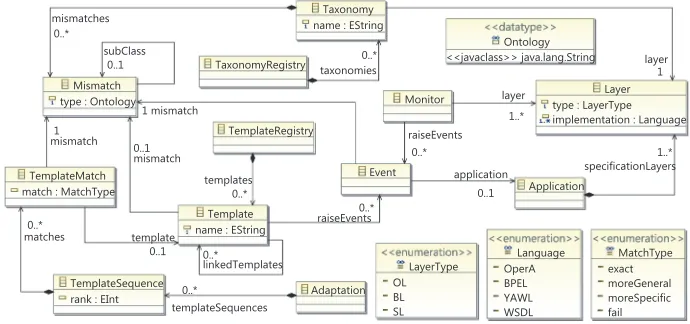
Fig. 1. A metamodel formalization for the system model.
The remainder of this article is organized as follows. Section 2 provides an overview of our cross-layer adaptation methodology. In Section 3 we formalize our methodology and present its application to the adaptation of a pervasive crisis management application. In Section 4 we describe related work. Section 5 presents a qualitative-based evaluation of our approach, followed by some concluding remarks in Section 6.
2. OVERVIEW OF THE ADAPTATION METHODOLOGY
In this section we present the structural and behavioral elements of our adaptation methodology, together with a description of the adaptation process. We illustrate the system model for our approach with a standard MOF [OMG 2006] metamodel; see Figure 1. The metamodel illustrates how elements of our approach such as layers, applications, events, mismatches, taxonomies, templates, template matches, and se-quences are defined and used.
Multilayer applications.Our system model supports applications with multiple lay-ers. Each layer has a type and one or more definition or implementation languages. Applications are defined as sets of specification layers. For example, a service-based application may have three layers: a “service layer" specifying services used by the ap-plication and defined using WSDL [Christensen et al. 2001], a “behavioral layer” that specifies the application as an orchestration of services and defined using BPEL [Alves et al. 2007], and an “organizational layer” that specifies the stakeholders involved in the business process defined using OperA [Dignum 2003].
Events.Adaptation events encapsulate application mismatches and are raised by layer-specific monitors [Erradi et al. 2006; Ezenwoye and Sadjadi 2007; Kazhamiakin
et al. 2009; Moser et al. 2008; Popescu et al. 2009]. Example events may be
message-ordering mismatch(at a behavioral layer), orinvocation mismatch(at a service layer).
Taxonomies of application mismatches.We classify adaptation techniques based on taxonomies of application mismatches that they can handle. For each application layer, the application architect/designer defines one or more such taxonomies. Taxonomies
should be tree-based withis arelationships between children and parent mismatches.
Given any two mismatchesm1andm2belonging to the same taxonomy, ifm1is the same
asm2 we say that they matchexactly. Both refer to the same application mismatch.
Ifm1is an ancestor ofm2 we say that there is aplug-inmatch between them;m2is a
submismatch ofm1. Dually, ifm1is a descendant ofm2we say that there is asubsumes
[image:3.612.131.476.119.281.2]By modeling taxonomies in this way, it is likely that adaptation techniques that can tackle higher-level nodes in the taxonomy can cope with application mismatches at lower levels of the taxonomy. Higher taxonomy nodes refer to bigger adaptation issues that require more radical changes. For example, a mismatch between the expected and actual input of a service could be resolved either by an adaptation that was designed for service input mismatches (exact match) or by an adaptation that was designed for service interface mismatches (more general match). Dually, adaptation techniques that tackle lower-level nodes in the taxonomy may also (partially) solve mismatches at higher-level nodes of the taxonomy. So, for example, a mismatch between the expected and the actual behavior of a service client could be solved by an adaptation that solves sequential mismatches (more specific match), when the service client’s behavior is a sequence of service calls.
Adaptation templates. Templates define mechanisms to deal with application mis-matches, that is, they express the behavior of adaptation processes. Developers expose adaptation templates as services that provide interfaces for invocation (e.g., WSDL). Developers further associate the templates they develop to application mismatches corresponding to the types of issues they can cope with. For example, an adaptation template based on the algorithm defined in Brogi and Popescu [2006] can be used to
solvemessage-ordering mismatches and should be associated to the respective
appli-cation mismatch. We assume the existence of registries of adaptation templates. There may be different templates bound to the the same mismatch. For example, one might handle an adaptation in a behavioral layer using BPEL processes, while another adapts YAWL workflows. Depending on the concrete language in use in a mismatch situation, the appropriate template should be used.
Cross-layer adaptation. Application mismatches may require changes at various lay-ers of an application. For example, in our previous service-based application, an event that captures a mismatch between stakeholder roles at the organizational application layer may require the removal of one role and the addition of another. This may also trigger changes at the behavioral and service layers. The behavior may be adapted so as to take into account the new role and a new partner link. A new service may be needed to fulfil an organizational goal of the new role. Such complex scenarios that cross several application layers can be implemented by linking adaptation templates corresponding to layers where adaptation is needed. Templates may be linked both
directlyandindirectly. In the direct case, a template invokes another adaptation tem-plate. In the indirect case, a template raises an event that will lead to the selection and execution of another template. Linking adaptation templates directly through invocations may be preferred when layers have tight dependencies (e.g., when a behav-ioral template makes use of another that (un)deploys a service) and these templates are unlikely to change over time, or when linking adaptation templates at the same layer. Linking adaptation templates indirectly through events may be preferred when more flexibility is required, for example, when adaptation templates and application-mismatch taxonomies are likely to change over time, or when triggering templates at different application layers. Linking templates and mismatches in taxonomies has the following benefits.
—Flexibility. Both application and adaptation logic may evolve over time. As developers evolve their applications, they may replace adaptation logic by replacing the event that triggers the required adaptation, or handle new mismatches by assigning new templates.
Fire Brigade Police Medical regulate _traffic Citizen provide_medical _assistance rescue _people resolve _incident Emergency Centre Sensor Role: Emergency_Centre
Objectives: handle_incident(Incident, Location) Sub-Objectives: file_incident ()
Role: Medical
Objectives: provide_medical_assistance()
Role: Fire_Brigade
Objectives: resolve_incident(), rescue_people()
Role: Police
Objectives: requlate_traffic()
Dependencies:
Emergency_Centre provide_medical_assistance Medical Emergency_Centre resolve_incident Fire_Brigade
Emergency_Centre rescue_people Fire_Brigade Emergency_Centre requlate_traffic Police
Organisation Level (OL) Behaviour L evel (BL) Service Level (SL) report _incident report _incident
PlanRoute (in: Location, in: Location, out: Route)
<service> External
WeatherForecast (in: Region, in: Date, out: Forecast)
WaterLevelMonitor (out: WaterLevel, out: SensorID, out: Location)
GetTrafficDirections()
<service> Police
RegulateTraffic() ReportIncident (in: Incident, in: Source,
in: Region)
<service> Emergency Centre
FileIncident (in: IncidentDetails, out: Report)
ProvideMedicalAssistance() <service> Medical ResquePeople() <service> Fire Brigade ResolveIncident() <manual>
<automated> Handle Incident
Resc ue & Resolve Regulate T raffic Pro vide Medic a l Ass istance
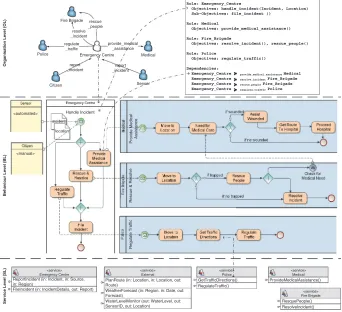
Fig. 2. Layers of a crisis management application.
efficiently through an adaptation template that just replaces the transport protocol, rather than looking for an alternative service and then replacing the entire service. —Increased application robustness.Although one would ideally employ only tailored adaptation templates, robust applications may consider employing substitute adap-tation templates when no exact ones can be found.
3. FORMALIZING THE ADAPTATION ENVIRONMENT WITH PETRI NETS
The adaptation model can be formally represented by means of PNs [Petri 1962].
More precisely, an adaptation environment, consisting of mismatch taxonomies and
adaptation templates associated with mismatches, can be modeled by a single PN. Such a PN can be exploited to model which templates can be (best) applied to solve an application mismatch.
[image:5.612.134.476.119.431.2]For example, one region has to be evacuated using a Transport Agency. In addition, resources (such as TransportService) may not be interoperable due to a number of mismatches.
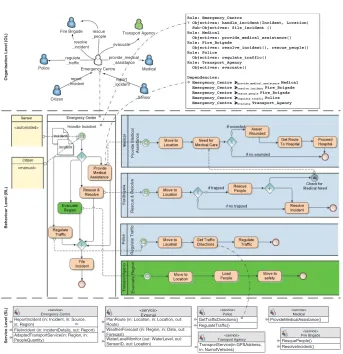
The application has three conceptual layers: Organization (OL), Behavior (BL), and Service (SL). The layers are related to one another, so adaptations defined at one layer could be linked to another in any direction. The OL specifies the application’s organizational requirements, modeled using OperA [Dignum 2003]. Software entities
undertakeroles, which are assigned toobjectives, that is, goals that roles have to fulfil.
Dependenciesmark the interactions among roles and depict howobjectivesare fulfilled by using roles. There are six roles: Emergency Center, Police, Fire Brigade, Medical Agency, Citizen, and Sensor (see top part in Figure 2). The Emergency Center role depends on the Citizen and Sensor roles to get an incident report, which initiates its main objective, that is to handle an incident. Handling the incident from the Emer-gency Center involves regulating the traffic, resolving the incident, rescuing people, and providing medical assistance. These requirements (objectives) are fulfilled by the Police, Fire Brigade, and Medical Agency roles. The BL details how stakeholders (pro-cess participants) undertake the organizational roles and orchestrate their tasks to fulfil the organizational requirements: objectives. The orchestration of tasks is repre-sented by the Business Process Modeling Notation (BPMN) [OMG 2009] and executed with a Business Process Execution Language for Web services (WS-BPEL) [Alves et al. 2007]. In our case study, a Citizen (manual task) or a Sensor (automated task) initi-ates the Handle Incident process provided by the Emergency Center (see middle part in Figure 2). Once the process receives the incident message, a parallel flow initiates the Provide Medical Assistance, Rescue and Resolve and Regulate Traffic tasks, that refer to processes offered by the Medical Agency, Fire Brigade, and Police participants. Once all previous processes terminate, a File Incident task will create an incident report. The SL presents the available services, together with their providers. For ex-ample (see bottom part in Figure 2), there are ReportIncident and FileIncident ser-vices from EmergencyCenter, GetTrafficDirections and RegulateTraffic serser-vices from Police, a ProvideMedicalAssistance service from Medical Agency, RescuePeople and Re-solveIncident services from FireBrigade, as well as PlanRoute, WeatherForecast, and WaterLevelMonitor services from other external providers. In principle, tasks defined at the BL are resolved to service invocations.
3.1. Adaptation Templates
Adaptation templates are formally described by PNs. PNs provide a mathematical modeling language for describing distributed systems and process analysis. Formally, PNs are graphs in which nodes are places (depicted as circles) and transitions (depicted as rectangles). Directed graph arcs connect places and transitions. Arcs originate at places and target transitions, or vice versa. Places hold tokens (e.g., a token can repre-sent a condition such as “the adaptation environment has a template associated with
mismatchm”). Transitions “transport” tokens from their input to their output places.
Template Tx
i(Tx) invoke(Tz)
invoked(Tz)
o(Tx)
Template Ty
i(Ty) raise(Ez)
raised(Ez)
o(Ty) (a)
(b)
Fig. 3. Example templates: (a) TemplateT xinvokes another templateT z. (b) TemplateT yraises an event
Ez. (Key transitions and places are colored in grey.)
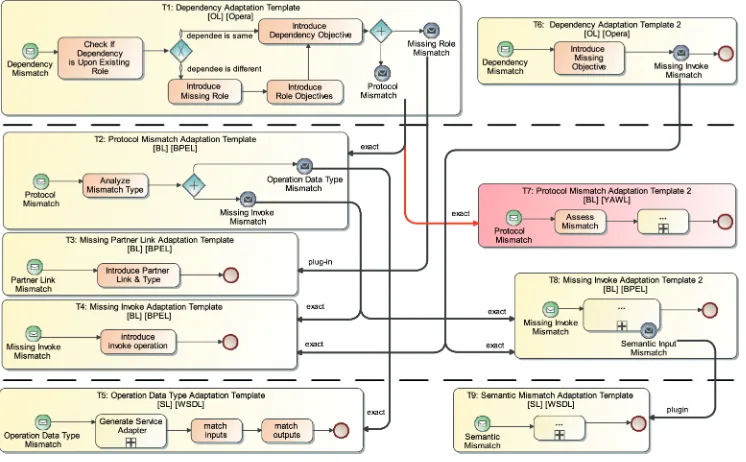
Fig. 4. Examples of adaptation templates with potential matches.
Templates that invoke other templates and/or raise events are modeled by PNs that describe their nondeterministic (communication) behavior. Figure 3 shows the PN
specifications of two examples. The top shows a template T x that invokes another
template T z(direct link). The bottom shows a template T ythat raises an event Ez
(indirect link). An invoked template is defined with aninvoke transition followed by
aninvokedplace. A raised event is defined with araisetransition followed by araised
place.
[image:7.612.199.413.118.264.2] [image:7.612.120.493.304.535.2]p(m)
MoreSpecific MoreGeneral
DOWN(m) m
UP(m) T(m)
Exact
LEGEND
m - Petri net place representing mismatch m p(m) - Petri net place corresponding to the parent mismatch of m
UP(m), MoreGeneral - supporting Petri net place and transition that direct query tokens from m to P(m) in search for templates bound to ancestors of m (if any)
DOWN(m), MoreSpecific - supporting Petri net place and transition that direct query tokens from P(m) to m in search for templates bound to descendants of m (if any)
T(m), Exact - supporting Petri net place and transition that direct query tokens to templates associated to m (if any)
select template, select(Tx) - Petri net place and transition that bind templates to the mismatch pattern and support the selection of templates during queries
select template
select(Ta) select(Tz)
Template Ta
Template Tz
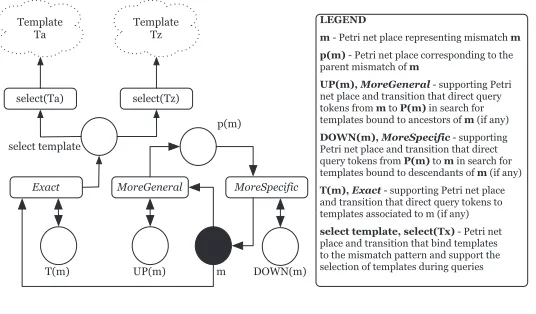
Fig. 5. PN taxonomy pattern.
the OL (top of figure), the adaptation template T1handles adependency mismatchfor
the OperA language. T1will initiate two parallel mismatches: aprotocol mismatchand
amissing role mismatch. The protocol mismatch is matched exactly to triggers of T2
and T7. However, T7is not a valid match as it is associated with a different
implemen-tation language (YAWL), so it is ignored. The missing role mismatch is matched to a
partner-link mismatch of T3with a more general match. Across the three layers,
mis-match triggering occurs in a similar manner. Please refer to Section 2 of the electronic appendix for details on the mismatch taxonomies of this scenario.
3.2. Taxonomies of Application Mismatches
We employ a PN pattern for the formal description of mismatches (see Figure 5). The pattern defines PN places and transitions that encode the following behavior.
—Select an adaptation template. In an adaptation environment, adaptation events are represented as tokens placed in the application mismatches they match. For example,
an event of typem(that occurs at application runtime) will be represented by a token
in the mplace of the corresponding mismatch. The availability of an adaptation
template bound to this mismatch (i.e., an adaptation solution for mismatch m) is
represented by a token in theT(m) place. The PN pattern will enable the execution
of aselect(T x) transition that will lead to the selection of an adaptation solution for
m.
—Navigate the taxonomy of mismatches upwards. The MoreGeneral transition and
U P(m) place enable the search for more general adaptation solutions when no
adap-tation templates are bound tom. In such cases a token will be pushed from minto
the place representing its parent mismatch in the taxonomy,p(m).
—Navigate the taxonomy of mismatches downwards. Assuming an adaptation event
matching p(m), the MoreSpeci f ic transition and Down(m) place enable the search
for more specific adaptation templates when no adaptation templates are bound to
p(m) or to any of p(m)’s ancestors.
The algorithms defining the required PN changes for the association and dissociation of templates are presented in Section 3 of the electronic appendix.
[image:8.612.174.442.123.280.2]Engine Event Bus
Application (Layer 1) Monitor 1
Adaptation Matchmaker
Taxonomy 1
Adaptation Templates
Registry of Taxonomies
of Adaptation Triggers Registry of Adaptation Templates
1
2 3 4
6
5b
5a
Fig. 6. Overview of our adaptation methodology.
3.3. Adaptation Process
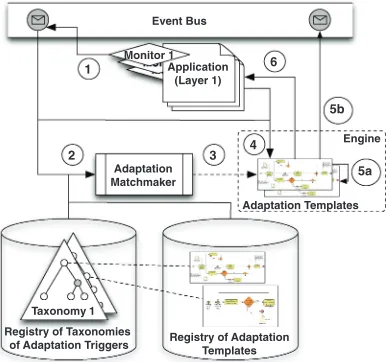
Figure 6 illustrates the main steps of our methodology for the cross-layer adaptation of multilayer applications.
3.3.1. Triggering the Adaptation Process.The adaptation process starts when a layer mon-itor (or a human stakeholder) raises an adaptation event (step 1 in Figure 6). A match-maker selects adaptation templates that may tackle the application mismatch iden-tified by the event (steps 2 and 3 in Figure 6). The matchmaker inputs a query that references the event, application, and adaptation environment and outputs a ranked
list ofsequences of templatesthat may solve the mismatch. The process first identifies
the taxonomy and mismatch that match the event. Then, it “navigates” the taxonomy
in search of adaptation templates associated to the respective mismatch (exact
solu-tions), their ancestors (more generalsolutions) or descendants (more specificsolutions).
Sequences of templates result from this process. The core of the matchmaking process is a reachability analysis of the PN that represents the adaptation environment.
Selecting the taxonomy and mismatch. The event definition contains a reference to a taxonomy mismatch. This information is used by the matchmaker to identify the taxonomy and the mismatch in the adaptation environment of the application. If the mismatch is found, then the matchmaker enables the search for possible sequences of adaptation templates by placing a token in the PN place corresponding to the matched mismatch. If no mismatches are found, the adaptation process aborts.
Matching adaptation templates. The matchmaker checks whether there are tem-plates bound to the matched mismatch. For each such template, the matchmaker checks whether the template can be employed for the desired adaptation by verifying that the specification of the application at the matched taxonomy layer can be processed by the template. For example, for our crisis management case study, templates bound to mismatches at the behavioral layer have to be able to adapt BPEL processes [Alves et al. 2007], since the application’s behavioral layer is expressed using BPEL. Next, the matching process analyses the template’s dependencies as directed by the PN
template structure. If noexacttemplates are found, the matchmaker checks whether
[image:9.612.209.402.118.299.2]other templates or taxonomies) as described previously. Otherwise, the matchmaker continues by searching for templates corresponding to the rest of the ancestors of the matched mismatch (if any), up to the root mismatch.
If there are no templates bound to the root mismatch, the matchmaker investigates the children of the matched mismatch. If any exist, the adaptation process analyses their dependencies. Otherwise, the matchmaker searches for templates corresponding to the rest of the descendants of the matched mismatch (if any), down to the leaves of the taxonomy.
The matchmaker generates the possible sequences of templates that may tackle a raised event through a reachability analysis of the PN encoding the adaptation environment. Please refer to Section 4 of the electronic appendix for a description of how the reachability analysis works.
Ranking sequences of templates. The matchmaker allows for a user-configurable ranking of matched sequences of adaptation templates that employs the following criteria:
C1. number of more specific template matches,
C2. number of more general template matches,
C3. number of templates, and
C4. number of raised events.
Generally speaking, exact templates are preferred to more general templates,
which are preferred to more specific ones. Note that, from a ranking perspective,
templates invoked directly are treated as exact templates. By default, the ranking
system applies the aforesaid criteria in top-down order and sequences with lower criteria scores rank higher. When two sequences have the same score for criterion
Cx, criterion Cx+1 applies (if any). Hence, a set of three sequences SequenceSet =
{S1,S2,S3,S4}, where CriteriaScores(S1) = 2,0,3,1, CriteriaScores(S2) = 0,0,
3,3, CriteriaScores(S3) = 0,1,4,3, and CriteriaScores(S4) = 0,1,5,2 will be
ranked as “S2,S3,S4,S1”, withS2ranked highest. The criteria to be applied, and their
order, can be configured by the user.
Adaptation Event and Template Sequences for the Crisis Management Case Study. As the case study is executed, contextual rules are evaluated periodically by the monitor by collecting data from sensors and services. As the severity of the incident escalates, these rules are validated to true and specific events are emitted and matched against predefined adaptation templates to accommodate the new requirements and failures. For example,
i f(W ater Level>10m and Forecast=Storm)then adapt(Level3)
states that the case study will be adapted to a new severity level (Level3), if the Wa-terLevelMonitor service and the WeatherForecast service report that the WaterLevel is greater than 10m and the Forecast is storm, respectively. Consequently, processes that are still active and long running such as the Handle Incident (Provide Medical Assistance, Rescue and Resolve, and Regulate Traffic) need to be adapted to reflect the new configuration requirements. The increase in the incident’s severity mandates that the Emergency Center has to coordinate the evacuation of the region, by utilizing a
new role, Transport Agency. Adependency mismatchevent is emitted from the monitor,
denoting the evacuate dependencyobjectiveand the Transport Agency role are not
ful-filled by the Emergency Center role (Figure 8). The matchmaker will fetch and match
the event to adependency mismatch. This is an exact match that can trigger both T1
Protocol Mismatch MoreGeneral UP(Missing-Invoke Mismatch) T(Protocol Mismatch) Exact Dependency Mismatch T(Dependency Mismatch) Exact select template select(T1) select(T6) T6 i(T6) raise(Missing Invoke Mismatch) o(T6) Missing-Invoke Mismatch T(Missing-Invoke Mismatch) Exact select template select(T4) select(T8) T4 i(T4) o(T4) T8
i(T8) raise(Semantic Input Mismatch) o(T8) select template select(T2) select(T7) T7 i(T7) o(T7) Partner-Link Mismatch MoreGeneral UP(Missing-Role Mismatch) T(Partner-Link Mismatch) Exact Missing-Role Mismatch T(Missing-Role Mismatch) Exact select template select(T3) T3 i(T3) o(T3) Operation Data-Type Mismatch T(Operation Data-Type Mismatch) Exact select template select(T5) T5 i(T5) o(T5) Semantic Mismatch MoreGeneral UP(Semantic-Input Mismatch) T(Semantic Mismatch) Exact Semantic-Input Mismatch T(Semantic-Input Mismatch) Exact select template select(T9) T9 i(T9) o(T9) OL SL BL T1 i(T1) raise(Missing Role Mismatch) o(T1) raise(Protocol Mismatch) T2 i(T2) raise(Operation Data Type Mismatch) o(T2) raise(Missing Invoke Mismatch)
Fig. 7. Adaptation environment for the crisis management case study. (Taxonomy transitions and places are
colored in black. Transitions that invoke templates or trigger events are colored in grey. Tokens are colored in yellow.)
From the configuration of adaptation templates, different adaptation template se-quences can be resolved. Selecting the more suitable one is based on an analysis and ranking of the criteria, in this case starting from the adaptation environment in
Fig-ure 7. With an event of typedependency mismatch, we can have the following valid
sequences, ranked as follows.
(1). T6, T4, CriteriaScore:0,0,2,1and
(2). T6, T8, T9, CriteriaScore:0,1,3,2.
(3). T1, T3, T2, T5, T4, CriteriaScore:0,1,5,4, and
(4). T1, T3, T2, T5, T8, T9, CriteriaScore:0,2,6,5.
PN transitions executed on a reachability graph corresponding to the
adap-tation environment in Figure 7 are: Exact(De pendencyMismatch), select(T6),
raise(MissingInvokeMismatch),Exact(Missing−RoleMismatch), andselect(T4), from
[image:11.612.141.469.120.475.2]Fire Brigade Police Medical regulate _traffic Citizen provide_medical _assistance rescue _people resolve _incident Sensor Role: Emergency_Centre
Objectives: handle_incident(Incident, Location) Sub-Objectives: file_incident ()
Role: Medical
Objectives: provide_medical_assistance() Role: Fire_Brigade
Objectives: resolve_incident(), rescue_people() Role: Police
Objectives: requlate_traffic() Role: Transport_Agency Objectives: evacuate()
Dependencies:
Emergency_Centre provide_medical_assistance Medical Emergency_Centre resolve_incident Fire_Brigade Emergency_Centre rescue_people Fire_Brigade Emergency_Centre requlate_traffic Police Emergency_Centre evacuate Transport_Agency
Organisation Level (OL) Behaviour Level (BL) Service L evel (SL) report
_incident _incidentreport
PlanRoute (in: Location, in: Location, out: Route)
<service> External
WeatherForecast (in: Region, in: Date, out: Forecast)
GetTrafficDirections()
<service> Police
RegulateTraffic() ReportIncident (in: Incident, in: Source,
in: Region)
<service> Emergency Centre
FileIncident (in: IncidentDetails, out: Report)
ProvideMedicalAssistance() <service> Medical ResquePeople() <service> Fire Brigade ResolveIncident() Transport Agency evacuate Emergency Centre TransportService(in:GPSAddress, in: NumofVehicles) <service> Transport Agency
AdaptedTransportService(in: Region, in:
PeopleQuantity) WaterLevelMonitor (out: WaterLevel, out: SensorID, out: Location) <manual>
<automated> Handle Incident
Resc ue & Reso lve Reg ulate Traf fi c Prov ide M edical Assistance E vacuate Regio n
Fig. 8. Adapting the case study across layers due to reconfiguration.
3.3.2. Performing the Adaptation.The process of engineering and adapting applications may be fully automated when the sequences of adaptation templates contain only
exacttemplates for which there exists the necessary input information (e.g., the inputs needed for the execution of the templates are provided by the raised event). Sequences
containingmore generalandmore specifictemplates require developer intervention for
adaptation selection. The developer may choose an adaptation based on the sequences presented and may also customize it prior to its execution based on whether it can handle the required adaptation given the application execution context.
Adapting the Crisis Management Case Study. Figure 8 presents the result of an adaptation process based on sequence (3), which provides cross-layer adaptation across
all application layers. At the OL, a new evacuateobjectiveis assigned to the Emergency
Center, using a new Transport Agency role. At the BL, an evacuate task is introduced in the Handle Incident process using a service from the Transport Agency. At the SL, the Transport service is adapted by the AdaptedTransport service that resolves parameter types mismatches.
More specifically, the application of the T1 adaptation template introduces a
new role (Transport Agency) to offer transport for evacuation. For the missing role
[image:12.612.133.476.104.458.2]TransportService can be invoked. The assignment of the evacuateobjectivedependency
also triggers a Protocol mismatch. T2 identifies both a missing invoke and an
Oper-ation Data Type mismatch. The missing invoke initiates the T4 adaptation template that alters (Handle Incident) by inserting an invoke operation for the evacuation
service provided by the Transport Agency. The Operation Data Type mismatch is
triggered by incompatible service parameters. The TransportService requires as input a GPSAddress and a number of vehicles, where previously the application operates
with Regions and people numbers. The application of the T5 adaptation template
creates a proxy service adapter (AdaptedTransportService), that intercepts the invoke operation and converts the service parameters to appropriate types.
4. RELATED WORK
This section presents related core adaptation techniques, aspect-oriented programm-ing-based adaptation approaches, ontology-aware adaptation frameworks, formal (PN-based) adaptation frameworks, and multilayer adaptation approaches.
Core adaptation frameworks. Targeted only at the service layer, Erradi et al. [2006] describe a framework for dynamic Web service selection and composition, designed to improve service application dependability. Dedicated framework services monitor interactions with participating services to verify that monitoring policies are satisfied. Similarly to our approach, whenever an undesired condition is detected, the monitoring service generates a violation event to trigger adaptation. van den Heuvel et al. [2007] propose a configurable adapter architecture for self-adaptive Web services. The key construct is a generic protocol adapter that defines a mapping between businesses’ pro-tocols that orchestrate service providers and consumers. At runtime, a service manager composes existing mappings to adapt interacting services. Although the architecture is extensible, it solves only Web Service protocol mismatches and it is not clear how self-adaptation of Web services can be triggered and woven to the running business process instance.
Aspect-oriented programming-based approaches. Various approaches propose the use of Aspect-Oriented Programming (AOP) to implement an adaptation. Kongdenfha et al. [2009] propose a framework using AOP for service adaptation due to interface and pro-tocol mismatches. The approach requires developers to manually define a mismatch before performing the adaptation. Charfi et al. [2009] define a plug-in architecture for self-adaptive Web service compositions by modularizing self-adaptation features in aspect-based plug-ins. Aspects can be hot-deployed to BPEL engines that support the aspect-oriented workflow language AO4BPEL. Karastoyanova and Leymann [2009] il-lustrate how the AOP paradigm can be mapped and applied in the BPEL language to enable the adaptation of running orchestrations. The authors do not discuss how to gen-erate appropriate WS-Policy attachments (aspects) for the desired service adaptation.
Ontology-aware adaptation frameworks. There is also ongoing research on auto-matic matchmaking and adaptation of Web services using ontologies. William et al. [2003] provide a framework for semantic matchmaking and service adaptation called ICENI. In this framework, the programmatic interface of services is annotated using OWL [McGuiness and van Harmelen 2004] in relation to some domain concepts. With the help of this ontology information, a syntactically different but semantically equiv-alent service can be autonomously adapted and substituted, but it deals only with sig-nature mismatches. Syu [2004] proposes ontology-aware approach service adaptation that solves limited cases of service signature mismatch and returns only exact matches.
of adaptation contracts used to overcome signature and behavioral mismatches. The algorithm is based on synchronous products and PN encoding. Gierds et al. [2008] gen-erate an adapter for interacting services with mismatches. Based on the Specification of Elementary Activities (SEA) that consists of transformation rules on message types that services use, the adapter specification can be generated automatically using a PN algorithm. Martens [2005] presents a method to define and verify usability (i.e., a soundness criterion for business workflow modules) using PNs.
With respect to these adaptation approaches, our proposal features a formal cross-layer adaptation framework that handles generic multicross-layer applications using tax-onomies of mismatches and adaptation templates. Our focus is on the dynamic and flexible discovery of composite adaptation templates that solve cross-layer adaptation dependencies.
Multilayer adaptation approaches. Gjørven et al. [2008] propose a technology-agnostic adaptation middleware that can be used to integrate adaptation techniques from both application and service layers. The middleware focuses on providing a frame-work that integrates adaptation techniques in different layers in order to control them in one place. Kazhamiakin et al. [2009] propose a cross-layer framework and under-lying conceptual model adopted in the S-Cube [2011] project to address monitoring and adaptation in service-based applications. The authors provide a set of require-ments for cross-layer monitoring and adaptation frameworks of service-based applica-tions and illustrate a uniform conceptual model underlying such frameworks. However, this cross-layer framework, to the best of our knowledge, is bound to three predefined layers (i.e., BPM, SCC, and SI), and new layers cannot be easily supported.
In summary, many existing adaptation techniques, such as the ones presented before, can be plugged into our adaptation framework as adaptation templates. For example, one may define an adaptation template based on the algorithm described in Kongdenfha
et al. [2009] to solveextra-message mismatches at the behavioral layer.
Ontology-aware service discovery approaches. Related work in semantic Web service discovery matches services to client queries. Some approaches search for single ser-vices (e.g., Li and Horrocks [2003], Klusch et al. [2006], and Srinivasan et al. [2006]) while others combine multiple (partial) service matches into composite services (e.g., Aversano et al. [2004], Benatallah et al. [2005], and Mokhtar et al. [2005]). These approaches, however, do not offer direct support for software adaptation. Matches usu-ally consist of services that comply with the inputs and outputs specified by the query. Bansal and Vidal [2003] and Pagliarecci et al. [2007], among others, augment queries with a specification of the desired service behavior. Query inputs and outputs can con-tain ontological information, which can be used (similarly to Paolucci et al. [2002]) to match services that can provide alternative outputs, or accept alternative inputs. For more information on ontology-aware service discovery approaches, see Corfini [2008].
5. EVALUATION
of Excellence in Software Services and Systems [S-Cube 2011]). Our assessment of each approach’s features is synthesised (in Section 5.4) in a set of results that reflect standard software development process steps, used as the basis for comparison. These are: requirements analysis (Req), Design (Des), Implementation (Imp), Integration (Int), Testing (Tes), Deployment (Dep), and Maintenance (Mai). For all scenarios and frameworks considered, we assume the existence of adaptation behavior (available as WSDL services) from which templates can be (manually) generated. The availability, or lack thereof, of code to support such behavior will have the same development impact for every approach considered.
5.1. Modify an Existing Adaptation to New Requirements
In this case we evaluate how an existing adaptation environment can be reused or modified to an emerging adaptation requirement. In particular, we distinguish two cases: one in which the existing adaptation environment is sufficient to adapt the application to its new requirements and one in which the adaptation environment needs to be modified.
In the crisis management scenario different stakeholders need to be orchestrated for the evacuation of a region when the threat level increases above a certain threshold. The application consists of three conceptual layers: Organization (defining relationships and rules among stakeholders in OperA), Behavior (defining stakeholders’ processes in BPEL), and Service (defining services offered or used by stakeholders in WSDL). Please note that we abbreviate the three application layers of this scenario as OL, BL, and SL. First, we assume that the medical team also needs to provide assistance to remote locations. In this case, the wounded are transferred either directly to hospitals as before, or to a nearby location for transfer with an air ambulance. The required adaptation is
performed at the BL, by modifying theProvide Medical Assistanceprocess for a medical
team. As a result, a conditional node is introduced to check whether air assistance is
needed, by raising aSequence vs. Conditional Mismatch, followed by either the existing
task toGet Route to Hospital or a new task toProceed to Nearby Air Ambulance by
raising aMissing Invoke Mismatch. In this case, the adaptation environment remains
unchanged.
Second, we assume that developers want to enhance the adaptation environment to solve semantic mismatches of inputs and outputs of services, for example, to identify
locations as regions with GPS coordinates. This is achieved by modifying theOperation
Data Type adaptation template by either associating it directly with the Semantic Mismatchadaptation template, or by triggering aSemantic Mismatch. In this case, the adaptation environment is updated automatically to reflect changes of the adaptation templates.
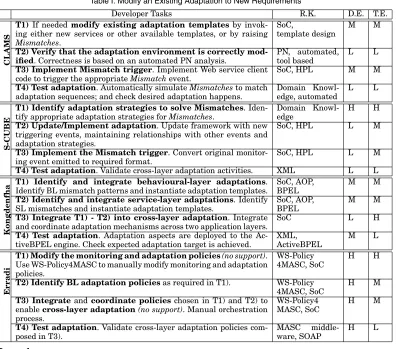
Table I shows that most approaches require a lot of effort to maintain and validate the adaptation environment, as they are defined manually and they are not supported by automated tools or model abstractions. Our approach, CLAMS, requires less effort as it has been specifically designed to support modifications of the adaptation environment in a flexible and dynamic way. In addition, the adaptation environment is generated automatically and verified by validating its formal PN representation.
5.2. Adding a New Adaptation at Behavioral Layer
In this scenario, we assume that a new adaptation template T10 has been deployed
in the case study described in Section 3, which solves theMissing-Role Mismatchwith
anexactmatch. Here, CLAMS replaces the more general templateT3 with the exact
templateT10 in the previous adaptation sequenceT1, T3, T2, T5, T4.
Table I. Modify an Existing Adaptation to New Requirements
Developer Tasks R.K. D.E. T.E.
CLAMS
T1)If needed modify existing adaptation templatesby invok-ing either new services or other available templates, or by raisinvok-ing
Mismatches.
SoC,
template design
M M
T2) Verify that the adaptation environment is correctly mod-ified. Correctness is based on an automated PN analysis.
PN, automated, tool based
L L
T3) Implement Mismatch trigger. Implement Web service client code to trigger the appropriateMismatchevent.
SoC, HPL M M
T4) Test adaptation. Automatically simulateMismatchesto match adaptation sequences; and check desired adaptation happens.
Domain Knowl-edge, automated
L L
S-CUBE
T1) Identify adaptation strategies to solve Mismatches. Iden-tify appropriate adaptation strategies forMismatches.
Domain Knowl-edge
H H
T2) Update/Implement adaptation. Update framework with new triggering events, maintaining relationships with other events and adaptation strategies.
SoC, HPL L M
T3) Implement the Mismatch trigger. Convert original monitor-ing event emitted to required format.
SoC, HPL L M
T4) Test adaptation. Validate cross-layer adaptation activities. XML L L
Kongdenfha
T1) Identify and integrate behavioural-layer adaptations. Identify BL mismatch patterns and instantiate adaptation templates.
SoC, AOP, BPEL
M M
T2) Identify and integrate service-layer adaptations. Identify SL mismatches and instantiate adaptation templates.
SoC, AOP, BPEL
M M
T3) Integrate T1) - T2) into cross-layer adaptation. Integrate and coordinate adaptation mechanisms across two application layers.
SoC L H
T4) Test adaptation. Adaptation aspects are deployed to the Ac-tiveBPEL engine. Check expected adaptation target is achieved.
XML, ActiveBPEL
M L
Erradi
T1) Modify the monitoring and adaptation policies(no support). Use WS-Policy4MASC to manually modify monitoring and adaptation policies.
WS-Policy 4MASC, SoC
H H
T2) Identify BL adaptation policiesas required in T1). WS-Policy 4MASC, SoC
H M
T3) Integrateandcoordinate policieschosen in T1) and T2) to enablecross-layer adaptation(no support). Manual orchestration process.
WS-Policy4 MASC, SoC
H M
T4) Test adaptation. Validate cross-layer adaptation policies com-posed in T3).
MASC middle-ware, SOAP
H L
Legend:
—H: High requirement; M: Medium requirement; L: Low requirement; —SoC: Service-oriented Computing technologies; PN: Petri net;
—HPL: High-level programming language; MASC: Manageable and Adaptive Service Compositions.
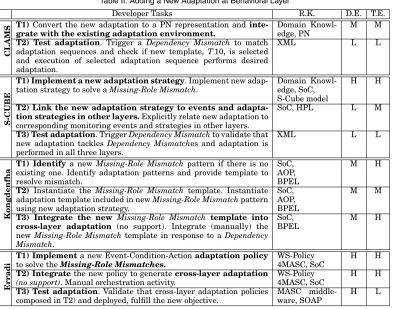
adaptation. From the comparison it is apparent that all approaches require medium to high level of expertise and effort to implement a new adaptation using a specific model/syntax. In CLAMS, this can be achieved more easily by associating the new adaptation template to a certain mismatch and linking it to other templates through triggered events, or direct invocations. The adaptation environment is also updated automatically, thus the effort needed to integrate the new adaptation is significantly less. In addition, while in other approaches a newly added adaptation can only serve as an exact match, in CLAMS, it can be resolved to an exact, a more general, or a more specific match, providing a high level of flexibility. Finally, the effort needed for triggering and testing the new adaptations is relatively low for all approaches, as it mostly requires developing and testing Web service clients.
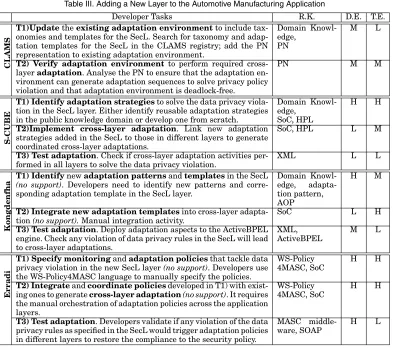
5.3. Adding a New Layer to the Automotive Manufacturing Application
Table II. Adding a New Adaptation at Behavioral Layer
Developer Tasks R.K. D.E. T.E.
CLAMS
T1)Convert the new adaptation to a PN representation and inte-grate with the existing adaptation environment.
Domain Knowl-edge, PN
M M
T2) Test adaptation. Trigger a Dependency Mismatch to match adaptation sequences and check if new template, T10, is selected and execution of selected adaptation sequence performs desired adaptation.
XML L L
S-CUBE
T1) Implement a new adaptation strategy. Implement new adap-tation strategy to solve aMissing-Role Mismatch.
Domain Knowl-edge, SoC, S-Cube model
H H
T2) Link the new adaptation strategy to events and adapta-tion strategies in other layers.Explicitly relate new adaptation to corresponding monitoring events and strategies in other layers.
SoC, HPL L M
T3) Test adaptation. TriggerDependency Mismatchto validate that new adaptation tacklesDependency Mismatches and adaptation is performed in all three layers.
XML L L
Kongdenfha
T1) Identify a newMissing-Role Mismatchpattern if there is no existing one. Identify adaptation patterns and provide template to resolve mismatch.
SoC, AOP, BPEL
M H
T2) Instantiate the Missing-Role Mismatch template. Instantiate adaptation template included in newMissing-Role Mismatchpattern using new adaptation strategy.
SoC, AOP, BPEL
M M
T3) Integrate the new Missing-Role Mismatch template into cross-layer adaptation (no support). Integrate (manually) the
newMissing-Role Mismatchtemplate in response to aDependency
Mismatch.
SoC, BPEL
M H
Erradi
T1) Implementa new Event-Condition-Actionadaptation policy
to solve theMissing-Role Mismatches.
WS-Policy 4MASC, SoC
H H
T2) Integratethe new policy to generatecross-layer adaptation
(no support). Manual orchestration activity.
WS-Policy 4MASC, SoC
H H
T3) Test adaptation. Validate that cross-layer adaptation policies composed in T2) and deployed, fulfill the new objective.
MASC middle-ware, SOAP
H L
automotive manufacturing case study published by S-Cube [Kazhamiakin et al. 2009], which explores the simulation and analysis of new automobile models before moving to mass production. Typically, after the design of a new automobile model, engineers would conduct a computer-based simulation on the new model to reproduce the characteristics of real vehicles.
The original automotive manufacturing application consists of three conceptual lay-ers: BL, SL, and SI. A new Security Layer (SecL) should be added, to enhance the privacy policy that simulation data must be kept at servers with access by authorized entities only. In addition, any violation of the security rules specified in the SecL may lead to an adaptation performed in different layers, to ensure compliance with the security policy.
The problem the developers face is that a new layer and corresponding adaptation mechanisms should be integrated into the existing adaptation environment in a sys-tematic way to ensure new cross-layer adaptation is generated correctly and effectively. In this scenario, we assume that mismatch taxonomies and adaptation templates for the SecL are already available in the CLAMS registry. This assumption is reasonable as in the long term, it is more likely for developers to find reusable taxonomies and templates for their applications.
Table III. Adding a New Layer to the Automotive Manufacturing Application
Developer Tasks R.K. D.E. T.E.
CLAMS
T1)Updatetheexisting adaptation environmentto include tax-onomies and templates for the SecL. Search for taxonomy and adap-tation templates for the SecL in the CLAMS registry; add the PN representation to existing adaptation environment.
Domain Knowl-edge,
PN
M L
T2) Verify adaptation environment to perform required cross-layeradaptation. Analyse the PN to ensure that the adaptation en-vironment can generate adaptation sequences to solve privacy policy violation and that adaptation environment is deadlock-free.
PN M M
S-CUBE
T1) Identify adaptation strategiesto solve the data privacy viola-tion in the SecL layer. Either identify reusable adaptaviola-tion strategies in the public knowledge domain or develop one from scratch.
Domain Knowl-edge,
SoC, HPL
H H
T2)Implement cross-layer adaptation. Link new adaptation strategies added in the SecL to those in different layers to generate coordinated cross-layer adaptations.
SoC, HPL L M
T3) Test adaptation. Check if cross-layer adaptation activities per-formed in all layers to solve the data privacy violation.
XML L L
Kongdenfha
T1) Identifynewadaptation patternsandtemplatesin the SecL
(no support). Developers need to identify new patterns and
corre-sponding adaptation template in the SecL layer.
Domain Knowl-edge, adapta-tion pattern, AOP
H M
T2) Integrate new adaptation templatesinto cross-layer
adapta-tion(no support).Manual integration activity.
SoC L H
T3) Test adaptation. Deploy adaptation aspects to the ActiveBPEL engine. Check any violation of data privacy rules in the SecL will lead to cross-layer adaptations.
XML, ActiveBPEL
M L
Erradi
T1) Specify monitoringandadaptation policiesthat tackle data privacy violation in the new SecL layer(no support). Developers use the WS-Policy4MASC language to manually specify the policies.
WS-Policy 4MASC, SoC
H H
T2) Integrateandcoordinate policiesdeveloped in T1) with exist-ing ones to generatecross-layer adaptation(no support). It requires the manual orchestration of adaptation policies across the application layers.
WS-Policy 4MASC, SoC
H H
T3) Test adaptation. Developers validate if any violation of the data privacy rules as specified in the SecL would trigger adaptation policies in different layers to restore the compliance to the security policy.
MASC middle-ware, SOAP
H L
assume the reuse of layer taxonomies and adaptation templates. Similarly to other scenarios, other approaches require more effort from developers, who have to manu-ally define, implement, and integrate cross-layer adaptation solutions.
5.4. Discussion
Table IV summarizes the level of support offered by CLAMS and related approaches to the development process of cross-layer adaptations. The scores in the table take into account the features of each approach and the developer effort required.
From our analysis, we conclude that CLAMS provides better support for the rapid design, implementation, integration, and maintenance of cross-layer adaptation into multiple-layer applications. The main factors that justify this conclusion are as follows.
—Design: extensible registries of taxonomies and templates, reusable taxonomies and templates (across same or different application domains), formal verification of the adaptation environment, alternative template matches that provide flexible adapta-tions through more general and more specific soluadapta-tions,
—Implementation: registries of reusable taxonomies and adaptation templates (ex-posed as WSDL services), which provide implemented adaptation solutions,
Table IV. Summary of Support for the Software Development Process
Approach Req Des Imp Int Tes Dep Mai
CLAMS 0 4 3 3 1 3 4
S-Cube 0 3 2 2 1 2 2
Kongdenfha et al. 0 2 2 2 1 2 2
Erradi et al. 0 1 2 1 1 2 2
Legend:0 (no support)→1 (low)→2 (low-to-medium)→3 (medium)
→4 (medium-to-high)→5 (high)
—Deployment: registries of reusable taxonomies and adaptation templates (exposed as WSDL services), which provide deployed adaptation solutions (“on-demand adapta-tion services”), and
—Maintenance: all of the preceding.
Where registries of taxonomies and templates are available, the process of developing cross-layer adaptations will be simplified through taxonomy and template reuse, loosely coupled adaptations, and the scope to provide alternative adaptations.
6. CONCLUSION
Large-scale, pervasive applications are required to dynamically adapt to cater for changes to the environments in which they execute. Given the scope and spread of architectural possibilities for pervasive application specification, it is challenging to provide a flexible adaptation model that can be utilized for an unpredictable range of architectural-layer types, and that caters for adaptations that may, in a single in-stance, affect multiple layers. In this article, we have outlined a generic methodology for cross-layer adaptation in multilayer applications. The methodology’s main struc-tural ingredients are events, taxonomies of application mismatches, and adaptation templates. As we would expect, the process of capturing these structural elements in a semiformal metamodel enabled us to reason about the relationships between the elements, and clarified our thinking on their specification. In addition, the common rep-resentation enabled with metamodels allows us to reason about integration properties of heterogeneous adaptation environments.
From a behavioral perspective, we were obliged to consider a more formal approach. The level of analysis needed to ensure detection of template dependency cycles, or deadlocks, and to support reachability analysis, led us to utilize PNs for the formal-ization of the matchmaking process. This process employs taxonomies of application mismatches to dynamically select adaptation templates based on the degree of match between their triggering mismatches and a raised event. Flexibility is achieved by matching templates corresponding to plug-in (more general) and subsumes (more spe-cific) mismatch matches. Cross-layer adaptation is achieved by allowing templates to be linked both directly, through invocations, and indirectly, through events. A PN en-codes application mismatch taxonomies and template dependencies and this enabled us to solve matchmaking queries by investigating possible template sequences obtained through a reachability analysis. A similar analysis may be employed to detect template dependency cycles, or deadlocks.
Fig. 9. A (partial) application mismatch taxonomy for the example organizational layer.
developers to easily define taxonomies of application mismatches and integrate adapta-tion logic into templates, as well as to match the templates needed to adapt multilayer applications. Another direction of future work is the formalization of criteria for check-ing the validity of templates. Finally, we intend to investigate an improved rankcheck-ing system that takes into account the importance of templates through an analysis of user feedback and template link weights.
APPENDIX 1. INTRODUCTION
This is the appendix for Popescu [2011]. The main text describes a generic, formal methodology that supports flexible, cross-layer adaptation in multilayer applications. Semiformal metamodeling techniques are combined with more formal Petri nets, which are used to capture complex behavior. The main structural elements of the adaptation methodology are: templates (also known as patterns) that define generic adaptation so-lutions to common application mismatches, and taxonomies of application mismatches that provide classifications of common layer-specific application mismatches. An adap-tation environment, modeled as a Petri net, captures the association of mismatches and templates. This appendix provides detail on these elements. Section 2 shows three sample taxonomies, one each for a three-layer system. Section 3 provides details of the algorithms used in the Petri net analysis of an adaptation environment containing mismatches and related templates. Section 4 illustrates a reachability graph for the crisis management scenario used in the article.
2. EXAMPLE ORGANIZATIONAL-LAYER, BEHAVIORAL-LAYER AND SERVICE-LAYER TAXONOMIES
Figure 9 describes part of a taxonomy of application mismatches for the organization application layer. An organizational layer provides a formalization of the application roles (stakeholders) and their objectives and relationships (dependencies) needed to support the achievement of the objectives. This taxonomy employs previously defined
organizational concepts [ALIVE 2010]. For example, astakeholder-role mismatchmay
be due to arole-name mismatchorobjective mismatch. Anobjective mismatchmay be
due to, for example, apredicate mismatch, caused by amissing-predicate mismatchor
[image:20.612.120.491.117.269.2]Fig. 10. A (partial) application mismatch taxonomy for the example behavioral layer.
Figure 10 illustrates part of the example taxonomy of application mismatches
for a behavioral layer1 of service-based applications. The partial taxonomy refines
1In this context we refer to behavior as containing protocol information (i.e., orchestration of messages) and
Fig. 11. A (partial) application mismatch taxonomy for the example service layer.
and extends previously defined behavioral mismatch patterns [Becker et al. 2004; Kongdenfha et al. 2009]. It refers to mismatches that may occur when comparing a required behavior specification with a provided one. We have split (design-time) protocol mismatches based on whether the required and provided protocols have to becompatibleorreplaceable. Protocol compatibility requires protocols to complement each other, for example, when one sends a message the other one has to receive it. Protocol replaceability requires the provided protocol to include the required one, that is, the provided protocol has to behave as the required one with respect to the clients of the required protocol. For example, when checking protocol compatibility, if both protocols define the same set of message exchanges (viz., invoke and receive operations) yet the required protocol executes these activities in a sequence while
the provided protocol executes them in a loop, we then have asequential vs. iteration
mismatch. Asplit-invoke mismatchoccurs when the required protocol sends a message (i.e., one invoke operation) yet the provided protocol expects to receive the same information as part of several messages (i.e., several receive operations).
Finally, Figure 11 presents part of a taxonomy of application mismatches for a service layer of a service-based application. The taxonomy refers to mismatches that
may occur when comparing arequiredservice specification with aprovidedone. An
in-terface mismatchcan be classified intosignature mismatch(the required and provided interfaces have operations that differ either syntactically—different operation names, number, order, or type of input and output parameters, or semantically—use different
ontological concepts for their inputs and outputs) andparameter-constraint mismatch
input or output parameters of one of its operations and they are different from what
the provided interface defines). Similarly, an operation data-type mismatch can be
classified intosyntactic-input mismatch(a service operation has an input data type of
unexpected/unknown type) andsyntactic-output mismatch(a service operation has an
output parameter of unexpected/unknown data type).
3. ALGORITHMS FOR THE ASSOCIATION AND DISSOCIATION OF TEMPLATES AND MISMATCHES
This section presents two algorithms that describe the steps needed for the update of adaptation environments when templates are added (i.e., bound to taxonomy mis-matches) and respectively removed (i.e., unbound from taxonomy mismis-matches). By construction of the PN, the following invariant property holds.
INV. For each mismatch m:
(a) There is a token inT(m) if and only if there exists a template associated withm.
(b) There is a token inU P(m) if and only if there is no template associated withmand
there exists a template associated with some ancestor ofm.
(c) There is a token inDOW N(m) if and only if there is no template associated with any
ancestor of mand there exists a template associated withmor with a descendant
ofm.
The invariant can also be expressed as follows.
Corollary of INV. For each mismatch m there is at most one token in T(p(m))∪
U P(p(m))∪DOW N(m), where p(m) denotes the parent of m in the taxonomy. The proof of the corollary is straightforward.
—By INV(b) and INV(a): token inU P(p(m))⇒no token in T(p(m)).
—By INV(c) and INV(a): token inDOW N(m)⇒no token in T(p(m)).
—By INV(c) and INV(b): token inDOW N(m)⇒no token in U P(p(m)).
Adaptation environments encode the adaptation logic of a multilayer application. The environment is set up at application design time by selecting taxonomies for (some of) the application layers and the templates bound to their mismatches. The following two subsections present the algorithms that define PN changes required by the association of templates to mismatches they can tackle, as well as their dissociation.
3.1. Associating Templates to Mismatches
The following ASSOCIATE algorithm updates the PN representing the adaptation
environment when a template T is bound to a mismatch m. Intuitively, the
algo-rithm updates (if needed) the representation ofm’s ancestors so that adaptation events
matching those mismatches can lead to selectingT as a more specific adaptation when
no exact or more general adaptation is possible. Similarly, the algorithm updates (if
needed) the representation of m’s descendants so that adaptation events matching
those mismatches can lead to selectingT as a more general adaptation when no exact
adaptation is possible.
The following proof establishes that INV is an invariant property for the ASSOCIATE algorithm.
PROOF. Initially INV trivially holds since there is no token present inT(m),U P(m),
DOW N(m) for all mismatchesm. We now assume that INV holds and we show that it continues to hold after executing ASSOCIATE.
(1) IfT(m) contains no token, then a token is put inT(m) (line 3) to satisfy INV(a).
(1.1.) If there is a token inU P(m) (line 4) thenU P(m) is the only place that must
ALGORITHMASSOCIATE:
1 IF no token in T(m) 2 THEN {
3 PUT token in T(m); 4 IF token in UP(m)
5 THEN REMOVE token from UP(m);
6 ELSE {
9 x = m;
10 WHILE x not root and no token in DOWN(x)
11 DO {
12 PUT token in DOWN(x);
13 x = p(x);
14 }
16 FOREACH child y of m DO Update(y);
17 }
18 }
19 Update(y) = 20 {
21 IF token in DOWN(y)
22 THEN REMOVE token from DOWN(y); 23 IF no token in T(y)
24 THEN {
25 PUT token in UP(y);
26 FOREACH child z of y DO Update(z);
27 }
28 }
ancestor ofmand hence, by INV(b) and INV(a), all descendantsdofmwill
continue to have a token either in U P(d) or in T(d). The same holds for
the ancestors ofmfrom p(m) topi(m), wherepi(m) is the highest ancestor of
mwith an associated template. The remaining ancestorsafrom pi+1(m) to
pi+k(m) (where pi+k+1(m) is the root) will instead continue to have a token in
DOW N(a).
(1.2.) If instead there is no token inU P(m) (line 6) then the descendants ofmthat
are pointing to a more specific mismatch must be updated (line 16) to satisfy INV(c) and INV(b). Descendants are hence visited top-down, and for each
descendant dof m, the token is moved from DOW N(d) to U P(d) (lines 22
and 25). The visit stops when a descendent with an associated template is
encountered (line 23). Such a descendentcwill continue to have a token in
T(c) (by INV(a)), while all the descendants f of c will continue to have a
token inU P(f) or inT(f) by INV(b) and INV(a). To compute the update, we
must also check whether there is a token inDOW N(m) (line 7).
(1.2.1.) If there is a token in DOW N(m) then, by INV(c), all ancestorsaofm
(but the root) already have a token in DOW N(a) and they need not
be updated.
(1.2.2.) If there is no token in DOW N(m) (and no token inU P(m)), then by
INV(c) (and by INV(b)), a token must be put inDOW N(m). Moreover
(lines 10–14) the parent pofmmay have no token in DOW N(p) (if
none of the childrencof phad a token in DOW N(c)), and in such a
case a token must be now put in DOW N(p). The other ancestors of
mmust be updated analogously until an ancestoraofmwith a token