JOURNAL OF FOREST SCIENCE, 64, 2018 (12): 514–522 https://doi.org/10.17221/79/2018-JFS
LAI estimation by direct and indirect methods
in Scots pine stands in Northern Steppe of Ukraine
Viktoriia LOVYNSKA
1*, Petro LAKYDA
2, Svitlana SYTNYK
1,
Mykola KHARYTONOV
1, Iryna PIESTOVA
31 Department of Parks and Gardens, Faculty of Agronomy, Dnipro State Agrarian
and Economic University, Dnipro, Ukraine
2 Education and Research Institute of Forestry and Park Gardening, National University of Life
and Environmental Sciences of Ukraine, Kyiv, Ukraine
3 Department of Geoinformation Technologies in Remote Sensing of the Earth,
Scientific Centre for Aerospace Research of the Earth, Kyiv, Ukraine
*Corresponding author: [email protected]
Abstract
Lovynska V., Lakyda P., Sytnyk S., Kharytonov M., Piestova I. (2018): LAI estimation by direct and indirect methods in Scots pine stands in Northern Steppe of Ukraine. J. For. Sci., 64: 514–522.
Leaf area index (LAI) of Scots pine (Pinus sylvestris Linnaeus) in the Northern Steppe of Ukraine was estimated. LAI estimated directly (LAI d, destructive sampling) was compared with LAI determined by digital hemispherical photography (indirect method, LAI id) in Scots pine stands. The studies to determine LAI were performed in pine stands of the age ranging from 57 to 87 years. The high coefficient of determination between needle weight and crown diameter as dependent variables and stand age as an independent variable was found at the tree level. LAI values of the stands estimated by the direct method were higher than those obtained by the indirect method on average by 8.8%. The results obtained by both methods were used for LAI determination from allometric relationships with tree mensuration parameters and stand biometric characteristics. There was a more significant relationship between LAI id values and tree crown diameter, basal area of stands as independent variables.
Keywords: Pinus sylvestris L.; leaf area index; needle area; allometric equations; age structure
The productivity of woody plants is significantly affected by the level of their structural parts func-tioning, and numerous geophysical factors (Ding et al. 2016; Lu et al. 2018). Tree crown is an im-portant component of tree biomass; it comprises branches and leaves (needles) and performs a num-ber of functions. Branches are a continuation of the stem, they form a mechanical and conduction sys-tem for the green parts of the crown where physi-ological processes (such as photosynthesis, respi-ration and transpirespi-ration) based on a gas exchange between tree and atmosphere are taking place. Leaf surface area is critically important for terrestrial ecosystems because it is a zone of implementation
of main physiological processes in plants (Utkin et al. 1997; Bondeau et al. 2008).
seasonality, habitat conditions and forest manage-ment practices (Falster, Westoby 2003; Fotis et al. 2018). Combination of these factors with differ-ences in methods of parameter determination leads to significant LAI variation (Field et al. 1995; Bus-sotti, Pollastrini 2015). Therefore, LAI calcula-tion, both by domestic and foreign scientists, still re-mains an important milestone in the development of a forestry regulatory framework (Jonckheere et al. 2005; Matushevych, Lakyda 2014; Stankevich et al. 2017). Published LAI values in forestry ranged from less than 1 (Le Dantec et al. 2000) to ~14 (Turner et al. 2000). Generally, the highest value reported in the international literature was typical of coniferous forest canopy (Chen et al. 1997). Stud-ies on LAI of Scots pine forest stands in Europe were conducted by many researchers who used several methods for the calculation of this index. Variations in needle specific leaf area (SLA) and LAI in differ-ent countries of Europe have already been reported (Niinemets et al. 2001; Utkin et al. 2008). A sum-mary of published values of canopy-averaged SLA for Scots pine across Europe (Finland, UK, Sweden, Germany, Netherlands, Belgium, Czech Republic, Italy, France, Spain) was presented by Mencuccini and Bonosi (2001); it ranged from 2.867 (Mäkela et al. 1995) to 5.506 (Mencuccini, Bonosi 2001). Variability of SLA in relation to position within the crown and to needle age and LAI estimation in dif-ferent needle age classes have been reported for mature Scots pine forests by Bealde et al. (1982) in southeastern England, Xiao et al. (2006) in the Belgian Campine region. Needle area has been cal-culated in Scots pine using allometric relationships at the tree and stand levels in the Netherlands (van Hees, Bartelink 1993) and Belgium (Jonckheere et al. 2005). Analysis of Scots pine LAI in Russia was performed by Grabovsky et al. (2015). There are two main categories of LAI estimation procedures: direct and indirect techniques. In many papers for LAI estimation in Scots pine stands across Europe techniques of indirect measurement were used. Indirect measurements are performed using opti-cal tools such as hemispheriopti-cal photography, re-mote sensing etc. (Bréda 2003; Jonckheere et al. 2005; Huang, Pretzsch 2010; Chaturvedi et al. 2017). In the conditions of a field survey, indirect techniques of measurement in conifer forest based on optical sensors were effective, for example with optical instruments LAI-2000 Plant Canopy Analyz-er (StenbAnalyz-erg et al. 1994; Majasalmi et al. 2013), Landsat ETM (Nilson et al. 1999; Eklundh et al. 2001), ceptometer (Chen et al. 1997), and also by the latest method of Bayesian inversion (Varvia et
al. 2018). The procedure of LAI estimation by a di-rect method is quite difficult, time-consuming and impossible for the whole stand (Chaturvedi et al. 2017), but it is more precise compared with optical measurements (Bréda 2003; Khan et al. 2005). In the Steppe zone, both direct and indirect techniques can be actively used to measure LAI and give accu-rate results due to specific characteristics of forest architecture where plantations are of artificial origin dominantly and usually one-layered (as a result of one-species culture).
The main objective of the study was an investi-gation of LAI variation in Scots pine stands of the Northern Steppe of Ukraine, development and comparison of allometric equations obtained by direct and indirect techniques of LAI estimation.
MATERIAL AND METHODS
Study area. The experimental site was located in the northern part of Ukraine, in Dnipropetrovsk re-gion (48°27'N and 34°58'E). Analysed stands of all temporary sample plots (TSPs) were selected in the same forest conditions and have a flat aspect, with elevation of 112 to 140 m a.s.l. Mean annual rainfall is 500 mm, mean temperature is 9.0°C. All mea-surements were carried out in 6 selected even-aged stands with high representation of Scots pine (Pinus
sylvestris Linnaeus), located within Novomoskovskiy
and Vasilkovskiy forest district in Dnipropetrovsk region (Ukraine). The areas selected as TSPs were surveyed, a biometric description was made for each one that includes average values of age, tree height and diameter within the plantation. When the area corresponded to the requirements, i.e. it was a rep-resentative unit of the plantation of the investigated species, it was selected for establishing TSP. The TSPs were chosen on the basis of stand age, and then the replicate sampling locations were randomly assigned within each Scots pine stand. In TSPs, the number of all trees was counted, its basal area (m2·ha–1),
diam-eter and height of each tree were measured. Biomet-ric description of the stands is represented in Table 1. Bonitet class of each TSP was taken from Data-base of Production Association “Ukrderzhlisproekt” (http://www.lisproekt.gov.ua/) for State Enterprises of the State Agency of Forest Resources of Ukraine. Bonitet scale was developed by Orlov and contains 3 parameters – average height, stand age and origin of stands (Anuchin 1982). Bonitet scale includes of 5 bonitet classes, with ranking of classes from the most productive (Ist) to the class with the lowest
stands was ranked as class with the highest produc-tivity (I) and only the third TSP had IInd bonitet class.
The stands were represented by three different age classes – one premature stand (age of 57 years) and mature stands over 60 (three plots) and 80 (two plots) years. The fieldwork was conducted between April and October 2016.
In each sample plot, stem DBH, tree height, and height of the crown base of each tree were measured.
Leaf area index estimation by direct method (LAI d). LAI d was assessed directly using har-vesting methods such as destructive sampling. The sample tree method consists of destructive sam-pling of trees out of the stand and measurement of their leaf area. Six Scots pine trees (one per each sample plot) were selected as representative sam-ples of the stand for harvesting. Selection of sample trees for LAI determination was conducted at dif-ferent stem diameter within the same (middle-old) age group; it comes from dominance of the middle-old age group in Scots pine plantations (58.5%) un-der conditions of the Northern Steppe of Ukraine (Lakyda, Lovinska 2015). The age of chosen trees ranged from 56 to 90 years. For each selected sam-ple tree, the following measurements were taken: age, overbark stem DBH, total tree height, crown diameter and crown length. Dendrometric data of the sample trees are summarized in Table 2.
According to selected methodology (Lakyda 2002), in field conditions 9 samples of fresh nee-dles (each sample was represented by 10 individ-ual needles or 5 fascicles) were randomly selected
from different parts of the sample tree crown (up-per, middle and lower – three samples in each part) followed by measuring and weighing. Total surface area of pine needles was developed using three variables: displaced volume of the needle sample, cumulative needle length of the sample and num-ber of needles per fascicle (Johnson 1984). The vol-ume values were estimated by xylometric determi-nation using the values of water volume displaced by the needle fascicle sample after its immersion in a measuring cylinder (Eq. 1):
needles 2 1 π π
v n
S l
n l
(1)
where:
l – total length of needles (m), n – total number of needles,
v – total volume of needles – calculated by the method
of xylometric determination (m3),
Sneedles – surface area of 10 individual samples of needles –
5 fascicles (m2).
Selected fresh pine needles were weighed in the field on an electronic balance to the nearest 0.001 g, and further dried in the laboratory in a drying cham-ber at a temperature of +105°C until constant mass.
Leaf mass per area (LMA) was calculated as a ratio of dry mass (m0) and foliage area (Sa needles), as Eq. 2:
0
0
needles
LMAm
a
m S
(2)
where:
LMAm0 – ratio of absolute dry mass of 10 sample needles
[image:3.595.66.533.73.179.2](5 fascicles) to their total area (kg·m–2).
Table 1. Characteristics of surveyed Scots pine stands
Stand
No. Stand area (ha) Scots pine (%) Age (yr) DBH (cm) Height (m) No. of trees per hectare Basal area (m2·ha–1) Bonitet class
1 0.25 100 56–66 20.7 21.8 856 28.90 I
2 0.25 100 54–84 29.3 30.4 416 28.01 I
3 0.25 100 77–90 24.2 22.7 448 20.57 II
4 0.25 100 70–80 23.9 19.5 440 19.79 I
5 0.25 100 78–84 24.5 16.8 512 24.22 I
6 0.25 90 65–80 23.2 22.5 496 22.13 I
Table 2. Dendrometric data on Scots pine sample trees destructively sampled at the study plots
Tree
No. Age (yr) Stem DBH (cm) Total height (m) diameter (m) length (m)Crown foliage (needles + twigs)Fresh mass (kg) needles
1 56 22.0 22.5 3.3 6.9 15.5 4
2 68 24.0 21.6 4.5 8 24.3 7.3
3 90 26.3 22.3 1.8 6 18.1 4.48
4 77 22.1 18.6 3.3 5.7 27.3 9.29
5 84 24.1 17.3 2 11.2 19.2 5.45
[image:3.595.63.532.650.757.2]Total needle surface area of sample tree (Stree needles) within TSP was determined as a share from the total mass of needles of sample tree designated as abso-lute dry matter of tree needles in LMA.
Total mass of needles of sample tree in absolute dry matter was determined using the content of dry matter in needles. In the first step of calcula-tion, tree greenery (foliage and twigs up to diam-eter of 1 cm) was weighed in the field conditions and mean foliage share – PL (%) was determined. For this, the collected fresh samples were weighed while re-weighing followed after manual defoliation described earlier (Sytnyk et al. 2017). Foliage share was then calculated using Eq. 3 (Turner et al. 2000; Lakyda 2002):
f def
L
f
100 m m
P
m
(3)
where:
mf – fresh mass of a model tree greenery sample (g),
mdef – fresh mass of a model tree greenery sample in
defoliated state (g).
Thus, the tree greenery fraction was separated into twigs and foliage, and the share of foliage in the greenery of each model tree was calculated. After determining the foliage share in model tree greenery, all the previously separated foliage was collected. From that amount, a series of 10-gram samples was selected and taken to the laboratory to provide their drying to constant weight at 105°C.
Content of dry matter in foliage (SL) was calcu-lated using Eq. 4 (Lakyda 2002):
0 L
nat
m S
m
(4)
where:
m0 – mass of foliage fraction dried at 105°C (g),
mnat – mass of foliage fraction in fresh state (g).
Total needle mass in absolute dry matter within TSP was calculated using the percentage of needles in total tree greenery. The content of absolute dry matter in foliage was calculated from the num-ber of trees in each thickness class. The weight of greenery in average tree of each thickness class was determined by a graphical method. For this pur-pose, a chart was drawn based on the ratio of DBH to the weight of tree greenery of model trees cut down on the TSP. Then, data on the mass of green-ery obtained from the chart on each thickness class within TSP were multiplied by the total number of trees of this thickness class. The weight of needles in freshly weighed condition was determined from the percentage of needles in the tree greenery on TSP calculated in each thickness class. Further,
these values were transferred to a completely dry condition through the content of absolute dry mat-ter in the needles.
Total needle surface area of Scots pine stands (Sstand needles) was determined by the ratio of total needle mass of all trees within TSP in absolute dry matter (mstand needles) to LMA.
Leaf area index (LAI) was computed by Eq. 5:
stand needles
LAI S
G
(5)
where:
G – area of TSP (m2),
Sstand needles – total surface area of pine needles of trees in
TSP (m2).
To assess LAI per stand area, we developed the allometric equations using DBH, tree height, basal area of stands as independent variables and needle area and needle mass as dependent variables. The best fitted regressions were selected on the basis of the coefficient of determination (R2). We
devel-oped different models and selected for investigated stands the one with the best goodness of fit by judg-ing the resultjudg-ing R2.
Estimation of leaf area index by indirect meth-od (LAI id). In sampling plots of Scots pine, con-tactless measurements of LAI were carried out that excluded direct interaction with trees.
LAI is estimated indirectly by measuring the spa-tial distribution and proportion of gaps in plant can-opies (Zheng, Moskal 2009) from optical remote sensing instruments. These instruments determine LAI based on an assumption of the random spatial distribution of leaves. These methods use a theoreti-cal model of canopy gap probability (Woodgate et al. 2015). So, LAI of plant canopies can be estimated by the real-time analysis of “gap size distribution” determined from hemispherical photographs.
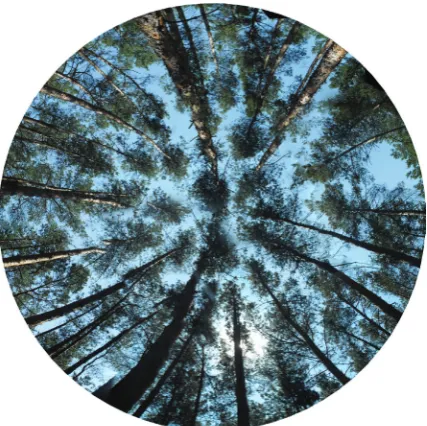
Leaf area index is computed from the hemi-spherical photographs from gap fraction estimates in different zenith and azimuthal ranges. To obtain digital hemispherical photography of the canopy we used a digital camera. Photographing is carried out from below of the canopy and in a circle in sev-eral rows with longitudinal and transverse overlap. The resulting number of photographs is stitched into a hemispherical panorama (Fig. 1) in an open-access software product Hugin (Version 2017.0.0, 2017; http://hugin.sourceforge.net/). The camera was placed on a tripod 1.3 m above ground. Photo-graphs were taken during semi-overcast conditions to minimise the glare from direct sunlight.
2.0, 1999) to compute gap fraction data and LAI (Frazer et al. 1999). First, to distinguish between visible sky and foliage, a threshold value was in-teractively selected for each photograph. To re-duce variation, all photographs were analysed by the same experienced operator. In the second step, LAI id was calculated for each hemispherical pho-tograph from the gap fraction data obtained by in-version of the Poisson model.
Mathematic models of LAI on different biomet-ric parameters were statistically verified using the STATISTICA program (Version 12.6, 2015).
RESULTS
In the first step, we analysed needle dry weight using LAI d calculation, surface leaf area and LAI (Table 3) for pine stands within TSP. The average weight of absolutely dry pine needles on the TSP amounted to 828.69 kg; mean total leaf area of nee-dles per TSP was 4,157.5 m2.
The establishment of allometric relationships with leaf area can be conducted in individual trees by taking readily measured variables, such as DBH, height of branches (Vertessy et al. 1995; Bréda 2003). Moreover, estimating allometric relationships through destructive sampling is a reliable method of deriving LAI for an experimental site (Maguire, Bennett 1996). According to the literature, for a sample of 6 units, the critical value of the coefficient of determination is 0.569 (Yantsev 2012). Regres-sion equations were statistically significant (P < 0.05) at the level of the tree in cases of dependences of needle weight and crown diameter on age (Table 4).
[image:5.595.71.285.56.269.2]A statistically close relationship was recorded be-tween LAI values obtained by direct (LAI d) and indirect (LAI id) methods (Fig. 2, Table 5).
[image:5.595.303.532.87.130.2]Fig. 1. Final image of the hemispherical panorama
Table 3. Leaf area and leaf area index of pine stands on temporary sample plots (TSPs)
Stand
No. weight (kg)Needle dry Total leaf area per TSP (m2) (mLAI d 2·m–2)
1 1,070.0 3,850.0 1.54
2 940.0 5,325.0 2.13
3 657.5 2,800.0 1.12
4 1,395.0 3,625.0 1.45
5 972.5 3,275.0 1.31
6 867.5 3,425.0 1.37
[image:5.595.305.531.409.579.2]LAI d – leaf area index estimated by a direct method
Table 4. Allometric equations for the determination of parameters for Scots pine trees depending on age
Regression equation R2
y1 = –0.017x2 + 2.442x – 80.371 0.842
y2 = –0.005x2 + 0.690x – 19.008 0.856
y1 – needle weight, y2 – crown diameter, R2 – coefficient of
determination; slopes always significant (P < 0.05), unless indicated
Table 5. Main statistics of Scots pine stands leaf area index obtained by different methods
Mean SD SE Skewness Kurtosis LAI d (m2·m–2) 1.48 0.346 0.141 1.525 3.095
LAI id (m2·m–2) 1.35 0.245 0.099 0.994 –0.720
LAI d – leaf area index estimated by a direct method, LAI id – leaf area index estimated by an indirect method, SD – stand-ard deviation, SE – standstand-ard error; slopes significant at the P < 0.05 level
Fig. 2. Comparison of the relationship between leaf area index (LAI) values obtained by direct (LAI d) and indirect (LAI id) methods
LA
I id (m
2·m –2)
LAI d (m2·m–2)
1.0 1.2 1.4 1.6 1.8 2.0 2.2 1.1
[image:5.595.64.291.635.743.2] [image:5.595.303.532.665.704.2]LAI values in pine stands ranged from 1.12 to 2.13 m2·m–2 in the direct method and from 1.13
to 1.74 m2·m–2 in the indirect one. Both maximum
LAI d and LAI id values were determined in pure 66-years-old Scots pine plantations with class І of forest capacity (refer to Table 1). Minimum LAI id value (1.12 m2·m–2) was determined in the oldest
(87 years) pure forest stand of Scots pine, with low (II) class of performance. A similar minimum LAI value (1.13 m2·m–2) was obtained in 83-years-old
pine plantations using the non-contact method of measurement. Mean LAI value of Scots pine stands measured by the direct method was estimated to 1.48 m2·m–2 and it was found higher than LAI id
only by 8.8% (r = 0.906, R2 = 0.820, P < 0.05).
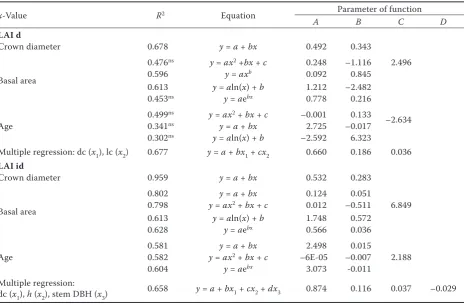
Developed regression models are presented in Table 6 for LAI estimation by direct and indirect methods. These models are developed by combin-ing several tree biometric parameters (age, crown diameter, crown length, stem DBH, total tree height) and such stand characteristics as basal area (m2·ha–1).
We obtained higher R2 by estimation of LAI id,
especially in the case of using linear regression models including crown diameter and basal area
as independent variables. The models developed for estimation of LAI d had lower R2 and higher
significance both for linear and non-linear regres-sion with using crown diameter and basal area as independent variables. During estimation of LAI irrespective of the effect of crown diameter, crown length, total height and stem DBH, we selected multiple regression models and obtained R2 = 0.677
(LAI d) and R2 = 0.658 (LAI id) (Table 6).
DISCUSSION
In recent years, theory prevails that forest pro-ductivity is mainly dependent on LAI, which deter-mines the growth of woody plants in the conditions of forest ecosystems. LAI is a convenient param-eter to measure; variability of its values is globally reflected in the form of theoretical mathematical models (Asner et al. 2003; Forrester et al. 2017).
Age of a tree is crucial for many of parameters of tree stands (Schleppi et al. 2011; Pokorný, Stojnič 2012), and LAI of older stands tends to slow descending (Battaglia et al. 1998; Sonohat et al. 2004). This coincides with early reached
re-Table 6. Allometric equations for leaf area index determination in Scots pine stands from different biometric values
x-Value R2 Equation Parameter of function
A B C D
LAI d
Crown diameter 0.678 y = a + bx 0.492 0.343
Basal area
0.476ns y = ax2 +bx + c 0.248 –1.116 2.496
0.596 y = axb 0.092 0.845
0.613 y = aln(x) + b 1.212 –2.482
0.453ns y = aebx 0.778 0.216
Age 0.499
ns y = ax2+ bx + c –0.001 0.133
–2.634
0.341ns y = a + bx 2.725 –0.017
0.302ns y = aln(x) + b –2.592 6.323
Multiple regression: dc (x1), lc (x2) 0.677 y = a + bx1 + cx2 0.660 0.186 0.036
LAI id
Crown diameter 0.959 y = a + bx 0.532 0.283
Basal area
0.802 y = a + bx 0.124 0.051
0.798 y = ax2 + bx + c 0.012 –0.511 6.849
0.613 y = aln(x) + b 1.748 0.572
0.628 y = aebx 0.566 0.036
Age 0.5820.581 y = yax = 2a + + bxbx + c –6E-052.498 –0.0070.015 2.188
0.604 y = aebx 3.073 -0.011
Multiple regression:
dc (x1), h (x2), stem DBH (x3) 0.658 y = a + bx1 + cx2 + dx3 0.874 0.116 0.037 –0.029
LAI d – leaf area index estimated by a direct method, dc – crown diameter, lc – crown length, LAI id – leaf area index es-timated by an indirect method, h – total tree height, R2 – coefficient of determination; slopes always significant (P < 0.05),
[image:6.595.66.531.72.376.2]sults on dependence of the studied parameter on age-class composition. LAI values obtained for ma-ture plantings were lower (1.12 m2·m–2) than data of
Soudani et al. (2002) with a value of 1.48 m2·m–2
for the 80–85-years-old stands, and significantly (1.54 m2·m–2 – LAI d, 1.57 m2·m–2 – LAI id)
dif-fer from the results given by the same authors (2.09 m2·m–2) for 45–50-years-old pine stands.
Di-rect methods relate to foliage, give access to LAI and provide the reference for the evaluation of in-direct methods (Bréda 2003). Inin-direct methods of estimating LAI in the field include the use of al-lometric relationships between leaf area and stand specific characteristics and show the dependence of LAI on age, stand density, tree crown size, cli-mate (Gholz et al. 1990; Mencuccini, Grace 1995). In this study, leaf area index relationships obtained through both destructive sampling and non-destructive method are needed to compare LAI estimates by different methods. Comparison of LAI determination by methods of direct and in-direct measurements was performed by many au-thors (Chason et al. 1991; Fassnacht et al. 1994; Dufrene, Bréda 1995; Olivas et al. 2013). Bréda (2003) reviewed direct and indirect methods and stated that indirect methods have pointed to a sig-nificant underestimation of LAI in forest stands. As reported by this author, underestimation in dif-ferent literature varied from 25 to 50% in difdif-ferent stands (Gower, Norman 1991). In our study, we found no significant difference between the two methods used, and distinction between mean val-ues was only 8.8%.
We compared with other researchers regression equations developed on needle weight and crown diameter (Mencuccini, Grace 1995; Jonck-heere et al. 2005). We have found significant re-gression relationships between age as the inde-pendent variable and needle dry weight, crown diameter as dependent variables at a tree level.
We observed that the model containing crown diameter as the estimator is a better predictor of LAI of Scots pine stands. This is especially true of the indirect method of LAI estimation. Tree crown has a determining effect on canopy formation and as a result it regulates surface leaf area. LAI is also observed to be influenced by basal area of stands and developed regression equations with this val-ue had significant R2. We detected the linear and
polynomial equations are the most appropriate for estimation of LAI obtained by indirect methods. In the case of LAI estimation by direct method the linear and logarithmic equations have the highest
R2. Also, when we tried several biometric
charac-teristics combined together, we detected multiple regression models as good predictors (R2 > 0.67) of
LAI estimates.
In general, the relatively low LAI values obtained may be explained by limitations of climatic re-sources within the area studied, especially air and soil moisture, because environmental conditions control the time to reach maximum LAI values and its interannual summer variability (Gholz et al. 1990).
CONCLUSIONS
Average weight of absolutely dry pine needles per hectare amounted to 3,314.76 kg. The ratio gave the best fit and was significant in dependences of needle weight and crown diameter on age. Average LAI estimated in Scots pine stand was 1.45 m2·m–2
for direct method and 1.37 m2·m–2 for
hemispheri-cal photography. For both methods, the maximum LAI value was reached in the pine plantations at the age of 66 years, and minimum LAI was deter-mined for the oldest trees. Higher R2 values were
registered during development of models for LAI id, when the application of linear and polynomial equations with the introduction of crown diameter of the tree and basal area of stands as independent parameters was used.
Thus, there is a need for further research and de-velopment of algorithms for quantitative LAI as-sessment in pine forests under steppe climatic con-ditions with the involvement of another indirect method, determination of this parameter depends on the main biometric indexes.
References
Anuchin N.P. (1982): Forest Inventory. Moskow, Forest In-dustry: 552. (in Russian)
Asner G.P., Scurlock J.M., Hicke J.A. (2003): Global synthesis of leaf area index observations: Implications for ecological and remote sensing studies. Global Ecology and Biogeog-raphy, 12: 91–205.
Battaglia M., Cherry M.L., Beadle C.L., Sands P.J., Hingston A. (1998): Prediction of leaf area index in eucalypt plantations: Effects of water stress and temperature. Tree Physiology, 18: 521–528.
Bealde C.L., Talbot H., Jarvis P.G. (1982): Canopy structure and leaf area index in a mature Scots pine forest. Forestry, 55: 105–123.
Importance of vegetation structure on seasonal NPP esti-mates. Global Change Biology, 5: 35–45.
Bréda N.J.J. (2003): Ground-based measurements of leaf area index: A review of methods, instruments and current con-troversies. Journal of Experimental Botany, 54: 2403–2417. Bussotti F., Pollastrini M. (2015): Evaluation of leaf features in
forest trees: Methods, techniques, obtainable information and limits. Ecological Indicators, 52: 219–230.
Chason J., Baldocchi D., Hutson M. (1991): A comparison of direct and indirect methods for estimating forest leaf area. Agricultural and Forest Meteorology, 57: 107–128. Chaturvedi R.K., Singh S., Singh H., Raghubanshi A.S. (2017):
Assessment of allometric models for leaf area index es-timation ofTectona grandis. Tropical Plant Research, 4: 274–285.
Chen J.M., Rich P.M., Gower S.T., Norman J.M., Plummer S. (1997): Leaf area index of boreal forests: Theory, techniques and measurements. Journal of Geophysics Research – At-mospheres, 102: 429–443.
Ding H., Chiabai A., Silvestri S., Nunes P.A.L.D. (2016): Valu-ing climate change impacts on European forest ecosystems. Ecosystem Services, 18: 141–153.
Dufrene E., Bréda N. (1995): Estimation of deciduous forest leaf area index using direct and indirect methods. Oeco-logia, 104: 156–162.
Eklundh L., Harrie L., Kuusk A. (2001): Investigating rela-tionships between Landsat ETM+ sensor data and leaf area index in a boreal conifer forest. Remote Sensing of Environment, 78: 239–251.
Falster D.D., Westoby M. (2003): Leaf size and angle vary widely across species: What consequences for light inter-ception? New Phytologist, 158: 509–525.
Fassnacht K.S., Gower S.T., Norman J.M., McMurtrie R.E. (1994): A comparison of optical and direct methods for estimating foliage surface area index in forests. Agricultural and Forest Meteorology, 71: 183–207.
Field C.B., Randerson J.T., Malmstrom C.M. (1995): Global net primary production: Combining ecology and remote sensing. Remote Sensing of Environment, 51: 74–88. Fisher A., Scarth P., Armston J., Danaher T. (2018):
Relat-ing foliage and crown projective cover in Australian tree stands. Agricultural and Forest Meteorology, 259: 39–47. Forrester D.I., Tachauer I.H.H., Annighoefer P., Barbeito
I., Pretzsch H., Ruiz-Peinado R., Stark H., Vacchiano G., Zlatanov T., Chakraborty T., Saha S., Sileshi G.W. (2017): Generalized biomass and leaf area allometric equations for European tree species incorporating stand structure, tree age and climate. Forest Ecology and Management, 396: 160–175.
Fotis A.T., Morin T.H., Fahey R.T., Hardiman B.S., Bohrer G., Curtis P.S. (2018): Forest structure in space and time: Biotic and abiotic determinants of canopy complexity and their effects on net primary productivity. Agricultural and Forest Meteorology, 250–251: 181–191.
Frazer G.W., Canham C.D., Lertzman K.P. (1999): Gap Light Analyzer (GLA), Version 2.0: Imaging Software to Extract Canopy Structure and Gap Light Transmission Indices from True-colour Fisheye Photographs: User’s Manual and Program Documentation. Burnaby, Simon Fraser University, Millbrook, Institute of Ecosystem Studies: 40. Gholz H.L., Ewel K.C., Teskey R.O. (1990): Water and forest
productivity. Forest Ecology and Management, 30: 1–18. Gower S.T., Norman J.M. (1991): Rapid estimation of leaf
area index in conifer and broad leaf plantations. Ecology, 72: 1896–1900.
Grabovsky V.I., Zukert N.V., Korzukhin M.D. (2015): Esti-mation of leaf area index for the territory of Russia ac-cording to the state forest register. Forestry, 4: 255–259. (in Russian)
Huang P., Pretzsch H. (2010): Using terrestrial laser scanner for estimating leaf areas of individual trees in a conifer forest. Trees, 24: 609–619.
Jagodziński A., Kałucka I. (2008): Age-related changes in leaf area index of young Scots pine stands. Dendrobiol-ogy, 59: 57–65.
Johnson J.D. (1984): A rapid technique for estimating total surface area of pine needles. Forest Science, 30: 913–921. Jonckheere I., Muys B., Coppin P. (2005): Allometry and eval-uation of in situ optical LAI determination in Scots pine: A case study in Belgium. Tree Physiology, 25: 723–732. Khan M.N.I., Suwa R., Hagihara A. (2005) Allometric
rela-tionships for estimating the aboveground phytomass and leaf area of mangrove Kandelia candel (L.) Druce trees in the Manko Wetland, Okinawa Island, Japan. Trees, 19: 266–272.
Lakyda P.I. (2002): Phytomass of Forests of Ukraine. Ternopil, Zbruch: 256. (in Ukrainian)
Lakyda P.I., Lovinska V.M. (2015): Peculiarities function of pine stands in condition of Pridnepropetrovskiy Northern Steppe of Ukraine. Forestry and Forest Melioration, 125: 19–24. (in Ukrainian)
Le Dantec V., Dufrene E., Saugier B. (2000): Interannual and spatial variation in maximum leaf area index of temper-ate deciduous stands. Forest Ecology and Management, 134: 71–81.
Li P., Peng C., Wang M., Li W., Zhao P., Wang P., Yang Y., Zhu Q. (2017): Quantification of the response of global terrestrial net primary production to multifactor global change. Ecological Indicators, 76: 245–255.
Lu X., Liu Z., An S., Miralles D.G., Maes W., Liu Y., Tang J. (2018): Potential of solar-induced chlorophyll fluorescence to estimate transpiration in a temperate forest. Agricultural and Forest Meteorology, 252: 75–87.
Maguire D.A., Bennett W.S. (1996): Patterns in vertical dis-tribution of foliage in young coastal Douglas-fir. Canadian Journal of Forest Research, 26: 1991–2005.
LAI of boreal forests. Forest Ecology and Management, 292: 10–18.
Mäkela A., Virtanen K., Nikinmaa E. (1995): The effects of ring width, stem position, and stand density between foli-age biomass and sapwood area in Scots pine (Pinus sylves-tris L.). Canadian Journal of Forest Research, 25: 970–977. Matushevych L.M., Lakyda P.I. (2014): Leaf area index of oak
forest in Eastern Polissya of Ukraine. Proceedings of the Forestry Academy of Sciences of Ukraine, 12: 148–153. (in Ukrainian)
Mencuccini M., Bonosi L. (2001): Leaf/sapwood area ratios in Scots pine show acclimation across Europe. Canadian Journal of Forest Research, 31: 442–456.
Mencuccini M., Grace J. (1995): Climate influences the leaf area/sapwood area ratio in Scots pine. Tree Physiology, 15: 1–10.
Niinemets U., Ellsworth D.S., Lukjanova A., Tobias M. (2001): Site fertility and the morphological and photosynthetic acclimation of Pinus sylvestris needles to light. Tree Physi-ology, 21: 1231–1244.
Nilson T., Anniste J., Lang M., Praks J. (1999): Determination of needle area indices of coniferous forest canopies in the NOPEX region by ground-based optical measurements and satellite images. Agricultural and Forest Meteorology, 98–99: 449–462.
Olivas P.C., Oberbauer S.F., Clark D.B., Clark D.A., Ryan M.G., O’Brien J.J., Ordoñez H. (2013): Comparison of direct and indirect methods for assessing leaf area index across a tropical rain forest landscape. Agricultural and Forest Meteorology, 177: 110–116.
Pokorný R., Stojnič S. (2012): Leaf area index of Norway spruce stand in relation to its age and defoliation. Beskydy, 5: 173–180.
Schleppi P., Thimonier A., Walthert L. (2011): Estimating leaf area index of mature temperate forests using regressions on site and vegetation data. Forest Ecology and Manage-ment, 261: 601–610.
Sonohat G., Balandier P., Ruchaud F. (2004): Predicting solar radiation transmittance in the understory of even-aged coniferous stands in temperate forests. Annals of Forest Science, 61: 629–641.
Soudani K., Trautmann J., Walter J.M.N. (2002): Leaf area index and canopy stratification in Scots pine (Pinus sylve-stris L.) stands. International Journal of Remote Sensing, 23: 3605–3618.
Stankevich S.A., Kozlova A.A., Piestova I.O., Lubskyi M.S. (2017): Leaf area index estimation of forest using Sentinel-1
C-band SAR data. In: Proceedings of 5th Microwaves, Radar
and Remote Sensing Symposium (MRRS-2017), Kiev, Aug 29–31, 2017: 253–257.
Stenberg P., Linder S., Smolander H., Flower-Ellis J. (1994): Performance of the LAI-2000 plant canopy analyzer in estimating leaf area index of some Scots pine stands. Tree Physiology, 14: 981–995.
Sytnyk S., Lovynska V., Lakyda I. (2017): Foliage biomass qualitative indices of selected forest forming tree species in Ukrainian Steppe. Folia Oecologica, 44: 38–45. Turner D.P., Acker S.A., Means J.E., Garman S.L. (2000):
Assessing alternative allometric algorithms for estimating leaf area of Douglas-fir trees and stands. Forest Ecology and Management, 126: 61–76.
Utkin A.I., Ermolova L.S., Utkina I.A. (2008): The Surface Area of Forest Plants. Subject. Matter. Parameters. Use. Moskow, Nauka: 292. (in Russian)
Utkin A.I., Ermolova L.S., Zamolodchikov D.G. (1997): Conversion indexes for determining the leaf area surface of plantations of main forest-forming species in Russia. Forest Science, 3: 74–78. (in Russian)
van Hees A.F.M., Bartelink H.H. (1993): Needle area relation-ships of Scots pine in the Netherlands. Forest Ecology and Management, 58: 19–31.
Varvia P., Rautiainen M., Seppänen A. (2018): Bayesian estimation of seasonal course of canopy leaf area index from hyperspectral satellite data. Journal of Quantitative Spectroscopy and Radiative Transfer, 208: 19–28. Vertessy R.A., Benyon R.G., O’Sullivan S.K., Gribben P.R.
(1995): Relationships between stem diameter, sapwood area, leaf area and transpiration in a young mountain ash forest. Tree Physiology, 15: 559–567.
Woodgate W., Disney M., Armston J.D., Jones S.D., Suarez L., Hill M.J., Wilkes P., Soto-Berelov M., Haywood A., Mellor A. (2015): An improved theoretical model of canopy gap probability for leaf area index estimation in woody ecosystems. Forest Ecology and Management, 358: 303–320.
Xiao C.W., Janssens I., Yuste J.C., Ceulemans R. (2006): Varia-tion of specific leaf area and upscaling to leaf area index in mature Scots pine. Trees, 20: 304–310.
Yantsev A.V. (2012): Selection of Statistical Criteria. Sim-feropol, Publishing House of the Taurida National V.I. Vernadsky University: 136. (in Russian)
Zheng G., Moskal L.M. (2009): Retrieving leaf area index (LAI) using remote sensing: Theories, methods and sen-sors. Sensors, 9: 2719–2745.