Abstract— this paper provides an analytical framework for
an Agri-food supply chain (ASC) network that consists of the farmers' group and/or cooperative (FGC) as a supplier of vegetables, modern retailers (MR), and end customers. In this network, FGC cannot supply vegetables direct to MR because they cannot fulfill the requirements as a qualified supplier. However, MR needs FGC as a supplier to shorten ASC network. In order to improve performance of FGC as a supplier, MR invests some amount of money in term of corporate social responsibility (CSR) programs. The CSR programs can be utilized by FGC to enhance business skills as a qualified supplier and to improve the quality of the vegetable distribution system. The framework is formulated as weighted goal programming and can be used to assess the financial risk faced by MR as the effects of CSR activities. The results show that the financial risk could be minimized and the benefit for both FGC and MR could be maximized.
Index Terms— Agri-food supply chain, corporate social
responsibility, farmers' group and/or cooperative (FGC) as supplier of vegetables, financial risk, weighted goal programming.
I. INTRODUCTION
UALITY and safety are the most important attributes of products, such as vegetables, to be sold by modern retailers [1]. Modern retailers (MR) require suppliers deliver fresh vegetables on the shelves so that MR can gain bigger profit because high-end consumers are willing to buy the commodities at a higher price [2], [3]. This can be an opportunity for farmers as suppliers to leverage the revenue from vegetable sales to modern retailers which offers a higher price compare with sales to traditional markets. However, the small-scale vegetable farmers in Indonesia do not have bargaining power to determine the amount of vegetable sold due to lower skills in improving the safety and quality of vegetables supplied to the high-class consumers [2]-[7].
Modern retailers must consider the environmental and social responsibility practices to improve effective business strategies [8]-[10]. One of corporate responsibility programs is to cultivate the capabilities of its supplier.
W. Sutopo1
, M. Hisjam2
, and Yuniaristanto3
are with the Laboratory of Logistics System and Business, Department of Industrial Engineering, Sebelas Maret University, Surakarta, 57126, INDONESIA. (Corresponding authors: phone/fax.+62-271-632110; e-mail: [email protected];
2
B. Kurniawan is with the Department of Industrial Engineering, Sultan Ageng Tirtayasa University, Banten, 42121, INDONESIA (e-mail: [email protected]).
Thus, implementing the Corporate Social Responsibility (CSR) programs in the integrated system of Agri-food Supply Chain (ASC) could be used to empower the farmers' group and/or cooperative (FGC) in managing the small-scale vegetable farmers [2], [3].
Corporate social responsibilities in supply chain network have gained interest among researchers. The coordination of buyer-supplier in ASC was studied by [11]-[13]. A number of studies have focused on the implementation of CSR programs to improve business performances [14]-[16] and measurement of the effect of CSR programs for ASC networks [17]-[19].
Our research differs from the above mentioned studies in that we incorporate some factors in CSR programs which can be considered to solve weaknesses of the small-scale farmers such as upgrading skills in managing business, adopting new technology and accessing market [2], [3], [23], [24]. This paper extends previous works by introducing the financial risk that faced by modern retailers by committing CSR activities.
The organization of this paper is as follows. In Section I, we describe the background of our research and describe the real problem. In Section II, we construct the problem formulation. In Section III, we provide the mathematical model formulation. In Section IV, we design the solution method and analysis. In Section V, we deliver the conclusion and future research.
II. PROBLEM FORMULATION
Fig. 1 depicts Agri-supply chain network that consists of groups of farmers that's affiliated with a farmer group, modern retailers, and remote supplier. As previously described in the introduction, modern retailers need high quality of vegetables to be sold to high-end customers. Hence, modern retailers impose restrictive quality specification for farmers to comply with. As a result, farmers don’t have a bargain power to control supply and price.
Farmers are affiliated in a FGC which has a main role to collect vegetables from farmers and distribute to modern retailers. Due to lower quality, only several percentages of the vegetable produced by each farmer can be sold to modern retailers. The remaining is sold to consumers which offers lower prices than modern retailers does. As a result, the farmer receives revenue from vegetable sales lower than it's supposed to be.
A Goal Programming Approach for Assessing
the Financial Risk of Corporate Social
Responsibility Programs in Agri-food Supply
Chain Network
Wahyudi Sutopo, Muhammad Hisjam, Yuniaristanto, and Bobby Kurniawan
Currently, modern retailers accept fresh vegetables from local farmers within FGC and remote suppliers. Modern retailers prefer supply from local farmers due to high availability and shorter delivery time than those of remote suppliers. Moreover, vegetable prices from local are cheaper than those of remote suppliers offering.
In order to secure supply from local farmers, modern retailers, cooperate with the FGC, commit to give farmers technical assistances to improve quality in terms of CSR programs. The CSR activities are organized by Human Resource Development (HRD) of the modern retailers in collaboration with the FGC. The technical assistances include product knowledge and packaging system, accounting and quality system, procurement, ordering, and contracting modules [22].
By employing CSR activities, farmers can increase the quantity of vegetable sold to the modern retailers. Both the modern retailers and farmers will receive additional vegetable supply and additional revenue respectively. Moreover, the modern retailers can increase its revenue by selling additional vegetable to consumers. Hence, CSR activities will bring benefits not only to farmers in the FGC but also to modern retailers as well.
However MR must evaluate the financial risk that will be faced by committing the CSR program for local farmers. Such important evaluations are:
how long does the CSR program must be given to local farmers?;
how much must be allocated (invested) to CSR program?; and
[image:2.612.81.286.514.710.2] how profitable will be a CSR program for MR?. In the next section, we try to propose a weighted goal programming model to give deep insights to the above evaluations. On Agri-food supply chain networks, modern retailers have several conflicted criteria, such as profit maximization while committing social responsibilities to farmers. One of the methods that suits for decision makers to analyze the trade-off among these criteria is goal programming.
Fig. 1. The ASC network consists of farmers, cooperative
III. MODEL FORMULATION
The notation used throughout the rest of the paper as follows.
Index
= 1,2, … , Index of local farmer
= 1,2, … , Index of cooperative group
= 1,2, … , Index of modern retailer
= 1,2, … , Index of remote supplier
= 1,2, … , Index of vegetables
= 1,2, … , Index of periods
Variables
Demand of modern retailer
Quantity of vegetables produces by farmer i in cooperative group j
Quantity of vegetables produces by farmer i in cooperative group j sold to modern retailer k
Quantity of vegetables procured by modern retailer
k from remote supplier m
Price of vegetable v at period t sold by farmer i
cooperative group j
Price of vegetable v at period t sold by remote supplier m
Price of vegetable v by modern retailer k to consumer
Production cost of vegetable v by farmer i
cooperative group j
Amount of CSR budget allocated in period t by modern retailer k
Risk associated with CSR programs conducted by modern retailer k
CSR training received by farmer i cooperative group j at period t
Unit cost of CSR training Weighted of criteria
A. Multi-criteria of Modern Retailers
Modern retailers receive a supply of vegetables from local farmers and remote suppliers as in (1). Note that due to the high quality requirements imposed by modern retailer, local farmers cannot sell the entire product to modern retailer. In order to meet consumer demand, modern retailers also procure vegetables from remote retailers as depicted in (2).
> ,∀ , , , , , (1)
+ = ,∀ , , , , , (2)
farmers, modern retailers allocate equal budget for t
period for local farmers in terms of CSR programs. We assume that this budget is as net present value (NPV) of the perpetuity of investment and expressed as
=
(1 + ) ∈
,∀ (3)
From (1)-(3) we can develop multi-criteria decision making that faced by the modern retailer as follows
. 1 =
∈ ∈
−
∈ ∈ ∈ ∈
−
∈ ∈ ∈ ∈
−
(1 + ) ∈
(4)
The first term of (4) represents revenue of modern retailers, the second and the third terms represent associated cost incurred by purchasing the vegetables from local farmers and remote retailers respectively. Note that all other costs (transportation cost, administration cost, etc.) are included in the associated procurement prices. The last term of (4) represents the CSR cost that incurred as risk faced by modern retailers.
B. Objective of Farmers
FGC and modern retailers provide CSR programs to help farmers increase technical skills in order to improve the quality of vegetables. The outcome of the CSR program will bring benefit for farmers so that vegetables produced by them can meet fresh vegetable requirement imposed by modern retailers. The relationship between CSR program and quality of vegetables is assumed to have a linear relationship as follows
> (5)
= ∈ ∈
,∀ , (6)
Note that the bigger the training received the highest quality of vegetables produced, i.e. local farmers can sell more vegetables to modern retailers that offer higher prices than sold in traditional markets. The objective
The objective of farmers can be expressed as
2 =
∈ ∈ ∈ ∈
−
∈ ∈ ∈
(7)
IV. RESULT AND DISCUSSION
In order to explore the effects of CSR programs for both modern retailers, a numerical example is given in this section. The data for the numerical example are given in Table 1 and Table 2. The hypothetical data are taken to picture the situation of farmers, FGC, and modern retailers in Boyolali regency, Indonesia.
TABLE I Value for Index Notation
Notation Description Value
i Number of farmers 8
j Members of cooperative groups 2 k Numbers of modern retailers 1 m Numbers of remote suppliers 1
v Numbers of vegetable 1
In this numerical example, there are 8 farmers affiliated in 2 FGC. Each FGC has 4 members. Each farmer collecting the vegetables to FGC.
TABLE II
Parameter's Value for Numerical Example
Notation Value Unit
12,000 Kg
10,000 Kg
1,100 Rp./Kg
1,300 Rp./Kg
1,500 Rp./Kg
900 Rp./Kg
500 Rp./Kg
The Agri-food supply chain model is analyzed using weighted goal programming with following scenarios and assumptions:
-We divide a CSR program into short term (3 periods, T
= 3) and long term (6 periods, T = 6).
-For each term, the quantity of vegetables produced by farmers and directly sold to modern retailer is determined (10,000; 9,000; 8,000; 7,000; 6000; and 5,000 respectively.
-The weight for all goals is equals.
A. Effects of return rate in long term CSR program
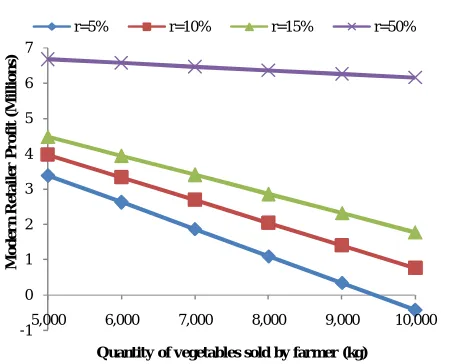
In Fig. 2, we present our numerical example to illustrate the behavior of the long term CSR program under the influence of rate of return and quantity of vegetables sold to modern retailer. From Fig. 2 we can infer two important findings:
1) The more budget is allocated for the CSR program to improve quality of vegetables, the more profit or modern retailer decreased;
2) The higher the risk (return rate), the higher profit gained by allocating more CSR budget.
Fig. 2. Effect of rate of return (risk) to modern retailer profit for T = 6 at various quantities should target
Fig. 3. Effect of rate of return (risk) to modern retailer profit for T = 3 at various quantities should target
The first findings can be inferred from r = 5% to r=15% which shows declined trending. However when r = 50%, the trend is inversed. This brings implication that if a modern retailer is heavily volatile to the external factor (such as market disruption), it would be preferred to commit long term CSR program.
B. Effects of return rate in short term CSR program
The result is almost similar to the long term CSR program with the difference return rate 50% also experienced declines trend (Fig. 3). Hence, it brings implication that short term CSR program is suitable if the business risk is low and modern retailer is not volatile to external factors.
C. Managerial Implication
The effect of financial risk for MR is investigated. We examined the of rate of return (risk) to modern retailer profit for T = 3 and T = 6. From the analysis of the both Fig. 2 and Fig. 3, it can be shown that the diminution gradient of T = 3 is sharper than T = 6. We can suggest to Human Resource Development (HRD) of the MR in collaboration with the FGC as follows. HRD of MR should choose a longer range of programs in implementing CSR program. HR should request CSR programs can be run on the lowest possible
V. CONCLUSIONS
This paper proposes an ASC network that considers modern retailers conduct corporate social responsibilities for farmers to increase the quality of vegetables. The CSR cost is considered as risk face by modern retailer. Numerical result shows that the proposed model can be used to analyze the trade-offs between the economic and social aspects of modern retailer multi-criteria decision making.
There are some extensions of this work that could be derived to elaborate the model formulation. First, the model can further incorporate supply-demand disruption. Additionally, we can investigate how CSR programs influence corporate financial risks from the ASC network perspective.
ACKNOWLEDGMENT
Thanks to the Directorate General of Higher Education (DGHE), Ministry of National Education, the Republic of Indonesia for the financial support in HIBAH BERSAING
Research Program FY 2012 (DIPA Sebelas Maret
University No. 02338/UN27.16/PN/ 2012, March 01, 2012) and to the Farmers Groups and the Modern Retail Corporation which have been partners in the research project.
REFERENCES
[1]. V.D.P. Correia and M.F Rola-Rubzen, “What Attributes Do Consumers Seek When Buying Vegetables: The Case of East Timorese Consumers,” World Journal of Social Sciences, vol. 2, no. 5, pp. 79 – 89 August 2012.
[2]. W. Sutopo, M. Hisjam dan Yuniaristanto, “An Agri-Food Supply Chain Model to Enhance The Business Skills of Small-Scale Farmers Using Corporate Social Responsibility,” MAKARA Journal of Technology Series, vol. 16, no. 1, pp. 43-50, April 2012.
[3]. W. Sutopo, M. Hisjam, and Yuniaristanto, “An Agri-Food Supply Chain Model to Empower Farmers For Supplying Deteriorated Product to Modern Retailer,” in Lecture Notes in Electrical
Engineering 186 LNEE, 1st
ed. S.I. Ao, G.C. Yang, X. Huang, and O. Castillo, Ed. Heidelberg: Springer, 2013, pp. 189-202. [4]. S. K. Chowdhury, A. Gulati, and E. Gumbira-Sa’id, “The rise of
supermarkets and vertical relationships in the indonesian food value chain: causes and consequences”, Asian Journal of Agriculture and Development, vol. 2, no. 1, pp. 39-48, June 2005.
[5]. A. Stamm, ”Agribusiness and poverty reduction: what can be learned from the value chain approach?,” In: Agri-Food Commodity Chains and Globalising Networks, C. Stringer and R. Le Heron, Eds. Hampshire, UK: Ashgate Publishing Limited, 2010, pp. 23-34. [6]. W. Morgan, S. Iwantoro, and I. A. S. Lestari, “Improving Indonesian
vegetable supply chains,” in Agri Product Supply-Chain Management in Developing Countries, G.I. Johnson and P.J. Hofman, Eds. Canbera: Australian Centre for International Agricultural Research, 2004, pp. 139-141.
[7]. N. Arumugam, M. A. Fatimah, E. F. C. Chew, and M. Zainalabidin, “Supply chain analysis of fresh fruits and vegetables,” Agric. Econ. Czech, vol. 56, no. 9, pp. 435–442, September 2010.
[8]. Law Number 40 of 2007 the Republic of Indonesia concerning on Limited Liability Companies, http://www.djpp.depkumham.go.id, (Accessed on 03 Augustus 2010).
[9]. H. Park-Poaps and K. Rees, “Stakeholder forces of socially responsible supply chain management orientation”, Journal of Business Ethics, vol. 92, no. 2, pp. 305-322, 2010.
[10]. M. A. Salam, “Corporate social responsibility in purchasing and supply chain”, Journal of Business Ethics, vol. 85, no. 2, pp. 355–370, 2009.
[11]. M. J. Maloni and M. E. Brown, “Corporate social responsibility in the supply chain: an application in the food industry,” Journal of Business Ethics, vol. 68, no. 1, pp.35–52, September 2006.
[12]. J. M. Cruz, “Dynamics of supply chain networks with corporate social responsibility through integrated environmental decision-0 20 40 60 80 100 120 140 160 180 200
5,000 6,000 7,000 8,000 9,000 10,000
P ro fi t o f M o d e rn R e ta ile r (M ill io n s)
Quantity of vegetable sold by farmer (kg)
r=5% r=10% r=15% r=50%
-1 0 1 2 3 4 5 6 7
5,000 6,000 7,000 8,000 9,000 10,000
M o d e r n R e ta il e r P r o fi t (M il li o n s)
Quantity of vegetables sold by farmer (kg)
[image:4.612.74.298.48.215.2] [image:4.612.72.300.253.435.2]making,” European Journal of Operational Research, vol. 184, no. 1, pp. 1005–1031, January 2008.
[13]. J. M. Cruz and T. Wakolbinger, “Multiperiod effects of CSR on supply chain networks, transaction costs, emissions, and risk,” International Journal Production Economics, vol. 116, no. 1, pp. 61– 74, November 2008.
[14]. P. Hohnen and J. Potts Corporate Social Responsibility-An Implementation Guide for Business, International Institute for Sustainable Development. 2007. www.iisd.org/pdf/2007/csr_guide.pdf
[15]. M. A. Salam, “Corporate social responsibility in purchasing and supply chain”, Journal of Business Ethics, vol. 85, no. 2, pp. 355–370, 2009.
[16]. M. J. Maloni and M. E. Brown, “Corporate social responsibility in the supply chain: an application in the food industry,” Journal of Business Ethics, vol. 68, no. 1, pp.35–52, September 2006.
[17]. J. M. Cruz, “Dynamics of supply chain networks with corporate social responsibility through integrated environmental decision-making,” European Journal of Operational Research, vol. 184, no. 1, pp. 1005–1031, January 2008.
[18]. J. M. Cruz and T. Wakolbinger, “Multiperiod effects of CSR on supply chain networks, transaction costs, emissions, and risk,” International Journal Production Economics, vol. 116, no. 1, pp. 61– 74, November 2008.
[19]. C. Mark-Herbert and C. von Schantz, “Communicating CSR–brand management,” Electronic Journal of Business Ethics and Organization Studies, Vol. 12, No. 2, pp. 4-11, November 2007. [20]. K. Amaeshi, O. Osuji, and P. Nnodim, “CSR in supply chains of
global brands: a boundary less responsibility?,” Journal of Business Ethics, vol. 81, no. 1, pp. 223-234, July 2008.
[21]. P. Castka and M. Balzarova, “ISO 26000 and supply chains - on the diffusion of the social responsibility standard,” International Journal of Production Economics, Vol. 111, No. 2, pp. 274-286, February 2008.
[22]. M. Mueller, V. G. dos Santos, and S. Seuring, “The contribution of environmental and social standards towards ensuring legitimacy in supply chain governance”, Journal of Business Ethics, vol. 89, no. 4, pp. 509-52, 2009.
[23]. W. Sutopo, M. Hisjam, and Yuniaristanto, An agri-food supply chain model for cultivating the capabilities of farmers accessing market using corporate social responsibility program, Proceedings of World Academic of Science, Engineering, and Technology (WASET) 2011, Venice, Italy, pp. 2440-2444.