Open Access
Research article
A role for cryptochromes in sleep regulation
Jonathan P Wisor
1
, Bruce F O'Hara
2
, Akira Terao
3
, Chris P Selby
4
,
Thomas S Kilduff
3
, Aziz Sancar
4
, Dale M Edgar*
1
and Paul Franken
2
Address: 1Dept. of Psychiatry and Behavioral Sciences, Stanford University School of Medicine, Stanford, CA, USA, 2Dept. of Biological Sciences,
Stanford University, Stanford, CA, USA, 3Molecular Neurobiology Laboratory, SRI International, Menlo Park, CA, USA and 4Dept. of Biochemistry
and Biophysics, University of North Carolina School of Medicine, Chapel Hill, NC, USA
Email: Jonathan P Wisor - [email protected]; Bruce F O'Hara - [email protected]; Akira Terao - [email protected]; Chris P Selby - [email protected]; Thomas S Kilduff - [email protected]; Aziz Sancar - [email protected]; Dale M Edgar* - [email protected]; Paul Franken - [email protected]
* Corresponding author
circadian genesoscillatory network of transcriptional factorsEEG slow-wave activity
Abstract
Background: The cryptochrome 1 and 2 genes (cry1 and cry2) are necessary for the generation of
circadian rhythms, as mice lacking both of these genes (cry1,2-/-) lack circadian rhythms. We studied sleep in cry1,2-/- mice under baseline conditions as well as under conditions of constant darkness and enforced wakefulness to determine whether cryptochromes influence sleep regulatory processes.
Results: Under all three conditions, cry1,2-/- mice exhibit the hallmarks of high non-REM sleep (NREMS) drive (i.e., increases in NREMS time, NREMS consolidation, and EEG delta power during NREMS). This unexpected phenotype was associated with elevated brain mRNA levels of period 1 and 2 (per1,2), and albumin d-binding protein (dbp), which are known to be transcriptionally inhibited by CRY1,2. To further examine the relationship between circadian genes and sleep homeostasis, we examined wild type mice and rats following sleep deprivation and found increased levels of
per1,2 mRNA and decreased levels of dbp mRNA specifically in the cerebral cortex; these changes
subsided with recovery sleep. The expression of per3, cry1,2, clock, npas2, bmal1, and casein-kinase-1ε did not change with sleep deprivation.
Conclusions: These results indicate that mice lacking cryptochromes are not simply a genetic model
of circadian arrhythmicity in rodents and functionally implicate cryptochromes in the homeostatic regulation of sleep.
Background
Sleep is regulated by both circadian and homeostatic mechanisms. As a consequence of a signal from the circa-dian clock, located in the suprachiasmatic nuclei (SCN) of the anterior hypothalamus in mammals [1], sleep is more likely to occur at certain times of the 24-h day than others, thereby determining the daily sleep-wake distribution [2].
Sleep is homeostatically regulated in the sense that sleep drive accumulates in the absence of sleep and decreases during sleep. Changes in sleep drive are thus driven by the sleep-wake history. Homeostatic and circadian mecha-nisms interact to determine the duration and quality of sleep and wakefulness [3–5]. Homeostatic regulation of sleep can still be observed in animals that lack circadian Published: 20 December 2002
BMC Neuroscience 2002, 3:20
Received: 12 November 2002 Accepted: 20 December 2002 This article is available from: http://www.biomedcentral.com/1471-2202/3/20
© 2002 Wisor et al; licensee BioMed Central Ltd. This is an Open Access article: verbatim copying and redistribution of this article are permitted in all media for any purpose, provided this notice is preserved along with the article's original URL.
rhythms after lesioning of the SCN [6–9], suggesting that circadian rhythms and sleep homeostasis are independent processes.
Homeostatic regulation of sleep can be quantified objec-tively after a period of enforced wakefulness (i.e., sleep deprivation), although a similar relationship between sleep parameters and spontaneous wakefulness can be quantified under baseline conditions as well [10,11]. The compensatory responses in time spent asleep, sleep con-solidation (i.e., sleep bout duration; [12]), and/or sleep intensity observed after an extended period of wakeful-ness are all taken as evidence that sleep drive is increased during wakefulness and thus that sleep is homeostatically regulated. Non-REM sleep (NREMS) intensity, quantified as EEG power in the delta frequency range (1–4 Hz), and NREMS consolidation are in a quantitative and predictive relationship with sleep history: both variables increase with the duration of prior wakefulness and subsequently decline during NREMS [3,4,10,12,13]. These variables are thus quantitative markers of NREMS homeostasis and are presumed to reflect an underlying physiological drive for sleep [4].
The time constants describing the dynamics of the increas-ing NREMS drive durincreas-ing wakefulness and decreasincreas-ing NREMS drive during NREMS [10,14] are compatible with a role for changes in gene expression in their regulation. Although past studies have shown that extended periods of wakefulness cause changes in gene expression (for re-view see [15]), no causal relationship between changes in gene expression and sleep homeostasis has been identi-fied. A recent study in Drosophila melanogaster implicates transcriptional regulation by the circadian gene cycle, a ho-molog of the mammalian bmal1 gene, in the homeostatic regulation of rest [16]. While rest in flies shares several features with sleep in mammals [17,18], it remains to be determined whether a similar role for BMAL1 or related transcriptional regulators is necessary for the homeostatic regulation of sleep.
In both flies and mammals, circadian rhythms are thought to be generated by transcriptional/translational feedback loops comprising a network of transcriptional regulators [19–21]. The core of this self-sustained molec-ular oscillation consists of positive and negative elements. In mammals, the positive elements are two basic helix-loop-helix (bHLH) PAS-domain-containing transcription factors, CLOCK and BMAL1, that form heterodimers that can drive the transcription of three period (per) genes per1–
3 and two cryptochromes (cry1,2). PER1,2 and CRY1,2
pro-teins suppress CLOCK:BMAL1-mediated transcription thereby forming the negative elements in the feedback loop. Consistent with their central role in circadian rhythm generation, genetic inactivation of both
crypto-chromes (cry1,2-/-) results in circadian arrhythmicity in mice [22,23]. Given the widespread expression of the ele-ments of the molecular clock in the brain (and elsewhere) and the large number of genes regulated by bHLH-PAS transcription factors (e.g. [24]), the role of cryptochromes may extend beyond circadian clock function. To deter-mine whether transcriptional regulation by CRY1,2 influ-ences the homeostatic regulation of sleep, we studied sleep in cry1,2-/- mice under baseline conditions, under conditions of constant darkness, and after sleep depriva-tion (SD). The expression of circadian genes that are regu-lated by cryptochromes were evaluated in the brain of
cry1,2-/- mice and in sleep deprived wild type mice and rats.
Results
Sleep regulation in cry1,2-/- mice
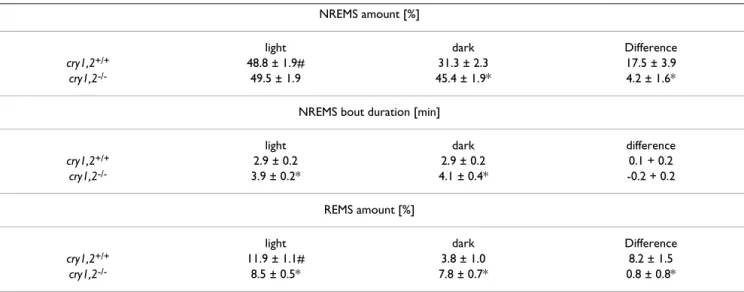
In baseline conditions, wild type mice showed the sleep-wake distribution typical for this nocturnal species with high values of sleep in the light period and low values in the dark period (Figure 1, Table 1). The sleep-wake distri-bution in cry1,2-/- mice was distinct from that of wild type controls (Figure 1) in that sleep variables did not differ be-tween the 12-h light (L) and dark (D) periods (Table 1). Nevertheless, as in wild type controls, the light-to-dark transition was accompanied by a pronounced decrease in sleep time in cry1,2-/- mice (Figure 1).
During baseline, total daily NREMS time was significantly greater in cry1,2-/- mice than in wild type mice (683 ± 25 vs. 576 ± 12 min, P < 0.002, unpaired t-test), whereas the daily time spent in REM sleep did not differ (118 ± 7 vs. 113 ± 10 min). The difference between genotypes in NREMS time was present only in the dark period and not in the light (Table 1; Figure 1). Average NREMS bout du-ration, a measure of NREMS consolidation that is posi-tively correlated with a high homeostatic sleep pressure [13], was greater by 34% in cry1,2-/- mice relative to wild type mice during the light period, and by 41% during the dark period (Table 1). Consistent with this increase in sleep consolidation, NREMS delta power was significantly higher in cry1,2-/- than in cry1,2+/+ mice during most of baseline (Figure 1). This difference in EEG delta power was specific for NREMS and did not extend to other EEG frequencies (Figure 2A), indicating that the increase in delta power is not due to a difference in EEG amplifica-tion. This state-specific EEG difference in delta power was especially evident at the wake-to-NREMS transition.
cry1,2-/- mice exhibited higher delta power values than
cry1,2+/+ immediately after the onset of NREMS (Figure 2B).
The same genotypic differences in sleep were observed in constant dark (DD) conditions (Figure 3). Mice lacking
Figure 1
Time course of sleep (upper panels) and NREMS EEG delta power (lower panel). Data from baseline (BSL), sleep deprivation (SD), and recovery (REC) are shown. Open (Cry1,2-/-) and closed (Cry1,2+/+) symbols designate mean hourly values ± 1 SEM. In the lower panel, thicker lines connect mean predicted delta power values based on the sleep-wake distribution in individual mice; (see Methods). Triangles mark intervals in which recovery values differed from corresponding baseline values within each genotype (triangle orientation designates direction of deviation; P < 0.05, post-hoc paired t-tests). Gray bars at the bottom of each panel mark intervals with significant genotype differences (P < 0.05, post-hoc t-tests). The baseline dark period was depicted twice to illustrate the changes at the dark-to-light transition.
min, P = 0.053, unpaired t-test), NREMS bouts were long-er (3.8 ± 0.3 vs. 2.6 ± 0.1 min, P < 0.001, unpaired t-test),
and EEG delta power in NREMS was higher in cry1,2
-/-compared to cry1,2+/+ controls (594 ± 21 vs. 448 ± 52 µV2/ 0.1 Hz, P < 0.04, unpaired t-test; Figure 3). The decrease in sleep time prior to the onset of the dark period (Figure 1) was still present in DD in cry1,2+/+ mice; sleep time de-creased in the latter half of the subjective day and mini-mum average sleep time was reached immediately after the onset of the subjective night (Figure 3). The anticipa-tory decrease in sleep time that occurred prior to the onset
of dark in cry1,2-/- mice in LD did not occur under DD
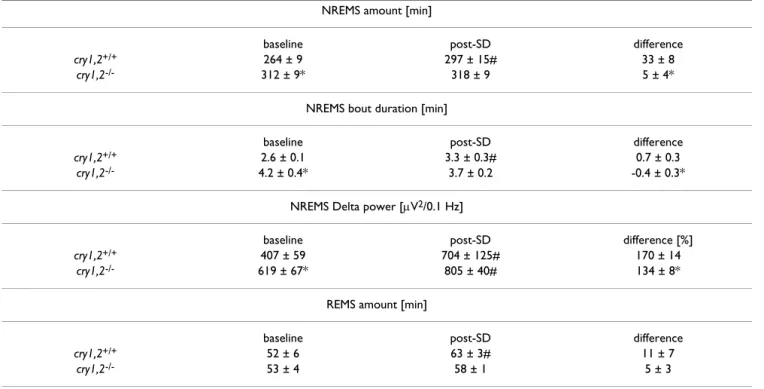
conditions (Figure 3). Under DD conditions, less REMS was present in cry1,2-/- mice than in cry1,2+/+ mice (119 ± 7 vs. 149 ± 9 min, P < 0.03, unpaired t-test) due to an in-crease in REMS in cry1,2+/+ mice in DD (149 ± 9 min) rel-ative to LD (113 ± 10 min, P < 0.03, paired t-test). To further investigate the homeostatic regulation of sleep in cry1,2-/- mice, we assayed the compensatory response to a 6 h SD (see Figure 1). After SD, wild type mice displayed the typical increase in REMS and NREMS time, NREMS bout duration, and EEG delta power above baseline levels ([10,13] Table 2, Figure 1). In contrast, cry1,2-/- mice did not exhibit significant increases in REMS, NREMS time or NREMS bout duration after SD; only a brief increase in NREMS delta power was observed (lasting 1 h in cry1,2 -/-vs. 5 h in wild type mice; Figure 1). The initial increase in delta power (relative to baseline), measured over the first recovery hour, was significantly smaller in cry1,2-/- than the increase observed in wild type mice (Table 2). Delta power (Figure 1, Table 2) and NREMS bout duration
(Ta-bles 1, 2), in cry1,2-/- mice is maintained at a level only at-tained by the wild type mice when their sleep pressure was highest, i.e., at the end of the active or dark period and af-ter SD.
In wild type mice, EEG delta power still varied as a func-tion of the sleep-wake history with high values at the end of the baseline dark period and after the SD and low val-ues at the end of the light or major rest period (Figure 1). Presumably due to the altered sleep-wake distribution, the daily range of EEG delta power values was smaller in
cry1,2-/- mice than in wild type mice (Table 1, Figure 1). We tested the assumption of a relationship between delta power and the sleep-wake history by using a mathemati-cal method that predicts the level of EEG delta power oc-curring in individual NREMS bouts based on the 42 h sequence of 10-sec behavioral state scores for individual animals [10]. With this analytical tool, the time constants of the increasing delta power during wakefulness and its decrease during NREMS are estimated. For both geno-types, delta power in both baseline and recovery from SD could be reliably predicted on the basis of sleep-wake his-tory (Figure 1), which is underscored by the highly signif-icant correlations between empirical and simulated data (r = 0.91 and 0.87 for cry1,2+/+ and cry1,2-/-, respectively, P < 0.0001 for both genotypes). Thus, in the absence of
cryptochromes, NREMS delta power varied as a function of
the prior sleep-wake history. However, in cry1,2-/- mice, a significantly shorter time constant for the increase (i.e., a faster build-up) of delta power was obtained (τincrease: 5.0 ± 0.3 h in cry1,2+/+ vs. 3.5 ± 0.5 h in cry1,2-/-; P < 0.05; un-Table 1: Sleep in 12-h light and dark periods under baseline conditions in cry1,2+/+ and cry1,2-/- mice.
NREMS amount [%]
light dark Difference
cry1,2+/+ 48.8 ± 1.9# 31.3 ± 2.3 17.5 ± 3.9
cry1,2-/- 49.5 ± 1.9 45.4 ± 1.9* 4.2 ± 1.6*
NREMS bout duration [min]
light dark difference
cry1,2+/+ 2.9 ± 0.2 2.9 ± 0.2 0.1 + 0.2
cry1,2-/- 3.9 ± 0.2* 4.1 ± 0.4* -0.2 + 0.2
REMS amount [%]
light dark Difference
cry1,2+/+ 11.9 ± 1.1# 3.8 ± 1.0 8.2 ± 1.5
cry1,2-/- 8.5 ± 0.5* 7.8 ± 0.7* 0.8 ± 0.8*
Post-hoc comparisons: * P < 0.05 vs. wild type, unpaired t-tests; # P < 0.05 vs. dark period, within same genotype, paired t-tests. Differences repre-sent the mean of individual light-dark differences.
Figure 2
EEG power in the 1–20 Hz range for NREMS, REM sleep (REMS) and wake during baseline. (A) EEG spectral power in cry1,2-/ - (thick lines) and wild type mice (thin lines). Differences between the genotypes are limited to NREMS delta power. (B) Delta power (1–4 Hz) during wake-to-NREMS transitions in the baseline light (left) and dark (right panel) period. Gray horizontal bars underneath the curves indicate significant genotype differences (P < 0.05; post-hoc t-tests). Error bars span ± 1 SEM.
FREQUENCY [Hz]
5
10
15
20
0
200
400
600
WT NREM KO NREMEE
G P
O
WER
[ µ V 2 / 0 .1 Hz]0
100
200
300
FREQUENCY [Hz]
5
10
15
20
0
100
200
300
REMS
WAKE
NREMS
b
a
DEL
T
A POW
E
R
[
µ
V
2/ 0.1
H
z
]
200
300
400
500
600
700
TIME
[Min]
-2 1 0 1 2 3
WAKE NREMS
WAKE NREMS
TIME
[Min]
Figure 3
Time course of sleep and NREMS EEG delta power during constant dark conditions (DD). Layout and symbols are same as in Figure 1. Gray bars at the bottom of each panel mark intervals with significant genotype differences (P < 0.05, post-hoc t-tests). The subjective day is marked with a gray horizontal bar at the top of the upper panel. The first 12-h represents the last dark-period under baseline (BSL) light-dark conditions.
paired t-test), whereas the time constant describing the de-cline of delta power during NREMS did not differ (τdecrease: 1.7 ± 0.2 h in cry1,2+/+ vs. 1.8 ± 0.3 h in cry1,2-/ -).
Circadian gene expression in the brain of cry1,2-/- mice
Deletion of the cryptochromes disinhibits the transcription-al activation of CLOCK:BMAL1 and NPAS2:BMAL1 target genes, resulting in increased levels of their transcripts in the SCN, liver, and retina [20,23,25]. We assayed the ex-pression in the brain of three genes that are known targets of cryptochrome mediated transcriptional inhibition:
albu-min D-binding protein (dbp [26]), period (per)1, and per2
[20,23,27], in the middle of the daily light period. Con-firming the earlier studies in other tissues, mRNA levels for all three genes were higher in the brains of cry1,2 -/-mice compared to wild type -/-mice (Figure 4). This relative increase was highly significant for all three genes (dbp,
per1: 3.3-fold; per2: 5.6-fold; P < 0.0003, unpaired t-tests,
n = 5/genotype).
Sleep deprivation-induced differences in circadian gene expression
Messenger RNA levels for per1,2, cry1,2, and dbp were quantified by RT-PCR in three brain areas (cerebral cortex, basal forebrain, and hypothalamus) from C57BL/6 mice
that were sacrificed immediately after 6 h of SD or after 4 h of recovery sleep (ZT10). Significant differences in ex-pression were observed only in the cortex (Figure 5A) and not in hypothalamus or basal forebrain (data not shown). Both per1 and per2 mRNA levels were higher immediately after SD compared to controls, cry1,2 expression did not change, and dbp mRNA decreased significantly (Figure 5A). After 4 h of recovery sleep, per1,2 and dbp expression returned to the normal levels for that time of day (ZT10; Figure 5A). We also measured the expression of five other circadian genes: bmal1, clock, npas2, per3, and casein kinase-1-ε (csnk1e) in the cortex; the levels of these five mRNAs were not affected by SD (data not shown).
As confirmation of our results in the mouse, we deter-mined the expression of per2 and per1 in the rat by RT-PCR and Northern analysis, respectively. In a similar ex-perimental paradigm, rats were sleep deprived for 6 h and then either sacrificed immediately after the SD (ZT6), or after 2 h of recovery sleep (ZT8; n = 5/group). The cortex-specific increase in per2 mRNA was confirmed by the RT-PCR analysis and, as in the mouse, per2 expression re-turned to basal levels after a period of recovery sleep (data not shown). Northern analysis confirmed that recovery sleep was associated with a decline in per1 mRNA relative Table 2: Effect of 6 h SD on sleep time and delta power in cry1,2+/+ and cry1,2-/- mice.
NREMS amount [min]
baseline post-SD difference
cry1,2+/+ 264 ± 9 297 ± 15# 33 ± 8
cry1,2-/- 312 ± 9* 318 ± 9 5 ± 4*
NREMS bout duration [min]
baseline post-SD difference
cry1,2+/+ 2.6 ± 0.1 3.3 ± 0.3# 0.7 ± 0.3
cry1,2-/- 4.2 ± 0.4* 3.7 ± 0.2 -0.4 ± 0.3*
NREMS Delta power [µV2/0.1 Hz]
baseline post-SD difference [%]
cry1,2+/+ 407 ± 59 704 ± 125# 170 ± 14
cry1,2-/- 619 ± 67* 805 ± 40# 134 ± 8*
REMS amount [min]
baseline post-SD difference
cry1,2+/+ 52 ± 6 63 ± 3# 11 ± 7
cry1,2-/- 53 ± 4 58 ± 1 5 ± 3
Post-hoc comparisons: * P < 0.05 vs. wild type, unpaired t-test; # P < 0.05, vs. baseline day, within same genotype, paired t-test. Delta power was calculated over the first hour after the SD (ZT6-ZT7). REMS and NREMS amount and bout duration were calculated over 12 hours (ZT6-ZT18). Differences indicate mean individual post-SD – baseline differences except for delta power which is calculated as percentage of baseline.
Figure 4
Whole-brain mRNA levels for dbp, per1, and per2 in cry1,2-/- and wild type mice. Levels of all three genes are elevated in cry1,2 -/- mice (KO) relative to wild type (WT) controls at ZT6 when dbp, per1, and per2 mRNAs are lowest in the forebrain of wild type mice [37]. In the lower three panels mean (± 1 SEM) expression levels are depicted. β-actin expression was used as an internal standard.
KO WT KO WT KO WT KO WT KO WT
dbp
per1
per2
ββββ
-actin
dbp
Express
io
n
le
vel
0 1 2 WTKO
per1
0 1 2 3 4WT KO
per2
0 1 2 3WT KO
Figure 5
Sleep deprivation alters mRNA levels of per1, per2, and dbp. (A) RT-PCR analysis of the expression of five 'clock'-genes in the mouse cortex across four experimental conditions [C = control; R = recovery sleep; SD = sleep deprived; ZT = Zeitgeber time (i.e., 6 or 10 h after light-onset)]. g3pdh expression was used as an internal standard. Bars depict mean ± 1 SEM. Asterisks denote significant differences (P < 0.05) between the experimental and corresponding control group (Student-Newman-Keuls
post-hoc tests; 1-way ANOVA factor 'condition': P < 0.05, for per1,2, and dbp only; n = 7/condition) (B) per1 mRNA falls
signif-icantly in rat cortex during a 2-h recovery period (R) subsequent to 6 h SD ending at ZT6 (P < 0.05, t-test). Northern analysis was performed on cortex of five sleep-deprived rats and five rats that were allowed 2 h of recovery sleep (ZT8).
R SD R SD R SD R SD R SD
ββββ
-actin
per1
b
a
per1
0
1
2
3
4
per2
0.0
0.5
1.0
1.5
2.0
dbp
0
1
2
3
*
*
*
C SD C R
ZT6 ZT10
C SD C R
ZT6 ZT10
C SD C R
ZT6 ZT10
cry1
C SD C R
ZT6 ZT10
0
1
2
3
4
cry2
0.0
0.1
0.2
0.3
0.4
C SD C R
ZT6 ZT10
E
x
pression Lev
el
to the level of expression reached at the end of the SD (Fig-ure 5B).
Discussion
Upon release into constant darkness cry1,2-/- mice imme-diately become arrhythmic at the behavioral level [22,23], at the level of SCN electrophysiology [28], and at the cel-lular/molecular level [23]. Of the available mouse models for circadian dysfunction, only per1,2 double mutant mice [29], bmal1 knockout mice [30], and mice with an abla-tion of the SCN [31] show a similarly dramatic pheno-type. Thus, cry1,2-/- mice appear to be a suitable model for studies of the regulation of sleep in the absence of an in-tact circadian clock.
Under light / dark (LD) conditions, running wheel activity patterns and, as we show here, the distribution of sleep in
cry1,2-/- mice still exhibit diurnal variation. LD cycles can influence the expression of sleep by entraining the circadi-an pacemaker that drives the diurnal rhythm of sleep circadi-and/ or by directly affecting the expression of sleep, thereby 'masking' the influence of the pacemaker on sleep. Mask-ing seems to be the mechanism by which light drives these rhythms under LD conditions in cry1,2-/- mice [22], since
the daily modulation of NREMS that occurs in cry1,2
-/-mice under a light/dark cycle immediately disappears upon placement in constant darkness ([22], Figure 3). At the molecular level, per2 expression (but not that of per1) is rhythmic in the SCN of cry1,2-/- mice under LD condi-tions. Upon release into constant dark conditions, per2 rhythmicity disappears concomitant with the immediate loss of behavioral rhythmicity, suggesting a role for 'light-driven' per2 expression in generating behavioral rhythms [23].
The most striking and unexpected finding of the current study is that, under baseline conditions, cry1,2-/- mice ex-hibit all the hallmarks of high NREMS pressure, including more consolidated NREMS, increased NREMS time, and higher levels of EEG delta power relative to wild type mice that were attained immediately after NREMS onset. The failure of cry1,2-/- mice to exhibit a robust increase in any of these measures after 6 h SD is consistent with the inter-pretation that these mice are already under high NREMS pressure during baseline conditions. Determination of the time constants that most accurately describe the dynamics of NREMS delta power revealed that during wake, the pro-pensity for high NREMS delta power increases during wake in cry1,2-/- mice at a faster rate than in wild type mice. This could help explain why NREMS delta power is chronically high in cry1,2-/- mice. The coincidence of high NREMS time and chronically high delta power in cry1,2 -/-mice is all the more striking when one considers that dur-ing NREMS, the drive for NREMS should dissipate and re-sult in lower delta power [14,32].
These findings in cry1,2-/- mice contrast with the findings of sleep studies in animals that are rendered arrhythmic by lesioning of the SCN. In nocturnal rodents, lesioning the SCN results in more fragmented sleep, with lower EEG delta power, but leaving the daily sleep time unchanged [6–8,31]. Lesioning the SCN in a diurnal primate, the squirrel monkey, did result in an increase in NREMS time, but sleep was more fragmented, with a higher proportion of 'light' NREMS [5]; i.e., with lower overall levels of EEG delta power. Furthermore, the homeostatic response to sleep deprivation does not seem to be altered in SCN-le-sioned rodents [6–8]. Thus, the sleep characteristics of
cry1,2-/- mice do not support the concept of cry1,2-/- mice as simply a genetic model for ablation of the circadian clock in the SCN. Together, these unexpected results are compatible with a role for cryptochromes in the homeostat-ic regulation of sleep in addition to their role in generat-ing circadian rhythms.
Recent observations, including the current report, suggest a complex interrelationship between homeostatic and cir-cadian influences on sleep at the molecular level. Deletion of the cycle gene in Drosophila produces flies that have an exaggerated homeostatic response to rest deprivation in addition to their lack of circadian rhythmicity [16]. In a striking parallel to our current results, flies with a muta-tion in the cryptochrome gene also exhibit increased rest time as well as a reduced compensatory response to rest deprivation (P. Shaw, personal communication). The
clock mutation in mice, which has a profound effect on
cir-cadian rhythmicity [33], decreases NREMS time and con-solidation under baseline conditions [34]. The clock sleep phenotype is the inverse of the sleep characteristics we re-port here for the cry1,2-/- mice and is thus consistent with CLOCK and CRY1,2 being positive and negative transcrip-tional regulators, respectively. Albumin D-binding protein (Dbp) is a transcription factor whose expression is under the direct transcriptional control of CLOCK:BMAL1 [26]. Deletion of the dbp gene, which results in a shortening of the circadian period [35], also results in decreased sleep consolidation and NREMS delta power [36].
We assume that the effects on sleep we observed in cry1,2 -/- mice are a result of a lack of cryptochrome-dependent in-hibition of the transcriptional activation provided by the bHLH-PAS heterodimers CLOCK:BMAL1 and NPAS2:BMAL1 [19,20,37], although cryptochromes also play a role in stabilizing and nuclear sequestration of PER proteins [38], and in photoreception [39]. Lack of
crypto-chromes results in increased mRNA levels of CLOCK/
NPAS2:BMAL1 target genes, including the circadian genes
per1 and per2 [20,23]. The expression of these two genes is
viewed as a state variable of the molecular circadian clock or a marker of CLOCK/NPAS2:BMAL1-induced transcrip-tion, although at least per1 transcription can also be
(rap-idly) induced by light [40,41], through a CREB-dependent signaling pathway [42–44]. The observation of high brain levels of per1,2 transcripts under baseline conditions in
cry1,2-/- mice raises the possibility that these or other CLOCK/NPAS2:BMAL1 target genes are involved in the homeostatic regulation of sleep. The observation of ele-vated per gene expression in the cortex of sleep-deprived rats and mice (Figure 5) supports this hypothesis. The increase in per expression after the sleep deprivation was specific to the cerebral cortex, although it cannot be ruled out, based on the present study, that circadian gene expression changes with sleep-wake history in specific nu-clei within the other two regions examined; i.e., the hy-pothalamus and basal forebrain. A surprisingly small number (~0.5%) of the ~10,000 genes screened by mRNA differential display and cDNA microarrays in the cortex to date change their expression with sleep deprivation [45]. It is intriguing and encouraging that, of the initial genes we assayed, three changed their expression with sleep dep-rivation (per1, per2, dbp), none of which were identified in the aforementioned screens. cry1,2 expression at the mRNA level did not change with sleep deprivation in wild type mice. This observation does not necessarily obviate a direct role for CRY proteins in mediating a response to sleep deprivation. CRY poteins may play a role at steady state levels or there may be post-translational changes in the functioning of CRY proteins in association with sleep deprivation, such as phosphorylation state, ubiquitina-tion [38], or intracellular localizaubiquitina-tion [46] of the protein, all of which are regulated dynamically, at least in vitro. In the liver, CRY protein oscillations are not necessary for cir-cadian oscillations of target transcripts, as CRY proteins are present in excess of PER and oscillations in the latter produce rhythmicity [46]. A similar situation might exist in the cortex.
The high per levels in cry1,2-/- mice and the low per levels in clock mutant mice [26,47] correlate with their contrast-ing sleep phenotype (see above; [34]). In this context, the sleep abnormalities in dbp-/- mice might also be related to a reduction in per expression since, at least in vitro, DBP can amplify the CLOCK:BMAL1-induced transcription of
per [48], but it is not known whether per transcript levels
are altered in dbp-/- mice. Apart from the present observa-tions in sleep-deprived rats and mice, several other reports confirm that cortical levels of per expression in wild type animals are high at times when sleep drive is high, irre-spective of the phase at which the circadian expression of
per peaks in the SCN. Thus, in both nocturnal and diurnal
species, per expression in the cortex is maximal in con-junction with the major waking episode [37,49,50]. Un-der conditions where the phase (methamphetamine administration, restricted feeding) or distribution (circa-dian splitting) of locomotor activity is altered, per
expres-sion in the cortex parallels the overt rhythm of wakefulness, whereas the circadian oscillation of per gene expression in the SCN remains unaffected [49,51,52]. Thus, in contrast to its role in the SCN, PER protein in the cortex is not a component of a self-sustaining circadian os-cillator [53]. Instead, per expression in the cortex seems to the follow sleep-wake history, consistent with the hypoth-esis that it is related to homeostatic regulation of sleep. However, in the current study and those cited above, the expression of per genes was studied at the mRNA level. PER protein level may be affected differentially from that of per mRNA and levels of the PER protein are reduced in
cry1,2-/- mice due to reduced stability of PER proteins in
the absence of heterodimerizing CRY partners [19,38,46].
Conclusions
In the discussion, we have focused on per1,2 mRNAs as transcriptional targets of cry1,2 because the expression patterns of these circadian genes have been widely de-scribed and because their transcriptional control by CRY proteins and by CLOCK/NPAS2:BMAL1 has been well es-tablished. At least 90 genes are regulated in a similar fash-ion by NPAS2:BMAL1 [37] and the identity of the target genes critical for the NREMS phenotype in cry1,2-/- mice remains to be determined. In the absence of cry1,2, the stability and overall level of PER proteins, particularly in the nucleus of the cell, is reduced [19,38,46]. It would therefore be interesting to observe sleep in per1,2 single and double mutant mice, the latter of which have been subjected to behavioral observation [29] but not to sleep EEG studies. per1 single knockout mice and mice express-ing a non-functional PER2 protein both exhibit subtle dif-ferences from wild type in the homeostatic rebound after SD [54], an observation compatible with the hypothesis that these genes are correlates of sleep homeostasis. In ad-dition, measurement of the effects of sleep deprivation on the expression of cry1,2 and per1,2 genes at the protein level will provide critical information. Finally, from a functional perspective, it is interesting that CLOCK/ NPAS2:BMAL1 transcriptional activity is sensitive to re-dox state [24]. This transcriptional activity might thus pro-vide a link between neuronal activity and an energy regulatory function for NREMS, as has been suggested pre-viously [55].
Methods
Sleep studies
Mice were generated by mating cry1 and cry2 single knock-out mice, both of mixed background (ca. 3/4 C57BL/6 – 1/4 129/Sv; [23]) to generate double heterozygotes that were interbred to generate double knockouts (cry1,2-/-) and wild type controls (cry1,2+/+). Eight wild type and 6
cry1,2-/- male mice were surgically prepared for EEG and electromyographic (EMG) recordings as described previ-ously [56]. Following two weeks of post-surgical recovery,
mice were isolated for recordings in sound-attenuated chambers. The experiments were conducted under an LD12:12 cycle (lights-on; i.e., Zeitgeber Time ZT0, at 0600 h). Twenty-four hour baseline recordings, starting at ZT0, were followed by a 6 h sleep deprivation (SD) starting at ZT0. The sleep deprivations in this experiment and the other two experiments (see below) were performed by the introduction of novel objects into the cage or by gentle handling. In addition to the SD experiment, animals were subjected to one day of baseline recording in constant darkness separated from the SD experiment by 72 hours. All experimental procedures complied with institutional and NIH guidelines.
Digitized EEG and integrated EMG were stored in 10-s ep-ochs and classified as NREMS, REM sleep (REMS), or wakefulness by visual inspection. The EEG was subjected to a Fast-Fourier-Transformation yielding power spectra between 0–20 Hz. Delta power was calculated as the aver-age EEG power in the delta (1–4 Hz) frequencies for ep-ochs scored as NREMS. For visual representation, hourly delta-power values (Figure 1) were expressed relative to an individual mean (i.e., 24-h baseline mean) before trans-forming back to absolute values to capture both the highly reproducible individual time course of delta power and the genotype differences in absolute values [10]. Statistical evaluation of genotype differences were based, however, on the absolute EEG values. Post-SD delta power was compared to baseline during the first hour of spontaneous sleep subsequent to SD, while NREMS amount and bout duration (Table 2) were compared over 12 hours (ZT6-ZT18), in accordance with the distinct dynamics of the compensatory responses of these variables to SD [57]. NREMS bouts were defined as periods of NREMS initiated by three consecutive 10-second epochs of NREMS and ter-minated by three consecutive epochs not classified as NREMS. EEG delta power changes at transitions between wakefulness and NREMS were measured during those transitions characterized by at least 12 consecutive 10-s epochs of wake followed by at least 18 consecutive 10-ep-ochs of NREMS.
A mathematical algorithm was used to quantify the sleep-wake dependent dynamics of delta power during both baseline and recovery from SD [10]. In this algorithm, del-ta power decreases during NREMS and increases during wakefulness according to saturating exponential func-tions, the time constants of which are estimated by mini-mizing the square of the differences between empirical (delta power) data and the values produced by the math-ematical functions. The two time constants (for the in-crease and dein-crease of delta power) that resulted in the smallest deviation from empirical values within each indi-vidual were used to statistically assess genotype effect on the dynamics of delta power [10].
Northern analysis
Five cry1,2-/- mice and 5 wild type controls were sacrificed in the middle of the light period (ZT6). Brains were rapid-ly removed and frozen on dry ice. Total RNA was extracted and Northern analysis was performed with 10 µg whole brain total RNA as previously described [58].
Ten Wistar rats were sleep deprived for 6 h beginning at light-onset (ZT0). Five rats were sacrificed at ZT6 at the end of the SD and five were allowed to recover for 2 h fol-lowing the SD and were sacrificed at ZT8. Rats were mon-itored by EEG/EMG throughout this period as described [59]. Brains were rapidly removed, dissected and frozen, and Northern analysis performed.
Quantitative real-time Reverse-Transcriptase Polymerase-Chain-Reaction (RT-PCR) analyses
Four experimental groups of male C57BL/6J mice were studied: 1) sleep deprived from light-onset (ZT0) to ZT6; 2) control mice for the SD group; 3) 6 h SD (ZT0-ZT6) fol-lowed by 4-h recovery sleep (ZT6-ZT10); and 4) control mice for the recovery group (n = 7 mice/group). Animals were sacrificed by decapitation. Brains were rapidly re-moved and the cerebral cortex, basal forebrain, and hy-pothalamus were dissected. After a mid-sagittal cut, the entire cortical tissue was peeled off and separated from the hippocampus and underlying diencephalon. Striatal tis-sue was also removed. From each animal, quantitative real-time PCR determinations of 5 target genes (cry1,2,
per1,2, and dbp) and a reference cDNA
(glyceraldehyde-3-phosphate dehydrogenase, g3pdh) were made from the cortex, basal forebrain, and hypothalamus (primer/probe sequences available upon request). For five other targets (bmal1, clock, npas2, per3, and csnk1e), expression was quantified in the cortex only. To confirm the specificity of the nucleotide sequences chosen for the primers and probes and the absence of DNA polymorphisms, BLASTN searches were conducted against the dbEST and nonre-dundant set of Genbank, EMBL, and DDBJ databases. Dual color fluorescence was detected using an ABI Prism 7700 Sequence Detection System (Perkin-Elmer Corp., Foster City, CA). For each experimental sample, the amount of the target and g3pdh reference was determined from the standard curve (range of 0.2–200 ng total RNA) measured in the same assay. A normalized value was ob-tained by dividing the target cDNA amount by the g3pdh reference. For details see [59].
Authors' contributions
CPS and AS generated the cry1,2-/- mice and provided some preliminary data on microarray gene expression profiles in the brains of these mice. JPW and DME con-ceived and implemented sleep studies in cry1,2-/- mice. PF analyzed sleep EEG data and conceived, with BFO, AT, and TSK, the molecular studies. BFO, AT, and TSK
per-formed gene expression assays on brain tissues from mice and rats. JPW and PF drafted the manuscript. All authors read and approved the manuscript.
Acknowledgments
We appreciate the generous gifts of cDNA clones from Drs. Ueli Schibler (dbp cDNA), Steven Reppert (per2 cDNA), and Hajime Tei (per1 cDNA). Funding was provided by the following NIH grants: HL64243 (JPW and DME), R01HL/MH59658 and R01MH61755 (AT and TSK), GM31082 (CPS and AS), and HL64148 and DA13349 (BFO and PF).
References
1. Klein DC, Moore RY and Reppert SM Suprachiasmatic nucleus: The mind's clock. New York: Oxford University Press 1991, 2. Edgar DM Functional role of the suprachiasmatic nuclei in the
regulation of sleep and wakefulness. In: Fatal Familial Insomnia:
In-herited prion diseases, sleep and the thalamus (Edited by: Guilleminault C) New York: Raven Press, Ltd 1994, 203-213
3. Dijk DJ and Czeisler CA Contribution of the circadian pace-maker and the sleep homeostat to sleep propensity, sleep structure, electroencephalographic slow waves, and sleep spindle activity in humans. J Neurosci 1995, 15:3526-38 4. Borbely AA and Achermann P Sleep homeostasis and models of
sleep regulation. In: Principles and practice in sleep medicine (Edited by:
Kryger MH, Roth T, Dement WC) Philadelphia: W.B. Saunders 2000,
377-390
5. Edgar DM, Dement WC and Fuller CA Effect of SCN lesions on sleep in squirrel monkeys: evidence for opponent processes in sleep-wake regulation. J Neurosci 1993, 13:1065-79
6. Mistlberger RE, Bergmann BM, Waldenar W and Rechtschaffen A Re-covery sleep following sleep deprivation in intact and supra-chiasmatic nuclei-lesioned rats. Sleep 1983, 6:217-33
7. Tobler I, Borbely AA and Groos G The effect of sleep deprivation on sleep in rats with suprachiasmatic lesions. Neurosci Lett 1983, 42:49-54
8. Trachsel L, Edgar DM, Seidel WF, Heller HC and Dement WC Sleep homeostasis in suprachiasmatic nuclei-lesioned rats: effects of sleep deprivation and triazolam administration. Brain Res 1992, 589:253-61
9. Wurts SW and Edgar DM Circadian and homeostatic control of rapid eye movement (REM) sleep: promotion of REM ten-dency by the suprachiasmatic nucleus. J Neurosci 2000, 20:4300-10
10. Franken P, Chollet D and Tafti M The homeostatic regulation of sleep need is under genetic control. J Neurosci 2001, 21:2610-21 11. Huber R, Deboer T and Tobler I Effects of sleep deprivation on sleep and sleep EEG in three mouse strains: empirical data and simulations. Brain Res 2000, 857:8-19
12. Edgar DM and Seidel WF Modafinil induces wakefulness without intensifying motor activity or subsequent rebound hyper-somnolence in the rat. J Pharmacol Exp Ther 1997, 283:757-769 13. Franken P, Dijk DJ, Tobler I and Borbely AA Sleep deprivation in
rats: effects on EEG power spectra, vigilance states, and cor-tical temperature. Am J Physiol 1991, 261:R198-208
14. Daan S, Beersma DG and Borbely AA Timing of human sleep: re-covery process gated by a circadian pacemaker. Am J Physiol 1984, 246:R161-83
15. Cirelli C How sleep deprivation affects gene expression in the brain: a review of recent findings. J Appl Physiol 2002, 92:394-400 16. Shaw PJ, Tononi G, Greenspan RJ and Robinson DF Stress response genes protect against lethal effects of sleep deprivation in Drosophila. Nature 2002, 417:287-91
17. Shaw PJ, Cirelli C, Greenspan RJ and Tononi G Correlates of sleep and waking in Drosophila melanogaster. Science 2000, 287:1834-7
18. Hendricks JC, Finn SM, Panckeri KA, Chavkin J, Williams JA, Sehgal A and Pack AI Rest in Drosophila is a sleep-like state. Neuron 2000, 25:129-38
19. Kume K, Zylka MJ, Sriram S, Shearman LP, Weaver DR, Jin X, May-wood ES, Hastings MH and Reppert SM mCRY1 and mCRY2 are essential components of the negative limb of the circadian clock feedback loop. Cell 1999, 98:193-205
20. Shearman LP, Sriram S, Weaver DR, Maywood ES, Chaves I, Zheng B, Kume K, Lee CC, van der Horst GT and Hastings MH Interacting molecular loops in the mammalian circadian clock. Science 2000, 288:1013-9
21. Reppert SM and Weaver DR Molecular analysis of mammalian circadian rhythms. Annu Rev Physiol 2001, 63:647-76
22. van der Horst GT, Muijtjens M, Kobayashi K, Takano R, Kanno S, Takao M, de Wit J, Verkerk A, Eker AP and van Leenen D Mamma-lian Cry1 and Cry2 are essential for maintenance of circadian rhythms. Nature 1999, 398:627-30
23. Vitaterna MH, Selby CP, Todo T, Niwa H, Thompson C, Fruechte EM, Hitomi K, Thresher RJ, Ishikawa T and Miyazaki J Differential regu-lation of mammalian period genes and circadian rhythmicity by cryptochromes 1 and 2. Proc Natl Acad Sci U S A 1999, 96:12114-9
24. Rutter J, Reick M, Wu LC and McKnight SL Regulation of clock and NPAS2 DNA binding by the redox state of NAD cofactors.
Science 2001, 293:510-4
25. Okamura H, Miyake S, Sumi Y, Yamaguchi S, Yasui A, Muijtjens M, Hoeijmakers JH and van der Horst GT Photic induction of mPer1 and mPer2 in cry-deficient mice lacking a biological clock.
Sci-ence 1999, 286:2531-4
26. Ripperger JA, Shearman LP, Reppert SM and Schibler U CLOCK, an essential pacemaker component, controls expression of the circadian transcription factor DBP. Genes Dev 2000, 14:679-89 27. Griffin EA Jr, Staknis D and Weitz CJ Light-independent role of
CRY1 and CRY2 in the mammalian circadian clock. Science 1999, 286:768-71
28. Albus H, Bonnefont X, Chaves I, Yasui A, Doczy J, van der Horst GT and Meijer JH Cryptochrome-deficient mice lack circadian electrical activity in the suprachiasmatic nuclei. Current biology
: CB 2002, 12(13):1130-3
29. Zheng B, Albrecht U, Kaasik K, Sage M, Lu W, Vaishnav S, Li Q, Sun ZS, Eichele G and Bradley A Nonredundant roles of the mPer1 and mPer2 genes in the mammalian circadian clock. Cell 2001, 105:683-94
30. Bunger MK, Wilsbacher LD, Moran SM, Clendenin C, Radcliffe LA, Hogenesch JB, Simon MC, Takahashi JS and Bradfield CA Mop3 is an essential component of the master circadian pacemaker in mammals. Cell 2000, 103:1009-17
31. Ibuka N, Nihonmatsu I and Sekiguchi S Sleep-wakefulness rhythms in mice after suprachiasmatic nucleus lesions.
Wak-ing SleepWak-ing 1980, 4:167-73
32. Borbely AA A two process model of sleep regulation. Hum
Neu-robiol 1982, 1:195-204
33. Vitaterna MH, King DP, Chang AM, Kornhauser JM, Lowrey PL, Mc-Donald JD, Dove WF, Pinto LH, Turek FW and Takahashi JS Muta-genesis and mapping of a mouse gene, Clock, essential for circadian behavior. Science 1994, 264:719-725
34. Naylor E, Bergmann BM, Krauski K, Zee PC, Takahashi JS, Vitaterna MH and Turek FW The circadian clock mutation alters sleep homeostasis in the mouse. J Neurosci 2000, 20:8138-43 35. Lopez-Molina L, Conquet F, Dubois-Dauphin M and Schibler U The
DBP gene is expressed according to a circadian rhythm in the suprachiasmatic nucleus and influences circadian behav-ior. Embo J 1997, 16:6762-71
36. Franken P, Lopez-Molina L, Marcacci L, Schibler U and Tafti M The transcription factor DBP affects circadian sleep consolida-tion and rhythmic EEG activity. J Neurosci 2000, 20:617-25 37. Reick M, Garcia JA, Dudley C and McKnight SL NPAS2: an analog
of clock operative in the mammalian forebrain. Science 2001, 293:506-9
38. Yagita K, Tamanini F, Yasuda M, Hoeijmakers JH, van Der Horst GT and Okamura H Nucleocytoplasmic shuttling and mCRY-de-pendent inhibition of ubiquitylation of the mPER2 clock pro-tein. Embo J 2002, 21:1301-1314
39. Selby C, Thompson C, Schmitz T, Van Gelder R and S A Functional redundancy of cryptochrome and classical photoreceptors for nonvisual ocular photoreception in mice. Proc Natl Acad Sci, USA 2000,
40. Albrecht U, Sun ZS, Eichele G and Lee CC A differential response of two putative mammalian circadian regulators, mper1 and
mper2, to light. Cell 1997, 91:1055-1064
41. Shigeyoshi Y, Taguchi K, Yamamoto S, Takekida S, Yan L, Tei H, Mori-ya T, Shibata S, Loros JJ and Dunlap JC Light-induced resetting of
Publish with BioMed Central and every scientist can read your work free of charge
"BioMed Central will be the most significant development for disseminating the results of biomedical researc h in our lifetime."
Sir Paul Nurse, Cancer Research UK
Your research papers will be:
available free of charge to the entire biomedical community peer reviewed and published immediately upon acceptance cited in PubMed and archived on PubMed Central yours — you keep the copyright
Submit your manuscript here:
http://www.biomedcentral.com/info/publishing_adv.asp
BioMedcentral
a mammalian circadian clock is associated with rapid induc-tion of the mPer1 transcript. Cell 1997, 91:1043-1053
42. Yokota S, Yamamoto M, Moriya T, Akiyama M, Fukunaga K, Miyamo-to E and Shibata S Involvement of calcium-calmodulin protein kinase but not mitogen-activated protein kinase in light-in-duced phase delays and Per gene expression in the suprach-iasmatic nucleus of the hamster. J Neurochem 2001, 77:618-27 43. Tischkau SA, Mitchell JW, Tyan SH, Buchanan GF and Gillette MU
CREB-dependent activation of Per1 is required for light-in-duced signaling in the suprachiasmatic nucleus circadian clock. J Biol Chem 2002,
44. Gau D, Lemberger T, von Gall C, Kretz O, Le Minh N, Gass P, Schmid W, Schibler U, Korf HW and Schutz G Phosphorylation of CREB Ser142 regulates light-induced phase shifts of the circadian clock. Neuron 2002, 34:245-53
45. Cirelli C and Tononi G Gene expression in the brain across the sleep-waking cycle. Brain Res 2000, 885:303-21
46. Lee C, Etchegaray JP, Cagampang FR, Loudon AS and Reppert SM Posttranslational mechanisms regulate the mammalian cir-cadian clock. Cell 2001, 107:855-67
47. Oishi K, Fukui H and Ishida N Rhythmic expression of BMAL1 mRNA is altered in Clock mutant mice: differential regula-tion in the suprachiasmatic nucleus and peripheral tissues.
Bi-ochem Biophys Res Commun 2000, 268:164-71
48. Yamaguchi S, Mitsui S, Yan L, Yagita K, Miyake S and Okamura H Role of DBP in the circadian oscillatory mechanism. Mol Cell Biol 2000, 20:4773-81
49. Abe H, Honma S, Namihira M, Masubuchi S and Honma K Behav-ioural rhythm splitting in the CS mouse is related to clock gene expression outside the suprachiasmatic nucleus. Eur J
Neurosci 2001, 14:1121-8
50. Mrosovsky N, Edelstein K, Hastings MH and Maywood ES Cycle of period gene expression in a diurnal mammal (Spermophilus tridecemlineatus): implications for nonphotic phase shifting.
J Biol Rhythms 2001, 16:471-8
51. Masubuchi S, Honma S, Abe H, Ishizaki K, Namihira M, Ikeda M and Honma K Clock genes outside the suprachiasmatic nucleus in-volved in manifestation of locomotor activity rhythm in rats.
Eur J Neurosci 2000, 12:4206-14
52. Wakamatsu H, Yoshinobu Y, Aida R, Moriya T, Akiyama M and Shiba-ta S Restricted-feeding-induced anticipatory activity rhythm is associated with a phase-shift of the expression of mPer1 and mPer2 mRNA in the cerebral cortex and hippocampus but not in the suprachiasmatic nucleus of mice. Eur J Neurosci 2001, 13:1190-6
53. Abe M, Herzog ED, Yamazaki S, Straume M, Tei H, Sakaki Y, Menaker M and Block GD Circadian rhythms in isolated brain regions. J
Neurosci 2002, 22:350-6
54. Kopp C, Albrecht U, Zheng B and Tobler I Homeostatic sleep reg-ulation is preserved in mPer1 and mPer2 mutant mice. Eur J
Neurosci 2002, 16:1099-106
55. Benington JH and Heller HC Restoration of brain energy metab-olism as the function of sleep. Prog Neurobiol 1995, 45:347-360 56. Edgar DM, Kilduff TS, Martin CE and Dement WC Influence of
run-ning wheel activity on free-runrun-ning sleep/wake and drinking circadian rhythms in mice. Physiol Behav 1991, 50:373-378 57. Franken P, Malafosse A and Tafti M Genetic determinants of
sleep regulation in inbred mice. Sleep 1999, 22:155-69 58. O'Hara BF, Watson FL, Srere HK, Kumar H, Wiler SW, Welch SK,
Bitting L, Heller HC and Kilduff TS Gene expression in the brain across the hibernation cycle. J Neurosci 1999, 19:3781-90 59. Terao A, Peyron C, Ding J, Wurts SW, Edgar DM, Heller HC and
Kilduff TS Prepro-hypocretin (prepro-orexin) expression is unaffected by short-term sleep deprivation in rats and mice.