A Detail Review on Energy Efficient Routing in
Zigbee Networks
Abstract: As we differentiate, the data communication in the wireless networks is more untrustworthy as compared to the wired network atmosphere. Even though the virtual carrier sensing technique can be utilized in the wireless unicast transmission, the broadcast and multicast still not feat the acknowledgement instrument for flexible transmission. This is because of the acknowledgement packets of broadcast mechanism will cause much sophisticated overhead and communication traffic. However, reliable data broadcast is severe and obligatory in some applications in the WSNs, our study concentrates on the ZigBee network which is a novel industrial standard for sensor networks. Some prior related papers enhanced the broadcast reliability by proposing redundant transmission and increasing coverage ratio of each recipient node, but there still available possibility of packet loss and additional communication because of redundant broadcast. Wireless sensor networks are working in many applications, involving medical, military, domestic and environmental. In all these applications, energy utilization is the determining factor in the wire- less sensor networks performance. As a result, mechanisms of zigbee based data routing and transmitting to the BS are very significant because the sensor nodes operate on battery power and the energy existed for sensors is restricted. This Paper surveys all the aspects and restraints concerned to data routing inside zigbee WSN.
Keywords: Zigbee Specifications, cluster based
routing, wireless sensor network, energy efficiency, IEEE 802.15.4
I. INTRODUCTION
Wireless sensor networks, an evolving technology are built up of sensor nodes which are disseminated and autonomous in behavior. These sensor nodes can change in no. from a few to thousands based on the condition in which they are being utilized. These
sensor networks are utilized in monitoring and military applications etc. they are also utilized in hostile atmosphere i.e. disaster struck regions. Based on the application or the field in which such a network is utilized the energy usage of the individual nodes can change. Wireless Sensor Network (WSN) is often deployed with a huge no. of sensor nodes to cover a large coverage area to scan events, gather data from atmosphere, etc. The data gathered by sensor nodes is often transferred to sink nodes, which are gateways to outside world, for further processing by a multi-hop network. Node relocations and failures should not hinder the successful data transmission to the sinks. At last, WSN requires to be capable of adapting to modifications in network configuration caused by node relocations and failures and so on. Initially, research interest is concentrated on single sink WSN [1] and [2]. Since, scalability of single sink WSN is not good enough to fulfill the requirement of transferring data from a huge no. of nodes to a single sink. As the no. of nodes increases, network congestion because of hot spot phenomenon will be so critical that transmission cannot proceed. Currently, interest is changed in multi-sink WSN [3]-[5]. In a multi-sink WSN, the mean no. of hops among nodes and sinks can be decreased remarkably; network congestion can be decreased by utilizing proper routing technique to balance load of traffic among the sinks evenly.
ZigBee is a specification of high level communication protocols made on top of IEEE 802.15.4 standard. Due to its low cost, low power consumption features and capability to support mesh network configuration, zigbee is an ideal technique for WSN implementation.
ZigBee [6] is a wireless “standard” of ZigBee alliance depending on IEEE 802.15.4 standard [7] for Personal Area Networks. It describes the application and network layers on the top of data link and physical layers normalized in IEEE 802.15.4. ZigBee stack provides a wireless communication solution
Preeti Pathak1, Ms. Vandana2
M-Tech Student1, HOD 2 & Department of CSE Delhi Institute of Technology, Management & Research, Faridabad, Haryana, India.
integrated with low energy consumption and low cost features. It can be utilized in industrial controls, consumer electronics, toys and games, PC peripherals etc. Since, one of the powerful applications of this standard is in Wireless Sensor Networks (WSN). In fact, IEEE 802.15.4 is planned to obtain very low power consumption by using various optimizations in Medium Access Control (MAC) and physical layer like the usage of low duty cycles. The network layer utilizes a changed AODV (Ad Hoc on Demand Distance Vector) by default and Hierarchical Tree Routing (HTR) as last resort.
WSN have concentrated on Quality of Service (QoS) support to enhance the performance and reliability under critical energy restraints. The QoS enhancement can be tackled in any layer. For example: various research work has been conducted on enhancing real time support in MAC sub-layer utilizing GTS (Guaranteed Time Slot) technique of IEEE 802.15.4 [8]. This enhances only real time QoS in single hop networks. In network layer, which offers end to end real time QoS in multi hop networks, this is performed by adding and enhancing the QoS support to the routing algorithm. Since, before doing that we require to examine the performance of the available routing algorithms. It is clear that our objective in long term is to offer real time support in ZigBee Routing Protocol (ZRP).
II. BACKGROUND OF ZIGBEE
The ZigBee specification determines three types of devices that supports ZigBee radios, with all three discovered in a typical ZigBee network:
A coordinator, which manages the network and routing table.
Routers, which can also have the routing capability for managing routes and talk to all types of devices.
End devices, which can talk to the coordinator and routers, but not to one another.
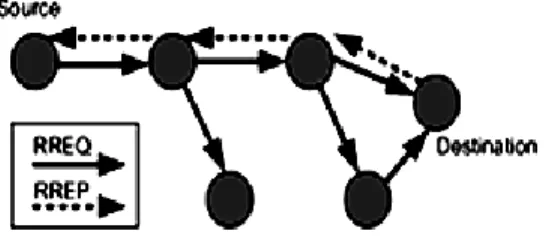
The ZigBee mesh routing follows the well-studied public domain algorithm AODV [9]. As AODV is a pure on-demand protocol, route discovery depends on a route request and route reply query cycle. Route discovery starts when a source node wants to forward data to some target nodes. As illustrated in Fig 1, the source node first floods a route request (RREQ) packet to its neighboring nodes. When a node obtains the RREQ, it then examines whether it has an unexpired route to the target node. If not, it generates a route entry and a route discovery entry. The information recorded in the route entry involves destination address, status, and next-hop address. Next, the route discovery entry consists Source
Address, Route Request ID, Sender Address, Residual cost, Forward Cost and Expiration Time. The Route Request ID is increased for each RREQ the node starts, and together with the source address, uniquely determines a RREQ.
Figure 1: Basic routing discovery
Along with its own sequence no. and the Route Request ID, the source node involves in the RREQ the most recent sequence no. it has for the destination. For responding to the RREQ, the node must be the target itself. If neither of this condition is satisfied, the node re-floods the RREQ. The latest ZigBee specification, named ZigBee 2012, provides full wireless mesh networking capable of supporting greater than 64,000 devices on a single network. It is planned to link the broad range of devices, in any industry, into a single control network. ZigBee supports the highest no. of
Figure 2. The ZigBee/IEEE 802.15.4 protocol stack.
III IEEE 802.15.4 BASICS
IEEE 802.15.4 defines data link layer and the physical layer protocols for low-rate wireless personal area networks (LR-WPAN), which underline low-cost and simple applications. Devices in such networks basically have less communication abilities and restricted power, but are required to work for a longer time period. As a result, energy-saving is a severe design problem. In IEEE 802.15.4, there are two basic kinds of network configurations, the peer to peer topology and star topology. Devices in a LR-WPAN and can be categorized as full function devices (FFDs) and reduced function
devices (RFDs). One device is targeted as the PAN coordinator, which has responsibility for managing the network and maintaining other devices. A FFD has the ability to become a PAN coordinator or linking with an available PAN coordinator. A RFD can only forward or obtain data from a PAN coordinator that it relates with. Every device in IEEE 802.15.4 has a unique 64-bit long address. After relating to a coordinator, a device will be allocated a 16-bit short address. Then packet interchanges among the coordinator and devices will utilize short addresses. In the following, the IEEE 802.15.4 data link layer and physical layer protocols are proposed.
3.1 PHYSICAL LAYER (PHY)
In IEEE 802.15.4 PHY, there are three operating frequency bands with 27 radio channels. These bands are 868 MHz, 915 MHz, and 2.4 GHz. The channel arrangement is illustrated in Fig. 3. Channel 0 is in the frequency 868.0~868.6 MHz, which offers 20 kbps data rate. Channels 1 to 10 operate in frequency 902.0~928.0 MHz and every channel offers 40 kbps data rate. Channels 11~26 are positioned in frequency 2.4~2.4835 GHz and every channel offers 250 kbps data rate.
Fig. 3. Arrangement of channels in IEEE 802.15.4.
Channels 0 to 10 utilize the binary phase shift keying (BPSK) as their modulation technique, and channels 11 to 26 utilize the offset quadrature phase shift keying (O-QPSK) as their modulation technique. The needed recipient sensitivity should be greater than -92 dBm for channels 0 to 10, and greater than -85 dBm for channels 11 to 26. The transmit power should be minimum -3 dBm (0.5 mW). The transmission radius may range from 10 meters to 75 meters. Designated at low-rate communication systems, in IEEE 802.15.4, the payload length of a PHY packet is restricted to 127 bytes.
3.2 DATA LINK LAYER
In all IEEE 802 specifications, the data link layer is classified into two sublayers: logical link control
(LLC) sublayer and medium access control (MAC) sublayer. The LLC sublayer in IEEE 802.15.4 adopts the IEEE 802.2 standard. The MAC sublayer maintains control channel access, superframes, validates frames, and forwards acknowledgements. The IEEE 802.15.4 MAC sublayer also supports security and low power operations techniques.
3.3. SUMMARY OF IEEE 802.15.4
IEEE 802.15.4 defines the data link layer and physical layer protocol for low-rate wireless personal area networks. Since, this specification only related to communications among devices that are inside of each other’s transmission coverage range. For huge sensor networks, the network layer protocols support is required. In the next section, we will propose a developing standard, ZigBee, which provides support to protocols above the data link layer for linking IEEE 802.15.4 devices together.
Fig. 4 Zigbee network topologies: (a) star, (b) tree, and (c) mesh.
3.4 ZIGBEE NETWORK LAYER
In ZigBee, the network layer offers secure and reliable transmissions between devices. Three types of networks are supported, namely tree, star and mesh networks. A ZigBee coordinator has responsibility for starting, managing, and controlling the network. A star network has a coordinator with devices directly linking to the coordinator. For mesh and tree networks, devices can interact with one another in a multi-hop manner. The network backbone is made by one ZigBee coordinator and several ZigBee routers. RFDs can join the network as end devices by linking with the ZigBee router or ZigBee coordinator. In a tree network, the routers and coordinator can declare beacons. Since, in a mesh network, regular beacons are not permitted. Devices in a mesh network can only interact with one another
by peer-to-peer transmissions defined in IEEE 802.15.4. Some example of ZigBee network configurations are illustrated in Figure 4.
Network Formation
Devices that are coordinator-capable and do not recently join a network can be candidates of ZigBee coordinators. A device that needs to be a coordinator will monitor all channels to determine an appropriate one. After choosing a channel, this device floods a beacon consisting a PAN identifier to start a PAN. A device that listens beacons of an available network can join this network by performing the association mechanisms and defining its role, as a ZigBee router or as an end device. The beacon forwarder will determine whether to accept this device or not by assuming its current capacity and its allowed association duration. Then the association reply can be carried by its beacons. If a device is successfully linked, the association reply will have a short 16-bit address for the request sender. This short address will be the network address for that device
IV. ROUTING IN WIRELESS NETWORK
Routing is the process of transferring information throughout an internetwork from a source node to a destination node. Along the way, minimum one intermediate node normally encountered. It is also referred to as the mechanism of selecting a path via which to forward the packets. Routing is usually contrasted with bridging, which might appear to achieve precisely the same thing to the casual observer. The main difference between the two is that bridging takes place at Layer 2 (the data link layer) of the OSI reference model, while routing takes place at Layer 3 (the network layer). This difference offers bridging and routing with different information to utilize in the mechanism of transferring information from source node to destination node, so the two functions achieve their tasks in different manners. The routing algorithm is the part of the network layer software responsible for choosing which output line an incoming packet should be transferred on, i.e. what should be the next intermediary node for the packet. Routing protocols utilize metrics to select what route will be the best for a packet to transfer. A metric is a measurement standard; i.e. reliability, path bandwidth, delay, current load on that path etc; that is utilized by routing algorithms to find the optimum path to a destination node. To aid the mechanism of path determination, routing algorithms start and manage routing tables, which consist route information. Route information changes based on the routing algorithm utilized.
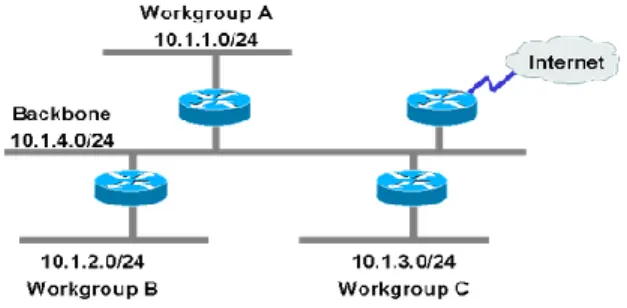
Figure 3: Typical router-based campus network
Required characteristics of a router are as follows: • Correctness and simplicity
• Robustness • Stability
• Fairness and optimality • Efficiency
V. CLASSIFICATION OF WIRELESS SENSOR NETWORKS
According to a novel report from research firm ON World “The home market for Wireless Sensor Networks (WSN) will arrive US$6 billion a year by 2012”. The prediction involves both services and products and services centred on in-home energy management and health monitoring. Meanwhile, ON World predicts the market for "Home Area Network" (HAN) energy management solutions to arrive 20 million homes worldwide by 2013. Wireless Sensor Networks may contain several kinds of sensors i.e. low sampling rate magnetic, seismic, visual, thermal, acoustic, infrared and radar. They are capable to scan a broad variety of ambient conditions that involve humidity, temperature, lighting condition, vehicular movement, soil makeup, pressure, noise levels, the availability or unavailability of certain types of objects, mechanical stress levels on associated objects, and the current features i.e. direction, speed and object size. WSN applications can be categorized into two classes [10] as illustrated in Fig 3:
VI ROUTING IN ZIGBEE TOPOLOGY
In a tree network, the ZigBee routers and coordinator can transfer beacons. Forwarding beacons provides devices to synchronize with their parents and hence can support devices to go to sleep and save energy. Recall that after building a network, the network coordinator will find the beacon order (BO) and super frame order (SO). When BO is greater than SO, devices can go to sleep during the superframes inactive portions. In the ZigBee network specification version 1.0, a superframe can be classified into 2BO-SO non-overlapping time slots. A router can select a slot to declare its beacon. The beacon start time is also the superframes start time of that router. Thus,
routers‟ superframes will be shifted away from those of the coordinator‟s by SD multiples. To avoid collisions, a device should not randomly select a slot to transfer its beacons. A device should avoid utilizing the same beacon transfer slots as its neighbors‟ and its parent’s; else, its children may lose beacons because of collisions. Beacon collisions may take place in two ways: direct beacon conflict between two neighbors and indirect beacon conflict between non-neighbors. However, A and B are not neighboring nodes, the conflict is more complicated to determine. The ZigBee network specification version 1.0 does not offer an explicit solution to this issue. In the current specification, a device should hold the beacon transmission schedules of its neighboring nodes and its neighbor’s parents. In other words, beacon transmission schedules of nodes within two hops should be managed. The same slots should be neglected. When forwarding beacons, a device will add the time offset among its beacon transmission time and its parent’s in the beacon payload. This will support a device to select a conflict-free slot. In a tree network, a device selects its beacon transmission time when joining the network. During the joining process, a device hears to the beacons from its parent and its neighbors for a time period. Then the device computes an empty slot as its beacon transmission slot. If there is no existed slot, this device will join this network as an end device. After selecting beacon transmission time, the network layer will report the MAC layer the time difference between its beacon transmission time and its related parent’s beacon transmission time. The ZigBee network specification version 1.0 describes the broadcast mechanism in mesh networks. The network layer reports the MAC layer to flood network-layer packets. In ZigBee, the broadcast initiator can specify the broadcast scope. A device that obtains a broadcast packet will examine whether the radius field in the broadcast packet is greater than zero. If so, the device will re-flood the packet; else, this packet will not be further broadcast. ZigBee describes a passive acknowledgement technique to assure the broadcasting reliability. After flooding, the ZigBee device stores the forwarded broadcast packet in its broadcast transaction table (BTT). The BTT will be integrated with its neighboring table. This permits devices to keep track whether their broadcast packets have been suitably rebroadcast or not. If a device detects that a neighbor does not rebroadcast, it will rebroadcast to ensure reliability. In ZigBee, devices utilize different techniques to broadcast packets according to the 𝑚𝑎𝑥𝑅𝑥𝑂𝑛𝑊ℎ𝑒𝑛𝐼𝑑𝑙𝑒 parameter in the MAC layer. 𝑚𝑎𝑥𝑅𝑥𝑂𝑛𝑊ℎ𝑒𝑛𝐼𝑑𝑙𝑒 manages whether a device can obtain data when idle. By the behavior of wireless communication, devices
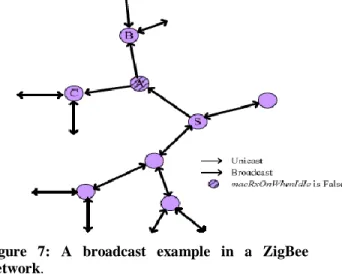
can determine radio signals when idle. Since, they will deny to process the obtained signals if 𝑚𝑎𝑥𝑅𝑥𝑂𝑛𝑊ℎ𝑒𝑛𝐼𝑑𝑙𝑒 is False. When broadcasting is required, a device with 𝑚𝑎𝑥𝑅𝑥𝑂𝑛𝑊ℎ𝑒𝑛𝐼𝑑𝑙𝑒 = True will do so immediately. This device will also unicast the flooded packet to those neighbors with 𝑚𝑎𝑐𝑅𝑥𝑂𝑛𝑊ℎ𝑒𝑛𝐼𝑑𝑙𝑒 set to False. On the other side, a device with 𝑚𝑎𝑐𝑅𝑥𝑂𝑛𝑊ℎ𝑒𝑛𝐼𝑑𝑙𝑒 set t False can only unicast the broadcast packet to its neighboring nodes. This is because that the device may miss passive acknowledgements from neighboring nodes. Unicasting can assure reliability. Fig. x. 7 illustrates an instance that router A adjusts 𝑚𝑎𝑐𝑅𝑥𝑂𝑛𝑊ℎ𝑒𝑛𝐼𝑑𝑙𝑒 to False. After obtaining the broadcast packet from S, A will relay the packet to B and C by unicasting. Since, broadcasting in ZigBee network may cause duplicate transmissions. Reference (Ding et al., 2006) proposes a tree-based broadcast technique to solve this issue. The writers use the features of ZigBee address assignment to determine a group of sending nodes in the network. The introduced algorithm introduces low computation cost. At the starting of a route discovery, the source floods a route request packet.
Figure 7: A broadcast example in a ZigBee Network.
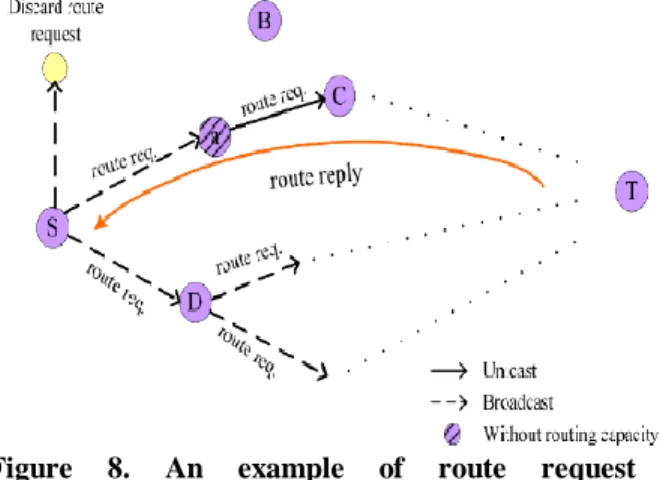
A ZigBee router that obtains a route request packet first calculates the connection cost. If this device has routing capability, it will re-flood this request if it does not obtain this request before or the connection cost stored in route request plus the cost it just calculated is lesser than the earlier obtained request. Else, it will drop this request. For the case that a ZigBee router that is not routing capable obtains a route request, it also detects whether to re-forward this request depending on the same comparison. If this device detects to re-forward this route request, it will examine the destination address and unicast this route request to its parent or to one of its children (in the tree network). Device S floods a route request for
destination node T and devices A and D obtain this packet. However, device A has no routing capability, it will examine the address of destination node T and unicast this request to device C. However, device D has routing capability, it will re-flood this request. A device that has resent a route request packet will store the request sender in its route discovery table. This information will be dropped if this device does not obtain a route response within a time interval. When the destination obtains route request packets from several paths, it will select the routing path with the lowest cost and forward a route response packet to the source node.
Figure 8. An example of route request dissemination in a ZigBee network
The route reply packet will be forwarded by unicast. An intermediary node that obtains the route response packet examines its route discovery table and forwards the route response to the request sender. After the source node successfully obtains the route reply, it can forward data packets to the target node along the found route.
VII. THE ROUTING PROTOCOLS FOR NETWORK STRUCTURE
Flat based routing: In these protocols, all nodes
have allocated equal roles in the network. The famous protocols assumed in flat based routing are: Directed Diffusion, Energy Aware Routing (EAR), Sequential Assignment Routing (SAR) etc. Sequential Assignment Routing [50] introduced was one of the first protocols for WSN that assumed QoS issues for routing decisions. The aim of SAR algorithm is to decrease the average weighted QoS metric throughout the network lifetime. SAR builds a routing decision depending on three factors: QoS planned for each path, energy resources, and the packes traffic type, which is enforced by a priority technique. To solve reliability issues, SAR utilizes
two systems containing a multipath mechanism and localized path restoration performed by interacting with neighboring nodes. Although this assures easy recovery and fault tolerance, the protocol endures certain overhead when node and table states must be managed or refreshed. This issue increases particularly when there are a huge no. of nodes.
A. Hierarchical based routing: It is also called
cluster based routing. In these protocols, the nodes can play several roles in the network and basically the protocol involves the generation of clusters. In addition, designations of tasks for the sensor nodes with various features are also performed.
Low Energy Adaptive Clustering Hierarchy (LEACH) is one of the most famous clustering algorithms with disseminated cluster formation for WSNs [51,52]. The algorithm arbitrarily chooses cluster heads and rotates the role to distribute the energy consumption. LEACH utilizes TDMA/CDMA MAC to decrease inter-cluster and intra-cluster collisions and data collection is centralized with specified periods. It makes clusters depending on the obtained signal strength and utilizes the CH nodes as routers to the BS. All the data processing i.e. data aggregation and fusion are local to the cluster. LEACH builds clusters by utilizing a distributed algorithm, where nodes build autonomous decisions without any centralized control. Initially a node selects to be a CH with a possibility P and floods its decision.
B. Adaptive based routing: In these protocols, the
system parameters are managed to be followed to the actual network conditions by means of obtained network information and negotiation among nodes (e.g. the existed node energy or QoS of the path). Adaptive based routing depends on the protocols family known as Sensor Protocols for Information through Negotiation (SPIN) which is explained in Negotiation based routing. The SPIN protocols are designed depending on two general ideas:
1. Sensor nodes operate more effectively and conserve energy by forwarding metadata rather than forwarding all the data.
2. Broadcasting technique wastes energy and bandwidth when forwarding additional and unessential copies of data by sensors covering overlapping regions.
C. Bio-inspired routing: In recent years insect
sensory systems have been motivational to new communications and computing paradigms, which have led to important advances i.e. bio inspired routing [53]. The most famous ACO (Ant Colony Optimization) is a colony of artificial ants is utilized
to build solutions assisted by the pheromone trails and heuristic information they are not intelligent or strong; but they successfully build the colony a highly organized society. Swarms are helpful in some optimization issues. A swarm of agents is utilized in a stochastic algorithm to achieve near optimum solutions to complicated, non-linear optimization issues [54].
Minimum Ant-based Data Fusion Tree (MADFT) [55] is a sink selection heuristic routing algorithm .It depends on ACO for collecting related data in WSN. It first allocates ants to source nodes. Then, the route is made by one of the ants in which other ants search the closest point of prior determined route. The selected formula is Probability function contains pheromones and costs for finding the minimum total cost path. MADFT not only analyzes over both the transmission and fusion costs, but also follows ant colony system to obtain the optimum solution.
V. CONCLUSION
In this paper, we have proposed the IEEE 802.15.4 design and ZigBee network layer protocols. A lot of research institutes and industrial companies have formulated their sensor platforms depending on ZigBee/IEEE 802.15.4 solutions. ZigBee and IEEE 802.15.4 are planned for lightweight sensor platforms. We have also approached some applications i.e. medical care and fire emergency applications and some prototyping systems.
REFERENCES
[1] K. Shuaib, M. Boulmalf, F. Sallabi and A. Lakas, “Co-existence of ZigBee and WLAN”, A Performance Study, ‖ Wireless Telecommunications Symposium, WTS '06, pp. 1 – 6, 2006
[2] T. Sawamura, K. Tanaka, M. Atajanov, N. Matsumoto, and N. Yoshida, “Adaptive router promotion and group forming in ad-hoc networks, “in Proceedings of International Journal of Ad Hoc and Ubiquitous Computing, Vol. 3, pp. 217-223,2008. [3]http://www.QUALNET.com/solutions/network_rd /modeler.html
[4] ZigBee Alliance. ZigBee Overview. September 2003.
[5] A. Sikora and V. F. Groza, ”Coexistence of IEEE802.15.4 with other Systems in the 2.4GHz-ISM-Band”, in IEEE Instrument and Measurement Technology Conference, vol. 3, pp. 1786-1791, May 2005.
[6] Jorjeta G. Jetcheva, Yih-Chun Hu, Amit Kumar Saha, and David B. Johnson. “Design and Evaluation of a Metropolitan Area Multitier Wireless Ad Hoc Network Architecture in Wireless Sensor Networks” In Proceedings of the Fifth IEEE Workshop on Mobile Computing Systems & Applications, Monterey, CA, pp 32-37,2004
[7] Patrick Kinney, ―ZigBee Technology: Wireless Control that Simply Works‖, Communications Design Conference, 2 October 2003
[8] ZigBee Alliance .ZigBee Specification. December 14th, 2004
[9] http://www.mobilenetx.com/zigbee-vs-bluetooth [10] Jun Huang1; Guoliang Xing1; Gang Zhou2; Ruogu Zhou1, ―Beyond Co-existence: Exploiting WiFi White Space for ZigBee Performance Assurance‖ IEEE ICNP, Kyoto, Japan, 2010
[11] I. S. Hammoodi, B. G. Stewart, A. Kocian1, S. G. McMeekin, “A Comprehensive Performance Study of QUALNET Modeler For ZigBee Wireless Sensor Networks,” Third International Conference on Next Generation Mobile Applications, Services and Technologies, pp, 35-40, 2006.
[12] Mathioudakis, I et al, “Wireless Sensor Networks: A case study for Energy Efficient Environmental Monitoring", Proceedings of Eurosensors conference, Dresden, Germany, September 2008.
[13] Sokullu, R.; Donertas, C, “Combined effects of mobility, congestion and contention on network performance for IEEE 802.15.4 based networks”, Computer and Information Sciences, 2008. ISCIS '08. 23rd International Symposium on, Vol 3, pp. 1-5, 2008
[14] Harsh Dhaka, Atishay Jain, Karun Verma, “Impact of Coordinator Mobility on the throughput in a ZigBee Mesh Networks”, 2010 IEEE 2nd International Advance Computing Conference, Thapar University, Patiala
[15] Petr Jur_ík, Anis Koubaa, Mário Alves, Eduardo Tovar, Zden_k Hanzálek, “A Simulation Model for the IEEE 802.15.4 Protocol: Delay/Throughput Evaluation of the GTS Mechanism”, pp 32-37. [16] Mikko Kohvakka, Mauri Kuorilehto, Marko Hännikäinen, Timo D. Hämäläinen, ―Performance analysis of IEEE 802.15.4 and ZigBee for large-scale wireless sensor network applications,‖ Energy Efficient algorithms, pp. 48 – 57,2006
[17] Tseng Y.C., Y.S. Chen, and J.P. Sheu, "The broadcast storm problem in a mobile ad hoc network(ZIGBEE)," In Proceeding of the 5th ACM/IEEE International Conference on Mobile Computing and Networking, NY, USA, pp. 51-162, 2009.
[18] H. Safa, H. Artail, and R. Shibli, “An interoperability model for supporting reliability and power-efficient routing in Wireless Sensor Networks,” International Journal of Ad Hoc and Ubiquitous Computing, Vol. 4, pp. 74-83, 2009