ISSN: 2278 – 7798 All Rights Reserved © 2014 IJSETR 2790
Analysis of Cloud Components & study on Scheduling
Framework in Local Resource
PariseSireesha, RapetiDeepthi
Abstract -Cloud computing is the use of scheduling algorithm that are delivered as a service over a network high performance computing based on cloud resources which allow storage many tasks requires to be executed by the available resources to achieve best performance. We investigate the problem of cost time scheduling algorithm for cloud components in local system. Unlimited resources scaling of cloud computing is considered a pay as you go model is challenged to guarantee the application of reasonable cost for cloud components and local resources. Compare to previous system our analysis built the combination between the computing resources on cloud computing and the computing components in the local systems and provides the balance between performance of application schedule and cost for the use of cloud resources.
Keywords – Cloud Components, Cost Scheduling, Local Resources, Cloud Computing. Introduction I
Cloud computing is the evolution of internet based computing provided a common infrastructure for applications static web pages began to add interactivity hosted applications like Hotmail more user configuration renamed software as a service. With a growing number of companies looking to get on the software as a service opportunity Amazon released web services that enable companies to operate their own software as a service applications. Cloud database usage patterns are evolving and business adoption of these technologies accelerates that evolution cloud databases serviced consumer applications these early applications put a priority on read access because the ratio of reads to writes was very high. Consumer centric cloud database applications have been evolving with the adoption of web 2.0 technologies user generated content particularly in the form of social networking for example consumer centric cosmetics website if the user does a search for a certain shade of makeup powder it is important that the results be delivered instantaneously to keep the user engaged so she does not click on another cosmetics site. If the site said that the chosen makeup powder is in inventory and completed the sale it would not be the end of the world to later find out that a result of inconsistent data that makeup powder was not really in inventory. Cloud database is a database that consists of cloud computing like Google Microsoft Salesforce Rackspace Amazon etc, cloud database management system are designed to satisfy applications such as availability of a service Data confidentiality flexible query interface. Cloud architecture consists of layers Manageability layer deals with managing various users keeps the record of the time a particular user uses the cloud database.
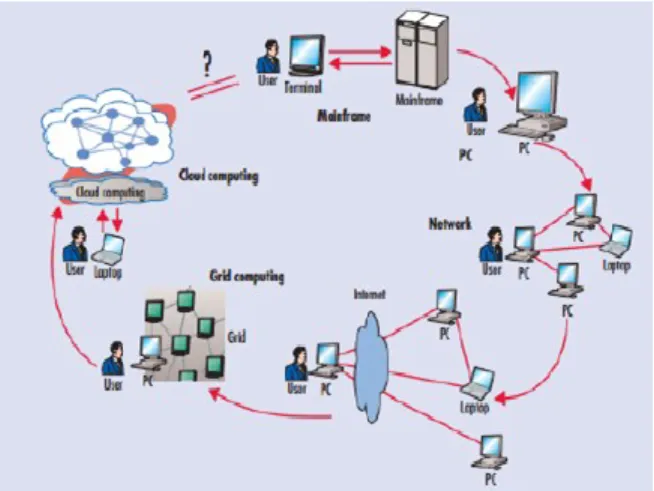
Cloud computing as a utility that has recently attracted significant features people used terminals to connect to powerful mainframes shared
by many users, the standalone personal computers became powerful enough to satisfy users daily work and computer networks allowed multiple computers to connect to each other, the cloud computing allows the exploitation of all available resources on the internet in a scalable way.
Figure 1 Cloud Computing Environment
Cloud computing is amodel for enabling ubiquitous convenient on demand network access to shared pool of configurable computing resources that can be rapidly provisioned and released with minimal
ISSN: 2278 – 7798 All Rights Reserved © 2014 IJSETR 2791 management effort or serive provider interaction.
Data mining represents finding useful patterns or trends through large amounts of data defined as atype of database useful patterns or relationships in a group of data uses advanced statistical methods such as cluster analysis and sometimes employs artificial intelligence or neural networks. Data mining is the extraction of hidden predictive information from large databases is a powerful with great potential to help companies focus on the most important information in their datawarehouse. Cloud computing denotes the new trend in internet services that rely on clouds of servers to handled tasks.
SECTION II
2. Related Work:Cloud computing outsourcing that fulfills all aforementioned requirements such as input output privacy correctness soundness guarantee has been shown feasible in theory by Gennaro et al. It is currently not practical due to its huge computation complexity instead of outsourcing general functions in the security community, Atallah et al explore a list of work for securely outsourcing specific applications. The customized solutions are expected to be more efficient than the general way of constructing the circuits. A set of problem dependent disguising techniques are proposed for different scientific applications like linear algebra sorting, string pattern matching etcAtallah et al give two protocol designs for both secure sequence comparison outsourcing and secure algebraic computation outsourcing. However both protocols use heavy cryptographic primitive such as homomorphism encryptions and/or oblivious transfer and do not scale well for large problem set. Atallah et al. give a provably secure protocol for secure outsourcing matrix multiplications based on secret sharing. While this work outperforms their previous work in the sense of single server assumption and computation efficiency (no expensive cryptographic primitives), the drawback is the large communication overhead. Namely, due to secret sharing technique, all scalar operations in original matrix multiplication are expanded to polynomials, introducing significant amount of overhead. Considering the case of the result verification, the communication overhead must be further doubled, due to the introducing of additional pre-computed “random noise” matrices.
Another existing work list of work that relates to secure multiparty computation introduced by Yao and later extended by Goldreich et al. and many others. Secure multiparty computation allows two or more parties to jointly compute some general function while hiding their inputs to each other. General SMC can be very inefficient Du and Atallah
et al. have proposed a series of customized solutions under the SMC context to a spectrum of special computation problems, such as privacy-preserving cooperative statistical analysis, scientific computation, geometric computations, sequence comparisons, etc. [3]. However, directly applying these approaches to the cloud computing model for secure computation outsourcing would still be problematic. The major reason is that they did not address the asymmetry among the computational powers possessed by cloud and the customers, i.e., all these schemes in the context of SMC impose each involved parties comparable computation burdens, which we specifically avoid in the mechanism design by shifting as much as possible computation burden to cloud only. Another reason is the asymmetric security requirement. In SMC no single involved party knows all the problem input information, making result verification a very difficult task. But in our model, we can explicitly exploit the fact that the customer knows all input information and thus design efficient result verification mechanism. Detecting the unfaithful behaviors for computation outsourcing is not an easy task, even without consideration of input/output privacy. Verifiable computation delegation, where a computationally weak customer can verify the correctness of the delegated computation results from a powerful but untrusted server without investing too many resources, has found great interests in theoretical computer science community. Some recent general result can be found in Goldwasser et al.. In distributed computing and targeting the specific computation delegation of one-way function inversion, Golle et al. [9] propose to insert some pre-computed results (images of “ringers”) along with the computation workload to defeat untrusted (or lazy) workers. In [10], Du. et al. propose a method of cheating detection for general computation outsourcing in grid computing. The server is required to provide a commitment via a Merkle tree based on the results it computed. The customer can then use the commitment combined with a sampling approach to carry out the result verification (without re-doing much of the outsourced work.) However, all above schemes allow server actually see the data and result it is computing with, which is strictly prohibited in the cloud computing model for data privacy. Thus, the problem of result verification essentially becomes more difficult, when both input and output privacy is demanded.
ISSN: 2278 – 7798 All Rights Reserved © 2014 IJSETR 2792 SECTION III
3. Problem:Cloud components requires communication or data transfer among processing nodes in the environment means that the output data of a task sometimes may be the input of its success the communication between cloud nodes and other systems need to reserve a specific amount of network resources at all clouds. Let the data transfer rate between cloud node and the local system meantime denotes the average data transfer rate among local components. Computing resources are dispersed into multiple cloud nodes as well as local network there is a need for centralized management component to receive and process all computation management component to receive and process computation request of users at the cloud components.A user should specify the necessary parameters of the workflow such as the numbers of tasks and input data of each task will do queries for the location of relevant data which cloud nodes are storing. Profiles about processing capacity and network bandwidth of all nodes as computation and communication costs together with data query returned from nodes are the mandatory input of the task scheduling problem.To monitor the cloud data security as implemented to create, store, share, archive or destroy the data every time scheduling algorithm cost finish time is demonstrates the benefits.
SECTION IV
4.1. Cost Based Scheduling:Cost Time based is a workflow scheduling for distributed environment with multiple heterogeneous processing nodes instead of optimizing the workflow, reducing the monetary cost that CCs need to pay between cloud node and local system. Two phases of Cost Time based are Task and Prioritizing to mark the priority level for all tasks and Node selection to select tasks in a descending order by the priority level and each selected task on an appropriate processing node to optimize the value of the utility function. Task prioritizing is estimated by the length of the critical path from task to the destination exit task including the computation is the longest execution path between the entry and the exit tasks of the workflow. Node selection is the earliest execution finish time present parameter for task scheduling data transfer time for input data of a task is only started when all preceding task are completed to represent the time when the last preceding task is completed. Finish time which each cloud computing needs to pay cloud resources that are used to execute tasks for executing on cloud nodes computation cost and communication cost which are computed as equation.
4.2. Cloud Resource: Cloud infrastructure is a complex system with large number of shared resources these are unpredictable requests and can be affected by external resources to control. The explicit goal of an admission control policy is to prevent the system form accepting workloads in violation of high level system, cloud resource associated with the delivery models service providers are faced with large fluctuating loads that challenge the claim of cloud elasticity. Cloud allocation technique must be implementing resource management policies are control theory uses feedback to guarantee system stability and predict transient behavior but it can only predict local behavior. Machine learning is the technique don’t need a performance model of the system could apply to manage several autonomic system manager, utility based approaches require a performance model and a mechanism to correlate user level performance with cost and market oriented don’t require a system model such as combining auctions for bundles of resources.
4.3. Cloud Components: components of cloud computing interacts as storage as service is the ability to store that physically exists at a remote site but is logically a local storage resource to any application that requires storage. Most primitive component of cloud computing that is leveraged by most of the order cloud computing components. Database as a service provides the ability to leverage the services of a remotely hosted databases sharing with other users and logically function as if the database were local. Information as a service is the ability to consume any type of information remotely hosted through a well-defined interface such as an API. Process as a service is remote that can build many resources together such as services and data either hosted within the same cloud computing resource or remotely to create business process as a meta application that spans systems leveraging key services and information that are combined into a sequence to form a process. Application as a service also known as software as a service is any application that is delivered over the platform of the web to an end user typically leveraging the application through a browser. People associate application as a service with enterprise applications such as salesforce office automation
ISSN: 2278 – 7798 All Rights Reserved © 2014 IJSETR 2793 applications are indeed applications as a service as
well including Google Docs Gmail and Google Calendar. Platform as a service is a complete including application development interface database development storage testing and delivered through as remotely hosted platform to subscribers based on the traditional time sharing model. Integration as a service is the ability to deliver a complete integration stack from the cloud including interfacing with applications semantic mediation flow control integration design and so on. Integration as service includes most of the features and functions found within traditional enterprises application technology but delivered as a service and security as service is guess the ability to deliver core security services remotely over the internet typical security services provided are rudimentary services such as identity management are becoming available. Testing as a service is the ability to test local or cloud-delivered systems using testing software and services that are remotely hosted. It should be noted that while a cloud service requires testing unto itself, testing-as-a-service systems have the ability to test other cloud applications, Web sites, and internal enterprise systems, and they do not require a hardware or software footprint within the enterprise.
SECTION V
5. Comparative Study: In previous system the data are shared through the cloud server by an individual user hence the uploading and downloading of the particular data can be done by the individual user only. If the user is requested for some other file in the database is not uploaded by the current user then it makes impossible for the user to download the file he is looking for in the previous system. Which the system data are shared by the individual user hence the user can request for the data that uploaded, there is no data sharing among user in this cloud. Comparing to the previous system our work allows in cloud such as Individual and Group member user who registers under the individual membership or scheme has an ability to download a particular file that the individual user can be uploaded and user who register on Group forms a group with a group name and share the data among the group causes an efficient share of data’s within the group which cause the cost and efficient way of scheduling to share the data among the group. The data can be shared among the group which the more effective sharing of data’s among the group. Our work is to provide the better tradeoffbetween the efficiency of workflow execution and the amountof cost that Cloud customer have to pay for cloud providers.
CONCLUSION
This paper presents the framework includes the unlimited processing capacity of cloud computing and the individual computing resources of environment in the local system which benefits cloud components from internal and external environment. This model also compare with existing workflow scheduling with a higher level of heterogeneity on the computing communication and storage capacity of processing nodes. Cost finish time scheduling algorithm workflow performance produce the schedule in computing environment. Proposed analysis producing the output schedule by the cost finish time algorithm to improve the workflow scheduling problem as well quality of the schedule.
Reference
[1] L. Zeng and B. Veeravalli and X. Li,
ScaleStar:BudgetConciousScheduling Precedence-Constrained Many-task Workflow Applications in Cloud. 2012 26th IEEE International Conference on
Advanced Information Networking and Applications, pp 534-541, March 2012.
[2] H. Topcuoglu, S. Hariri and M. Wu,
Performance-Effective and Low- Complexity Task Scheduling for Heterogeneous Computing. IEEE
Trans. on Parallel and Distributed Systems, Vol.13, No.3, pp 260-274, March 2002.
[3] Ruben V. den Bossche, K. Vanmechelen and J. Broeckhove, Cost- Efficient Scheduling Heuristics
for Deadline Constrained Workloads on Hybrid Clouds. 2011 Third IEEE International Conference
on Cloud Computing Technology and Science, pp 320-327, November 2011.
[4] J. Li, S. Su, X. Cheng, Q. Huang and Z. Zhang,
Cost-Conscious Scheduling for Large Graph Processing in the Cloud. 2011 IEEE International
Conference on High Performance Computing and Communications, pp 808-813, September 2011. [5] Peter Mell, and Timothy Grance, “The NIST Definition of Cloud Computing”, The National Institute of Standards and Technology, USA, 2011, Link: http://csrc.nist.gov/publications/nistpubs/800-145/SP800-145.pdf.
[6] IT Strategists, “Top Cloud Computing Companies
ISSN: 2278 – 7798 All Rights Reserved © 2014 IJSETR 2794
http://www.itstrategists.com/Top-Cloud-Computing-Companies.aspx.
[4] Merriam-Webster Dictionary, “Definition of data mining”, Link: http://www.merriam-webster.com/dictionary/data%20mining.
[7] W. Du and M. J. Atallah, “Secure multi-party computation problems and their applications: a review and open problems,” in Proc. of NewSecurity
Paradigms Workshop (NSPW), 2001, pp. 13–22.
[8] S. Goldwasser, Y. T. Kalai, and G. N. Rothblum, “Delegating computation: interactive proofs for muggles,” in Proc. of STOC, 2008, pp. 113–122. [9] P. Golle and I. Mironov, “Uncheatable distributed computations,” in Proc. of CT-RSA, 2001, pp. 425– 440.
[10] W. Du, J. Jia, M. Mangal, and M. Murugesan, “Uncheatable grid computing,” in Proc. of ICDCS, 2004, pp. 4–11.
PariseSireesha pursuing M.Tech from Loyolo Institute of Engineering & Technology Completed Master of Computer Applications. Her interested subjects include Cloud Computing
RapetiDeepthi M.TechB.Tech working as Asst Prof atAndhraLoyolo Institute of Engineering & Technology. She is having five years of experience and interested subjects include Cloud Computing & Image Processing.