WIRELESS CONTROLLED SPY ROBOT BY USING PIC
MICROCONTROLLER
Wai Mo Mo Khaing
Department of Mechatronic Engineering, Mandalay Technological University
Mandalay, Myanmar
Abstract- The most of spy robots are remotely
controlled robots, equipped with a camera, transmitting video data to the intervention troop. They are made to small and compact enough to easily transport. Humans are moved out from direct exposure to potentially dangerous situations. Robotic system can perform many security and surveillance functions more effectively than humans. In this paper, the project supposes a movable robot with a remote controller by using PIC 16F628A and PIC 16F877. This robot based on PICs microcontroller. In remote control system, Radio Frequency modules are used for transmitting and receiving logic signals. A (16×2) LCD display is mounted on remote controller to check the user command. This research mainly concentrates on control logic program and simulation software for this robot system. By using PicBasic Pro language, Proteus simulation software, the motor driver of L298N control and the required movements of brush DC control are simulated. This robot is a small robot designed for detection, surveillances and saving purposes.
Index Terms- PIC Microcontroller, CCD camera,
RF modules, L298N, LCD display
I. INTRODUCTION
A movable spy robot with a remote controller is implemented. The robot is not quite huge one and designed to be easy in transportation [1]. The remote controller is to control the robot to reach the desirable destination. The spy robot is made up of PICs microcontroller, a wireless camera, an antenna, batteries and four movable wheels. The robot will transmit the images that are spied via antenna to the laptop for a good spying system. The user will get required information due to a movable the spy robot and seeing the images when it spies. The system is to build a spy robot that has a wireless camera and the capabilities to control the movement by using the remote controller. The images will appear on the laptop which is intended for the visual. In this research, the wireless camera is involved the two
direction to rotate left and right. It is just only to monitor the images around the robot. The block diagram of remote operated spy robot is shown in figure 1; RF modules Motor Driver (CCD camera motor) TX Spy Robot Rear wheels motor PIC 16F628A
Capture Card CCD camera RX Laptop
Remote
PIC 16F877
Figure 1: Overview Block Diagram of the System
II. SYSTEMCOMPONENTS
A. PIC Microcontrollers
PORTA pins 1,2,3,18,17 and 13 are connected with LCD display which is mounted in the remote controller. The controls bits of these pins are RA0, RA1, RA2, RA3, RA4 and RA7 of PORTA. PORTB 0 to 7 except PORTB2 and the controls bits PORTB 6,7,9,10,11 and 12 are used for the user inputs which are forward, backward, left, right, CCD left and CCD right.PORTB7 bit no: 8 is used for data output pin. The power supply of this controller is +5V DC and connected the pin no: 14. The Ground is pin no: 5 in figure 2. 1 2 3 6 7 9 10 11 13 14 17 18 12 PIC16F628A RA1 RA0 RA7 RB6 RB3 RB4 RB5 RB0 RB1 RA2 RA3 RA4 VDD
For LCD display For LCD display
+5V For data output
For the user input For the user input
Vss 5 RB7 8
Figure 2: PIC16F628A Microcontroller Pins Assign The motor is driven by motor driver circuit which controls by PORTB0 to 5 (pin no: 33 to 38). The power supply of this controller is also +5V DC and
connected the pin no: 11 and 32. The Ground is pin no: 12 and 31 in figure 3.
35 38 37 36 40 RB7 RB2 RB3 RB4 RB5 RB0 RB1 PIC16F877 12 31
For motor control For the data input
VDD Vss 34 33 11 32 +5V
Figure 3: PIC16F877 Microcontroller Pins Assign
B. RF Modules
RF module operates at Radio Frequency and transmits data or command with 434 MHz. Radio Frequency modules is mainly used to command the robot by wireless communication. RF modules comprises of an RF Transmitter and RF Receiver as shown in figure 4. The transmitter RF module on the remote controller takes serial input and transmits these signals through RF through its antenna connected at pin 4. The transmission occurs at the rate of 1 Kbps- 10 Kbps. The transmitted data is received by an RF receiver operating at the same frequency as that of the transmitter.
GN D VC C DA TA GND DATA DATA VCC Figure 4: RF Transmitter and RF Receiver
C. L298N Motor Driver
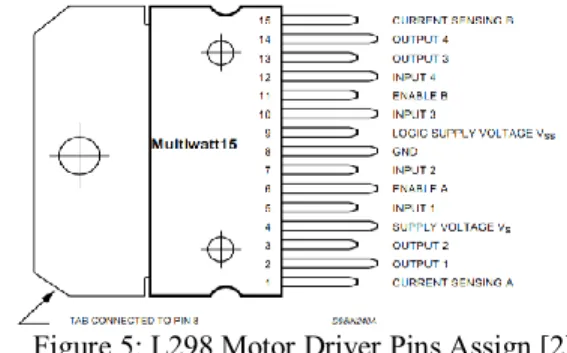
L298N is a dual H-Bridge motor driver, so it can drive the motors which can be controlled in both clockwise and counter clockwise direction. L298N is an integrated monolithic circuit in a 15-lead Multiwatt [2]. L298N motor driver has four inputs and outputs pin so that it can drive two DC motors and one stepper motor. L298Ns pins assign are shown in figure 5.
In the project, L298N motor driver is connected with PIC16877 microcontroller for CCD camera rotation of left and right function. PORTB5 and PORTB4 (pin no: 38 and 37) are connected the motor driver‟s pin no: 5 and 7 (input 1 and input 2) for data input. And then, motor driver‟s pin no: 2 and 3 are used for data output which is connected the Brush DC motor.
The next L298N motor driver is connected with PIC16F877 for Spy robot movement direction. PORTB3 and PORTB2 (pin no: 36 and 35) are connected the motor driver‟s pin no: 5 and 7 (input 1
and input 2) for data input and pin no: 2 and 3 as data output for rear wheel left motor activate. PORTB1 and PORTB0 (pin no: 34 and 33) are connected the motor driver‟s pin no: 10 and 12 (input 3and input 4) are used for data input and pin no: 13 and14 as data output for rear wheel right motor activate. +12V power is supplied L298N motor driver because 12V Brush DC motors are used in this project.
Figure 5: L298 Motor Driver Pins Assign [2]
D. CCD Camera
Charge-coupled devices (CCDs) find wide applications in almost all digital image-acquisition devices [3]. The wireless CCD camera has audio and video system shown in figure 6. The range of transmitted is 100ft visible around the Spy robot and resolution is 1024×800. Power is supplied to CCD camera by +12V from lead acid battery. This camera can move left and right direction to see survey around the robot.
Transmitter Receiver Figure 6: Wireless CCD Camera E. Capture Card or TV Tuner Card
There is no USB port in this camera so that saving and records process of the project need capture card. EasyCap is one of the types of capture card or TV tuner card. The USB 2.0 of EasyCap Video Adapter with Audio in Figure 7, it can capture High-quality video and audio file direct by USB 2.0 interface without sound card.
III. HARDWARE CONFIGURATION
A. Remote Controller
The remote controller consist six press button which is forward, backward, left, right, CCD left and CCD right as shown in figure 8. Moreover, it consists of (16×2) LCD which is used for user‟s command directions. Drawbars antenna is used because the frequency is determined by the length of antenna.
left CCD Right CCD left Backward Right Forward LCD Display Antenna
Figure 8: Remote Controller B. Remote Control Circuit
In remote controller circuit, PIC 16F628A is used. PIC 16F628A is an 18 pins and 8 bits microcontroller [4]. The microcontroller records the user command and then sends it to the RF transmitter module. The RF module sends the data to the spy robot as radio frequencies via its antenna. A 9V battery is used to supply the power to the whole controller circuit.
RA2 RA3 RA5 RA4 Vss RB0/INT RB1 RB2 RB3/CCP1 RA1 RA0 RA7 RA6 VDD RB6 RB5 RB4 RB7 P IC 1 6F 62 8A 10 K 10 K 10 K 10 K 10 K 10 K F O R W A R D R E V E R S E L E F T R IG H T L E F T (C C D ) R IG H T ( C C D ) LCD V ss V D D V E E R S E D0 D1 D2 D3 D4 D5 D6 D7 R /W RF Module Transmitter D at a A N T V ss V d d +5V +5V +5V 10k 7805 1 3 2 0. 33 µ F 100µF 9V/12V 1000 µ F +5V
Figure 9: Circuit Diagram for the Remote Controller The voltage regulator LM7805 is used to supply power the microcontroller. For versatile PIC 16F628A microcontroller, LM7805 regulator is suitable to control the incoming voltage stable. LM7805 regulator is used not only to be stable the voltage but also the voltage to be 5 and it is connected with a battery. The regulator supplies
power to the RF transmitter module and the PIC 16F628A respectively. The whole remote controller circuit is composed as shown in figure 9.
C. Spy Robot
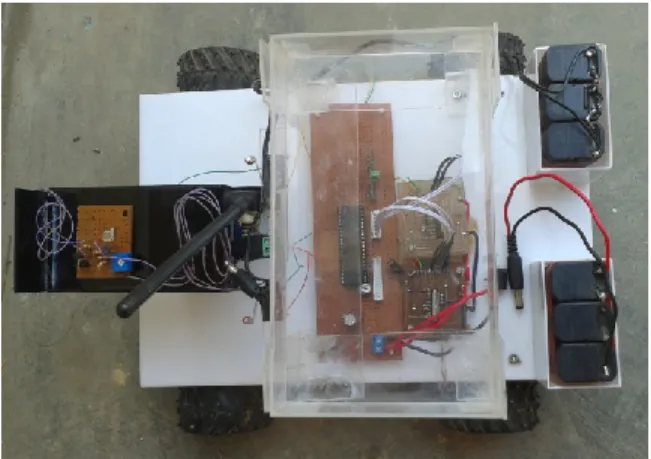
In top view robot shown in figure 10, it consists of CCD camera, PIC 16F877 microcontroller, four movable wheels, three brush DC motors, three L298N motor drivers, LM7805 voltage regulator, and RF receiver module. The PIC 16F877 microcontroller which has 40 pins is used in construction of spy robot [5]. The voltage regulator LM7805 is used again to have stable power 5V for the microcontroller.
Figure 10: Top View of Spy robot D. Spy Robot Circuit
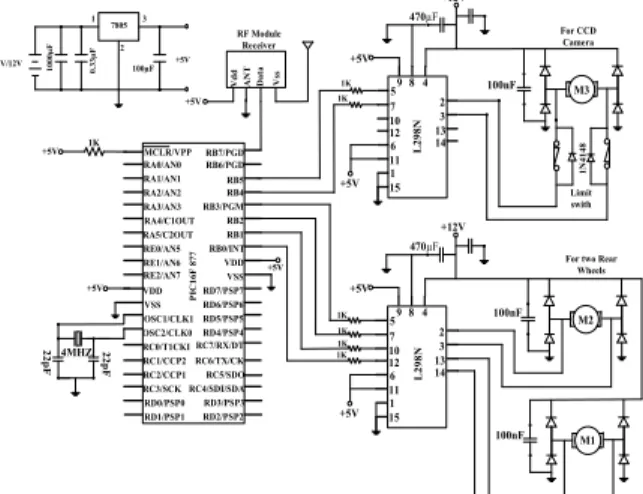
PIC 16F877 is performed not only receiving the user command via RF receiver module but also instruct the motor driver to move as directly as by use command. There are two brush DC motors for rear wheels and one for camera motion. These brush DC motors need 12V power supply. To activate the motors, L298N motor drivers are used in this project. There are required two motor drivers: ones for motor of CCD sensor camera and next for motors of rear wheels. In this system, Brush DC motors are used for all required motorized equipments. Each Brush DC motor is applied on each rear wheel. Rear wheels can perform forward and backward functions because of Brush DC motor‟s reversible abilities. Brush DC motors join with worm gear as a set in this project for moving control. The two set are mounted on rear wheels respectively and also one for camera motion. Worm gear is used to reduce a large speed ratio of the motors.
To control the angle of camera rotation, two limited switches are mounted on the both left and right side of the camera respectively. When the CCD camera touches the limited switch, it‟s stopped. The camera is not worked for reverse function after it reached the limited switch. So diodes are mounted on each limited switches respectively. These diodes will help the limited switch in the function of rotating the
camera reversely. These diodes permit the motor for reverse direction. MCLR/VPP RA0/AN0 RA1/AN1 RA2/AN2 RA3/AN3 RA4/C1OUT RA5/C2OUT RE0/AN5 RE1/AN6 RE2/AN7 VDD VSS OSC1/CLK1 OSC2/CLK0 RC0/T1CKI RC1/CCP2 RC2/CCP1 RC3/SCK RD0/PSP0 RD1/PSP1 RB6/PGD RB5 RB4 RB3/PGM RB2 RB1 RB0/INT VDD VSS RD7/PSP7 RD6/PSP6 RD5/PSP5 RD4/PSP4 RC7/RX/DT RC6/TX/CK RC5/SDO RC4/SDI/SDA RD3/PSP3 RD2/PSP2 P IC 16 F 8 77 RB7/PGD RF Module Receiver D at a A N T V ss V d d +5V +5V +12V 9 1 11 6 12 10 7 5 84 14 13 3 2 15 +5V +5V +12V 9 1 11 6 12 10 7 5 84 14 13 3 2 15 +5V 1N 41 48 Limit swith M1 470µF 470µF 100nF 100nF M2 M3 100nF 1K 1K 1K 1K 1K 1K 4MHZ 22 p F 22pF 1K +5V +5V +5V L 29 8N L 29 8N For CCD Camera
For two Rear Wheels 7805 1 3 2 0. 33 µ F 100µF 9V/12V 1000µ F +5V
Figure 11: Circuit Diagram for Spy Robot Vehicle E. Night Vision System
The robot equipped with a wireless camera, which is not very useful in situations where the visibility or light level is very low. For night or dark area, spy robot will be almost impossible for identifying objects because the lights, which are provided on the robot, are fixed therefore it may not be possible to view those objects which are in the dark. At night or dark area where light is low a lighting circuit can be mounted on the robot instead of a night vision camera, which will increase the visibility in case of no light at all. Lighting circuit is shown in figure 12 used in this project to use the Spy robot in the dark area as night. For night vision, three LED is set up on the top of the CCD camera that connected by lighting circuit. Lighting circuit need +12V power supply.
Figure 12: Lighting Circuit Based On LDR F. Brush DC Motor Drive Operation
This project builds a rotatable CCD sensor camera on top of the Spy Robot. For rotation of camera, the system uses a motor especially for camera. If the motor spins forwardly is left camera rotation, the motor spins reversely is right camera rotation, vice versa.
In left and right operation of spy robot, the system proposes the PIC‟s controls. To rotate the left direction, while the left motor will move reverse, the right motor will move forward. To rotate the right direction, while the right motor will turn reverse, the left motor will turn forward.
G. Time Duration for robot
Spy robot is to operate last an hour longer and detect around the transmit range area according to the calculation of time duration as follow:
Load power = Load amps × Battery Volts P = 1.66 A × 12V
= 19.92
= 20 Watts (approximately) Run Time in Hours = (10 × Battery Capacity in Ah)
Load Power in Watts = (10 × 2Ah) / 20 Watts
= 1 Hours
IV. SOFTWARE CONFIGURATION
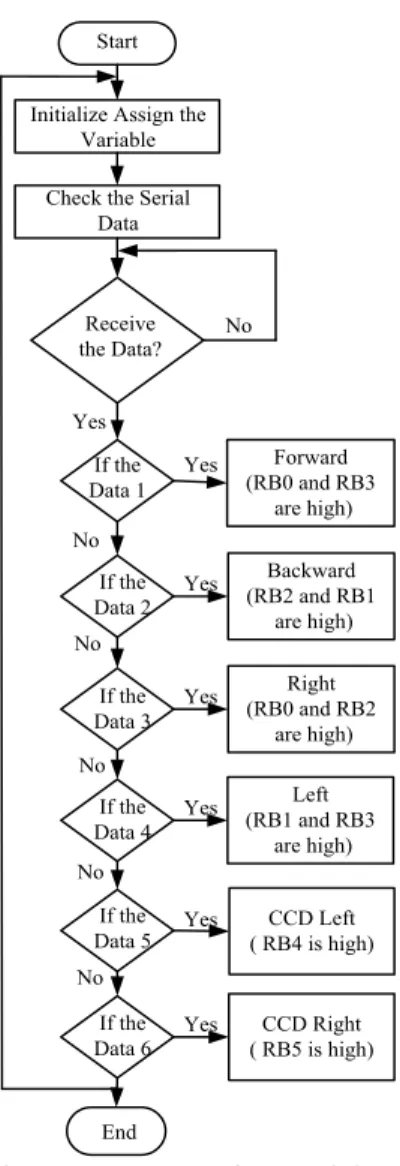
Basic Pro programming language is used for the development of PIC microcontroller. They include file “modedefs.bas” has to be declared because it assigns the variables such as „B1‟ for transmit in figure 13 and „w‟ for receive in figure 14 that are used in the program. PICs pin of PORTA and PORTB are used as input and output pins. PIC16F628A‟s PORTA pins which are analog inputs are connected with LCD display which is mounted in remote controller.
Assign the Variable User‟s Instruction
Press the buttons?
Start
Define the I/O pins Initialize the Port
No
Yes
Transmit Data process
End
Receive the Data? If the Data 1 Forward (RB0 and RB3 are high) Backward (RB2 and RB1 are high) Left (RB1 and RB3 are high) Right (RB0 and RB2 are high) CCD Left ( RB4 is high) CCD Right ( RB5 is high) If the Data 2 If the Data 3 If the Data 4 If the Data 5 If the Data 6 No No No No No Yes Yes Yes Yes Yes Yes No Initialize Assign the
Variable Check the Serial
Data Start
Yes
End
Figure 14: Program for Receiving
V. SIMULATIONANDTEXTRESULT
A. Simulate Result of the System
For the system, the simulation result is done by using Proteus professional schematic software. After the two programs are compiled as hex files, the compiled code sent to a PICs microcontroller to load the microcontrollers with no errors. The programs have successful complication and then the circuit is tested using the proteus software as shown in figure 15. This control system is completely tested and can be used remotely to enter and exit dangerous places. In this system, remote is used as the main controller. PIC16F628A sends the signals to the PIC16F877 to operate the Brush DC motor from the L298N motor driver.
For “Straight Forward”, the two rear wheel motors are rotated clockwise in direction. When the two rear wheel motors are rotated counter clockwise, the spy robot will move “Straight Backward” direction. The spy robot turns to the left when rear
wheel‟s left motor rotates counter clockwise and rear wheel‟s right motor rotates clockwise direction. To work the camera turn to right, rear wheel‟s left motor is rotated clockwise and rear wheel‟s right motor is rotated counter clockwise direction. When CCD camera turns to Left, CCD camera‟s motor is rotated clockwise direction. If CCD camera‟s motor is rotated counter clockwise direction, the camera will move to the right.
Figure15: Simulate Result of Spy Robot
B. Display Image on Laptop Monitor
Ulead VideoStudio software is used for spy robot view configuration. The user can use the capture button in this software to capture image. The operation of this project can be able to capture images and record information.
Figure 16: Capturing Images with Laptop
VI. CONCLUSION
The wireless spy robot has been designed in such a way that it can fulfill the needs of the rescue, detection and searching for human beings at hazardous area. It has many applications and only tends to spy around the spy robot in this system. In this research, wireless remote control system for moving spy robot and CCD rotate is considered battery. In PIC microcontroller, programming can be done in several languages such as Assembly, C, or Basic, etc. In this research has presented the programming that PicBasic Pro language is implemented into the PIC microcontrollers which control the whole system by sending USART data from one to another. The simulation and operation of control system can support in one corner of fully functional hardware construction. This control system needs many considerations of motor specifications and torques for further research works. In this research, the user can control the spy robot with wireless remote.
VII. FURTHEREXTENSION
This operation system is the spy robot with wireless remote control. The CCD camera can modify range more than 100ft .The wireless camera can be able to upgrade with the 360 degree left and right directions by using PIC program so that the functionality is having a movement at many sides. Moreover, this camera can upgrade to move up and down directions. Instead of DC motors which driver the CCD camera, stepper motors can also be used. The spy robot can be commanded directly by laptop keyboard without using remote controller. For the advance of spy robot, it can be built a robot with wireless visual system that the user can observe and control the situation via computer or mobile.
ACKNOWLEDGEMENT
The author is very thankful and deeper gratitude to Dr. Wut Yi Win, Associate Professor and Head of Mechatronics Department, for her encouragements, useful discussion and her kind support in carrying out this paper. The author wishes to extend her gratitude to Dr. Kyaw Thiha, Associate Professor, for his kind guidance, help and permission and suggestions for completion of the paper.
REFERENCES
[1] Ad Hoc, Project Report, 2D1426 Robotics and Autonomous Systems.
[2] http://www.campuscomponent.com “L298N Motor Driver”
[3] http://en.wikipedia.org/wiki/Charge-coupled device
[4] Microchip, “PIC16F627A/628A/648A Data Sheet”, ISO/TS 16949:2002, Microchip Technology Incorporated, USA, 2005.
[5] Microchip, “PIC16F87X Data Sheet 40-pin8-Bit CMOS FLASH Micro controller”, ISO 9001/ QS-9000, Microchip Technology Incorporated, USA, 2001.
[6] D. Ibrahim, “Microcontroller Based Applied Digital Control”, ISBN: 0-470-86335-8, John Wiley & Sons, Ltd, England, 2006.
[7] http://en.wikipedia.org/wiki/DC_Motor
[8] J. Iovine, “PIC Robotics: A Beginner‟s Guide to Robotics Projects Using the PICmicro”, McGraw-Hill, 2004.
[9] P. Robert, “Introduction to Gear Design”, Continuing Education and Development, Course No: M03-016, 2012.
[10] T. Wilmshurst, “Designing Embedded Systems with PIC Microcontrollers”, ISBN-10: 0-7506-6755-9, Elsevier, 2007.
[11] www.circuitstoday.com “Mobile Operated Spy Robot”