Abstract— Shadows and highlights are the significant
challenges in motion object detection and tracking applications of automated video surveillance systems for outdoors environments where accurate operation is required. This paper presents an effective shadows (highlights) detection and removal technique using hybrid color and texture of video frame images. In this paper, both brightness and chromaticity distortions are measured between background and foreground pixels. Shadows are defined by comparing between the measurement and pre-defined threshold. Similarly, shadow region is also defined by comparison between texture distortions and thresholds. By the two results, if pixels of a particular region are confirmed as shadows, the regions are marked by morphological mark filter and reconstruct with pixels of previous frame image without shadows. The experiments on variety real-world video data demonstrate the favorable performance and robustness of the proposed technique.
Index Terms— Shadow Detection, Shadow Removal, Color and Texture, Surveillance Videos
1) INTRODUCTION
Shadows in images have long been challenges on computer vision and pattern recognition research area. They appear as surface features, when in fact they are caused by the interaction between light and objects. This may lead to problems in scene understanding, object segmentation, tracking and recognition. Because of the undesirable effects of shadows on image analysis, much attention was paid to the area of shadow removal over the past decades and covered many specific applications such as traffic surveillance, face recognition, image segmentation and so on [1, 2]. In spite of these extensive studies, however, it is difficult to develop a fully automatic, general-purpose shadow removal system in that shadows and shadings vary from scene to scene and different kinds of shadows may have different physical properties.
A shadow occurs when an object partially or totally occludes direct light from a source of illumination. Shadows can be divided into two sets: self- shadows and cast shadows. A self-shadow occurs in the portion of an object whereas a cast shadow is the dark area projected by the object. Cast shadows can be further classified into umbra and penumbra region, which is a result of multi-lighting. One crucial
Manuscript received August, 2018.
Phyo Phyo Aung is with the Department of Information Technology, West Yangon Technological University, Yangon, Myanmar (Phone: +95943070625).
Cho Cho Myint is with the Department of Information Technology, West Yangon Technological University, Yangon, Myanmar.
difference between these shadows is their contrast to the background. Usually, self-shadows are vague shadows which gradually change intensity and have no clear boundaries. Cast shadows are, on the other hand, hard shadows with sharp shadow boundaries.
In this paper, a robust technique is proposed to remove self-shadow from surveillance video frame images. Firstly, input frame images without shadow from a particular environment are saved. Then, shadows caused by motion objects are detected by color and texture features based processing. These shadows areas are determined by pre-defined thresholds and selected by morphological mark filter. These selected areas are reconstructed by replacing pixels of shadow free image, at the same coordinates of that area. According to the proposed technique, a shadow free video for motion object detection in complex and dynamic background environment can be received.
The rest of the paper is organized as follows: Section 1 presents about of shadows and shadow removal. Section 2 reviews related work on this topic. Section 3 introduces the proposed shadow removal system. Section 4 gives experimental results and discussion and conclusions of the paper will be finally discussed at the Section 5.
2) REVIEWS ON RELATED WORKS
Shadow removal is usually implemented in two steps: shadow detection and image reconstruction. Many methods have been presented to automatically detect shadow regions and removal. Some of them are summarized as following.
In firstly, a texture consistent shadow removal introduced by F. Liu and et al in 2008 [3]. In this paper, an approach was presented to shadow removal that preserves texture consistency between the original shadow and lit area. Illumination reduction in the shadow area not only darkens that area, but also changes the texture characteristics in there. Next, efficient shadow removal was proposed by C. Xiao and
et al [4]. This paper presented an effective and automatic
shadow detection algorithm incorporating global successive thresholding scheme and local boundary refinement. This method could process complex images with different kinds of shadowed texture regions and illumination conditions. Experimental results proved the better capabilities in both the shadow removal quality and performance. After that Saritha M. and et al proposed another shadow detection and removal technique [5]. This work proposed a simple method to detect and remove shadows from a single RGB image in which a shadow detection method was selected on the basis of the mean value of RGB image in A and B planes of LAB equivalent of the image. The shadow removal is done by
Shadow Removal for Human Motion by Using
Color and Texture Based Technique
multiplying the shadow region by a constant. Shadow edge correction is done to reduce the errors due to diffusion in the shadow boundary. Next, A. K Shahade and et al submitted efficient shadow removal technique for tracking human objects [6]. This was implemented by initially considering a reference frame and using its background information. When a new object enters into the frame, the foreground image and background image are derived using the reference frame which was taken earlier as background image. The shadow from background information mixes with the foreground object hence results in intricate tracking process. Morphological operations was used for identifying and removing the shadow. The occlusion is one of the most common events in object tracking and centroid of each object are used for detecting the occlusion and identifying each object separately. Next was a review work of shadow detection and removal published by V. Chondagar [7]. Researchers had been developed numerous algorithms and techniques that help to detect a shadow in image and remove such shadow from that image. This work was aimed to provide a survey on various algorithms and methods of shadow detection and removal with their advantages and disadvantages. This paper served as a quick reference for the researchers working in same field. Another automatic shadow detection and removal technique was submitted by S. H. Khan and et al [8]. The work learned features at the super-pixel level and along the dominant boundaries in the image. The predicted posteriors based on the learned features were fed to a conditional random field model to generate smooth shadow masks. Using the detected shadow masks, a Bayesian formulation was proposed to accurately extract shadow matte and subsequently remove shadows. The model were efficiently estimated using an iterative optimization procedure. Finally, the work of K. Nagarathinam [9] want to present in this section. In this work, a novel method for identifying and removing moving shadows using stationary wavelet transform (SWT) based on a threshold was presented. The multi-resolution property of the stationary wavelet transform leads to the decomposition of the frames into four different bands without the loss of spatial information. For detection and removal of shadow, a new threshold in the form of a variant statistical parameter—―skewness‖—is proposed. The value of threshold is determined through the wavelet coefficients without the requirement of any supervised learning or manual calibration. The experimental results proved that the proposed method works better than other state-of-art- previous methods.
In studying the above discussed previous related works, the proposed shadow detection and removal technique is proposed in this paper as following section.
3) PROPOSED TECHNIQUE
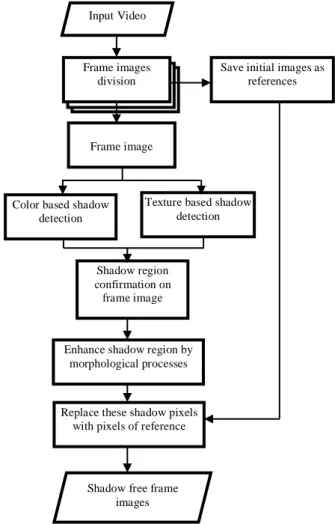
The proposed system is composed of two main stage, the combined color and texture based shadow detection and the morphological reconstruction stage for shadow removal. The only color based algorithms generate errors when the underlying assumptions are violated, meaning that foreground objects having similar colors to that of the shadowed background regions may be wrongly diagnosed and removed. Similarly with only the texture based approach, the foreground regions having similar textures to that of their corresponding background may also be deleted by mistake.
Hence, the hybrid of color and texture based shadow detection technique is applied in this proposed system. The following figure is the system flow diagram of the proposed system.
Figure 1. System flow diagram of proposed shadow detection and removal technique.
1)COLOR AND TEXTURE BASED SHADOW DETECTION
A shadow is normally an area that is not only partially irradiated and but also illuminated according to the interception of radiation by an opaque object between the area and the source of radiation. Assuming that the irradiation consists only of white light, the chromaticity in a shadowed region should be defined based on a normalized chromatic color space, r = R /(R + G + B), g = G /(R + G + B) and b =
B/(R + G + B) but the lightness information is unfortunately
lost in there. Keeping lightness information is important in order to avoid some simple errors such as confusing a white car with a grey road. Another important issue is that we are only interested in detecting shadows that form part of the foreground objects.
According to the above facts, both brightness and chromaticity are very important in detecting shadow. Hence, it should measure a good distortion between foreground and background pixels should account for the discrepancies in both their brightness and chromaticity components. Brightness distortion (Bdistortion) is a scalar value that takes expected background close to the observed chromaticity line. Similarly, color distortion (Cdistortion) can be defined as the orthogonal distance between the expected color and the
Input Video
Save initial images as references
Frame image Frame images
division
Color based shadow detection
Texture based shadow detection
Shadow region confirmation on frame image
Enhance shadow region by morphological processes
Replace these shadow pixels with pixels of reference
Shadow free frame images
observed chromaticity line. Both measures are shown in Fig. 2 and formulated in equation (1).
G
R
B
Figure 2. Distortion measurements in the RGB color space: F is the RGB value of a pixel in the incoming frame that has been classified as foreground and B is its counterpart in the background.
Brightness distortion values over 1.0 correspond to lighter foreground so the foreground is darker when Bdistortion is below 1.0. The Bdistortion and Cdistortion can be estimated as the following formula.
Where, F is the RGB value of a pixel in the incoming frame that has been classified as foreground and B is its counterpart in the background. is a predefined constant.
Finally, the foreground, highlighted or shadowed pixel are classified by a set of thresholds according to the following procedures.
If Cdistortion < 10.0 then:
If 0.5 < Bdistortion < 1.0 then SHADOW Else HIGHLIGHT
Else FOREGROUND
According to the above procedure, the proposed technique can detect shadow in color based detection approach. However, to achieve more precise result, texture based approach is also implemented.
The same regions of an image should have the same texture properties. In this proposed method, the textures of an image are computed by using Prewitt edge detector with less threshold on both the reference frame and incoming frames. After that Euclidean distance between them is computed in pixel by pixel. If the distance between the two pixels of reference and incoming frame images is larger than a certain threshold, the pixel can be defined as a shadow pixel. Otherwise, the pixel is not a shadow. By this way, shadow regions can be selected among regions of an incoming frame. By applying both color and texture-based procedures discussed in above, the regions can be confirmed as shadow regions according to the same decisions of these two procedures. Otherwise, the regions are not shadows. This
process paves the way for the proposed foreground object shape reconstruction process for recovery of miss-pixels from the shadow detection processes.
2) Foreground reconstruction and shadow removal
The shadow/highlights detection expressed as above is a destructive process so original object shapes are likely distorted and some pixels may remain misclassified. Hence, some morphological process can be employed in order to reconstruct the detected shadow regions. By using the image morphological processes, imclose(), imopen() and imfill() can enhance and mark these shadow regions as pixel value 1’s of binary image and other background area with pixel value 0’s. After enhancing and marking the shadow regions, some residual small regions may appear with the pixel value 1’s at this situation. To remove the residual small region, median filter with larger kernel (17x17) can be applied. After performing all the above processes, at the same coordinates, the shadow region pixels from incoming frame images are replaced with pixels of reference image.
By the above two main stages, the proposed method can remove shadow from incoming frame image in efficiently. The performance of the proposed method can be seen in next section.
3) EXPERIMENTAL RESULTS
This section is with respect to the experimental results and discussions for measuring the performance and accuracy of the proposed method. This section can be divided into two main sections, experimental setting and experiments as follow.
1) Experimental setting
In this experiments, there are 30 videos with 720x576 of frame size and 30 frame per sec are used to evaluate performance. As a simulator for the technique, Matlab 2016 Ra is used with Intel Core ™ i3-3217 CPU 1.8GHz laptop. Before performing these experiments, camera is placed on a particular fixed position and video is captured from 10 m distance. The following figures are shown sample images of proposed method. ….. .…. Bdistortion B Cdistortion F B (1)
…..
Figure 3. Sample testing frame images of the proposed method
2) Experiments
In this experiments, two initial frame images are at first saved as reference frame images in which there is no moving shadow objects. The following figures the results of the proposed techniques.
(Initial reference image) (incoming frame image)
(shadow detection image) (morphological enhanced image)
(shadow removal image)
(a)
(Initial reference image) (incoming frame image)
(shadow detection image) (morphological enhanced image)
(shadow removal image)
(b)
Figure 4. Some experimental result images of (a) video 1 and (b) video 2
According to the experimental result images, the proposed method can remove shadow of the moving objects. Note that some shadows included in reference images are not disappear in the result image. It is because of the replacement pixels of the reference image in which the shadow pixels have already contained.
4) CONCLUSION
The proposed shadow removal technique based on color and texture approach already has been presented. According to the experimental results, the proposed method can remove shadows in moving objects. There is a few limitation in this technique. Actually, as the shadow is removed by replacing from reference shadow free initial image, the replacement pixels are not exactly the same with the neighbor pixels of the incoming image. Pixel color and brightness may be wrong with the pixels of the current incoming image. However, as the removal of shadows from moving objects, the moving objects can exactly detect and track using the proposed method. Motion object detection and tracking is a so exciting and interesting research area so our research will continue play on this field trying more precise results and better performance.
5) ACKNOWLEDGMENT
The author would like to thank her supervisor, head and all of her teachers from Department of Information Technology Engineering, West Yangon Technological University who gave good suggestions, guidance and supervision for supporting this research. Finally, she is grateful to her parents who specifically offered strong moral and physical support, care and kindness, during the year of her M.E study and anybody for overall supporting during the thesis.
REFERENCES
[1] J.M. Wang, Y.C. Chung, C.L. Chang, S.W. Chen, ―Shadow Detection and Removal for Traffic Images‖, Proc. IEEE International Conference on Networking, Sensing and Control, vol. 1, pp. 649 – 654, 2004.
[2] T. Chen, W. Yin, X.S. Zhou, D. Comaniciu, and T.S. Huang, ―Illumination Normalization for Face Recognition and Uneven Background Correction Using Total Variation Based Image Models‖, Proc. Computer Vision and Pattern Recognition (CVPR), vol. 2, pp. 532-539, 2005.
[3] F. Liu and M. Gleicher, ―Texture-Consistent Shadow Removal‖, European Conference on Computer Vision (ECCV), vol. 4, pp. 437–450, 2008.
[4] C. Xiaoy, D. Xiao, L. Zhang and L. Chen, ―Efficient Shadow Removal Using Sub-region Matching Illumination Transfer‖, The Eurographics Association and Computer Graphics Forum 2013, vol.32, no. 7, pp. 507-512, 2013.
[5] Saritha Murali and V. K. Govindan, ―Shadow Detection and Removal from a Single Image Using LAB Color Space‖, Cybernetics and Information Technologies, vol.13, no. 1, pp. 95-100, 2013.
[6] A. K. Shahade and Gajendra Y Patil, ―Efficient Shadow Removal Technique for Tracking Human Objects‖, Proc. IEEE International Conference on Image Processing and Computer Vision, vol.12, no.24, pp. 1054 – 1060, 2014.
[7] V. Chondagar, H. Pandya and M. Panchal, ―A Review: Shadow Detection and Removal‖, International Journal of Computer Science and Information Technologies, vol. 6, no.6, pp. 5536-554, 2015. [8] Khan, S. H., Bennamoun, M., Sohel, F., and Togneri, R, ―Automatic
shadow detection and removal from a single image‖, IEEE Transactions on Pattern Analysis and Machine Intelligence, vol. 38, no.3, pp. 431- 446, 2016.
[9] K. Nagarathinam and R. S. Kathavarayan, ―Moving shadow detection based on stationary wavelet transform‖, EURASIP Journal on Image and Video Processing, vol. 10, pp. 220 – 225, 2017.
Phyo Phyo Aung received her BE (Information Technology) degree from Toungoo Technological University, Toungoo, Myanmar. She is currently doing postgraduate research for master degree at Information Technology Engineering Department, West Yangon Technological University. Her research work is concerned security environment. She is also an lecturer at West Yangon Technological University.
Dr.Cho Cho Myint (Professor), Department of Information Technology Engineering at West Yangon Technological University.