Eiszeitalter und Gegenwart Band 14 Seite 77-84 ÖhringenlWürtt., 1. September 1963
P l e i s t o c e n e s c r e e s in C y r e n a i c a (Libya)
By R. W. H E Y , C a m b r i d g e With 2 figs.
A b s t r a c t : Northern Cyrenaica is an area of limestone hills with deep and narrow valleys. On the sides of these valleys are Pleistocene screes of two ages. The earlier are cemented and are interbedded with terraced gravels, the later are not cemented and have no associated terraces. Both series of screes can be correlated archeologically with the sequence in the cave of H a u a Fteah, where a climatic succession has been obtained by H I G G S (1961). It is found that they correspond to two successive cold phases in the late Pleistocene. They are ascribed to frost-shattering, which would thus be indirectly responsible for the terraced gravels. An attempt is made to interpret these results in terms of temperature and rainfall.
Z u s a m m e n f a s s u n g : Nord-Cyrenaika besteht aus einem Gebiet von Kalksteinhügeln, welche von tiefen und schmalen Tälern durchsetzt sind. Auf den Abhängen dieser Täler finden sich Schuttdecken zweierlei Alters, wovon die älteren festverkittet und mit terrassiertem Kies wechsel lagern, während die jüngeren nicht verfestigt sind und keine zugeordneten Terrassen haben. Beide Schichten können archäologisch mit der Schichtfolge in der H a u a Fteah-Höhle korreliert werden, wo HIGGS (1961) eine klimatische Folge nachgewiesen hat. Es wurde gefunden, daß die beiden Schichten zwei sukzessiven kalten Zeiten des Spätpleistozäns entsprechen. Die Gerolle werden dem Spaltenfrost zugeschrieben, welch letzterer daher mittelbar für die terrassierten Kiese verantwort lich wäre. E s wird versucht, diese Resultate als abhängig von Temperatur und Niederschlag zu erklären.
I n t r o d u c t i o n
Much of northern C y r e n a i c a is occupied b y the Gebel A k h d a r , a mass of limestone hills rising to heights of m o r e than 800 metres. O n its north side it falls steeply to the sea, making a high and well-defined escarpment; this feature a l s o continues r o u n d the west side of the Gebel, though here it gradually retreats further inland. A t frequent intervals along the w h o l e of its length the escarpment is notched b y w a d i s , most of them d r y at all times except for a few d a y s of violent flooding each year. Perennial springs are rare, and only a few a r e copious enough to maintain a stream as much as a kilometre in length.
In these w a d i s and a l o n g the coastal e s c a r p m e n t various Pleistocene deposits are found, of which a n account w a s g i v e n by me in M C B U R N E Y & H E Y ( 1 9 5 5 ) . With r e g a r d to the non-marine deposits, I c o n c l u d e d that they belonged to t w o distinct phases of deposition, both subsequent to the L a s t Interglacial. F i r s t , much tufa a n d calcareous m a r l were laid down in s o m e wadis, together with small a m o u n t s of g r a v e l . T h e climate of this time I believed to h a v e been w e t a n d temperate. T h e n , after a period of down-cutting, great quantities o f gravel were l a i d down, forming terraces in a l m o s t all the w a d i s a n d alluvial fans on the coastal plains. T h e s e , which I c a l l e d the Y o u n g e r Gravels, I attributed to frost-shattering under conditions much colder than those o f t o d a y . Both series o f deposits contained L e v a l l o i s o - M o u s t e r i a n artifacts, which were a l s o found on top of the Younger Gravels.
M e a n w h i l e , Dr. M C B U R N E Y had completed his e x c a v a t i o n s at H a u a F t e a h , a c a v e on the north c o a s t in which deposition had been v i r t u a l l y continuous from before 50,000 B . P . down to C l a s s i c a l times. A full report on the c a v e has not yet been published, but in 1 9 6 1 H I G G S p u t f o r w a r d a climatic succession b a s e d largely upon his o w n analysis of the faunas. His climatic phases and their archaeological associations are given in T a b l e 1 , which also incorporates such r a d i o c a r b o n dates as were then a v a i l a b l e .
78 R. W. Hey
Table 1.
Climatic and archaeological succession of Haua Fteah, after HIGGS (1961) D a t e s B . P . C l i m a t e s A r c h a e o l o g y
9,800 - 6,800 Somewhat wetter and cooler Mesolithic 11,500 - 9,800 Warm and dry Upper Palaeolithic 32,000- 11,500 Cold, possibly wet Upper Palaeolithic
43,000 - 32,000 Warm and dry Upper Palaeolithic succeeding Levalloiso-Mousterian (changeover at c. 36,000 B. P.) 51,000 - 43,000 Cold, wetter than before Levalloiso-Mousterian
Over 51,000 Warm and dry Early Levalloiso-Mousterian
S o m e information on absolute temperatures was a l s o p r o v i d e d by E M I L I A N I (in H I G G S , 1 9 6 1 ) , who carried o u t oxygen- isotope determinations on marine g a s t r o p o d s found in certain layers of the cave-deposits. H e suggested that sea-water temperatures during the w a r m periods were much the same as t o d a y , but that during the cold periods they sank in winter at least as low as 8 degrees C . Finally, the lithology of the deposits p r o v i d e d w h a t appeared to be one further climatic indication, for both cold periods were represen ted b y layers with abundant angular fragments of limestone ( MCB U H N E Y , 1960, p p . 1 9 9
-200, a n d personal information). T h i s a g a i n suggested frost-shattering, i m p l y i n g winter conditions perhaps even more severe t h a n those indicated by EMILIANI'S results.
U p to a point, correlation with the wadi-deposits w a s easy. T h e tufaceous deposits h a d yielded artifacts which, accrding to D r . M C B U R N E Y , resembled those f o u n d in the c a v e in layers dated to a b o u t 50,000 B . P . ; the deposits w o u l d thus denote a n especially w e t p h a s e at the v e r y beginning of the first cold period. T h e Younger G r a v e l s , on the other h a n d , h a d artifacts which were less distinctive and which, according to the H a u a F t e a h time-scale, could h a v e been m a d e a t a n y time between 50,000 and 3 6 , 0 0 0 . Since the g r a v e l s could n o w m o r e confidently be ascribed to frostshattering, it seemed at first that their obvious p l a c e w a s before 4 3 , 0 0 0 , that is, within the first cold period. T h e r e w a s , however, another possibility: that debris loosened by frost might initially h a v e remained in place, to be deposited only when the succeeding w a r m , dry conditions h a d led to the destruction of vegetation.
Other doubts, of a more fundamental kind, arose from the fact that no direct evidence for frost-shattering h a d been found outside the c a v e . T h e Younger G r a v e l s themselves were indirect evidence, while the second cold period, so far as I knew, w a s represented in the wadis by no deposits whatever. A suspicion thus remained that the angular f r a g ments in H a u a F t e a h might after all be the products, not of frost-shattering, but of some u n k n o w n and p u r e l y local process.
In the hope of resolving these uncertainties I revisited Cyrenaica in 1 9 6 2 . T h i s has enabled me to reach certain conclusions which a m p l i f y those of H I G G S a n d which m a y , also, be of interest to geologists w h o are obliged to b a s e climatic deductions solely u p o n lithological and morphological features, without help from fossils.
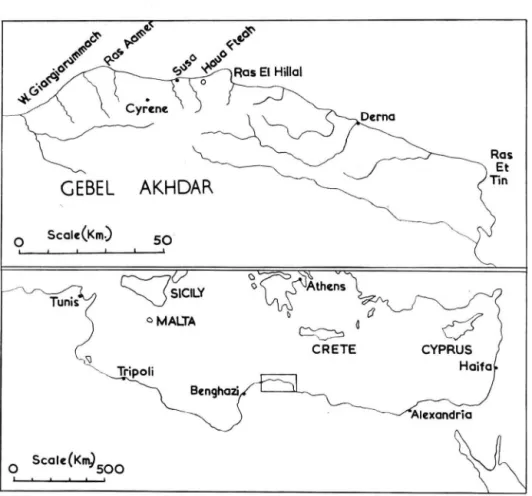
M o s t of my new observations were m a d e on or near the coast between D e r n a a n d S u s a ( A p o l l o n i a ) ( F i g . 1 ) . T h e escarpment here runs very close to the sea, a n d rises in places to over 500 metres. T h e bedrock consists almost entirely of very gently d i p p i n g limestones of U p p e r Cretaceous and Lower T e r t i a r y age. T h e y a r e typically fine-grained, m a s s i v e a n d poorly jointed, a n d there is an a l m o s t total absence o f incompetent beds, such as shale, which might induce slipping. As a result the lower reaches of the coastal w a d i s form deep, n a r r o w , steep-sided gorges.
Y o u n g e r G r a v e l s a n d c o n t e m p o r a r y d e p o s i t s
I h a d already noted that the Y o u n g e r G r a v e l s included, in addition to normal g r a v e l a n d some mudflows, material "so a n g u l a r as to be indistinguishable from scree" ( M C B U R N E Y & H E Y , 1955, p . 7 4 ) . A further e x a m i n a t i o n showed t h a t such material w a s even m o r e a b u n d a n t than I h a d supposed.
Pleistocene screes in Cyrenaica (Libya) 79
Fig. 1. Maps showing the area examined in 1962 (above) and its setting in the eastern Mediterranean (beiow).
A t numerous points along the length of any w a d i , sections of the terraced Younger Gravels showed intercalated beds of a n g u l a r limestone fragments, each b e d sharply distinct from the rounded gravels above a n d below but itself showing little or no internal stratification. Often there were several such beds in one section, a n d in a few places the entire terrace consisted o f angular unbedded material from top to bottom.
M o r e o v e r , sections a t right angles to the w a d i - a x e s showed that these intercalations were in reality no more t h a n the lower m a r g i n s of great sheets of breccia, plastered against the sides of the wadis ( F i g . 2 a ) . These sheets were discontinuous and seldom more than a few metres thick, but c o u l d often be t r a c e d to great heights a b o v e the wadi-floors. T h e rock-fragments in the breccias were mostly between 25 a n d 100 millimetres across, though a few w e r e much larger. Generally they l a y in contact with one another, the interstices being filled with a c o m p a c t , fairly hard m a t r i x , full of impressions of rootlets. T h i s was found to contain between 50 and 80%> of calcium carbonate, the remaining material being a red o r brown clay.
T h e distribution of the breccias g a v e a clear indication of their mode of formation. In the first place they w e r e found only on slopes of 30 degrees or more, a n d for this reason were uncommon outside the gorge-like l o w e r reaches of the w a d i s . Secondly, they were further restricted to positions directly b e l o w vertical cliffs, such as those formed by especially resistant beds o f limestone. F r o m this it was clear that they were simply
con-so R. W. Hey
Bedrock
Younger Gravels
M.Pal. Breccia
U.Pal. Scree
Modern wadi-beds
5 metres
i jFig. 2. Schematic sections showing the disposition of Pleistocene deposits in the wadis of northern Cyrenaica. (a) Younger Gravels forming a terrace, which is only partially covered by the later screes, (b) Younger Gravels absent, later screes descending to the wadi-bed.
s o l i d a t e d sheets of scree, formed in the usual manner b y the disintegration of vertical "free faces" and not by any more general form of weathering.
Since the breccias were interbedded with gravels containing M i d d l e Palaeolithic artifacts, a few being also found in the breccias themselves, there could be little doubt that they were the equivalents of the layers with angular rock-fragments in H a u a Fteah, which represent the first c o l d period of H I G G S . T h i s , then, w a s a time when disintegration w a s widespread, not merely confined to the c a v e . It occurred, moreover, a t all altitudes, for some of the cliffs from which the breccias were derived s t o o d less than 20 m. a b o v e sea-level, lower even than H a u a Fteah itself. T h i s was so, for e x a m p l e , in several minor w a d i s just west of D e r n a .
H I G G S had a d m i t t e d (1961, p . 149) that the faunal evidence for his first cold period was not so good as for the second. Nevertheless, I could see no alternative to the conclusion that the disintegration was indeed c a u s e d by frost-action, effective even near present sea-level. T h o u g h this is perhaps a surprising conclusion for a country such as L i b y a , it will be remembered that the same suggestion was m a d e b y RAMSAY SC J A M E S G E I K I E as long a g o as 1878 to account for cemented Pleistocene screes at G i b r a l t a r , a n d has since been m a d e m a n y times elsewhere in the Mediterranean region.
As for the Y o u n g e r Gravels, it w a s clear that they were deposited a t the same time as the formation of the screes, a n d that the screes themselves had in fact p r o v i d e d most
Pleistocene screes in Cyrenaica (Libya) 81
of their m a t e r i a l ; evidently the supply of debris h a d far o u t s t r i p p e d the transporting power of the streams. A t times, indeed, this p o w e r must have been very great, for the gravels contain l a r g e boulders. Nevertheless, they contain no a q u a t i c snails or other signs of perennial water, and it is therefore thought that the wadis a t this time were occupied only by occasional floods, such as occur today.
D e p o s i t s l a t e r t h a n t h e Y o u n g e r G r a v e l s
M a n y w a d i s were searched for deposits later than the Y o u n g e r G r a v e l s . N u m e r o u s fragments of a low a l l u v i a l terrace were, indeed, identified b y M r . V I T A - F I N Z I , w h o was with me in 1962, but in his opinion these w e r e all p o s t - C l a s s i c a l . A few masses of tufa were also f o u n d which m i g h t have been l a t e Pleistocene, but none compared in size with the great M i d d l e Palaeolithic deposits of W a d i D e r n a a n d elsewhere.
O n the sides of the w a d i s , however, I f o u n d other deposits which p r o v e d to be of greater interest. These were in the form of sheets of scree, often with an earthy m a t r i x but never cemented. T h e y resembled the breccias in their thickness of one or t w o metres and in the m e a n size of their rock-fragments, though in this case there was a greater abundance of boulders, several metres across, either i m b e d d e d in the scree or lying along its lower margin. L i k e the breccias, a g a i n , the screes occurred a t all altitudes, and a l w a y s beneath steep cliffs, a n d thus the t w o deposits were often found together. Where this w a s so the scree was a l w a y s uppermost, but in general it w a s more continuous and m o r e widespread than the breccia and often o v e r l a p p e d it on t o solid rock. T h e upper surfaces of the screes formed slopes of about 30 degrees, very near the angle of rest, and were generally free from gullies or other signs of erosion.
I h a d noticed these screes before a n d h a d assumed them to be modern. I h a d also noticed, however, that they were often c o v e r e d with vegetation a n d showed no convincing signs of being a d d e d to at the present day. M o r e o v e r , in 1948 I h a d collected artifacts from within a similar deposit a t the mouth of W a d i G i a r g i a r u m m a c h , a n d Dr. M C B U R N E Y had shown that these belonged t o the D a b b a culture of the U p p e r Palaeolithic. E v e n in this case I had suspected that the scree might still be modern, the artifacts being p e r h a p s derived from some surface site higher up the slope.
In 1 9 6 2 , however, I f o u n d artifacts in m a n y other places, both on a n d within the screes. T h e principal localities were the l o w e r reaches of W a d i bu Msafer, W a d i en N a g a and W a d i ben Gebara, respectively 5, 9 a n d 25 km. west of D e r n a , and a restricted area near the springs of W a d i S u s a , 4 km. south of Susa. O f the 850 specimens collected very few were recognisable tools a n d most of these, according t o M r . H I G G S , a p p e a r e d to be of Middle Palaeolithic types. Nevertheless, since the collection also included l a r g e numbers of blades, D r . M C B U R N E Y a d v i s e d me to m a k e a statistical a n a l y s i s of the specimens accor ding to frequencies of lengths and of length-breadth ratios. T h i s he had a l r e a d y done himself for the various industries of H a u a Fteah, a n d h a d obtained very consistent results for each culture. M y o w n results s h o w e d clearly that the majority of the artifacts from both within and u p o n the screes m u s t be assigned to the D a b b a culture, the few Middle Palaeolithic specimens having a l m o s t certainly been derived from the underlying breccias.
In H a u a F t e a h the D a b b a culture, the earliest of the local U p p e r Palaeolithic, m a d e its first a p p e a r a n c e during the second warm p e r i o d . Thereafter it continued throughout most of the second cold period, to be replaced b y the Eastern O r a n i a n only at a b o u t 15,000 B . P . Since the cavedeposits o f this cold p e r i o d , as of the first, are full of a n g u l a r limestone fragments, I could only conclude that this w a s also the time when the loose screes were formed. T h e lack of erosion during the p a s t 12,000 years is certainly r e m a r k a b l e , and especially so since the underlying breccias h a d been heavily eroded even before the screes were l a i d d o w n . T h e most probable e x p l a n a t i o n is that the screes, being highly porous,
82 R. W. Hey
c a n n o t support surface drainage, whereas the m a t r i x of the breccias is more or less impermeable.
O n c e again, therefore, there was evidence for w i d e s p r e a d distintegration during a k n o w n cold p e r i o d , a n d again I h a d t o conclude that frost-shattering w a s responsible. In this case, however, the results were different, for no terraces had f o r m e d in the w a d i s . T h e reason for the difference emerged from a study of the lower m a r g i n s of the screes. In a few places they descended almost to the present w a d i - b e d (Fig. 2 b ) : this only incre ased the difficulty, for it showed that screeformation h a d been preceded b y downcutting a n d that at least one important condition h a d existed for the formation of a second terrace. M o r e commonly, however, the lower edge of the scree rested upon the surface of the terrace of the Y o u n g e r Gravels, a n d where this was it offen failed to c o v e r more than a p a r t of the width of the terrace ( F i g . 2 a ) . T h i s showed that most of the scree could never h a v e reached the w a d i - b e d s , whereas the products of the first phase of disintegration h a d done so in sufficient quantity to p r o v i d e the material for v a s t amounts of g r a v e l .
In other w o r d s , the first cold period, though p r o b a b l y shorter than the second, must h a v e produced m a n y times as much debris. T h i s in itself was an a d e q u a t e explanation for the absence of a second Pleistocene terrace; it w a s not necessary t o i n v o k e either a greater c o n t e m p o r a r y flow of water or total r e m o v a l of debris b y subsequent erosion. Since so little of the debris h a d been removed, it w a s often possible to m a k e a rough estimate of the v o l u m e of rock lost during this period of disintegration b y o n e particular cliff, a n d hence of the distance by which the cliff h a d receded. T h e estimated distances r a n g e d from 1.6 to 6 metres, giving a v e r a g e rates of recession of from 0.08 to 0.3 milli metres a year. A l l these results were obtained from l o w - l y i n g screes; higher values w o u l d presumably have been obtained at higher altitudes.
D i s c u s s i o n o f c l i m a t i c i m p l i c a t i o n s
Altough the process of frost-shattering is still imperfectly understood, it seems generally agreed that there are two m a i n climatic requirements: a d e q u a t e precipitation, a n d temperatures oscillating on either side of freezing-point. Once these requirements are satisfied, the rate of disintegration will presumably depend partly on the amount of precipitation, p a r t l y on the frequency o f frost-changes (oscillations of the temperature through freezing-point). T h e amplitude of the frost-changes must also be important, for the degree of frost will govern the depth to which the rocks will be penetrated in a given time.
"With so m a n y variables, a n y climatic interpretation of my estimated rates of dis integration can only be tentative. M o r e o v e r , such a n interpretation will o n l y be possible with a knowledge of modern weathering processes a n d climatic conditions in other areas which, besides being cold enough for frost-shattering, are also geologically similar to northern C y r e n a i c a . Fortunately there is at least one suitable area where such information is a v a i l a b l e . A . R A P P (1960) has carried out a study of this kind at T e m p e l f j o r d e n , S p i t s bergen, where the rocks resemble those of northern C y r e n a i c a both in their lithology a n d in their low dips, the only important difference being that they are a p p a r e n t l y better jointed. Here he f o u n d extensive screes, lying, as in C y r e n a i c a , beneath vertical cliffs, and for the present rates of recession o f these cliffs he o b t a i n e d figures r e m a r k a b l y close to m y o w n : 0.02 to 0.2 mm. a year.
T h e area where R A P P worked receives about 300 m m . of precipitation a year. In C y r e n a i c a , the a n n u a l rainfall a t D e r n a is only 2 0 0 m m . , but elsewhere on the coast of the Gebel A k h d a r it is generally over 300 mm., while on the higher p a r t s of the Gebel it rises to 600 a n d 7 0 0 . During the cold periods the rainfall, according t o H I G G S , m a y h a v e been still higher, so that even D e r n a w o u l d have h a d a greater annual precipitation than
Pleistocene screes in Cyrenaica (Libya) 83
present-day Tempelfjorden. T h o u g h the effect of this w o u l d be reduced by a higher rate of e v a p o r a t i o n , it seems reasonable to conclude that, with similar rates of disintegration, frost-changes on the C y r e n a i c a n coast during the second c o l d period would h a v e been somewhat fewer a n d of smaller amplitude than a t Tempelfjorden today.
A c c o r d i n g to R A P P ( 1 9 6 0 , p . 1 8 ) frost-changes now occur a t Tempelfjorden on an average of 5 9 d a y s each y e a r a n d their m a x i m u m amplitude is 5 . 5 degrees C . T h u s , the lowlying C y r e n a i c a n screes m a y not necessarily i m p l y more than t w o months of moderate nightly frost each winter, with a J a n u a r y m e a n temperature perhaps a few degrees above zero. E v e n s o , this represents a climate a p p r e c i a b l y more severe than that of t o d a y , when the temperature at sea-level rarely falls below 7 degrees a n d the J a n u a r y m e a n tempe rature is a b o u t 1 4 .
In Spitsbergen, of course, winter temperatures are so low that frost-shattering ceases altogether over long periods. I t is conceivable that this w a s a l s o the case in L i b y a , and this is certainly suggested b y results obtained b y E M I L I A N I ( 1 9 5 5 ) from a deep-sea core collected some 5 5 0 km. east-north-east of D e r n a . A p p l y i n g the oxygen-isotope method to planktonic foraminifera, he estimated that, a t 1 7 , 2 0 0 B . P . , s u m m e r surface-water temperatures in the eastern Mediterranean sank to 8 degrees C , some 2 0 degrees lower than they a r e today. T h e s e results have, however, been questioned by P A R K E R ( 1 9 5 8 , p p . 2 3 8 - 4 0 ) . In a n y case so cold a climate would h a r d l y have permitted the survival of animals such as the gazelle, which H I G G S shows to h a v e been present throughout this time; it would also have induced phenomena such as cryoturbation, of which no traces h a v e been found even on the highest parts of the Gebel.
For the first cold period no estimates of rates of disintegration can be m a d e . Reasons have a l r e a d y been given, however, for believing that they were far higher than during the second. T h i s w a s an unexpected conclusion, for P A R K E R , w o r k i n g on frequencies of fora minifera from deep-sea cores, agreed with E M I L I A N I that temperatures in the eastern Mediterranean were lower a t about 1 7 , 0 0 0 B . P . than at a n y other time during the past 1 0 0 , 0 0 0 years ( P A R K E R , 1 9 5 8 , F i g . 2 ; E M I L I A N I , 1 9 5 5 , F i g . 1 ) . I t can only be s u p p o s e d that, during the first cold period, cracks in the rocks were more consistently filled with water than during the second; in other words, that the climate, though not so cold, w a s wetter. This would agree with the results of H I G G S , a n d with the fact t h a t extensive tufa deposits are associated with the first cold period but not with the second. I t also agrees with con clusions reached elsewhere in the Mediterranean region (e.g. B U T Z E R , 1 9 5 8 , p p . 1 0 1 — 2 ) .
Finally, some consideration must be given to the m a t r i x of the screes a n d breccias. C l a y is the main constituent in the case of the breccias, the o n l y constituent in the case of the screes, a n d is itself of doubtful origin. Since the limestone are mostly v e r y pure it can hardly be a product o f chemical weathering within the deposits; most p r o b a b l y it originated on the plateaux between the wadis a n d w a s w a s h e d or blown on to the scree-slopes during their formation.
T h e real point of interest is that only the older deposits are cemented. Since the water-table must a l w a y s have been low in this region of cavernous limestone, the water b y which the calcium carbonate w a s mobilised must h a v e come from a b o v e , not from the under lying bedrock. T h e uniform cementing of the breccia suggests t h a t it percolated slowly d o w n w a r d s from a uniform cover of vegetation, for which evidence exists in the form of rootlet-impressions. R a i n f a l l must have been sufficiently h e a v y a n d frequent, during a part of each year, to keep the deposits d a m p without a c t u a l l y causing leaching; there must, at the same time, h a v e been a definite d r y season, to a l l o w the calcium carbonate to be redeposited.
T h e process of cementing cannot have begun before the scree w a s stabilised. I t must, on the other hand, have been completed long enough before the deposition of the later screes to h a v e allowed some erosion to take place. T h e erosion itself m a y well h a v e been
84 R. W. Hey
the result of destruction of vegetation during the intervening w a r m period; it is being continued t o d a y wherever the breccia is exposed. T h e cementing thus seems to represent a time a t the e n d of the first cold p e r i o d when the rainfall remained high even though frost-shattering h a d already ceased.
After the stabilisation of the later screes, the c l i m a t e , as shown b y the uncemented m a t r i x , must h a v e been relatively d r y u p to the present d a y . There are, indeed, some signs of incipient cementation, in the form of thin films o f secondary calcium carbonate a r o u n d m a n y of the rock-fragments; these must denote a brief w e t season, such as there is t o d a y . A g a i n , the state o f the matrix gives n o direct indication of conditions during the a c c u m u l a t i o n of the scree. If, however, the former level of rainfall was a g a i n maintained for a time after the screes became stable, that level must h a v e been very much lower than during the first cold period. T h i s , of course, is a conclusion a l r e a d y reached o n other a n d m o r e convincing evidence.
S u m m a r y o f c o n c l u s i o n s
I t will now be useful to summarise m y conclusions concerning the climatic a n d p h y s i o g r a p h i c history of northern C y r e n a i c a during the last 50,000 years.
D a t e s B . P . C l i m a t i c a n d G e o l o g i c a l e v e n t s
About 5 0 , 0 0 0 Temperate and very wet, perhaps only for a few millennia. Deposition of tufa and calcareous marl in some wadis.
5 0 , 0 0 0 - 4 3 , 0 0 0 Cold; winters still very wet, summers probably dry. Active frost-shat tering in winter, leading to formation of screes and re-deposition of much debris in the wadis as the terraced Younger Gravels. Screes cemented soon after their final stabilisation.
4 3 , 0 0 0 - 3 2 , 0 0 0 Warm and dry. Erosion of cemented screes, down-cutting in wadis, no deposition.
3 2 , 0 0 0 - 1 2 , 0 0 0 Cold; winters wetter than today but not so wet as in the previous cold period; summers probably dry. Frost-shattering less active than before, leading to scree-formation but not to deposition in wadis. N o cementing of screes.
1 2 , 0 0 0 - present day Generally warm and dry. Renewed down-cutting, no deposition. A c k n o w l e d g e m e n t s
I should like to thank Mr. R . G . G O O D C H I L D , of the L i b y a n D e p a r t m e n t of Antiquities, for his help during m y last visit to L i b y a . I should a l s o like to thank D r . C . V I T A - F I N Z I , w h o a c c o m p a n i e d m e a n d with w h o m I h a d m a n y useful discussions. I a m very grateful to D r . M C B U R N E Y a n d Mr. B . W . S P A R K S , for reading the paper in m a n u s c r i p t a n d m a k i n g m a n y valuable suggestions.
R e f e r e n c e s
BUTZEB, K . W. ( 1 9 5 8 ) : Quaternary stratigraphy and climate in the Near East. - Bonner geogr. Abhand. 24, 1 5 7 pp.
EMILIANI, C. ( 1 9 5 5 ) : Pleistocene temperature variations in the Mediterranean. - Quaternaria 2 , pp. 8 7 - 9 8 , Rome.
H I G G S , E . S. ( 1 9 6 1 ) : Some Pleistocene faunas of the Mediterranean coastal areas. - Proc. prehist. S o c , 2 7 , p p . 1 4 4 - 1 5 4 , London.
MCBURNEY, C. B . M . ( I 9 6 0 ) : The Stone Age of Northern Africa. - Pelican Books, 2 8 8 pp., London. MCBURNEY, C . B . M . and HEY, R. W. ( 1 9 5 5 ) : Prehistory and Pleistocene geology in Cyrenaican
Libya. - Cambridge University Press, 3 1 5 pp., Cambridge.
PARKER, F. L . ( 1 9 5 8 ) : Eastern Mediterranean foraminifera. - Reports of the Swedish Deep Sea Expedition 1 9 4 7 - 1 9 4 8 , 8 : Sediment cores from the Mediterranean Sea and the Red Sea, pp. 2 1 7 - 2 8 3 .
RAMSAY, A. C . and GEIKIE, J . ( 1 8 7 8 ) ; On the geology of Gibraltar. - Quart. Journ. geol. Soc. London 3 4 , pp. 5 0 5 - 5 4 1 .
RAPP, A. ( 1 9 6 0 ) : Talus slopes and mountain walls at Tempelfjorden, Spitsbergen. - Norsk Polar-institutt Skrifter 1 1 9 , 9 6 pp., Oslo.
Manuskr. eingeg. 1 5 . 9 . 1 9 6 2 . Anschrift des Verf.: Dr. R. W. Hey, Cambridge, Sedgwick Museum.