From 1949 to 2004, UNC Press and the UNC Department of Germanic
& Slavic Languages and Literatures published the UNC Studies
in the Germanic Languages and Literatures series. Monographs,
anthologies, and critical editions in the series covered an array of
topics including medieval and modern literature, theater, linguistics,
philology, onomastics, and the history of ideas. Through the generous
support of the National Endowment for the Humanities and the
Andrew W. Mellon Foundation, books in the series have been reissued
in new paperback and open access digital editions. For a complete list
of books visit
www.uncpress.org
.
Bifocal Vision
Novalis’ Philosophy of Nature and Disease
Copyright © 1971
This work is licensed under a Creative Commons cc by-nc-nd
license. To view a copy of the license, visit
http://creativecommons.
org/licenses
.
Suggested citation: Neubauer, John.
Bifocal Vision: Novalis’ Philosophy
of Nature and Disease. Chapel Hill: University of North Carolina Press,
1971. doi:
https://doi.org/10.5149/9781469658070_Neubauer
Library of Congress Cataloging-in-Publication Data
Names: Neubauer, John.
Title: Bifocal vision : Novalis’ philosophy of nature and disease / by
John Neubauer.
Other titles: University of North Carolina Studies in the Germanic
Languages and Literatures ; no. 68.
Description: Chapel Hill : University of North Carolina Press, [1971]
Series: University of North Carolina Studies in the Germanic
Languages and Literatures. | Includes bibliographical references.
Identifiers: lccn 74028422 | isbn 978-1-4696-5806-3 (pbk: alk. paper)
| isbn 978-1-4696-5807-0 (ebook)
Subjects: Novalis, 1772-1801.
Foreword
I received generous help from many friends and colleagues in the course of my work; to list them all would efface my sole responsibility for the final shortcomings. In the last stages I particularly benefited from the suggestions of Professor Victor Lange and Professor Richard Samuel. The Kohlhammer Verlag kindly provided me with the printer's copy of the critical edition of Novalis' works. I received generous financial grants from Princeton University towards the research and the typing and from Case Western Reserve University towards the publi-cation of this book. To Professor Siegfried Mews I am indebted for his kind editorial help.
Contents
INTRODUCTION
Nature and Disease . . . .
II Harden berg: Life and Character . . . .
III The Value of Hardenberg's Notes on Science.
IV The Variety in Hardenberg's Scientific Interest .
v General Considerations . . . .
I ASPECTS OF EIGHTEENTH-CENTURY SCIENCE
Locke, Bacon, and Descartes . . . .
II Leibniz, Haller, and the Development of Biology ..
III John Brown's Medical Theory
IV Brown's Theory in Germany .
II SOURCES AND IMPULSES
Imagination and Hypochondria. n First Studies . . . .
III Schelling's Early Philosophy . .
IV Excerpts from Kant and Eschenmayer .
v Hemsterhuis and Baader . . . .
III THE ANTHROPOLOGY AND PHYSIOLOGY OF MAGIC I Romantisirung. . . .
II The Epistemology of Magic .
III The Physiology of Poetry . .
IV The Doctor as a Young Artist
IV IDEAS FOR AN ENCYCLOPEDIA
The "Brouillon" and the other Notebooks .
3 9 II I3 I6 I7 23 26
li External Unity-A. G. Werner .
III Internal Unity-Kant, Fichte, and Lambert IV The Bible Project .
v Hemsterhuis vs. Schelling . v SENSIBILITY AND MEDICINE
The Vocabulary of the Encyclopedia
II An Essay on Medicine.
VI THE CASE OF DieLehr/ingezuSais The Importance of Die Lehrlinge
II Plans .
III "Hyazinth und Rosenbliitchen" . IV "Der Lehrling".
v "Die Natur" .
VI The Travelers VII THE LAST YEARS
Religion and Poetry.
II Readings and Professional Work III J. W. Ritter and Galvanism IV Sensibility and Disease
v Epilogue on "Romantic Medicine"
NOTES • • . •
APPENDICES
I Disease Chart According to Brown II Brown's Disease Chart in German .
III A Diagram of Diseases from Novalis
IV List of Scientific Books Read by Novalis. BIBLIOGRAPHY INDEX • • • • • So s3 S6 ss 95 I04 113 114 117 I20 I2I I24 uS I30 I32 I35 I3S I44 171 173 174 175 ISO
Introduction
I. NATURE AND DISEASE
The view that romanticism represented an irresponsible and pathological escape from the empirical world still lingers on, in spite of efforts to correct the image; in fact, the newly emerging view that romantic poets are "mythmakers" often only reinforces old stereotypes: both the commonplace and the sophisticated view give inadequate attention to the curiosity with which romantic poets approached organic and human nature. The poetic realms of Wordsworth, Keats, Shelley, Coleridge, or Novalis were created not through the exclusion but the transformation of the empirical world: if they were more intensely poetical than previ-ous creations of the eighteenth century, they were also more directly reflecting the natural world and its newly emerging study, the sciences; if it was frequently felt tbat nature was a counterpart to the human mind, and science a new mode of thought threatening the primacy of poetic imagination, fear was nevertheless mingled with fascination. The romantics showed consistent efforts to master and humanize the new scientific experience because they recognized that science was to alter radically and permanently all areas of individual and social life. Hand in hand with the interest in science went a curiosity for the physiologically or psychologically unnatural and the socially unaccepted. After the fall of the "ancien regime" and the failure of the French Revolution to realize the enlightened optimism of
the eighteenth century, hopes for new syntheses seemed to lie only in radical individual efforts subjecting to scrutiny all aspects of the fragmented world-without regard to traditional tabus. These attempts are perhaps most dramatically and representa-tively expressed in Faust, although Goethe himself was clearly unwilling to carry through a radical "transvaluation of all values". Much of his wisdom-and some of his pedantry-may be ascribed to that hard-fought-for and only temporarily achieved balance between the "two souls" of Faust, in which the human mind had deep affinity with a benevolent nature, and the inherent moral qualities of organisms provided a basis for a humanism. To this Goethe, any human activity or thought which had no organic attachment to nature, be it Newton's physics, Kant's Critique of Pure Reason, or Kleist's metaphysical desperation, appeared fallacious and morbid. He described the romantics as sick because he disliked their irreverence and their unrestrained penetration into life's secrets.
Indeed, the "poete maudit" and Marquis de Sade are faces of romanticism, together with ennui, the addiction to drugs, and morbid introspection. The intent to explore the "dark recesses of the soul" informs Blake's "Sick Rose", Keats's "La Belle Dame Sans Merci", as well as Navalis' Hymnen an die Nacht. Morbidity is manifest, among other things, in an unusual concern for pathology itself; yet the preoccupation with disease need not always be a sign of decadence and abandon. As in the psychoanalytical theory of Freud-for which the romantics prepared the ground- in the profoundest romantic investi-gations of disease the clinical-therapeutic and scientific elements more than balanced the rolling "in abysses of despair and ennui" .1 The final aim was not anarchy but the conquest of
hitherto uncontrolled forces and the illumination of darkness. As Thomas Mann-who was unable to decide whether to trace nazism to excessive romanticism or those opponents of romantic mentality who demanded mental hygiene-once characteristi-cally stated: "Das Interesse fur Tod und Krankheit, fur das Pathologische, den V erfall ist nur eine Art von Ausdruck fur das Interesse am Leben, am Menschen, wie die humanistische Fakul-tat der Medizin beweist; wer sich fur das Organische, das Leben,
interessiert, der interessiert sich namentlich fur den Tod; ... Keine Metamorphose des Geistes ist uns besser vertraut als die, an deren Anfang die Sympathie mit dem Tode, an deren Ende der EntschluB zum Lebensdienste steht."2
The passage belongs to the speech "Von deutscher Republik"
(1922) in which Thomas Mann defended the Weimar Republic by calling upon the testimony of Friedrich von Hardenberg (Novalis).3 Mann, no less than his audience, was surprised to
learn that Navalis, this "Traumer von ewiger Brautnacht", had relevant things to say both about German politics and physiology. In the nineteenth century Navalis was remembered only as an ethereal sickly poet who created the symbol of romantic yearning, the "blue flower", who mystically exalted his adoles-cent fiancee after her death, and died himself a premature ro-mantic death. According to Hegel he was dominated by a noble but unhealthy yearning for the unattainable, Heine classed him with E. T. A. Hoffmann and felt that both wrote morbid poetry, in France he found followers among the purists of poetry, es-pecially Maeterlinck. 4 Yet N ovalis remarked towards the end of
his life: "Ich bin uberzeugt, daB man durch kalten, technischen V erstand, und ruhigen, moralischen Sinn eher zu wahren Offenbarungen gelangt, als durch Fantasie, die uns bios ins Gespensterreich, diesem Antipoden des wahren Himmels, zu leiten scheint."6 Those who come to his works expecting only
dark romanticism must be struck by his preoccupation with philosophy, his interest in nature and the natural sciences, and his sober acceptance of everyday life. 6 The exceedingly
complex intertwining of scientific and pathological elements, which is unique for Navalis and yet in some way so characteristic of our culture ever since the romantic period, brought me originally to Navalis and prompted the first plans for this book.
II. HARDENBERG: LIFE AND CHARACTER
Friedrich von Hardenberg's life has often been mythologized, though it was relatively uneventful. He was born in 1772 at Oberwiederstedt, the small country estate of his family, near Halle. His father belonged to the prominent old Hardenberg
family, but had himself only moderate means and gained his income from supervising the royal salt mines of Saxony. When he became district director in 1784, the family moved to the middle-sized town of Weissenfels, about twenty miles west of Leipzig.
Novalis entered the university of Jena in 1790 to study law. However, he seemed to bemore interested in Schiller's lectures and the trappings of student life, and finally, as result of parental pressure and perhaps a moderating intervention by Schiller himself, he moved to the University of Leipzig in the autumn of 1791. In Leipzig he made his lasting friendship with Friedrich Schlegel and continued to live a gay student life until in a moment of love-sickness he suddenly decided on a military career and left. However, parental persuasion prevailed once again and Novalis enrolled at the University in Wittenberg. This time he showed his powers and quickly obtained his degree in 1794·
The same year Novalis took a minor job in Tennstedt to gain practical experience, and encountered in the neighboring Gruningen the thirteen-year-old Sophie von Kuhn. This proved to be the decisive experience of his life: they got engaged in the spring of 179 5, but Sophie soon contracted consumption and she passed away in the spring of 1797. At the end of the same year Novalis went to the School of Mining Technology at Freiberg-near Dresden-and he studied there science and technology till the spring of 1799. Upon return to Weissenfels he worked in the Directorate of the salt-mines of Saxony. He was engaged for a second time when he fell sick, and he died on March 25, 18o1 after prolonged sickness.
The only existing picture of him shows a small elongated head where the protruding cheekbones contrast with the long hair femininely curling over his shoulders. 7 In Friedrich Schlegel's
first description one finds a similarly curious blend of traits:
4
Ein noch sehr junger Mensch-von schlanker guter Bildung, sehr feinem Gesicht mit schwarzen Augen, von herrlichem Ausdruck, wenn er mit Feuer von etwas Schonem redet-unbeschreiblich viel
Feuer-er redet dreimal mehr und dreimal schnellFeuer-er wie wir andre-die schnellste Fassungskraft und EmpHing-lichkeit .
. . . Nie sah ich so die Heiterkeit der Jugend. Seine Empfindung hat eine gewisse Keuschheit, die ihren Grund in der Seele hat, nicht in Unerfahrenheit. Denn er ist schon sehr viel in Gesellschaft gewesen (er wird gleich mit jedermann bekannt) ... (IV, 417).
The picture of robust health that emerges from the reminiscences of Tieck is even more surprising since Tieck was largely respon-sible for the myth of the ethereal poet:
,Wie er auch am liebsten die Tiefen des Gemiites im Gesprach enthiillte, als begeistert von den Regionen unsichtbarer Welten sprach, so war er doch fri:ihlich wie ein Kind, scherzte in unbefangener Heiterkeit und gab sich selbst den Scherzen der Gesellschaft hin" (IV, 457). ,Er warder gesundeste, frohsinnig-ste Mensch, der keckfrohsinnig-ste Reiter, unermiidlicher Berg-steiger und Wanderer, schlief fast nicht, indem er praktisch und schreibend immer tatig war-aber freilich starb er, und unerwartet, an der Schwind-sucht" (IV, 459).
And finally, Friedericke von Mandelsloh's remark which is in sharp contrast with Tieck's protrayal:
[N ovalis] , war zu aller Zeit korperlich krankhaft und leidend und sein friiher Tod vorher zu sehen" (IV,
438).
How are we to correlate these seemingly incompatible obser-vations? Even after allowing for inaccuracies in the re-collections-Mandelsloh's were made forty years after the poet's death-and variations in individual judgement, the answer is difficult. For the disagreement on Novalis' features, his social behavior, and his health extends to all aspects of his personality
and life; the volatile poet with an impulse towards the meta-physical was also a careful scholar and a conscientious high official in the Directorate of the salt-mines of Saxony. His sensibility, his exalted love, his physical suffering and early death contrast so much the toughness and discipline with which he applied himself to everyday matters or problems of philosophy that one would be inclined to believe he was among the first of those modern St. Sebastians of whom Thomas Mann has said that their art, born of suffering, represents a triumph over biological frailty and hostile environment. Indeed, if one reads the diary Navalis kept after the death of his fiancee, one is moved by his heroic and touching efforts to transcend everyday life and enter a mystic union with the beloved. And yet, a confrontation between "spirit" and "matter" or "art" and "life", as Schopenhauer later dramatized, is not typical of Navalis, and his letters seldom reveal such an agonizing self-division as is so familiar to us from the writings of Baudelaire, Flaubert, Kaf-ka, Mann, and many others. Navalis is difficult to comprehend because he himself sensed no inconsistency in the diversity of his personality, and his poetry often appears as deceptively simple. The paradoxes of his mind and life are ultimately explainable only in terms of a supple and accommodating spiritual dispo-sition which resolved these conflicts in Navalis himself, but which appears at times as admirable, and at others as inconsistent or naive to the skeptical modern reader.
A critical assessment of Navalis has to start with this para-doxical unity in multiplicity, for whatever aspect of Harden-berg's life or thought one takes under the magnifying glass, one quickly recognizes the outlines of his personality. The stuff of his life-his love, the course of his studies, and his final disease-seems to be incidentally encountered raw bits of ex-perience upon which this personality printed a shape and colour of its own. Carlyle is therefore surely right when he remarks about the Sophie experience: "We cannot but think that some result precisely similar in moral effect might have been attained by many different means; nay, that by one means or another, it would not have failed to be attained."8 On similar grounds
Theodor Haering can assert that in the final analysis Navalis
absorbed only those influences for which there was an a priori basis in his mind. 9 As Novalis had formulated it even more
radically: "Jeder geliebte Gegenstand ist der Mittelpunkt eines Paradieses" (II, 43 3), which means that through the transforming power of love almost any object, event, or person may achieve ultimate significance, or saving grace.l0
It seems then that the facts of Novalis' life, the nature of his disease, or the list ofhis readings would be of little value to those who wish to understand the products of his mind: the poetry and the ideas in his writing.11 Yet,it has become clear in recent years
that in the case of Novalis a precise knowledge of biographical circumstances and background material, above all an acquaint-ance with his readings, is indispensable for unraveling his complex, sometimes cryptic notebooks. As Novalis himself wrote about encounters with other minds. "Man studirt fremde Systeme urn sein eignes System zu finden" (III, 278); "Bin junger Gelehrter muB mit specieller Kritik anfangen. Am fremden Faden und Gewebe lernt er eigene Ideen entwickeln und zu Faden und einem vollst[andigen ], regelmaBigen Gewebe auszuspinnen" (III, 3 So).
Due to Hardenberg's early death, his contacts with other minds seldom crystallized in finished works of his own: apart from an early poem, published in the Teutscher Merkur in 1791, only two slim fragment collections, Bliithenstaub and Glau-ben und Liebe, and the cycle lfymnen an die Nacht were published during his lifetime. The remaining poetry and fiction-including the Geistliche Lieder, other poems, and the two novel-fragments: Die Lehrlinge zu Sais and Heinrich von Ofter-dingen-were posthumously published by Hardenberg's friends, Ludwig Tieck and Friedrich Schlegel. This collected edition also contained fragments from the essay "Die Christenheit oder Europa" and miscellaneous notebook-material selected and arranged by Tieck under such headings as "Philosophic und Physik" or "Asthetik und Literatur". Tieck: entitled the whole last section "Fragmente" -in analogy to the collections pub-lished by N ovalis himself.
The first steps towards a representative and reliable edition of Hardenberg's works were taken at the beginning of this century
by Jacob Minor and Eduard Havenstein, but only in the first critical edition of 1929 were Paul Kluckhohn and Richard Samuel able to accomplish the task in a satisfactory way by returning to the manuscripts. However, this edition was still selective.
The manuscripts were auctioned by the Hardenberg family in 1930. Some of them went into unknown hands, others disappeared during the war, most of them, however, were bought by Salman Schocken and resold to the Freies Deutsches Hochstift in I 96o. Through this last sale new possibilities opened
up to the editors of the second critical edition: in the second and third volume of this edition all of Hardenberg's known note-books were printed for the first time, with original orthography and in vastly improved chronological order. The resultant text necessitated an important revision concerning the notion and use of "fragments" in Hardenberg's writing.
The term "fragment" was defined by Friedrich Schlegel in the course of "Symphilosophieren" -a joint venture of the friends to establish a set of guidelines for the romantic artistic credo: "Ein Fragment muB gleich einem kleinen Kunstwerke von der umgebenden Welt ganz abgesondert und in sich selbst vollendet sein wie ein Igel."12 However, Schlegel's definition is not very
applicable to Hardenberg's Bliithenstaub or Glauben und Liebe:
the individual pieces in these collections are seldom self-contained, their structure is dialectical and discontinuous, while their ending is open and suggestive.l3
More important, the term "fragment" cannot be applied at all to the rest of the material in Hardenberg's notebooks-with the exception of a half-finished collection usually referred to as "Teplitzer Fragmente" (II, 5 96-622). These notebooks, espe-cially the ones on science, are filled with excerpts from books or notes on them, interspersed with sketches, brief memos, or even plans for reading and daily activity. The return to the original manuscripts has made it evident that many of Hardenberg's cryptic "fragments" were artificially manufactured by Tieck, who tore passages from their context, thereby masking their origin and giving them a. semblance of self-contained finality. That many of these notes become illuminated by the underlying
foreign text was conclusively demonstrated by Professor Miihl, who discovered important sources for Novalis' notes and was thereby able to characterize the way in which Hardenberg's mind seized upon seemingly unimportant matters and extracted from them what it needed.14
With the exceptions mentioned then, Hardenberg's notebooks contain no "fragments", and one should rather refer to the material as notes being at various stages between raw material and finished product. In particular, the meaning of individual notes on science and their interrelation can only be explored by giving attention to the works and the ideas that stimulated the poet's mind: Hardenberg's natural philosophy has to be pieced together from the comments he makes on the scientific theories and practices of his day.
III. THE VALUE OF HARDENBERG'S NOTES ON SCIENCE
What may one expect from studying the scientific notes of a romantic poet? I assumed that Novalis' natural philosophy will be of interest to historians of science as well as students of literature, that his thoughts on science have an intrinsic value beyond the aid they might provide to understand his poetry. This is by no means obvious and could hardly have been defend-ed on the basis of earlier unsatisfactory defend-editions. Wilhelm Dilthey, an admirable critic of Novalis who was first to claim that his "fragments" were not merely confused aggregates of contradictory remarks, treasured the notebooks for those metaphysical and humanistic ideas that he found still alive and important from the point of view of his own philosophy. But he saw no intrinsic value in Novalis' scientific writings. Even in retrospect, when Dilthey included the essay in his volume Das Erlebnis und die Dichtung, he defended this position: "Und auch dabei muB ich bleiben, daB ich mit meiner Abschiitzung des wissenschaftlichen Wertes der Fragmente damals das Richtige getroffen habe.... In den metaphysischen und geisteswissen-schaftlichen Fragmenten sah ich die Bedeutung des Nachlasses. Meine Absicht war, zu zeigen, welchen Wert die letzteren auch noch fiir die heutigen Geisteswissenschaften haben."15 In fact,
Dilthey felt vindicated by the first studyofHardenberg's notes on science, a dissertation by W. Olshausen which appeared in 1 90 5 .16
Although Olshausen differed from Dilthey on specific points of interpretation, he agreed with him that Hardenberg's scientific studies were erratic and chaotic, and therefore worthless from a scientific point of view.17
Both Dilthey and Olshausen had to rely on very incomplete editions ofNovalis' works which were particularly misleading in the presentation of the scientific material. Olshausen's conten-tions have been challenged on that account in several studies, 18
but only now, with the publication of all the scientific notes, a better chronological ordering, and a clearer delineation of context, can the validity of Olshausen's findings be judged. I believe that Novalis' studies were on the whole thorough and consistent and one should not judge them on the ground of occasional excentric speculations. He had a comprehensive knowledge of contemporary views and achievements in medi-cine and science, and his selective attention in the notebooks was not a sign of insufficient information, but a critique he applied. In emphasizing the breadth of his readings and the contemporary scientific context I kept, as far as was possible, the discussion of Novalis' conception of disease in terms of contemporary thought on pathology, physiology, and philosophy, and not, as for instance in the works of R. Unger and W. Rehm,19 in
terms of the theology and metaphysics of romanticism.
The scientific and philosophical value of Navalis' natural philosophy has been a particularly vexing question to German historians of medicine who felt torn between their scientific credo and their attachment to the cultural tradition of romanticism.20 In the compromise which seems to be generally
accepted now, Navalis' stature is vindicated by the claim that "Romantic Medicine" -a peculiar chapter in the history of German medicine covering the first decades of the nineteenth century-was decisively shaped by Hardenberg's thoughts on the nature of disease and the art of healing. Yet, this argument can hardly be construed as a compliment since to many historians of medicine the romantic period was merely an aberration from the forward march of science. As P. Diepgen put it: "Mit dem
diffusen Reizbegriffliel3 sich schon spekulieren. Das haben denn auch Schelling, der ihm nahestehende ... Andreas Roeschlaub ... und der Dichter ( !) [sic] N ovalis ... griindlich getan, nicht ohne zahlreiche Anhanger zu gewinnen, abet ohne die wissenschaft-liche Medizin auch nur im leisesten zu fordern."21 There is no
concrete evidence that Navalis had authority among doctors of medicine and we have to assume that whatever Navalis shared with the doctor-philosophers of the succeeding generation was derived from common sources and the general intellectual atmosphere of the age.
At any rate, even from a historical and scientific point of view what is at issue is not Navalis' contribution to cumulative knowledge but the consistency and reasonableness of his ideas in terms of eighteenth-century science. Historians of science recognize the inadequacy of the assumption that science develops through the gradual and uninterrupted accumulation of facts, or that it is historically possible to separate neatly discoveries from "errors" or "myths". Wrong theories might contain partial truths, valuable discoveries might result from incorrect hypotheses, and even complete errors may serve as stimuli for constructive efforts. As Professor T. S. Kuhn remarks, one ought to examine scientific attitudes in the context of their age and ask about their inner coherence and integrity: "Out-of-date theories are not in principle unscientific because they have been discarded."22
IV. THE VARIETY IN
HARDENBERG'S SCIENTIFIC INTEREST
It has often been asserted that romanticism represents pure organicism, anthropomorphically directed among the sciences towards biology and anthropology since these define man and his position in nature. It has even been suggested by Professor Gillispie that romanticism may be defined by its preference for biology over physics and mathematics: "... we may be in a position to venture that consistent account of romanticism which eludes us in the history of politics, philosophy, and the arts. Romanticism began as a moral revolt against physics,
expressed in moving, sad, and sometimes angry attempts to defend a qualitative science, in which nature can be congruent with man, against a measuring, numbering science which alien-ates the creator of science from his own creation by total objectification of nature. For physics romanticism would substitute biology at the heart of science."23
Professor Gillispie's remark may be applied to Blake and Goethe, both of whom had a long-standing quarrel with Newtonian science, and to a lesser extent to Wordsworth and Schelling who were organicists uninterested in mathematical thinking. But Navalis' conception of mathematics was more complex. He did, of course, look for an organic and personal relationship with nature. But if he wrote a little poem which anticipates a future where poetry and fables will take the place of numbers and figures (I, 344 and 36o), he also remarked that letters ought to become numbers and languages mathematics (III, 5o). In fact, to Navalis mathematics did not consist merely of numbers. As Kate Hamburger has shown, his idea of mathe-matics was related to Kant's interpretation of it, and his concepts anticipated such modern terms as function and continuity. From Kant he accepted that mathematical operations were a
priori synthetic judgments and that consequently all the sci-ences should become mathematics (III, 5o and 59 3). In the search of unity, coherence, and certainty in knowledge, mathematics showed to him how, from a few basic principles, a universally applicable system may be constructed.
From Kant Navalis differed, however, in the interpretation he gave to synthetic judgments. If such judgments always were beyond empirical proofs, mathematical knowledge required an affirmation of faith: "In allem Wissen ist Glauben". He felt the need for reinforcing mathematics with "Glauben und Liebe" and followed the Pythagorean tradition of raising it to a mystic and divine science.
While the sciences were in need of an a priori mathematical structure which the pattern of the mind would supply, the study of the mind, and the body in general, necessitated the develop-ment of biology, physiology, anatomy, psychology, and the other life sciences. Medicine, as the most humane and inclusive
of the sciences, was therefore of central importance to many of the romantics. As Schelling stated in the Introduction to the Jahrbiicher der Medicinals Wissenschaft, medicine was the crown of all the sciences, because it studied man who was himself the center and image of the universe. Discussing Navalis' "Natur-philosophie", one has to devote therefore greatest attention to his notes on medicine, physiology, and psychology. These were indeed the sciences that concerned him most: physics and chemistry were important to him for their practical value in the technology of salt mining and for what they revealed of the method of science in general, but in the formation of his philosophy they had relatively little significance. The phenome-na of galvanism and magnetism form an exception, because it was believed that these constituted a link between physical and psychic forces.
V. GENERAL CONSIDERATIONS
It might be asked whether the picture of Navalis emerging from this study of his notebooks will be representative, since I shall neither discuss his best-known poetic works nor even all aspects of his theoretical writings. Although the ideas of Hardenberg's natural philosophy do enter into his poetry and fiction, one has to admit that these works do not center on science and medicine, and an exclusively scientific analysis would damage their poetic fabric. Nevertheless, the notes on science do play an important role in Hardenberg's intellectual development. In spite of some older views, Navalis achieved no genuine and lasting synthesis during his life, and very likely he had no illusions about realizing one in general-except in an eschato-logical future. Not only did he believe that there can be no unique and universal mode in which men perfect themselves, but he also saw man's crucial relation to nature from several different angles. His earliest philosphical studies in 1794-96 centered on the works of Fichte, where nature was reduced to a mere not-I. Emerging from, but never fully rejecting Fichte's exaltation of the self, Navalis turned to the sciences and for a while he inclined to agree with Schelling that nature and mind,
subject and object were corresponding to each other. The stay in Freiberg vastly enlarged his understanding of the empirical sciences, but, paradoxically, it also brought his differences from Schelling in sharper relief: philosophically he moved away from empiricism and theories of correspondence. The attempt at an encyclopedia, "Das allgemeine Brouillon", and, briefly after-wards, Die Lehrlinge were Novalis' attempts to construct a synthesis, to give a poetic, moral, and religious meaning to the empirical world and to its systematic explanation-science. The incompleteness of both, as well as the shift from the encyclo-pedic form in the "Brouillon" to the poetic form in Die Lehrlinge,
indicates that Novalis was dissatisfied with his attempts and moved towards a more consistently poetic view of the world. In the discussion of Die Lehrlinge I attempt to show that the ironies and ambiguities in this work issue from a clash between contradictory states of mind. After this unsuccessful attempt the polar forces clearly separated and remained active only in a realm of their own: the empirical and scientific talents of Novalis, no longer employed in the construction of scientific philosophies, found an outlet in his technical-professional work, while his poetic and visionary self became actively engaged in the writing of poetry. The late poetic works, above all Heinrich von Ofterdingen, do not encompass the empirical world as the "Brouillon" or Die Lehrlinge set out to do: they are primarily a synthesis within a delicately woven poetic structure, incor-porating, perhaps by necessity, only linguistic reminiscences of science.
It is possible to look upon this development from a different angle, and describe it not in terms of change but as a single undu-lating interaction of radical philosophical and historical positions. In connection with Hardenberg's reading of Schelling I attempt to show that already during his early study ofFichte there appears a pantheistic strain in his thought. According to this there is an organic unity between man and the universe, and the human mind is not radically separated from the realm of nature. Hardenberg's later preoccupation with the interaction of polari-ties, with the nature of organisms, and with the relationship between parts and the whole indicate that he was in search of a 14
theory of correspondences and a holistic view of the universe. Yet, Fichte's (and Schiller's) notion that nature will have to be overcome through the assertion of human freedom never disappears from Harden berg's thought: it dominates the "Brouil-lon" and his crowning poetic works. There is no unanimity in these works as to what human forces ought to propell this transformation. At times it appears as a purely ethical task, as the assertion of practical reason only, at others as a work of the imagination, of man's creative powers. Neither of these positions is consistently upheld in Hardenberg's works: he repeatedly questions the guiding power of the imagination, and towards the end of his life he becomes convinced that moral development can only result from an exposure to sin.
A complete treatment of what has been sketched here is beyond the scope of my book, even though I have tried to stress throughout Hardenberg's "bifocality". Too often in the past critics tended to overemphasize the unity of his thought, by giving exclusive attention to only one aspect of it. I hope to illuminate the variety in him, those tensions and hesitations between mind and nature or ethics and aesthetics that make him a poet of our problems too.
I
Aspects of Eighteenth-Century Science
I. LOCKE, BACON, AND DESCARTES
He that in physic shall lay down fundamental maxims, and, from thence ... shall reduce 1t into the regular form of science, has indeed done something to enlarge the art of talking and perhaps laid a foundation for endless disputes; but, if he hopes to bring men by such a system to the knowledge of the infirmities [of men's] bodies, the constitution, na-ture, signs, changes and history of diseases, with the safe and discreet way of their cure, takes much what a like course with him that should walk up and down in a thick wood ... and draw a map of the country .... True knowledge grew first in the world by experi-ence and rational operations .... 1
In more than one way, this passage from the hand of the young Locke defines a point of reference and a perfect antithesis to the romantic conception of medicine and science. It not only asserts that medicine is an empirical science based on careful bedside observations and that the "fundamental maxims" of physics and chemistry can contribute little to the art of curing, but shows also a general skepticism of the potentials of science and of the value of erecting abstract structures of the mind-a somewhat surprising view considering Locke's enthusiastic
reception of Newton's discovery. The scientific method that Locke endorses here, as well as in An Essery Concerning Human Understanding,2 is based on empirical observation and induction,
according to the principles that Bacon had formulated eloquently some seventy years earlier in his fight against scholastic logic: " ... the logic which is received, ... is not nearly subtle enough to deal with nature; and in attempting what it cannot master, has done more to establish and perpetuate error than to open the way to truth."3 "There is none who has dwelt upon experience
and the facts of nature as long as is necessary."4
Locke's modest claims for science were founded on Bacon's empiricism and on Descartes' theory of sensation. For in Descartes' dualistic system the physical realm (res extensio) became sharply separated from consciousness (res cogitans) and a serious problem arose when the motions of the external world were to be correlated with the perceptions of the self. Like Descartes, Locke assumed that many little corpuscules moved about in the external world, creating sensations when impinging upon the senses. But since such mechanical move-ments and collisions were very incongruent with our ideas of such secondary qualities as colour, sound, or temperature, the exact correspondence between the world and the self remained undefined, and science rested on shaky grounds.
II. LEIBNIZ, HALLER, AND THE DEVELOPMENT OF BIOLOGY
Neither the Baconian conception of empiricism and induction, nor the Descartian mechanical conception of the world in space became widely held in eighteenth-century Germany. At the dim beginnings of German science one perceives the towering figure of Leibniz who gave a different direction to scientific research, by opposing equally the method of induction, Locke's theory of no innate ideas, and Descartes' mechanical inter-pretation of the physical world. To this eminently mathematical mind the constructs of mathematics proved without doubt that certain truths do not originate from sensory experience: " ... It would seem that necessary truths, such as are found in pure
mathematics and especially in arithmetic and in geometry, must have principles the proof of which does not depend on examples, nor, consequently, on the testimony of the senses, although without the senses we would never take it into our heads to think of them."5
Leibniz believed that he delivered himself of the deceptive demon of the senses that haunted both Descartes and Locke and he set the course for a scientific method which became prevalent in Germany: with a few notable exceptions, such as Albrecht Haller, German scientists of the eighteenth century and the romantic period were more inclined to argue deductively from general principles than empirically and inductively. The success of Newtonian science only strengthened this tendency, for, by ignoring its empirical and analytical method, scientists and philosophers frequently understood only the simplicity and beauty of the final Newtonian equations, which captured such vastly different motions as the falling of an apple and the orbital revolution of planets. Newton's way of synthesizing and sys-tematizing knowledge in a highly abstract and mathematical form fascinated those who were preoccupied with the unity of nature and the foundations of knowledge. Among them was Kant, who found a priori synthetic judgments exemplified in mathematics.
Equally important for eighteenth-century German science was Leibniz's rejection of mechanisms and mechanical interactions. True, he went even further than Descartes in separating mind and body by rightly contesting the Cartesian claim that the direction of a body's motion may be altered through the action of the mind. According to Leibniz, bodies obeyed only natural (efficient) causes, and coordination between mind and body was possible only because of a divinely pre-established harmony. Yet nothing would have been more alien to him than a mecha-nistic machine-like view of bodies. The "simple substances" of his philosophy, the self-contained and "windowless" monads, were independent of external forces and subjected only to their internal nature: " ... the natural changes of the monads proceed from an internal principle, since an external cause could not influence their inner being."6 This internal principle or force,
which made the monad the source of its own internal activity and moved it teleologically from one state into another, was to Leibniz the Aristotelean entelechy. Since every such monad was a microcosm of the universe, and since each particle of matter was made up of an infinite number of simple substances, the universe was an organic structure where the tiniest part reflected the whole.
This organic view of nature became dominant in eighteenth-century German science, even though Leibniz's radical separa-tion of body and mind was not always accepted. In the powerful "animistic" or "vitalistic" school, founded by Georg Ernst Stahl (r66o-1734), it was assumed that the mind can directly intervene in the natural processes, and the entelechy was made directly responsible for all changes in organic matter, 7 including
patho-logical ones. Stahl's colleague at Halle, Friedrich Hoffman (r66o-1742), rejected the theory that a spiritual principle might guide the body, nevertheless he believed that health was regulated by a central agent. He assumed that the organic body was made up of fibres contracting and expanding upon the action of a "nervous ether" concentrated in the brain. He was thereby among the first to ascribe a central function to nerves in the body.
The emerging school of neuro-pathology was opposed by the somewhat older school that stressed the physiological function of fluids. According to the outdated Galenic conceptions, four fluids (blood, phlegm, yellow bile, and black bile) existed in the body, and the particular mixture of these determined whether the temperament of the person was sanguinic, phleg-matic, choleric, or melancholic. With the slow development of chemistry and physiology this conception was abandoned but the basic principle, that the interaction of fluids determined the constitution, was retained. The founding of iatrochemistry is usually associated with the name of Van Belmont (r 5 77-r 644), a student of Paracelsus who caught N ovalis' interest (see Ch. VI). The corresponding theory of pathology, resting on the analysis of bodily humours (fluids) was termed humoral pathology.
The greatest physician of the early eighteenth century, the Dutch Hermann Boerhave (r668-r738), was neither an adherent
of the humoral pathologist school nor an advocate of animism, but an empiricist without a theory, collecting "true knowledge" through "experience and rational operations" by working in hospitals and laboratories. This too was the method of his most gifted student, Albrecht Haller (r7o8-1777), who is chiefly remembered today in literary history for his poem "The Alps". But Haller was above all a scientist and a scholar, the dominating figure in the early history of the university at Gottingen, where he lead the scientific society and contributed prodigiously (around ten-thousand reviews!) to the Giittingische Gelehrte Anzeigen. He was also the founder of modern physiology,
principally through his famous experiments which separated irritability, the muscles' capacity to answer stimulation, from sensibility, a reaction to stimuli involving not only the muscles but the whole nervous system and even the soul. As Haller reported to the scientific society at Gottingen on April 22, I 752:
I call that part of the human body irritable, which becomes shorter upon being touched; very irritable if it contracts upon a slight touch . . . I call that a sensible part of the human body, which upon being touched transmits the impression of it to the soul; and in the brutes, in whom the existence of a soul is not so clear, I call those parts sensible, the Irritation of which occasions evident signs of pain and disquiet in the animal. 8
Everybody agreed that these were important experiments, but there was little consensus concerning their meaning and histo-rians of medicine still disagree widely on the issues in the debate ensuing from Haller's paper. Some believed that by establishing sensibility as the transmission of physiological impulses to the soul Haller's theory supported Stahlian animism; on the other end, Lamettrie, the author of L'homme machine (1747), claimed
that Haller's concept of irritability actually disproved the soul and affirmed the exclusive existence of mind-a conclusion which greatly chagrined the pious Haller. In England, Robert Whytt defended a form of animism and violently fought Haller's
separation of irritability and sensibility by claiming that the soul was diffused throughout the nervous system and always responsible for muscular movements. Whytt was supported by a professor from Prague, Georg Prochaska (I 7 49-I 8 20 ),
whose book on physiology was in Novalis' possession. 9
The reaction to Haller's experiments was generally favorable in Germany for they seemed to confirm the widely held belief that physical and psychological phenomena were inseparable from each other. Sensibility appeared as the "missing link", the palpable evidence for the unity of life: at last, the Descartian dualism seemed defeated by the irrefutable evidence emerging from the laboratory of the physiologist. It was still in the wake of Haller's experiments that in 1774 F. C. Medicus coined the term "Lebenskraft", a mysterious, immaterial agent guiding the life and the development of organisms.10 The stage was now
set for the biology of the "Goethezeit", according to which everything was interrelated and alive, striving to unfold the potentials dormant in the womb of nature.
In fact, a friend of Goethe and one of the first evolutionists formulated this principle most clearly and coherently.
J.
F. Blumenbach (1752-I84o) saw nature as an unceasingly changing being that regenerated, reproduced, and organically developed, so that the related organs, the species of nature, continually showed their kinship. The vision of organic unity in nature led him to initiate the study of comparative anatomy, a science which recognized everywhere a basic vital force that drove life from the seed towards its teleological end: "[ich bin uberzeugt ], daB in allen belebten Geschopfen . . . ein besondrer, eingebohrner, lebenslang thatiger wurksamer Trieb liegt, ihre bestimmte Gestalt anfangs anzunehmen, dann zu erhalten, und wenn sie ja zerstort worden, wo moglich wieder herzustellen."11Blumenbach named this force "Bildungstrieb" (nisus jormativ11s), which indicates that he regarded it not merely as a symbol of unity in nature but as an assertion of individuality in the sense in which Goethe's "Bildung" meant a harmonious and ultimately self-centered development of individual potentials; as in Goethe's understanding of life, in Blumenbach's biology the dynamic indestructibility of "Gestalt" was claimed.
But scientific concepts should in some way be observable or measurable, and attempts to find a physically measurable correlative for the "Bildungstrieb" in galvanism or magnetism remained unsuccesful. It was not a scientific "discovery", but an index to the intellectual climate of the age: in the decades following it emerged as a useful expression of organic drive which was felt to be operating in individual lives as well as in the movement of history.
For instance, "Bildungstrieb" provided the biological pattern to Herder's historical scheme in Ideen zur Philosophie der Geschichte der Menschheit, where it was claimed that a unique force
pervaded the universe and moved the tiniest part of it. Following Blumenbach, 12 Herder imagined that this universal power was
constitutive in a number of component forces, each with a peculiar function and value within a hierarchical order. Production and reproduction as muscular activities were on the lowest level; higher forms were supposed to exhibit a more delicate structure, and a division of labor guided by the nerves and the brain. The latter was the center and director of recepti-vity and actirecepti-vity.l3 This way Herder combined Haller's ideas on sensibility and irritability with Blumenbach's conception of a unitary force, and projected a vast dynamic movement along an evolutionary scale.
Herder's impact upon the German intellectual life of the last two decades in the eighteenth century is well-known and need not be discussed here; Navalis entered his university studies with a copy of the ldeen-the only book in his library at that time
which had some relevance to scientific problems.I4 Later he also
acquired a copy of a speech by the biologist C. F. Kielmeyer
(1765-1844) which seems to be a codified version of Herder's sketchy ideas on the hierarchy of organic forces.15 Kielmeyer
recognized five different properties unequal in value but all of them indispensable for the maintenance of life. On the lowest level were the mechanical forces of secretion and propulsion providing for the proper distribution, absorption, and secretion of fluids. Above these vegetative forces rose the tripartite hierarchy of "higher" properties, an arrangement that owes much to the experiments of Haller for Kielmeyer defined these
properties as sensibility, the passive property of internalizing external impulses, irritability, the contractility of muscles, and finally the reproductive capacity of the organism.l6 Although
Kielmeyer's speech was hailed by Schelling as epochmaking (Sch, I, 633), it was never seriously adopted in scientific in-vestigations, perhaps because the list seemed arbitrary. Like Blumenbach's theory, Kielmeyer's scheme became important, however, in the emerging "Naturphilosophie", where it met with medical and biological speculations also related to Haller's experiments but originating from England.
III. JOHN BROWN'S MEDICAL THEORY
Although the conclusions of Haller's experiments were not universally accepted in England, they were received with interest and subjected to scrutiny; as a consequence, the functioning of the nervous system received increased attention in medical research and thinking. The word "neurosis" was coined in the Synopsis Nosologiae Methodicae (London, 1769) of the Scot William Cullen (1710-179o),U professor of chemistry and medicine at Edinburgh and founder of the medical school at Glasgow. Cullen was among the originators of the neuro-pathologist school of medicine by claiming that the nervous system regulated the organism, and nervous atony and spasm were responsible for diseases.
It remained, however, for a student and later opponent of Cullen, John Brown (1735-1788), to simplify and popularize these ideas. This odd genius founded an illustrious family which includes Ford Madox Brown the painter and Ford Mad ox Ford, 18 opened an odd chapter in the history of medicine,
and exerted a remarkable influence on the intellectual life of Goethe's age.
Brown's chef d'oeuvre, the Elementa Medicinae,19 appeared
a year after its author graduated from medical school, to answer the momentuous question posed by the author himself: "whether the medical art, until then conjectural, incoherent, and, in the great body of it, false, was not, at last, reduced to a demon-strated science, which might be called the science of life."20
This rhetorical question, prompted in Brown by the shining success of Newton, he answered himself in a modest footnote: "That question has been answered in the affirmative by every one who had been at due pains to understand the doctrine."21
This "science of life" rested on the central idea that in "all states of life, man and other animals differ from themselves in their dead state, or from any other inanimate matter in this property alone: that they can be affected by external agents, as well as by certain functions peculiar to themselves."22 Thus
internal and external stimulations enter the organism much the same way as ideas enter consciousness in Locke's theory of ideas. But whereas the Lockean stimuli impinge on a tabula rasa,
in Brown's definition the organism was not quite passive with regard to external stimulation (a central feature of his philosophy for Schelling and Novalis), for at the outset of life it was supposed to have received a fixed quantity of excitability:
"We know not what excitability is, or in what manner it is affected by the exciting powers. But whatever it be, either a certain quantity, or a certain energy of it is assigned to every being upon the commencement of its living state."23 External
agents, such as heat, food, and air, and internal stimuli, due to thinking and the emotions, constantly feed upon this excit-ability, which recovers a part, but never the totality of its loss during rest or sleep. According to Brown, internal and external stimuli constitute together the exciting powers, and if excitability or either of the two exciting powers is withdrawn, life ceases, for "nothing else is necessary to life."24 Paradoxically, the exciting
powers support life but simultaneously exhaust it-which gives a touch of melancholy to Brown's theory: "It is not therefore true, that some powers are contrived by nature for the preser-vation of life and health, others to bring on diseases and death. The tendency of them all is indeed to support life, but in a forced way, and then to bring on death, but by a spontaneous operation. "25
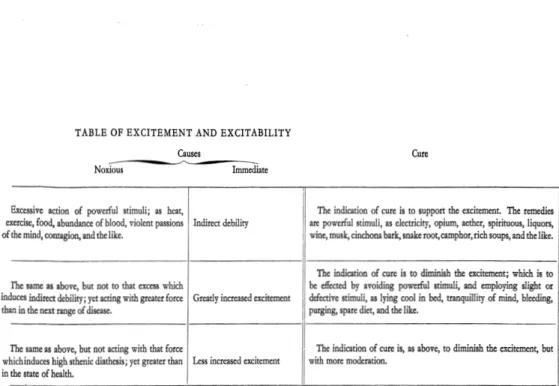
Brown believed that the health of an organism depended solely on the proper amount of stimulation, sicknesses could therefore arise only from a lack or an overdose of it and had to be one of two types: overstimulation brought the body into
a state of excitement called sthenic, while organisms with a debility in stimulation and excitement were said to be asthenic. The two states also differed insofar as the extreme of the sthenic state converted into exhaustion, called Indirect Debility (or indirectly asthenic state), while the extreme of the asthenic diseases directly led to death.
Since all diseases merely depended on the quantity of stimu-lation, the aim of healing was to reestablish the proper amount of it: stimulation and excitement were to be reduced in sthenic diseases and increased in asthenic ones. 25 Brown considered
most diseases asthenic, and therefore his cure usually consisted in the application of stimulating and strengthening medicaments and foods-a positive contribution to the medical practice of the time, still steeped in debilitating methods such as bloodletting.26
Yet Brown's fortifying cure was a mixed blessing. He believed that "spirituous or vinous drink . . . stimulates more quickly, and more readily, than seasoned food, and its stimulus is in proportion to the quantity of alkahol which it contains." More important: ". . . there are stimuli, which possess an operation as much quicker, and more powerful, than these just now mentioned ... the highest of all, as far as experiments have yet reflected light upon the subject, is opium."27 Perhaps these
stimulating yet life-consuming powers inspired Brown's resigned and poetic meditation on human fate: ". . . life is a forced state; . . . the tendency of animals, every moment, is to dissolution; ... they are kept from it by foreign powers, and even by these with difficulty, and only for a little; and then, from the necessity of their fate, give way to death."2B
The "foreign powers" caught up with Brown-in 1788 still poor and neglected-and the years to come did not bring him more recognition in England. Yet his works were embarking upon a curious new life all over the world: in the United States his fellow-student from Edinburgh, Benjamin Rush, published an edition of the Elements which was followed by five more; there were several Spanish translation both in Spain and in Mexico; in Italy the reception was so serious that versions of his theory dominated Italian medical thinking into the third decade of the nineteenth century; in France it was published and according
to Walter Scott even Napoleon was a confirmed believer in the theory. One medical authority claims, however, that Brown's treatment had more casualties than all the Napoleonic Wars.
IV. BROWN'S THEORY IN GERMANY
Brown's theory had its most serious intellectual impact in Germany. Although Blumenbach, Goethe, Kielmeyer, Herder, and many others may be regarded as forerunners, romantic science and medicine did not come to full life until Brown's ideas invaded Germany. The precise date of this is, however, somewhat obscure. During his tour in 1798-99 Coleridge noted with curiosity that in Germany, where foreign ideas were as a rule taken up quickly, Brown's theory had found only a late reception.29 We know now that this remark, copied almost
verbatim from the Allgemeine Literatur Zeitung, was not quite correct. As early as 1790 an article in Rosier's journal de P~sique
described a medical theory ominously resembling the Elementa, deviating from it only insofar as it ascribed the degree of irritability (excitability) in the body to the quantity of oxygen in it.30 The article was written by a German, Christoph
Girtan-ner, and received much critical attention in Germany; but a few years later the plagiarism was discovered and Girtanner had to defend himself by claiming that he had written a parody of Brown which the sullen Germans had missed. 31 Later he became
serious enough to write a two volume critique of Brown's work and to close the affair with the feeling of victory: "Nunmehr aber, nachdem ich meinen miichtigen Gegner durch die Waffen der V ernunft bekiimpft, und ihn so zu Boden geworfen habe, daB er nicht wieder aufstehen kann, trete ich, mit dem ange-nehmen Gefiihle des Siegers, von dem Kampf-Plaze ab, und hiinge, gleich den Gladiatoren des alten Roms, meine Waffen-Rustung auf."32
Another entry in Coleridge's notebook throws light both on himself and on the philosophical conditions prevailing in Germany when Brown's ideas penetrated there. Answering Girtanner's accusations that Brown attributed universal validity to ideas which were built on induction and analogy, 33 Coleridge 2.6
wrote that "Brown was no Kantian & probably held nothing but high degrees of Probability possible."34 Once more,
Coleridge's remark holds only partially: although Brown was indeed no Kantian, he was, for all practical purposes, turned into one by German philosophers and physicians. To the same objection by Girtanner, an avid supporter of Brown remarked in the spirit of Kant: Excitability was no object of spatial perception but an a priori concept of the mind and that both induction and analogy were indispensable modes of under-standing in all the natural sciences.35
In 1798, when Girtanner believed he had eliminated Brown from the ring, the Elements of Medicine actually enjoyed
rising reputation in Germany. Its most loyal defender was M.A. Weikard (1742-I8o3), a former court physician to Empress Catherine of Russia. He had published a German translation of the Elements in 179 5 together with his own Entwurf einer einfachern Arzenrykunsf36 which also dealt with the teachings of
Brown. In the following two years W eikard added to these a handbook and a magazine,37 all of which were to disseminate
the "dogmas" in a fittingly dogmatic manner; he was a passionate but untalented and intolerant disciple of the new gospel, advo-cated the discarding of nosology and diagnostics, and held all former medical knowledge in contempt. His ruthless, personal attacks against members of the establishment and critics of the new system polarized opinions, and while they alienated many of the older doctors they won him a significant section of the young students. The spirit of revolution was smuggled with Brown into Germany.
Of Weikard's medical practice we possess a charming little souvenir in Justinus Kerner's Das Bilderbuch atts meiner Knaben-zeit. The young Kerner, who suffered of a nervous stomach, was once brought to the "Wunderdoktor" of Heilbronn and was subjected to a lengthy examination, at the end of which he fainted. Weikard, the "Wunderdoktor", until then evidently undecided whether to call the disease sthenic or asthenic, now unhesitatingly declared that the disease was asthenic and prescribed for it "Hoppelpoppel" and "Pfefferkorn". Since "Hoppelpoppel", a Russian concoction of tea, egg yolk, and
cherry brandy, did not appeal to the young Kerner, he promtly decided to throw up whenever it was administered to him. The "Wunderdoktor", in turn, remarked with firmness and decorum upon departure: "Furchtbare Asthenie durch zu schnelle Entwickelung ist es, sonst nichts ... und da miissen nur starken-de Mittel gereicht werstarken-den"38 - which might have been the
correct diagnosis after all.
For all his zeal, Weikard probably did more harm than good, and the fad would have quickly passed, had more imaginative minds not seized, developed, and reinterpreted the dogma. A. F. Marcus and A. Roschlaub were engaged in such a re-valuation at the clinic of Bamberg, which became the center for the study of Brown's theory. Marcus, the chief physician, published the Priifung des Brownischen Systems der Heilkunde
between 1797 and 1799, a book consisting of bedside observa-tions and case histories interpreted in terms of Brown's theory.a9
Roschlaub, in turn, published the Magazin zur Vervollkomnm11ng der theoretischen und practischen Heilkunde which became the
mouthpiece of Brown's followers after the quick foundering of Weikard's magazine.
Even more important was the appearance of Roschlaub's
Untersllch11ngen iiber Pathogenic, a book which started from
Brown's premises but subtly and perhaps unknowingly read-justed them according to German philosophical ideas. The young Schelling was deeply impressed by it even though he disagreed with its mechanistic premises, and when he decided that his medical knowledge needed reinforcement he went to observe Marcus and Roschlaub at work. He spent the ill-fated summer of r 8oo in Bamberg while Karoline Schlegel and her daughter, K. Bohmer, stayed in the nearby Bocklet; it was rumored that Schelling applied Brownian cure to the girl who suddenly died at the end of the summer-at least this is what the
Allgemeine Literatur Zeitung asserted years later in its war against
the romantics.40 Schelling remained, however, a friend of the
physicians at Bamberg and became with Marcus co-editor of the
Jahrbiicher der Medicinals Wissenschajt( r 8o6-o8). By that time both
Marcus and Roschlaub became followers of his "Naturphilo-sophie".
Goethe too had his experience with Brown's treatment, though this was considerably milder. As recorded in the Tag-und jahreshefte, Goethe once accepted from a young friend a Brownian medication with opium against pains in his chest. The pains deceptively ceased for a brief period but soon returned with increased vigor.41 As a result, both Brown and Roschlaub
found their way into the pantheon of Goethe's enemies: Wenn ich nun im holden Baine
Unter meinen Freunden wandle, Mogens meine Feinde haben, Die als Kegel ich behandle. Kommt nur her, geliebte Freunde! LaBt uns schleudern, laBt uns schieben; Seht nur, es ist jedem Kegel
Auch sein Name angeschrieben .... Brown steht hinten in dem Grunde, Roschlaub aber trutzt mir vorne, Und besonders diesen letzten Hab ich immer auf dem Korne. 42
Goethe's criticism was shared by others, and most medical authorities expressed some reservations about the new ideas. The opposition grouped around the dignified C. W. Hufeland
(1762-1836), a court physician at Weimar who published the influental]ourna/ der practischen Arznrykunde und Wundarznrykunst
and Bibliothek der practischen Heilkunde, and ran a series of critical articles on the Brownians and their theory. As a student of Blumenbach Hufeland was not unfavorably disposed towards theories of excitability (which did seem to be a form of "Lebens-kraft"), but the Brownian movement in Germany appeared to him as a misguided revolution. He claimed that in science development was evolutionary and not revolutionary, 43 and he
shared with Locke the view that medicine ought to be put together piecemeal, by the slow accumulation of bedside obser-vations. A priori constructs of pure reason had no place in medicine, for its theories were always contingent upon
ex-perience.44 Even worse, the adherents of Brown, like the
Jacobins in France, were not heralds of a new freedom, but would-be dictators of a new dogma and oppressors of the mind's freedom to inquire. 4 5
Hufeland was of course right in regarding the Brownians as a group of zealots in defence of a "dogma" which promised all too easy solutions for life, death, and disease. But he was too deeply steeped in seventeenth-century rationalism to recognize that only on the elementary level did science develop through the evolutionary process of collecting facts. The history of eighteenth-century science was dotted with important dis-coveries which were made in the name of an imaginative scheme or a theory which later proved to be wrong. It remained for the romantics to recognize the role that imagination, conviction, and even partisan fanaticism have in the apparently objective and neutral sciences. As Wordsworth put it, the poet "considers man and nature as essentially adapted to each other, and the mind of man as naturally the mirror of the fairest and most interesting properties of nature" -thus theory need not wait till all empirical evidence is collected. Novalis was acquainted with Hufeland's magazines,46 but the editor's approach seemed
pedestrian and pedantic to him: Hufeland's "Makrobiotik", a popular work on how to prolong life through moderation, upheld a "principle of mediocrity" (II, 464) against which Novalis developed his own vision of qualitatively raising and projecting humanity into the infinite.