The Thirty-Third AAAI Conference on Artificial Intelligence (AAAI-19)
Generalized Distance Bribery
Dorothea Baumeister, Tobias Hogrebe, Lisa Rey
Institut f¨ur InformatikHeinrich-Heine-Universit¨at D¨usseldorf 40225 D¨usseldorf, Germany
Abstract
The bribery problem in elections asks whether an external agent can make some distinguished candidate win or prevent her from winning, by bribing some of the voters. This prob-lem was studied with respect to the weighted swap distance between two votes by Elkind et al. (2009). We generalize this definition by introducing a bound on the distance between the original and the bribed votes. The distance measures we con-sider include a restriction of the weighted swap distance and variants of the footrule distance, which capture some real-world models of influence an external agent may have on the voters. We study constructive and destructive variants of dis-tance bribery for scoring rules and obtain polynomial-time algorithms as well as NP-hardness results. For the case of element-weighted swap and element-weighted footrule dis-tances, we give a complete dichotomy result for the class of pure scoring rules.
1
Introduction
In an election in which voters influence the election’s re-sult by casting their votes they might not be the only agents interested in its outcome. A well known example of strate-gic influence on elections is bribery, formally introduced by Faliszewski et al. (2009) (see also the book chapter by Faliszewski and Rothe (2016)). By paying voters with a re-source, e. g. money, to change their vote, an external agent tries to change the election outcome to her advantage. In the constructive case the aim is to make a specific candidate a winner of the election, while in the destructive case the briber tries to prevent a candidate from winning. Originally the number of voters that can be bribed is limited. However, there is no limitation to the amount of change within a vote. It is natural to assume that a voter’s cost for changing her vote to a large extent is higher than the cost for making small adjustments. This intuition is modeled in the microbribery problem introduced by Faliszewski et al. (2009), and in the swap-bribery problem introduced by Elkind et al. (2009). In both models the briber has to pay certain prices for swaps of adjacent candidates. In order to obtain a more realistic model, we propose to imply a bound on the distance between the truthful and the bribed votes.
Copyright c2019, Association for the Advancement of Artificial Intelligence (www.aaai.org). All rights reserved.
The idea of limiting the distance between originally cast votes and their altered versions in strategic influences is not restricted to bribery. Obraztsova and Elkind (2012) have in-troduced distances to manipulation, where a voter changes her vote in order to subjectively improve the election out-come. They focus on the unweighted swap distance and footrule distance, and the maximum displacement distance between the truthful and the strategic vote in the constructive case. We propose to extend the study of distances to both, the constructive and destructive bribery problem and use un-weighted and un-weighted variants of the swap and footrule dis-tance. One motivation for introducing a bound on the over-all distance of the bribed profile follows from the work by Obraztsova and Elkind (2012) on optimal manipulation. The distance between a truthful and a manipulative vote should be bounded since otherwise a manipulation may be detected more easily. In a more positive sense bribery can be seen as a form of campaign management where an external actor tries to make her desired candidate win by running specific campaigns. While the swap distance counts the inversions of pairs of candidates, it is a more realistic approach to as-sign a weight to a specific swap, as, in a natural election, voters are often very sure about the positioning of some can-didates, while being less concerned with others. We show that different assumptions on how to calculate the weights have a crucial influence on the complexity. The restriction of element-weighted distance functions (studied by Kumar and Vassilvitskii (2010) for linear orders) assigns a weight to every candidate. The weight of a swap is the product of the corresponding candidate weights. This can be seen as an indicator of how sure a voter is about the position of a candi-date in the vote. The same weight functions can also be ap-plied to the footrule distance. Instead of inversions, here the positions a candidate is shifted by are counted. The idea is to measure the cumulative change in the candidate’s standing in the vote, based on its position. In the weighted version, the influence of one candidate on the standing of another can be set by the weight function. Hence, the footrule dis-tance is more realistic in terms of robustness or comparison of profiles.
relation-ships between the distances in order to transfer complexity results but also demonstrating the limits by giving exam-ples for cases where the complexity differs. Weights only apply to the distances, votes remain unweighted. In par-ticular, for the considered voting systems the destructive case is never harder than the constructive one. We present polynomial-time algorithms obtained through dynamic pro-gramming andNP-completeness results, solving a number of open questions from the literature. A detailed overview of our results is given in Section 2.2.
2
Preliminaries
An election is a pair(C, V)with a set of candidatesCand a list of votersV = (v1, . . . , vn)(also called profile), where
a voteviis associated with a preference order>vi over the
candidates. If the voteviis clear from the context we omit
the index or simply write >i. The set of all linear orders
over the candidates inCwill be denoted byL(C). The posi-tion of candidatecin voteviwill be denoted bypos(vi, c),
and the candidate on positionk in votevi will be denoted
bycand(vi, k). For two listsA = (a1, . . . , an)andB =
(b1, . . . , bk)of votes letA∪B = (a1, . . . , an, b1, . . . , bk)
be the concatenation of both lists. A voting rule is a function Ethat maps an election(C, V)to an element of2C. In this paper tie-breaking is not an issue since we focus on the so-callednon-uniquewinner model, where a bribery action is successful if the designated candidate is one of the winning candidates in the constructive case and if she is none of the winners in the destructive case. However, our results can be adapted to the unique winner case by slight changes.
We will consider different voting rules, all belonging to the class of scoring rules. Every scoring rule is charac-terized by a scoring vector ~α = (α1, α2, . . . , αm) with
α1≥α2 ≥ · · · ≥αmand valueαj ∈N0, for1≤j ≤m,
wherem ≥2 is the number of candidates, and will be de-noted byEα~. Every candidate getsαjpoints according to her
positionjin each vote. The winners are the candidates with the maximum number of points. Byscore(C,V)(c)we denote
the points that candidatecgets in the election(C, V). We as-sume that at least two different entries in the scoring vector exist. A scoring rule for an arbitrary number of candidates is defined as a series of scoring vectors for which we can deter-mine the scoring vector formcandidates in polynomial-time depending onm. We will focus on so called pure scoring rules as defined by Betzler and Dorn (2010). Apure scor-ing ruleis a scoring rule, for which the scoring vector for mcandidates can be obtained from inserting a legal entry in the vector form−1candidates. We call a pure scoring rule
polynomially bounded, ifα1is bounded by a polynomial
de-pending onm. This includesplurality, which gives only one point for a first position andk-approval, where one point is given to every candidate placed in the topkpositions of a vote. Accordingly this includesvetoandk-veto, which give one point to all candidates but the candidate(s) in the last/last kpositions who get zero points, and alsoBorda, character-ized by the scoring vector(m−1, m−2, . . . ,1,0)for an m-candidate election.
2.1
Distances
Now we will introduce different distance measures. For-mally, a distance measure d on a space A is a mapping d:A×A→Rthat fulfills the following properties for all a, b, c ∈ A: (i)d(a, b) ≥ 0(non-negativity), (ii)d(a, b) = 0 if and only if a = b (identity of indiscernibles), (iii) d(a, b) = d(b, a)(symmetry), and (iv)d(a, b) +d(b, c) ≥ d(a, c)(triangle inequality). We will focus on distances be-tween votes. For a fixed set of candidates this is a distance of the formd : L(C)× L(C) → R. As we will study the complexity of problems involving such distances we actu-ally consider a family of distances (dm)m>1 that contains
one distance function for each possible candidate set sizem. The two basic distance measures we consider are the swap distance and the footrule distance. For two votes v andv0 fromL(C)theswap distanceswap(v, v0)counts the number of inverted pairs and is formally defined as swap(v, v0) = |{(x, y) ∈ C×C | x >v yandy >v0 x}|. Beside the swap distance, we will also consider the footrule distance. Instead of counting swaps, this distance counts the positions that a candidate needs to be shifted by to obtain the target order. Thefootrule distancefr(v, v0)is defined asfr(v, v0) =
P
y∈C|pos(v, y)−pos(v0, y)|.
In addition to the well-known unweighted versions of these distance measures we also consider weighted forms. The most general form of the swap distance is the weighted swap distance which is also used for the swap bribery prob-lem (see Elkind et al. (2009)). In order to define the weighted distance we introduce the general notion of a weight func-tion π : C×C → N0, that assigns a weight to each pair
of candidates. We will always assume thatπ(x, x) = 0for everyx∈Candπ(x, y) =π(y, x)for everyx, y∈C. This function is analogous to the price function in the context of swap bribery.
Definition 1 (Weighted swap/footrule distance) Let π
be a weight function, the weighted swap distance be-tween two votes v, v0 from L(C) is swapw
π(v, v0) =
P
(x,y)∈C×C:x>vyandy>v0xπ(x, y), and the weighted
footrule distance between v and v0 is frwπ(v, v0) =
P
y∈C
P
x∈C:x>vy
π(x, y)− P
x∈C:x>v0y π(x, y)
.
For matters of consistency we denote the unweighted dis-tances by frπ and swapπ, where the weight function is π(x, y) = 1for allx, y∈C, x6=y. The following example illustrates how these distances are calculated.
Example 2 Consider the votesv :a > b > c > d > eand
v0:a > d > c > b > e. The swap distance isswap(v, v0) = |{(b, c),(b, d),(c, d)}| = 3. For a weight function π, the weighted swap distance is the sum of the weights of these pairs:swapwπ(v, v0) =π(b, c) +π(b, d) +π(c, d). The
un-weighted footrule distance isfr(v, v0) =|2−4|+|4−2|= 4, whereas the weighted footrule distance for a weight function
πisfrwπ(v, v0) =| −π(d, b)−π(c, b)|+|π(b, c)−π(d, c)|+ |π(b, d) +π(c, d)|.
element-weighted distances described by Kumar and Vas-silvitskii (2010). In theelement-weighted swap/footrule dis-tance(denoted byswapew
π andfr
ew
π respectively), the
func-tion πis restricted to the formπ(x, y) = ϕ(x)·ϕ(y)for x¬y, whereϕ:C→N0is a function that assigns a weight
to every candidate. While our distances are obviously heav-ily inspired by the weighted distances proposed by Kumar and Vassilvitskii (2010), they actually differ widely. Their distances are invariant, i. e., they are not dependent on the actual identity of each element but on the permutation be-tween votesvandv0. Our distances are not invariant for a good reason. They should depend on the identity of each candidate and the measurable differences or similarities be-tween them. If weights of0are not allowed for a pair of two distinct candidates, the metric properties are still fulfilled for our definition of the element-weighted swap distance since it is a special case of the weighted swap distance, for which it is not hard to show these properties. For the triangle in-equality, note that for a swap to appear between two candi-dates comparing a votevato a votevcthis swap also has to
appear comparingvato a third votevborvbtovc. This
argu-ment can be modified to show that the weighted footrule dis-tance fulfills the triangle inequality as well. Non-negativity, identity of indiscernibles, and symmetry are obviously also fulfilled by the weighted footrule distance.
Note that if weights of 0 are allowed for a pair of two distinct candidates, all distance measures only fulfill the re-quirements for a pseudometric, i. e., the identity of indis-cernibles is replaced by the propertyd(a, a) = 0. For the sake of readability we neglect identity of indiscernibles in some of our proofs. However, these proofs can be easily rewritten to fulfill this property.
Even though the swap and footrule distances focus on dif-ferent aspects of the differences between two votes, it can be shown that they are somehow related, and we will make use of this in our proofs.
Lemma 3 For a set of candidatesC, a weight function π
overC, andv, v0, v∗∈ L(C)the following statements hold:
swapπ(v, v0)≤ frπ(v, v0) ≤2·swapπ(v, v0); (1)
swapewπ (v, v0)≤ frewπ (v, v0) ≤2·swapewπ (v, v0); (2)
2·ˆπ(v, v0)≤ frwπ(v, v0) ≤2·swapwπ(v, v0) (3)
withπ(v, vˆ 0) = max{π(x, y)|x >v yandy >v0 x}. Ifvandv∗are 3-inversion free1, it holds that
frwπ(v, v∗) = 2·swapw
π(v, v∗). (4)
The first part is the well-known Diaconis-Graham inequality (see Diaconis and Graham (1977)). The remaining proofs can be shown by slight adaptions.
2.2
Distance Bribery
Now we will define decision problems in order to study their computational complexity. For details on computa-tional complexity we refer to the textbooks by Papadim-itriou (1994) and Arora and Barak (2009). The study of the
1
There is a3-inversion betweenvandv∗ifa >v b >vcand
c >v∗b >v∗afor some candidatesa,b, andc.
computational complexity of such manipulative actions is important, since in the context of voting in multi-agent sys-tems it is crucial to know about the possibility of an external intervention. Of course, a worst-case complexity analysis is only the first step and should be followed by a more fine-grained analysis and the design of approximation algorithms and fast algorithms for the average case.
The original bribery problem asks if for a given election a designated candidate can be turned into a winner of the election by bribing a specific number of voters, whereas the swap bribery problem (introduced by Elkind et al. (2009)) requires that the sum of the swaps’ weights may not ex-ceed a budget. In the related shift bribery problem, also in-troduced by Elkind et al. (2009), only swaps involving the desired candidate are allowed. Note that there is a reduction of shift bribery to the element-weighted variant of our lem. However, it does not transfer any results to the prob-lems studied in this paper.
For a given distance functionDand a voting ruleE we define a generalization of the swap bribery problem as fol-lows:
(D,E)-DISTANCEBRIBERY
Given: An election E = (C, V), with V =
(v1, . . . , vn), a weight functionπi,1≤i≤n, for every voter, a positive integerK, and a dis-tinguished candidatep∈C.
Question: Is there a list of votesV0 = (v01, . . . , v0n)such that P
i∈{1,...,n}Dπi(vi, v
0
i) ≤ K and p ∈
E(C, V0)?
In the destructive variant (D,E)-DESTRUCTIVE DIS-TANCE BRIBERY we have the same input, but we ask whether there is an alternative profile V0 = (v01, . . . , vn0) with P
i∈{1,...,n}Dπi(vi, v
0
i) ≤ K and p 6∈ E(C, V0).
Hence, we want to prevent pfrom being a winner of the election.
One restriction is that the weight function is identical for all voters. This follows the work on bribery where only a certain number of votes can be changed arbitrarily (see Fal-iszewski et al. (2009)). All our polynomial-time results obvi-ously cover this restricted version, and we mention whether ourNP-hardness results also hold in this special case. The most general problems are those for the weighted distances, while unweighted distances lead to the most restricted prob-lems. Hence, polynomial-time algorithms for swapw
π and
frwπ carry over to the corresponding problems forswapew
π
andfrewπ , and both to the corresponding problems forswapπ andfrπ. At the same time,NP-hardness for the unweighted distances (swapπ and frπ) implies NP-hardness for the element-weighted distances (swapewπ andfr
ew
π ) which in turn
implyNP-hardness for the weighted distances (swapw
π and
frwπ). Obviously, all decision problems are contained inNP,
since the winners for all voting rules considered here can be computed in polynomial time and as, given two votes, it is possible to compute all introduced distances in polynomial time.
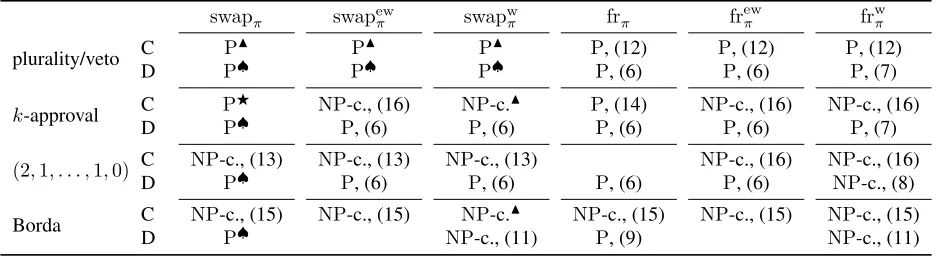
described relations), the respective source is given. For all other cases, the number of the corresponding theorem, for which the proof is provided in this paper, is given in brack-ets. The results show that the introduction of weighted dis-tances may turn the problem NP-complete. We study the scoring vector (2,1, . . . ,1,0), since this is a very simple scoring vector with only 3 different values. Interestingly this is an example for a scoring rule for which the result differs in the constructive case for the weighted swap distance and the weighted footrule distance. To the best of our knowledge, such a difference was not known before for other problems. Our results solve a number of open questions from the lit-erature. Shiryaev et al. (2013) conjectured thatswapwπ DE-STRUCTIVE DISTANCEBRIBERYis hard for many scoring rules, especially Borda and k-approval for any fixed k ≥ 2. We confirmed this conjecture for Borda (Corollary 11) but disproved it for k-approval (Corollary 6). Obraztsova and Elkind (2012) posed the question whether the swap bribery problem, where only one voter can be bribed, re-mains tractable for scoring rules. We give a negative answer in the case of Borda elections. In our NP-hardness proof of (swapwπ,Borda)-DESTRUCTIVE DISTANCE BRIBERY (Theorem 10) there is only one voter that may be bribed. Thereby, the proof also shows that the corresponding opti-mal manipulation problem for weighted swap distances is NP-complete. In addition, Obraztsova and Elkind (2012) suggested to extend the study of optimal manipulation to other distances. Since the optimal manipulation problem is a special case of bribery where only one voter can be bribed, all ourPresults carry over to the corresponding optimal ma-nipulation problems. Furthermore, all our hardness results for the destructive cases carry over, since in our reductions, there is only one voter that may be bribed.
Related Work Distance bribery is a general framework for many problems. Based on the distance used, and whether we look at the destructive or constructive variant, we get various possible motivations such as robustness (Shiryaev et al. (2013)), the standing of a non-winning candidate (Brels-ford et al. (2008)), optimal manipulation (Obraztsova and Elkind (2012)), possible winner (Konczak and Lang (2005)), coalitional manipulation (Conitzer and Sandholm (2002)), tie-breaking, and so on.
The use of individual prices for the change of each vote has been introduced by Faliszewski et al. (2009) for the priced bribery problem. There is however one price fixed irrespective of the change in the vote. Distance restrictions on constructive and destructive bribery problems have also been studied by Yang et al. (2016) for the swap distance and the Hamming distance. The related bribery problems with distance restrictions introduced by Yang et al. additionally include an upper bound on the number of votes that can be bribed. Obviously, our hardness results also hold in this case. Since we follow the work on swap bribery we relate the up-per bound of allowed bribery actions to the distance at hand. Furthermore, we consider the distance bound to be part of the input, whereas Yang et al. fix it in the problem name. It is obvious that their distance restricted bribery problem
for an unlimited distance bound equals the ordinary bribery problem, as well as ours does, if one uses the discrete tance. Another difference is that Yang et al. bound the dis-tance for each bribed voter, while we have a global bound on the distance, consistent with the swap bribery problem. Elkind et al. (2009) showed that the swap bribery problem is a generalization of the possible winner problem. In our notation the swap bribery problem corresponds to the dis-tance bribery problem with theswapw
π distance. However,
there is no direct reduction for problems with other distance functions than the weighted swap distance. Even for the element-weighted swap distance their reduction no longer holds. On the one hand, our problem differs from the nonuni-form bribery, which was introduced by Faliszewski (2008), since they use utility-based voting, while our definition ap-plies to profiles where votes are linear orders over the can-didates. On the other hand, it should be mentioned that our model can also be applied to various other preference rep-resentations, as well as to the approval vectors used by Fal-iszewski (2008), as long as meaningful distances can be de-fined on that form of representation.
Another related problem is the margin of victory in an election studied, e. g., by Magrino et al. (2011) and Xia (2012), and the robustness of an election studied by Shiryaev et al. (2013). They focus on the possibility to change the election winner through some changes in the votes. It is argued that the amount of change needed to ob-tain a different outcome can be seen as a measure for the robustness of a voting rule. Similar as for the optimal ma-nipulation problem the motivation is again to detect fraud in elections. The latter problem is equivalent to destructive swap bribery, and the same arguments obviously apply to the bribery problem. Hence, the distance measures used in this paper also provide a way of measuring the robustness of a voting rule.
3
Results
To construct relative scores in the reductions below, we use the circular block votes defined by Betzler and Dorn (2010). This allows us to generate a set of votes with arbitrary scores that can be generated from the scoring vector, for an offset βand a dummy candidated, which gets less thanβpoints.
Destructive Distance Bribery In this section we will con-sistently denote the undesirable candidate asqand a possibly more preferable candidate asp. Before stating our results, we introduce a notion for the minimum necessary distance to improve the designated candidatepcompared to some other candidate. For a given instance of (D,E)-DESTRUCTIVE DISTANCEBRIBERYwith election(C, V), andp, q∈C, let cost(C,V)(p, q, i, r)denote the minimum necessary distance
to improve the relative score ofpcompared toqin voteviby
at leastr, with0≤r≤α1−αm. We setcost(C,V)(p, q, i, r)
to∞if the relative score cannot be improved by at leastr.
swapπ swapewπ swapwπ frπ fr
ew
π fr
w
π
plurality/veto C PN PN PN P, (12) P, (12) P, (12)
D P♠ P♠ P♠ P, (6) P, (6) P, (7)
k-approval C PF NP-c., (16) NP-c.N P, (14) NP-c., (16) NP-c., (16)
D P♠ P, (6) P, (6) P, (6) P, (6) P, (7)
(2,1, . . . ,1,0) C NP-c., (13) NP-c., (13) NP-c., (13) NP-c., (16) NP-c., (16)
D P♠ P, (6) P, (6) P, (6) P, (6) NP-c., (8)
Borda C NP-c., (15) NP-c., (15) NP-c.N NP-c., (15) NP-c., (15) NP-c., (15)
D P♠ NP-c., (11) P, (9) NP-c., (11)
Table 1: Overview of complexity results for the constructive and destructive DISTANCEBRIBERYproblems for various dis-tances, where “NP-c.” stands forNP-complete. Results that were previously known (or directly follow from them) are marked by their corresponding source:NElkind et al. (2009),FDorn and Schlotter (2012), and♠Shiryaev et al. (2013). For all other results the reference to the corresponding theorem is given in brackets. TheNP-completeness of constructive distance bribery forswapewπ ,frewπ ,swapwπ, andfrwπ fork-approval holds for a fixedk≥2.
Proof. We will use the following method for each candi-datep∈ C\ {q}, to compute an overall distance minimal bribery makingpbetter thanq. To solve the decision prob-lem, we then have to compare the minimum overall distance of the destructive bribery with the distance limitK. Given a set of candidates Cwith{p, q} ⊆ C and a list of votes V = (v1, . . . , vn), such thatscore(C,V)(q)≥score(C,V)(p)
(otherwise q is not a winner). The weight function for voter vi will be denoted by πi. Let δ = score(C,V)(q)−
score(C,V)(p) + 1be the deficit betweenqandp.
The following formula is a straightforward generaliza-tion of the formula presented by Kaczmarczyk and Fal-iszewski (2016) for destructive shift bribery. Byf(i, r)with i ∈ {1,2, . . . , n} we denote the minimum overall dis-tance for reducing the deficit by at least r in the votes v1, v2, . . . , vi. The value off(0,·)is only defined as an
ini-tial value for technical reasons. Forf it holds that
f(0,0) = 0, f(0, g) =∞forg >0,and
f(i, r) = min
r0≤r
f(i−1, r−r0) + cost(C,V)(p, q, i, r0)
.
Therefore, the minimum necessary overall distance to elim-inate the deficit betweenpandqis given byf(n, δ)which can be determined in polynomial-time ifcost(C,V) can be
determined efficiently. q
We apply this result and show thatcost(C,V)can be
com-puted in polynomial time for a large class of rules.
Theorem 5 Let E be a pure scoring rule with a lim-ited number of different values, and additionally only one value has an unlimited number of entries, then (D,E )-DESTRUCTIVE DISTANCE BRIBERY is in P for D ∈ {swapπ,swapewπ ,swapwπ,frπ,fr
ew
π }.
Proof (sketch). First note that the above restriction on the pure scoring rule implies that it is polynomially bounded. Hence, due to Theorem 4 we only show thatcost(C,V)can
be computed in polynomial time. This can indeed be done for all listed distances by a brute force approach.
For swap distances, the idea is to calculate the minimum necessary distancecost(C,V)by looking at each possible
dis-tribution of candidates to the values.
The minimum distance is obtained by placing the candi-dates of some value in their original order. Since there is only one value with an unlimited number of entries, the number of distributions is polynomially bounded by the number of candidates. By placing the candidates assigned to a value in the original order the minimum element-weighted footrule distance is produced. Therefore, it suffices to show that ev-ery corrective swap in the unweighted footrule distance re-duces or maintains the distance. This can be shown via a connection between the unweighted and element-weighted
distance. q
Corollary 6 For plurality, veto, k-approval, and
(2,1,1, . . . ,1,0) elections (D,E)-DESTRUCTIVE DISTANCE BRIBERY is in P for D ∈ {swapπ,swapew
π ,swapwπ,frπ,fr
ew
π }.
This corollary follows directly from Theorem 5. The ap-proach cannot be extended to the weighted footrule distance since additional inversions can actually lower the distance. Consider the votesv:q > a > b > p,v0:p > a > b > q, andv∗ : p > b > a > qand the weight function given by π(a, b) = 4,π(a, p) = 1, π(a, q) = 4, π(b, p) = 4, π(b, q) = 1, andπ(p, q) = 1. We receive the following dis-tances:frwπ(v, v0) = 18andfr
w
π(v, v∗) = 14. Next, we show
that fork-approval elections it is indeed possible to extend the approach to the weighted footrule distance. Note that for k = 1 this proof covers plurality, and a very similar ap-proach can be used to show polynomial-time solvability for k-veto.
Theorem 7 (frwπ, k-approval)-DESTRUCTIVE DISTANCE BRIBERYis inP.
weighted footrule distance. This holds, since one can show that correcting the left- or rightmost inversion of two adja-cency candidates always lowers or maintains the weighted
footrule distance. q
For(2,1, . . . ,1,0)elections it is indeed not possible to extend the previous result.
Theorem 8 (frwπ,E(2,1,1,...,1,0))-DESTRUCTIVEDISTANCE
BRIBERYisNP-complete.
Proof. NP-hardness will be shown via a reduction from the NP-complete problem SUBSET SUM (see Garey and Johnson (1979)). A SUBSETSUMinstance consists of a set of integersA = {a1, a2, . . . , ah}and a positive integerT.
The question is whether there exists a subsetA0 ⊆Awith
P
ai∈A0ai = T. We construct an instance of the
destruc-tive bribery problem as follows. The set of candidates is C ={p, q, s, u1, u2, . . . , uh}. The profile contains the vote
v1 :q > s > u1 > u2 >· · · > uh > pand a list of votes
Vd. The latter is constructed by using the circular block votes
with someuias the dummy candidate to ensure the
follow-ing scores for some score offsetβ. The current winner of the election should beqwithβ+ 3points, followed bypwith βpoints. Each other candidate should receive at mostβ−4 points. The weight functionπ1is as follows:π1(p, ui) =ai,
π1(p, s) = 0,π1(p, q) = 0,π1(q, ui) = 0,π1(q, s) = 2T,
π1(s, ui) = 2ai,π1(ui, uj) = 0, for1≤i, j≤h. For every
other voter we set the weights for every swap to K + 1, that means only v1 can be bribed. The distance limit is
K= 2·P
ai∈Aai+ 2T. Since onlyv1is bribable and only
pcan beatq, the only way of defeatingq is to movepto the first andqto the last position inv1. The resulting vote
v10 =p > s > u1> u2>· · ·> uh> qinflicts the distance
frwπ
1(v1, v
0
1) = 2 P
ai∈Aai + 4T. Due to the weight
func-tion, the only way of lowering the distance, is to swapuis
in front ofs. Lowering the distance by2T is possible if and only if there exists a subsetA0 ⊆A, withP
ai∈A0ai =T
such that swapping each ui, whereai ∈ A0, in front ofs,
lowers the term ofsby2T. Note that the term of eachuiis
not lowered by swapping withs. q
One can extend this proof to all pure scoring rules, which have two distinct values separated by entries of at least one other value, with the number of entries increasing at least linearly with a polynomial number of candidates.
Next, we will consider the unweighted footrule distance.
Theorem 9 (frπ,E)-DESTRUCTIVE DISTANCE BRIBERY
is inPfor all pure scoring rules.
Proof. The approach used by Shiryaev et al. (2013) for the (swapπ,E)-DESTRUCTIVEDISTANCEBRIBERYregarding scoring rules, can be easily generalized to apply to all dis-tances which are polynomially bounded depending on the number of candidates, for which one can efficiently deter-mine the maximum deficit reduction in a vote for a given bound on the distance. This is indeed possible for the un-weighted footrule distance by testing every possible com-bination of positions ofpandq and placing the remaining candidates according to their original order. q
We continue, by considering the destructive variant of distance bribery for Borda elections. It is known that de-structive shift bribery and dede-structive unweighted swap bribery are inPfor Borda (see, e. g., Kaczmarczyk and Fal-iszewski (2016) and Shiryaev et al. (2013)). In contrast we will showNP-completeness for DESTRUCTIVEDISTANCE BRIBERYfor a class of pure scoring rules, including Borda, when using the weighted swap distance. We will call a pure scoring ruleE separable with polynomial effort, if there ex-ists a polynomially bounded functionf :N→N, so that for each integerrwithm = f(r)andα~ as the scoring vector formcandidates the following holds:∃k∈ {1, . . . , m−1}: αk> αk+1andr≤k≤(m−r). Intuitively this condition
means that the candidates may be divided into two “large enough” groups that do not get the same number of points. The integerrdetermines the minimal size of these groups.
Theorem 10 (D,E)-DESTRUCTIVE DISTANCE BRIBERY
isNP-complete forD ∈ {swapwπ,fr
w
π}for every pure
scor-ing ruleEwhich is separable with polynomial effort, even if the weight functions are identical for all voters.
The proof is a reduction from theNP-complete problem BALANCEDBICLIQUE. The above theorem includes scor-ing rules like Borda,bm
2c-approval and many more rules.
Corollary 11 (D,Borda)-DESTRUCTIVE DISTANCE BRIBERY isNP-complete forD ∈ {swapw
π,fr
w
π}, even if
the weight functions are identical for all voters.
Constructive Distance Bribery We now turn to the con-structive case. For the sake of readability, candidatepwill always be the candidate who should be made a winner of the election through the bribery action.
Theorem 12 For plurality and veto (D,E)-DISTANCE BRIBERYis inPforD ∈ {frπ,frewπ ,frwπ}.
Proof. We show polynomial-time solvability for the weighted variant, which directly implies the results for the other two variants. Elkind et al. (2009) argue that for the bribery problem with the weighted swap distance for plural-ity and veto elections it suffices to calculate the minimum distance for replacing the top or rearmost candidate with another specific candidate and use this value as input for the polynomial-time nonuniform-bribery algorithm by Fal-iszewski (2008). Hence, it is sufficient to show that these values can be computed in polynomial time for the weighted footrule distance.
The more general proof of Theorem 7 implies that for plurality the most efficient way of transferring the points from candidate cand(vi,1) to candidate cand(vi, j) with
2 ≤j ≤mis to shiftcand(vi, j)to the top position while
moving each candidate in between one position downwards. For veto the most efficient way of transferring one point from cand(vi, j)with1 ≤ j ≤ m−1 tocand(vi, m)is
to shiftcand(vi, j)downwards to positionmwhile moving
each candidate in between one position upwards. q
Theorem 13 (D,E(2,1,1,...,1,0))-DISTANCE BRIBERY is
NP-complete forD ∈ {swapπ,swapew
π ,swapwπ}, even if
Proof. We show the result for the unweighted variant, which directly implies the results for the other two variants. NP-hardness will be shown via a reduction from the NP-complete problem X3C (see Garey and Johnson (1979)). An X3C instance consists of a setU ={u1, . . . , u3q}of items
and a familyS ={S1, . . . , Sr}of3-element subsets ofU.
The question is, whether there is an exact cover ofU, i. e., a subsetS0 ⊆Ssuch thatS
Si∈S0Si =U. For the reduction,
the set of candidates is given byC=U∪ {p} ∪ {si, ci, di |
1≤i≤r} ∪ {x1, x2, . . . , x12r}. The number of candidates
ism= 3r+ 12r+ 3q+ 1and we assumeq < randr≥5. The list of votes isV =Vs∪Vd.Vscontains the following
three votes for eachSi={ui1, ui2, ui3}:
vi,1:ui1 > X >· · ·> D−r> si > p > dr;
vi,2:ui2 > X >· · ·> D−r> dr> ci> p > si;
vi,3:ui3 > ci> X >· · ·> D−r> p > dr.
Here X is a shorthand for the order x1 > · · · > x12r,
D−r for the order d1 > · · · > dr−1, and the ellipsis in
the votes contains all the candidates that are not specified in the vote itself in arbitrary order. Here, β is the num-ber of points, candidatepreceives. The current winners of the election should be each uj with β + 2q+ 1 points,
followed by eachxj,ci, andsi withβ + 2qpoints. Each
dj should receive at most β points. We can construct the
scores through the following votes inVd, increasing the
rel-ative score of the selected candidate by 1 point compared to each other candidate exceptdr with2points. For pwe
usep > X > · · · > D−r > dr,for c ∈ {uj, ci, si}we
use c > X > · · · > D−r > p > dr, and for xj we
usexj > x1 > · · · > x12r > · · · > D−r > p > dr,
wherex1 > · · · > x12rdoes not containxj. The distance
limit is set to be K = q(2m−1). Note that decreasing the score of eachxj by one point alone would increase the
overall distance by at least12r·3r > Kforq < r. There-fore, the briber has to increase the score ofpby at least2q points. Sincepis either already ranked at the top position or on positionm−1, increasing the score ofpby2q makes 2q(m−2)additional swaps, and therefore an increase in the overall distance by at least2q(m−2), necessary. Note that as2q(m−2)< K <(2q+ 1)(m−2),β+ 2qis the maxi-mum score thatpcan reach. Thus, the briber has to increase the score ofpby exactly2qwhile lowering the score of each ujby at least1.
We will show thatpcan only be made the winner while staying inside the distance limit if and only if there exists a solution to the X3C instance with the corresponding votes arranged such that
vi,01:p > ui1 > X >· · ·> D−r> dr> si;
vi,02:p > ui2 > X >· · ·> D−r> dr> si> ci;
vi,03:ci> ui3 > X >· · ·> D−r> p > dr.
This increases the distance by2m−1. We will show that swappingpforward to the first position in votes besidevi,1
andvi,2 makes it impossible to make pthe winner while
staying inside the distance limit. Note that beside swapping pupwards for an additional distance of 2q(m−2) while
possibly already reducing the score of 2q items, there is a leftover distance of3qfor reducing the score of the otheruj
by1with the cheapest way of reducing the score of anuj
being3.
Reducing the score ofujby1by swapping it away from
the last position without swapping it withpis not possible since it increases the distance by at least15 ≤ 3r(r ≥ 5) (for reducing the score of thexagain). Reducing the score ofuj(or any other relevant candidate) by swapping it down
past d1, . . . , dr is also not an option since it increases the
distance by at least5 (r ≥ 5). In both cases we could not reduce the score of all the at least(q−1)leftover items.
We can use the same argumentation to show that swap-ping down ui3 in vi,3 without swappingpforward to the
first position invi,1andvi,2is not an option. In both cases
we have to swap si down in vi,1 to swap ci down invi,2
to swapui3 withci. But doing so without swappingp
for-ward in one of the votes increases the distance by at least 4. Thereby we could not reduce the score of all the at least (q−1)leftover items. Therefore, the briber has to swapp forward in exactlyqpairs ofvi,1andvi,2exactly as shown
above with swapping downui3invi,3. Since it is necessary
to reduce the score of eachujby one, makingpthe winner
with respect to the distance limit is only possible if and only if there exists a solution to the X3C instance. q
Theorem 14 (frπ, k-approval)-DISTANCE BRIBERY is in
P, even ifkis part of the input.
Proof. This proof makes use of an algorithm proposed by Dorn and Schlotter (2012, Theorem 1) to compute a swapπ distance optimal bribery fork-approval. LetV∗ = (v1∗, . . . , vn∗) be the swapπ distance optimal bribery
com-puted by the above mentioned algorithm. Since V∗ is swapπ distance optimal each vote v∗
i fulfills the order
proposed in the proof of Theorem 5 with the candidates on the top k and latter m − k positions in their orig-inal order. Since each v∗i is 3-inversion free, it holds due to Diaconis and Graham (1977) that frπ(vi, v∗i) =
2 · swapπ(vi, v∗i), which extends to the overall distance:
Pn
i=1frπ(vi, vi∗) = 2·
Pn
i=1swapπ(vi, vi∗). Assume there
is a differentfrπdistance optimal briberyV0= (v0
1, . . . , vn0)
withPn
i=1frπ(vi, v0i)<
Pn
i=1frπ(vi, vi∗). Again, sinceV0
is distance optimal, by the proof of Theorem 7 we know that eachv0ifulfills the 3-inversion free order proposed in the proof, soPn
i=1frπ(vi, vi0) = 2·
Pn
i=1swapπ(vi, vi0)holds.
Substituting frπ withswapπ in the above inequality leads
toPn
i=1swapπ(vi, v0i) <
Pn
i=1swapπ(vi, vi∗)which is a
contradiction to theswapπdistance optimality ofV∗. q
Theorem 15 (D,Borda)-DISTANCE BRIBERY is NP -complete forD ∈ {swapπ,swapewπ ,swapwπ,frπ,fr
ew
π ,fr
w
π},
even if the weight functions are identical for all voters.
Theorem 16 (D,E)-DISTANCE BRIBERYisNP-complete forD ∈ {swapewπ ,frewπ } and for all pure scoring rules ex-cept plurality and veto, and forswapew
π even if the weight
Since (D,E)-DISTANCE BRIBERY for D ∈ {swapew
π ,fr
ew
π } is solvable in polynomial-time for
plu-rality and veto this completes a dichotomy result for pure scoring rules.
4
Conclusions
We introduced various forms of distances, namely weighted and unweighted versions of the swap and footrule distance, to the bribery problem in elections. We showed how the re-lation between the distances may be used in the proofs, but we also showed that there are limits. For(2,1, . . . ,1,0)we have a P result for the weighted swap distance, but NP-completeness for the weighted footrule distance in the de-structive case. On the one hand, we have shown for pure scoring rules that in the constructive case the complexities of the element-weighted and weighted problems coincide. On the other hand, for(2,1, . . . ,1,0)in the destructive case they differ. Regarding the open cases from Table 1, we con-jectureNP-completeness for all of them. For many voting systems, which, like Borda, distinguish each position, the problem is already hard in the destructive (as well as con-structive) case, even if only one voter is suggestible. Thus, the design of voting systems which are sensitive regarding the position of the candidates, combined with certain politi-cal integrity of the voters make the influence through bribery hard from a complexity theoretic point of view. This ef-fects today’s political agendas as distances can be consid-ered in terms of campaigning and its limits. It is an inter-esting task to explore exactly which distance properties and which election properties are causing the jump fromP to NP-completeness. As a next step the parameterized com-plexity of the presented problems and approximation algo-rithms for the hard problems should be considered in detail.
5
Acknowledgments
We thank the reviewers for their helpful comments. This work is supported by the DFG-grant BA6270/1-1.
References
Arora, S., and Barak, B. 2009. Computational Complexity: A Modern Approach. Cambridge University Press.
Betzler, N., and Dorn, B. 2010. Towards a Dichotomy of Finding Possible Winners in Elections Based on Scoring Rules.Journal of Computer and System Sciences76(8):812– 836.
Brelsford, E.; Faliszewski, P.; Hemaspaandra, E.; Schnoor, H.; and Schnoor, I. 2008. Approximability of Manipulating Elections. InProceedings of the 23rd AAAI Conference on Artificial Intelligence, 44–49. AAAI Press.
Conitzer, V., and Sandholm, T. 2002. Complexity of Ma-nipulating Elections with Few Candidates. InProceedings of the 18th National Conference on Artificial Intelligence, 314–319. AAAI Press.
Diaconis, P., and Graham, R. 1977. Spearman’s footrule as a measure of disarray.Journal of the Royal Statistical Society. Series B (Methodological)39(2):262–268.
Dorn, B., and Schlotter, I. 2012. Multivariate Complexity Analysis of Swap Bribery. Algorithmica64(1):126–151. Elkind, E.; Faliszewski, P.; and Slinko, A. 2009. Swap Bribery. InProceedings of the 2nd International Symposium on Algorithmic Game Theory, 299–310. Springer-Verlag
Lecture Notes in Computer Science #5814.
Faliszewski, P., and Rothe, J. 2016. Control and Bribery in Voting. In Brandt, F.; Conitzer, V.; Endriss, U.; Lang, J.; and Procaccia, A., eds.,Handbook of Computational Social Choice. Cambridge University Press. chapter 7, 146–168. Faliszewski, P.; Hemaspaandra, E.; Hemaspaandra, L.; and Rothe, J. 2009. Llull and Copeland Voting Computationally Resist Bribery and Constructive Control. Journal of Artifi-cial Intelligence Research35:275–341.
Faliszewski, P.; Hemaspaandra, E.; and Hemaspaandra, L. 2009. How Hard Is Bribery in Elections? Journal of Artifi-cial Intelligence Research35:485–532.
Faliszewski, P. 2008. Nonuniform bribery. InProceedings of the 7th International Joint Conference on Autonomous Agents and Multiagent Systems, 1569–1572. IFAAMAS. Garey, M., and Johnson, D. 1979. Computers and In-tractability: A Guide to the Theory of NP-Completeness. W. H. Freeman and Company.
Kaczmarczyk, A., and Faliszewski, P. 2016. Algorithms for Destructive Shift Bribery. In Proceedings of the 15th International Joint Conference on Autonomous Agents and Multiagent Systems., 305–313. ACM Press.
Konczak, K., and Lang, J. 2005. Voting Procedures with Incomplete Preferences. InProceedings of the Multidisci-plinary IJCAI-05 Worshop on Advances in Preference Han-dling, 124–129.
Kumar, R., and Vassilvitskii, S. 2010. Generalized distances between rankings. InProceedings of the 19th International Conference on World Wide Web, 571–580. ACM Press. Magrino, T.; Rivest, R.; Shen, E.; and Wagner, D. 2011. Computing the Margin of Victory in IRV Elections. In
Proceedings of the Electronic Voting Technology Work-shop/Workshop on Trustworthy. USENIX Association. Obraztsova, S., and Elkind, E. 2012. Optimal Manipula-tion of Voting Rules. InProceedings of the 11th Interna-tional Joint Conference on Autonomous Agents and Multia-gent Systems, 619–626. IFAAMAS.
Papadimitriou, C. 1994. Computational Complexity. Addison-Wesley.
Shiryaev, D.; Yu, L.; and Elkind, E. 2013. On elections with robust winners. In Proceedings of the 13th Interna-tional Joint Conference on Autonomous Agents and Multia-gent Systems, 415–422. IFAAMAS.
Xia, L. 2012. Computing the margin of victory for various voting rules. InProceedings of the 13th ACM Conference on Electronic Commerce, 982–999. ACM Press.