2
Phosphorus
Peter Leinweber,
1Benjamin L. Turner
2and Ralph Meissner
3 lInstitute of Soil Science, University of Rostock, Justus-von-Liebig-Weg 6, D-18059 Rostock, Germany; 2 USDA — ARS, Northwest Irrigation and Soils Research Laboratory, 3793 N. 3600 E. Kimberly, ID 83341, USA; 3UFZ Centre for Environmental Research,Leipzig-Halle, Lysimeter Station, D-39615 Falkenberg, Germany
E •1••• CO 'V n-• C .0
C =
C) 0-CO .0
1-n
5- CO 5- (0
cn
•P >2
rel et = •
^ • 0 5-
f
."-Options for Mitigation and Conclusions Acknowledgements
References
Key words: detachment, fertilizer, inorganic phorus, phosphorus runoff, soil solution,
W 4-1 .0 • •
1-ell
LiJ Introduction
C •,- . • 4_1
C vl
►-1 Phosphorus (P) is one of the most important
mineral nutrients for biological systems, yet it is also one of the most scarce nutrients in terms of its demand in both terrestrial and aquatic environments (Moss, 1988). In nat-0 CAB International 2002. Agriculture, Hydrology and
(eds P.M. Haygarth and S.C. Jarvis)
Introduction 29
Phosphorus Use on Farms 30
Livestock feeding and manure production 30
Mineral fertilizers 31
Soil phosphorus 32
Phosphorus uptake by crops 36
Imbalances of agricultural phosphorus 36
Impact of excess fertilizer application on the amounts and forms of soil
phosphorus 37
Environmental Consequences of Excessive Phosphorus Enrichment in Soils 39
Introduction and general problem 39
Forms of phosphorus in soil solution and runoff waters 40
Movement of phosphorus from soils to watercourses 41
Critical phosphorus concentrations and loads 47
48 50 50
phosphorus, leaching, manure, organic phos-solubilization
0
• C I 0 C) 5-O 1:7 C
5- CV cu C
• 1-• CL)
ural systems, P is tightly cycled through the plant-soil continuum, but in agricultural systems soil P is removed in the crop or animal products and must be replaced if P deficiency is to be avoided. Therefore, min-eral PO fertilizers and animal manures are applied to agricultural land to raise soil
Water Quality
30 P. Leinweber et al.
P levels and maintain crop yields (Sibbesen and Sharpley, 1997).
Phosphorus fertilizer has traditionally been applied to agricultural land with no concern over losses to water, because inor-ganic P is strongly fixed in the soil and pre-vented from leaching (Sample et al., 1980). However, while this is true from an agro-nomic standpoint, the small amounts of P lost from the soil can have severe impacts on water quality in receiving catchments, especially in terms of eutrophication and the growth of undesirable algae (Moss, 1996). In aquatic ecosystems, P can con-tribute to eutrophication, toxic algal blooms and a general deterioration of water quality. Known far-reaching consequences of these aquatic processes include the disappear-ance of sensitive ichthyofauna, the increased cost of drinking water purifica-tion and loss of income from recreapurifica-tional tourism. In particular, accumulations of P can occur under heavy manure or fertilizer application (Breeuwsma et al., 1995), which can eventually reduce the capacity of the soil to retain P and accelerate the loss of P in runoff to watercourses. Examples of areas with severe eutrophication problems that are directly attributable to agricultural P include the Chesapeake bay area of north-eastern USA and the Gippsland Lakes area in south-eastern Australia (Burkholder et
al., 1992; EPA, 1995).
In this chapter we discuss the role of agricultural management of P in contribut-ing to water quality problems. The main areas of consideration are the imbalances in P use at the farm scale, the dynamics of soil P and the transfer of P from soils to water-courses. Emphasis is placed on understand-ing the mechanisms and pathways of losses from soil to water and forms of P in surface waters. Finally, options for improved man-agement of agricultural P for the prevention of surface water pollution are considered.
Phosphorus Use on Farms
Agricultural soils receive P from livestock (direct excreta and manures), mineral fertil-izers and municipal sludges and
waste-waters. Imbalances originate because P is applied at levels that are in excess of the amounts required for optimum crop yields. This is often exacerbated where areas requir-ing P fertilizer (e.g. crop producrequir-ing areas) are spatially separated from areas with large P surpluses (e.g. areas of intensive livestock production). The following sections examine the basic sources and pathways of P in agri-cultural systems that can lead to the over-application and consequent acceleration of transfer to watercourses.
Livestock feeding and manure production
greater level of intestinal phytase. Phos-phorus uptake efficiency can be greatly improved through the use of phytase sup-plements, reducing P contents in excre-ment by up to 25-35% (Oloffs, 1998). This has environmental as well as financial ben-efits, because increased efficiency in live-stock production reduces the P returns to land. It should be noted, however, that P in manures from animals fed with phytase supplements may be present in more soluble forms and, hence, may actually increase the likelihood of manure-derived P transfer to watercourses.
Mineral fertilizers
The addition of mineral P fertilizer to crops is commonly based on soil tests and the resulting fertilizer recommendations. More than ten different soil tests are used in
European countries (Tunney et al., 1997).
These include various lactate methods such as double lactate (DL), calcium-ammonium lactate (CAL) and ammonium acetate (AL) (Austria, Belgium, Germany, Hungary, The Netherlands, Norway, Poland, Romania, Sweden), the Olsen method (sodium bi-carbonate (NaHCO3): Denmark, Greece, Italy, Spain, UK) and the water-extractable P method (Austria, Netherlands, Switzer-land). A more recent development is the extraction of soil with 0.01 M calcium chloride (CaC12), which is used for multi-element determination and evaluation for various nutrients and contaminants. The
critical soil value to obtain the desired high crop yield varies widely, even if the same soil P test is used (Table 2.1). This results from differences in soil and climatic condi-tions, P requirements and uptake by crops, and also from differences in the experi-mental basis used to derive these critical levels. Therefore, a re-evaluation of experi-mental data to match P requirements of crops and minimize the risk of P losses from soils is urgently needed.
Clearly, the differences in soil P test methods and their evaluations result in widely different P fertilizer recommenda-tions in various regions (Sibbesen and Sharpley, 1997; Tunney et al., 1997).
Mineral P applications are typically in the range of 10-20 kg P ha-1 year-1. Common types of P fertilizer are superphosphate (8-10% P), triple superphosphate (20% P), ammonium phosphates (21-24% P) and rock phosphates (apatites, 13% P) (Mengel and Kirkby, 1987). Examples of current mean fertilizer P applications in European countries are given in Table 2.2. In calcu-lating fertilizer application rates, it is necessary to consider the manure-P inputs so that the farmer can reduce mineral fertil-izer application, thereby saving money, avoiding undesirable soil P enrichments and reducing the potential impacts of P transfer to aquatic ecosystems. However, this is not always the case, especially when manure applications are calculated on the basis of N, rather than P, content, which can result in disproportionate quantities of P being applied to the land.
Table 2.1. Examples of soil-test phosphorus (P) levels for 95% relative yield or no yield response (data from Sibbesen and Sharpley, 1997).
Soil P test method
Critical level
(mg P kg- 1 ) Crops Number and duration of trials Region, soils
H2O 5 Rotation 105 trials, 1 year Germany, loess
112 0 14 Potatoes 37 trials, 1 year The Netherlands
DL 26 Rotation 150 trials, 1-3 years Germany, various
DL 50-60 Rotation 1 trial, 42 years Germany, Pheozem
Olsen 5 Maize 25 trials, 1 year Iowa, various
Olsen 21-35 Rotation 7 trials, 20 years Denmark, various
Bray-1 11 Maize 25 trials, 1 year Iowa, various
32 P. Leinweber et al.
Table 2.2. Phosphorus field balances in some European Countries (Isermann, 1999). The Netherlands
(1997)
Denmark (1996)
Poland (1997/98)
Greece (1988)
Input (kg ha- 1 year 1 ) 58 28 14 > 22
Animal manure 41 18 6 n.d.
Fertilizer 14 8 8 22
Deposition 1 n.d. n.d. n.d.
Other 2 2 n.d. n.d.
Output (kg ha- 1 year 1 )
Plant products 31 20 14 9
Surplus 27 8 >0 >13
Efficiency of use (%) 53 71 98 <41
n.d. = Not determined.
Soil phosphorus
Soils are the source of P for plant uptake and also for transfer to watercourses, so an understanding of soil P dynamics under-pins the two fundamental aspects of agri-cultural P research.
Phosphorus contents and forms
Total P contents of topsoils in temperate regions typically range between 300 and 2000 mg kg -1 depending on parent material, soil type, land use and fertilizer/manure application method (Frossard et al., 1995;
Leinweber, 1996). In contrast, some soils in densely stocked areas of Western Europe and the USA are greatly enriched in P (Barberis et al., 1996). The proportions of organic P can range between 25 and 50% of total P in mineral soils and up to 60-90%
in organic soils (Harrison, 1987). Soil management (e.g. arable vs. permanent grassland and biological vs. conventional farming) and rates of P fertilizer/manure application all affect soil P contents and the ratio of inorganic to organic compounds.
Inorganic P-containing minerals include the various calcium phosphates, such as Ca(H2PO4)2, CaHPO4, Ca4 (HPO4)3 and
Ca,(PO4)30H. The solubility of calcium phosphates depends on pH and the Ca2+
concentrations in soil solution. In alkaline
soils, the availability of freshly applied fertilizer P gradually decreases through proci pitation of less soluble calcium
phos-phates. In neutral and acidic soils, the dynamics of inorganic P are dominated by PO4- sorption on to the edges of clay miner-als and to pedogenic Al and Fe oxides. Sorbed Pgr can diffuse inside pedogenic oxides and become less soluble. These sorbed and occluded insoluble phosphates of Al and Fe predominate in acid soils. This presents a serious problem in highly weath-ered soils rich in Al and Fe oxides, like Ferralsols and Sesquisols, especially in trop-ical regions. Low molecular organic anions and higher molecular organic acids such as
fulvic and humic acids compete with POI-and, possibly, organic P compounds, for sorption sites. Furthermore, chelating organic compounds may also contribute to the desorption of PO4-. Hence, agronomic treatments that enhance soil organic matter content often also improve PO4- availabil-ity. There is substantial evidence that redox dynamics are closely linked to the dynamics of sorbed and dissolved PO4- in soil which can directly affect the amounts and forms that leach from soils.
Quantitatively, the most important organic P compound in most soils is phytic acid, which can form up to 80% of the organic P (Turner et al., 2002). Other measurable organic P compounds include phospholipids and nucleotide phosphates (Harrison, 1987). Despite their prevalence, soil organic P com-pounds remain poorly understood, especially in terms of their availability to plants and transfer to watercourses (Frossard et al.,
organic P has eluded even basic chemical characterization (Harrison, 1987). This is partly attributable to the fact that recoveries of organic P compounds are often < 50% in common extractants such as sodium hydrox-ide (NaOH) (Cade-Menun and Preston, 1996).
This may result from the `trapping' of organic P compounds by more complex organic macromolecules, such as fulvic and humic acids, which makes their direct determina-tion difficult.
The soil microbial biomass can contain a large and active P fraction, which can be determined by the fumigation-extraction method (Brookes et al., 1982). Typical pro-portions of microbial P range from 2 to 5%
of organic P in arable soils (Brookes et al.,
1982) and up to 24% in grassland soils (Turner et al., 2001). Estimated annual fluxes of P through the microbial biomass of 5 (arable) to 23 (grassland) kg ha-1 year-1 (Brookes et al., 1984) indicate that micro-bial biomass P is an important pool for plant nutrition and possible losses to water.
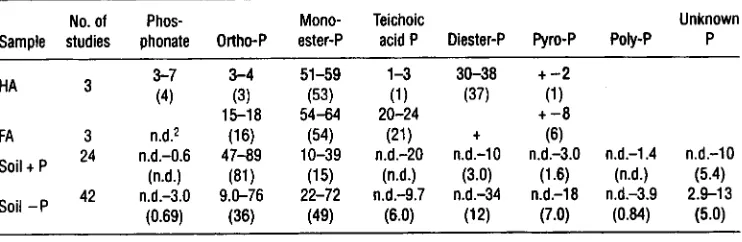
Advances in the characterization of organic P in soils have been achieved by the application of solution-state 31Pnuclear magnetic resonance (31P NMR) spec-troscopy to soil extracts (Newman and Tate, 1980). This technique enables the characterization of functional classes of P in alkaline extracts with NaOH (Table 2.3).
In general, these studies have shown that, as well as POI-, monoester P is the domi-nant class of compounds in most soils. Individual studies have shown the effects of land use and manuring or fertilizer prac-tice on the relative abundance of P com-pounds. However, the data in Table 2.3 do not show a significant influence of P applications on the relative proportions of P compounds. Direct comparison between studies is often difficult because of the dif-ferences in P forms extracted by the vari-ous extraction methods employed in these studies (Cade-Menun and Preston, 1996). Solid-state 31PNMR spectroscopy has been used to investigate Ca-P and Al-P com-pounds in soils, but bonds between P and Fe cannot be observed because of the para-magnetic character of Fe (Frossard et al.,
1994; Lookman et al., 1994).
Sequential extractions have been widely used to distinguish P forms of different sol-ubilities and, thus, with different ecological significance (Hedley et al., 1982). The basic sequential extraction starts with the removal of POI- ions by an anion exchange resin (resin P). The following NaHCO 3 and NaOH extracts usually contain inorganic and organic P, which are considered as labile and moderately labile fractions, respectively (Cross and Schlesinger, 1995).
The sulphuric acid (H 3SO4) or hydrochloric
Table 2.3. Ranges (and median) percentage of phosphorus (P) compounds from total signal area as compiled from investigations by 31P NMR spectroscopy. The samples included humic acids (HA), fulvic acids (FA) and NaOH extracts of whole soils, and particle-size fractions which were either native (Soil – P) or received organic or mineral P applications (Soil + P) (Leinweber et al., 1997b).
Sample No. of studies Phos-phonate Ortho-P Mono-ester-P Teichoic
acid P Diester-P Pyro-P Poly-P
Unknown
HA 3 3-7
(4) 3-4 (3) 51-59 (53) 1-3 (1) 30-38 (37)
+ –2 (1) 15-18 54-64 20-24 + –8
FA 3 n.d .2 (16) (54) (21) (6)
Soil + P 24 n.d.-0.6 (n.d.) 47-89 (81) 10-39 (15) n.d.-20 (n.d.) n.d.-10 (3.0) n.d.-3.0 (1.6) n.d.-1.4 (n.d.) n.d.-10 (5.4)
Soil –P 42 n.d.-3.0 (0.69) 9.0-76 (36) 22-72 (49) n.d.-9.7 (6.0) n.d.-34 (12) n.d.-18 (7.0) n.d.-3.9 (0.84) 2.9-13 (5.0)
34 P. Leinweber et al.
acid (HO) soluble P is assumed to be linked with Ca. After this strong acid extraction, a residual P fraction remains comprising sta-ble inorganic and organic P. Examples of the differences in P forms among soil types are shown in Table 2.4. Heavily manured soils in an area of intensive livestock pro-duction in north-west Germany contained P contents an order of magnitude larger and also a disproportional enrichment in PO4-ions and labile P fractPO4-ions compared with the other soils.
The distribution of P compounds between soil particle size fractions is an important property with regard to P transfer in runoff, because of the different suscepti-bilities of physical fractions to detachment, erosion and transport. The P content of soil particles often increases with decreasing particle size. For example, the contents of • (resin-P), NaHCO3-P, NaOH-P, H,SO4 -P and residual--P decreased from the clay fraction to the sand fraction of two loam soils under originally native prairie (Tiessen et al., 1983). Despite the decreas-ing P contents with increasdecreas-ing particle size, large proportions of soil P are associated with the sand fraction. For example, in sandy soils receiving large amounts of manure, the proportions of NaHCO3-P and residual-P were larger in sand than in clay
(86-87% sand) (Fig. 2.1). This P probably comes from manure-derived specific light particles, which enter the sand fraction. Under the geographical conditions of north-west Germany, this P may be especially sus-ceptible to losses by wind erosion.
Soil phosphorus dynamics and transformations
According to turnover rates, slow and rapid cycling organic and inorganic P pools can be distinguished (Fig. 2.2). Inorganic and organic P compounds can be assigned to these pools on the basis of sequential soil P fractionation methods. For instance, resin-P, NaHCO3-P and microbial biomass P represent most of the rapid cycling P. These fractions, along with organic NaOH-P (which is interpreted as
moderately labile organic P), can be involved in biotic processes controlling P release to the soil solution (Frossard et al., 2000).
Determination of the concentrations and forms of P in soil solution is important for the investigation of P uptake by plants and of leaching losses. This requires soil solu-tion collecsolu-tion by zero-tension lysimeters or suction cups. However, the exchange of P ions between the solid phase and soil solution is time-dependent, so isotopic exchange methods can be used to quantify P transfer and determine the effects of soil type, P concentration in solution and time on the kinetics of P transfer. Morel et al.
(2000) showed that more reliable predic-tions of the crop response to soil P were obtained with isotopic exchange methods compared with traditional soil extraction methods and concluded that the isotopic exchange approach could be helpful in esti-mating P loss to water. Applications of P to soils in fertilizer or manures initially reach the rapidly cycling fractions. The P that is not taken up into the biomass or removed
Table 2.4. Typical contents of total phosphorus (P) (g kg- 1 ) and proportions of sequentially extracted forms of phosphorus in topsoils of different origin (% of total P).
Material Total P Resin P NaNCO3-P NaOH-P H2SO4-P
Mollisola 0.3-0.7 1-9 1-17 1-12 10-42
Vertisol a 0.3-0.7 1-6 1-2 3-7 22-46
Spodosolb 0.4 3 15 43 3
Histosol 0.5-0.9 1-9 3-8 11-28 0-2
Gleysol 0.5-0.8 2-9 4-8 4-25 16-24
Manured soils' 0.5-8.1 2-17 4-33 2-62 1-41
100 90 80 70 60 50 40
30
20
10 0
clay
m-silt c-silt Particle size fractions
Residual-P H2SO4-P NaOH-P NaHCO3-P DOWEX-P 0
0
Co
a)
0
0 0
.o
0 0
sand f-silt
Rapid cycling organic
inorganic organicSlow
Slow organic
Fertilizer Plants manureAnimal Primary P
minerals
Chemically and physically protected organic P Microbial
P Secondary
P minerals
V
Labile and moderately labile
inorganic P
Labile and moderately labile
organic P
A
•
OccludedP
Fig. 2.2. The soil phosphorus cycle: its components and measurable fractions (adapted from Stewart and Sharpley, 1987).
Fig. 2.1. Distribution of sequentially extracted P fractions in organic-mineral particle size fractions averaged for two soils.
from the soil can be sorbed, occluded or incorporated into soil organic matter. These reactions reduce the rate of P turnover and explain why soils can be a sink for P. This is especially valid for soils with large amounts of pedogenic oxides or Ca, which tend to adsorb PO strongly or form
36 P. Leinweber et al.
Phosphorus uptake by crops
Soil P is taken up by crops as dihydrogen phosphate ions (H 2PO4) under acid condi-tions and as hydrogen phosphate ions (HPQr) under neutral and alkaline condi-tions. To maintain equilibration, crop roots release anions such as OH- or HCO3. In plant physiology, P is essential to the pro-duction of a variety of organic P com-pounds that are building blocks or part of coenzymes in many synthesis processes. Adenosine diphosphate (ADP) and adeno-sine triphosphate (ATP) take part in energy metabolism, which is involved in all syn-theses in plant cells. The hydrogen-trans-ferring coenzymes, such as nicotinamide adenine dinucleotide (NAL)) and nicoti-namide adenine dinucleotide phosphate (NADP), are involved in oxidation and reduction reactions. Phosphates are also building blocks of nucleic acids and phos-pholipids; the latter are important cell wall components. In addition to these and other organic P containing compounds, inorganic P occurs in larger quantities in the vegeta-tive organs of crops. Total P contents of plant materials range from 2 to 8 g kg- 1 . They tend to be smaller in root crops than in grain crops and smaller in the vegetative than in the generative organs. Phosphorus uptake from the soil (kg ha- 1 year- 1) at mean crop yields follows the order of cere-als and potatoes (25) < forage maize (30) < sugarbeets (35) < oilseed rape (38).
Agricultural crops have different strate-gies to acquire soil Pgr. Some grasses and cereals increase their root systems under P-deficient conditions. Other plants, such as maize, oilseed rape and some legumes and inter-cultures (e.g. buckwheat), exude protons, organic acids and phosphatase enzymes into the rhizosphere to enhance P availability. In this way, inter-cultures can mobilize P from insoluble fractions and pro-vide this in plant-available form for use by the main crops (Eichler and KOppen, 1998). Deficiency of P results in a general reduction of most metabolic processes and, therefore,
in reduced crop yields. The large
concentra-tions of Al and Fe oxides in the soil present problems for the supply. of P to plants,
because they strongly adsorb PO4- and pre-vent availability for biological uptake. Traditionally, P fertilizer recommendations have aimed to maintain large amounts of P in the soil, but the current concerns over P loss to water from over-fertilized soils has challenged this approach. However, the experimental bases for target levels of soil P ensuring the economical yield optimum and protecting aquatic ecosystems from inevitable P inputs are not well established.
Imbalances of agricultural phosphorus
Imbalances in agricultural P use can result from the use of P in livestock feeding, P excretion and manure disposal, mineral P fertilizers and P turnover in soils, which together provide total and available P above the P requirements of crops. The magnitude of these imbalances can be cal-culated by various approaches and at dif-ferent scales. These scales can be the field, farm or catchment scale, or for political units they can be districts or nations.
Table 2.5. Mean values of phosphorus farm balances in European countries (Isermann, 1999 and references cited therein).
Austria
(1992)
Germany
(1995)
Switzerland
(1995)
UK (1993)
Input (kg ha - ' year' 11 21 20 13
Mineral fertilizer 8 13 10 9
Imported feeds 2 7 5 3
Deposition <1 n.d. <1 <1
Sludge, compost <1 1 4 <1
Output (kg ha- l year- 1 ) 5 9 6 3
Plant products 3 6 2 <1
Animal products 2 3 4 >2
Surplus 6 12 14 10
Efficiency of utilization (%) 45 43 30 23
n.d. = Not determined.
stocking density in Europe, the mean P surplus originating from manure is 37 kg ha-1 year-1 (von Hammel, 1994).
National P balances have revealed sur-plus values ranging from 0.8 (Lithuania) to 6.4 (Poland) and c. 7 kg ha-1 year (Sweden and Denmark) (data for 1995 com-piled by Marcinkowski and Sapek, 1998). A national P balance for Germany showed that the contribution of animal excrement is on average c. 17 kg P ha-1 agricultural area year-1. This confirms that livestock feeding is an important source of P inputs to soils (Fleischer, 1997).
Impact of excess fertilizer application on the amounts and forms of soil phosphorus
The application of excess mineral fertilizer, manures and sewage sludges to soil increases the total P concentration. In a European Community research project, over-fertilized soils had total P concentra-tions of 890-1168 mg kg-1 (Germany), 333-1400 mg kg-1 (Spain), 1331-1920 mg kg-1 (UK) and 709-1067 mg kg-1 (Italy) (Barberis et al., 1996). In a region with intensive livestock feeding in north-west Germany, total P contents ranging from 565 to 8173 mg kg-1 with mean values of 1335-2693 mg P kg-1 clearly indicated large P enrichments (Leinweber, 1996).
Three farms with alternative agricultural management systems in that area had smaller total P concentrations (1580-1690 mg kg-1) than farms with known high live-stock densities (mean 3113 mg P kg-1).
tii P. Leinweber et al.
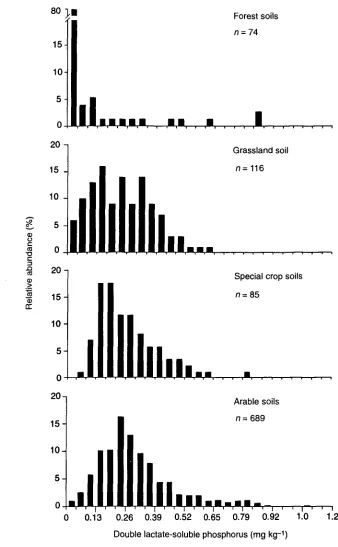
Forest soils
n=74
20
-Grassland soil
n= 116
111,1111111„)...
15
10
-
5-0
Special crop soils
n=85
Arable soils
n=689
20
15
10
5
0
20
15
10
5
0
0 0.13 0.26 0.39 0.52 0.65 0.79 0.92 1.0 1.2
Double lactate-soluble phosphorus (mg kg-1)
In The Netherlands, soil P accumula-tions were recognized in the early 1980s. Studies of the regional P distribution were based on PO:- saturation characteristics (Breeuwsma
et al.,
1995). According to these authors, the degree of PO: - satura-tion is defined as:DPS (%) = P. / PSC x 100
where DPS = degree of phosphate satura-tion,Pox = sorbed P (extracted by oxalate) (mol kg- 1 ) and PSC = PO:- sorption capac-ity, often determined by 0.5 x (Al. + Fe.) (mol kg- 1).
These detailed studies revealed that
70% of farmland soils were P saturated, with values of 88% for maize and 69% for grassland. More than 21% of farmland was strongly (DPS > 50%) and 6% very strongly (DPS > 75%) P saturated. In north-west Germany, Leinweber
et al.
(1997a) deter-mined DPS values from 14 to 145% in soils from a catchment with relatively low stock-ing density. In contrast, in an area with high stocking densities the DPS ranged from 13 to 179%, with most frequent val-ues in the range of 70 to 90%. The differ-ences between the two areas clearly originated from the contents of P„ and not differences in the PSC, hence they could be assigned to the P input with manure rather than to differences in the P sorption.Besides these effects on total P contents, soil P test values and DPS, excessive fertil-izer application and waste disposal also alter the amounts and proportions of soil P fractions, as shown by sequential extrac-tion and spectroscopic investigaextrac-tions. Mineral fertilizer application usually increases the proportions of inorganic P in labile and moderately labile fractions. Repeated manure applications can increase the amounts and percentages of Ca-P phases and residual P.
Combinations of inorganic and manure P increase the P proportions over a wider range of differently soluble fractions (Zhang and MacKenzie, 1997). Extensive soil man-agement can lead to reduced proportions of resin-P, NaHCO3-P and NaOH-P, whereas intensively used arable soils with organic and mineral fertilization contain high levels
of resin-P, H2SO4P and residual-P (Leinweber
et al.,
1999). Generally, there are various interactions between amounts and forms of P application, fertilization with other nutrients, soil type and proper-ties, crop rotation and the contents and the proportions of inorganic and organic P forms. Sequential fractionation of P forms in 69 soils from the densely stocked area in north-west Germany yielded results in the order: resin-P (2-17%) < NaHCO3-P (4-33%) < NaOH-P (2-62%). Soil manage-ment influenced the percentages of the dif-ferent P fractions. Grouping of the samples according to different soil use gave the order, arable > horticultural crops and grassland for the mean concentrations of resin-P and NaHCO 3-P. This was in accor-dance with the large proportions of labile P in manure and the particular use of arable soils for its disposal. The large proportions of resin-P and NaHCO3-P show that, as well as greater total P concentration, the soils of this densely stocked area have more soluble P (Leinweber, 1996). In particular, liquid pig manure and poultry litter contain large amounts of P, of which large proportionsoccur as PO:- (Leinweber, 1996).
Therefore, it can be expected that soils receiving large amounts of these materials will be enriched in these labile P com-pounds. This is a serious problem in regions with high livestock densities, such as north-west Germany (Vechta, Lower Saxony), where it has been calculated that the P contents in some soils could only be explained by annual manure-P inputs of up to 180 kg P ha- 1 year- 1 over the last 40 years (Leinweber
et al.,
1993). Such high P inputs may increase the potential for losses of P to water.Environmental Consequences of Excessive Phosphorus Enrichment in
Soils
Introduction and general problem
40 P. Leinweber et al.
soils. The perception that fertilizer P is strongly held in soil and prevented from leaching has meant that P fertilizer recom-mendations have often been above the requirements of plants and have not adequately considered the P inputs from manures. As a consequence, P contents have gradually increased in many European soils, which can accelerate the transfer of P to watercourses in runoff. In the following section we describe the effects of oversup-ply on the contents and forms of soil P. The movement of P from soil to surface waters is described, including the mechanisms of P release and pathways of P transfer from soil to water: this is not only affected by the soil P contents and forms, but also by land use. Finally, an assessment of the environ-mental consequences of excessive P enrich-ment of soils requires basic information on the forms of P in soil solution and runoff and on critical concentrations and loads in drainage waters.
Forms of phosphorus in soil solution and runoff waters
Phosphorus forms in water are convention-ally determined on the basis of operational procedures, which are used throughout the world. These procedures involve: (i) chem-ical fractionation, based on the reaction of inorganic P with molybdate followed by subsequent reduction and spectrophoto-metric detection; and (ii) physical fraction-ation, based on filtration through a sub-micron filter. The spectrophotometric procedures are based on an original method described by Murphy and Riley (1962) for the determination of dissolved POI". The P determined by this procedure is termed reactive P (RP) rather than inor-ganic P (Haygarth and Sharpley, 2000) because the procedure can overestimate true POI - . The sample preparation and reaction conditions can result in other forms of P, such as labile organic P species, being hydrolysed in the strongly acid con-ditions required for colour development (Tarapchak, 1993), while interference from silica (Ciavatta et al., 1990) and sample
tur-bidity has also been noted. Recent studies using alternative methods of detecting POI-, such as ion chromatography, have indicated the extent of this problem in soil runoff and lake waters (Baldwin, 1998;
Halliwell et al., 2000).
Total P can be determined in the sam-ple using an appropriate digestion proce-dure (recently reviewed by Rowland and Haygarth, 1997), which allows the UP fraction to be determined by difference. This fraction generally represents organic P compounds, including monoester P (e.g. inositol phosphates, sugar phosphates or mononucleotides), diester P forms (e.g. nucleic acids and phospholipids), phos-phonates (e.g. aminoethylphosphonic acid) and condensed organic P forms (e.g. ATP), although only a few of these have been directly identified in soil waters (Espinosa et a]., 1999). However, UP
(< 0.45) cannot strictly be termed organic P, because inorganic condensed forms that are not Mo-reactive, such as pyrophos-phate, are included in the UP fraction (Ron Vaz et al., 1993). Alternative meth-ods for the determination of the true 'organic' P fraction using ultraviolet light induced persulphate oxidation are avail-able, but are not widely employed (Ron Vaz et al., 1992; Benson et al., 1996). However, some studies have indicated that condensed inorganic P can represent a large part of the soil solution P (Ron Vaz
et al., 1993).
Samples can be further fractionated by filtration through a sub-micron filter, most commonly of pore size 0.45 gm, although
0.211m filters are used in some countries where a sterile sample is required. Filtration is often used to define 'dis-solved' (< 0.45 pm) and 'particulate'
(> 0.45 pun) P fractions, but this is incor-rect, because soil waters have been shown to contain a continuum of particles in the
< 0.4511m size range (Haygarth et al.,
1997; Sinai et al., 1998). Particles of size
< 0.45 gm are often referred to as col-loidal, although this term strictly defines particles ranging in size from
1
nm to2
Therefore, four fractions are directly determined on the basis of Mo reaction with or without digestion and on filtered and unfiltered samples (TP, TP (< 0.45), TRP and RP (< 0.45)). From these, five additional fractions can be determined by difference (Fig. 2.4).
Identification of the various P forms is complicated by changes within the solution after release from the soil (Sharpley
et al.,
1981). For example, rapid sorption or desorp-tion of orthophosphate between the solid soil, solution particles and solution can occur, in addition to the hydrolysis of organic forms by enzymes and immobilization by biomass uptake. These changes can occur rapidly, as noted by Haygarth
et al.
(1995), who discov-ered that RP (< 0.45) concentrations in soil leachate were substantially reduced within 8hours of sampling. Clearly, it is strictly wrong to describe RP as 'inorganic', UP as 'organic', filtered P as 'dissolved' and unfilterable P as 'particulate'. These ambiguities mean that is only correct to use strict operational defini-tions for the fracdefini-tions determined.
Movement of phosphorus from soils to watercourses
The transfer of P from agricultural soils to watercourses is now regarded as a serious problem in many areas of the world, high-lighted by recent major conferences on the subject (Tumaey
et al.,
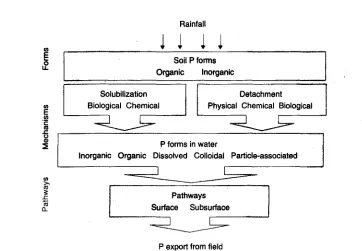
1997; Foy and Dils,1998). Phosphorus transfer is a complex phenomenon, but can be defined as a func-tion of the forms of P, the mechanisms of their release from soil to water and the hydrological pathways by which the mobi-lized P moves from the land (Haygarth and Jarvis, 1999). The following sections present brief reviews of these three aspects of P transfer from the soil shown conceptually in Fig. 2.5. Each aspect is important for a comprehensive understanding of P transfer.
Mechanisms of phosphorus release from soil
to
waterThe critical first step in the transfer process is release from the soil solid phase to soil
Total
Total phosphorus
(TP)
Total reactive phosphorus
(TRP)
Total unreactive phosphorus
(TUP)
Size fractionation
< 0.45 gm
Total phosphorus
< 0.45 gm (TP < 0.45)
Reactive phosphorus
< 0.45 gm
(RP < 0.45)
Unreactive phosphorus
< 0.45 gm (UP< 0.45)
> 0.45 gm
Total phosphorus
> 0.45 gm (TP
r > 0.45)
Reactive phosphorus
> 0.45 gm (RP > 0.45)
Unreactive phosphorus
> 0.45 gm __(UP > 0.45)
42 P. Leinweber et al.
Rainfall
a
_C a
a-Soil P forms
Organic Inorganic
Solubilization Biological Chemical
Detachment
Physical Chemical Biological
P forms in water
Inorganic Organic Dissolved Colloidal Particle-associated
Pathways
Surface Subsurface
P export from field
Fig. 2.5. A conceptual illustration of the transfer process (adapted from Haygarth and Jarvis, 1999).
water. This occurs through various mecha-nisms of P release. These can be classified into solubilization and detachment mecha-nisms of solid colloids and particles.
The processes controlling the solubiliza-tion of soil inorganic P have received con-siderable attention, mainly in terms of the cycling and plant availability of inorganic P (Barrow, 1978; Frossard et al., 1995; Barberis et al., 1996), and a limited amount of information also exists on organic P sorp-tion by chemical mechanisms (Anderson et
al., 1974; Frossard et al., 1989). However,
relatively little attention has been paid to the implications of these processes for P transfer (Haygarth and Jarvis, 1999). Solubilization of inorganic P results primar-ily from desorption of PO4- from solid sur-faces. Similar processes apply to sorbed organic P. Release of P0,1- to solution is largely controlled by the amount of readily desorbable P in the soil. Desorption of inor-ganic P from soil to solution appears to involve a readily exchangeable pool of inor-ganic P, which can move rapidly between the solid—liquid phases, at timescales of sec-onds to minutes (Cole et al., 1977; Lopez-Hernandez et al., 1998). The steady-state
Biological mechanisms can exert strong controls on the solubilization of P, but rep-resent the most under-investigated aspect of P transfer. Most studies have centred on the role of the soil microbiology in soil P cycling and the availability of P to plants, although even this information has been fairly scarce until relatively recently. This is highlighted by the fact that reliable tech-niques for measuring P in the microbial biomass were only developed as late as the 1980s (Brookes et al., 1982; Hedley and Stewart, 1982). However, biological mecha-nisms appear to be critically important in determining soil solution P concentrations (Cole et al., 1977; Lee et al., 1990; Seeling and Zasocki, 1993; Turner and Haygarth, 2002) and, therefore, have the potential to exert a considerable influence on P solubi-lization. Indeed, recent studies of leaching indicate that seasonal patterns of microbial release in the soil translate into P concen-trations in leachate water at depth (Turner and Haygarth, 2000).
Growing plants and microorganisms immobilize inorganic P from the soil solu-tion in their biomass. The immobilized P is released on cell death and decay, mostly as organic P, particularly through lysis of microbial biomass cells. Therefore, these biological mechanisms transform inorganic forms into organic P. These processes main-tain a low soil solution inorganic P concen-tration, with a relatively large organic P concentration (Lee et al., 1990; Seeling and Zasocki, 1993). The cycle is completed by phosphatase enzymes, released into the soil from plants and microorganisms, which catalyse the release of inorganic forms from organic compounds (Spier and Ross, 1978; Turner and Haygarth, 2002). Phosphatase enzymes appear to have a fundamental, but poorly understood, role in the P transfer process, by regulating the availability of P to the microbial biomass and the forms of P available for transfer in runoff. In addition to microbial controls, macrofauna such as earthworms play a major role through the mineralization and translocation of P in the soil profile (Sharpley et al., 1979), while plants release substantial amounts of water-soluble P after defoliation (Bromfield and Jones, 1972).
Soil detachment and transport processes are well described in standard texts (e.g. Hudson, 1995; Morgan, 1995). Detachment of P primarily involves the erosion of soil particles by the hydraulic action of flowing water or by raindrop impact. However, chemical mechanisms, such as changing ionic strength or pH, can also result in the detachment of particle-associated P forms sorbed to the soil. In addition, the release of some biological P may be classed as detachment, such as the cell fragments released by cell lysis.
Erosion mechanisms have been rela-tively well investigated, partly because of the traditional perception of P transfer being dominated by P export in overland flow (see Sharpley and Smith, 1990, for review). Erosion is frequently associated with P transfer by overland flow, especially from arable land, where losses of particu-late P can be extremely high and constitute most of that transferred (e.g. Burwell et al.,
1977; Sharpley and Syers, 1979; Haith and Shoemaker, 1987). This is often associated with the preferential transport of fine clay-sized materials, which are relatively en-riched in P because of their high P sorption capacities (Sharpley, 1985; Kretzschmar
et
al., 1999). Erosion can also result from rapid subsurface drainage, with particles eroded from the edges of wormholes, cracks and underground fissures. This can contribute to high concentrations of partic-ulate P in subsurface drainage through macropores (Dils and Heathwaite, 1996) and in tile drainage (Turtola and Jaakkola, 1995; Grant et al., 1996; Ulen, 1999). Fine colloidal sized (1 nm-1 gm) particles may be particularly efficient at transporting P through subsurface pathways, because they have high capacities to sorb P but are not easily stabilized in the soil profile (Kretzschmar et al., 1999). Therefore, although physical release of P has traditionally been associated with surface pathways, there is the potential for parti-cle-associated P forms to make a significant contribution to P transfer through sub-surface pathways.44 P. Leinweber et al.
release of particle-associated P in terms of clay and organic matter. For example, CaC1 2 solution suppresses the release of these par-ticles to solution (Wild and Oke, 1966), while high Na* and low ionic strength can result in the release of particulate P through dispersion of aggregates (Kaplan et al., 1996). These processes have been suggested as par-ticularly important in P movement through soils (Chardon et al., 1997).
Surface applied P in animal manure or mineral fertilizer can be directly lost from the field without ever becoming part of the soil P. This process cannot be classed by a mechanism of release, because the P never actually becomes part of the soil matrix. This type of P loss has recently been termed `incidental' (Haygarth and Jarvis, 1999) and can be especially important in grassland systems where surface applied manure is used, especially when `best management practices' are not employed. Incidental losses may account for substan-tial losses of P from the land (Harris et al.,
1995), but little information currently exists on this potentially important aspect of P transfer.
Pathways of phosphorus transfer from soil to water
The driving force behind P transfer from the land is the hydrology, because water provides the energy and the carrier for P movement (Haygarth and Jarvis, 1999). The route taken by water as it carries P off the land describes the pathway of P transfer. Pathways can be broadly separated into surface (overland flow) and subsurface pathways and the pathways taken are of critical importance in determining the extent of P loss from agricultural land. Comprehensive details and definitions of the pathways within these broad separa-tions can be found in Ryden et al. (1973) and Haygarth and Sharpley (2000).
The traditional perception of P being strongly fixed in the subsoil has meant that research into transfer traditionally has focused on surface pathways (Baker et al.,
1975; Burwell et al., 1977; Sharpley and Syers, 1979). Detachment mechanisms and
loss as particulates are considered to domi-nate transfer in overland flow, but all forms and release mechanisms can contribute to loss via overland flow. Overland flow is often associated with catastrophic events, which are considered to be the most severe in terms of loss, although there is evidence that lower frequency events that occur for a much greater time throughout the drainage period are equally important in P transfer (Fraser et al., 1999). This is because over-land flow preferentially erodes and trans-ports clay-sized material (Sharpley, 1985). As shown in Fig. 2.1, total P and des-orbable P0,1- are enriched in clay frac-tions. Using 32P studies, overland flow has been found to interact with only the top few mm of soil, termed the effective depth of interaction (Ahuja et al., 1981). This coincides with the depth of soil that often contains the greatest amount of P and can result in especially high concentrations in overland flow.
Subsurface pathways include lateral flow through the soil, vertical drainage, preferential flow through macropores and artificial drainage channels. Until recently, subsurface P losses were consid-ered to be negligible, because of the propensity for P to be retained at depth in the soil profile (Baker et al., 1975; Burwell
et al., 1977; Sharpley and Syers, 1979). This was exacerbated by the fact that mea-sured losses of P in subsurface flows were small compared with the total amount of P in the soil (Sample et al., 1980). However, the change from an agronomic to an environmental perspective on soil P has refocused attention on subsurface P transfer, because small concentrations of P can cause significant problems for water quality (Tunney et al., 1997; Turner and Haygarth, 2000). This phenomenon is not restricted to waterlogged soils (Khalid et
Studies using lysimeters have revealed that P concentrations in leachate water from a range of soil types occur at levels that could present problems for water qual-ity. For example, Leinweber et al. (1999) and Turner and Haygarth (2000) measured TP concentrations routinely in excess of 100 gg 1- 1 in leachate from a range of con-trasting grassland soil types and manage-ment conditions. Organic P constitutes a large proportion of the total P transported in leachate (Magid and Nielsen, 1992; Espinosa et al., 1999; Turner and Haygarth, 2000), where its mobility in the soil com-pared with inorganic P forms makes it an important mechanism by which P may escape from the soil. Inorganic P is readily fixed in the soil and prevented from leach-ing by precipitation with Ca, Fe and Al, or sorption to clays and other soil particles (Frossard et al., 1995). However, some organic P is not strongly sorbed and can move easily through the soil to surface waters (Rolston et al., 1975; Frossard et al.,
1989; Chardon et al., 1997), where it can contribute to algal growth after the release of inorganic P by phosphatase enzymes (Whitton et al., 1991).
Preferential flow pathways may be important in subsurface P transfer. The high concentrations of > 0.45 gm P forms in leachate water indicates the importance of preferential flow even in sandy-textured soils (Turner and Haygarth, 2000). The potential for P transport through macro-pores was demonstrated by Simard et al.
(2000), while Dils and Heathwaite (1996) detected P concentrations in macropore flow through agricultural grassland soils of > 1 mg 1- 1 . The large amounts of TP (> 0.45) present in subsurface drainage water indicate that erosion mechanisms within macropores may contribute to P transfer. The importance of TP (> 0.45) transport confirms that process terms such as leaching (which is synonymous with all subsurface transport, but actually means the release and movement of exclusively dissolved P) can be very misleading (Haygarth and Sharpley, 2000).
Colloidal P can facilitate export through soil, through protection by sorption in the
soil profile, and is a large component of P in overland flow (Matthews et al., 1998) and in river waters (Haygarth et al., 1997). Colloidal P may be an especially important component of P transfer through preferen-tial flow pathways, because the low ionic strength water that results from the mini-mal contact between rainfall and soil results in the mobilization of colloids and associated P (Chardon et al., 1997).
Subsurface export from artificially drained land can be responsible for consid-erable amounts of P transfer (Turtola and Jaakkola, 1995; Grant et al., 1996; Haygarth
et al., 1998; Ulen, 1999), despite the fact that artificially drained soils are mainly loams and clays that are low in P. Much of the P can occur in dissolved forms, although large amounts also occur as par-ticulates, probably by detachment from the walls of drainage channels. High P concen-trations in artificial drainage water are probably a result of the rapid movement of water to depth, thereby bypassing the soil matrix and minimizing removal from solu-tion by sorpsolu-tion. However, artificial drainage has the overall effect of reducing P transfer from the land, by as much as 30% compared with undrained plots (Haygarth et al., 1998).
Effects of land use on phosphorus losses
46 P. Leinweber et al.
in large amounts of P available for loss through leaching (Heckrath et al., 1995). However, higher rates of mineral fertilizer applications do not necessarily result in larger P losses. Experience from long-term lysimeter studies showed that P concentra-tions in leachates and leaching losses depend on soil texture, cropping, mineral fertilizer applications and intensity of soil management. Phosphorus losses were larger in sands than in loamy sands and were greater in arable soils than in grass-land soils (Meissner et al., 1995). In lysimeters of a loamy sand under a winter barley–oats rotation, the mean leaching losses were largest (657 g P ha- 1 year'") with the smallest fertilizer rate (12.5 kg P ha"" year-') and decreased by more than 100 g P ha'' year"' if the fertilizer rates used were up to three times larger. Interestingly, intensively used arable soils with organic and mineral P fertilizer inputs had the smallest leaching losses (Leinweber et al., 1999).
Even if arable land is found on light-tex-tured soils on relatively flat land, it can still be susceptible to overland flow and erosion through soil 'capping' (Fraser et al.,
1999). Sandy soils under heavy manure applications can also result in high concen-trations of P in leachate water (Breeuwsma and Silva, 1992; Chardon et al., 1997; Meissner et al., 1997).
Grasslands appear to transfer a smaller proportion of soluble inorganic P than arable land, especially on soils with low extractable P contents. However, this does not account for organic and particulate P exports, which can be substantial from grasslands. For example, exports of P of between 2 and 3 kg ha'' year-' have been recorded from 1 ha grassland lysimeters in south-west England (Haygarth and Jarvis, 1997; Haygarth et al., 1998). Because grass-lands are often located on heavy, poorly draining soils on steeply sloping ground, they can lose large amounts of > 0.45 um P by detachment, erosion and overland flow; in one extreme storm event, in excess of 0.5 kg P ha'' was lost by this pathway (Haygarth and Jarvis, 1997). Large P con-centrations have also been observed in
leachates from grassland established in sandy soils, although mean annual concen-trations did not reflect the rate of mineral P fertilizer applications (Leinweber et al.,
1999). Grasslands are also susceptible to incidental losses of P from ill-timed manure applications; for example, Harris et al. (1995) measured RP (< 0.45) concentra-tions of 267 jis 1' 1 from plots that had received slurry applications just prior to heavy rainfall, compared with 30 jig from control plots.
Compaction of soil by farm machinery and poaching by livestock can further pro-mote the occurrence of overland flow. The high P concentrations in overland flow from grasslands can be exacerbated by an intense surface accumulation (Haygarth et al., 1998), because of the permanent (untilled) nature of the soil and high inputs from fertilizer, slurry applications and exc-retal returns from grazing animals. In one extreme case, concentrations of RP (< 0.45) of > 7 mg have been reported in over-land flow from high input pasture plots in south-eastern Australia (Nash and Murdoch, 1997).
Critical phosphorus concentrations and loads
The pollution of watercourses with P is a serious problem in many parts of the devel-oped world. In unpolluted freshwaters, TP concentrations are typically below 25 jtg P 1- 1 . In water management, it is generally assumed that concentrations above 50 lig P 1- 1 are the result of anthropogenic influ-ences. In Germany, the quality classifica-tion in Table 2.6 is applied to running
surface waters.
A survey of rivers in Europe (European Environment Agency, 1998) revealed that a large proportion of c. 1000 monitoring sta-tions observed TP concentrasta-tions exceeding 50 j.tg 1- 1 . Only c. 10% of the monitoring stations reported mean TP concentrations below 50 jig P The lowest concentrations
of P were found in the streams and rivers of the Nordic countries where 91% of the moni-toring stations reported mean concentrations below 30 jig P 1- 1 and 50% below 4 jig P 1- 1 . This pattern results from a low human popu-lation and the presence of slowly weathering bedrock poor in nutrients. Higher P concen-trations were found in a band stretching across central Europe, from southern England to Romania.
A similar pattern of P levels can also be found in lakes with low concentrations in the Nordic and Alpine regions. Lakes can be severely affected by eutrophication after P enrichments. This can be a particularly diffi-cult problem because P may accumulate in lake sediments and be released (for example, by climatic events, changes of redox-condi-tions or the action of fish) into the water col-umn, maintaining a eutrophic status.
Phosphorus levels in surface waters gen-erally declined across Europe between
1987 and 1996. This trend occurred for
annual average concentrations of both total and dissolved P, but it appears that high peak concentrations still occur even where improvements have been achieved. Such improvements originate to a great extent from a more intensive treatment of urban and industrial wastewater and some decline in fertilizer use. In recent years, great efforts have been undertaken in Europe to reduce and control aquatic P pol-lution and eutrophication in general. These activities (policies, legislation, conven-tions, etc.) were started at the national and international scale, especially within the framework of the European Union.
It is important to note that some pres-sure for action comes from international conventions to protect marine environ-ments. These include HELCOM (The Helsinki Convention to protect the Baltic Sea), OSPAR (The Paris and Oslo Conventions to protect the North Sea and Atlantic) and The Barcelona Convention to protect the Mediterranean Sea. The
HEL-COM and OSPAR conventions focused
particularly on reductions of nutrient pol-lution (N and P). However, Table 2.7 shows that this was not achieved by all countries. Great efforts are necessary to solve this problem. The proposed Water Framework Directive of the European Union is cur-rently under intensive debate within the legislative process. It will provide the basis for an overall management framework for surface (including estuarine and coastal) waters and groundwaters. This is a major
Table 2.6. Threshold values for total phosphorus (TP) in running surface waters as used in Germany (Umweltbundesamt, 1997).
Quality class Degree of pollution
Not anthropogenic polluted
II (target class) Moderately polluted
III Raised polluted
IV Highly polluted
TP-concentration ( jig 1- 1 )
50 80 150 5 300
48 P. Leinweber et al.
Table 2.7. Annual discharges of total phosphorus (106 kg year- 1 ) to the North Sea, the north-east Atlantic Ocean and to the Baltic Sea (European Environment Agency, 1998).
Country 1991 1995
North Sea, Atlantic Ocean
Belgium' 2.0 4.0/5.0
Denmark 2.3 2.0
France n.d. n.d.
Germany 11.6 11.5
Ireland 6.3 7.3
The Netherlands 17.0 34.1
Norway 3.3 3.9
Portugal 3.1 3.1
Sweden 0.2 1.3
UKa 39/40 36
Baltic Sea
Denmark 5.3 2.3
Estonia 2.8 1.3
Finland 3.4 3.6
Germany 1.2 0.6
Latvia 3.2 2.2
Lithuania 1.7 1.4
Poland 15.0 14.2
Russia 9.5 7.1
Sweden 4.0 4.7
a Low/high estimate. n.d. = Not determined.
new development for water legislation and a fundamental basis for sustainable protec-tion of water resources against polluprotec-tion.
Options for Mitigation and Conclusions
To establish successful management options for reducing P losses to water-courses, it is necessary that farmers, other stakeholders and politicians are aware of the problem and accept that improper P use in agriculture is a main reason for sur-face water pollution with P. Much evi-dence has been compiled to show that uneven distribution of livestock results in particular enrichments in total and labile P in certain regions. Hence, political and economic measures are necessary to achieve a more even distribution of ani-mal production. However, the socio-eco-nomic impacts of such measures on rural and urban communities need to be con-sidered, as emphasized by Sharpley and Tunney (2000).
Besides this international or national level, a lot can be done locally to improve agricultural P management. Phosphorus use in animal production can be reduced by improving utilization (e.g. precise recom-mendations, improved P utilization, better choice of inorganic P supplements, plant breeding, etc.; Damgaard-Poulsen, 2000), so that better farm balances can be achieved without loss in productivity (Valk
et al.,
Novel techniques such as isotopic exchange (Morel
et al.,
2000), 3113 NMR spectroscopy, or microbiological measure-ments, will improve the general understand-ing of P transformations in soil and thus potential for P solubilization. This will enable a closer matching of fertilizer appli-cations with plant requirements. In plant production, various measures can reduce the risk of losses. These include: (i) reduc-ing P availability in excessively fertilized soils by lowering inputs and either increas-ing removal in produce or increasincreas-ing the sorption capacity of soil; and (ii) modifica-tion of the cropping systems to achieve optimum utilization of soil and fertilizer P (Frossardet al.,
2000). One example for increasing the sorption capacity of soil is the application of aluminium sulphate (A13 (SO4)3 .14H20) to poultry litter (Mooreet
al.,
2000). This amendment reduces P in runoff and NH3 loss from poultry litter broadcast on to grassland. However, from an environmental perspective, all options for avoiding surplus P balances and improving utilization are preferable to 'technical solu-tions' for temporal immobilization.The identification of critical source areas and assessment of the risks of eutrophication requires a comprehensive understanding of movement from soil to water, and of the P forms and critical concentrations and loads in water bodies. A first step is to evaluate how agronomic and environmental soil tests predict P losses to water. Studies using lysimeters have revealed that DPS predicts P in leachate better than a range of agronomic tests (Leinweber
et al.,
1999). For acid sandy soils in The Netherlands, Schoumans and Groenendijk (2000) concluded from model calculations that the water-extractable P used for fertilizer recommendations was a good predictor of pollution risk. They also demon-strated that it will take several decades to reduce P contents in over-fertilized soils to levels that are acceptable from an environ-mental perspective. This calls for an immedi-ate reduction of inputs along with increasing removal by crops and stabilizing mobile frac-tions in P enriched acid sandy soils.If critical source areas within catchments are identified, the risk of P mobilization and transport to surface waters can be mini-mized. Surface application of manure can
be followed by substantial losses in over-land flow, so manure should immediately be incorporated into soil. The method of tillage is also important: mouldboard ploughing can exacerbate erosion by creat-ing pathways for water flow, while least damage occurs from direct drilling or no-tillage systems, which are now common in the grain belt of the USA. Contour plough-ing and other practices that minimize ero-sion are equally valid for minimizing P loss from arable land. For example, McDowell and McGregor (1984) found that no-till cropping reduced TP loss ninefold com-pared with conventional maize cropping practices, although this was at the expense of an eightfold increase in dissolved P loss.
Possible effects of land use on losses must be considered in conjunction with overall P management. These call for a criti-cal evaluation of possible effects on P losses in advance of large-scale land use changes. The same need applies for setting aside land and Histosol re-wetting measures. However, research in Nordic countries has shown that small-scale measures such as buffer zones, constructed wetlands and ponds may be very efficient in retaining P from agricultural runoff. For example, Uusi-Kamppà
et al.
(2000) reported that total P concentrations decreased by 27-97%(0.24-0.67 kg P ha- 1 year- 1 ), depending on the width of buffer zones. Constructed wet-lands and ponds retained 17 and 21% of their P loads, respectively. However, the retention of RP (< 0.45) was inconsistent. Therefore, more data are needed on the availability of P, influences of soil types, and effects of cutting and harvesting.
50 P. Lei nweber et al.
Acknowledgements
Part of this work was financially supported by the European Community within the network COST 832 Quantifying the Agricultural Contribution to
Eutrophica-tion and within the PROWATER project (contract EVKI-1999-00212). Peter Lein-weber thanks his research associates K.-U. Eckhardt and A. Schlichting for their. excellent cooperation.
References
Ahuja, L.R., Sharpley, A.N., Yamamoto, M. and Menzel, R.G. (1981) The depth of rainfall–runoff interaction as determined by 32P. Water Resources Research 17,969-974.
Anderson, G., Williams, E.G. and Moir, J.O. (1974) A comparison of the sorption of inorganic orthophosphate and inositol hexaphosphate by six acid soils. Journal of Soil Science 25,51-62.
Baker, J.L., Campbell, K.L., Johnson, H.P. and Hanway, J.J. (1975) Nitrate, phosphorus, and sulfate in subsurface drainage water. Journal of Environmental Quality 4,406-412.
Baldwin, D.S. (1998) Reactive 'organic' phosphorus revisited. Water Research 32,2265-2270. Barberis, E., Marsan, F.A., Scalenghe, R., Lammers, A., Schwertmann, U., Edwards, A.C., Maguire, R.,
Wilson, M.J., Delgado, A. and Torrent, J. (1996) European soils overfertilized with phosphorus: Part 1. Basic properties. Fertilizer Research 45,199-207.
Barrow, N.J. (1978) The description of phosphate adsorption curves. Journal of Soil Science 29,447-462.
Barrow, N.J. (1984) Modelling the effects of pH on phosphate adsorption by soils. Journal of Soil Science 35,283-297.
Beck, M.A. and Elsenbeer, H. (1999) Biogeochemical cycles of soil phosphorus in southern alpine spodosols. Geoderma 91,249-260.
Benson, R.L., McKelvie, I.D., Hart, B.T., Truong, Y.B. and Hamilton, I.C. (1996) Determination of total phosphorus in waters and wastewaters by on-line UV/thermal induced digestion and flow injec-tion analysis. Analytica Chimica Acta 326,29-39.
Breeuwsma, A. and Silva, S. (1992) Phosphorus Fertilisation and Environmental Effects in The
Netherlands and the Po Region (Italy), Report No. 57, DLO, The Winard Staring Centre for
Integrated Land, Soil and Water Research (SC-DLO), Wageningen, The Netherlands.
Breeuwsma, A., Reierink, J.G.A. and Schoumans, O.F. (1995) Impact of manure on accumulation and leaching of phosphate in areas of intensive livestock farming. In: Steele, K. (ed.) Animal Waste
and the Land Water Interface. Lewis Publishers, New York, pp. 239-249.
Bromfield, S.M. and Jones, O.L. (1972) The initial leaching of hayed-off pasture plants in relation to the recycling of phosphorus. Australian Journal of Agricultural Research 23,811-824.
Brookes, P.C., Powlson, D.S. and Jenkinson, D.S. (1982) Measurement of microbial biomass phosphorus in soil. Soil Biology and Biochemistry 14,319-329.
Brookes, P.C., Powlson, D.S. and Jenkinson, D.S. (1984) Phosphorus in the soil microbial biomass.
Soil Biology and Biochemistry 16,169-175.
Burkholder, J.M., Noga, E.J., Hobbs, C.W., Glasgow, H.B. Jr and Smith, S.A. (1992) New 'phantom' dinoflagellate is the causative agent of major estuarine fish kills. Nature 358,407-410.
Burwell, R.E., Schuman, G.E., Heinemann, H.G. and Spomer, R.G. (1977) Nitrogen and phosphorus movement from agricultural watersheds. Journal of Soil and Water Conservation 32,226-230.
Cade-Menun, B.J. and Preston, C.M. (1996) A comparison of soil extraction procedures for 31 P NMR spectroscopy. Soil Science 161,770-785.
Chardon, W.J., Oenema, 0., del Castilho, P., Vriesema, R., Japenga, J. and Blaauw, D. (1997) Organic phosphorus solutions and leachates from soils treated with animal slurries. Journal of
Environmental Quality 26,372-378.
Ciavatta, C., Antisari, L.V. and Sequi, P. (1990) Interference of soluble silica in the determination of orthophosphate-phosphorus. Journal of Environmental Quality 19,761-764.
Cole, C.V., Innis, G.S., and Stewart, J.W.B. (1977) Simulation of phosphorus cycling in semi-arid grassland. Ecology 58,1-15.
Cross, A.F. and Schlesinger, W.H. (1995) A literature review and evaluation of the Hedley fractiona-tion: Applications to the biogeochemical cycle of soil phosphorus in natural ecosystems.
Damgaard-Poulsen, H. (2000) Phosphorus utilization and excretion in pig production. Journal of
Environmental Quality 29,24-27.
Dils, R.M. and Heathwaite, A.L. (1996) Phosphorus fractionation in hillslope hydrological pathways contributing to agricultural runoff. In: Anderson, M. and Brookes, S. (eds) Advances in Hillslope
Processes. John Wiley & Sons, Chichester, UK, pp. 229-252.
Eichler, B. and Klippen, D. (1998) Interculture – an opportunity to utilize phosphorus reserves in soil. In: Foy, R.H. and Dils, R. (eds) Practical and Innovative Measures for the Control of
Agricultural Phosphorus Losses to Water. Greenmount College of Agriculture and Horticulture,
Northern Ireland, pp. 70-71.
EPA (1995) Protecting Water Quality in Central Gippsland, Rep. No. 144. Environment Protection Authority, Melbourne, Australia.
Espinosa, M., Turner, B.L. and Haygarth, P.M. (1999) Pre-concentration and separation of trace phosphorus compounds in soil leachate. Journal of Environmental Quality 28,1497-1504. European Environment Agency (1998) Europe's Environment: the Second Assesment. EEA,
Copenhagen.
Fardeau, J.C. (1996) Dynamics of phosphate in soils. An isotopic outlook. Fertilizer Research 45,91-100. Fleischer, E. (1997) Nutztierhaltung und nationale Phosphorbilanz des Bereiches Landwirtschaft.
Archiv Acker- und Pflanzenbau und Bodenkunde 41,1-73.
Foy, R.H. and Dils, R. (1998) Practical and innovative measures for the control of agricultural phos-phorus losses to water. An OECD sponsored workshop, Antrim, Dept. of Agriculture for Northern Ireland.
Fraser, A.I., Harrod, T.R. and Haygarth, P.M. (1999) The effect of rainfall intensity on soil erosion and particulate phosphorus transfer from arable soils. Water Science and Technology 39,41-45. Frossard, E., Stewart, J.W.B. and St Arnaud, R.J. (1989) Distribution and mobility of phosphorus in
grassland and forest soils of Saskatchewan. Canadian Journal of Soil Science 69,401-416. Frossard, E., Tekeley, P. and Grimal, J.Y. (1994) Characterization of phosphate species in urban
sewage sludges by high-resolution solid-state "P-NMR. European Journal of Soil Science 45, 403-408.
Frossard, E., Brossard, M., Hedley, M.J. and Metherell, A. (1995) Reactions controlling the cycling of P in soils. In: Tiessen, H. (ed.) Phosphorus in the Global Environment. John Wiley & Sons, New York, pp. 107-138.
Frossard, E., Condron, L., Oberson, A., Sinaj, S. and Fardeau, J.C. (2000) Processes governing phos-phorus availability in temperate soils. Journal of Environmental Quality 29,15-23.
Grant, R., Laubel, A., Kronvang, B., Anderson, H.E., Svendsen, L.M. and Fugslang, A. (1996) Loss of dissolved and particulate phosphorus from arable catchments by subsurface drainage. Water
Research 30,2633-2642.
Haith, D.A. and Shoemaker, L.L. (1987) Generalized watershed loading functions for stream flow nutrients. Water Resources Bulletin 23,471-478.
Halliwell, D., Coventry, J. and Nash, D. (2000) Inorganic monophosphate determination in overland flow from irrigated grazing systems. International Journal of Environmental Analytical
Chemistry 76,77-78.
Harris, R.A., Heathwaite, A.L. and Haygarth, P.M. (1995) High temporal resolution sampling of P exported from grassland soil during a storm, and the impact of slurry additions. In: Johnston, A.E. (ed.) Proceedings of the International Workshop on Phosphorus Loss to Water from
Agriculture. TEAGASC, Johnstown Castle, Wexford, Ireland, pp. 25-26.
Harrison, A.F. (1987) Soil Organic Phosphorus – a Review of World Literature. CAB International, Wallingford, UK.
Haygarth, P.M. and Jarvis, S.C. (1997) Soil derived phosphorus in surface runoff from grazed grass-land lysimeters. Water Research 31,140-148.
Haygarth, P.M. and Jarvis, S.C. (1999) Transfer of phosphorus from agricultural soils. Advances in
Agronomy 66,195-249.
Haygarth, P.M. and Sharpley, A.N. (2000) Terminology for phosphorus transfer. Journal of
Environmental Quality 29,10-15.
Haygarth, P.M., Ashby, C.D. and Jarvis, S.C. (1995) Short-term changes in the molybdate reactive phosphorus of stored soil waters. Journal of Environmental Quality 24,1133-1140.