IJHR
Open Access
Abstract
Background and Objectives: Shift working has the potential to negatively influence the quality of work life among nurses. The purpose of this study was to investigate the outbreak of shift work-related disorders and the relationship between shift work and job satisfaction in order to help identify potential strategies for improv-ing the quality of life of shift-workimprov-ing nurses of Ilam University’s subsidiary hospitals.
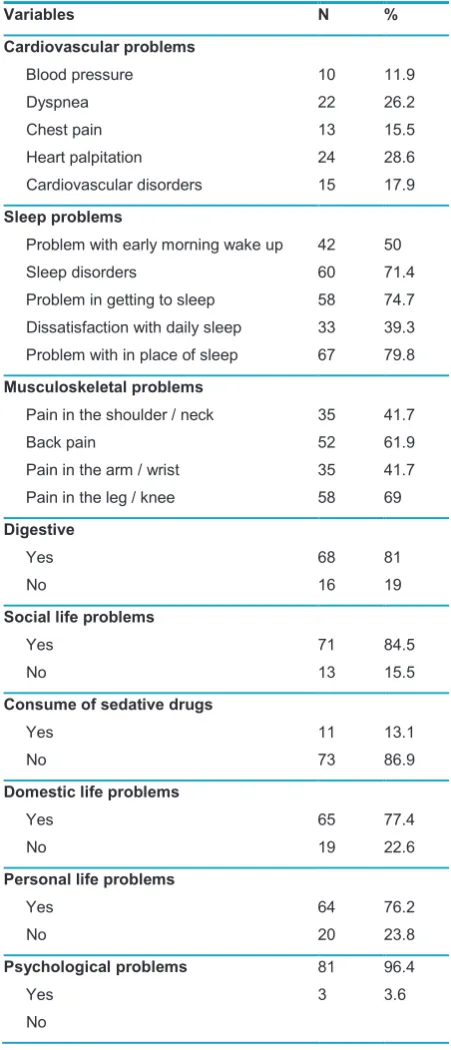
Methods: In a cross-sectional study, 84 shift-working nurses at three hospitals were randomly selected. The Survey of Shift worker (SOS) questionnaire was used as the major study tool. The nurses’ demographic and work condition data were collected using a research-made questionnaire. Chi-square test was used for inferential analysis of the data.. Findings: Psychological disorder (96.4%) was found to be the most prevalent shift work-related problem followed by social life (84.5%) and digestive problems (81%), respectively. The nurses who had chosen shift work voluntarily showed significantly higher job satisfaction as compared with those who were forced to work on shift (P < 0.05).
Conclusions: Our study recommends that shift work is assigned preliminarily to the nurses who voluntarily choose to work on shift in order to reduce the associated disorders, and increase the nurses’ job satisfaction. Keywords: Shift work, Nurse, Job satisfaction, Hospital management.
Background and Objectives
Research has shown that shift work may cause several difficulties for the healthcare professionals [1]. These in-cluded higher risk of concerns and anxiety [2], sleepless-ness, depression and sadness [3], and chronic fatigue, as well as different cardiovascular and gastrointestinal disorders [4, 5].
Job satisfaction and satisfaction with shift work are crucial for effective contribution of employees to the organizational goals [6]. In addition, studies have shown that job satisfaction can directly influence the satisfaction of employees with their personal life [7].
Nursing is one of the occupations in which a high proportion of its members are involved in shift work
with nurses working ‘‘straight shifts’’ of day, after-noon, night shifts or rotating shift patterns. While some nurses tolerate shift work well, many others en-counter serious problems due to shift working. Shift working of hospital nurses can induce tension and stress in them [8], disturb their family life [9], interrupt normal food schedules, and affect their satisfaction with job [10-12].
Some studies have indicated that shift work can lead to health problems such as metabolic syndromes [13, 14]. In addition, night shift work could have signif-icant effects on the sleeping patterns in the long run, leading to higher cardiac sympathetic regulation [15]. Shift work is recognized as an occupational stressor that affects the consent of job satisfaction among the hospital nurses [16-21]. Among the different pat-terns of shift work, in particular, the night shift work has been shown to bring about more serious health risk. A survey of prospective, longitudinal data from
The Relationship between Shift Work
and Job Satisfaction among Nurses:
a Cross-sectional Study
Saber Moradi
1,Zahra Farahnaki
2, Arash Akbarzadeh
3, Faramarz Gharagozlou
4, Abdolhessein
Pournajaf
2, Ali Mohammad Abbasi
2, Leila Omidi
1, Mahsa Hami
5, Mohsen Karchani
6*1 Department of Occupational Health, School of Public Health, Tehran University of Medical Sciences, Tehran, Iran 2 Department of Occupational health, School of Public Health, Ilam University of Medical Sciences, Ilam, Iran 3 Department of Epidemiology and Biostatistics, School of Public Health, Tehran University of Medical Sciences, Tehran, Iran 4 Department of Occupational Health Engineering, School of Public Health, Kermanshah University of Medi-cal Sciences and Health Services, Kermanshah, Iran 5 Firoozkooh Branch, Islamic Azad University, Firoozkooh, Iran 6 Department of Occupational health, School of Public Health, Tehran University of Medical Sciences, International Campus (TUMS-IC),Tehran, Iran
the nurses’ health study also indicated an increase in the risk of cardiovascular diseases in the nurses who worked rotating shifts for more than 6 months when compared with the nurses who never rotated shifts or those who had worked rotating shifts for fewer years [22]. Meanwhile, another study on 463 nurses work-ing diverse shift patterns found no relationship be-tween shift work and the nurses’ self-reported physi-cal or mental health [23]. In the study of Ruggiero, the nurses working night shifts expressed more fatigue and depressed mood than the nurse’s working day shifts [24]. It has been reported that chronic fatigue in nurses not only decreases the quality of patient care, but also increases the nurses’ risk of health problems such as depression [25, 26].
Despite the wealth of studies on the health-related and occupational consequences of shift work, the physical and psychological responses to shift work among hospital nurses are not well understood, par-ticularly in the developing countries, calling for further investigation. To help narrow this gap, this study in-vestigated the prevalence of shift work disorders and its relationship with the different aspects of quality of life in the nurses serving in selected teaching hospi-tals of Ilam University of Medical Sciences.
Methods
Setting and sampleThis cross-sectional study was carried out in 2010 in Ilam Province (Western Iran). The sample included nurs-es in the selected teaching hospitals affiliated with Ilam University of Medical Sciences (Imam Khomeini Hospi-tal, Shahid Mostafa Khomeini HospiHospi-tal, and Ayatollah Taleghani Hospital).
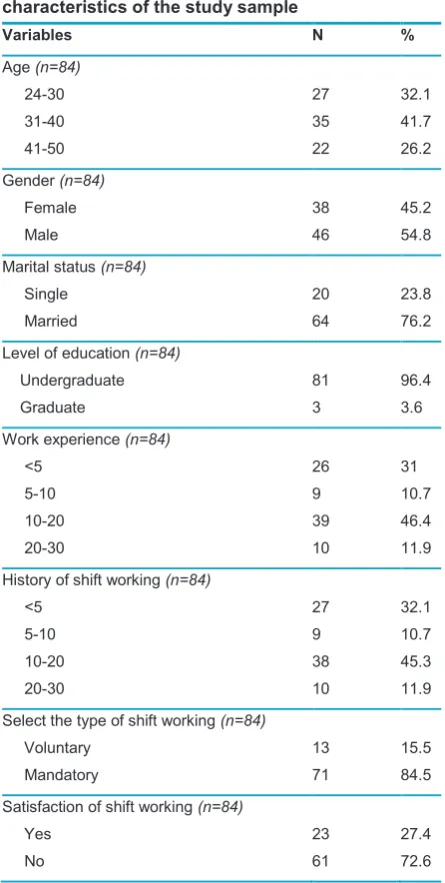
Table 1 presents the demographic and professional characteristics of the study sample. A sample size of 84 was determined based on the confidence level of 95%, test power of 80%, and absolute error of 25%. The nurses had an average age of 35.40 years, a shift working history of 11.37% years, and a work ex-perience of 11.52 years. The majority of nurses were in the 24–50 years-old age group, 45.2% were fe-male, and 76.2% were married. Overall, 96.4% of the nurses held a BS degree, and 3.6% held MS degree. All nurses had at least 1 year of work experience.
Study instruments and data collection
The Survey of Shift workers (SOS) questionnaire was used to collect data on the nurses’ job satisfaction, type of system shift work, sleep time, insomnia,
muscle-skel-etal disorders, sedative drugs, and the adverse effects of shift work on the individual social and domestic life, as well as the gastrointestinal, cardiovascular and mental health problems (27). A Personal Information Form (PIF) was developed by the researchers for collecting the par-ticipants’ demographic and professional information that may affect sleep quality and job satisfaction of the nurses working rotating shifts.
The data collection tools were administered through direct meeting with the nurses. The time and place for completing the questionnaire were determined by the nurses. The time to complete the questionnaire was unrestricted.
Ethics
Approval for conducting this study was obtained from the university’s Institutional Review Board and the hos-pitals’ Nursing Research Committees. All participants were briefed about the objectives of the study, and their informed consents were obtained. The participants were also assured of the confidentiality of their responses.
Data analysis
The collected data were summarized using descriptive statistical methods. The correlation between the variables was tested using Chi-square test. All statistical analy-ses were carried out using SPSS software (version 16) (SPSS Inc. Chicago Illinois, United States of America).
Results
Selected demographic and work-related characteristics of the participating nurses are presented in Table 1. The ages of the participants were between 24 and 50 years, and the mean age was almost 35 years. Most of the par-ticipants were married (76.2%), and almost all of them (96.4%) held a university degree. Nearly half of the par-ticipants (54.8%) were male. The work experience of the participants was between 1 and 30 years, and the mean work experience was almost 11.52 years.
prob-lems (81%), respectively.
Sleep disorders were more prevalent in the staff working at night or on shifts than those working a regular day-time schedule. While the nurses who had voluntarily chosen the shift work were satisfied with the shift work system, the majority (77.5%) of the nurses who had forcedly chosen the shift work ex-pressed their dissatisfaction with shift working. Chi-square test showed a significant correlation between voluntarily choosing of the shift work system and sat-isfaction with it (P = 0.008).
Based on the findings of the present work, 23.4% of the studied population who were satisfied with the shift work system had disorder in their personal life. The nurses who were satisfied with the shift work-ing showed significantly lower personal-life disorders compared to the dissatisfied nurses (P = 0.01). Our results hsowed that 52% of the nurses, who were satisfied with their shift work, were satisfied with the amount of time they spend with their families, as well. In this regard, Chi-square results identified significant correlation between satisfaction with shift work and the time nurses spend with their families (P = 0.003).
Among the nurses who were satisfied with the shift work system, 81.5% did not perceive any undesirable effects of shift work on their family life, which was confirmed by Chi-square test (P = 0.002).
Also among those nurses who were satisfied with working on shift, 20.3% believed that shift work has had undesirable effects on their social life, but 79.7% perceived that shift work had no undesirable effects on their social life, which was confirmed by Chi-square test too (P = 0.01).
Discussion
Our findings indicated an inverse significant relationship between satisfaction with shift work and undesirable ef-fects of shift work on the nurses’ personal, family and so-cial life. A similar result was achieved by Choobineh et al. when investigating the shift work-related problems of the operating room technicians [28].
Researches have indicated that shift work may have several negative effects on different aspects of life. Among these effects are psychological and digestive problems. Being affected by shift working is highly prevalent in the nursing staff. This prevalence may be attributed to the lack of conformity of the body’s bio-logic cycle with the shift work system schedule [29].
In contrast to several studies showing a significant role for shift work in appearance of digestive disor-ders [30, 31], such a significant relationship was not observed in our survey. This discrepancy may be due
to the environmental, organizational, and cultural differences, as well as the nature of the shift work system, working hours per week, employment sta-tus, and education level in different communities. In addition, mental/psychological disorders have been shown to be effective in the appearance of digestive problems [32].
Our results showed that nurses who have volun-tarily chosen shift work were more satisfied with their job compared with those who have been obligated to work on shift. A similar result has been achieved in the study of Bohle et al. [33].
Our study further revealed that the shift-working nurses were less satisfied with their daily sleeping. This is con-sistent with a study carried out by Ohida et al. in Japan, where only 8% of the two-shift nurses and 6% of the Table 1 Demographic and professional characteristics of the study sample
Variables N %
Age (n=84) 24-30 31-40 41-50
27 35 22
32.1 41.7 26.2 Gender (n=84)
Female Male
38 46
45.2 54.8 Marital status (n=84)
Single Married
20 64
23.8 76.2 Level of education (n=84)
Undergraduate Graduate
81 3
96.4 3.6
Work experience (n=84)
<5 5-10 10-20 20-30
26 9 39 10
31 10.7 46.4 11.9 History of shift working (n=84)
<5 5-10 10-20 20-30
27 9 38 10
32.1 10.7 45.3 11.9 Select the type of shift working (n=84)
Voluntary Mandatory
13 71
15.5 84.5 Satisfaction of shift working (n=84)
Yes No
23 61
three-shift nurses had a good sleep quality [34].
Improper daily sleeping may cause many problems for shift workers. According to the Sleep Disorders Committee of the American Academy of Otolaryngol-ogy, sleep disorder can lead to medical error incidents by the healthcare professionals [35, 36]. Gold et al. [19] and Ohida et al. [37], investigating the associa-tions between night shift work and sleep disorders among nurses, found that the nurses who worked during the nights or worked irregular shifts tended to doze off more often while driving or working com-pared with those who worked normal day shifts.
We observed an overall prevalence of 53.5% for musculoskeletal disorders during this study, which is lower than in a previous Swedish study, where 84 % of the professional nurses suffered neck, shoulder, upper back, or lower back musculoskeletal disorders [38]. This finding also contrasts with another inves-tigation conducted in the US, in which 72.5% of the nurses reported a musculoskeletal disorder of some description [39]. Furthermore, the period prevalence of shoulder disorders in our study was 41.7%, which is slightly higher than that in the study of Trinkoff et al. (35.1 %) in the US [39], similar to the survey carried out by Botha and Bridger in South Africa (41 %) [40], and lower than the studies conducted in Australia (60 %) [41] and Sweden (60 %)[42]. Differences in the study populations, educational background, and data collection methods may underlie the discrepancies in the results of various investigations.
According to the results obtained in the present work, 70.2% of the shift workers are dissatisfied with the time they spend with their family, which shows a good correlation with the results from a previous study [43].
Nurses are required to develop ever higher skill lev-els due to continuing advances in medical care and the technology associated with them. Since, occupa-tional errors or accidents have a direct and perhaps critical influence on a patient’s life and prognosis, nurses often work in a mentally stressful environment [44]. The results of this study, which is among the limited studies conducted in this field in Iran, can be useful for policy makers and managers to develop effective interventions, aiming to improve the shift-working programs and the quality of work life of staff in various health care professions.
Study Limitations
The results obtained in this study are related to a limited survey in a few hospitals of Ilam Province. Therefore, al-though most of our results are consistent with previous
studies, caution should be exercised in their generaliza-tion. In addition, because only a small group of nurses responded to this question, the power of our statistical tests is limited.
Conclusions
In this study, we investigated the prevalence of shift
work-Table 2 Frequency of sleep disorders among study sample
Variables N %
Cardiovascular problems
Blood pressure Dyspnea Chest pain Heart palpitation Cardiovascular disorders
10 22 13 24 15
11.9 26.2 15.5 28.6 17.9
Sleep problems
Problem with early morning wake up Sleep disorders
Problem in getting to sleep Dissatisfaction with daily sleep Problem with in place of sleep
42 60 58 33 67
50 71.4 74.7 39.3 79.8
Musculoskeletal problems
Pain in the shoulder / neck Back pain
Pain in the arm / wrist Pain in the leg / knee
35 52 35 58
41.7 61.9 41.7 69
Digestive
Yes No
68 16
81 19
Social life problems
Yes No
71 13
84.5 15.5
Consume of sedative drugs
Yes No
11 73
13.1 86.9
Domestic life problems
Yes No
65 19
77.4 22.6
Personal life problems
Yes No
64 20
76.2 23.8
Psychological problems
Yes No
81 3
related disorders among the nurses and the impact of shift work on the nurses’ quality of life. Emotional and mental problems, social life problems, digestive problems, and sleep disorder were among the most frequent shift work-related problems in the surveyed nurses. In addition, the majority of shift-working nurses were dissatisfied with the time they spend with their families. These findings can guide development of modified shift working programs to improve the quality of life of shift working nurses. A critical finding of this study was that the prevalence of shift-work related factors leading to reduced quality of life was less prevalent among nurses who had voluntarily chosen shift work compared to their counterparts obligated to work on shift. Hence, our study recommends that shift work is as-signed preliminarily to the nurses who voluntarily choose to work on shift in order to reduce the associated disor-ders and increase their job satisfaction.
Abbreviations
(SOS): survey of shift workers
Competing interests
The authors declare no competing interests.
Authors' Contributions
The authors contributed equally to this study.
Acknowledgements
The authors would like to thank the authorities and person-nel of Ilam University of Medical Sciences for their valuable cooperation and supporting this study.
References
1. Stevens RG. Light-at-night, circadian disruption and breast cancer: assessment of existing evidence. Int J Epidemio 2009, 38(4):963-70.
2. Haus E, Smolensky M. Biological clocks and shift work: circadian dysregulation and potential long-term effects. Cancer causes control 2006, 17(4):489-500.
3. Costa G. Factors influencing health of workers and toler-ance to shift work. Theor Issues Ergon 2003, 4(3-4):263-88. 4. Monk TH, Folkard S. Making shiftwork tolerable.
Whash-ington DC: CRC Press; 1992.
5. Harrington JM. Health effects of shift work and extended hours of work. Occup Environ Med 2001, 58(1):68-72. 6. Paoli P. Third European survey on working conditions
2000. Luxembourg: Office for Official Publications of the European Communities;2001.
7. Atkinson G, Fullick S, Grindey C, Maclaren D. Exercise, energy balance and the shift worker. Sports Med 2008, 38(8):671-85.
8. Ardekani ZZ, Kakooei H, Ayattollahi S, Choobineh A, Seraji GN. Prevalence of mental disorders among shift work hospital nurses in Shiraz, Iran. Pak J Biol Sci 2008, 11(12):1605-9.
9. Ursin R, Baste V, Moen BE. Sleep duration and sleep-related problems in different occupations in the Horda-land Health Study. Scand J Work Environ Health 2009, 35(3):193-202.
10. Waterhouse JM, Folkard S, Minors D. Shiftwork, health and safety: An overview of the scientific literature, 1978-1990. London: HM Stationery Office; 1992.
11. Çelik S, Veren F, Ocakci A. Gastrointestinal complaints related to eating and drinking habits and work life of in-tensive care nurses in Zonguldak, Turkey. Dimens Crit Care Nurs 2008, 27(4):173-9.
12. Thakor MV, Joshi AW. Motivating salesperson customer orientation: insights from the job characteristics model. J Bus Res 2005, 58(5):584-92.
13. Judge TA, Watanabe S. Another look at the job satisfac-tion-life satisfaction relationship. J Appl Psychol 1993, 78(6):939-48.
14. Callaghan P, Tak‐Ying SA, Wyatt PA. Factors related to stress and coping among Chinese nurses in Hong Kong. J Adv Nurs 2000, 31(6):1518-27.
15. Gates DM. Stress and Coping. A model for the work-place. AAOHN J 2001, 49(8):390-8.
16. Persson M, Mårtensson J. Situations influencing habits in diet and exercise among nurses working night shift. J Nursing Manage 2006, 14(5):414-23.
17. Lancaster J, Pickles D, Dobson K. Barriers to healthy eating in the nursing profession: part 1. Nurs Stand 2001, 15(36):33-6.
18. Geliebter A, Gluck ME, Tanowitz M, Aronoff NJ, Zam-mit GK. Work-shift period and weight change. Nutrition 2000, 16(1):27-9.
19. Esquirol Y, Bongard V, Mabile L, Jonnier B, Soulat JM, Perret B. Shift work and metabolic syndrome: respec-tive impacts of job strain, physical activity, and dietary rhythms. Chronobiol Int 2009, 26(3):544-59.
20. De Bacquer D, Van Risseghem M, Clays E, Kittel F, De Backer G, Braeckman L. Rotating shift work and the metabolic syndrome: a prospective study. Int J Epidemio 2009, 38(3):848-54.
21. Chung M-H, Kuo TB, Hsu N, Chu H, Chou K-R, Yang CC. Sleep and autonomic nervous system changes-enhanced cardiac sympathetic modulations during sleep in permanent night shift nurses. Scand J Work Environ Health 2009, 35(3):180-7.
22. Golubic R, Milosevic M, Knezevic B, Mustajbegovic J. Work‐related stress, education and work ability among hospital nurses. J Adv Nurs 2009, 65(10):2056-66. 23. Gordon NP, Cleary PD, Parker CE, Czeisler CA. The
prevalence and health impact of shiftwork. Am J Public Health 1986, 76(10):1225-8.
25. Gold DR, Rogacz S, Bock N, Tosteson TD, Baum TM, Speizer FE, Czeisler CA. Rotating shift work, sleep, and accidents related to sleepiness in hospital nurses. Am J Public Health 1992, 82(7):1011-4.
26. Callister R, Suwarno NO, Seals DR. Sympathetic activ-ity is influenced by task difficulty and stress perception during mental challenge in humans. J Physiol 1992, 454(1):373-87.
27. McCaffery JM, Muldoon MF, Bachen EA, Jennings JR, Manuck SB. Behaviorally-evoked plasma catecholamine response and 24-hour excretion of urinary catechol-amines among cardiac and vascular reactors. Biol Psy-chol 2000, 52(1):53-69.
28. Kawachi I, Colditz GA, Stampfer MJ, Willett WC, Manson JE, Speizer FE, Hennekens CH. Prospective study of shift work and risk of coronary heart disease in women. Circulation 1995, 92(11):3178-82.
29. Skipper JK, Jung FD, Coffey LC. Nurses and shiftwork: effects on physical health and mental depression. J Adva Nurs 1990, 15(7):835-42.
30. Ruggiero JS. Correlates of fatigue in critical care nurses. Res Nurs Health 2003, 26(6):434-44.
31. Lee S, Colditz GA, Berkman LF, Kawachi I. Prospective study of job insecurity and coronary heart disease in US women. Ann Epidemiol 2004, 14(1):24-30.
32. McVicar A. Workplace stress in nursing: a literature re-view. J Adv Nurs 2003, 44(6):633-42.
33. Barton J, Folkard S, Smith L, Spelten E, Totterdell P. Standard shift work index manual. J Appl Psychol 2007, 60:159-70.
34. Choobineh A, Shahcheragh B, Keshavarzi S, Rahnama K. Shift work-related problems among operation room technicians of Shiraz University of Medical Sciences hospitals, 2006-2007. Iran Occup Health 2007, 4(1):48-52.
35. Wetterberg L. Melatonin in humans physiological and clinical studies. J Neural Transm Suppl 1977, (13):289-310.
36. Fischer FM, Paraguay AIB, de Castro Bruni A, Moreno CRdC, Berwerth A, Riviello C, Vianna MML. Working conditions, work organization and consequences for health of Brazilian petrochemical workers. Int J Ind Er-gon 1998, 21(3):209-19.
37. Knutsson A. Health disorders of shift workers. Occup Med (Lond) 2003, 53(2):103-8.
38. Golshani MF. Sociology of Education. 3 edition. Qom: Davaran publication; 2010.
39. Bohle P, Quinlan M, Kennedy D, Williamson A. Working hours, work-life conflict and health in precarious and” permanent” employment. Appl Ergon 2004, 42(2):225-32.
40. Soleiman Z. The assessment of job satisfaction and re-lated factors. MScThesis. Tehran University of Medical Sciences, School of Nursing; 2000.
41. Yekta FR. The Assessment of related factors in satis-faction of nurses in delivered interventions. MSc Thesis. Tehran University of Medical Sciences, School of
Nurs-ing; 2004.
42. Afsharimogadam F, Golchin M. The assessment of job satisfaction and related factors in the nurses of educa-tional hospital (Dissertation). MSc Thesis.Zanjan: School of Nursing, Zanjan University of Medical Sciences; 1995. 43. Nolan M, Nolan J, Grant G. Maintaining nurses’ job
satis-faction and morale. B J Nurs 1994, 4(19):1149-54. 44. Price M. Job satisfaction of registered nurses working in
an acute hospital. B J Nurs 2002, 11(4):275-80.
Please cite this article as: