Volume 57, 2018, Pages 143–163
LPAR-22. 22nd International Conference on Logic for Programming, Artificial Intelligence and Reasoning
Why These Automata Types?
Udi Boker
∗Interdisciplinary Center (IDC) Herzliya, Israel
Abstract
There are various types of automata on infinite words, differing in their acceptance conditions. The most classic ones are weak, B¨uchi, co-B¨uchi, parity, Rabin, Streett, and Muller. This is opposed to the case of automata on finite words, in which there is only one standard type. The natural question is why—Why not a single type? Why these particular types? Shall we further look into additional types?
For answering these questions, we clarify the succinctness of the different automata types and the size blowup involved in performing boolean operations on them. To this end, we show that unifying or intersecting deterministic automata of the classic ω-regular-complete types, namely parity, Rabin, Streett, and Muller, involves an exponential size blowup.
We argue that there are good reasons for the classic types, mainly in the case of nondeterministic and alternating automata. They admit good size and complexity bounds with respect to succinctness, boolean operations, and decision procedures, and they are closely connected to various logics.
Yet, we also argue that there is place for additional types, especially in the case of deterministic automata. In particular, generalized-Rabin, which was recently introduced, as well as a disjunction of Streett conditions, which we call hyper-Rabin, where the latter further generalizes the former, are interesting to consider. They may be exponentially more succinct than the classic types, they allow for union and intersection with only a quadratic size blowup, and their nonemptiness can be checked in polynomial time.
1
Introduction
Automata on infinite words were introduced in the 1960s in the course of solving decision problems in logic, and since the 1980s they play a key role in formal verification of reactive systems. Unlike automata on finite words, these automata have various acceptance conditions, the most classic of which are weak, B¨uchi, co-B¨uchi, parity, Rabin, Streett, and Muller.
We look into the question of why these automata types: Can we do with a single type? If not, are these particular types the right ones? And do we still need to look for new types?
A simple answer to the question might be “for historical reasons”. Yet, though historical events always play a role, they certainly do not give the full answer, and do not explain why these types survived the test of time, while others, such as∀-automata [42], did not.
A more thorough answer should consider the properties of the different types, as put for example by Kurshan [36]: “The choice of automaton type to use in connection with formal verification is governed by two issues: syntactic suitability and computational complexity. ”
Toward answering the question, we look into the following properties of the classic automata types: i) Their succinctness, compared to each other and to an arbitrary automaton type; ii) The size blowup involved in performing boolean operations on them; and iii) The complexity of resolving their decision questions.
Succinctness. Considering automata succinctness, there is a massive literature on trans-lations between the classic types, accumulated along the past 55 years, and continuing to these days. Having “only” seven classic types, where each can be deterministic or nondeterministic, we have 175 possible non-self translations between them, which has become difficult to follow. Moreover, it turns out that there is inconsistency in the literature results concerning the size of automata—Some only consider the number of states, some also take into account the index (namely, the size of the acceptance condition), while ignoring the alphabet size, and some do consider the alphabet size, but ignore the index.
To make an order with all of these results, we maintain a website [5] that provides informa-tion and references for each of the possible translainforma-tions. The high-level tables of the size blowup and of the state blowup involved in the translations are given in Table1. The size blowup in the table relates to an automaton of sizen, and the state blowup to an automaton withnstates (and index as large as desired). The capital letters stand for the type names: Weak, Co-B¨uchi, B¨uchi, etc. A question mark in the tables stands for an exponential gap between the currently known lower and upper bounds.
As for succinctness with respect to an arbitrary type, we argue in Section4 that the clas-sic types are “well positioned” with respect to the inevitable tradeoff between succinctness, determinization, and complementation—We observe that for an automaton typeT whose com-plementation only involves a exponential size blowup, there must also be at least a single-exponential size blowup in translating arbitraryω-regular automata intoT-automata. In this sense, we show that the classic types, except for Muller, provide a reasonable tradeoff between their succinctness and the size blowup involved in their determinization and complementation, having all of these measures singly exponential.
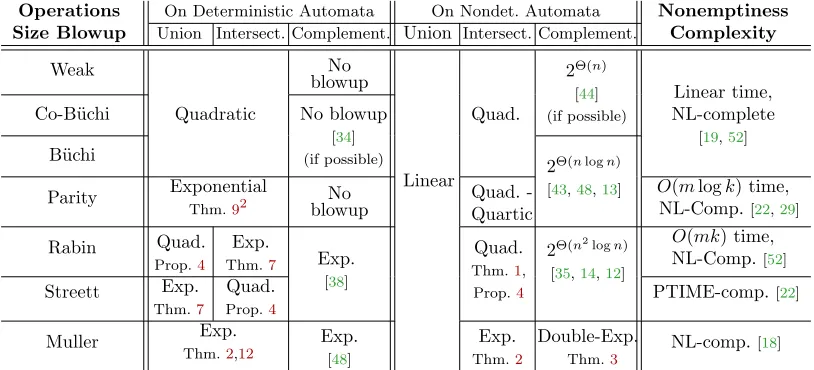
Boolean operations. There are many works on automata complementation (see [50] for a survey until 2007, after which there are yet many new results), while very few on the positive operations of union and intersection. This is possibly because positive operations are simple on nondeterministic automata, and were less interesting on deterministic automata, as nondeterministic ones are adequate for model checking. However, in recent years there is a vast progress in synthesis and in probabilistic model checking, which require deterministic or almost deterministic automata, such as limit-deterministic [51] or good-for-games automata [26,8,10]. We complete the picture of the size blowup involved in boolean operations, as summarized in Table2. To this end, we provide a new construction for intersecting nondet. Rabin automata with only a quadratic size and state blowup, show that intersecting nondet. Muller automata involves an exponential size blowup, and complementing them a double-exponential blowup. For deterministic automata, we show that unifying or intersecting the classicω-regular-complete types, namely parity, Rabin, Streett, and Muller, involve an exponential size blowup.
containment—The language of an automatonAis contained in the language of an automatonB
iff the intersection ofAwith the complement ofBis empty. The complexity of the nonemptiness problem of the classic types is clear in the literature and is summarized in Table2.
So? Based on these, and other results, we argue that the classic types are interesting and well deserve the attention they get, yet there is a need for additional types, especially in the deterministic setting. There is no inherent reason for having an exponential size blowup in pos-itive boolean operations on deterministicω-regular-complete automata. These operations are particularly interesting in verification of compound systems, in which setting there may already be some deterministic automata for the individual systems, which are then to be combined.
Indeed, the problem with boolean operations on classic deterministic automata and the current interest in the deterministic setting, may explain the emergence of new, or renewed, au-tomata types in the past five years. Among these are “Emerson-Lei” (EL), which was presented in 1985 [22], and was recently “rediscovered” within the “Hanoi” format [2], “generalized-Rabin” [32], and “generalized-Streett” [3]. The EL condition allows for an arbitrary boolean formula over sets of states that are visited finitely or infinitely often, generalized-Rabin extends the Ra-bin pairs into lists, and generalized-Streett analogously extends Streett pairs. We analyze these, and some other types, in Section5, and show that they indeed provide additional benefits.
While positive boolean operations on EL automata are obviously simple, it is known that its nonemptiness check is NP-complete [22] and complementing nondet. EL automata involves a doubly-exponential size blowup [49]. Nevertheless, due to the practical progress in solving the SAT problem, to which the EL condition is naturally related, it may still be interesting to further pursue deterministic EL automata. (See [20,45].)
We observe that generalized-Rabin is a special case of a disjunction of Streett conditions, which was considered in [22] under the name “canonical form”, and which we dub “hyper-Rabin”. These types provide an interesting potential, as they may be exponentially more succinct than the classic types, they allow for union and intersection with only a quadratic size blowup, and their nonemptiness check is in PTIME. Indeed, in the deterministic setting there seem to also be practical benefits for generalized-Rabin automata [32,15,23], which may possibly be extended to the more general hyper-Rabin condition.
The generalized-Streett condition is analogously a special case of a conjunction of Rabin conditions, which we dub “hyper-Streett”. Positive boolean operations on them only involves a quadratic size blowup, yet we show that like EL automata, their nonemptiness check is NP-complete, and complementing their nondeterministic version is doubly-exponential.
Paper structure and main contributions. The paper aims at providing the big picture ofω-regular automata, and along the way provides quite a few new results, the main of which are Theorems1,3,7, 12, and 24.
Table 1 puts an order in the chaos of translations between the different automata types. Section 3 organizes the complexity of boolean operations, as summarized in Table 2, while providing a new algorithm for intersecting Rabin automata, and several new negative results on the exponential size blowup involved in some boolean operations. Section 4 is mostly of a non-technical nature, providing reasons for why the classic types are indeed so. Section 5
analyzes a family of types that are stronger than the classical ones, as summerized in Tables3
and4, while providing new results on the size blowup involved in boolean operations on them and in translations between them.
Size
Blowup To Deterministic Nondeterministic
From W C B P R S M W C B P R S M
Det.
W ·
2Θ(n)
·
Θ(n)
2Θ(n)
C · ·
B · Θ(n) ·
P ·
Θ(n2) · R 2Θ(n)
Θ(2nlogn)
O(n2)
Ω(n) O(n 2
)
Ω(n) · O(n 2
) Ω(n)
S 2Θ(n)
·
· Θ(n) 2Θ(n) ·
M OΩ((nn2)) ? O(2nlogn) 2Ω(n) ·
O(n2)
Ω(n) Θ(n3) Θ(n2) ·
Non-Det. W
∗1
2
2Ω(n)·
Θ(n)
2Θ(n)
C 2Θ(n) ·
B
2Θ(nlogn)
2Θ(n)
·
P
Θ(n2) · R
∗2 2Θ(n2logn) O(n 2
)
Ω(n) · O(n 2
) Ω(n)
S ·
M ∗3 2O(n3logn)
2Ω(nlogn) Θ(n3) Θ(n2) ·
State
Blowup To Deterministic Nondeterministic
From W C B P R S M W C B P R S M
Det.
W ·
Θ(n)
·
C · · Θ(n)
B · ·
P · Θ(n2)
·
R 2Θ(n)
Θ(2nlogn)
·
S
2Θ(n)
·
· Θ(n) 2Θ(n)
Θ(n2) ·
M · ·
Non-Det.
W ·
Θ(n)
C 2Θ(n) ·
B
2Θ(nlogn) ·
P Θ(n2) ·
R ? 22Θ(n)
2Θ(n) ·
S ∗4 ? ∗5 ? ∗4
Θ(n2) ·
M ? 22Θ(n)
·
∗1: Upper bounds between 22O(n) and 22O(n3 logn) ∗2: Lower bound to DBW: 2Ω(nlogn)
∗3: Lower bound to DBW: 2Ω(n) ∗4: 2O(n2logn) and 2Ω(nlogn) ∗5: 2Θ(n2logn)
2
Preliminaries
Aword over a finite alphabet Σ is a sequencew=w(0)·w(1)· · · of letters in Σ.
Anondeterministic automatonis a tupleA=hΣ, Q, δ, ι, αi, where Σ is the input alphabet,
Q is a finite set of states, δ : Q×Σ → 2Q is a transition function, ι ⊆ Qis a set of initial states, andα is an acceptance condition. The first four elements, namelyhΣ, Q, δ, ιi, are the automaton’s structure. In the case where |ι| = 1 and for every q ∈ Q and σ ∈ Σ, we have
|δ(q, σ)| ≤1, we say thatAisdeterministic.
A run r=r(0), r(1),· · · of Aonw=w(0)·w(1)· · · ∈Σω is an infinite sequence of states such thatr(0)∈ι, and for everyi≥0, we haver(i+ 1)∈δ(r(i), w(i)).
Acceptance is defined with respect to the setinf(r) of states that the runrvisits infinitely often, for which reason these automata are calledω-regular automata. Formally,inf(r) ={q∈ Q | for infinitely manyi ∈IN, we haver(i) =q}. We describe below the most classic types of acceptance conditions. In Section5, we will describe additional types.
• B¨uchi, whereα⊆Q, andris accepting iffinf(r)∩α6=∅. (The states ofαareaccepting.)
• co-B¨uchi, where α ⊆ Q, and r is accepting iff inf(r)∩α = ∅. (The states of α are
rejecting.)
• weakis a special case of the B¨uchi condition, where every strongly connected component of the automaton is either contained inαor disjoint toα.
• parity, whereα={S1, S2, . . . , S2k} withS1⊂S2⊂ · · · ⊂S2k =Q, andris accepting if
the minimalifor whichinf(r)∩Si 6=∅ is even.
• Rabin, whereα={hB1, G1i,hB2, G2i, . . . ,hBk, Gki}, withBi, Gi⊆Qandr is accepting
iff for somei∈[1..k], we haveinf(r)∩Bi =∅ andinf(r)∩Gi 6=∅.
• Streett, whereα={hB1, G1i,hB2, G2i, . . . ,hBk, Gki}, withBi, Gi⊆Qandris accepting
iff for alli∈[1..k], we haveinf(r)∩Bi =∅orinf(r)∩Gi 6=∅.
• Muller, whereα={α1, α2, . . . , αk}, withαi⊆Qandris accepting iff for somei∈[1..k],
we have inf(r) =αi.
Notice that B¨uchi and co-B¨uchi are special cases of the parity condition, which is in turn a special case of both the Rabin and Streett conditions. In the latter conditions, we refer to the
Bi andGi sets as the “bad” and “good” sets, respectively.
The number of sets in the parity and Muller acceptance conditions or pairs in the Rabin and Streett acceptance conditions is called the index of the automaton. For weak, co-B¨uchi, and B¨uchi automata, the index is 1.
Thesize of an automaton is the maximum size of its elements; that is, it is the maximum of the alphabet length, the number of states, the number of transitions, and the index.
An automaton accepts a word if it has an accepting run on it. The language of an automaton
A, denoted by L(A), is the set of words that A accepts. We also say that A recognizes the languageL(A). Two automata,Aand A0, areequivalent iffL(A) =L(A0).
Theclassof an automaton characterizes its transition mode (deterministic,
B¨uchi, parity, Rabin, Streett, and Muller automata areω-regular complete, recognizing all
ω-regular languages. Weak, co-B¨uchi, and deterministic B¨uchi automata, are less expressive.
3
Classic Types – Boolean Operations
In the nondeterministic setting, boolean operations on the classic automata types, except for Muller, roughly involve an asymptotically optimal size blowup: linear for union, quadratic for intersection, and singly exponential for complementation. In the deterministic setting, however, the picture is different, having an exponential size blowup on union or intersection for all of the
ω-regular-complete types. We provide below known and new results on the boolean operations, and summarize them in Table2.
3.1
Nondeterministic Automata
Union is simply achieved by adding up the two automata via an initial nondeterministic choice. Intersection requires at least a quadratic blowup, already for automata on finite words, and can indeed be done with that size blowup for most classic types. For parity automata the exact blowup is still to be resolved. Intersection of Streett automata is straightforward due to the conjunctive nature of the acceptance condition, while for Rabin automata it is more involved, and given here for the first time. For Muller automata, we prove that it is exponential.
Complementation involves at least an exponential blowup, already for automata on finite words, and for all classic types, except for Muller, it involves a size blowup between 2Θ(n)and
2Θ(n2logn). Yet, the state blowup for Rabin automata (with index exponential in the number of
states) might be doubly exponential [14]. For Muller automata, we prove that the size blowup is doubly exponential.
We elaborate below on the intersection operation for each of the types, considering input automataAandB. For Muller, we also elaborate on complementation.
Weak and Co-B¨uchi. Intersection is done directly on the product automaton A × B, with the definition that a state (a, b) is accepting iffais accepting in Aand bis accepting in
B. Notice that the resulting automaton retains the weak property, when bothAandBhave it, and accepts exactly the words inL(A)∩L(B), as the runs of bothAandBeventually remain in only accepting/rejecting states.
B¨uchi. For B¨uchi intersection, the product automaton is not enough, since parallel ac-cepting runs ofAandBneed not visit their accepting states simultaneously. Nevertheless, the standard intersection construction only needs two copies of the product automaton, where a jump from one component to the other is done once visiting states accepting w.r.t.A(resp.B), thus guaranteeing infinitely many visits in the accepting states of bothAandB.
Parity. A parity automaton can be translated to a B¨uchi automaton with only a quadratic state and size blowup [17]. Thus, intersection involves up to a quartic state and size blowup (yielding a B¨uchi automaton). The exact inevitable blowup in direct intersection of parity automata into a parity automaton is yet to be resolved.
Rabin. A Rabin automaton can be translated to a B¨uchi automaton with only a quadratic size blowup [17], implying intersection construction with up to a quartic size blowup. However, state wise, this approach is inadequate, as there might be an exponential blowup in the trans-lation of Rabin to B¨uchi automata [7]. We show below that the Rabin condition allows for a direct intersection construction, involving only a quadratic state and size blowup.
The idea is to extend the B¨uchi-intersection construction, taking advantage of the Rabin condition. Recall that in the construction for intersecting B¨uchi automata, a jump from one copy of the product automaton into the other is done once reaching a state accepting w.r.t.
A (respectively B). This does not work for the Rabin condition, since a state is no longer accepting w.r.t.A, but may belong to several “good” and “bad” sets ofA’s accepting pairs.
We extend the construction by adding a “bridge” that is visited when jumping from the first to the second copy of the product automaton, and another bridge between the second and first copy. A bridge is a limited copy of the product automaton, in which all states can only move to the next copy. Then, for every acceptance pairshB1, G1iofAand hB2, G2iofB, we
define an acceptance pairhB, Githat enforces a visit inG1when going through the first bridge
and a visit inG2 when in the second bridge. This enforcement is done by having inB all the
states of the first bridge that are not inG1and all the states of the second bridge that are not
inG2.
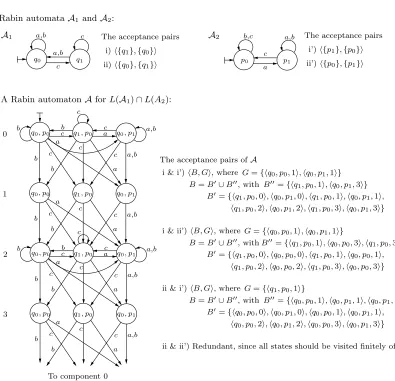
An example of intersecting Rabin automata along this construction is illustrated in Figure1. We give below the formal construction, and provide the correctness proof in the full version.
Theorem 1. For every two NRWsA1 andA2 withn1 andn2 states,m1 and m2 transitions,
and indices k1 and k2, respectively, there is an NRW recognizing L(A1)∩L(A2) with 4n1n2
states,6m1m2 transitions, and indexk1k2.
Construction. Consider NRWsA1=hΣ, Q1, ι1, δ1, α1iand A2=hΣ, Q2, ι2, δ2, α2i. We define
the NRWA=hΣ, Q, ι, δ, αi, which we claim to recognizeL(A)∩L(B), as follows.
• Q=Q1×Q2×[0..3]. (We shall call each instance of Q1×Q2 a “component”, and the
odd components we dub “bridges”.)
• ι=ι1×ι2× {0}.
• For every statehq1, q2, ii ∈Qandσ∈Σ, the transition function is defined as follows.
– If i is even, then δ(hq1, q2, ii, σ) = {hqˆ1,qˆ2,ˆii | qˆ1 ∈ δ1(q1, σ), ˆq2 ∈ δ2(q2, σ), and
ˆi∈ {i, i+1}}.
– If i is odd, then δ(hq1, q2, ii, σ) = {hqˆ1,qˆ2,(i+1) mod 4i | qˆ1 ∈ δ1(q1, σ) and ˆq2 ∈ δ2(q2, σ)}.
• For every acceptance pairshB1, G1i ∈α1andhB2, G2i ∈α2, we have inαthe acceptance
pairhB, Gi, whereB andGare defined as follows.
– G=G1×Q2× {1}.
– B is the union of two sets B0 andB00. The first includes all the states that are bad w.r.t.B1 or B2. The second handles the transitions through the bridges, adding in
component 2i−1 the states that are not inGi. Formally,B=B0∪B00, whereB0 =
B=B0∪B00, with
B=B0∪B00, with
B0={hq0, p0,0i,hq0, p1,0i,hq0, p0,1i,hq0, p1,1i, hq0, p0,2i,hq0, p1,2i,hq0, p0,3i,hq0, p1,3i}
ii & ii’) Redundant, since all states should be visited finitely often. i & i’)hB, Gi, where
B0={hq1, p0,0i,hq0, p1,0i,hq1, p0,1i,hq0, p1,1i, hq1, p0,2i,hq0, p1,2i,hq1, p0,3i,hq0, p1,3i} The acceptance pairs ofA
i & ii’)hB, Gi, where
B=B0∪B00, with
G={hq0, p0,1i,hq0, p1,1i} B00={hq1, p0,1i,hq0, p1,3i}
G={hq0, p0,1i,hq0, p1,1i}
B00={hq1, p0,1i,hq0, p0,3i,hq1, p0,3i}
ii & i’)hB, Gi, whereG={hq1, p0,1i} B00={hq
0, p0,1i,hq0, p1,1i,hq0, p1,3i} B0={hq1, p0,0i,hq0, p0,0i,hq1, p0,1i,hq0, p0,1i,
hq1, p0,2i,hq0, p0,2i,hq1, p0,3i,hq0, p0,3i} ii’)h{p0},{p1}i The acceptance pairs
ii)h{q0},{q1}i The acceptance pairs
i)h{q1},{q0}i i’)h{p1},{p0}i
2
3 1 0
A1
A Rabin automatonAforL(A1)∩L(A2):
To component 0
Rabin automataA1andA2:
A2
q1
q1, p0 q0, p1
q1, p0 q0, p1
q0, p0
q0, p0
q1, p0 q0, p1
q1, p0 q0, p1
q0, p0
q0, p0
q0 p0 p1
a a,b c b b a c c b ac c a,b c a a,b c b b a c c a a,b c b b a c c a,b a,b c b b a c c a c a c a,b b,c a,b c b b b ac c a,b c
Figure 1: An example of intersecting Rabin automata with a quadratic state and size blowup, as per the construction of Theorem1.
Muller. A Muller automaton can be translated to a B¨uchi automaton with only a cubic size blowup [6]. However, when considering the intersection of Muller automata into a Muller automaton, one cannot take advantage of the quadratic intersection of B¨uchi automata, as the translation back from B¨uchi to Muller automata might involve an exponential size blowup [48]. Moreover, we show below that due to the very descriptive nature of the Muller condition, intersection might involve an exponential size blowup.
Theorem 2. Intersection of (deterministic) Muller automata involves an exponential size
blowup. In particular, for every n ≥ 1, there are DMWs M0
n and M00n with up to n states,
2n transitions, and indexn+ 1each, over an alphabet of 3 letters, such that every NMW that
recognizesL(M0
n)∩L(M00n)has an index of at least 2n.
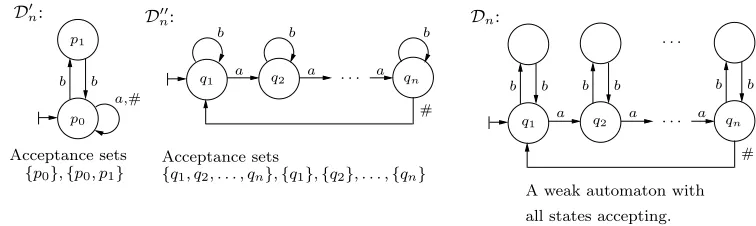
Proof. Consider the DMWsD0
n andDn00 of Figure2. Observe that bothDn0 andDn00 accept all
{q1, q2, . . . , qn},{q1},{q2}, . . . ,{qn}
A weak automaton with
all states accepting.
Dn:
D00 n:
Acceptance sets
{p0},{p0, p1}
Dn0:
Acceptance sets
· · ·
· · · · · ·
p1
a,#
qn
a a
q2
a
# b
b
qn
q2
q1
a a
a
#
b
b b b
q1
b
b b
b b
p0
Figure 2: Deterministic Muller automataD0
nandDn00of size inO(n), whose intersection, which
is equivalent to Dn, is recognized by a nondeterministic Muller automaton with index of at
least 2n.
on their structures, all of whose states are accepting. Thus, the language L(D0
n)∩L(Dn00) is
recognized by the weak automatonDn, whose structure is the product ofDn0 andD00n’s structures.
Now, in [6, proof of Theorem 12], it is shown that an NMW equivalent to Dn must have an
index of at least 2n.
Complementation of Muller automata is also very inefficient, involving a doubly exponential size blowup.
Theorem 3. Complementation of Muller automata into Muller automata involves a
doubly-exponential size blowup. In particular, for everyn≥1, there is a languageLn over an alphabet
of 4 letters, recognized by an N M W with O(n) states and index in O(1), while an NMW for
Ln has an index of at least 22n.
Proof. Let Σ ={a, b,#,$}. For everyn≥1, consider the languageHn={u1#u1$u2#u2$. . . |
for everyi∈IN, ui∈ {a, b}n} over Σ. That is,Hn consists of infinite words that are sequences
of pairs of finite words of lengthnover{a, b}, such that the two words in each pair are identical. LetLn be the complement ofHn. We claim that an NMW forHn has an index of at least 22
n
, while there is an NMW of size inO(n) recognizingLn.
An NMW of size in O(n) forLn is straightforward. There are two options for a word not in Hn: either it violates the pattern of n{a, b} letters between a # and a $, or there are two different letters that are n positions apart and there is a # between them. Both cases can be recognized by a nondeterministic finite automaton withO(n) states, after which there is a forever accepting state.
We continue with analyzing an NMWM forHn. LetU ={u|u∈ {a, b}n}be the set of
words of lengthnover{a, b}. For every subsetT ⊆U, lettbe the number of words inT, and letwT = (u1#u1$u2#u2$. . . ut#ut$)ωbe an infinite word that repeats exactly the words inT.
Notice that for every suchT, the word wT belongs toHn. LetST be an acceptance set ofM
via whichMacceptswT. We show that for every T 6=T0, we haveST 6=ST0.
Indeed, for every wordu∈U, consider the setSu of states ofM, such thats∈Suiff there
is a finite wordxending withuand an infinite word ystarting with #u, such that there is an accepting runrofMonxy, andMreachessalongrafter readingx. We claim that for every
u6=u0 ∈U, we haveSu andSu0 are disjoint. Indeed, assume by way of contradiction a state
s∈Su∩Su0. Letrandr0 be the runs ofMwitnessing thats∈Su ands∈Su0, and reaching
set of states that it visits infinitely often is the same as that ofr0. Yet, it accepts a word not inHn, having an infixu#u0.
Hence, for everyT 6=T0 with someu∈T\T0, we haveST contains some states∈Su, such
thats6∈ST0. Thus, since there are 22
n
different setsT ⊆U,Mmust have an index of at least 22n.
3.2
Deterministic Automata
We show below that positive boolean operations might involve an exponential size and state blowup over deterministic parity, Rabin, Streett, and Muller automata.
Rabin and Streett. We start with straightforward positive results on constructions that are natural to each type.
Proposition 4. Intersection of (deterministic) Streett automata and union of deterministic Rabin automata can be done with quadratic state and size blowup.
Proof. The NSWS can be defined over the product ofS0 and S00, where the acceptance
con-dition is taken to be the union of the two accepting concon-ditions. When both S0 and S00 are
deterministic, so isS.
Formally, letS0 = (Σ, Q0, ι0, δ0, α0) andS00= (Σ, Q00, ι00, δ00, α00). We defineS= (Σ, Q, ι, δ, α),
where
• Q=Q0×Q00
• ι=hι0, ι00i
• For everyq0∈Q0, q00∈Q00, anda∈Σ,δ(hq0, q00i, a) =hδ0(q0, a), δ00(q00, a)i
• α={hB0×Q00, G0×Q00i | hB0, G0i ∈α0} ∪ {hQ0×B00, Q0×G00i | hB00, G00i ∈α00}
By the duality of deterministic Streett and Rabin automata, the result follows for the union of DRWsR0 andR00: L(R0
n)∩L(R00n) =L(Sn0)∪L(Sn00).
For showing the exponential size blowup in the intersection of det. Rabin automata and union of det. Streett automata, we leverage a recent lower-bound proof from [1].
Consider the family of languages{Ln}n≥1, where the alphabet ofLn is {1,2, . . . , n} and a
word belongs to it iff the following two conditions are met:
i. A letter i is always followed by a letter j, such that i−1 ≤ j ≤ i+1. For example, 5433245. . .is a bad prefix, since 2 was followed by 4, while 55434322. . . is a good prefix. ii. The number of letters that appear infinitely often is odd. For example, 23321(22343233)ω
is in Ln, while 1(233)ωis not.
We provide for everyn, det. Streett automataS0
nandSn00of sizen, such thatL(Sn0)∪L(Sn00) = Ln. Intuitively,S0
n requires both the smallest and biggest letters that appear infinitely often to
be odd, whileS00
n requires both of them to be even. This covers, together with the enforcement
of condition (i), all cases in which the number of letters that appear infinitely often is odd.
Lemma 5. For every n ≥ 1, there are deterministic Streett automata S0
n and Sn00 of size n, such thatL(S0
Yet, deterministic Rabin and Streett automata forLn must have at least 2b
n−1
2 c states.
Lemma 6 ([1, Lemma 5.11 and Remark 5.13]). 1 Every deterministic Rabin and Streett au-tomata recognizingLn must have at least2bn−21c states.
By the above lemmas, we get the exponential blowup in intersecting deterministic Rabin automata and unifying deterministic Streett automata.
Theorem 7. Union of det. Streett automata and intersection of det. Rabin automata involve
an exponential state and size blowup. In particular, for every n≥1, there are DSWs S0
n and
S00
n (over the same structure) with nstates, 3n−2 transitions, and n accepting pairs over an
alphabet ofnletters, s.t. every DSW that recognizes L(S0
n)∪L(Sn00)has at least 2b
n−1
2 c states.
Parity and generalized parity. Complementation of det. parity automata involves no blowup, however both union and intersection might involve an exponential state and size blowup, as shown below. (This exponential blowup was independently shown by Christof L¨oding and Haidi Yue, while investigating the memory requirements in two-player infinite games [40].) We first construct for everyn, four deterministic parity automata over the same structure, such that their union and intersection provideLn.
Lemma 8. For every n≥1, there are deterministic parity automata P0
n,Pn00,Pn000, andPn0000 of sizenover the same structure, such thatL(P0
n)∩L(Pn00)∪L(Pn000)∩L(Pn0000) =Ln.
Now, using the above lemma and the negative results on unifying det. Streett automata, we get the negative results on det. parity automata.
Theorem 9. Union and intersection of deterministic parity automata involve an exponential
state and size blowup. In particular, for everyn ≥1, there are DPWs P0
n andPn00 (over the
same structure) with n states, 3n−2 transitions, andn colors over an alphabet of n letters,
such that every DPW that recognizesL(P0
n)∩L(Pn00)has at least 2b
n−1
4 c states.
Proof. For everyn≥1, consider the DPWsPn0,Pn00,Pn000, andPn0000 as per Lemma8. LetAand
Bbe DPWs recognizingL(P0
n)∩L(Pn00) andL(Pn000)∩L(Pn0000), respectively. Observe thatAand
Bare also DRWs, andL(A)∪L(B) =Ln.
By Proposition4, the union of DRWs involves at most a quadratic size blowup. Now, by Lemma6, a DRW that recognizesLn must have at least 2bn−21c states. Hence, either of Aor
Bmust be of a size that is at least the square root of 2bn−21c, which is 2b
n−1
4 c. This concludes
the claim concerning the intersection of DPWs.
As for the union of DPWs, we get the result from the self duality of parity automata: Assume thatP0 andP00are the DPWs whose intersection involves the exponential size blowup. LetD0
andD00be the DPWs that result from dualizingP0andP00, respectively. SinceL(P0
n)∩L(Pn00) = L(D0
n)∪L(Dn00), we have that a DPW that recognizesL(Dn0)∪L(Dn00) must have at least 2b
n−1 4 c
states.
The parity condition is also considered in the literature in a generalized form, called “general-ized parity” [16], allowing for either a disjunction or a conjunction of standard parity conditions. Analogously to Proposition4, unifying disjunctive-generalized-parity automata, as well as in-tersecting conjunctive-generalized-parity automata, is easy. Yet, the dual operations involve an exponential size blowup.
An: Bn:
Both automata have a single Muller acceptance set of all states.
· · ·
· · · p1 b
a
p0
a
b a
a b
# q1
a b
q0
b
pn
qn
# a
b
Figure 3: Deterministic Muller automata of size in O(n), whose union is recognized by det. Muller automata of index at least 2n.
Corollary 10. Union of deterministic conjunctive-generalized-parity automata and intersection of disjunctive-generalized-parity automata involve an exponential state and size blowup.
Muller. Union and intersection of det. Muller automata only involves a quadratic state
blowup, and for automata over the same structure, also only a linear size blowup. Yet, for automata over different structures, both union and intersection involve an exponential size
blowup.
Proposition 11. Union and intersection of deterministic Muller automata involves a quadratic state blowup. Union and intersection of (deterministic) Muller automata over the same struc-ture involves no state blowup and linear size blowup.
Exponential size blowup in intersection is shown in Theorem2, when the target automaton may even be a nondeterministic Muller automaton. We show below that when the target automaton is a deterministic Muller automaton, union also involves an exponential size blowup.
Theorem 12. Union of deterministic Muller automata involves an exponential size blowup. In
particular, for everyn≥1, there are DMWsAn andBn withn+ 1states,2(n+ 1)transitions,
and index1each, over an alphabet of 3letters, such that every DMW that recognizes L(An)∪
L(Bn)has an index of at least2n.
Proof sketch. Consider the DMWsAnandBnof Figure3. The language ofAnis ((b∗a)nb∗#)ω
and ofBn is ((a∗b)na∗#)ω. Let Mbe a DMW for L(An)∪L(Bn). We first classify its states
according to their relation with the states of An and Bn. Formally, for everyi, j ∈ [0..n], let Si,j be the set of states s of M, for which there exists a finite word u, such that M(u) =s,
An(u) =qi, andBn(u) =pj.
Now, letU be the set of finite words of length 2nover{a, b}, having exactlyn a’s andn b’s. Notice that for everyu∈U, the infinite wordwu= (u#)ω belongs to bothL(An) andL(Bn),
and in particular also belongs toL(M). Therefore, for everyu∈U, there is a set Su of states ofMthat is visited infinitely often in the run of Monwu, and Su belongs to the acceptance sets ofM. We analyzeMand show that for everyu6=u0∈U,S
u6=Su0, getting 2n
n
different Muller sets in the acceptance condition ofM.
4
In Favor of The Classic Types
We start with some general observations on the classic types, claiming that they are “well positioned” with respect to the inevitable tradeoff between succinctness, determinization, and complementation. We then briefly specify some good qualities of each type.
Operations Size Blowup
On Deterministic Automata On Nondet. Automata Nonemptiness Complexity Union Intersect. Complement. Union Intersect. Complement.
Weak Quadratic No blowup Linear Quad.
2Θ(n)
[44]
(if possible)
Linear time, NL-complete
[19,52]
Co-B¨uchi No blowup
[34] (if possible)
B¨uchi
2Θ(nlogn) [43,48,13]
Parity Exponential
Thm.92
No blowup
Quad. -Quartic
O(mlogk) time, NL-Comp.[22,29]
Rabin Quad.
Prop.4
Exp.
Thm.7 Exp.
[38]
Quad.
Thm.1, Prop.4
2Θ(n2logn)
[35,14,12]
O(mk) time, NL-Comp.[52]
Streett Exp.
Thm.7
Quad.
Prop.4
PTIME-comp.[22]
Muller Exp.
Thm.2,12
Exp.
[48]
Exp.
Thm.2
Double-Exp.
Thm.3
NL-comp.[18]
Table 2: The size blowup involved in boolean operations on the classic word automata, and the complexity of checking their nonemptiness. The complexity is w.r.t. the automaton sizen, and if specified, w.r.t.mstates and indexk.
Inevitable: Succinctness + Complementation
≥
Double-Exp
There is an inherent tradeoff between the succinctness of an automaton and the size blowup involved in its complementation—It is shown in [49] that there is a family ofω-regular languages
{Ln}n≥1, such that for everyn, there is an Emerson-Lei automaton of sizenforLn, while every ω-regular automaton forLn has at least 22n states. (See Section5 for details.)
Hence, for an automaton of some type T whose complementation only involves a single-exponential size blowup, there must also be at least a single-single-exponential size blowup in trans-lating arbitrary ω-regular automata into T-automata. Analogously, if we aim for a single-exponential blowup in determinization, and no blowup in the complementation of deterministic automata, there must be at least a double-exponential size blowup in translating arbitrary automata into deterministicT-automata.
In this sense, the classic types, except for Muller, provide a reasonable tradeoff between their succinctness and the size blowup involved in their determinization and complementation, having all of these measures singly exponential.
Proposition 13. For everyn∈IN and nondeterministicω-regular automaton of sizen, there is an equivalent nondeterministic B¨uchi automaton of size in2O(n)and an equivalent deterministic parity automaton of size in22O(n).
For the classic types, except for Muller, positive boolean operations on nondet. automata are optimal, as union and intersection are generally done with only linear and quadratic size blowup, respectively (see Table 2), which matches the lower bound for arbitrary automata types. So is the case with the nonemptiness check (see Table2), which is generally resolved in nondet. logarithmic space.
Weak. The restriction on the structure of the automaton often limits the expressive power, and allows for simple analysis. In particular, the Myhill-Nerode property holds for DWW, while not for the other types, and a language is expressible by a DWW iff it is expressible by both a DBW and a DCW [37,41,4].
When considering alternating automata, the weak condition no longer limits the expressive power and AWWs recognize allω-regular languages [46]. When further restricting the automa-ton structure to only allow cycles that are self loops (“very weak” automata), we get the exact expressiveness of linear temporal logic (LTL) [39]. Over trees, weak alternating automata are particularly natural [46] and are equivalent to alternation free mu-calculus (AFMC) [47].
B¨uchi and Co-B¨uchi. Somewhat surprisingly, the simple B¨uchi condition, consisting of a single set of states, allows nondet. automata to capture all of theω-regular languages [11]. Due to its simplicity and natural connection to fairness constraints, it is the most preferred condition in the nondet. setting. Dually, for universal automata, the co-B¨uchi condition is very useful [25,9].
Deterministic B¨uchi automata are less expressive, yet everyω-regular language is equal to a boolean combination of DBWs, namely to a positive boolean combination of DBWs and DCWs. Generalized-B¨uchi (GB) automata, in which there are several sets of accepting states, each of which should be visited infinitely often, are useful in the translation of LTL to automata (which involves an exponential size blowup), and can be translated into equivalent B¨uchi automata with a quadratic size blowup. Deterministic GB automata are as expressive as DBWs.
Parity. The parity condition is naturally related to fixpoint expressions [31,21], and alter-nating parity tree automata are expressively equivalent toµ-calculus [21,28]. This equivalence follows to the hierarchy of parity automata w.r.t. their index and the hierarchy of µ-calculus formulas w.r.t. their alternation depth. Deterministic parity automata are attractive due to their self duality, and the fact that they are ω-regular complete, even though their index is bounded by the number of states.
In the game setting, the parity condition enjoys a special popularity, as both players can do with memoryless strategies [21], and deciding the winner is inN P ∩coN P.
Rabin and Streett. The Rabin and Streett conditions are union-closed with respect to rejecting and accepting, respectively, sets of states visited infinitely often. This allows to simplify many aspects of automata and games with the Rabin and Streett conditions. In particular, it allows Rabin (resp. Streett) games to have memoryless strategies for the first (resp. second) player [30], and provides thetypenessproperty of deterministic Rabin and Streett automata with deterministic B¨uchi and co-B¨uchi automata, respectively [33].
The Streett condition naturally relates to strong fairness, and NSWs are only up to quadrat-ically less succinct than every other classic nondet. automaton (though not than arbitrary non-det.ω-regular automaton). State-wise, on the other hand, every nondet.ω-regular automaton can be translated to an equivalent Rabin automaton with only a quadratic state blowup [7].
5
In Favor of Additional Types
The good qualities of the nondeterministic classic types do not follow to the deterministic setting. In particular, union or intersection of all the classic deterministic ω-regular-complete automata involve an exponential size blowup (see Table2). This has recently become a practical problem, as det. automata are required in synthesis and in probabilistic model checking, which are rapidly developing. As a result, new, or renewed, acceptance types have emerged, on which positive boolean operations only involve a quadratic size blowup.
We formally define these types and then elaborate on each. Acceptance is defined, as usual, with respect to the setinf(r) of states that the runr visits infinitely often. We also define for a setSof states thatInf(S) holds in a runrifS∩inf(r)6=∅andFin(S) holds otherwise. We describe for each type the form of boolean formula overFin andInf that it allows.
• Emerson-Lei: An arbitrary boolean formula overFin andInf. (A positive boolean
for-mula is enough, as¬Fin(S) =Inf(S).)
• Generalized-Rabin: Wn
i=1Fin(Bi)∧Inf(Gi1)∧. . .∧Inf(Giki).
• Generalized-Streett: Vn
i=1Inf(Gi)∨Fin(Bi1)∨. . .∨Fin(Biki).
• Hyper-Rabin: Wn
i=1
Vm
j=1Fin(Bi,j)∨Inf(Gi,j). • Hyper-Streett: Vn
i=1
Wm
j=1Fin(Bi,j)∧Inf(Gi,j).
Another related type iscircuit [27], which further shortens Emerson-Lei, by representing the acceptance formula as a boolean circuit.
The index of an automaton is the length of the boolean formula describing its acceptance condition. (For the classic types, it coincides with the standard definition of Section2.)
The three-letter acronyms of classic automata is extended to four-letter acronyms for the above types. For example, DGRW stands for a deterministic generalized-Rabin word automa-ton.
Emerson-Lei. The acceptance condition was introduced in 1985 by Emerson and Lei [22], gained some popularity shortly after, was much less popular afterwards, and regained popularity in the past five years. It now appears also as part of the Hanoi Omega-Automata Format (HOAF), which is a new standard for representing automata with some boolean condition over states or transitions [2]
It obviously allows for simple boolean operations. However, complementing as well as de-terminizing nondet. EL automata involves a doubly-exponential size blowup [49], and their nonemptiness check is NP-complete [22]. Yet, due to the tremendous progress in practically solving the SAT problem, to which the EL condition is naturally related, it may still be inter-esting to further pursue deterministic EL automata. (See [20,45])
Proposition 14. The Muller and Rabin conditions are special cases of the generalized-Rabin condition, which is a special case of the hyper-Rabin condition.
By Proposition14, we get lower bounds on translations to classic automata. (See Table1.)
Proposition 15. There is an exponential size blowup in the translation of det. generalized-Rabin and hyper-generalized-Rabin automata to det. parity, generalized-Rabin, Streett, and Muller automata.
Their positive boolean operations are simple.
Proposition 16. Union and intersection of (deterministic) generalized-Rabin and hyper-Rabin automata can be done with quadratic size blowup.
Still, their nonemptiness check is in PTIME.
Proposition 17([22, Theorem 4.6]). Nonemptiness check of hyper-Rabin automata is PTIME-complete.
In the nondet. setting, hyper-Rabin automata are quite similar to standard Streett au-tomata, analogously to the connection between standard Rabin and B¨uchi automata: The disjunction in the acceptance condition is turned into nondeterminism between copies of the automaton with the weaker condition. Hence, there is only a quadratic size blowup in trans-lating between them.
Proposition 18. Nondeterministic hyper-Rabin automata can be translated to equivalent non-deterministic Streett automata with a quadratic size blowup.
As a result, nondet. hyper-Rabin automata can be complemented and determinized with only a single exponential size blowup.
Proposition 19. Complementation (and determinization) of nondeterministic hyper-Rabin automata can be done with a single-exponential size blowup.
Hyper-Streett and generalized-Streett. The generalized-Streett condition [3] is the dual of generalized-Rabin, and Hyper-Streett is the dual of Hyper-Rabin.3 These types
natu-rally occur inn-playerω-regular games [24]. Their succinctness and the simplicity of performing boolean operations on them follow from their duality to hyper/generalized-Rabin automata.
Proposition 20. There is an exponential size blowup in the translation of det. generalized-Streett and hyper-generalized-Streett automata to det. parity, Rabin, generalized-Streett, and Muller automata.
Proposition 21. Union and intersection of (deterministic) generalized-Streett and hyper-Streett automata can be done with quadratic size blowup.
However, the simplicity of the nonemptiness check does not follow.
Proposition 22. Nonemptiness check of generalized-Streett and hyper-Streett automata is NP-complete.
Furthermore, while nondet. hyper-Rabin automata can be easily translated to standard Streett automata, nondet. hyper-Streett automata cannot be easily translated to standard Rabin automata, and complementing them involves a doubly-exponential size blowup. It was also recently shown in [24] that their universality problem is ExpSpace-complete.
The acceptance condition:Vn
i=1(Fin({pi})∨Fin({pi0}))
Deterministic generalized-Streett automatonDn
· · ·
· · · · · ·
q0
p02 p0n
p0
1
pn
p1 p2
#
a a
c
# c
# #
c a
b b b
#
a
#
Figure 4: A deterministic generalized-Streett automatonDnof size inO(n), for which equivalent
nondeterministic hyper-Rabin automata are of size in 2Ω(n).
Theorem 23. Complementation (and determinization) of nondet. generalized-Streett and
hyper-Streett automata of sizen into any ω-regular automaton results in an automaton with at least
22n states.
Proof sketch. In [48, Lemma 2.4], it is shown that for everyn >0, there exists a languageLn
that is recognized by a nondet. EL automatonAof sizen, while any nondet.ω-automaton for the complement ofLn has at least 22
n
states. We observe that due to the special structure of
A, its acceptance condition can be simplified and therefore defined by generalized-Streett and hyper-Streett conditions of length inO(n).
Translating between hyper-Rabin and hyper-Streett automata. While the size
blowup involved in translating a nondet. hyper-Rabin to an hyper-Streett automaton is quadratic (Proposition 18), in the opposite direction it is exponential, even if starting from a det. generalized-Streett automaton. (A matching single-exp. upper bound follows from Proposi-tion13.)
Theorem 24. For every n∈IN, there is a deterministic generalized-Streett automaton of size
n, for which equivalent nondeterministic hyper-Rabin automata are of size at least2n/2.
Proof sketch. Consider the family {Dn}n≥1 of DGSWs depicted in Figure 4. We describe 2n
different words, such thatDn accepts each of them, while it rejects each combination of a pair
of them. As a result, we prove that an equivalent NSW needs a unique state for each such word. Then, by the result that every NHRW can be translated to an NSW with only a quadratic size blowup, the required lower bound follows.
Complementing deterministic hyper-Rabin and hyper-Streett automata is the same, due to their duality, which is also the same as translating between them. It can be done with a single exponential size blowup, using the quadratic translation of hyper-Rabin automata to NSWs, and the single exponential blowup in determinizing the latter. As a corollary of Theorem24, this exponential blowup is inevitable.
Translations
Size Blowup Deterministic Nondeterministic
From To H-Rabin H-Streett H-Rabin H-Streett
Det. Hyper-Rabin · Cor.Exp.25 · O(n
2)
Prop.18
Hyper-Streett Exp.
Cor.25
· Exp.
Thm.24
·
Non-Det.
Hyper-Rabin Exp.
Prop.19 · O(n
2)
Prop.18
Hyper-Streett Double-Exp.
Thm.23
Exp.
Thm.24
·
Table 3: The size blowup involved in translations between hyper-Rabin/Streett automata. The translations to and from generalized-Rabin/Streett automata have the same blowup.
Operations Size Blowup
On Deterministic Automata On Nondet. Automata Nonemptiness Complexity Union Intersect. Complement. Union Intersect. Complement.
Hyper-Rabin
Quadratic
Prop.16,21
Exp.
Thm.24,
Cor.25 Linear
Quad.
Prop.16,21
Exp.
Prop.19
PTIME-comp.
[22]
Hyper-Streett
Double-Exp.
Thm.23
NP-Complete
Prop.22
Emerson-Lei No
blowup
Table 4: The size blowup involved in boolean operations on the non-classic word automata, and the complexity of checking their nonemptiness. The complexity is w.r.t. the automaton size. Generalized-Rabin/Streett have the same blowup and complexity as hyper-Rabin/Streett.
6
Conclusions
The paper provides a comprehensive picture ofω-regular automata, analyzing and summarizing the properties of classic and non-classic automata types. Along the way, it completes the data on the size blowup involved in boolean operations, providing quite a few new results.
The need for various automata types on infinite words is clear from the richness ofω-regular languages; Each of the classic types has its own good qualities with respect to simplicity, expressibility, succinctness, complexity of decision problems, and connection to specific logics. Yet, we show that positive boolean operations on deterministic automata of all of the classic
References
[1] D. Angluin, U. Boker, and D. Fisman. Families of DFAs as acceptors of ω-regular languages.
Logical Methods in Computer Science, 14(1):1–21, 2018.
[2] T. Babiak, F. Blahoudek, A. Duret-Lutz, J. Klein, J. Kˇret´ınsk´y, D. M¨uller, D. Parker, J. Strejˇcek, and C. S. P˘as˘areanu. The Hanoi omega-automata format. InProc. of CAV, pages 479–486, 2015. [3] F. Blahoudek. Translation of an LTL fragment to deterministic Rabin and Streett automata.
Master’s thesis, Masarykova Univerzita, 2012.
[4] B. Boigelot, S. Jodogne, and P. Wolper. On the use of weak automata for deciding linear arithmetic with integer and real variables. InProc. of IJCAR, pages 611–625, 2001.
[5] U. Boker. Word-automata translations, 2010–2018. URL: http://www.faculty.idc.ac.il/ udiboker/automata.
[6] U. Boker. On the (in)succinctness of Muller automata. InCSL, pages 12:1–12:16, 2017. [7] U. Boker. Rabin vs. Streett automata. InFSTTCS, pages 17:1–17:15, 2017.
[8] U. Boker, D. Kuperberg, O. Kupferman, and M. Skrzypczak. Nondeterminism in the presence of a diverse or unknown future. InProc. of ICALP, pages 89–100, 2013.
[9] U. Boker and O. Kupferman. Translating to co-B¨uchi made tight, unified, and useful.ACM Trans. Comput. Log., 13(4):29:1–29:26, 2012.
[10] U. Boker, O. Kupferman, and M. Skrzypczak. How deterministic are good-for-games automata? InProceedings of FSTTCS, pages 18:1–18:14, 2017.
[11] J.R. B¨uchi. On a decision method in restricted second order arithmetic. InProc. Int. Congress on Logic, Method, and Philosophy of Science. 1960, pages 1–12. Stanford University Press, 1962. [12] Y. Cai and T. Zhang. A tight lower bound for Streett complementation. In FSTTCS, pages
339–350, 2011.
[13] Y. Cai and T. Zhang. Tight upper bounds for Streett and parity complementation. InCSL, pages 112–128, 2011.
[14] Y. Cai, T. Zhang, and H. Luo. An improved lower bound for the complementation of Rabin automata. InLICS, pages 167–176, 2009.
[15] K. Chatterjee, A. Gaiser, and J. Kˇret´ınsk´y. Automata with generalized Rabin pairs for probabilistic model checking and LTL synthesis. InProc. of CAV, pages 559–575, 2013.
[16] K. Chatterjee, T. A. Henzinger, and N. Piterman. Generalized parity games. InProc. of FOSSACS, pages 153–167, 2007.
[17] Y. Choueka. Theories of automata onω-tapes: A simplified approach. Journal of Computer and Systems Science, 8:117–141, 1974.
[18] E. Clarke, I. Browne, and R. Kurshan. A unified approach for showing language containment and equivalence between various types ofω-automata. InCAAP ’90, pages 103–116, 1990.
[19] E.M. Clarke, E.A. Emerson, and A.P. Sistla. Automatic verification of finite-state concurrent systems using temporal logic specifications.ACM Transactions on Programming Languagues and Systems, 8(2):244–263, 1986.
[20] A. Duret-Lutz. Contributions to LTL andω-Automata for Model Checking. Habilitation thesis, Pierre et Marie Curie, 2017.
[21] E.A. Emerson and C. Jutla. Tree automata, µ-calculus and determinacy. In Proc. 32nd IEEE Symp. on Foundations of Computer Science, pages 368–377, 1991.
[22] E.A. Emerson and C.-L. Lei. Modalities for model checking: Branching time logic strikes back.
Science of Computer Programming, 8:275–306, 1987.
[23] J. Esparza, J. Kˇret´ınsk´y, and S. Sickert. From LTL to deterministic automata: A Safraless compositional approach. Formal Methods in System Design, 49(3):219–271, 12 2016.
[24] E. Filiot, R. Gentilini, and J. F. Raskin. Rational synthesis under imperfect information. In
[25] E. Friedgut, O. Kupferman, and M.Y. Vardi. B¨uchi complementation made tighter. InProc. of ATVA, volume 3299 ofLNCS, pages 64–78. Springer, 2004.
[26] T.A. Henzinger and N. Piterman. Solving games without determinization. InProc. of CSL, volume 4207 ofLNCS, pages 394–410. Springer, 2006.
[27] P. Hunter and A. Dawar. Complexity bounds for regular games. InProc. of MFCS, pages 495–506, 2005.
[28] D. Janin and I. Walukiewicz. Automata for the modalµ-calculus and related results. InProc. of MFCS, volume 969 ofLNCS, pages 552–562. Springer, 1995.
[29] V. King, O. Kupferman, and M.Y. Vardi. On the complexity of parity word automata. InProc. of FoSSaCS, volume 2030 ofLNCS, pages 276–286. Springer, 2001.
[30] N. Klarlund. Progress measures, immediate determinacy, and a subset construction for tree au-tomata. Annals of Pure and Applied Logic, 69(2):243 – 268, 1994.
[31] D. Kozen. Results on the propositionalµ-calculus. Theoretical Computer Science, 27:333–354, 1983.
[32] J. Kret´ınsk´y and J. Esparza. Deterministic automata for the (f, g)-fragment of LTL. InProc. of CAV, volume 7358 ofLNCS, pages 7–22. Springer, 2012.
[33] S.C. Krishnan, A. Puri, and R.K. Brayton. Deterministicω-automata vis-a-vis deterministic B¨uchi automata. InAlgorithms and Computations, volume 834 ofLNCS, pages 378–386. Springer, 1994. [34] O. Kupferman, G. Morgenstern, and A. Murano. Typeness forω-regular automata. InProc. of
ATVA, volume 3299 ofLNCS, pages 324–338. Springer, 2004.
[35] O. Kupferman and M.Y. Vardi. Complementation constructions for nondeterministic automata on infinite words. InProc. of TACAS, volume 3440 ofLNCS, pages 206–221. Springer, 2005. [36] R.P. Kurshan. Computer Aided Verification of Coordinating Processes. Princeton Univ. Press,
1994.
[37] L.H. Landweber. Decision problems forω–automata. Mathematical Systems Theory, 3:376–384, 1969.
[38] C. L¨oding. Optimal bounds for the transformation of omega-automata. InProceedings of FSTTCS, volume 1738 ofLNCS, pages 97–109, 1999.
[39] C. L¨oding and W. Thomas. Alternating automata and logics over infinite words. InTheoretical Computer Science, volume 1872 ofLNCS, pages 521–535. Springer, 2000.
[40] C. L¨oding and H. Yue. Memory bounds for winning strategies in infinite games, 2008, unpublished. [41] O. Maler and L. Staiger. On syntactic congruences forω-languages.Theoretical Computer Science,
183(1):93–112, 1997.
[42] Z. Manna and A. Pnueli. Specification and verification of concurrent programs by∀-automata. In
Proc. of PoPL, pages 1–12, 1987.
[43] M. Michel. Complementation is more difficult with automata on infinite words. CNET, Paris, 1988.
[44] S. Miyano and T. Hayashi. Alternating finite automata onω-words.Theoretical Computer Science, 32:321–330, 1984.
[45] D. M¨uller and S. Sickert. LTL to deterministic emerson-lei automata. InProceedings of GandALF 2017, pages 180–194, 2017.
[46] D.E. Muller, A. Saoudi, and P.E. Schupp. Alternating automata, the weak monadic theory of the tree and its complexity. InProc. 13th Int. Colloq. on Automata, Languages, and Programming, volume 226 ofLNCS, pages 275 – 283. Springer, 1986.
[47] D.E. Muller and P.E. Schupp. Simulating alternating tree automata by nondeterministic automata: New results and new proofs of theorems of Rabin, McNaughton and Safra. Theoretical Computer Science, 141:69–107, 1995.
1989.
[49] S. Safra and M.Y. Vardi. Onω-automata and temporal logic. InProc. 21st ACM Symp. on Theory of Computing, pages 127–137, 1989.
[50] M. Vardi. The B¨uchi complementation saga. In STACS 2007, pages 12–22. Springer Berlin Heidelberg, 2007.
[51] M.Y. Vardi. Automatic verification of probabilistic concurrent finite-state programs. InProc. 26th IEEE Symp. on Foundations of Computer Science, pages 327–338, 1985.
[52] M.Y. Vardi and P. Wolper. Reasoning about infinite computations.Information and Computation, 115(1):1–37, 1994.
[53] K. W. Wagner. A hierarchy of regular sequence sets. In Jir´ı Becv´ar, editor,MFCS, volume 32 of
![Table 1: Size blowup and state blowup involved in automata translations [5].](https://thumb-us.123doks.com/thumbv2/123dok_us/8877610.1817794/4.612.103.512.106.660/table-size-blowup-state-blowup-involved-automata-translations.webp)