11
Available online at www.ijiere.comInternational Journal of Innovative and Emerging
Research in Engineering
e-ISSN: 2394 - 3343 p-ISSN: 2394 - 5494
Atomized Rainfall Measurement System
Mahesh Manik Kumbhar
a, Suhas Katkar
b, Pradnya Ravindra Narvekar
ca,b Assistant Professor, Annasaheb Dange College of Engineering & Technology, Ashta, Sangli, Maharashtra, India.
c Assistant Professor, Sanjay Ghodawat Group of Institutions, Aigre, Maharashtra, India
ABSTRACT:
Today’s system for measurement of rainfall using funnel opening into cylindrical gauge is not as much accurate. Regular rainfall measurement is essential for agriculture, industry, forestry and other activities. This project is used for measuring the rainfall and to monitor the temperature, humidity of the environment with the help of the ultrasonic sensor, temperature sensor and humidity sensor. The rainfall in (mm.), temperature and humidity will be monitored and it is displayed on the PC through the GSM available at the disaster management office. This system will help to people getting update or alerts of weather conditions.
Keywords: GSM, SMS, Microcontroller, RTC
I. INTRODUCTION
Day by day, the electronics industry develops the different systems as per requirement of people. So as engineering we always think about the need of people and try to complete that requirement. So as per requirement of society we design this project, which is a combination of different subsystems and using this subsystem we can produce this important and intelligent device system [1]. This project which can help the people in different condition to Measure Automatic Rainfall Using this Automatic Rainfall Measurement system under disaster Management, Also We try to make This system non Seasonal Using Another sensor For Temperature Measurement and Humidity Measurement, when an natural or manmade problem or situation will be create like flood, Drought. We calculate the rainfall and remotely collect the data Using wireless system [2]. The more interesting advantage of our system is that, it has low cost and movable system, as per requirement we change the input then we can change the application of system. So we use that system as multipurpose electronic System [3]. We are try to produce an Smart Electronics System can usable for more and more people at critical and problematic condition when he has required help, and we try to help those people between this project.
II. NECESSITY
The automated rainfall monitoring system addresses the need for obtaining timely, accurate information which is critical for the agricultural sector, using a widely available communication technology, the cellular network. Rainfall is monitored via rain gauges (remote stations) interfaced to GSM radio module which can send the rainfall information embedded in an SMS (Short message Service) to the central station [4]. The data transfer is initiated either by the remote station or by a request from the central station. There can be a large number of remote stations communicating with the central station. The data received is extracted, sorted and saved in the central database. The data can be accessed via a web interface, and analysed time-wise or location-wise. The data may thus be made readily available to any interested party via the Internet.
III.OBJECTIVE
12
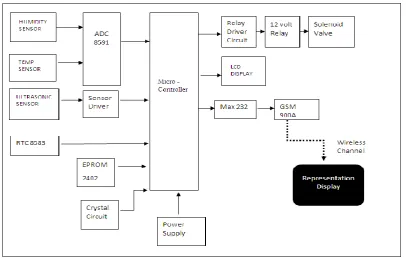
IV.BLOCK DIAGRAM
Figure 1. Block diagram of the system
V. WORKING OF SYSTEM
This is basically depends on three main section and every section is consist of an electronics concepts with his related technological tools. As per project requirement, three sections are:
1) Input section
2) Control and observation section 3) Output section
The following basic block diagram shows the basic blocks in our project.
Figure 2 Basic Building blocks
A. Input Section:-
The input section consist of different types of sensors for example humidity sensor, temperature sensor and ultrasonic sensor along with analog to digital converter (ADC) PCF8591.The 5V power supply is required to control the whole system so by using step down transformer 230V direct supply is converted into 12V.Ultrasonic sensor gives both the analog as well as digital output so, it is directly connected to the microcontroller.
B. Control and Observation Section:-
13
• The time and date of rainfall• The rainfall measured
The timer dedicated to the reception of massages the timer is set with a predefined interval i.e. there is a predefined time lapse between two ticks. Each time a tick occurs the communication object will be accessed. It will check if a new message has arrived. If there is no new message, it will leave the communication object and wait for the new object. The message can be of two types. It could either be a new message sent by the remote station or it could be a delivery report sent by the network to a message sent by the central station if a new message has arrived it will identify which type of a message it is. Then the information along withthe data contained in the message will be extracted. The extracted message will consist of the transmission time and date of message, the number or the address from which the SMS has been sent and the message embedded in the message. Then the next step is to verify that the message has been sent from a valid remote station. The extracted address or the number will be checked against the remote station addresses stored in the table Station Data. If the message is from a valid address, the extracted details (station name, date, time and rainfall will be placed in the Rainfall Data table. Otherwise, the message will be discarded. If it is a delivery report it will check what the delivery.
a) b)
Figure 3 LCD display a) Parameters b) Parameters reading
C. Output Section:-
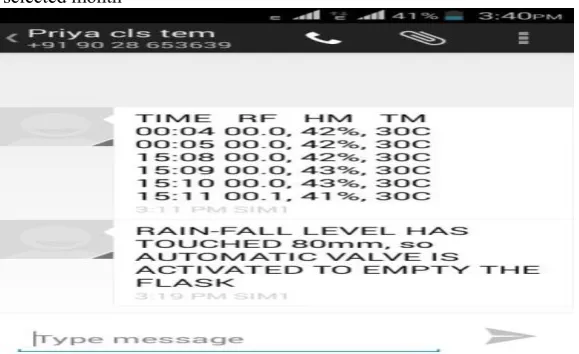
In this system by using ultrasonic sensor fixed at the top of flask. It will transmit the ultrasonic waves to the level of water surface and distance is calculated. This is the actual measurement of rainfall in mm. The LCD display is used to display the all the readings i.e. temperature in Celsius, humidity and rainfall. As RTC is used all the measurements are real time. The rainfall information collected is embedded in an SMS message, and is sent to the central station through the GSM radio module. The data transfer can be initiated either by the remote station or by a request from the central station. The user is given several options to select data such as,
• The rainfall report for a day
• The rainfall report for a selected area • The rainfall report for a selected month
14
15
VI.ADVANTAGES
1 Accurate data of rainfall for disaster management.
2 Used in all seasons entire the year
3 Ensures high performance
VII. SUMMARY:-
The paper describes the design and implementation of an automatic rainfall measurement system. The system comprises of remote unit i.e. ultrasonic sensor which measure rainfall and reports the measurements to a central station. The central station saves measurements received in a database. The communication between the remote and the central station is based on the available cellular infrastructure, and hence is reliable, and simple to use.
VIII. CONCLUSIONS:-
An Automated rainfall monitoring System is a more reliable and accurate way of monitoring the rainfall at any area compared to existing manual systems. This is particularly useful in remote areas that lack easy road access and manual measurement of rainfall is inconvenient. In areas where main power supply is not available, provision of solar power is planned to power the remote station. The main drawback of the system is its high dependability on the cellular infrastructure. But this has a significant advantage in that, by using the existing cellular infrastructure, the rainfall data communication inherits its reliability and coverage, which greatly simplifies the design. The remote station, built around the GSM module and peripheral interface circuitry, can be easily extended for evolution into a fully-fledged weather station, monitoring not only rainfall, but other environmental parameters such as humidity, temperature, etc. by incorporating appropriate sensors. Further, the data collected can be used for further benefits, not only to the agricultural sector, but also to society as large, can Prediction and warning of natural disasters such as floods and landslides be facilitated through analysis of data collected in a timely manner from a number of sensing stations.
REFERENCES
[1] Alkar, A. Z., & Buhur, U., “An Internet Based Wireless Home Automation System for Multifunctional Devices”, IEEE Consumer Electronics, 51(4), 1169-1174, Jan 2005.
[2] Ciubotaru-Petrescu, B., Chiciudean, D., Cioarga, R., &Stanescu, D., “Wireless Solutions for Telemetry in Civil Equipment and Infrastructure Monitoring”, 3rd Romanian-Hungarian Joint Symposiumon Applied Computational Intelligence (SACI) May 25-26,2006
[3] Gunawardena, et al. "An Automated Rainfall Monitoring System”, www.ent.mrt.ac.lk/dialog/publications.shtml [4] Conte, G., & Scaradozzi, D. (2003). Viewing home automat ion systems as multiple agents systems.