The Effect of System-Nested, Genre-Oriented,
Structurally-Mediated Model (SGSM) of Writing
Instruction, and Swalesian Model (SM) upon Iranian
Learners’ Writing Performance:
A Comparative Study
Alireza Amjadiparvar
Ph.D. Candidate of TEFL, Science and Research Branch, Islamic Azad University, Tehran, Iran
Parviz Maftoon*
Associate Professor of TEFL, Science and Research Branch, Islamic Azad University, Tehran, Iran
Massood Yazdanimoghaddam
Assistant Professor of TEFL, Islamic Azad University, Garmsar Branch
Abstract
The purpose of the present study was first to offer a tentative solution to the problems observed in writing pedagogy in Iran by devising a more comprehensive approach to genre-based writing instruction. In the second phase, a quasi-experimental research design was adopted to determine how effective the model was in writing instruction, compared with the traditional, product-oriented approach, as well as Swales’ genre-based approach. The participants were selected randomly and then divided into three groups: A control group (CG) (N=8) that received product-oriented instruction, Swales’ model (SM) group (N=8), and the system-nested, genre-oriented, structurally mediated model (SGSM) group (N=7). The results obtained through One-way ANOVA revealed that the SM group outperformed the CG group on the posttest of writing. Moreover, the SGSM group outperformed the other two groups on the posttest of writing. The pedagogical and theoretical findings of the study were then discussed.
Keywords: writing, genre-based instruction, system-nested, genre-oriented, structurally-mediated model
INTRODUCTION
Writing in any activity system, including the scientific disciplines, is one of the most prominent tools which is shaped by, and also shapes, the system and warrants its development. Despite the integral role writing adopts in and among various systems of activity (Y. Engeström, 1999), to the researchers’ best knowledge, no study has so far explored the role of context and different aspects of contextualized teaching of writing in Iran. Mostly, writing is taught through a manual dictating a prescriptive stance favored by both teachers and learners. Furthermore, a heavy reliance on product-oriented approaches to writing instruction and grammar is observed, while no functional approach is implemented to make the students appreciate the rhetorical purposes authentic texts serve and the functional choices writers opt for. What is more, the dominant approaches to writing pedagogy seem to be outdated. In view of this, Naghdipour (2016) has called for the necessity to “inform English language teachers and educators about the importance of advocating more realistic curricula and deploying more effective instructional approaches to better accommodate the learning needs of students in writing classes” (p. 82). Therefore, L2 writing pedagogy in Iran needs to be reevaluated in the light of more recent breakthroughs in writing scholarship.
Bhatia (2002) also calls for the necessity of a more comprehensive model of genre analysis.
From the discussions above, it can be concluded that drawing on one single model provides a deficient picture of genre knowledge. To develop a comprehensive model, the researchers explored three important elements of genre knowledge: social motivation and socially constructed elements, cognitive organizational structures, and actual linguistic realizations of the discourse. By integrating these three elements, it was hoped that the linguistic elements could be retained as the functioning features of a larger discoursal system.
PURPOSE OF THE STUDY
This study aims to offer a tentative solution to the current problem of the writing pedagogy in Iran, and to propose a more comprehensive model to teach writing genres. The validity of the model will then be put to test empirically.
After developing the model, the purpose of the study was to answer the following research question:
1. Does the employment of system-nested, genre-oriented, structurally-mediated model of writing instruction have any statistically significant effect on the writing performance of Iranian EFL learners compared with the control group?
2. Does the employment of Swalesian genre-based instruction have any statistically significant effect on the writing performance of Iranian EFL learners compared with the control group?
3. Does the employment of system-nested, genre-oriented, structurally-mediated model of writing instruction have any statistically significant effect on the writing performance of Iranian EFL learners compared with the Swalesian model group?
LITERATURE REVIEW
the role of context in writing as a system-nested conception will be highlighted. Following that, the literature on social and cognitive genre models will be discussed. Next, the role of intra-sentential structures in establishing coherence will be clarified. Finally, the model will be proposed based on the discussions.
Context as a System-Nested Conception
“Embeddedness” or “situatedness” of language is the shared premise of the three camps of genre analysis (i.e., Systemic Functional Linguistics, New Rhetoric, and English for Specific Purposes). They unanimously hold that language is functionally motivated, and this “motivatedness” connects text to context. Context itself has both a broad and a narrow sense. In its broad sense, context is defined in sociocultural and historical terms. Its narrow sense, however, considers only the immediate context (Halliday, 1978).
Despite having this common premise, they have never devised or utilized a comprehensive theory of context which can account for the truth of context and “motivatedness.” Probably, the only model in which context is incorporated as a component is Bruce’s (2008) “social genre/cognitive genre model” in which Widdowson’s (2004) approach to context (i.e., specialist knowledge of a field and its particular language) is applied. This choice serves the model’s purpose well as it aims to facilitate academic writing instruction. Nonetheless, the model seems to have a narrow scope and cannot account for writing in other domains.
In “activity theory,” context is represented as a dynamic process in which language/writing is employed as a tool to set the social activity in motion (R. Engeström, 2005; Leont’ev, 2001; Luria, 2005). Given the premise of the theory that activities are embedded in socio-historical and cultural networks containing specific settings and motives, it is considered to be quite comprehensive and effective in pedagogical settings (see Cole & Engeström, 1993).
writings (Y. Engeström, 1999). Subjects in an activity system, according to Y. Engeström (1999), are regarded as agents who can have their own voice and ways of expression provided the system keeps achieving desirable outcomes. Therefore, individuality of subjects is preserved along with their collective identity. Through an activity-nested genre model, learners may better recognize what individual/collective contributions can help the system achieve the expected outcomes. Activity theory asserts that the act of an individual is extracted from the collective social act of the system. Further, from an activity theory perspective, texts are not standalone entities; rather, they are voices in ongoing dialogues within and between subjects and activity systems. From this perspective, context is a negotiated concept which can be collectively constructed, deconstructed, and reconstructed. Considering this, activity theory provides a more dynamic context through which the rigidity of classroom objectives and activities can be transcended (Kain & Wardle, 2005). In addition, Kain and Wardle (2005) state that activity theory can “extend students’ repertoire of analytical skills from a focus on texts and audience to a focus on context and the role of texts in mediating activities” (p. 114).
According to Widdowson (2004), establishing a context is “a discourse process engaged in by the participants themselves in the online achievement of pragmatic meaning” (p. 54). The authors of this article also believe that, in the processes of text production, writers fall back on contextual factors to decide on the generic/discoursal values of their opted constructs/elements. Since the assumption underlying the current study is that genre can be aptly understood and used if student writers acquire in-depth knowledge of context, it is suggested that learners be given some enquiry questions to interrogate the context of the genre they require to learn. The questions, nonetheless, cannot be fixed since different activities necessitate different questions. However, corresponding to the three levels of any activity system, there can be at least three types of questions: why-questions, what-why-questions, and how-questions. It is believed that such questions will provide a heuristic frame for the analysis of activity-nested contexts students might come up with. The answers given by course members can undergo as many adaptations as possible until improved responses are provided collectively.
Genre Models: Social and Cognitive
Genres can be put in two broad categories: social genres and cognitive genres:
Social genre refers to socially recognized constructs according to which whole texts are classified in terms of their overall social purpose. Purpose here is taken to mean the intention to communicate consciously a body of knowledge related to a certain context to a certain target audience. Cognitive genre refers to the overall cognitive orientation and internal organization of a segment of writing that realizes a single, more general rhetorical purpose [such as] to recount a sequence of events, to explain a process, to present an argument. (Bruce, 2014, p. 88)
Social genres and cognitive genres are not mutually exclusive categories, but two complementary approaches to examining the discoursal and textual elements of a genre (Bruce, 2008).
In the rhetorical taxonomies, the eight categories of report, recount, narrative, procedure, explanation, argument, response, and discussion are shared. They are named and defined in terms of their general rhetorical functions and staged structures.
Intra-Sentential Structures: T-unit as a Functional Unit in Discourse
Apart from the above-mentioned taxonomies, a linguistic theory of text organization needs to be incorporated in the model. One functionalist theory of text structuring is “Rhetorical Structure Theory” (henceforth RST) (Mann & Thompson, 1987). Since the rhetorical relations presented in Mann and Thompson’s work contain a disorganized and open-ended inventory, relevant relations are supposed to be opted out of this list. Therefore, the researchers critically studied the existing RST taxonomies (e.g., Halliday & Hasan, 1976; Hobbs, 1985; Longacre, 1983; Mann, 2005; Nicholas, 1994) to find or come up with a comprehensive taxonomy. To be useful, as Nicholas (1994) argues,
a rhetorical taxonomy should satisfy three criteria. It should be comprehensive, covering the entire rhetorical inventory. It should be externally motivated by some independent classificatory criteria, rather than empirically derived; otherwise, it is not falsifiable, and thus not scientific. And it should be feature-based to allow classes of relations and generalisations about relations to be formulated easily and flexibly, along more than one taxonomical dimension. (p. 29)
refers to the piece of text occurring between two full-stops. It normally contains one finite verb, having superordinate relationship with any other possible finite verbs which may exist in the unit. It may also carry more than one finite verb having coordinating relationship with one another. (p. 5)
Therefore, the next stage of the model deals with how a T-unit, as a functional unit in discourse, is structured.
For a genre model to be pedagogically viable, it needs to deal not only with the macro-syntax of discourse, but also with the micro-syntax of sentences (van Dijk, 1977), hence the need for an add-on to the prospective model. As noted above, any textual choice opted for by any author in any given text is socio-contextually motivated. This motivatedness spreads over the whole text from its smallest building blocks, i.e., T-units, to its larger units, i.e., paragraphs, through to the totality of the whole block, i.e., the text. So far, the last two have been explicated. In this section, the authors intend to demonstrate how a T-unit is discoursally/functionally structured. To this end, Lotfipour-Saedi’s (2016) discoursal approach is adopted, in which the types and textual forms within T-units are functionally defined.
or coordinating one (hypotactic or paratactic), lexical density, use of connections, etc” (p. 5).
Following Lotfipour-Saedi (2016), the authors of the present study believe that conscious attention to the structural configurations of T-units can raise learners’ awareness about the rhetorical arrangement of English sentences. However, it is claimed that such awareness is better achieved if learners are familiarized with the system-nested context where their texts will be used.
THE PROPOSED MODEL
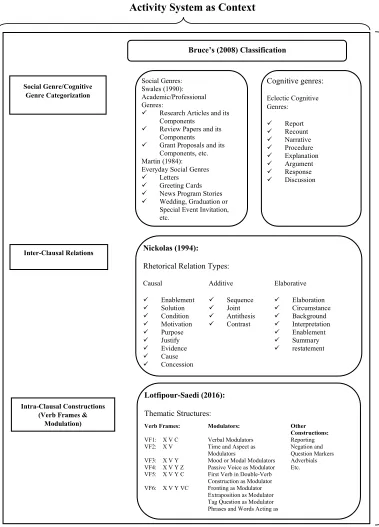
The proposed model has five intertwined components which are separable in theory. However, when applied, no borderline can be drawn between them. The first component (i.e., context and its ingredients) lays the foundation upon which the other components can gain sense. As discussed earlier, the theory which offers an exhaustive account of context is Activity Theory (R. Engeström, 1991; Leont’ev, 1978) whose unit of analysis is activity system defined as “any ongoing, object directed, historically conditioned, dialectically structured, tool-mediated human interaction” (Russell, 1995, p. 51).
To enrich the model, linguistic/formal features of a genre should be addressed as well. In the proposed model, therefore, it is attempted to show how activity system, genre, and text are meaningfully inter-connected by incorporating some genre and linguistic theories into the model.
In the first stage, Bruce’s (2008) social genre/cognitive genre classification is adopted. To characterize social genres, Martin’s (1987/1389, 1992), and Swales’ (1990) approaches are resorted to. Cognitive genres, however, are described using an eclectic taxonomy in which eight genre types (report, recount, narrative, procedure, explanation, argument, response, and discussion) are defined and described in terms of their rhetorical patterns. The main reason for incorporating both social and cognitive genres in the model is the belief that student writers will be better informed about the communicative process of text production when they consciously attend to both genres as inclusive parts of a textual phenomenon.
describe this connectedness, RST is incorporated into the model to explain how text coherence in discoursally achieved. This theory elucidates coherence by positing texts as hierarchically connected structures. In RST, discourse is defined in terms of nuclearity. According to Taboada and Mann (2006), two types of units are established in RST analyses: nuclei and satellites. Nuclei are the focal parts of a text in which writers’ purposes are encoded, while satellites are on the periphery contributing to the nuclei.
To make the model pedagogically viable, an extension was added to it, whose aim was to describe the informational structure of T-unit constructions. Figure 1 illustrates the devised model and its components. This model is named “system-nested, genre-oriented, structurally-mediated model” (henceforth SGSM).
Activity System as Context
Bruce’s (2008) Classification
Cognitive genres: Eclectic Cognitive Genres: Report Recount Narrative Procedure Explanation Argument Response Discussion Social Genres: Swales (1990): Academic/Professional Genres:
Research Articles and its
Components
Review Papers and its
Components
Grant Proposals and its
Components, etc. Martin (1984): Everyday Social Genres
Letters
Greeting Cards
News Program Stories
Wedding, Graduation or
Special Event Invitation, etc.
Social Genre/Cognitive Genre Categorization
Inter-Clausal Relations Nickolas (1994):
Rhetorical Relation Types:
Causal Additive Elaborative
Enablement Solution Condition Motivation Purpose Justify Evidence Cause Concession Sequence Joint Antithesis Contrast Elaboration Circumstance Background Interpretation Enablement Summary restatement Lotfipour-Saedi (2016): Thematic Structures:
Verb Frames: Modulators: Other Constructions:
VF1: X V C Verbal Modulators Reporting
VF2: X V Time and Aspect as
Modulators Negation and Question Markers
VF3: X V Y Mood or Modal Modulators Adverbials
VF4: X V Y Z Passive Voice as Modulator Etc.
VF5: X V Y C First Verb in Double-Verb Construction as Modulator VF6: X V Y VC Fronting as Modulator
Extraposition as Modulator Tag Question as Modulator Phrases and Words Acting as
Intra-Clausal Constructions (Verb Frames &
Modulation) O pt in g f or F un ct io na lly a pt N om en cl at ur e
METHOD Participants
Twenty-five Iranian MA graduates of TEFL from Islamic Azad University, Sanandaj Branch, participated in this study. The participants consisted of both males and females ranging in age from 25 to 33. They were selected randomly. After administrating the Oxford placement Test (OPT) and analyzing the data, two scores were identified as outliers. The remaining 23 participants were randomly divided into three groups including Control group (CG) (N = 8), Swalesian Model (SM) group (N = 8) and System-nested, Genre-oriented, Structurally-mediated (SGSM) group (N = 7). The CG received product-oriented instruction; the SM group received instruction informed by Swalesian approach; and the SGSM group was taught through the developed model. Moreover, the teacher of the course was a non-native speaking teacher of English who possesses an M.A. in TEFL. Three raters also assisted the researchers in scoring the writing pretest and posttest papers. These three raters were TEFL PhD holders with the teaching experience ranging from 7 to 12 years. All three had taught different courses at the university, including general English courses for non-TEFL university students and courses specific to TEFL, translation, and literature.
Instruments
To collect the required data for the present study, two instruments were utilized: (a) OPT, and (b) three writing assignments. Moreover, a set of heuristic questions based on the content of instruction were presented to participants of the SGSM group.
Oxford Placement Test (OPT)
Oxford Placement Test (Allan, 2004) was administered to make sure the participants were relatively homogeneous regarding L2 proficiency. It includes 200 items, measuring the skills of listening, grammar, vocabulary, and reading.
Writing Pretest and Posttest
two introductions, one as a pretest before the treatments and one after the treatments as posttest. Their writings were scored by three independent raters.
Heuristic Questions and Tasks
In different stages of instruction, learners were given some questions. For instance, while addressing the issue of system as context in the realm of Teaching English to Speakers of other Languages (henceforth TESOL), the following questions were posed:
1. What sort of activity is TESOL? (ACTIVITY)
2. Who is involved in carrying out TESOL? (SUBJECTS)
3. By what means are the subjects carrying out TESOL? (TOOLS)
4. Why is TESOL taking place? (OBJECT)
5. What is the desired outcome of TESOL? (OUTCOME)
6. Are there any disciplinary norms, rules and regulations governing the performance of TESOL? (RULES)
7. What is the environment in which TESOL is being carried out? (COMMUNITY)
8. Who is responsible for what, when carrying out TESOL, and how are the roles organized? (DIVISION OF LABOR)
Scoring Scheme
To rate the writing pretests and posttests, a scoring scheme was developed. The scoring scheme consisted of six criteria:
• Inclusion of the required moves and steps for the introduction section based on Swales’ (1990) model
• Appropriacy of inter-clausal relations (Causal, Additive, and Elaborative) used in paragraphs
• Variety of clause types used in each paragraph of the introduction section
• Appropriate Use of Modulators
• Appropriate Diction
• Overall Impression
TEFL Ph.D. holders and their comments regarding the content were addressed. To make sure that the scheme was reliable enough, three raters scored the participants’ written products and inter-rater reliability was established.
PROCEDURE
The participants took an academic writing course whose aim was to teach how to write a research paper. In the CG group, the product-based approach was implemented. In the SM group, the Swales’ (1990) genre approach was employed, and in the SGSM group, the developed genre model was used.
The student writers in each of the groups were required to write a paper-friendly introduction based on their theses as the pretest of writing. The guidelines provided to write the first draft of the introduction were the same in all the three groups. This assignment started in the class, but students were allowed to finalize the task at home. The deadline to deliver their assignment was set four days, and they all worked to deadline. It was made clear to the participants that their written introductions would be confidentially assessed. The final version of their written introductions were independently scored by three expert raters. The scores assigned by the three raters were found to enjoy high inter-rater reliability. The results of statistical analysis indicated that the inter-rater reliability indices were above .70 which are considered satisfactory.
The scores of the three groups on the writing pretest were analyzed via running one-way ANOVA to make sure the three groups were not significantly different in terms of their writing performance prior to the treatment and after that the instructional processes initiated. The courses involved 90-minute English classes for eight weeks. The aim of all the classes was to help participants improve their writing ability by means of different models of instruction.
paragraphs in the introduction sections for the articles. Finally, the participants were asked to write an introduction. The learners in this group were not given explicit feedback and their written products were simply scored and returned to them.
Treatment in the SM Group
The teaching cycle in the SM group comprised of three stages: (1) the instructor modeled the text (i.e., an article introduction). The schematic structure (i.e., Create a Research Space (CARS) model) (see Swales, 1990), and linguistic features of the text (i.e., lexico-grammatical features such as verb tenses, discourse markers, etc.) were described through analyzing authentic samples in the class. Enough oral descriptions of such features were provided to direct the participant’s attention to the generic and linguistic features of the sample texts. To do so, the moves of the introduction section of research articles were put on the board and the instructor explained each move via examples. Several samples of introduction sections of articles in the field of applied linguistics were analyzed and the respective moves in the introductions were identified. Then, these samples were given to the participants and the instructor fully elaborated on the moves and their functions based on Swales’ (1990) model. Following that, the learners were given the introduction section of a research article and asked to identify the moves. Finally, their identified moves were checked as a class; (2) students were asked to follow the schematic structure of the sample introductions and to collaboratively rewrite the introductions they wrote as pretest; and (3) students were required to write an research article introduction based on their theses as a posttest, but this time individually.
Treatment in the SGSM Group
of the following ways: (1) interview experienced/informed subjects, (2) read relevant books, handbooks, and articles, (3) join on-line discussion groups, (4) contact the system members who have made successful contributions to the system, etc. To continue the discussions, an online group was formed on Telegram by the teacher. The next class meeting was held a week later. During that week, all the course members shared their findings in the group and the discussions continued. The discussions finally amounted to some conclusions such as (a) TESOL is a general field of study and research whose purpose is to find efficient ways to facilitate language learning and teaching; (b) TESOL is a broad field of study and research to which a multitude of people can effectively contribute, such as TESOL researchers/authors (e.g., graduate students, and professors), and TESOL practitioners (e.g., syllabus designers, curriculum developers, textbook writers, and teachers); and (c) TESOL can be carried out through various means including books, research projects, theses, dissertations, book reviews, seminars, conferences, review papers and research articles.
Some members, however, raised concerns regarding the use of such discussions and conclusions. Therefore, the instructor decided to clarify the objectives of such discussions. During the next session, a lecture was given by the first author on how context familiarity can help learners write effectively. In the lecture, the instructor attempted to explain the components of an activity system including tools, subjects, rules, community, division of labor, object, and outcome (see Y. Engeström (1999) for further information), and relate them to how they can determine the success of a text both as an outcome and a tool. At the end of the session, the students were asked what part of the lecture attracted their attention and how it could help them become better writers.
some informed conclusions were drawn such as: (a) an article can have one or a limited number of purposes which are all well-established within TESOL; (b) generally, there are five to nine sections in each article: Abstract, Introduction, Methodology, Results, Discussion, Conclusion, Implications, References, and Appendices; (c) the articles follow somewhat the same arrangement though variations could be observed; (d) such a pattern is a rule conventionally laid down by expert subjects; (e) in the introduction section, one can understand the whole plot and purpose of the article, and its main purpose seems to be twofold: to situate the research is an established territory and to state the problem.
The learners’ responses indicated that they had become more conscious about the processes and motivations behind a text. The next session, the participants were required to read the introduction they handed in as pretest and to see if they could perceive the same information they found in the sample article introductions. They started to humorously criticize their own pieces of writing and seemed highly amused to find how their texts deviated from the samples. This activity paved the way for the teaching of the Swales’ (1990) CARS model. Swales describes three “moves” (i.e., establishing a territory, establishing a niche, and occupying a niche) that almost all research introductions include. In the first move, which might entail the three steps of claiming centrality, making topic generalizations, and reviewing previous items of research, the author sets the context for his or her research, providing necessary background on the topic. In the second move, the author argues that there is an open “niche” in the existing research, a space that needs to be filled through additional research. This move can be comprised of four steps: counter-claiming, indicating a gap, question-raising, and continuing a tradition. In the third move, the author turns the niche established in Move 2 into the research space that he or she will fill and this is usually done in three steps: outlining purpose/announcing present research, announcing principle findings, and indicating the structure of the research article.
introductions they had already written using the pattern they believed would serve their purpose best. In the next session, they all had a revised copy of the written introductions. Forty minutes was spent on checking how and why they changed the pattern of their previous introductions. They were not quite satisfied with the outcomes, though. The instructor tried to discover the reasons behind students’ discontent. One reason was that although the patterns were changed, the students felt their re-written introductions still suffered from discontinuity. What they were worried about seemed to be the issue of coherence which is attended to in the proposed model through RST relational structures. The instructor decided to make the next transition to what RST has to offer regarding the issue of coherence.
assignment, they were demanded to give a report of what they found in the texts regarding verbal modulators.
After four sessions, the participants were required to re-write their introductions but this time attend to intra-sentential structures. A sample was done in the class as a model. In the following session, their rewritten introductions were collected and two of them were analyzed and discussed in the class. Their changes, as well as the reasons behind those changes, were discussed. One of the palpable improvements was the conscious use of modulators. Another was the use of more complex sentence structures in which adverbials were included. As it was the last session of the class, they were requested to go through all the points they had learned in the course and deliver a finalized version of their introductions the day after as the posttest. Their finalized introductions were collected and submitted to the same three raters to be scored.
RESULTS
The current study aimed at discovering if the use of SGSM has any statistically significant effect on the writing performance of Iranian EFL learners. Moreover, the study attempted to probe if the employment of Swalesian genre-based instruction has any statistically significant effect on the writing performance of Iranian EFL learners. Finally, the study sought to examine any significant differences between the effects of the SGSM and SM on the writing performance of Iranian EFL learners.
Initially, it was necessary to make sure that the participants in CG, SM and SGSM groups were not significantly different in terms of their writing performance prior to the experimentation. To do so, a One-way ANOVA was run on the pretest scores of the three groups. Table 1 displays the descriptive statistics for the pretest writing scores.
Table 1: Descriptive Statistics for the Writing Pretest scores of the Groups
Groups Mean SD N
W_Pre_Mean CG 45.38 5.625 8
SM 46.59 5.630 8
SGSM 44.54 4.094 7
As Table 1 presents, the mean scores of the three groups on pretest were not substantially different. To find if the differences among the means are statistically significant, a One-way ANOVA was run on the pretest writing scores. Prior to running ANOVA, the homogeneity of variances was checked. Table 2 illustrates the results of Leven’s test for the homogeneity of variances for the pretest writing scores.
Table 2: Leven’s Test for the homogeneity of Variances for the Pretest Writing Scores
Test of Homogeneity of Variances
Levene Statistic df1 df2 Sig.
8.977 2 21 .187
As Table 2 shows, the level of significance equals 0.187 meaning that the variances of the three sets of scores meet the homogeneity assumption. Therefore, one-way ANOVA was run on the obtained scores to detect any significant differences among them. Table 3 shows the results of ANOVA for the writing pretest scores.
Table 3: Results of One Way ANOVA for the Writing Pretest Scores
ANOVA Scores for the Three Groups
Sum of Squares df Mean Square F Sig. Between Groups 154.205 2 77.103 .645 .378 Within Groups 4370.462 23 121.402
Total 4524.667 35
Since the significance value in Table 3 equals .536, it can be concluded that there was not any significant difference among the three groups in terms of their writing performance prior to the experimentation.
After making sure that the three groups were not significantly different in terms of writing performance, the experimentation started. After the study ended, the learners were given the writing posttest and the scores of the writing posttest were analyzed to find answers to the research questions. Table 4 illustrates the descriptive statistics for the posttest writing scores.
Table 4: Descriptive Statistics for the Writing Pretest scores of the Groups
W_Post_Mean CG 44.58 5.362 8
SM 55.79 3.972 8
SGSM 65.29 4.482 7
Total 54.78 9.641 23
Before running ANOVA, the assumption of homogeneity of variances was checked. Table 5 displays the results of Leven’s test for the homogeneity of variances for the posttest writing scores.
Table 5: Leven’s Test for the homogeneity of Variances for the Posttest Writing Scores
Test of Homogeneity of Variances
Levene Statistic df1 df2 Sig.
9.321 2 21 .321
As Table 5 illustrates, the level of significance is 0.321 indicating that the variances of the three sets of scores meet the homogeneity assumption. Therefore, one-way ANOVA was run on the posttest scores to detect any significant differences among them. Table 6 demonstrates the results of ANOVA for the writing posttest scores.
Table 6: Results of One Way ANOVA for the Writing posttest Scores
Sum of Squares df Mean Square F Sig. Between Groups 164.230 2 295.278 7.263 .005 Within Groups 4380.233 23 47.922
Total 5444.463 25
The results of ANOVA showed that there were significant
differences among the three groups on the writing posttest (F=7.26, P≤0.05).
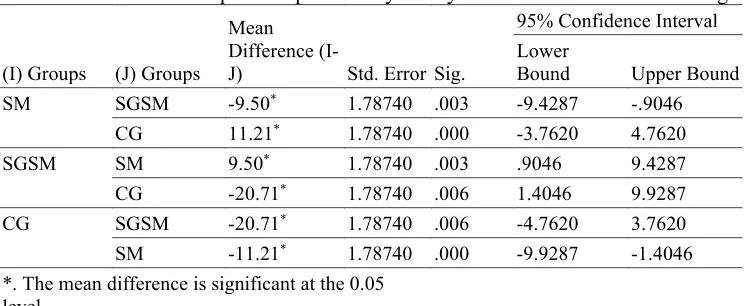
Table 7: Result of Multiple Comparisons by Tukey Test on the Posttest of writing
(I) Groups (J) Groups
Mean Difference
(I-J) Std. Error Sig.
95% Confidence Interval Lower
Bound Upper Bound SM SGSM -9.50* 1.78740 .003 -9.4287 -.9046
CG 11.21* 1.78740 .000 -3.7620 4.7620
SGSM SM 9.50* 1.78740 .003 .9046 9.4287
CG -20.71* 1.78740 .006 1.4046 9.9287
CG SGSM -20.71* 1.78740 .006 -4.7620 3.7620
SM -11.21* 1.78740 .000 -9.9287 -1.4046
*. The mean difference is significant at the 0.05 level.
Answering the Research Questions
The first research question of the present study aimed to examine whether employment of the newly-developed genre model has any statistically significant effect on the writing performance of Iranian EFL learners. Table 7 shows that the difference between the means of the SGSM group and the CG group was statistically significant (p = .006 < 0.05). Thus, it can be inferred that the SGSM group in which the proposed model was implemented outperformed the CG group on the writing posttest. It can therefore be concluded that the employment of the system-nested, genre-oriented, structurally-mediated model had a statistically significant effect on the writing performance of EFL learners in Iran.
The third research question of the current study aimed at finding if employment of system-nested, genre-oriented, structurally-mediated model has any statistically significant effect on the writing performance of Iranian EFL learners compared with the Swalesian model. As Table 7 shows, the difference between the means of the SM group and the SGSM group was statistically significant (p = .003 < 0.05). Thus, there was a significant difference between the effects of the developed genre model and Swalesian genre-based instruction on the writing performance of EFL learners in Iran. Moreover, as Table 6 shows the mean scores for participants in the SGSM group was higher than the that of the SM group one (65.29>55.79). Therefore, students in the SGSM group who were exposed to SGSM outperformed the SM group.
DISCUSSION
In the first stage of this study a tentative model of writing instruction was developed and proposed. In the development of the model, the following elements were included: activity system theory to account for the conception of context, social genre/cognitive genre classification to integratively account for the probable genre-types, rhetorical structure theory to define the rhetorical relations which lead to text coherence, and inter-clausal constructions which form the building blocks of a text.
In the second stage, the study explored how this model which is called “system-nested, genre-oriented, structurally mediated model,” helped student writers develop their genre awareness, and writing performance as they engaged in system-situated writing activities that incorporated writing the “introduction” section of thesis-extracted research papers. To this end, a sample of 23 Iranian MA graduates of TEFL were randomly assigned to three groups of CG, SM and SGSM. The participants in the SGSM group were exposed to writing instruction through the developed model, the SM group received instruction informed by Swalesian approach, while the control group received product-oriented instruction. The results indicated that the learners instructed through SGSM significantly outperformed the learners in the other groups.
engaged in various stages of the instruction, they appeared to have developed a keener awareness of the context involving the participants, goals and audience of a text and gained a much clearer understanding of how genre and language are used accordingly. The results suggest that, as Mitchell, Ryan, and Miller (2018) observed in their study, resorting to genre to explicitly instruct disciplinary writing can help student writers to show significant gains. The positive effect of system-nested instruction of writing is corroborated by the findings reported by Parkinson, Demecheleer, and Mackay (2017). In their study, they demonstrated how system-situatedness helped writing trainees produce improved impersonal writings as they matured in that very system of activity. The findings published by Wang (2017) also supports those of the current research. In his study, Wang confirmed that genre can more effectively be acquired if learners actively participate in academic and professional systems of activity they are supposed to be a member of. The results of this study is also corroborated by Negretti and McGrath (2018) who reported that an integrated understanding of genre among the student writers encouraged them to use this knowledge as a tool for writing. The findings of the current research is also underpinned by Wette’s (2017) conclusion that synthesizing multiple dimensions of genre knowledge can enhance students’ generic competence and accordingly their writing performance. In the second stage of the proposed model, coherence was targeted through RST. The results gained in this study can partly be assigned to the students’ increased awareness of coherence through this stage of instruction. This claim and also the findings of the study are supported by the findings of the research carried out by Crossley and McNamara (2016) in which they have reported that learners’ raised consciousness of the coherence-inducing features led them to producing writings of better quality.
participants who had received genre-based instruction had improved in their ability to demonstrate all the rhetorical and linguistic conventions of a literary criticism piece of writing. Likewise, Bae’s (2012) findings revealed the experimental group, provided with explicit genre-based instruction, showed statistically significant improvement in their writing ability.
CONCLUSION AND IMLICATIONS
Given the results of our study, we can conclude that SGSM might make positive contributions to the teaching and learning process and its success can be attributed to its continued emphasis on meaningfulness/purposefulness of the activities carried out in the class. Its success can also be related to the raised consciousness of the students about the typical stages and features of the genres under instruction. It is assumed that such consciousness can help students create texts which are perceived by readers as well-formed and appropriate.
The proposed model offers several distinctive features which allow learners/student writers to deliver more polished instances of writing performance. The most outstanding feature is the inclusion of a versatile, multi-layered, multi-component, and comprehensive framework in which the issue of context can be explored, defined, comprehended, and deployed effectively throughout the course of instruction. Nested in such a framework, student writers seem to be actively involved in the process of learning in general and writing in particular. Given that the purpose is defined as being system-driven, learners’ top mission throughout the course and even beyond it is to acquire a knowledge of what the system entails, how it works, and what purposes it pursues. The further the student authors find themselves assimilated in the system, the more they seem to find the task of writing meaningful. Being obsessed with the system as a purposeful unit of activity, student authors seem to adopt a broadened perspective which gives them the resources required to effectively examine their actions and choices in the context of that system. This context-rich frame of mind makes learners extract or even, at times, assign sense/purpose to the textual options and preferences. That might be the rationale behind the learners’ serious commitment to what they were required to do during the course.
instruction, where generic patterns, rhetorical constructions, and T-unit configurations were being explored, discussed and taught, unlike the other two classes, no confusion could be perceived. This might be indicative of how effective system familiarity can be in writing pedagogy. From the biggest unit of discourse (i.e. text) to the smallest one (i.e. clause), all the textual decisions and options are rendered and perceived as being functionally motivated. This seems to partially justify why learners in the SGSM group outperformed the other two groups in the study. Seemingly, the instructions provided to the learners in the SGSM group has increased their awareness concerning different elements existing in the introduction section of the article both at the textual and extra-textual levels which has, in turn, drawn the students’ attention to these elements and has caused their better performance on the posttest. This raised consciousness facilitates instruction and learning since less time and energy can be spent to draw the learners’ attention to the formal/structural/organizational features of the genre they intend to learn. This attention to different features of the text can provide learners with consciousness about form and this raised consciousness in the proposed model is taken to be the prerequisite for learning to take place in the other stages. It is worth mentioning that, since learners educated in a system-nested, genre-oriented, structurally-mediated writing pedagogy seem to gain higher degrees of consciousness and proficiency, the probability of their maintaining efforts to further climb the social ladder in that very system might increase.
Taken together, teaching the writing skill through this model seems to offer several advantages over the other two approaches to writing pedagogy: Firstly, it helps both teachers and learners gain a profound understanding of the context in which learners are supposed to do writing; secondly, it helps both teachers and learners concentrate on larger language units; thirdly, organizational patterns and elements of written discourse are meaningfully attended to; and finally, linguistic components are treated as functioning features of a larger unit of discourse and this seems to avoid atomistic handling of language teaching.
the model to be further validated, more research studies are required in various domains. The model proposed in this research seems to serve various purposes, hence multifunctional. The potential applications it can have are as follows: 1.This model might be found effective in teaching the skill of reading as well, especially in the domains of ESP, EAP and EOP; 2. It can be used to do genre analysis of various text types/genres; 3. The results of the analyses can be used to design genre-based, rhetoric-based, and even form-based functional tasks which can be used to design syllabi and write textbooks; 4. Comparative genre analysis of various genres/text types can be carried out; 5. The issues of text complexity and text difficulty can take on a new aspect if defined in terms of this model; and 6. If the model is proved to be pedagogically effective, it can be resorted to in teacher-training courses. Then, its effect on teachers’ perspectives and instructional preferences/strategies can be explored through observation and interview.
References
Allan, D. (2004). Oxford placement test. Oxford: Oxford University Press. Bae, H. J. (2012). The effectiveness of genre-based L2 writing instruction
on Korean middle school students' writing ability. English Teaching, 67(3), 147-185.
Bhatia, V. K. (2002). Applied genre analysis: A multi-perspective model. Ibérica, 4, 3-19.
Bhatia, V. K. (2004). Worlds of written discourse: A genre-based view. London: Continuum International.
Bruce, I. (2008). Cognitive genre structures in methods sections of research articles: A corpus study. Journal of English for Academic Purposes, 7, 38-54.
Bruce, I. (2014). Expressing criticality in the literature review in research article introductions in applied linguistics and psychology. English
for Specific Purposes, 36, 85–96. doi:10.1016/j.esp.2014.06.004
Butt, D., Fahey, R., Feez, S., Spinks, S., & Yallop, C. (2000). Using
functional grammar: An explorer's guide (2nd ed.). Sydney: National
Cole, M., & Engeström, Y. (1993). A cultural-historical approach to distributed cognition. In G. Salomon (Ed.), Distributed cognitions (pp. 1-64). New York, NY: Cambridge University Press.
Crossley, S. A., & McNamara, D. S. (2016). Say more and be more coherent: How text elaboration and cohesion can increase writing quality. Journal of Writing Research, 7(3), 351-370. doi:10.17239/jowr-2016.07.03.02
Derewianka, B. (1990). Exploring how texts work. Sydney: Primary English Teaching Association.
Engeström, R. (1991). Reconstructing organizational memory in a health center. Multidisciplinary Newsletter for Activity Theory, 9(10), 20– 26.
Engeström, R. (2005). Polyphony of activity. In J. L. Y. Engestrom, & G. Ruckriem (Ed.), Putting activity theory to work (pp. 49–74). Berlin: ICHS.
Engeström, Y. (1999). Introduction. In Y. Engestrom, R. Miettinen, & R. L. Punamaki (Eds.), Perspectives on activity theory (pp. 1-16). Cambridge: Cambridge University Press.
Halliday, M. A. K. (1978). Language as social semiotic: The social
interpretation of language and meaning. London: Edward Arnold.
Halliday, M. A. K., & Hasan, R. (1976). Cohesion in English. London: Longman.
Hobbs, J. R. (1985). On the coherence and structure of discourse. Report No. CSLI-85-7. Centre for the Study of Language and Information, Leland Stanford Junior University.
Hyland, K. (2007). Genre pedagogy: Language, literacy and L2 writing instruction. Journal of Language Writing, 16, 148-164.
Johns, A. M. (2011). The future of genre in L2 writing: Fundamental, but contested, instructional decisions. Journal of Second Language
Writing, 20, 56–68. doi:10.1016/j.jslw.2010.12.003
Knapp, P., & Watkins, M. (1994). Context-text-grammar: Teaching the genres and grammar of school writing in infant and primary
classrooms. Broadway: Text Productions.
Knapp, P., & Watkins, M. (2005). Genre, text, grammar: Technologies for
teaching and assessing. Sydney: University of New South Wales
Press.
Latour, B. (1994). We have never been modern. Hertfordshire: Harvester Wheatsheaf.
Lee, K. (2006). The effect of genre-based instruction: Improving English writing ability in the classroom. English Teaching, 61(1), 257-282. Leont’ev, A. N. (1978). Activity, consciousness, and personality.
Englewood Cliffs, NJ: Prentice-Hall.
Leont’ev, A. N. (2001). Lectures on general psychology. Moscow: Smysl (in Russian).
Longacre, R. E. (1983). The grammar of discourse. New York, NY: Plenum.
Lotfipour-Saedi, K. (2015). Suggestions toward some discourse-analytic approaches to text difficulty: with special reference to ‘T-unit configuration’ in the textual unfolding. Iranian Journal of Language
Teaching Research, 3(1), 1-18.
Lotfipour-Saedi, K. (2016). Towards the textuality of a text: A grammar for
communication. Tabriz: Zaban Academic Publishing.
Luria, A. R. (2005). The making of mind: A personal account of Soviet psychology. In K. L. M. Cole, & A. R. Luria (Ed.), The autobiography of Alexander Luria: A dialogue with “The Making of
Mind.”. Mahwah, NJ: Erlbaum.
Macken-Horarik, M. (2002). “Something to shoot for”: A systemic functional approach to teaching genre in secondary school science. In A. M. Johns (Ed.), Genre in the classroom: Multiple perspectives (pp. 14–42). Mahwah, NJ: Lawrence Erlbaum Associates.
Macken, M., Kalantzis, M., Kress, G., Martin, J. R., Cope, W., & Rothery, J. (1989). A genre-based approach to teaching writing, Years 3-6,
Book 4: The theory and practice of genre-based writing. Sydney:
Mann, W. C., & Thompson, S. A. (1987). Rhetorical structure theory: A
theory of text organization. ISI Reprint Series ISI/RS–87–190.
Retrieved from Marina del Rey (California):
Martin, J. R. (1987). Factual writing: Exploring and challenging social
reality (2nd ed.). Geelong: Deakin University Press.
Martin, J. R. (1992). English text: System and structure. Philadelphia, PA: John Benjamins Publishing Company.
Martin, J. R. (2000). Design and practice: Enacting functional linguistics.
Annual Review of Applied Linguistics, 20, 116-126.
Mitchell, T. D., Ryan, T., & Miller, R. T. (2018). Scaffolding the argument genre in a multilingual university history classroom: Tracking the writing development of novice and experienced writers. English for
Specific Purposes, 50, 81–96. doi:10.1016/j.esp.2017.12.002
Naghdipour, B. (2016). English writing instruction in Iran: Implications for second language writing curriculum and pedagogy. Journal of
Second Language Writing, 32, 81–87.
doi:10.1016/j.jslw.2016.05.001
Negretti, R., & McGrath, L. (2018). Scaffolding genre knowledge and metacognition: Insights from an L2 doctoral research writing course.
Journal of Second Language Writing, 40, 12-31.
doi:https://doi.org/10.1016/j.jslw.2017.12.002
Nicholas, N. (1994). Problems in the application of rhetorical structure
theory to text generation. (Unpublished Master's Thesis), University
of Melbourne, Melbourne, Australia.
Ong, W. A. (2016). Using genre-based writing instruction to teach the writing of literary criticism. Journal of Language Studies, 16(1), 35-49.
Parkinson, J., Demecheleer, M., & Mackay, J. (2017). Writing like a builder: Acquiring a professional genre in a pedagogical setting.
English for Specific Purposes, 46, 29-44.
doi:https://doi.org/10.1016/j.esp.2016.12.003
Quinn, J. (1993). A taxonomy of text types for use in curriculum design. EA
Journal, 11(2), 33–46.
Russell, D. R. (1995). Activity theory and its implications for writing instruction. In J. Petraglia (Ed.), Reconceiving writing: Rethinking
Salehpour, S., & Saeidi, M. (2016). The effect of genre-based scaffolding on research paper writing of MA candidates in an EFL context. The
Journal of Applied Linguistics, 7(15), 91-114.
Schmidt, R. (1990). The role of consciousness in second language learning.
Applied Linguistics, 11, 129-158.
Schmidt, R. (2001). Attention. In P. Robinson (Ed.), Cognition and second
language instruction (pp. 3-32). Cambridge: Cambridge University
Press.
Swales, J. M. (1990). Genre analysis: English in academic and research
settings. Cambridge: Cambridge University Press.
Taboada, M., & Mann, W. C. (2006). Rhetorical structure theory: Looking back and moving ahead. Discourse Studies, 8(3), 423–459. doi:10.1177/1461445606061881
van Dijk, T. A. (1977). Text and context explorations in the semantics and
pragmatics of discourse. London: Longman.
Wang, W. (2017). Learner characteristics in an EAP thesis-writing class: Looking into students' responses to genre-based instruction and pedagogical tasks. English for Specific Purposes, 47, 52-60. doi:https://doi.org/10.1016/j.esp.2017.04.002
Wette, R. (2017). Using mind maps to reveal and develop genre knowledge in a graduate writing course. Journal of Second Language Writing, 38, 58-71. doi:https://doi.org/10.1016/j.jslw.2017.09.005
Widdowson, H. G. (2004). Text, context, pretext: Critical discourse in