Effectiveness of mindfulness based cognitive therapy on the distress tolerance of
nurses and job burnout
Abstract
Background and Purpose: Distress is an important issue with significant effects on nurses and patients in the nursing profession. This study aimed to investigate the effects of mindfulness-based cognitive therapy (MBCT) on the distress tolerance of nurses with job burnout.
Methods: This quasi-experimental study was conducted with a pretest-posttest design and a control group. Study population consisted of 202 female nurses employed at Fatemeh Zahra Hospital (heart center) of Sari, Iran in 2015. Collected data were indicative of job burnout in 70 participants. In total, 30 nurses were selected as eligible subjects and equally divided into two groups of intervention and control. Pretest was performed on both groups. Nurses in the intervention group received eight sessions of training (two hours each) twice per week, while the control group had no intervention. Both groups were evaluated after the intervention (posttest). Data were collected using Maslach Burnout Inventory (MBI) and Simons and Gaher’s Distress Tolerance Scale (DTS). Data analysis was performed in SPSS version 21 using analysis of covariance.
Results: In this study, use of MBCT was observed to positively affect the distress tolerance of nurses with job burnout.
Conclusion: According to the results of this study, factors such as prompt decision-making, job difficulty, long working shifts, and stressful environments were significantly involved in the psychological and physical stress of nurses, and MBCT could effectively enhance distress tolerance in the participants.
Keywords: Distress tolerance, Job burnout, Mindfulness-based cognitive therapy
Haydeh Motaghedi1, Reza Donyavi2*, Bahram Mirzaian3
(Received: 1 May 2016; Accepted: 19 Jul 2016)
1 Department of Clinical Psychology, Faculty of Psychology and Educational Sciences, Islamic Azad University, Sari Branch, Mazandaran, Iran 2,* Corresponding author: Department of Clinical Psychology, Faculty of Psychology and Educational Sciences, Islamic Azad University, Neka
Branch, Mazandaran, Iran. Email: [email protected]
3 Department of Clinical Psychology, Faculty of Psychology and Educational Sciences, Islamic Azad University, Sari Branch, Mazandaran, Iran
Original article
Introduction
Psychological distress has been increasingly affecting medical professionals across the world (1). Nurses are constantly faced with obstacles and challenges due to the nature of their job. Some of the influential factors known to impose psychological pressure on nurses are rules and regulations, patient care problems, and failure to meet the needs of patients (2).
Today, job burnout is considered a common problem in various professions, especially among
nurses (3, 4). According to the findings of Maslach et al. (5), burnout is a psychological syndrome frequently experienced in professions requiring long-term, close interactions with other individuals (5). Burnout is defined as the negative change of attitude, mood or behavior in the face of stressful events in a job (6).
Employees with job burnout tend to feel tremendously pressured, which leads to the exhaustion of their emotional resources due to
contact with the individuals who receive a particular service. Consequently, these employees become unconcerned toward their responsibilities and recipients of services, which ultimately gives rise to negative emotions (7).
Considering the job content and emotional demands, nurses are highly prone to experiencing job burnout (8). According to the literature, burnout in nurses might reduce their ability in proper patient care (9). Furthermore, this phenomenon is associated with employee absenteeism and possible resignation, which ultimately diminishes the quality of patient care (10).
Individual, interpersonal and organizational changes are known to cause stress and burnout in different professions (11). In this context, nurses could be evaluated in terms of the effects of confusion on their professional performance (12). Confusion could induce various psychological problems in nurses; for instance, it may lead to distress through several external factors, including limited resources, security pressures, experiencing pain, and lack of patient dignity (13). When nurses are faced with organizational barriers and interpersonal conflicts, confusion might arise primarily due to frustration, anger and anxiety.
Previous studies have denoted several issues, such as feelings of weakness and insufficiency, to describe distress in nurses (14). Continuous confrontation with stressful conditions leads to the decline of resistance resources in nurses, thereby leading to low job satisfaction and burnout. Nurses with discomposure are most likely to change their workplace or leave their profession (15, 16).
In this regard, Hemrich (17) suggests that job burnout may lead to devastating psychological problems in nurses (e.g., chronic depression) since these healthcare providers might often feel helpless due to their long working shifts and daily challenges. Some of the evident symptoms of chronic depression include unnecessary crying, insomnia, nightmares, loss of appetite, palpitation, headaches, and changes in physical performance (18). Moreover, nurses who experience turmoil in their work environment tend to talk about wretchedness, futility, and melancholy (12, 13).
Evidence suggests that turmoil in nurses affects the quality of patient care and causes secondary health problems in the patients (19, 20). Inability of nurses in proper patient care is associated with a traumatic emotional state, which undermines the adaptability and self-esteem of nurses, as well as the quality of patient care (12). Receding, escape, and avoidance are among the negative coping mechanisms used by nurses to manage their moral confusion in case they feel guilty for not fulfilling the basic needs of patients; these factors might encourage nurses to leave their job (2).
Mindfulness-based cognitive therapy (MBCT) is a prominent approach used to manage psychological trauma. This method is based on the mindfulness-based stress reduction program by Kabat-Zinn, which consists of various techniques (physical examination, meditation and yoga) to improve the quality of mindfulness (21).
Presence of mind could be attained through three major qualities, including the refusal to judge, intentional awareness, and focused attention on the present moment, which encompasses all the aspects of immediate experiences (i.e., cognitive, physiological or behavioral activities).
Exercises and techniques based on the presence of mind have remarkable effects on daily activities, learning abilities, and recognition of the automatic function of the mind in the past and future. The mind could be controlled through awareness of thoughts, emotions, and physical states, resulting in the automatic negligence of past and future events (21). In a study by Williams et al. (22) entitled the "Impact of cognitive-behavioral therapy on psychological distress tolerance and treatment of depression", distress tolerance was defined as the ability to properly understand and experience negative emotional states. Findings of the mentioned study were indicative of a significant inverse relationship between distress tolerance, severity of depression, and psychological distress.
Cognitive therapy has proven effective in reducing depressive symptoms. Current findings in this regard have suggested distress tolerance to be a significant variable in the treatment of depression. According to the literature, mindfulness-based interventions
diminish attentional and emotional bias, avoidance behaviors, and automatic emotional responses to low esteem, while enhancing emotional self-regulation (23).
Previous studies by Crane (24), Hartenstein (25), Song (26), Hamill (27), and Schmertz (28) regarding the effectiveness of MBCT have indicated that this method results in several positive outcomes, including overall relaxation, self-awareness, emotional self-regulation, decreased sensitivity of the behavioral inhibition system, avoidance and evasion, psychological distress control, improved mindfulness, and reduced anxiety and depression. Furthermore, Wels (23) has confirmed the effectiveness of mindfulness-based training in the treatment of generalized anxiety disorder, noting that this approach has been widely used to manage pathological worry and stress in order to enhance the quality of life of patients during the follow-up period.
This study aimed to evaluate the effectiveness of MBCT in the distress tolerance of nurses with job burnout.
Materials and Methods
This quasi-experimental study was conducted using a pretest-posttest design with a control group. Study population consisted of 202 female nurses engaged at Fatemeh Zahra Hospital (heart center) of Sari, Iran in 2015. Results of the questionnaires indicated that 70 nurses had job burnout (scores of ≥66).
Using random sampling, 30 nurses with burnout were selected based on their working shifts and willingness to participate in the training intervention.
In compliance with the MBCT protocol, 8-12 subjects were allocated to each study group, and considering the possible sample loss, 15 participants were assigned to each group.
Effect of confounders were adjusted by controlling the dependent variables (e.g., age, gender, department of employment, work experience) and selecting the participants based on gender, work experience of more than 10 years, age of more than 40 years, and employment in particular health
sectors.
Inclusion and exclusion criteria
Inclusion criteria of the study were as follows: 1) female nurses engaged in Fatemeh Zahra hospital; 2) job burnout based on the results of the questionnaire (scores of ≥66); 3) absence of specific physical diseases; 4) no psychiatric disorders and use of psychiatric medications within the past two months; 5) willingness to participate in therapy sessions; 6) work experience of over 10 years; 7) age of more than 40 years and 8) employment in other particular health sectors. The only exclusion criterion was the absence of subjects from the training intervention for more than two sessions.
In case of illness or unwillingness to continue participation, subjects were allowed to withdraw from the study. Moreover, written informed consent was obtained from all the nurses to ensure full participation. To reduce the possibility of sample loss or absence of subjects, part of the training session was focused on explaining the importance of psychological interventions in the elimination of distress in nurses.
Finally, 30 nurses were randomly assigned to two groups of intervention and control (15 subjects per each group), and pretest was performed on both groups afterwards. Nurses in the intervention group received eight sessions of MBCT training (two sessions per week, two hours each), while the control group received no intervention. After completing the training course, posttest was carried out on both study group.
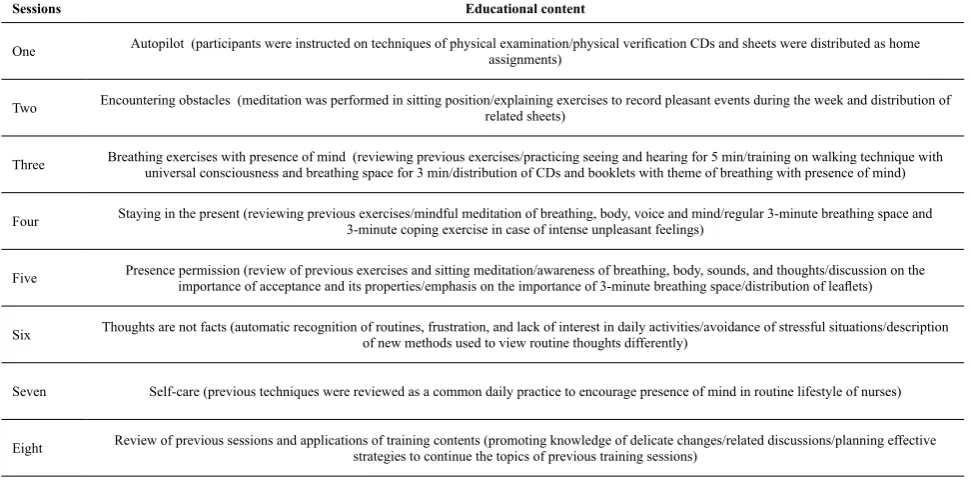
Contents of training sessions and educational packages were designed based on the MBCT treatment guide by Segal et al., which has been translated into Persian by Mohammad Khani, Tammanayeefar, and Jahani Tabesh (2004). Summarized contents of the therapy sessions are presented in Table 1. In order to observe the ethical principles after conducting the tests on the experimental and control groups, subjects in the control group received treatment for eight sessions.
Since in MBCT and most psychotherapies participants and therapists are aware of the intervention, we controlled the subjects to eliminate
bias. For the same purpose, our research team consisted of four trainee researchers in order to avoid the impact of researcher bias on the results and different stages of research (proposal, treatment implementation, data collection, and data analysis). It is noteworthy that only the researchers in charge of the preparation of the proposal and implementation of treatment were aware of the hypotheses in this study. To investigate the hypotheses, required data were collected using the following tools:
Maslach Burnout Inventory (MBI)
Maslach Burnout Inventory (MBI) has been developed by Maslach and Jackson (29) based on a new estimate of the phenomenon of stress (i.e., burnout). This scale consists of 22 sample to investigate job burnout in three domains of emotional exhaustion, depersonalization, and individual accomplishment (30).
According to Maslach and Jackson, internal consistency coefficient of the domains of emotional exhaustion, depersonalization, and individual accomplishment is 0.9, 0.79, and 0.71, respectively. Validity and reliability of MBI have been confirmed for the Iranian population by Filian (31) at the Cronbach’s alpha reliability coefficient of 0.78.
Additionally, Behnia (32) determined the reliability of this scale at the Cronbach’s alpha of 0.55-0.87, while Badri Gregory (33) reported the reliability of MBI to be within the range of 0.75-0.84.
As for the job burnout questionnaire, this scale has been shown to be a valid measurement tool. Maslach and Jackson have confirmed the validity of this scale by determining the correlations between the scores and total score (as obtained by an individual with complete knowledge of the respondents), work experience and job burnout, as well as the scores of the questionnaire and different outcomes associated with job burnout.
Distress Tolerance Scale (DTS)
Distress Tolerance Scale (DTS) has been developed by Simmons and Gaher to evaluate emotional distress tolerance through self-rating (34). Items in DTS measure distress tolerance based on the ability of the individual to cope with emotional distress, assessment of mental confusion, and attention of individuals to negative emotions, offering regulatory measures in the event of action to alleviate distress.
DTS is a self-indicator of emotional distress tolerance, which is composed of 15 items and Table 1. Therapy session contents
Educational content Sessions
Autopilot (participants were instructed on techniques of physical examination/physical verification CDs and sheets were distributed as home assignments)
One
Encountering obstacles (meditation was performed in sitting position/explaining exercises to record pleasant events during the week and distribution of related sheets)
Two
Breathing exercises with presence of mind (reviewing previous exercises/practicing seeing and hearing for 5 min/training on walking technique with universal consciousness and breathing space for 3 min/distribution of CDs and booklets with theme of breathing with presence of mind) Three
Staying in the present (reviewing previous exercises/mindful meditation of breathing, body, voice and mind/regular 3-minute breathing space and 3-minute coping exercise in case of intense unpleasant feelings)
Four
Presence permission (review of previous exercises and sitting meditation/awareness of breathing, body, sounds, and thoughts/discussion on the importance of acceptance and its properties/emphasis on the importance of 3-minute breathing space/distribution of leaflets) Five
Thoughts are not facts (automatic recognition of routines, frustration, and lack of interest in daily activities/avoidance of stressful situations/description of new methods used to view routine thoughts differently)
Six
Self-care (previous techniques were reviewed as a common daily practice to encourage presence of mind in routine lifestyle of nurses) Seven
Review of previous sessions and applications of training contents (promoting knowledge of delicate changes/related discussions/planning effective strategies to continue the topics of previous training sessions)
Eight
4 subscales of emotional distress tolerance, assimilation, assessment, and regulation. Alpha coefficients for the reliability of the mentioned subscales have been determined to be 0.72, 0.82, 0.70, respectively, while the reliability of the entire scale has been confirmed at 0.82. Intraclass correlation of DTS has been reported to be 0.61 after six months. Moreover, this scale has been shown to have favorable criterion validity and initial convergence.
DTS has a positive association with the adoption of morality and a negative association with coping strategies in case of alcohol and marijuana consumption, as well as their use to improve relationships (34). In a study by Andami Khoshk (35), Cronbach’s alpha of this scale was estimated at 0.86, while Azizi, Mirzaei and Shams (36) have reported the induction of this questionnaire to be 0.67 with the test-retest reliability of 0.79 (36).
Data analysis
Data analysis was performed in SPSS version
21 using descriptive and inferential statistics. Descriptive statistics were applied for the accurate description of the studied variables with tables and graphs to compare the mean pretest-posttest scores. In addition, since the experiment was conducted on two groups of intervention and control, analysis of covariance and effect size were used to evaluate the collected data.
Results
In this study, mean, standard deviation, minimum and maximum scores of job burnout and its components were calculated separately for each study group (Table 2).
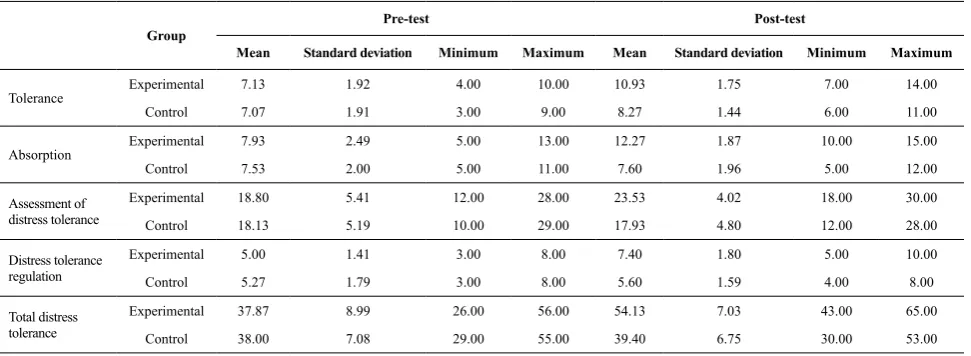
Mean, standard deviation, minimum and maximum scores of the tolerance component of distress tolerance were calculated separately for the intervention and control groups before and after the experiment (Table 3). According to the information in Table 3, distress tolerance in the experimental group at post-test had a significant difference with
Table 2. Descriptive index of job burnout and its components
Experimental Control
Variable Mean Standard deviation Minimum Maximum Mean Standard deviation Minimum Maximum
Emotional exhaustion 27 6.15 16.00 39.00 27 4.89 26.00 44.00
Depersonalization 24.27 3.01 20.00 29.00 15 4.69 11.00 29.00
Lack of personal success 24 5.13 14.00 32.00 24 6.43 14.00 35.00
Job burnout 66 9.16 65.00 93.00 66 12.28 56.00 100.00
Group Pre-test Post-test
Mean Standard deviation Minimum Maximum Mean Standard deviation Minimum Maximum
Tolerance Experimental 7.13 1.92 4.00 10.00 10.93 1.75 7.00 14.00
Control 7.07 1.91 3.00 9.00 8.27 1.44 6.00 11.00
Absorption Experimental 7.93 2.49 5.00 13.00 12.27 1.87 10.00 15.00
Control 7.53 2.00 5.00 11.00 7.60 1.96 5.00 12.00
Assessment of distress tolerance
Experimental 18.80 5.41 12.00 28.00 23.53 4.02 18.00 30.00
Control 18.13 5.19 10.00 29.00 17.93 4.80 12.00 28.00
Distress tolerance regulation
Experimental 5.00 1.41 3.00 8.00 7.40 1.80 5.00 10.00
Control 5.27 1.79 3.00 8.00 5.60 1.59 4.00 8.00
Total distress tolerance
Experimental 37.87 8.99 26.00 56.00 54.13 7.03 43.00 65.00
Control 38.00 7.08 29.00 55.00 39.40 6.75 30.00 53.00
Table 3. Descriptive index of tolerance component of distress tolerance
the pre-test phase.
In this study, assumptions of the analysis of covariance included the normal distribution of variables in study groups (based on the Kolmogorov-Smirnov test), similar mean and variance at pre-test, linear relationship between pre-test and post-test values, identical variance of variables at post-test, homogeneity of the slope of regression lines, and correlations between dependent variables.
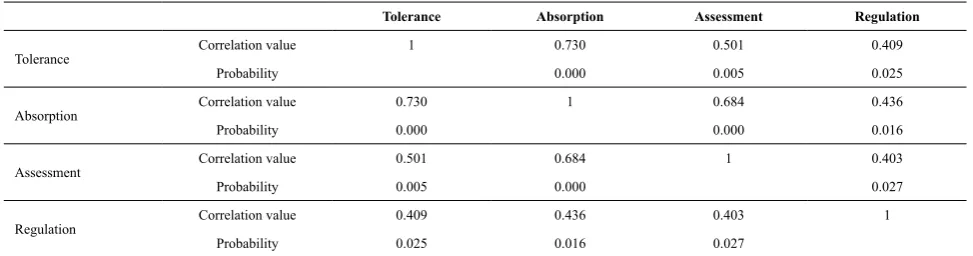
According to the information in Table 4, components of distress tolerance had significant correlations in the post-test evaluation (α=0.05). As such, these components can be used to examine some of the assumptions of the multivariate analysis of covariance with multivariable nature.
According to the information in Table 5, MBCT simultaneously affected the components of distress tolerance in nurses (P<0.001; Df: 21,4; F=35.933). Furthermore, pre-test distress tolerance scores were observed to influence these components simultaneously in the post-test evaluation (P<0.036; Df: 25,4; F=3.131).
On the other hand, pre-test scores of aassimilation were found to affect the components of distress tolerance at the post-test phase (P<0.041; Df: 21,4;
F=3.026). Moreover, pre-test scores of assessment affected the components of distress tolerance at post-test (P<0.001; Df: 21,4; F=27.495). Pre-test scores of regulation were observed to influence the components of distress tolerance at post-test (P<0.001; Df: 21,4; F=11.802). Analysis of covariance of the studied variables is presented in Table 6.
According to the information in Table 6, MBCT could affect the distress tolerance of nurses
(P<0.000; Df: 27,1; F=26.120; MS=52.209). In
addition, pre-test distress tolerance scores were observed to affect distress tolerance at post-test
(P<0.006; Df: 27,1; F=8.954; MS=17.898).
On the other hand, MBCT was found to influence the employment of nurses (P<0.001; Df: 27,1; F=76.668, MS). Pre-test scores of employment were observed to affect the post-test employment of nurses (P<0.001; Df: 27,1; F=26.930; MS=51.200). Furthermore, MBCT was found to influence nursing assessment (P<0.001; Df: 27,1; F=147.991; MS=469.011). Finally, MBCT was significantly effective in nursing regulation (P<0.001; Df: 27,1; F=26.633; MS=30.482), as the pre-test regulation scores influenced the post-test evaluation (P<0.001;
Table 4. Correlations between components of distress tolerance
Tolerance Absorption Assessment Regulation
Tolerance Correlation value 1 0.730 0.501 0.409
Probability 0.000 0.005 0.025
Absorption Correlation value 0.730 1 0.684 0.436
Probability 0.000 0.000 0.016
Assessment Correlation value 0.501 0.684 1 0.403
Probability 0.005 0.000 0.027
Regulation Correlation value 0.409 0.436 0.403 1
Probability 0.025 0.016 0.027
Table 5. Analysis of multivariate covariance between components of distress tolerance
Source changes Method Index F Degree of freedom Probability Effect size Test power Box's test
Tolerance (pre-test) Pillai 0.374 3.131 4,21 0.036 0.374 0.717
3.704 P=0.978
Absorption (pre-test) Pillai 0.366 3.026 4,21 0.041 0.366 0.701
Assessment (pre-test) Pillai 0.840 27.495 4,21 0.000 0.840 1.000
Regulation (pre-test) Pillai 0.692 11.802 4,21 0.000 0.692 1.000
Group effect Pillai 0.873 35.933 4,21 0.000 0.873 1.000
Df: 27,1; F=44.072; MS=50.352).
According to the information in Table 7, MBCT had a significant effect on the distress tolerance of nurses (P<0.001; Df: 27,1; F=505.106; MS=379.1488), as the pre-test scores of distress tolerance influenced the post-test evaluation
(P<0.001; Df: 27,1; F=124.68; MS=017.952).
Discussion and Conclusion
According to the results of the present study, MBCT could affect distress tolerance in nurses
(P<0.001; F=505.106), as the pre-test scores of
distress tolerance were observed to influence the post-test evaluation (P<0.001; F=124.68). Furthermore, MBCT was found to affect distress tolerance (P<0.000; F=120.26), employment
(P<0.001; F=668.76), and nursing assessment
(P<0.001; F=633.26). Consistent with the results
obtained by Williams et al. (22), Rosenzweig et al. (37), Kabat (38), and Baer (39), these findings could elucidate repetitive, uncontrollable thought patterns (e.g., excessive worry) as indications of long-term
mental disorder and confusion (40).
In previous studies, MBCT has been applied to facilitate the timely identification of thought patterns, feelings and physical sensations in different patients before the appropriate stage of development and expansion (19). Mindfulness involves behavioral, cognitive and metacognitive strategies to particularly focus on a process, which in turn prevent the tendency toward excessive worry and growing answers, thereby creating pleasant thoughts and emotions (41).
In MBCT, patients learn to shift their attention from inefficient thoughts and feelings to their body and surroundings (24). Moreover, MBCT alters the emotional state since mental confusion and anger without self-restraint might lead to the tendency toward conflict and controversy in some individuals (42).
Use of MBCT to alleviate distress in nurses is justifiable through certain principles, such as respiratory training with presence of mind, practicing mindful seeing and hearing, walking techniques with universal consciousness, staying in the present, non-judgmental observation, promoting Table 6. Single-factor ANCOVA with separate components
Source changes Sum of squares Degree of freedom Mean square F Probability Effect size Test power
Tolerance
Pre-test 17.898 1 17.898 8.954 0.006 0.249 0.822
Group Effect 52.209 1 52.209 26.120 0.000 0.492 0.998
Error 53.968 27 1.999
Absorption
Pre-test 51.200 1 51.200 26.930 0.000 0.499 0.999
Group Effect 145.764 1 145.764 76.668 0.000 0.740 1.000
Error 51.333 27 1.901
Assessment
Pre-test 464.011 1 464.011 147.991 0.000 0.846 1.000
Group Effect 193.376 1 193.376 61.675 0.000 0.696 1.000
Error 84.656 27 3.135
Regulation
Pre-test 50.352 1 50.352 44.072 0.000 0.620 1.000
Group Effect 30.428 1 30.428 26.633 0.000 0.497 0.999
Error 30.848 27 1.143
Table 7. Analysis of singlefactor covariance
Source changes Sum of squares Degree of freedom Mean square F Probability Effect size Test power
Pre-test 952.017 1 952.017 68.124 0.000 0.716 1.000
Group effect 1488.379 1 1488.379 106.505 0.000 0.798 1.000
Error 376.316 27 13.975
acceptance, raising awareness of experiences, and showing adaptive responses to different conditions (43). Continual practice of mindfulness results in remarkable behavioral changes for better self-care and coping with turmoil in nurses.
Limitations of the study
In the present study, we only investigated the short-term effects of MBCT on the distress tolerance of nurses, which might have affected the generalizability of the results. Furthermore, sample population was limited to female nurses employed at Fatemeh Zahra Hospital of Sari, Iran.
Recommendations
Distress tolerance in nurses could be enhanced through the implementation of training programs based on MBCT, job consultation, and raising individual awareness. In addition, evaluating the efficacy of other therapies as easier, more economical approaches is necessary for the application of other psychological techniques to reduce trauma and moral confusion in these healthcare providers. In this regard, research collaborations between hospitals and research institutes could eliminate common issues in the process of experimentation.
Among other essential factors for further research in this area are the formation of groups to recount the events and challenges associated with distress tolerance and mental health of nurses in hospitals, assembling appropriate committees, strengthening professional ethics, and improvement of communication skills. Extensive research could provide an appropriate background in order to compare the results and increase the quality of future studies. It is also suggested that future studies in this regard consider the social status of samples as a variable overlapping with the effectiveness of MBCT. Finally, further research in this area requires the development of follow-up plans for the participants.
Conflicts of interest
None declared.
Authors’ contributions
All authors contributed equally to the writing of the scientific proposal, data collection, and manuscript drafting. The final manuscript was reviewed and approved by all the authors.
Acknowledgements
This article is extracted from Master’s Thesis
Clinical Psychology in the Department of Islamic
Azad University of sari, Iran. Hereby, we extend our gratitude to the Vice Chancellor of the Research Department, Faculty of Psychology and Educational Sciences, Islamic Azad University of Sari for assisting us in this research project. We would also like to thank the personnel of Fatemeh Zahra Hospital (heart center) of sari, Iran and all the nurses who cooperated in this study.
References
1. Weinberg A, Creed F. Stress and psychiatric disorder in healthcar professionals and hospital staff. Lancet 2000; 355(9203):533-7.
2. Massah H, Dibaji M. Peak effect: the interaction of moral distress and moral residue. Review institutional mechanisms to reduce moral distress in nursing. Proceeding of the National Conference of Organizational Behavior in Nursing, Shirvan, Iran, Islamic Azad University; 2011. 3. Khajeddin N, Hakim Shoushtari M, Hajebi A. The impact
of perception of locus of control on Burnout syndrome among nurses in a psychiatric hospital. Iran J Psych Clin Psychol 2004; 12(1):43-8.
4. Toubaei SH, Sahraeian A. Burnout and job satisfaction of nurses working in internal, surgery, psychiatry burn and burn wards. Horizon Med Sci 2007; 12(4):40-5.
5. Maslach C, Schau feli WB, Leuter MP. Job burnout. Ann Rev Psychol 2001; 52(1):397-422.
6. Schaufeli WB, Maslach CE, Marek TE. Professional Burnout: recent development in theory and research. Abingdon: Taylor & Francis; 1993.
7. Schmidt N, Neumannt W, Opperman R. Stress, burnout and locus of control in German nurses. Int J Nurs Stud 2000; 37(2):95-9.
8. Foxall M, Zimmerman L, Standley R, Bene B. A comparison of frequency and sources of nursing job stress perceived by intensive care, hospice and medicalsurgical nurses. J Adv Nurs 2005; 15(5):577–84.
9. Shanafelt TD, Bradley KA, Wipf JE, Back AL. Burnout and
self-reported patient care in an internal medicine residency program. Ann Intern Med 2002; 136(5):358-67.
10. Seuntjens AD. Burnout in nursing--what it is and how to prevent it. Nurs Adm Q 2005; 7(1):12-9.
11. Yaghoubi F, Mazloom R, Salehi J, Esmaeili H. The study of relationship between self-esteem with burnout in nurses who works at hospitals of Mashhad medical sciences. J Sabzewar Univ Med Sci 2003; 10(3):73-9 (Persian). 12. Shakerinia I. Moral distress: the latent stress in nursing.
Iran J Med Ethics Hist Med 2011; 4(3):26-35 (Persian). 13. Corley MC. Nursing moral distress: a proposed theory and
research agenda. Nurs Ethics 2002; 9(6):636-50.
14. Hannigan B, Edwards D, Coyle D, Fothergill A, Burnard P. Burnout in community mental health nurses: findings from the all-Wales stress study. J Psychiatr Ment Health Nurs 2000; 7(2):127-34.
15. Millette BE. Using Gilliagn’s framework to analyze nurses’ stories of moral chices. West J Nurs Res 1994; 16(6):660-74. 16. Corly MC, Minick P, Elswick RK, Jacobs M. Nurses moral
distress and ethical work environment. Nurs Ethics 2005; 12(4):381-90.
17. Fuerst D, Hemrich AB. Strategies for coping with moral distress in managing moral distress in clinical practice. Charlottesville Virginia: Nursing Leadership Initiative, UVA Health System; 2001.
18. Fry ST, Haevey RM, Hurley AC, Foley BJ. Development of moral distress in military nursing. Nurs Ethics 2002; 9(4):373-87.
19. Rice EM, Rady My, Harmic A, Verheijde JL, Pendergast DK. Determinants of moral distress in medical and surgical nurses at an adult acute tertiary care hospital. J Nurs Manag 2008; 16(3):360-73.
20. Curtis JR, Burt RA. Why are critical care clinicans so powerfully distressed by family demands for futile care? J Crit Care 2003; 18(1):22-4.
21. Segal ZV, Williams JM, Teasdale JD, Gemar M. A cognitive science perspective on kindling and episode sensitization in recurrent affective disorder. Psychol Med 2007; 26(2):371-80.
22. Williams JM, Alatiq Y, Crane C, Barnhofer T, Fennell MJ, Duggan DS, et al. Mindfulness-based cognitive therapy (MBCT) in bipolar disorder: preliminary evaluation of immediate effects on between-episode functioning. J Affect Disord 2013; 107(1-3):275-9.
23. Wells A. The metacognitive model of GAD: assessment of met worry and relationship with DSM-IV generalized anxiety disorder. Cognit Ther Res 2013; 29(1):107–21. 24. Crane, R. Mindfulness based cognitive therapy: Distinctive
features. 1st ed. New York: Routledge; 2013.
25. Hartenstein E, Rose N, Voderholzer U, Heidenreich T, Nissen C, Thiel N, et al. Mindfulness-based cognitive therapy in obsessive-compulsive disorder – a qualitative study on patients’ experiences. BMC Psychiatry 2012; 12:158. 26. Song Y, Lindquist R. Effects of mindfulness-based stress
reduction on depression, anxiety, stress and mindfulness in Korean nursing students. Nurse Educ Today 2015; 35(1):86-90.
27. Hamill TS, Pickett SM, Amsbaugh HM, Aho KM. Mindfulness and acceptance in relation to Behavioral Inhibition System sensitivity and psychological distress. Personal Indiv Diff 2015; 72:24-9.
28. Schmertz SK, Masuda A, Anderson PL. Cognitive processes mediate the relation between mindfulness and social anxiety within a clinical sample. J Clin Psychol 2012; 68(3):362-71.
29. Maslach C, Jackson S. Manual of the maslach burnout inventory. 2nd ed. Palo Alto: Consulting Psychologist Press
Inc; 1983.
30. Maslach C, Jakson SE. The measurement of experienced burnout. J Occupat Behav 1981; 2(2):99-113.
31. Filian E. The study of burnout and its relationship with coping strategies of nurses. [Master Thesis]. Tehran, Iran: Nursing Education of Tarbiat Modarres University; 1995. 32. Behnia G. The relationship between burnout, mental health
and job satisfaction according to the moderating variable of male teachers’ tenacity in mathematics, social sciences, physics and literature subjects in the academic year of 78-77 (new system), of Khuzestan, Ahvaz. Research Council in office of education, Khuzestan, Ahvaz; 2000.
33. Badri Gregory R. Teachers’ psychological burnout syndrome & coping mechanisms. [Master Thesis]. Tehran, Iran: Tarbiat Modares University; 1999.
34. Simons JS, Gaher RM. The distress tolerance scale: development and validation of a self report measure. Motivat Emot 2005; 29(2):83-102.
35. Andamikhoshk AR. The mediating role of tolerance in the relationship between cognitive emotion regulation and distress tolerance with life satisfaction. [Master Thesis]. Tehran, Iran: Allameh Tabatabaei University; 2012. 36. Azizi A, Mirzaie A, Shams J. Study of distress tolerance and
emotion regulation with student’s dependency to cigarette. Hakim Bahar 2010; 13(1):11-8 (Persian).
37. Rosenzweig S, Greeson JM, Reibel DK, Green JS, Jasser SA, Beasley D. Mindfulness-based stress reduction for chronic pain conditions: variationin treatment outcomes and role of home meditation practice. J Psychosom Res 2010; 68(1):29-36.
38. Kabat-Zinn J. Mindfulness-based interventions in context: past, present and future. Clin Psychol Sci Pract 2003; 10(2):144-56.
39. Baer RA, Smith GT, Allen KB. Assessment of mindfulness by self-report: the kentucky inventory of mindfulness skills. Assessment 2004; 11(3):191-206.
40. Calms CA, Raberts JE. Repetitive thought and emotional distress: rumination and worry as prospective predictors of depressive and anxious symptomatology. Cogn Ther Res 2007; 30(3):343–56.
41. Segal Z, Williams M, Teasdale J. Mindfulness-based
cognitive therapy guide. Trans: Mohamadkhani P. Tehran: Faradid; 2002 (Persian).
42. Panaoura AR, Gagatsis AT, Demetriou AN. An intervention to the metacognitive performance: self-regulation in mathematics and mathematical modeling. Acta Didact Univ
Comen Mathemat 2009; 9:63-79.
43. Ahmadkhaniha HR, Gharaeipour M, Panaghi L. Effectiveness of contingency management and cognitive-behavioral therapy for opium dependence. Iran J Psych Clin Psychol 2006; 12(1):3-8.