*Corresponding author: Shweta Singh ISSN: 0976-3031
Research Article
DECODING THE CODED, AN OVERVIEW OF -BIO MEDICAL WASTE MANAGEMENT
Shweta Singh., Sahana S., Anuradha P., Manu Narayan and Sugandha Agarwal
Department of PHD (BBDCODS)
DOI: http://dx.doi.org/10.24327/ijrsr.2017.0807.0445
ARTICLE INFO ABSTRACT
The bio medical waste management is a very serious matter of concern already acknowledged by major public health services including medical and dental health care takers. But the real threat for the nature and human world is the harm occurring through the waste generated from these activities. This review aims to know the level of knowledge of bio medical waste management practices that currently encompasses disposal, treatment, reduction, recycling, segregation and modification which has developed over the past 150 years and has recently been employed in many places around the world.
INTRODUCTION
Medical and Dental care is vital for our life and health, but the waste generated from these activities represents a real problem for nature and human world. Bio Medical Waste (BMW) originates from human, animal health care, medical teaching facilities, medical research, biological laboratory waste and other facilities. Such waste is dangerous and needs safe disposal. Wastes of hospitals and dental clinics generate lots of medical waste which can transmit infections, particularly HIV, Hepatitis B & C and Tetanus, to the people who handle it or come in contact with it.1 India generates around three million tonnes of medical wastes every year and the amount is expected to grow at eight per cent annually. The new bio-medical waste management rules will definitely change the way our country used to manage this waste earlier. Under the new regime, the coverage has increased and also provides for pre-treatment of lab waste, discarded blood, sharp instruments, used dressings and cotton etc. It mandates bar code system for proper control. It has simplified categorisation and authorisation. Thus, it is expected to make a big difference to clean India Mission.2
The present review is to propagate education and awareness in hospital waste management to the hospital staff, as well as to the general public. It deals with the basic issues as categories, problems relating to biomedical waste and procedure of
handling and disposal method of Biomedical Waste Management. It also intends to create awareness amongst the
personnel involved in health care unit. It also envisages
promotion and improvement in public health, protection to the environment, hospitals and individuals through the practice and education in the matters dealing with the healthcare waste management. Wastes from the Hospitals are a potential health hazard to the health care workers, public and flora and fauna of
the environment.1 The issues of the waste disposal in the
hospitals and other health-care institutions has become a major public health concern mandating the need for the review.
Commonly Used Terminoligies
Waste
According to the Basel Convention on the Control of Transboundary, Movements of Hazardous Wastes and Their Disposal of 1989, Art. 2, "'Wastes' are substance or objects, which are disposed of or are intended to be disposed of or are required to be disposed of by the provisions of national law"3. Bio-Medical Waste
Biomedical waste is any kind of waste containing infectious (or potentially infectious) materials.4 It can be any waste, which is generated during the diagnosis, treatment or immunization of human beings or animals or in research activities pertaining
Available Online at http://www.recentscientific.com
International Journal of
Recent Scientific
Research
International Journal of Recent Scientific Research
Vol. 8, Issue, 7, pp. 18066-18073, July, 2017
Copyright © Shweta Singh et al, 2017, this is an open-access article distributed under the terms of the Creative Commons Attribution License, which permits unrestricted use, distribution and reproduction in any medium, provided the original work is properly cited.
Article History: Received 06th April, 2017 Received in revised form 14th May, 2017
Accepted 23rd June, 2017 Published online 28th July, 2017
DOI: 10.24327/IJRSR
CODEN: IJRSFP (USA)
Key Words:
thereto or in the production or testing of biologicals. (Bio-medical waste-management and handling rules,1998 India). Clinical Waste
Clinical waste is defined in the controlled waste Regulation 1992. It refers to “Any waste coming out of medical care provided in hospitals or other health care establishments, but does not include waste generated at home5”.
Hospital Waste
It refers to “Any waste which is generated in the diagnosis, treatment or immunization of human beings or animals or in research” in a hospital6.
Health Care Waste
Health-care waste includes all the waste generated by health-care establishments, research facilities, and laboratories. In addition, it includes the waste originating from minor or scattered sources such as that produced in the course of health care undertaken in the home (dialysis, insulin injections, etc.)7. Nosocomial Infection
An infection caught while hospitalized. The medical term for Hospital Acquired Infections is Nosocomial. These infections can be serious and difficult to treat. A Nosocomial infection is strictly and specifically an infection “not present or incubating prior to admittance to the hospital, but generally occurring 48 hours after admittance”.8
Infectious Disease
Infectious diseases are diseases transmitted from a person, an animal, an insect, the environment or contaminated food and water. Most infectious diseases are spread by a single, well-defined route. Understanding how they spread helps determine the best prevention methods.
Offensive/Hygiene Waste
Waste that may cause offence to persons coming into contact with it, but does not present a risk of infection. This was previously known as sanpro waste. Examples of offensive/hygiene waste include incontinence products and other waste produced from human hygiene, sanitary waste and nappies.
Plastic Waste
Plastic products in the environment that adversely affects wildlife, wildlife habitat and humans are known as plastic waste. Humans are getting affected by plastic wastes or through chemicals within plastics through disruption of the thyroid hormone axis or hormone levels.
Problems Related to Bio Medical Waste
A major problem related to current Bio-Medical waste management in many hospitals and private dental clinics around the world is that the implementation of Bio-Waste regulation is unsatisfactory as some hospitals and clinics are disposing of waste in a haphazard, indiscriminate and improper manner. This ignorance of segregation practices, results in mixing of hospital and clinical wastes with general waste making the whole waste stream hazardous. Improper segregation ultimately results in an incorrect method of waste
disposal. Also, the creepage of plastic into the bio medical waste further hampers the treatment process if not segregated properly. Inadequate Bio-Medical waste management thus will cause environmental pollution, unpleasant smell, growth and multiplication of vectors like insects, rodents and worms and may lead to the transmission of diseases like typhoid, cholera, hepatitis and AIDS through injuries from syringes and needles
contaminated with human.8
Current scenario
Of the total hospital waste generated, approximately 10% is hazardous, 85% is general (non risk) waste while a small percentage (5%) is labeled as highly hazardous. Currently, all the hospital biomedical waste is being disposed along with municipal solid waste. The untreated liquid waste from the health institutions is let into drainage.9
All hospitals in the country have been asked to developed the system of colour coding. Since the infectious waste getsmixed with municipal solid waste, it has potential to make the whole lot of infections in adverse to environmental conditions.
Medical waste Categories of bio management
There are ten categories notified in The Government of India, "Biomedical Waste (Management and Handling) rules" 1998.10 They are:
Category No. 1: Human Anatomic Waste; Category No. 2: Animal Waste;
Category No. 3: Microbiology and Biotechnology Waste; Category No. 4: Waste Sharps;
Category No. 5: Discarded Medicines and Cytotoxic drugs; Category No. 6: Soiled Waste;
Category No. 7: Solid Waste; Category No. 8: Liquid Waste; Category No. 9: Incineration Ash; and Category No. 10: Chemical waste.
Classification of dental waste: According to Nancy Godwin: 11
1. General waste (nonregulated) 2. Contaminated waste:
Regulated and
Infectious waste 3. Hazardous waste:
Regulated and
Toxic waste.
Who Classification of Biomedical Waste
Classified into 8 categories, each of which represents varying degrees of risk of transmission of infectious disease or adverse effect on health, due to human exposure to this waste.
1. General waste- It is largely composed of domestic or household type of waste which is non- infectious. For eg. Kitchen waste, packaging materials, waste water from laundries.
International Journal of Recent Scientific Research Vol. 8, Issue, 7, pp. 18066-18073, July, 2017
3. Radioactive waste- Radioactive waste is nuclear fuel that is produced after being used inside of a nuclear reactor. Although it looks the same as it did before it went inside of the nuclear producer it has changed compounds and is nothing like the same. What is left is considered radioactive material and is very dangerous to anyone. This is very dangerous and remains this way for not just a few years but for thousands of years. Radioactive waste is a kind of waste in gas, liquid or solid form that contain radioactive nuclear substance.
4. Chemical waste- Chemical waste is a waste that is made from harmful chemicals mostly produced by discarded chemicals from diagnostic and experimental work, cleaning, housekeeping and disinfecting procedures. E.g. Lab reagents, film developers, disinfectants.
5. Infectious waste- Infectious waste is municipal and residual waste which is generated in the diagnosis, treatment, immunization or autopsy of human beings or animals, in research pertaining there to, in the preparation of human or animal remains for interment or cremation, or in the production or testing of biologicals, and which falls under one or more of the following categories like human blood and body fluid waste, Liquid waste human blood, Blood products, contaminated dressings and bandages etc.
6. Sharps- Wastes which have the capability to injure by piercing and cutting the skin comes under this category for eg. needles, scalpels, blades, broken glass, endodontic files and reamers etc.
7. Pharmaceutical wastes- Wastes containing pharmaceutical products like expired drugs, spilled drugs, boxes with drugs etc are known as pharmaceuticals wastes.
8. Pressurized containers- Containers with innocuous or inert gas that may explode if incinerated or accidentally punctured. E.g. Gas cylinders, gas cartridges, aerosol cans.
Dental Wastes of Environmental Concern
1. Amalgam-Dental Amalgam particles are a source of mercury, which is known to be neurotoxic and
nephrotoxic to humans especially new borns12. 2. X-ray wastes- contains the following:
X-ray fixer solution: It is considered a hazardous waste because of its high silver content. 13 In the environment, free ionic silver acts as an enzyme inhibitor by interfering with the metabolic processes of organisms.
X-ray developer solution: Developer solution can go into the wastewater drain. 15
X-ray cleaner solution: Many cleaners for X-ray developer system contain chromium. If the cleaner solution used contains chromium, it should be disposed as a hazardous waste or switch to a non-chrome cleaner 12
X-ray lead foil / lead shields: The lead foils and lead shields contain pure lead. 16 Lead is a heavy metal that affects neurological development and functions and can potentially leach from landfills into the
environment. These are hazardous waste unless they are recycled for their scrap metal content or disposed off as hazardous waste. 12
1. Chemicals, disinfectants, and sterilizing agents 2. Plastics, latex, gloves, extracted teeth, cotton
3. Dental materials such as plaster of Paris, alginate, putty, dental stone etc
The Process of Bio Medical Waste
Collection of waste
Wastes should not be allowed to accumulate at the point of production. Routine programme for collection has to be established. Non-infectious waste can be collected in any convenient color bag which are not recommended for any biomedical waste (these bags should not contain the biohazard symbol).Collect waste daily and transport it to the central storage site. Bags should not be removed unless they are labeled. Bags or containers should be replaced when they are three quarters full. A supply of fresh collection bags should be available at the site of production.
Segregation
The "key for waste management" is waste segregation. Segregation (separation) is the key to minimization and effective waste management. Only a segregation system can ensure that the waste will be treated according to the hazards of the waste and that the correct disposal routes are taken, and the correct transportation equipment will be used.
Waste is segregated into colour coded bags as specified. Bins used for holding the colour coded bags should be of the same colour. In case a bin of the same colour is not available due to some reason, a neutral colour bin may be used with a prominent sticker of the colour of the bag pasted on the lid and/or body. The size of the sticker must be approximately half the size of the lid of the bin. 17
Impression compound, agar, dental waxes, green stick compound, impression pastes, shellac base plates should be kept in a "yellow plastic bag" then sent for either incineration or deep burial. Rubber base impression material, investment material, pumice, acrylic, metal dust, alginate, old models, and casts, old acrylic dentures and teeth kept in a "black plastic bag" and dispose of in municipal dump. 18
Labelling
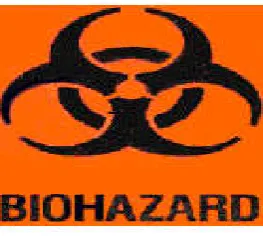
Labeling warns hospital staff and the general public of the hazardous nature of the waste. All bags, containers or bins directly used in the collection of bio-medical wastes should be labelled with appropriate Hazard Symbol. (Fig 1)
The labelling of the waste at the point of generation is in the form of a tag or adhesive label which is to be attached to the bag or container when it is collected by the cleaning staff. This waste tagging system allows waste audits conducted at treatment/disposal points to identify areas that are in compliance.(Fig 2)
Waste containers should be labeled with the following Information:
Waste category number……..
Waste quality………
Date of collection(Day.... Month….. Year…..)
Sender’s Name and address…..
Place in hospital where produced (e.g. wards)
Phone Number….
Contact person…..
In case of emergency please contact…..
Name and Address:
Phone No.
Waste destination
Reciever’s Name and Address:
Phone No.
Contact person…..
Note: Label be shall be non-washable and prominently visible. 4. Storage: It is the delay between production and treatment. A storage location should be designated inside the health care establishment. Storage time for health care waste should not be beyond 48 hours. Cytotoxic waste should be stored separately from other health care waste like all packed pharmaceutical partially used or expired shall be returned to the pharmacy to their original containers, then stored in bags of polyethylene of medium duty (gauge 300) marked as (Medical wastes) should be tied in their neck and should not be filled more than the capacity and shall be stored until collection and disposal. All the cellular or poisonous materials shall be returned to a predetermined point inside the pharmacy in which such materials are prepared or issued. All poisonous cellular medicines and other materials contaminated with cellular poisonous drugs and medicines (except for under skin needles and other sharp objects classified under Group B waste, shall be placed in heavy duty (gauge 400) polyethylene bags of clearly marked up “Poisonous (Cellular Cytotoxic) Waste
Figure 2 Cytotoxic hazard symbol
The labelling of the waste at the point of generation is in the form of a tag or adhesive label which is to be attached to the bag or container when it is collected by the cleaning staff. This waste tagging system allows waste audits conducted at disposal points to identify areas that are in
Waste containers should be labeled with the following
collection(Day.... Month….. Year…..) Place in hospital where produced (e.g. wards)
In case of emergency please contact…..
washable and prominently visible. 4. Storage: It is the delay between production and treatment. A storage location should be designated inside the health care
health care waste should not be beyond 48 hours. Cytotoxic waste should be stored separately ll packed pharmaceutical partially used or expired shall be returned to the pharmacy to in bags of polyethylene of (Medical wastes). Bags should be tied in their neck and should not be filled more than the capacity and shall be stored until collection and disposal.19
all be returned to a predetermined point inside the pharmacy in which such materials are prepared or issued. All poisonous cellular medicines and other materials contaminated with cellular poisonous drugs and medicines (except for under skin needles her sharp objects classified under Group B waste, shall be placed in heavy duty (gauge 400) polyethylene bags of Poisonous (Cellular Cytotoxic) Waste” and
such bags should not be filled more than 65% of their capacity and tied in the neck and properly stored until collection and disposal by incineration.
All the Chemical waste to which medical waste characteristics apply as industrial solvents and other liquid materials used in diagnostics tests in addition to all remaining chemical mate shall be returned to a predetermined point in the pharmacy or the central laboratory store where they shall be tagged according to their respective kinds and types either by using adhesive tags or cards attached. Tags and marks placed on each pack shall indicate its components and hazards. Containers then are put into after that shall be stored awaiting collection and disposal.
All used materials receiving patient secretions and stomach waste and other waste (except patient suffering from contagious disease listed under Group A) shall be placed in medium duty (gauge 300).
Transportation: Transport the waste from the a
generation at regular intervals. Designated staff should be aware of the hazards of the material they handle. They should be provided with adequate personal protective equipment like gloves, face mask, head cap, aprons, gowns, suits or other apparels. Trolleys, carts or any ot
transporting waste must be kept clean and have clear cleaning schedules - especially when spillages of blood and/or body fluids may contaminate them.
premises or at a licensed or permitted transfer, disposal facilities should have the following: well
ventilated, sited away from food preparation and general storage areas, and from routes used by the public; totally enclosed and secure, provided with separate storage for sharps receptacles and waste medicines, which may need a higher degree of security to prevent unauthorised access, sited on a well-drained, impervious hard
only to authorised people, kept locked when not in use, secure from entry by animals and free from insect or rodent infestations, provided with wash
washing facilities for employees, provided with appropriate fire protection or suppression, clearly marked with warning signs, provided with separate, clearly labelled areas for waste that requires, rather than is destined for, different treatment or disposal options, provided with access to first
Treatment: It is defined as the process that changes the character of hazardous waste to render them less hazardous or non-hazardous.
Treatment of biomedical waste depends upon many factors like nature of the waste, volume of waste, technology (technologically and economically
safe) and it must meet regulatory standards. There are four levels of disinfecting the biomedical waste during its treatment.19 These levels evaluate the new or the existing medical waste treatment methods. Level 1:
Disinfectants-In this level most of the vegetative bacteria, fungi and some viruses become inactive, but micro bacteria and bacterial spores remains active. Therefore a treatment method of this level is considered inadequate. Level 2: Intermedia Level Disinfectant- This type of treatment methods includes inactivating all the micro bacteria, viruses and fungi and vegetative bacteria, although the bacterial spores remains
Cytotoxic hazard symbol
such bags should not be filled more than 65% of their capacity k and properly stored until collection and
All the Chemical waste to which medical waste characteristics apply as industrial solvents and other liquid materials used in diagnostics tests in addition to all remaining chemical materials shall be returned to a predetermined point in the pharmacy or the central laboratory store where they shall be tagged according to their respective kinds and types either by using adhesive tags or cards attached. Tags and marks placed on each all indicate its components and hazards. Containers then are put into after that shall be stored awaiting collection and
All used materials receiving patient secretions and stomach waste and other waste (except patient suffering from under Group A) shall be placed in
Transport the waste from the areas of intervals. Designated staff should be aware of the hazards of the material they handle. They should be provided with adequate personal protective equipment like gloves, face mask, head cap, aprons, gowns, suits or other apparels. Trolleys, carts or any other containers used for transporting waste must be kept clean and have clear cleaning especially when spillages of blood and/or body fluids may contaminate them. Bulk storage areas in healthcare premises or at a licensed or permitted transfer, treatment or disposal facilities should have the following: well-lit and ventilated, sited away from food preparation and general storage areas, and from routes used by the public; totally enclosed and secure, provided with separate storage for sharps eptacles and waste medicines, which may need a higher degree of security to prevent unauthorised access, sited on a drained, impervious hard-standing, readily accessible, but only to authorised people, kept locked when not in use, secure y animals and free from insect or rodent infestations, provided with wash-down facilities, provided with washing facilities for employees, provided with appropriate fire protection or suppression, clearly marked with warning signs, clearly labelled areas for waste that requires, rather than is destined for, different treatment or disposal options, provided with access to first-aid facilities19.
It is defined as the process that changes the character of hazardous waste to render them less hazardous or
International Journal of Recent Scientific Research Vol. 8, Issue, 7, pp. 18066-18073, July, 2017
active. Level 3: High Level Disinfectants At least log and reduction of bacterial spores of either B subtious or B stearothermophilus is included so as to achieve a high level disinfection. A 4 log10 reduction is considered equal to about 99.99 percent reduction of bacterial spores. Level 4: Sterilization This level is achieved by at least 6log reduction in spores of B stearothermophilus.20
Autoclaving: Autoclaving is typically used for sterilizing the reusable medical equipments.
Incineration: It is a high temperature dry oxidation process that reduces organic and combustible waste to inorganic, incombustible matter and results in a very significant reduction of waste- volume and weight.
Chemical disinfection: Chemicals are added to wastes to kill or inactivate the pathogens it contains.
Dry thermal treatment: It is based on non-burn, dry thermal disinfection process in which waste is shredded and heated in a rotating auger. Resulting in 80% volume and 25-30% by weight. It is suitable for infectious wastes and sharps but not suitable for pathological, cytotoxic and radioactive waste. Microwave irradiation: Microwave radiation is that portion of the electromagnetic radiation spectrum lying between the frequencies of 300 and 3,00,000 MHz with the help of which Microbial inactivation occurs due to thermal effect of the radiation.
Hydroclaving: It is the expansion of autoclave technology with some disinfection features added. Steam does not actually come in contact with the waste. Another difference is the presence of an internal, rotating fragmenter. It is indirect heating by providing steam into the outer jacket while the waste is kept inside another chamber and turned mechanically. Plasma technology: It is based on high temperature pyrolysis process using plasma torch which allows complete destruction of wastes. The process takes place at 2000-3000 o c where the material attains a plasma state during which there is total destruction of the material. Institute of plasma research (IPR), Gandhinagar, Gujarat has developed indigenous plasma pyrolysis reactors.21
Inertization: This process involves mixing waste with cement and other substances before disposal in order to minimize the risk of toxic substance contained in the wastes migrating into the surface water or ground water.
Grinding and shredding: This is a mechanical destruction method which is used to convert biomedical waste into more homogenous form for easy handling. The waste is physically broken down into smaller particles.
Land disposal: The use of a land fill has to be regarded as an acceptable disposal route when the municipal or medical authorities genuinely lack the means to treat waste before disposal.
Deep burial: A pit or trench should be dug about 2 m deep. It should be half filled with waste, and then covered with lime within 50 cm of the surface, before filling the rest of the pit with soil. Covers of galvanized iron/wire meshes may be used. On each occasion, when wastes are added to the pit, a layer of
10cm of soil be added to cover the wastes. Burial must be performed under close and dedicated supervision.22
Infection control and waste disposal in non hospital settings Any room used by the suspected case, such as bedroom, toilet/ shower/bathroom facilities may also need to be quarantined once the diagnosis is confirmed. In the event that all rooms within the residence were used and are deemed to be a possible risk of infection to others that live within that residence, these members of the residence may be relocated until a diagnosis has been out-ruled or confirmed. In the first instance, members of the patient’s household may contact their local General Practitioner. They should be referred to the local Department of Public Health who will advise on these issues and the follow-up steps to be taken by the other members of the effected/ quarantined residence.
If the patient has symptoms such as vomiting, diarrhoea and/or bleeding then environmental contamination is high and poses a serious risk, and decontamination must only be undertaken by the Health and safety executive- contracted cleaners. Any company can be accessed via local Department of Public Health. Areas that the patient contaminated and the room in which the patient was assessed or used by the patient must be quarantined off immediately. High contact surfaces such as door handles or touch screens should be wiped using standard disinfectants. All patient care equipments used must be cleaned with disinfectant.23
Cleaning & Disinfection Decontamination Processes Cleaning
A surfactant based cleaning product must first be used, prior to the use of disinfectant products or systems. Steam cleaning is also an appropriate decontamination process. Items that are permeable and have been contaminated with blood or body fluids will need to be appropriately removed from the facility/ home as waste in appropriate leak-proof packaging. This will include visibly soiled furniture, upholstery, carpets, and soft furnishings, with in the Surgery or in the home. In addition, in a patient’s home, special attention will have to be paid to permeable mattresses, permeable pillows, cushions, sheets, towels, clothing etc. Impermeable items and surfaces can be cleaned and then adequately decontaminated with general neutral purpose detergent after being disinfection with hypochlorite or NaDCC compounds.24
Disinfection
It is important to ensure that products used in the decontamination procedure have been validated as effective against Viral Haemorrhagic Fever (VHF). Pathogens with appropriate agents include Chlorine releasing agents and sodium dichloroisocyanurate (NaDCC) agents for chemical disinfection. [1,000 ppm chlorine releasing agent where no blood/blood stained body fluid contamination has occurred and 10,000 ppm chlorine releasing agent - for disinfection of blood stained body fluid contamination].
Sterilisation
(not PVC) should be preferred to minimize environmental impacts and placed in the solid waste stream.
Legal considerations country wise
The international symbol for biological hazard
In India, the Bio-medical Waste (Management and Handling) Rules, 1998 and further amendments were passed for the regulation of bio-medical waste management. On 28 2016 Biomedical Waste Management Rules 2016
notified by Central Govt. Each state's Pollution Control Board or Pollution control Committee will be responsible for implementing the new legislation.26
The Ministry of Environment and Forest, Government of India, in exercise of the powers conferred under environment (protection) act, 1986 issued draft rules called ‘bio
waste (management and handling) rules, 1998. The ‘bio medical waste (management and handling) rules are conferred by section 6,8 and 25 of the environment (protection)
The Environment (Protection) ACT, 1986
enactment providing a single focus in the country for the protection of environment. It consists of a
provide for control of pollution of air, water and various aspects of management of hazardous chemicals, wastes etc. Kolkata Municipal Corporation spends 70
expenditures on collection of solid waste, 25
transportation, and less than 5% on final disposal arrangements. The Kolkata Environmental Improvement Project, funded by the Asian Development Bank, is seen as only a partial solution to the problem. A detailed plan should emphasize
at the source, investment in disposal arrangements
the use of liners and leachate collection), and an optimized transport arrangement, among improvements.
There is consensus that all healthcare waste must be stored in an area which is secure against unauthorised access by persons27,28 or scavengers. According to this one consensus, guideline/expert the central or bulk storage of healthcare waste must be kept in the correct lockable containers suitable for the specific waste type.28,29 These recommendations are supported in guidance on the prevention and control of infection in care homes published by the Department of Health, which states that specific areas (stillages) should be designated for waste storage and is kept secure.
Department of Health guidance on the prevention and control of infections in care home settings also states that storage should be in a well-drained area, with impervious hard standing and wash-down facilities.29
(not PVC) should be preferred to minimize environmental impacts and placed in the solid waste stream.25
al symbol for biological hazard
medical Waste (Management and Handling) Rules, 1998 and further amendments were passed for the medical waste management. On 28th Mar 2016 Biomedical Waste Management Rules 2016 were also notified by Central Govt. Each state's Pollution Control Board or Pollution control Committee will be responsible for
The Ministry of Environment and Forest, Government of India, nferred under environment (protection) act, 1986 issued draft rules called ‘bio-medical waste (management and handling) rules, 1998. The ‘bio-medical waste (management and handling) rules are conferred by section 6,8 and 25 of the environment (protection) act, 1986. The Environment (Protection) ACT, 1986-An umbrella enactment providing a single focus in the country for the protection of environment. It consists of a set of rules which control of pollution of air, water and various aspects of management of hazardous chemicals, wastes etc. Kolkata Municipal Corporation spends 70-75% of its total expenditures on collection of solid waste, 25-30% on disposal arrangements. The Kolkata Environmental Improvement Project, funded by the Asian Development Bank, is seen as only a partial solution to the problem. A detailed plan should emphasize segregation at the source, investment in disposal arrangements (including the use of liners and leachate collection), and an optimized transport arrangement, among improvements.
There is consensus that all healthcare waste must be stored in an area which is secure against unauthorised access by ngers. According to this one consensus, guideline/expert the central or bulk storage of healthcare waste must be kept in the correct lockable containers suitable for the These recommendations are supported ntion and control of infection in care homes published by the Department of Health, which states that specific areas (stillages) should be designated for waste
Department of Health guidance on the prevention and control infections in care home settings also states that storage drained area, with impervious hard standing
The ash or vitrified material generated from the ‘Plasma Pyrolysis or Gasification shall be disposed
with the Hazardous Waste (Management, Handling and Transboundary Movement) Rules 2008 and revisions made thereafter in case the constituents exceed the limits prescribed under Schedule II of the said Rules or else in accordance with the provisions of the Environment (Protection) Act, 1986, whichever is applicable.
In British Columbia, Alberta, New Brunswick and Nova Scotia, all hazardous biomedical waste is taken to a third vendor or disposed of at a centralized facility.
Canada’s hospitals appear to moving away from on incinerators toward centralized provincial facilities for the actual sterilization of biomedical waste.
“adequate financial resources to all public and private institutions and bodies respon
environmentally sound management of health
Canadian Council of Minters of the Environment (CCME) has worked on developing minimum national standards for handling, treating and disposing of wastes.
In the UK, clinical waste and the way it is to be handled is
closely regulated.31 Applicable legislation
Environmental Protection Act 1990 (Part II), Waste Management Licensing Regulations 1994, and the Hazardous Waste Regulations (England & Wales) 2005, as
Special Waste Regulations in Scotland.
Various central legislation related to biomedical waste management in India are as follows
The water (prevention and control of pollution) Act, 1974
The Air (prevention and control of pollution) Act,
The Environment(Protection) Act,1986
The hazardous waste(management and handling) rules,1998
The Biomedical waste(management and handling) rules,1998
Municipal Solid waste (management and handling) rules, 2000
The Biomedical waste(management and Amendment ,2000 and 2003
The Bio-medical Waste (Management and Handling) Rules, 2011 [Draft].
LITERATURE REVIEW
The seriousness of the issue can be understood by considering a few studies.
J Thornton, M McCally, P Orris
1999showed in a study that health care institutions should implement policies to reduce the use of PVC plastics, thus achieving major reductions in medically related dioxin formation.33
Lee, et al. 2002 stated that major components of total plastic wastes constitute cafeteria plastics, medical packaging, sharps, blood bags, I.V. bags and tubing are the major sources of plastic wastes generated by the hospitals laboratory, operating rooms, and cafeterias.
According to Agarwal et al
wards of patients admitted for review and follow
The ash or vitrified material generated from the ‘Plasma Pyrolysis or Gasification shall be disposed-off in accordance with the Hazardous Waste (Management, Handling and Transboundary Movement) Rules 2008 and revisions made thereafter in case the constituents exceed the limits prescribed under Schedule II of the said Rules or else in accordance with sions of the Environment (Protection) Act, 1986,
In British Columbia, Alberta, New Brunswick and Nova Scotia, all hazardous biomedical waste is taken to a third-party vendor or disposed of at a centralized facility.
hospitals appear to moving away from on-site incinerators toward centralized provincial facilities for the actual sterilization of biomedical waste. Government allocated “adequate financial resources to all public and private institutions and bodies responsible for the safe and environmentally sound management of health-care waste.” The Canadian Council of Minters of the Environment (CCME) has worked on developing minimum national standards for handling, treating and disposing of wastes.30
cal waste and the way it is to be handled is
Applicable legislation32 includes the
Environmental Protection Act 1990 (Part II), Waste Management Licensing Regulations 1994, and the Hazardous Waste Regulations (England & Wales) 2005, as well as the Special Waste Regulations in Scotland.
Various central legislation related to biomedical waste management in India are as follows
The water (prevention and control of pollution) Act, 1974 The Air (prevention and control of pollution) Act, 1981 The Environment(Protection) Act,1986
The hazardous waste(management and handling) The Biomedical waste(management and handling) Municipal Solid waste (management and handling) rules, The Biomedical waste(management and handling) rules Amendment ,2000 and 2003
medical Waste (Management and Handling)
The seriousness of the issue can be understood by considering a
P Orris, and J Weinberg in that health care institutions should implement policies to reduce the use of PVC plastics, thus achieving major reductions in medically related dioxin
stated that major components of total plastic cafeteria plastics, medical packaging, sharps, blood bags, I.V. bags and tubing are the major sources of plastic wastes generated by the hospitals laboratory, operating
International Journal of Recent Scientific Research Vol. 8, Issue, 7, pp. 18066-18073, July, 2017
excluded, the average waste generation amounts to 135.38 grams per patient per day.
Mishra Ashish, Mishra Shweta, Tiwari Anurag (2013) stated that Public awareness, political will and public participation as essential for the successful implementation of the legal provisions and to have an integrated approach towards sustainable management of municipal solid wastes. There should be sufficient health and safety provisions for workers at all stages of waste handling.
Eighty two percent of the subjects had the knowledge regarding the disposal of different types of Bio Medical Waste in the corresponding coloured bags in the study conducted by Saini et al 35whereas 88% of the dentists agreed to the fact that infectious waste should be put in yellow coloured plastic bag with a bio hazard symbol in the study reports of Rudraswamy et al.36
Daljit kapoor et.al37 in 2014 that colour coding of wastes was not done by 67% of the subjects in one of the studies conducted in Haryana and there is a great need for continuing education and training programmes to be conducted in dental teaching institutions in India.
Mohammad Abul Bashar Sarker et al. through one his studies showed that nearly one-third of medical doctors and nurses and two-thirds of technologists and cleaning staff have inadequate knowledge, and about half of medical doctors (44.0%) and cleaning staff (56.0%) had poor practices in Bangladesh.38 Manyele and Lyasenga (2010) state that urban health centres in Tanzania generate 50% of the country’s clinical hazardous waste.
Implications for research: There is lot of scientific research on this topic, however being an important growing hazard this is not a priority because of the ignorance and un awareness of the institutions and hospitals. The safe management of waste in health and social care settings can only be applied with regulations, legislation and national guidance developed by waste management experts. Management of waste in social care settings and home care settings is relatively neglected in comparison to management of waste in healthcare settings; however, the regulations, legislation and national guidance described in this review if followed can create a better resources for management of bio medical waste. In the context of the integration of human health and social care, it will be beneficial if this was given more attention and followed strictly. Medical and dental professionals must be provided with the copy of safe management of health care waste. All the hospitals and clinics must be regularly checked by the authorised person to ensure that the bins with the colour coding are been properly used and all the staff is aware of the criteria of the waste diposal. All staff handling healthcare waste should be made aware of the benefits of basic hygiene and the importance it has in reducing the risk from handling healthcare waste. Our country needs more suppliers and trained staff to reduce the level of waste packaging. All staff handling healthcare waste should be offered appropriate immunisation for free of cost.
Suggestion
The municipal corporation should be informed so that your local Department of Public Health can provide the contact details of the waste disposal companies.
CONCLUSION
A clear lack of awareness is noted from the above literature regarding proper disposal of bio medical waste. Public education is the key to tackle this concern. It is the duty of both the municipal and the government bodies to dispose bio medical waste economically. The usage of PPE should be made mandatory to not jus health professionals but also to those who are involved in the bio medical waste management process.
References
1. Mathur Praveen, Sangeeta Patan and Anand S. Shobhawat. Need of Biomedical Waste Management System in Hospitals - An Emerging issue. Current World Environment 2012;7(1):117-124.
2. Bio medical waste management Guidelines 2017, Clean India Journal. Accessed on 22nd may 2017
3. “Basel Convention.” 1989. Accessed on may 2017 4. Https:extranet.fhcrc.org.EN sections;ehs, hamm,
chap6:section8.htm
5. www.initial.co.UK: Clinical-Waste1992
6. www.parn.org.pk: index_files/ Waste. html&ved Accessed on May 2017
7. PAHO (1994). Hazardous waste and health in Latin America and the Caribbean. Washington, DC, Pan American Health Organization.
8. www.medicinenet.com; main; mobileart. Accessed on 24.5.17
9. Kalaivani K A Case Study of Biomedical Waste Management in Hospitals. Global Journal Of Health Sciences. 2009; vol 1:82-88
10. Govt. of India. Bio-medical waste (management and handling) rules. The Gazette of India. Ministry of Environment and Forest; 1998.
11. Goodwin N. Lab procedures and waste management module-8. Available from:http://www.sngoodw intraining.com/resources/Lab Procedures and Waste Management.ppt. Last accessed on 2011 July 3
12. CEET: Biomedical Waste Management-Burgeoning
issue (2008)
13. Preben Horsted - Bindslev:Amalgam toxicity - environmental and occupational hazards, J Dentist ;2004, 32: 359-65
14. http://www.p2pays.org/htm. accessed nov2016 http: guidefordentist.pdf. accessed in 2016.
15. Fan PL, Bindslev DA, Schmalz G, Halbach S, Berendsen H. Environmental issues in dentistry. Int Dental J 1997; 47: 105-109
16. Waste segregation and national colour codng approach. Available waste segregarion and National colour coding approach. Available from: http://www.defra.gov.uk/ environment/waste/special/index.htm. Accessed on june 2012
17. cdn.fortishealthcare.com Bio-Medical-Waste-Management. March 31 2017
portalimages/articlepdfs/segregation.pdf. [Last accessed on 2011 Oct 28].
19. www.nipcm.hps.scot.nhs.uk/documents/sicp-safe-management-of-waste. Accessed on 25.5.17
20. Hospital waste management. Dr. AG Chandorkar and Dr. BS Nagoba: 1st edition, 2003, Paras publishing. 21. K Park Park’s Text book of preventive and social
medicine. 23rd edition, 2015, Banarasidas Bhanot Publishers
22. Infection Control & Waste Disposal in Non-Hospital Settings. Guidance note for Public Health Version 1.0- 9th December 14
23. Blenkharn JI. Standards of clinical waste management in UK hospitals. J Hosp Infect. 2006; 62:300-3
24. "Disposal of Medical Waste". Press Information Bureau. 25 July 2014. Retreived july 2016.
25. Hall S. Infection control: legal aspects and audit tools. Practice Nurse 2007;2007 23 Feb. 33(4)
26. Griffith R. Legal regulations for management of health care waste. Nurse Prescribing 2007 Oct;5(9):409-12 27. Townend WK, Cheeseman CR, Townend WK,
Cheeseman CR. Guidelines for the evaluation and assessment of the sustainable use of resources and of wastes management at healthcare facilities. Waste Manag Res 2005 Oct;23(5):398-408
28. Department of Health and Health Protection Agency. Prevention and control of infection in care homes - an information resource. Department of Health; 2013. 29. www.ccme.ca/files/Resources/waste/hazardous/pn_1060
_e.pd accessed on 25.5.17
30. https://www.gov.uk/healthcare-waste accessed on may 2017
31. NetRegs - Current legislation lists Archived September 27, 2007, at the Wayback Machine.
32. J Thornton, M McCally, P Orris, and J Weinberg Hospitals and plastics. Dioxin prevention and medical waste incinerators. PMC1999; 111(4): 298-313.
33. Https://www.researchgate.net/publication/solid waste management case study [accessed May 26, 2017]. 34. Saini R, Pithon MM, Singh HK, Popoff DV. Knowledge
of Biomedical Waste Management among the Students of Rural Dental College, Maharashtra, India. Int J Experiment Dent Sci. 2013;2:24-6.
35. Rudraswamy S, Sampath M, Doggalli N. Staff's attitude regarding hospital waste management in the dental college hospitals of Bangalore city, India. Indian J Occup Environ Med. 2012; 16:75-8.
36. Kapoor Daljit et al. Knowledge and awareness regarding biomedical waste management in dental teaching institutions in India- A systematic review. Journal of Clinical and Experimental Dentistry 2014;6(4): 419-424 37. Mohammad Abul Bashar Sarker. Evaluation of
Knowledge, Practices, and Possible Barriers among Healthcare Providers regarding Medical Waste Management in Dhaka, Bangladesh. Nagoya journal of medical science.2014: 20: 2590-2597.