Nuclear war as false memory
John Timberlake
abstract
In this paper Timberlake outlines aspects of his creative practice as an artist, explaining his fascination for the ‘fictions of nuclear war’ – a war that never happened and so became the subject of ‘false memory’. Highlighting discontinued historical trajectories, the author shows how the cultural legacy of Britain’s nuclear test programme of the 1950s and ’60s may be explored meaningfully in paintings and photography resulting from his archival research at the Imperial War Museum in London.
Keywords: false memory, nuclear war, Britain, art, archive, Imperial War Museum DoI: dx.doi.org/10.5456/issn.2050-3679/2014s24jt
Biographical note
John Timberlake (born in Lancashire, 1967) is a London-based artist whose combinations of drawing, painting and photography reflect a longstanding engagement with landscape and history. He is an alumnus of Brighton Polytechnic and the Whitney Museum of American Art Independent Study Program, and holds a PhD from Goldsmiths College, University of London. Exhibitions include: We Are History (Beaconsfield, London); two international surveys in 2009, Beyond the Picturesque (Stedelijk Museum voor Actuele Kunst, Ghent), and Pittoresk
‘Disturbing Pasts: Memories, Controversies and Creativity’ is financially supported by the HERA Joint Research Programme ‘Humanities as a Source of Creativity and Innovation’, co-funded by AHRC, AKA, DASTI, ETF, FNR, FWF, HAZU, IRCHSS, MHEST, NWO, RANNIS, RCN, VR and the European Union’s Seventh Framework
Programme for research, technological development and demonstration under grant agreement no 235366/291827.
Co-funded by the European Union
An earlier version of this material was presented on the occasion of the project conference ‘Disturbing Pasts: Memories, Controversies and Creativity’ (20 -22 November 2012, Museum of Ethnology/Weltmuseum Wien, Vienna). To view the film footage on the Open Arts Archive, www.openartsarchive.org, follow this link:
Nuclear war as false
memory
John Timberlake, middlesex university
My series of staged photo works, collectively titled
Another Country, made between 1999 and 2001, explores the idea of the nuclear war that never happened as a constructed false memory, as an iatrogenic disorder arising from the culture of the Cold War. I made the work – a series of handmade dioramas using model making paraphernalia and painted backdrops – between 1999 and 2001, drawing on
imagery in the Imperial War Museum’s Photographic Archive of British nuclear tests conducted in Australia and the Pacific. I was drawn to the labelling of a box file in which the photographs were kept: it simply read ‘Atomic Warfare’. Of course, the photographs were not of warfare itself (involving the attack or assault of an enemy), nor of the US bombing of Hiroshima and Nagasaki, but solely of British nuclear test explosions. I was therefore struck by how this labelling inserted the fiction of a nuclear war that had not happened amidst the other file boxes containing documentation of actual military conflict.
An iatrogenic disorder is one that arises as a negative, unwanted result from a medical treatment
or therapy. In psychotherapy, an iatrogenic disorder such as false memory syndrome allows the patient to see him/herself as victim. During the 1990s, a number of cases were studied involving apparent memories of physical or sexual abuse that may inadvertently have been suggested to the person undergoing therapy by an ill-trained or inexperienced therapist. As Mollon, has pointed out, the terms of the debate were contentious to say the least: ‘[The] purported syndrome has not been validated, is not listed in official diagnostic texts and no clinical case studies outlining its features have been published in any medical or scientific journal’ (2000, p.5). Whilst scientific research on the issue was subsequently produced, Mollon’s observation was that the debate’s intensity – and the attack on Freud that it entailed – emerged, as it were, from somewhere other than clinical evidence.
However, as Mollon also points out, the heated character of the debate that erupted in the 1990s around false memory syndrome goes to the heart of the act of remembering itself, which, (according to Mollon) as current scientific understanding tends to argue, is not a process of accessing recorded data filed away in the brain, but rather a reconstructive process, hostage to the deceptive plasticity of memory in circumstances of suggestion, or pressure from
either therapist or peers (2000, p.5). My concern here, however, is to seek an analogy between those iatrogenic disorders generated by ‘bad therapy’ and those arising from the extended period of cultural, political and social conditioning of the Cold War. My contention is that there is a useful analogy to be drawn here between iatrogenic disorders thinking through how and the self-inflicted experience of the arms race, international tensions and crises of the Cold War period allow the West to imagine itself as a victim or sufferer. In this way, the construction of ‘false memory’ of a martyred and destroyed Europe is constructed from the actual destruction of Japanese cities a generation earlier, and juxtaposed with the real but evaded risk of nuclear annihilation faced at the height of the Cold War.
For John Kihlstrom, a cognitive psychologist cited by Mollon, False Memory Syndrome is defined as:
A condition in which the subject’s identity and interpersonal relationships are centered around a memory of traumatic experience which is objectively false but in which the person strongly believes. Note that the syndrome is not characterised by false memories as such … Rather, the syndrome may be diagnosed when the memory is so deeply engrained that
it orientates the individual’s entire personality and lifestyle, in turn disrupting all sorts of other adaptive behaviours … the person assiduously avoids confrontation with any evidence that might challenge the memory.
(Mollon, 2000, p.5) As is well documented, the immediate response of the United States Command structure on the day of the 11 September 2001 attacks bore strong similarities to what would have been initiated in the event of attack by Soviet nuclear missiles during the Cold War. By the time of the 9/11 attacks, of course, the Cold War had been over for over a decade. However, in the US, the four airborne command aircraft, the so-called ‘Doomsday planes’, designed to oversee a nuclear missile retaliation, were dispatched, and the steel doors of various strategic command centres in the American Mid West, designed to withstand a nuclear attack by the USSR, were closed for the first time, along with various other measures, including the mobilisation and deployment of National Guard.
The conflation of the terrorist hijackings and subsequent mass murder of 9/11 with nuclear war was not limited to the immediate response on the day. On numerous occasions, the actual attacks of 11 September have become conflated with the false memory of the nuclear war that was not fought sometime between 1949 and 1991. Examples of this might include the titling of Peter Taylor’s series of programmes for the BBC, Al Quaeda: The Third World War; David Levi Strauss’s collection of essays Between the Eyes, wherein he likens the 9/11 fireballs at the
World Trade Center to those of nuclear weapons; more anecdotally, having personally witnessed the attacks in New York on 9/11, I recall New York
residents comparing the events to the Hiroshima bomb, even though a comparison of the respective death tolls for these events reveals huge differences.
The logic of strategic military planning, of course, involves considerable and repeated attempts to imagine oneself under the type of assault one intends to inflict upon one’s enemy. Such visualisation of nuclear war scenarios reached a particular peak in the cinematic, televisual and literary culture of the North Atlantic during those periods of greatest tension. Now, decades later, it is in the context of recalling that culture and psychology that I wish to draw further analogies between the memory of the Cold War and iatrogenic disorders. Iatrogenic disorders often result in false accusations of abuse against not only the alleged perpetrator, but, significantly, supposed or alleged neglect by another guardian or parent. Studies of false memory syndrome highlight the manner in which a parent or guardian
not alleged to have perpetrated the abuse can be made the central object of anger and resentment, for their alleged inaction, neglect or indifference to the analysand’s suffering revealed through constructed memory.
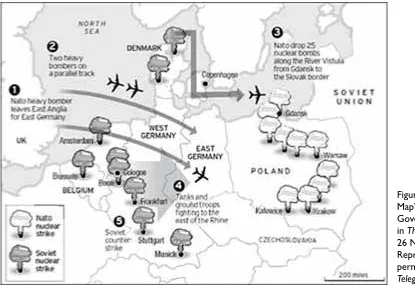
My concerns as a landscape artist, and, more specifically, one interested in that area of speculative fiction known as alternative history, is the publication in 2005 by the Polish government of Soviet war maps, containing details of which European cities would be attacked in the event of a nuclear exchange with
NATO. The map was presented in the context of an outcry against Russia, Poland’s former Warsaw Pact ally, and its preparedness to ‘sacrifice’ Poland, even though the maps made clear that the destruction would have been visited upon Polish territory by NATO bombers, not Russian ones, laying down a barrage of 25 nuclear explosions extending from Gdansk to the Polish-Slovak border, rather than on the then Soviet Union.
During the 1960s and ’70s, British ‘Vulcan’ nuclear bomber crews were trained to fly with a patch
covering one eye. The logic of this rationing of eyesight was simple: as such crew would be flying through that barrage along the Vistula, they faced a strong risk of being blinded by the flashes. The patch ensured that once they had lost the sight in one eye, the crew could uncover the saved eye, and continue flying. Between them, the pilot and co-pilot could thus afford to have three eyes blinded and still be able to reach their targets. Such a blinkering might seem historically poignant.
I want to suggest that, as with the 9/11 examples, there is a tendency here to position oneself as a victim that strongly recalls false memory syndrome.
Of course, the posturing behind the Polish outcry can be seen as a part of a wider repositioning by a conservative government, seeking to align itself with the US – which was spared any criticism – and blame the Cold War on Russia. This might seem to be analogous
to what psychotherapists term ‘reconstructive retrieval’ (Brainerd and Reyna, 2005, p.383), wherein the subject begins with general concepts (‘Russia has never been an ally of Poland, the West was never an enemy’) and generates events by constructively processing that concept (Poland’s nuclear annihilation through a presumed betrayal by Russia, not by NATO bombs). As the work of E.F. Loftus has shown (quoted in Brainerd and Reyna, 2005, p. 383), reconstructive retrieval would seem to be a consistent feature of patients of therapy recovered false memories.
In the immediate aftermath of 9/11, a further spectral fragment of the nuclear war that never happened re-emerged. In March 2002, two American magazines, the left-leaning The Nation and the more conservative Newsweek both reported that Soviet-made ‘suitcase bombs’ were possibly in circulation, and that in the immediate aftermath of 9/11, the US security services had been acting on credible evidence that such a bomb was somewhere in Manhattan. At the same time, fears were raised around the possibility of a nuclear device being concealed in one of the thousands of shipping containers being delivered to New York every day. This fear of a bomb carried in a cargo ship resurrected earlier anxieties entertained by the British government half a century earlier in the 1950s. Indeed, Britain’s first nuclear test, Hurricane in 1952, involved a bomb detonated in the hold of a ship moored in
the Bunsen Channel, a stretch of water off North West Australia chosen for its similarities in depth and mud content to the River Thames and the Port of London. The British government feared such a bomb vaporising river water and spreading a radioactive mist over southern England. The fear that the British government entertained at this time arose not from a demonstration of such intent by its enemy (the Soviet Union, which at the time of the British commencement of its own bomb project had no such capability) but from a nuclear test conducted in 1946 by its ally the US.
Again, as in all the examples cited, there is the lingering sense that the nuclear war that did not
occur sometime between 1949 and 1989 remains a touchstone, but also a possible threat projected onto, and emanating from the Other: nuclear war as a constructed recollection of a traumatic experience
from which belief and motivation can be drawn, and via which any challenges to one’s self-positioning can be assiduously avoided.
references
1 Bjorklund, D.F. (ed.) (2000) False-Memory Creation in Children and Adults: Theory, Research and Implications, London and New Jersey, Lawrence Erlbaum Associates. 2 Brainerd, C.J. and Reyna, V.F. (2005) The Science of False Memory, Oxford Psychology Series 38, Oxford, Oxford University Press.
3 Mollon, P. (2000) Freud and False Memory Syndrome, London, Icon.