A Monthly Double-Blind Peer Reviewed (Refereed/Juried) Open Access International e-Journal - Included in the International Serial Directories
Indexed & Listed at:
VOLUME NO.4(2014),ISSUE NO.03(MARCH) ISSN 2231-5756
INTERNATIONAL JOURNAL OF RESEARCH IN COMMERCE, IT & MANAGEMENT
CONTENTS
Sr.
No.
TITLE & NAME OF THE AUTHOR (S)
Page
No.
1
.
PERFORMANCE OF KHADI AND VILLAGE INDUSTRIES COMMISSION (KVIC) IN INDIA
SK.GHOUSE, K. RAJAIAH & P.R SIVASANKAR
1
2
.
COST MANAGEMENT PRACTICES IN INDIA: AN ANALYTICAL STUDY
DR. SAMBHAVNA GUPTA, DR. R. K. SHARMA & DR. M.S.S. RAJU
6
3
.
IMPLICATIONS OF INFLATION ON INVESTMENT DECISIONS: AN EMPIRICAL STUDY
DR. SANJIV MITTAL, RITESH GUPTA & DR. SUNIL GUPTA
10
4
.
STUDY OF THE EDUCATIONAL LEVEL AND IT’S INFLUENCE ON MALL SHOPPING
BEHAVIOUR
DR. ANIL CHANDHOK & DR. BHAVET
14
5
.
THE NETWORK CONFIGURATION OF AN OBJECT RELATIONAL DATABASE
MANAGEMENT SYSTEM: A REVIEW
DEEPSHIKHA
17
6
.
ISLAMIC BANKING: AWARENESS AND PERCEPTIONS (A STUDY WITH SPECIAL
REFERENCE TO SOUTH INDIA, INDIA)
DR. A. MOHAMED SALI & DR. K. SALEEM KHAN
19
7
.
A STUDY ON COMPETENCY MAPPING OF THE EXECUTIVES AND ITS IMPLICATION ON
THEIR PERFORMANCE WITH SPECIAL REFERENCE TO MNC, CHENNAI, INDIA
DR. VIMALA VENUGOPAL & RIZALDY RAPSING
24
8
.
QUALITY MANAGEMENT PRACTICES IN HIGHER EDUCATION
SHEETAL DUBEY
28
9
.
A STUDY ON IMPACT OF PROMOTIONAL STRATEGIES ON BRAND AWARENESS IN
DAIRY INDUSTRY
P SUJATHA
30
10
.
AMERICAN AND CHINESE CULTURES: A COMPARATIVE STUDY
ROBIN INDERPAL SINGH
33
11
.
PERCEPTION OF THE POLICYHOLDERS TOWARDS SERVICE QUALITY OF THE LIFE
INSURANCE CORPORATION OF INDIA IN BANGALORE DIVISION
DR. SHOBHA. C
37
12
.
INTERPERSONAL COMMUNICATION SKILLS OF INDUSTRIAL ENGINEERS: A CASE
STUDY
CHIRAG PATHANIA & NUPUR KUMAR
43
13
.
AN INVESTIGATION INTO DEFICIENCIES IN STRATEGIES OF MANAGING EMPLOYEE
DIVERSITY IN THE HOSPITALITY INDUSTRY IN KENYA: A SURVEY OF SELECTED HOTELS
IN MOMBASA COUNTY
VICTORIA TUMAINI & KARIM OMIDO
49
14
.
TPAS: A CURE FOR THE INDIAN HEALTH INSURANCE SECTOR
MANJUSHREE S
57
15
.
2011 CONTINENTAL ECONOMIC COMPARISON: AN EMPIRICAL INVESTIGATION
ABDURRAUF IDOWU BABALOLA
62
CHIEF PATRON
PROF. K. K. AGGARWAL
Chairman, Malaviya National Institute of Technology, Jaipur
(An institute of National Importance & fully funded by Ministry of Human Resource Development, Government of India)
Chancellor, K. R. Mangalam University, Gurgaon
Chancellor, Lingaya’s University, Faridabad
Founder Vice-Chancellor (1998-2008), Guru Gobind Singh Indraprastha University, Delhi
Ex. Pro Vice-Chancellor, Guru Jambheshwar University, Hisar
FOUNDER PATRON
LATE SH. RAM BHAJAN AGGARWAL
Former State Minister for Home & Tourism, Government of Haryana
Former Vice-President, Dadri Education Society, Charkhi Dadri
Former President, Chinar Syntex Ltd. (Textile Mills), Bhiwani
CO-ORDINATOR
AMITA
Faculty, Government M. S., Mohali
ADVISORS
DR. PRIYA RANJAN TRIVEDI
Chancellor, The Global Open University, Nagaland
PROF. M. S. SENAM RAJU
Director A. C. D., School of Management Studies, I.G.N.O.U., New Delhi
PROF. M. N. SHARMA
Chairman, M.B.A., Haryana College of Technology & Management, Kaithal
PROF. S. L. MAHANDRU
Principal (Retd.), Maharaja Agrasen College, Jagadhri
EDITOR
PROF. R. K. SHARMA
Professor, Bharti Vidyapeeth University Institute of Management & Research, New Delhi
CO-EDITOR
DR. BHAVET
Faculty, Shree Ram Institute of Business & Management, Urjani
EDITORIAL ADVISORY BOARD
DR. RAJESH MODI
Faculty, Yanbu Industrial College, Kingdom of Saudi Arabia
PROF. SANJIV MITTAL
University School of Management Studies, Guru Gobind Singh I. P. University, Delhi
PROF. ANIL K. SAINI
VOLUME NO.4(2014),ISSUE NO.03(MARCH) ISSN 2231-5756
INTERNATIONAL JOURNAL OF RESEARCH IN COMMERCE, IT & MANAGEMENT
DR. SAMBHAVNA
Faculty, I.I.T.M., Delhi
DR. MOHENDER KUMAR GUPTA
Associate Professor, P. J. L. N. Government College, Faridabad
DR. SHIVAKUMAR DEENE
Asst. Professor, Dept. of Commerce, School of Business Studies, Central University of Karnataka, Gulbarga
ASSOCIATE EDITORS
PROF. NAWAB ALI KHAN
Department of Commerce, Aligarh Muslim University, Aligarh, U.P.
PROF. ABHAY BANSAL
Head, Department of Information Technology, Amity School of Engineering & Technology, Amity
University, Noida
PROF. A. SURYANARAYANA
Department of Business Management, Osmania University, Hyderabad
DR. SAMBHAV GARG
Faculty, Shree Ram Institute of Business & Management, Urjani
PROF. V. SELVAM
SSL, VIT University, Vellore
DR. PARDEEP AHLAWAT
Associate Professor, Institute of Management Studies & Research, Maharshi Dayanand University, Rohtak
DR. S. TABASSUM SULTANA
Associate Professor, Department of Business Management, Matrusri Institute of P.G. Studies, Hyderabad
SURJEET SINGH
Asst. Professor, Department of Computer Science, G. M. N. (P.G.) College, Ambala Cantt.
TECHNICAL ADVISOR
AMITA
Faculty, Government M. S., Mohali
FINANCIAL ADVISORS
DICKIN GOYAL
Advocate & Tax Adviser, Panchkula
NEENA
Investment Consultant, Chambaghat, Solan, Himachal Pradesh
LEGAL ADVISORS
JITENDER S. CHAHAL
Advocate, Punjab & Haryana High Court, Chandigarh U.T.
CHANDER BHUSHAN SHARMA
Advocate & Consultant, District Courts, Yamunanagar at Jagadhri
SUPERINTENDENT
CALL FOR MANUSCRIPTS
We invite unpublished novel, original, empirical and high quality research work pertaining to recent developments & practices in the areas of Computer Science & Applications; Commerce; Business; Finance; Marketing; Human Resource Management; General Management; Banking; Economics; Tourism Administration & Management; Education; Law; Library & Information Science; Defence & Strategic Studies; Electronic Science; Corporate Governance; Industrial Relations; and emerging paradigms in allied subjects like Accounting; Accounting Information Systems; Accounting Theory & Practice; Auditing; Behavioral Accounting; Behavioral Economics; Corporate Finance; Cost Accounting; Econometrics; Economic Development; Economic History; Financial Institutions & Markets; Financial Services; Fiscal Policy; Government & Non Profit Accounting; Industrial Organization; International Economics & Trade; International Finance; Macro Economics; Micro Economics; Rural Economics; Co-operation; Demography: Development Planning; Development Studies; Applied Economics; Development Economics; Business Economics; Monetary Policy; Public Policy Economics; Real Estate; Regional Economics; Political Science; Continuing Education; Labour Welfare; Philosophy; Psychology; Sociology; Tax Accounting; Advertising & Promotion Management; Management Information Systems (MIS); Business Law; Public Responsibility & Ethics; Communication; Direct Marketing; E-Commerce; Global Business; Health Care Administration; Labour Relations & Human Resource Management; Marketing Research; Marketing Theory & Applications; Non-Profit Organizations; Office Administration/Management; Operations Research/Statistics; Organizational Behavior & Theory; Organizational Development; Production/Operations; International Relations; Human Rights & Duties; Public Administration; Population Studies; Purchasing/Materials Management; Retailing; Sales/Selling; Services; Small Business Entrepreneurship; Strategic Management Policy; Technology/Innovation; Tourism & Hospitality; Transportation Distribution; Algorithms; Artificial Intelligence; Compilers & Translation; Computer Aided Design (CAD); Computer Aided Manufacturing; Computer Graphics; Computer Organization & Architecture; Database Structures & Systems; Discrete Structures; Internet; Management Information Systems; Modeling & Simulation; Neural Systems/Neural Networks; Numerical Analysis/Scientific Computing; Object Oriented Programming; Operating Systems; Programming Languages; Robotics; Symbolic & Formal Logic; Web Design and emerging paradigms in allied subjects.
Anybody can submit the soft copy of unpublished novel; original; empirical and high quality research work/manuscriptanytime in M.S. Word format
after preparing the same as per our GUIDELINES FOR SUBMISSION; at our email address i.e. [email protected] or online by clicking the link online
submission as given on our website (FOR ONLINE SUBMISSION, CLICK HERE).
GUIDELINES FOR SUBMISSION OF MANUSCRIPT
1. COVERING LETTER FOR SUBMISSION:
DATED: _____________ THE EDITOR
IJRCM
Subject: SUBMISSION OF MANUSCRIPT IN THE AREA OF.
(e.g. Finance/Marketing/HRM/General Management/Economics/Psychology/Law/Computer/IT/Engineering/Mathematics/other, please specify)
DEAR SIR/MADAM
Please find my submission of manuscript entitled ‘___________________________________________’ for possible publication in your journals.
I hereby affirm that the contents of this manuscript are original. Furthermore, it has neither been published elsewhere in any language fully or partly, nor is it under review for publication elsewhere.
I affirm that all the author (s) have seen and agreed to the submitted version of the manuscript and their inclusion of name (s) as co-author (s).
Also, if my/our manuscript is accepted, I/We agree to comply with the formalities as given on the website of the journal & you are free to publish our contribution in any of your journals.
NAME OF CORRESPONDING AUTHOR:
Designation:
Affiliation with full address, contact numbers & Pin Code: Residential address with Pin Code:
Mobile Number (s): Landline Number (s): E-mail Address: Alternate E-mail Address:
NOTES:
a) The whole manuscript is required to be in ONE MS WORD FILE only (pdf. version is liable to be rejected without any consideration), which will start from the covering letter, inside the manuscript.
b) The sender is required to mentionthe following in the SUBJECT COLUMN of the mail:
New Manuscript for Review in the area of (Finance/Marketing/HRM/General Management/Economics/Psychology/Law/Computer/IT/
Engineering/Mathematics/other, please specify)
c) There is no need to give any text in the body of mail, except the cases where the author wishes to give any specific message w.r.t. to the manuscript. d) The total size of the file containing the manuscript is required to be below 500 KB.
e) Abstract alone will not be considered for review, and the author is required to submit the complete manuscript in the first instance.
f) The journal gives acknowledgement w.r.t. the receipt of every email and in case of non-receipt of acknowledgment from the journal, w.r.t. the submission of manuscript, within two days of submission, the corresponding author is required to demand for the same by sending separate mail to the journal.
2. MANUSCRIPT TITLE: The title of the paper should be in a 12 point Calibri Font. It should be bold typed, centered and fully capitalised.
3. AUTHOR NAME (S) & AFFILIATIONS: The author (s) full name, designation, affiliation (s), address, mobile/landline numbers, and email/alternate email address should be in italic & 11-point Calibri Font. It must be centered underneath the title.
4. ABSTRACT: Abstract should be in fully italicized text, not exceeding 250 words. The abstract must be informative and explain the background, aims, methods,
VOLUME NO.4(2014),ISSUE NO.03(MARCH) ISSN 2231-5756
INTERNATIONAL JOURNAL OF RESEARCH IN COMMERCE, IT & MANAGEMENT
5. KEYWORDS: Abstract must be followed by a list of keywords, subject to the maximum of five. These should be arranged in alphabetic order separated by commas and full stops at the end.
6. MANUSCRIPT: Manuscript must be in BRITISH ENGLISH prepared on a standard A4 size PORTRAIT SETTING PAPER. It must be prepared on a single space and
single column with 1” margin set for top, bottom, left and right. It should be typed in 8 point Calibri Font with page numbers at the bottom and centre of every page. It should be free from grammatical, spelling and punctuation errors and must be thoroughly edited.
7. HEADINGS: All the headings should be in a 10 point Calibri Font. These must be bold-faced, aligned left and fully capitalised. Leave a blank line before each
heading.
8. SUB-HEADINGS: All the sub-headings should be in a 8 point Calibri Font. These must be bold-faced, aligned left and fully capitalised.
9. MAIN TEXT: The main text should follow the following sequence:
INTRODUCTION REVIEW OF LITERATURE
NEED/IMPORTANCE OF THE STUDY STATEMENT OF THE PROBLEM OBJECTIVES
HYPOTHESES
RESEARCH METHODOLOGY RESULTS & DISCUSSION FINDINGS
RECOMMENDATIONS/SUGGESTIONS CONCLUSIONS
SCOPE FOR FURTHER RESEARCH ACKNOWLEDGMENTS REFERENCES APPENDIX/ANNEXURE
It should be in a 8 point Calibri Font, single spaced and justified. The manuscript should preferably not exceed 5000 WORDS.
10. FIGURES &TABLES: These should be simple, crystal clear, centered, separately numbered & self explained, and titles must be above the table/figure. Sources of data should be mentioned below the table/figure. It should be ensured that the tables/figures are referred to from the main text.
11. EQUATIONS:These should be consecutively numbered in parentheses, horizontally centered with equation number placed at the right.
12. REFERENCES: The list of all references should be alphabetically arranged. The author (s) should mention only the actually utilised references in the preparation
of manuscript and they are supposed to follow Harvard Style of Referencing. The author (s) are supposed to follow the references as per the following:
•
All works cited in the text (including sources for tables and figures) should be listed alphabetically.•
Use (ed.) for one editor, and (ed.s) for multiple editors.•
When listing two or more works by one author, use --- (20xx), such as after Kohl (1997), use --- (2001), etc, in chronologically ascending order.•
Indicate (opening and closing) page numbers for articles in journals and for chapters in books.•
The title of books and journals should be in italics. Double quotation marks are used for titles of journal articles, book chapters, dissertations, reports, working papers, unpublished material, etc.•
For titles in a language other than English, provide an English translation in parentheses.•
The location of endnotes within the text should be indicated by superscript numbers.PLEASE USE THE FOLLOWING FOR STYLE AND PUNCTUATION IN REFERENCES: BOOKS
•
Bowersox, Donald J., Closs, David J., (1996), "Logistical Management." Tata McGraw, Hill, New Delhi.•
Hunker, H.L. and A.J. Wright (1963), "Factors of Industrial Location in Ohio" Ohio State University, Nigeria.CONTRIBUTIONS TO BOOKS
•
Sharma T., Kwatra, G. (2008) Effectiveness of Social Advertising: A Study of Selected Campaigns, Corporate Social Responsibility, Edited by David Crowther & Nicholas Capaldi, Ashgate Research Companion to Corporate Social Responsibility, Chapter 15, pp 287-303.JOURNAL AND OTHER ARTICLES
•
Schemenner, R.W., Huber, J.C. and Cook, R.L. (1987), "Geographic Differences and the Location of New Manufacturing Facilities," Journal of Urban Economics, Vol. 21, No. 1, pp. 83-104.CONFERENCE PAPERS
•
Garg, Sambhav (2011): "Business Ethics" Paper presented at the Annual International Conference for the All India Management Association, New Delhi, India, 19–22 June.UNPUBLISHED DISSERTATIONS AND THESES
•
Kumar S. (2011): "Customer Value: A Comparative Study of Rural and Urban Customers," Thesis, Kurukshetra University, Kurukshetra.ONLINE RESOURCES
•
Always indicate the date that the source was accessed, as online resources are frequently updated or removed.WEBSITES
STUDY OF THE EDUCATIONAL LEVEL AND IT’S INFLUENCE ON MALL SHOPPING BEHAVIOUR
DR. ANIL CHANDHOK
PROFESSOR
M M INSTITUTE OF MANAGEMENT
M M UNIVERSITY
MULLANA
DR. BHAVET
FACULTY
SHREE RAM INSTITUTE OF BUSINESS & MANAGEMENT
URJANI
ABSTRACT
One of the demographic variables, Education, has been studied to understand its influence in clustering mall shoppers and accordingly an attempt has been made to propose strategies based on education level of shoppers in a manner motivating them to take appropriate decisions while shopping from malls of their choice. The study undertaken is an extension of scholarly research work i.e. why only one demographic variable has been discussed here. The study has been conducted in select shopping malls in Delhi and NCR. Clustering technique has been used for the purpose. The shoppers have been clustered into Mall Visitors and Mall Shirkers. It has been observed that most of the shoppers who visited malls were undergraduates based on the sample surveyed. Accordingly, shopping mall managers need to focus on youth-centric strategies. The youth also constitute major portion of Indian population. This would help them position their malls effectively.
KEYWORDS
Education, Mall Shopping, Cluster Analysis, Strategies and Shoppers.
INTRODUCTION
ducation level of the customer and its role in mall shopping is really an interesting area for conducting the research. Does it influences shopping decisions of buyers in malls and if yes, up to what extent? An attempt has been made by the researcher in the area. Shoppers in malls have varied educational levels. The information could be gathered by contacting the select customers representing the entire population. Shopping mall culture is growing rapidly in India and is now moving towards semi-urban and rural areas from metropolitans. Besides other demographic and behavioural variables, the entire focus of the study is on ‘Education’ as demographic variable. The data collected has been cluster analysed into different groups. Each cluster could be analysed to achieve ultimate objective of the respective mall with focus on increase in footfall .
Thus, the objective of the study has been focused on:
1. To understand the role of education level of customers in mall shopping.
REVIEW OF LITERATURE
The studies from corners of the world have been referred to know the research work already conducted in the area of the study. These could be summarized as profiling of customers as Teenagers and Adult Customers (Chebat et al., 2008) based on age group. Similarly, other categorizations include Male and Female Shoppers (Kuruvilla & Ranjan, 2008). Another classification could be Economic and Recreational Shoppers (Jarboe & McDaniel, 1987), followed by Loyal and Non-Loyal Mall Shoppers (LeHew et al., 2002). The review of literature motivated the researcher to conduct further research focusing ‘Education’ variable and its role in mall shopping.
RESEARCH METHODOLOGY
For conducting the research, the data has been collected primarily by contacting the sample respondents via mall intercept survey method at the exit gate in select malls in Delhi and NCR. In Delhi, the survey was conducted in DLF Emporio, followed by Gurgaon where Ambience Mall was visited for the purpose. In Ghaziabad, Shipra Mall was selected whereas in Noida, The Great India Place was chosen. The data was collected using structured questionnaire. The respondents included shoppers’ visiting the said malls on the day the survey was conducted. Only the shoppers, who appeared to be 18 years or more in age, were contacted. Non-probability convenience sampling has been employed. The secondary data was collected from various relevant magazines, newspapers, journals and other published and unpublished sources. Of the 400 shoppers contacted 327 responses were found to be useful for further analysis.
INSTRUMENT DEVELOPMENT
Measures: The items in the questionnaire were based on literature reviewed. The questions related to respondent demographics- education were also included, besides using Shopping Motivation Measurement Scale.
Shopping Motivation Measurement Scale: was developed by Arnold and Reynolds (2003). There were eighteen items in the scale focused on capturing the hedonic fulfillment experienced through shopping. The items pertaining to demographic variable were drawn from researches conducted by Kuruvilla & Ranjan (2008), Teller et al., (2008) and Salim (2008). Kuruvilla & Ranjan (2008), Wakefield & Baker (1998) and Bellenger et al (1997) contributed in providing the items related to shopping behavior and loyalty strategies. Necessary alterations have been made in context with Indian malls.
The five-point Likert Scales ranging from Strongly Agree (5 points) to Strongly Disagree (1 point) was used to measure items on this scale.
The shopping motivation constructs showed Cronbach’s alpha coefficients to be 0.89. This indicated the scale to be highly reliable. The composite reliability, variance extracted, and Cronbach alpha coefficient values for all shopping motivation factors, greatly exceeded the minimum acceptable values. This indicated that measures were free from error and yielded very consistent results (Zikmund, 2003).
Sampling Design: The survey population consisted of all shoppers above 18 years of age residing in Delhi and NCR approached at the point of exit in the select shopping mall on the day of administering the schedule. The non-probability convenience sampling design has been employed.
Description of Sample: The data was collected from adult male and female shoppers who appear to be at least 18 years of age. They were approached with a request to respond to queries made by researcher regarding the descriptive: ‘Education’, one of the major demographic variables.
361 active mall shoppers visiting shopping malls constituted the final sample (Table 1):
VOLUME NO.4(2014),ISSUE NO.03(MARCH) ISSN 2231-5756
INTERNATIONAL JOURNAL OF RESEARCH IN COMMERCE, IT & MANAGEMENT
TABLE – 1: OVERALL MALL SHOPPERS’ SAMPLE FREQUENCIESDescriptive Code Frequency Percentage Education Undergraduate Graduate Post Graduate Research Scholar Total 1 2 3 4 163 126 54 18 361 45.15 34.90 14.96 4.99
In response to the question on educational qualifications, maximum respondents indicated they were undergraduates (45.15 %), followed by 34.9 % indicating they were graduates, 14.96 % were post graduates and the balance (of those surveyed) 4.99 % were research scholars.
In summary, the typical sample respondent profile can be described as: The mall shoppers included in the sample were mainly students in the young-age group.
Statistical Analysis:The study conducted statistically tested the motives of shoppers towards shopping in malls. The statistical significance was set at a level of 0.05. Cluster analysis via Ward’s method was used. One case was assigned only to one cluster (Malhotra and Dash 2009). An attempt has been made to identify relatively homogeneous groups of cases (or variables) based on selected characteristics.
RESULTS AND FINDINGS OF THE STUDY
SPSS Statistics (originally, Statistical Package for the Social Sciences, later modified to read Statistical Product and Service Solutions), 16.0.1 version, was used for performing Cluster Analysis. Factors were clustered by Ward’s method, and distance was calculated using squared Euclidean distance. The study was designed to go for an ‘a priori’ solution by asking for a 2-cluster solution. The reason being the need of the study, the bi-polar shopping orientation concept based on demographic variables such as Teenagers, Adult Customers (Chebat et al., 2008) based on age group and Male Shoppers, Female Shoppers (Kuruvilla & Ranjan, 2008) based on gender and so on.
Cluster Analysis of the Mall Shoppers Sample: With 3.08 as mean score in cluster 1 and 3.53 as mean score in cluster 2 5 on 5-point hedonic shopping motivation scale, the respondents were found to be less positive in cluster 1 and those in cluster 2 were found to be positive towards shopping. A new shopper typology, named as Mall Shopping Avoiders and Mall Shopping Goers. Mall shopping scenario based on profiling of shoppers types was created.
Mall Shopping Scenario: Profiling of mall shoppers clusters based on shoppers’ loyalty was done. A significant association between loyalty and shopping motives was checked using Pearson Correlation Coefficient. A significant association (positive correlation) was based on results was found between mall shoppers’ loyalty and their mall shopping motive levels. This indicates that shopping motivation is directly proportional to shopping mall loyalty. The next stage of profiling included demographics and shopping behavior variables.
Cross Tabs and Chi-Square Tests of Mall Shoppers’ Responses: For cross-tabulating the data, a Chi-Square Test has been administered in order to profile the two segments. The statistically significant differences were found. To test the hypothesis that two categorical variables are independent of each other, the Chi-Square Test of Independence is used (Refer Table 2).
TABLE 2: MALL SHOPPERS’ FREQUENCIES
Descriptive Shopping Mall Avoiders (Cluster I) Shopping Mall Goers (Cluster II) Total Sample Frequency
Education
Undergraduate 35 94 129
Graduate 25 73 98
Post Graduate 26 33 59
Research Scholar 12 7 19
Total 98 207 305
The Calculated Chi-Square Static (χ2
cal)with a value less than the Critical (Tabulated) Value (χ2tab) indicated that the Null Hypothesis (Ho) of association/
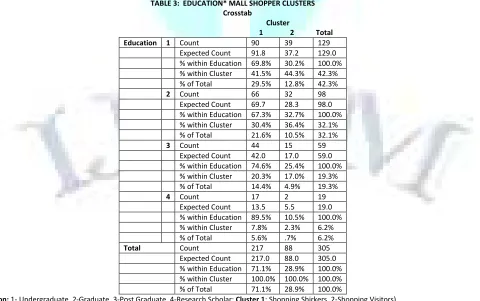
relationship (or no association/ relationship) could not be rejected, indicating that the association was found to be statistically significant (or not statistically significant) at or greater than the 0.05 level of p-value (probability value or significant value), Malhotra and Dash 2009 (Refer Table 3).
TABLE 3: EDUCATION* MALL SHOPPER CLUSTERS Crosstab
Cluster
1 2 Total
Education 1 Count 90 39 129
Expected Count 91.8 37.2 129.0
% within Education 69.8% 30.2% 100.0%
% within Cluster 41.5% 44.3% 42.3%
% of Total 29.5% 12.8% 42.3%
2 Count 66 32 98
Expected Count 69.7 28.3 98.0
% within Education 67.3% 32.7% 100.0%
% within Cluster 30.4% 36.4% 32.1%
% of Total 21.6% 10.5% 32.1%
3 Count 44 15 59
Expected Count 42.0 17.0 59.0
% within Education 74.6% 25.4% 100.0%
% within Cluster 20.3% 17.0% 19.3%
% of Total 14.4% 4.9% 19.3%
4 Count 17 2 19
Expected Count 13.5 5.5 19.0
% within Education 89.5% 10.5% 100.0%
% within Cluster 7.8% 2.3% 6.2%
% of Total 5.6% .7% 6.2%
Total Count 217 88 305
Expected Count 217.0 88.0 305.0
% within Education 71.1% 28.9% 100.0%
% within Cluster 100.0% 100.0% 100.0%
% of Total 71.1% 28.9% 100.0%
Result of Chi-Square Test: The null hypothesis cannot be rejected. There is significant relationship between educational qualifications and shopping motives-based clusters (χ2cal = 4.256, χ2tab =7.815,df = 3, p-value = 0.235)
Summary of Results of Chi-Square Tests of Independence on Mall Shopper Shoppers Clusters
In summary, we can say that there is a statistically significant relationship between the shopping motives-based clusters (Shopping Avoiders & Shopping Goers) and the select demographic variable: Education.
DISCUSSIONS
The findings of this research are bi-polar shopping orientation concept in line with the study of Barnes, 1998 who classified shoppers into two categories as Traditional Mall Shoppers and Manufacturer's Outlet Shoppers. The Manufacturer's Outlet Shoppers were attracted towards branded designer wear and that too at a discount. They are convinced of hunting for such offers and of getting bargains. They represent the target market of choice for the apparel industry. The Traditional Mall Shoppers were older; more educated, and have a higher income. It is expected that continued growth of outlet centers might attract Traditional Mall Shoppers as shoppers prefer branded products at the lowest prices. The findings of this research indicated those shoppers who have positive motivation towards shopping value adventure, gratification, social and idea shopping.
Segmentation Profiles of Mall Shoppers: The findings of the study are in line with that of Patel (2008) that the average Indian shopper in our sample was price and quality conscious. Shopping is funny activity for Indian consumers (Refer Table 4).
TABLE 4: SEGMENTATION PROFILES OF THE MALL SHOPPERS CLUSTERS Characteristics Mall Shopping Shirkers Mall Shopping Visitors Shopping motives Avoid shopping Enjoy shopping
Education 27.1% Undergraduate 72.9% Undergraduate
25.5% Graduate 74.5% Graduate
44.1% Post Graduate 55.9% Post Graduate
63.2% Research Scholar 36.8% Research Scholar
Shopping Mall Marketing Strategies for Building Shopping Mall Loyalty among Shoppers: Suitable marketing strategies to meet the retail marketing objectives should be designed at Retailer level as well as Shopping Mall Management level keeping in view important shopping mall clusters. These could be focused on the major dimensions of entertainment, specialty, value, one stop shop and convenience. A balance between these dimensions and mall retail space is essential as it might influence mall selection decision of shoppers. Children, attracted more by gaming zone, are major influencers in mall selection. Parents prefer to visit such secured places where children enjoy and entire family can spend together whether it is watching movie, dining and shopping. This acts as a pull strategy motivating prospects for first visit. To retain them and to encourage them for repeat visits, mall managers need to focus on mall loyalty strategies such as Specialty Strategies, Value-oriented Strategies, One Stop Shop Strategies and Convenience Strategies.
CONCLUSION
The education level of mall shoppers might contribute to devising effective strategies enhancing long-term customer loyalty, besides other demographic, behavioural and other variables. Accordingly, mall managers could focus on promoting and positioning the respective mall strategically. This might contribute to help them understand their customers in a better way. The malls might vary in terms of the demographic groups they attract (Jarboe and McDaniel, 1987).
FURTHER SCOPE OF STUDY
Customers loyalty strategies based on educational background of customers might be successfully implemented in other functional areas focusing long-term relationship. Other demographic, behavioural, psychological and other variable might be analysed with the objective to boost value-cum-entertainment based mall shopping.
REFERENCES
BOOKS
1. Berman & Evans (2009), Retail Management- A Strategic Approach, 10th Edition, Pearson Education
2. Gilbert, David, Retail Marketing Management, Pearson Education
3. Kazmi Azhar, (2009), Strategic Management and Business Policy, 3rd Edition, Tata McGraw Hill Education Private Limited, New Delhi, pgs 12-15
4. Kotler, Phillip, Marketing Management: Analysis, Planning and Control, Prentice Hall, New Delhi.
5. Levy, Weitz & Pandit (2009), Retailing Management, 6th edition, Tata McGraw Hill Education Private Limited, New Delhi
6. Malhotra, Naresh K. and Dash S. (2009), Marketing Research - An Applied Orientation, 5th Edition, New Delhi, Pearson Education
7. Pradhan, Swapna (2009), Retailing Management, 3rd Edition, Tata McGraw Hill Education Private Limited, New Delhi
8. Solomon Michael R. (2009), Consumer Behaviour – Buying, Having, and Being, 8th Edition, PHI Learning Private Limited, New Delhi
JOURNALS & ONLINE RESEARCH PUBLICATIONS:
9. Barnes 1998, Brands and Bargains: Defining the Outlet Shopper; The Journal of Marketing Management, Spring/ Summer
10. Bellenger et al 1977, Shopping Center Patronage Motives, Journal of Retailing
11. Chebat et al 2008, Antecedents to the Perceived Value of a Shopping Mall: A Comparison between Teenage and Adult Consumers
12. Jarboe & McDaniel 1987, A Profile of Browsers in Regional Shopping Malls, Academy of Marketing Science Journal
13. Johnson & Raveendran 2009, Retail Patronage Behaviour and Shopper Segmentation: A Study among Shoppers of Organised Retailers, Vilakshan, XIMB Journal of Management
14. Kar & Sahoo 2007, Shopping Mall: Driving Force in Organized Retailing, SCMS Journal of Indian Management
15. Kuruvilla & Ranjan 2008, Gender and Mall Shopping, International Journal of Business Insights and Transformation
16. LeHew et al., 2002, Expanding the Loyalty Concept to Include Preference for a Shopping Mall, Int. Rev. of Retail, Distribution and Consumer Research
17. Patel & Sharma 2009, Consumers' Motivations to shop in Shopping Malls: A Study of Indian Shoppers; Advances in Consumer Research (Volume VIII)
18. Rajagopal 2009, Growing shopping malls and behavior of urban shoppers, Palgrave Macmillan 1479–1110 Journal of Retail & Leisure Property Vol. 8, 2, 99–
118 www.palgrave-journals.com/rlp/
19. Teller et al 2008, Hedonic and utilitarian shopper types in evolved and created retail Agglomerations; The International Review of Retail, Distribution and
Consumer Research; Vol. 18, No. 3, July 2008, 283–309
20. Wakefield & Baker 1998, Excitement at the Mall Determinants and Effects on Shopping Response, Journal of Retailing
RESEARCH REPORTS
21. BMI (Business Monitor International ) India Retail Report Q1 2011
22. Clustering Techniques and STATISTICA, Case Study: Defining Clusters of Shopping Center Patrons, STATISTICA Solutions for Business Intelligence, Data Mining, Quality Control, and Web-based Analytics
23. IMAP’s Retail Industry Global Report — 2010
24. India Retail Report (2009) by IMAGES F&R Research
WEBSITES
25. http://www.imagesretail.com/
VOLUME NO.4(2014),ISSUE NO.03(MARCH) ISSN 2231-5756
INTERNATIONAL JOURNAL OF RESEARCH IN COMMERCE, IT & MANAGEMENT
REQUEST FOR FEEDBACK
Dear Readers
At the very outset, International Journal of Research in Commerce, IT & Management (IJRCM)
acknowledges & appreciates your efforts in showing interest in our present issue under your kind perusal.
I would like to request you tosupply your critical comments and suggestions about the material published
in this issue as well as on the journal as a whole, on our E-mail
for further
improvements in the interest of research.
If youhave any queries please feel free to contact us on our E-mail
.
I am sure that your feedback and deliberations would make future issues better – a result of our joint
effort.
Looking forward an appropriate consideration.
With sincere regards
Thanking you profoundly
Academically yours
Sd/-
Co-ordinator
DISCLAIMER