A Monthly Double-Blind Peer Reviewed (Refereed/Juried) Open Access International e-Journal - Included in the International Serial Directories Indexed & Listed at:
VOLUME NO.4(2014),ISSUE NO.12(DECEMBER) ISSN 2231-5756
INTERNATIONAL JOURNAL OF RESEARCH IN COMMERCE, IT & MANAGEMENT
CONTENTS
Sr.
No.
TITLE & NAME OF THE AUTHOR (S)
Page
No.
1
.
IMPACT OF INFORMATION SYSTEMS SUCCESS DIMENSIONS ON SYSTEMS EFFECTIVENESS: A CASE OF
SUNPLUS ACCOUNTING PACKAGE WITHIN THE ZIMBABWE UNION CONFERENCE OF THE SEVENTH-DAY
ADVENTIST CHURCH
DR. B. NGWENYA, R. CHISHIRI & F. NCUBE
1
2
.
CAPACITY BUILDING THROUGH INFORMATION TECHNOLOGY INITIATIVE IN ENVIRONMENTAL CONCERN
OF UTTARAKHAND ENVIRONMENT PROTECTION AND POLLUTION CONTROL BOARD (UEPPCB)
AMIT DUMKA & DR. AJAY GAIROLA
5
3
.
STRESS MANAGEMENT IN PRESENT SCENARIO: A CHALLENGING TASK
ABHA SHARMA & DR. AJAY KUMAR TYAGI
12
4
.
CORPORATE SIZE AND CAPITAL STRUCTURE: AN EMPIRICAL ANALYSIS OF INDIAN PAPER INDUSTRY
DR. A. VIJAYAKUMAR & A. KARUNAIATHAL
20
5
.
APPLICATION OF KNOWLEDGE MANAGEMENT PRACTICES IN SMALL ENTERPRISES
T. S. RAVI
25
6
.
A STUDY ON CUSTOMER PREFERENCE AND ATTITUDE TOWARDS DATA CARD SERVICE PROVIDERS WITH
REFERENCE TO COIMBATORE CITY
B. JANANI & T. M. HEMALATHA
28
7
.
THE SIGNIFICANCE OF EMPLOYEES TRAINING IN THE HOTEL INDUSTRY: A CASE STUDY
S. KALIST RAJA CROSS
33
8
.
A STUDY ON CUSTOMER SATISFACTION TOWARDS HEALTH DRINKS PRODUCTS (WITH SPECIAL REFERENCE
TO COIMBATORE CITY)
S. HARIKARAN
37
9
.
DATA MINING PRACTICES: A STUDY PAPER
B.AYSHWARYA
41
10
.
ASSESSING THE ORTHOPEDICALLY HANDICAPPED CUSTOMERS’ (OHC) ACCEPTANCE OF MOBILE BANKING
ADOPTION THROUGH EXTENDED TECHNOLOGY ACCEPTANCE MODEL
UTHARAJA. K & VINOD KUMAR. G
44
11
.
A FINANCIAL ANALYSIS OF INDIAN AND FOREIGN STEEL INDUSTRIES: A COMPARISON
M. BENEDICT & DR. M. SINDHUJA
48
12
.
TRENDS OF FDI IN INDIA
DR. M. K. PANDEY & ANUMEHA PRIYADARSHNI
52
13
.
CURRENT e-CRM PRACTICES IN INDIAN PRIVATE SECTOR BANKS AND THE NEED FOR STRATEGIC
APPROACH
WASEEM JOHN & SUHAIL JAVAID
55
14
.
SECURITY ISSUES IN e-COMMERCE
DR. SARITA MUNDRA, DR. SADHANA ZANZARI & ER. SURABHI MUNDRA
60
15
.
STUDY ON INVESTOR’S PERCEPTIONS TOWARDS ONLINE TRADING WITH REFERENCE TO
MAYILADUTHURAI TOWN
DR. C. BALAJI
64
16
.
IMPACT OF DEBT CAPITAL ON OUTREACH AND EFFICIENCY OF MICROFINANCE INSTITUTIONS: A SURVEY
OF SOME SELECTED MFIs IN TANZANIA
HARUNI MAPESA
69
17
.
RURAL CONSUMER ATTITUDE TOWARDS ONLINE SHOPPING: AN EMPIRICAL STUDY OF RURAL INDIA
MALLIKA A SHETTY
74
18
.
MICRO INSURANCE: A PRODUCT COMPARISON OF LIC & SBI LIFE INSURANCE
LIMNA .M
79
19
.
AN INTERDISCIPLINARY APPROACH TO EMPLOYABILITY IN INDIA
HARI G KRISHNA
82
20
.
AN OPINION-STUDY ABOUT 5-S PRACTICES TOWARDS IMPROVING QUALITY & SAFETY AND MAINTAINING
SIMPLIFIED WORK ENVIRONMENT
K.BHAVANI SELVI
87
CHIEF PATRON
PROF. K. K. AGGARWAL
Chairman, Malaviya National Institute of Technology, Jaipur
(An institute of National Importance & fully funded by Ministry of Human Resource Development, Government of India)
Chancellor, K. R. Mangalam University, Gurgaon
Chancellor, Lingaya’s University, Faridabad
Founder Vice-Chancellor (1998-2008), Guru Gobind Singh Indraprastha University, Delhi
Ex. Pro Vice-Chancellor, Guru Jambheshwar University, Hisar
FOUNDER PATRON
LATE SH. RAM BHAJAN AGGARWAL
Former State Minister for Home & Tourism, Government of Haryana
Former Vice-President, Dadri Education Society, Charkhi Dadri
Former President, Chinar Syntex Ltd. (Textile Mills), Bhiwani
CO-ORDINATOR
AMITA
Faculty, Government M. S., Mohali
ADVISORS
DR. PRIYA RANJAN TRIVEDI
Chancellor, The Global Open University, Nagaland
PROF. M. S. SENAM RAJU
Director A. C. D., School of Management Studies, I.G.N.O.U., New Delhi
PROF. M. N. SHARMA
Chairman, M.B.A., Haryana College of Technology & Management, Kaithal
PROF. S. L. MAHANDRU
Principal (Retd.), Maharaja Agrasen College, Jagadhri
EDITOR
PROF. R. K. SHARMA
Professor, Bharti Vidyapeeth University Institute of Management & Research, New Delhi
CO-EDITOR
DR. BHAVET
Faculty, Shree Ram Institute of Business & Management, Urjani
EDITORIAL ADVISORY BOARD
DR. RAJESH MODI
Faculty, Yanbu Industrial College, Kingdom of Saudi Arabia
PROF. SANJIV MITTAL
University School of Management Studies, Guru Gobind Singh I. P. University, Delhi
PROF. ANIL K. SAINI
VOLUME NO.4(2014),ISSUE NO.12(DECEMBER) ISSN 2231-5756
INTERNATIONAL JOURNAL OF RESEARCH IN COMMERCE, IT & MANAGEMENT
DR. SAMBHAVNA
Faculty, I.I.T.M., Delhi
DR. MOHENDER KUMAR GUPTA
Associate Professor, P. J. L. N. Government College, Faridabad
DR. SHIVAKUMAR DEENE
Asst. Professor, Dept. of Commerce, School of Business Studies, Central University of Karnataka, Gulbarga
ASSOCIATE EDITORS
PROF. NAWAB ALI KHAN
Department of Commerce, Aligarh Muslim University, Aligarh, U.P.
PROF. ABHAY BANSAL
Head, Department of Information Technology, Amity School of Engineering & Technology, Amity
University, Noida
PROF. A. SURYANARAYANA
Department of Business Management, Osmania University, Hyderabad
DR. SAMBHAV GARG
Faculty, Shree Ram Institute of Business & Management, Urjani
PROF. V. SELVAM
SSL, VIT University, Vellore
DR. PARDEEP AHLAWAT
Associate Professor, Institute of Management Studies & Research, Maharshi Dayanand University, Rohtak
DR. S. TABASSUM SULTANA
Associate Professor, Department of Business Management, Matrusri Institute of P.G. Studies, Hyderabad
SURJEET SINGH
Asst. Professor, Department of Computer Science, G. M. N. (P.G.) College, Ambala Cantt.
TECHNICAL ADVISOR
AMITA
Faculty, Government M. S., Mohali
FINANCIAL ADVISORS
DICKIN GOYAL
Advocate & Tax Adviser, Panchkula
NEENA
Investment Consultant, Chambaghat, Solan, Himachal Pradesh
LEGAL ADVISORS
JITENDER S. CHAHAL
Advocate, Punjab & Haryana High Court, Chandigarh U.T.
CHANDER BHUSHAN SHARMA
Advocate & Consultant, District Courts, Yamunanagar at Jagadhri
SUPERINTENDENT
CALL FOR MANUSCRIPTS
We invite unpublished novel, original, empirical and high quality research work pertaining to recent developments & practices in the areas of Computer Science & Applications; Commerce; Business; Finance; Marketing; Human Resource Management; General Management; Banking; Economics; Tourism Administration & Management; Education; Law; Library & Information Science; Defence & Strategic Studies; Electronic Science; Corporate Governance; Industrial Relations; and emerging paradigms in allied subjects like Accounting; Accounting Information Systems; Accounting Theory & Practice; Auditing; Behavioral Accounting; Behavioral Economics; Corporate Finance; Cost Accounting; Econometrics; Economic Development; Economic History; Financial Institutions & Markets; Financial Services; Fiscal Policy; Government & Non Profit Accounting; Industrial Organization; International Economics & Trade; International Finance; Macro Economics; Micro Economics; Rural Economics; Co-operation; Demography: Development Planning; Development Studies; Applied Economics; Development Economics; Business Economics; Monetary Policy; Public Policy Economics; Real Estate; Regional Economics; Political Science; Continuing Education; Labour Welfare; Philosophy; Psychology; Sociology; Tax Accounting; Advertising & Promotion Management; Management Information Systems (MIS); Business Law; Public Responsibility & Ethics; Communication; Direct Marketing; E-Commerce; Global Business; Health Care Administration; Labour Relations & Human Resource Management; Marketing Research; Marketing Theory & Applications; Non-Profit Organizations; Office Administration/Management; Operations Research/Statistics; Organizational Behavior & Theory; Organizational Development; Production/Operations; International Relations; Human Rights & Duties; Public Administration; Population Studies; Purchasing/Materials Management; Retailing; Sales/Selling; Services; Small Business Entrepreneurship; Strategic Management Policy; Technology/Innovation; Tourism & Hospitality; Transportation Distribution; Algorithms; Artificial Intelligence; Compilers & Translation; Computer Aided Design (CAD); Computer Aided Manufacturing; Computer Graphics; Computer Organization & Architecture; Database Structures & Systems; Discrete Structures; Internet; Management Information Systems; Modeling & Simulation; Neural Systems/Neural Networks; Numerical Analysis/Scientific Computing; Object Oriented Programming; Operating Systems; Programming Languages; Robotics; Symbolic & Formal Logic; Web Design and emerging paradigms in allied subjects.
Anybody can submit the soft copy of unpublished novel; original; empirical and high quality research work/manuscriptanytime in M.S. Word format
after preparing the same as per our GUIDELINES FOR SUBMISSION; at our email address i.e. [email protected] or online by clicking the link online
submission as given on our website (FOR ONLINE SUBMISSION, CLICK HERE).
GUIDELINES FOR SUBMISSION OF MANUSCRIPT
1. COVERING LETTER FOR SUBMISSION:
DATED: _____________ THE EDITOR
IJRCM
Subject: SUBMISSION OF MANUSCRIPT IN THE AREA OF.
(e.g. Finance/Marketing/HRM/General Management/Economics/Psychology/Law/Computer/IT/Engineering/Mathematics/other, please specify)
DEAR SIR/MADAM
Please find my submission of manuscript entitled ‘___________________________________________’ for possible publication in your journals.
I hereby affirm that the contents of this manuscript are original. Furthermore, it has neither been published elsewhere in any language fully or partly, nor is it under review for publication elsewhere.
I affirm that all the author (s) have seen and agreed to the submitted version of the manuscript and their inclusion of name (s) as co-author (s).
Also, if my/our manuscript is accepted, I/We agree to comply with the formalities as given on the website of the journal & you are free to publish our contribution in any of your journals.
NAME OF CORRESPONDING AUTHOR:
Designation:
Affiliation with full address, contact numbers & Pin Code: Residential address with Pin Code:
Mobile Number (s): Landline Number (s): E-mail Address: Alternate E-mail Address:
NOTES:
a) The whole manuscript is required to be in ONE MS WORD FILE only (pdf. version is liable to be rejected without any consideration), which will start from the covering letter, inside the manuscript.
b) The sender is required to mentionthe following in the SUBJECT COLUMN of the mail:
New Manuscript for Review in the area of (Finance/Marketing/HRM/General Management/Economics/Psychology/Law/Computer/IT/
Engineering/Mathematics/other, please specify)
c) There is no need to give any text in the body of mail, except the cases where the author wishes to give any specific message w.r.t. to the manuscript. d) The total size of the file containing the manuscript is required to be below 500 KB.
e) Abstract alone will not be considered for review, and the author is required to submit the complete manuscript in the first instance.
f) The journal gives acknowledgement w.r.t. the receipt of every email and in case of non-receipt of acknowledgment from the journal, w.r.t. the submission of manuscript, within two days of submission, the corresponding author is required to demand for the same by sending separate mail to the journal.
2. MANUSCRIPT TITLE: The title of the paper should be in a 12 point Calibri Font. It should be bold typed, centered and fully capitalised.
3. AUTHOR NAME (S) & AFFILIATIONS: The author (s) full name, designation, affiliation (s), address, mobile/landline numbers, and email/alternate email address should be in italic & 11-point Calibri Font. It must be centered underneath the title.
4. ABSTRACT: Abstract should be in fully italicized text, not exceeding 250 words. The abstract must be informative and explain the background, aims, methods,
VOLUME NO.4(2014),ISSUE NO.12(DECEMBER) ISSN 2231-5756
INTERNATIONAL JOURNAL OF RESEARCH IN COMMERCE, IT & MANAGEMENT
5. KEYWORDS: Abstract must be followed by a list of keywords, subject to the maximum of five. These should be arranged in alphabetic order separated by commas and full stops at the end.
6. MANUSCRIPT: Manuscript must be in BRITISH ENGLISH prepared on a standard A4 size PORTRAIT SETTING PAPER. It must be prepared on a single space and
single column with 1” margin set for top, bottom, left and right. It should be typed in 8 point Calibri Font with page numbers at the bottom and centre of every page. It should be free from grammatical, spelling and punctuation errors and must be thoroughly edited.
7. HEADINGS: All the headings should be in a 10 point Calibri Font. These must be bold-faced, aligned left and fully capitalised. Leave a blank line before each
heading.
8. SUB-HEADINGS: All the sub-headings should be in a 8 point Calibri Font. These must be bold-faced, aligned left and fully capitalised.
9. MAIN TEXT: The main text should follow the following sequence:
INTRODUCTION REVIEW OF LITERATURE
NEED/IMPORTANCE OF THE STUDY STATEMENT OF THE PROBLEM OBJECTIVES
HYPOTHESES
RESEARCH METHODOLOGY RESULTS & DISCUSSION FINDINGS
RECOMMENDATIONS/SUGGESTIONS CONCLUSIONS
SCOPE FOR FURTHER RESEARCH ACKNOWLEDGMENTS REFERENCES APPENDIX/ANNEXURE
It should be in a 8 point Calibri Font, single spaced and justified. The manuscript should preferably not exceed 5000 WORDS.
10. FIGURES &TABLES: These should be simple, crystal clear, centered, separately numbered & self explained, and titles must be above the table/figure. Sources of data should be mentioned below the table/figure. It should be ensured that the tables/figures are referred to from the main text.
11. EQUATIONS:These should be consecutively numbered in parentheses, horizontally centered with equation number placed at the right.
12. REFERENCES: The list of all references should be alphabetically arranged. The author (s) should mention only the actually utilised references in the preparation
of manuscript and they are supposed to follow Harvard Style of Referencing. The author (s) are supposed to follow the references as per the following:
•
All works cited in the text (including sources for tables and figures) should be listed alphabetically.•
Use (ed.) for one editor, and (ed.s) for multiple editors.•
When listing two or more works by one author, use --- (20xx), such as after Kohl (1997), use --- (2001), etc, in chronologically ascending order.•
Indicate (opening and closing) page numbers for articles in journals and for chapters in books.•
The title of books and journals should be in italics. Double quotation marks are used for titles of journal articles, book chapters, dissertations, reports, working papers, unpublished material, etc.•
For titles in a language other than English, provide an English translation in parentheses.•
The location of endnotes within the text should be indicated by superscript numbers.PLEASE USE THE FOLLOWING FOR STYLE AND PUNCTUATION IN REFERENCES: BOOKS
•
Bowersox, Donald J., Closs, David J., (1996), "Logistical Management." Tata McGraw, Hill, New Delhi.•
Hunker, H.L. and A.J. Wright (1963), "Factors of Industrial Location in Ohio" Ohio State University, Nigeria.CONTRIBUTIONS TO BOOKS
•
Sharma T., Kwatra, G. (2008) Effectiveness of Social Advertising: A Study of Selected Campaigns, Corporate Social Responsibility, Edited by David Crowther & Nicholas Capaldi, Ashgate Research Companion to Corporate Social Responsibility, Chapter 15, pp 287-303.JOURNAL AND OTHER ARTICLES
•
Schemenner, R.W., Huber, J.C. and Cook, R.L. (1987), "Geographic Differences and the Location of New Manufacturing Facilities," Journal of Urban Economics, Vol. 21, No. 1, pp. 83-104.CONFERENCE PAPERS
•
Garg, Sambhav (2011): "Business Ethics" Paper presented at the Annual International Conference for the All India Management Association, New Delhi, India, 19–22 June.UNPUBLISHED DISSERTATIONS AND THESES
•
Kumar S. (2011): "Customer Value: A Comparative Study of Rural and Urban Customers," Thesis, Kurukshetra University, Kurukshetra.ONLINE RESOURCES
•
Always indicate the date that the source was accessed, as online resources are frequently updated or removed.WEBSITES
DATA MINING PRACTICES: A STUDY PAPER
B.AYSHWARYA
ASST. PROFESSOR
DEPARTMENT OF COMPUTER SCIENCE
KRISTU JAYANTI COLLEGE
BANGALORE
ABSTRACT
In this paper, the thought of data mining was précised and its importance towards its methodologies was showed. The data mining based on Neural Network and Genetic Algorithm is researched in detail and the key technology and ways to achieve the data mining on Neural Network and Genetic Algorithm are also
surveyed. This paper also conducts a formal review of the area of rule extraction from ANN and GA.
KEYWORDS
Data Mining, Neural Network, Rule Extraction. Genetic Algorithm.
I. INTRODUCTION
ata mining talk about extracting or mining the knowledge from large amount of data. The word data mining is properly named as ‘Knowledge mining from data’ or “Knowledge mining”.
Data collection and storage technology has made it likely for organizations to store huge amounts of data at lesser cost. Taking advantage of this stored data, in order to extract useful and actionable information, is the overall goal of the generic activity termed as data mining.
Data mining comprises of computational process of bulky data sets patterns discovery. The aim of this innovative analysis process is to extract information from a data set and transform it into an reasonable structure for further use. The procedures used are at the occasion of artificial intelligence, machine learning, statistics, database systems and business intelligence. Data Mining is all about solving problems by exploring data at present in databases.
HOW DOES DATA MINING WORK?
Despite the fact information technology has been evolving separate transaction and analytical systems; data mining offers the link between the two. Data mining software investigates relationships and patterns in stored transaction data based on flexible user queries. Numerous analytical software are available: statistical, machine learning, and neural networks. Four types of relationships are hunted:
Classes: Stored data is used to detect data in predetermined groups. For example, a restaurant chain could mine customer purchase data to decide when customers visit and what they naturally order. This information could be used to increase traffic by devouring daily specials.
Clusters: Data items are clustered according to logical relationships or consumer preferences. For example, data can be mined to categorize market segments or consumer attractions.
Associations: Data can be mined to identify associations. The beer-diaper example is an example of associative mining. Sequential patterns: Data is mined to forestall behaviour patterns and trends.
Data mining involves of five key elements:
· Extract, transform, and load transaction data onto the data warehouse system.
· Store and manage the data in a multidimensional database system.
· Provide data access to business analysts and information technology professionals.
· Analyse the data by application software.
· Present the data in a useful format, such as a graph or table.
Data mining functionalities are used to specify the kind of patterns to be found in data mining tasks. Data mining tasks can be classified in two categories-descriptive and predictive. Descriptive mining tasks characterize the general properties of the data in database. Predictive mining tasks perform inference on the current data in order to make predictions.
The purpose of a data mining effort is normally one or the other to create a descriptive model or a predictive model. A descriptive modelpresents, in concise
form, the main characteristics of thedata set. It is fundamentally a summary of the data points, making it possible to study key aspects of the data set. Typically,
a descriptive model is found through undirected data mining; i.e. a bottom-up approach where the data “speaks for itself”. Undirected data mining finds
patterns in the data set but leaves the interpretation of the patterns to the data miner. The purpose of a predictive model is to allow the data miner to forecast
an unfamiliar value of a specific variable; the target variable. If the target value is one of a predefined number of discrete labels, the data mining task is so-called classification. If the target variable is a real number, the task is regression.
The predictive model is thus formed from given known values of variables, possibly comprising previous values of the target variable. The training data consists of pairs of measurements, each consisting of an input vector x (i) with a corresponding target value y(i). The predictive model is an estimation of the function y=f(x; q) able to predict a value y, given an input vector of measured values x and a set of estimated parameters q for the model f. The process of finding the best q values is the core of the data mining technique.
At the core of the data mining process is the use of a data mining technique. Some data mining techniques directly acquire the information by carrying out a descriptive partitioning of the data. However, data mining techniques utilize stored data in order to build predictive models. General point is that there is strong pact among both researchers and executives about the criteria that all data mining techniques must meet. Significantly, the techniques should have great performance. This criterion is, for predictive modeling, understood to mean that the technique should produce models that will generalize well, i.e. models having high accuracy when performing predictions based on data.
Classification and prediction are two forms of data analysis that can be used to extract models describing the important data classes or to predict the future data trends. Such analysis can help to provide us with a better understanding of the data at large. The classification predicts categorical (discrete, unordered) labels, prediction model, and continuous valued function.
II. PROCEDURES OF DATA MINING
NEURAL NETWORKAn artificial neuron network (ANN) is a computational model constructed on the structure and functions of biological neural networks. Information that runs through the network disturbs the structure because a neural network changes in a sense based on that input and output. It is a nonlinear statistical data modelling tool wherever the complex relationships between inputs and outputs are modelled or patterns are established.
An ANN has numerous pluses but one of the most familiar is the fact that it can actually learn from witnessing data sets. In this way, ANN is used as a random function estimate tool. These types of tools help estimate the most cost-effective and ultimate methods for arriving at solutions while describing computing functions or distributions. It takes data samples rather than full data sets to arrive at solutions, which saves both time and money. ANNs are considered fairly simple mathematical models to increase existing data analysis technologies.
VOLUME NO.4(2014),ISSUE NO.12(DECEMBER) ISSN 2231-5756
INTERNATIONAL JOURNAL OF RESEARCH IN COMMERCE, IT & MANAGEMENT
ANNs have three layers that are intersected. The first layer comprises of input neurons. Those neurons send data on to the second layer, which in turn sends the output neurons to the third layer.FIG. 1: NEURAL NETWORK WITH HIDDEN LAYERS
DECISION TREES
Decision tree is a widely used data mining method. In decision theory, a decision tree is a graph of decisions and their possible consequences, represented in form of branches and nodes.
This data mining method is been used in various fields in business and science for many years and has given outstanding results. Decision trees offer a symbolic
decision-making model with high level of interpretability.
A decision tree is a special form of tree structure. The tree consists of nodes where a logical decision has to be made, and connecting branches that are chosen according to the result of this decision.The nodes and branches that are followed constitute a sequential path through a decision tree that reaches a final decision in the end. Decision trees are generated from the training data in a top-down direction. The root node of a decision tree is the trees initial state - the first decision node. Each node in a tree contains some data.
On a basis of an algorithm some calculations are completed, and the decision tree node is been split into two or more branches. In some cases, the node cannot be split, in this case it will be the final decision node.
The process is repeated until obtaining a completely discriminating tree. At this very point the decision tree might have nodes that are too specific to noise, that might be present in the training data. This is called over-fitting. To avoid over-fitting, a decision tree is generalized, by eliminating sub-trees.
Once a decision tree solution is generated from the learning data, it can be used for predictive analysis or estimating the best decision.
FIG. 2: VIEW OF DECISION TREE
Decision trees can be viewed from the business perspective as creating a segmentation of the original data set. Thus marketing managers make use of segmentation of customers, products and sales region for predictive study. These predictive segments derived from the decision tree also come with a description of the characteristics that define the predictive segment. Because of their tree structure and skill to easily generate rules the method is a favoured technique for building understandable models.
GENETIC ALGORITHM
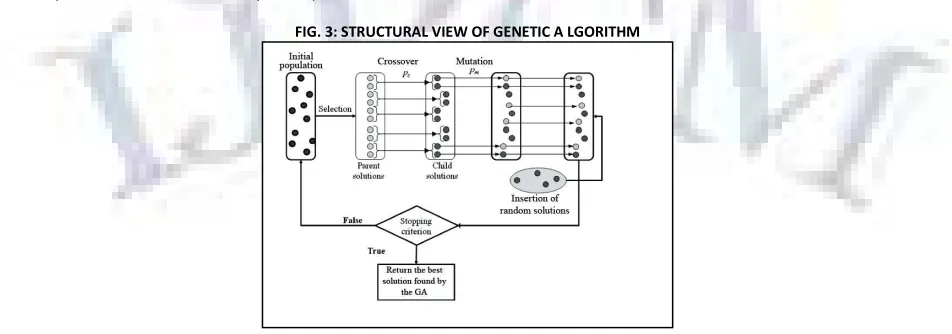
Genetic Algorithm challenge to incorporate ideas of natural evaluation The common idea behind GAs is that we can shape a better solution if we one way or another combine the "good" parts of other solutions similar to the nature does by joining the DNA of living beings.
Genetic Algorithm is mainly used as a problem solving policy in order to provide with a optimal solution. They are the finest way to solve the problem for which little is branded. They will work well in any hunt space because they form a very universal algorithm. The only thing to be well-known is what the particular situation is where the solution performs very well, and a genetic algorithm will produce a high quality solution. Genetic algorithms use the principles of selection and evolution to yield numerous solutions to a specified problem.
FIG. 3: STRUCTURAL VIEW OF GENETIC A LGORITHM
RULE EXTRACTION
rules that might be advisable: predictive versus descriptive algorithms.Moreover this taxonomy the evaluation criteria appears in almost all of these surveys-Quality of the extracted rule; Scalability of the algorithm; uniformity of the algorithm.
Generally a rule comprises two values. A left hand antecedent and a right hand consequent. An antecedent can have one or multiple conditions which must be true in order for the consequent to be true f or a given precision whereas a consequent is just a single condition. Thu s while mining a rule from a database antecedent, consequent, accuracy, and coverage are all targeted. Sometimes “interestingness” is also targeted used for ranking. The situation occurs when rules have high coverage and accuracy but deviate from standards. It is also essential to note that even though patterns are produced from rule induction system they all not necessarily mean that a left hand side should cause the right h and side part to come about. Once rules are created and interestingness is checked they can be used for predictions in business where each rule completes a prediction keeping a consequent as the target and the accuracy of the rule as the accuracy of the prediction which gives an opportunity for the overall system to improve and execute well.
For data mining domain, the non-existence of explanation facilities seems to be a serious problem as it produce opaque model, along with that accuracy is also required. To eradicate the deficiency of ANN and decision tree, we suggest rule extraction to produce a clear model along with accuracy. It is becoming increasingly outward that the absence of an explanation capability in ANN systems bounds the realizations of the packed potential of such systems, and it is this precise deficiency that the rule extraction process looks for to reduce. Experience from the field of expert systems has shown that an explanation capability is a vital function provided by symbolic AI systems. In particular, the ability to generate even limited
Explanation is totally crucial for user acceptance of such systems. Meanwhile the purpose of most data mining systems is to support decision making, the need for explanation abilities in these systems is apparent. But many systems must be regarded as black boxes; i.e. they are opaque to the user.
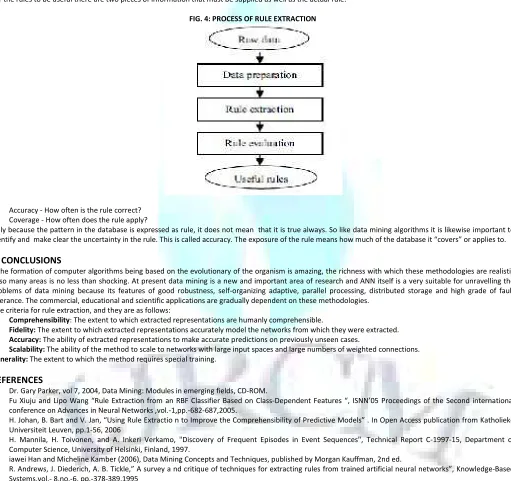
For the rules to be useful there are two pieces of information that must be supplied as well as the actual rule:
FIG. 4: PROCESS OF RULE EXTRACTION
· Accuracy - How often is the rule correct?
· Coverage - How often does the rule apply?
Only because the pattern in the database is expressed as rule, it does not mean that it is true always. So like data mining algorithms it is likewise important to identify and make clear the uncertainty in the rule. This is called accuracy. The exposure of the rule means how much of the database it “covers” or applies to.
III CONCLUSIONS
If the formation of computer algorithms being based on the evolutionary of the organism is amazing, the richness with which these methodologies are realistic in so many areas is no less than shocking. At present data mining is a new and important area of research and ANN itself is a very suitable for unravelling the problems of data mining because its features of good robustness, self-organizing adaptive, parallel processing, distributed storage and high grade of fault tolerance. The commercial, educational and scientific applications are gradually dependent on these methodologies.
Five criteria for rule extraction, and they are as follows:
· Comprehensibility: The extent to which extractedrepresentations are humanly comprehensible.
· Fidelity: The extent to which extracted representationsaccurately model the networks from which they were extracted. · Accuracy: The ability of extracted representations tomake accurate predictions on previously unseen cases.
· Scalability: The ability of the method to scale tonetworks with large input spaces and large numbers of weighted connections. Generality: The extent to which the method requiresspecial training.
REFERENCES
1. Dr. Gary Parker, vol 7, 2004, Data Mining: Modules in emerging fields, CD-ROM.
2. Fu Xiuju and Lipo Wang “Rule Extraction from an RBF Classifier Based on Class-Dependent Features “, ISNN’05 Proceedings of the Second international conference on Advances in Neural Networks ,vol.-1,pp.-682-687,2005.
3. H. Johan, B. Bart and V. Jan, “Using Rule Extractio n to Improve the Comprehensibility of Predictive Models” . In Open Access publication from Katholieke
Universiteit Leuven, pp.1-56, 2006
4. H. Mannila, H. Toivonen, and A. Inkeri Verkamo, "Discovery of Frequent Episodes in Event Sequences", Technical Report C-1997-15, Department of Computer Science, University of Helsinki, Finland, 1997.
5. iawei Han and Micheline Kamber (2006), Data Mining Concepts and Techniques, published by Morgan Kauffman, 2nd ed.
6. R. Andrews, J. Diederich, A. B. Tickle,” A survey a nd critique of techniques for extracting rules from trained artificial neural networks”, Knowledge-Based
VOLUME NO.4(2014),ISSUE NO.12(DECEMBER) ISSN 2231-5756
INTERNATIONAL JOURNAL OF RESEARCH IN COMMERCE, IT & MANAGEMENT
REQUEST FOR FEEDBACK
Dear Readers
At the very outset, International Journal of Research in Commerce, IT & Management (IJRCM)
acknowledges & appreciates your efforts in showing interest in our present issue under your kind perusal.
I would like to request you tosupply your critical comments and suggestions about the material published
in this issue as well as on the journal as a whole, on our E-mail
for further
improvements in the interest of research.
If youhave any queries please feel free to contact us on our E-mail
.
I am sure that your feedback and deliberations would make future issues better – a result of our joint
effort.
Looking forward an appropriate consideration.
With sincere regards
Thanking you profoundly
Academically yours
Sd/-
Co-ordinator
DISCLAIMER