polymers
ISSN 2073-4360 www.mdpi.com/journal/polymers ArticleFlame Retardance and Physical Properties of Novel Cured
Blends of Unsaturated Polyester and Furan Resins
Baljinder Kaur Kandola 1,*, John Russell Ebdon 1 and Kawser Parveen Chowdhury 1,2
1 Fire Materials Group, Institute for Materials Research and Innovation, University of Bolton,
Deane Road, Bolton, BL3 5AB, UK; E-Mail: [email protected]
2 Faculty of Textile Chemical Processing Engineering & Applied Science,
Bangladesh University of Textiles, 92 Shaheed Tajuddin Ahmed Avenue, Tejgaon, Dhaka-1208, Bangladesh; E-Mail: [email protected]
* Author to whom correspondence should be addressed; E-Mail: [email protected]; Tel.: +44-0-1204-903517; Fax: +44-0-1204-399074.
Academic Editor: Alexander Morgan
Received: 15 December 2014 / Accepted: 4 February 2015 / Published: xx February 2015
Abstract: Novel blends of two furan resins with an unsaturated polyester have been prepared and cured by parallel free radical (for the unsaturated polyester) and acid-catalysed crosslinking (for the furan resin) to give co-cured composite materials. Although these materials have inferior physical properties, such as low Tg and low storage modulus
compared with those of unsaturated polyester and furan resins alone, they show markedly improved flame retardance compared with that of the normally highly flammable unsaturated polyester. This increased flame retardance arises from a condensed phase mechanism in which the furanic component forms a semi-protective char, reducing rates of thermal degradation and total heat release and heat of combustion. The blends also burn with reduced smoke output compared with that from unsaturated polyester alone.
Keywords: unsaturated polyester; furan; blend; fire performance; thermal stability; cone calorimetry
1. Introduction
Fibre-reinforced composites based on thermosetting polymeric resins (thermosets) are becoming popular alternatives to conventional metals in structural applications owing to their good mechanical properties combined with light weight and corrosion resistance [1]. Thermosetting resins, composed of a resin, a curing agent, a catalyst or initiator, and sometimes a solvent can be easily tailored to provide high cross-linking densities for desired ultimate properties such as high modulus, strength, durability, and thermal and chemical resistances [2]. However, the organic nature of the polymeric resins makes them, and composites made using them, flammable; however, their flammability depends upon the resin type. Of the commonly used thermosets, namely unsaturated polyester (UP), vinyl ester (VE), epoxy (EP) and phenolic (PH) resins, UP and VE are the most flammable. For curing both UP and VE, styrene is used as a cross-linking agent, leading to a highly cross-linked structure with good mechanical properties. However, while these resins are thermally stable up to ~250 °C, above this temperature depolymerization occurs, producing styrene and other volatiles, which burn with heavy smoke and soot [3,4]. The depolymerization in these resins is close to 100%, leaving little char residue at the end of burning. Despite this drawback and because of other favourable properties, these two resins dominate the ship- and boat-building market and hence solutions to address the problem of their flammability need to be sought. One solution is for UP and VE resins to be compounded with halogen- and/or phosphorus-containing flame-retardant (FR) additives. However, these often have to be used at concentrations of 20 wt% or above to ensure efficacy, with deleterious effects on physical and mechanical properties [1]. Alternatively, for UP resins, the backbone may be chemically modified with FR groups (a reactive strategy) [5], or be crosslinked using an FR monomer in partial replacement of the styrene [6,7], but either strategy significantly increases cost. We have adopted an alternative approach of blending and co-curing these resins with other less flammable, char-forming resins [8].
This problem is particularly acute in conventional thick composites, cured by conventional thermal processes. Hence, these resins are not suitable for use in marine structural composites.
In our recent research at Bolton we have taken advantage of the char-forming ability of PH resins by blending them with UP resin and co-curing the blended resin to produce systems with improved flame retardancy, but that still have good physical and mechanical properties [4,8,11–13]. We have published extensively on the use of PH resoles [4,11,13] which, being liquids, are easy to use in this capacity. However, although the incorporation of PH resoles reduced the flammability of the UP, these blends needed much higher curing temperatures than UP (~200 °C compared to room temperature curing followed by post curing at 80 °C in UP) and longer curing times. To address this, we explore here the use of furan resins as alternatives to PH, since furan resins can be cured at room temperature. Like PH resins, furan resins are relatively thermally stable and are char-forming, and have established uses, for example as binders for foundry sands and as components of sealants and mortars [17]. More recently they have been used as intermediates for the manufacture of carbon-carbon composites [18]. 2. Experimental Section
2.1. Materials
Unsaturated polyester (UP) resin: Crystic 2-406PA (Scott Bader, Wellingborough, UK), a pre-accelerated, thixotropic condensate of phthalic anhydride, propan-1,2-diol and maleic anhydride containing
35–40 wt% styrene and 0.2 wt% cobalt octoate accelerant.
Free radical initiator for UP curing: Catalyst M (Scott-Bader, Wellingborough, UK): a solution of methyl ethyl ketone (MEK) peroxide in MEK.
Furan resins: Furolite (TransFurans Chemicals, Geel, Belgium): a furfuryl alcohol prepolymer with methylol end-groups having a molecular weight of 500–700. Furobond HO (TransFurans Chemicals, Belgium): A furfuryl alcohol prepolymer of structure similar to Furolite but with a molecular weight of ca. 2000.
Catalyst for furan resin curing: p-toluene sulfonic acid monohydrate (Tokyo Chemical Industry Co. Ltd., Tokyo, Japan).
2.2. Preparation of Cured Resin Plaques
Unsaturated polyester: Twelve grams of UP resin and 0.24 g of catalyst M (i.e., 2 wt% w.r.t. resin) were mixed by continuous hand stirring for around 5 min in a 100 mL beaker. Samples of mixed resin were poured into round moulds (5 cm diameter, 3 mm depth), allowed to cure at room temperature for 24 h, and then post cured at 80 °C for a further 6 h in an oven. These curing conditions used for UP are similar to those reported in our previous publications [4,9].
The curing/post curing conditions of both furan resins and their blends with UP discussed below were established by differential scanning calorimetry (DSC), discussed in a later section.
solvent, 96 g of dissolved resin. Twelve grams of this dissolved resin was mixed with 0.087 g (1 wt% w.r.t. resin, excluding the added solvent) of p-toluene sulfonic acid monohydrate, pre-dissolved in a small amount of methanol, and samples poured into round moulds as for UP. These cast samples were cured using the same thermal regime as for UP except that the postcuring at 80 °C was carried out for 24 h.
Furobond HO (FB): Twenty grams of FB and 15 mL of furfuryl alcohol as solvent were mixed and stirred for around 3 h in a 100 mL beaker giving 33.3 g of dissolved resin. Twelve grams of this dissolved resin and 0.12 g (1 wt% w.r.t. resin) of p-toluene sulfonic acid monohydrate catalyst were measured into two separate beakers. A small amount of THF was used to dissolve the solid acid monohydrate (methanol cannot be used in this case as it is not miscible with FB), which was then stirred into the resin for around 5 min. Samples of this mixed FB resin were then poured into round moulds and cured at room temp for 24 h followed by post-curing at 80 °C for another 48 h in an oven. Some samples were subjected also to a second post-curing at 100 °C for 4 h.
UP/FL blends: Blends of UP with FL were prepared with 50/50 ratios and a 70/30 ratios by weight of UP and FL. After mixing the resin components, 2 wt% w.r.t UP of catalyst M was added to the mixture together with 1 wt% w.r.t. FL of p-toluene sulfonic acid monohydrate. Samples of these blends were cured in round pans following the same curing regime as for the pure FL samples.
UP/FB blends: Blends of UP with FB were prepared also with 50/50 and 70/30 ratios by weight of UP and FB following procedures similar to those adopted for the UP/FL blends, except that a small amount of THF rather than methanol was used to solubilize the p-toluene sulfonic acid monohydrate in the resin mixture. The 50/50 blend was cured using the same temperature regime as for pure FB whilst for the 70/30 blend, the second post-curing at 100 °C was omitted.
In all resin samples mentioned above, prior to adding curing agent, the resin mixtures were degassed in a vacuum oven to remove any trapped gases including moisture. This is in line with the procedure used commercially.
2.3. Differential Scanning Calorimetry (DSC)
Resins are cured commercially at the lowest practicable temperature for a long period of time rather than at higher temperatures for shorter times in order to achieve maximum cross-linking, resulting in good mechanical properties. These curing conditions are established by running DSC experiments on small samples at very low heating rates (3–5 °C/min). Thus, in this work a DSC (Polymer Laboratory Thermal Sciences Division) was used to monitor the curing of resins and resin blends. About ten milligrams of an uncured resin or resin blend containing the appropriate amount(s) of curing agent(s) was placed in a standard aluminium pan fitted with a lid that had been pierced with a pin to introduce a small hole through which any volatiles could escape and then heated from 30 to 300 °C, at 5 °C/min under N2 at a gas flow rate of 100 mL/min. From the onset and maximum temperatures of curing peaks,
2.4. Dynamical Mechanical Thermal Analysis (DMTA)
A DMTA instrument (Polymer Laboratory Thermal Sciences Division) was used to measure glass transition temperatures (Tg), to study resin compatibility and to assess likely mechanical properties,
using a single cantilevered clamp bending geometry at a frequency of 1 Hz, an RMS strain of 0.1%, over a temperature range of room temperature to 300 °C at a heating rate of 5 °C/min.
2.5. Thermo Gravimetric Analysis (TGA)
TGA (TA Instruments) was performed on 8–10 mg samples of cured resins and resin blends at a heating rate of 10 °C/min under air at a flow rate of 100 mL/min between 40 and 900 °C. Mass losses during heating were recorded.
2.6. Limiting Oxygen Index (LOI)
Measurements of LOI (Fire Testing Technology, UK) were carried out according to a standard method (BS 2782) on samples of each cured resin and resin blend specimens of 50 mm length, 10 mm thickness and 3.6 mm thickness.
2.7. Cone Calorimetry
A Cone Calorimeter (Fire Testing Technology, UK) was used to measure standard flammability parameters on circular plaques of cured resin and resin blends measuring 50 mm in diameter and 3.6 mm in thickness, in the horizontal mode with an ignition source at an applied heat flux of 50 kW/m2. Before testing, the bottom surfaces and the edges of the samples were wrapped with aluminium foil to ensure that only the top surfaces would be directly exposed to the heat source. A minimum of three tests were performed for each formulation.
The sample size used here is smaller than the normal 100 mm × 100 mm sizes as outlined in ISO 5660 and ASTM E 1354. Previously in our laboratories, a comparative study of the cone calorimetric behaviour of round and standard square (10 cm × 10 cm) samples was undertaken in order to understand the effect of geometry on flammability properties of polymeric materials [19]. Circular specimens with a four-fold reduction in area produced similar results for the peak heat release rates (PHRR), total heat release (THR) and effective heat of combustion (EHC).
3. Results and Discussion
3.1. Physical Appearances of Cured Resins and Resin Blends
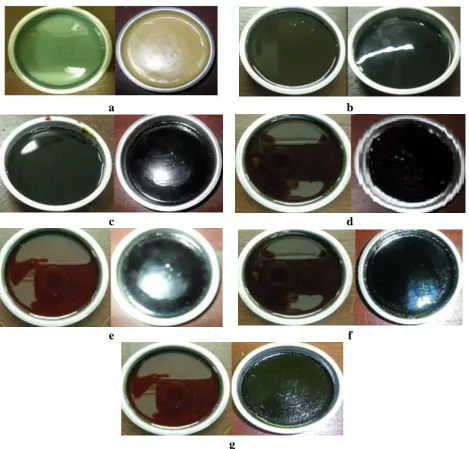
Digital images of uncured, optimally cured and postcured samples of resins and resin blends are shown in Figure 1a–g, with the image on the left in each pair being of the uncured sample, and that on the right being of the cured and postcured sample.
a b
c d
e f
g
Figure 1. Digital images of uncured and cured samples of (a) UP, (b) FL, (c) FB, (d) 50/50 UP/FL, (e) 70/30 UP/FL, (f) 50/50 UP/FB and (g) 70/30 UP/FB.
O O O O O O O O O O R O O O O O O O O O O O R O
Scheme 1. An early stage in the crosslinking of an unsaturated polyester (UP), based on the condensation of maleic anhydride and phthalic anhydride with propylene glycol, via a free-radical chain reaction of the maleate double bonds in the UP with styrene. R• represents a primary radical arising from the decomposition of the free-radical initiator (in this work, MEK peroxide). Note that phthalate units are not involved in the crosslinking reaction and therefore are not shown in the interests of clarity.
It is generally accepted that the principal reactions involved in the acid-catalyzed polymerization of furfuryl alcohol (and by analogy the acid-catalyzed chain extension of –CH2OH ended furfuryl alcohol
oligomers) are those originally proposed by Dunlop and Peters [22], namely reaction of methylol groups with the C5 carbon of a neighbouring furfuryl alcohol moiety (Reaction (1) in Scheme 2) to produce methylene linked species, plus mutual reaction of methylol groups to produce methylene ether links (Reaction (2) in Scheme 2), in both cases with the elimination of water. Methylene ether linkages are not particularly stable, but decompose with the elimination of formaldehyde to produce methylene links, especially at the high temperatures employed in our curing of FL and FB based resins (see also Scheme 2).
O CH2OH O CH2OH +
O CH2 E+
E+
O CH2OH
O CH2 O
CH2 O (1)
(2)
+ H2O
+ H2O
- CH2O
O CH2 O
The simple reactions shown in Scheme 1 result only in linear structures and do not explain the highly coloured and crosslinked materials obtained when polyfurfuryl alcohol is fully cured. The colour can only be explained by the development of intra- and/or inter-chain conjugation. Choura et al. have published the most extensive investigation of both colour formation and crosslinking based on studies of reactions of model compounds [23]. Their proposed reactions for the development of conjugation are shown, in simplified form, in Scheme 3, Reaction (3). It will be seen that this scheme involves successive hydride ion and proton eliminations. However, whilst this proposal seems reasonable for reactions catalyzed by reagents such as Ph3CAsF6 in aprotic organic
solvents in which the Ph3C+ ion can act as a hydride acceptor, in our systems, which are catalyzed by
p-toluene sulfonic acid with eliminations of water, no such hydride acceptor is present, unless one considers possible hydride abstractions from one chain by a carbocationic centre on another.
O CH2 O CH2 O
O CH O CH2 O
O CH O CH O - H
-- H+ +
(3)
Scheme 3. Reaction suggested for the development of conjugated unsaturation, and hence colour, in polyfurfuryl alcohols [23].
O CH2+
O CH O CH
O
CH O CH
O
O CH
CH O CH2 O
O CH2+
+
O CH O
CH2
O
(5) (6)
+ H+
(4)
Scheme 4. Reactions suggested for the crosslinking of furfuryl alcohol resins [24–26].
Although appearances (clear viscous liquids of uniform appearance) suggest that the blends are homogeneous mixtures prior to curing, after curing and postcuring the samples are at best translucent and have rough surfaces, suggesting that some slight phase separation has taken place, or that curing has not been uniform throughout the samples (see, for example, Figure 1f,g). SEM and/or TEM examinations of some of these samples might be informative in any future work, provided of course that phase separation gives rise to domains of at least micron dimensions.
3.2. Curing Behaviour of Resins and Resin Blends Investigated by DSC
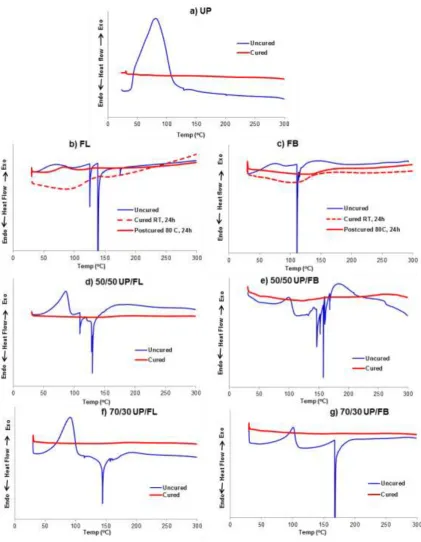
UP: DSC traces recorded at a heating rate of 5 °C/min on a sample of uncured UP and a sample cured following the curing and postcuring procedure outlined for UP above are shown in Figure 2a. The run on uncured UP shows a pronounced exotherm between ca. 40 and 140 °C with a maximum at about 80 °C arising from the thermal curing of the sample. The run on the cured and postcured sample gives essentially a flat trace, indicating that cure was complete.
FL: The DSC trace recorded on uncured FL, Figure 2b, shows an exothermic transition starting from room temperature, which is then masked by a sharp endothermic peak between ca. 120 and 150 °C. Furan resins cure with the release of water (Scheme 1) and we assume that the endotherm observed here arises from evaporation of this water, possibly with evaporation of residual methanol solvent. The curing was conducted at room temperature for 24 h, followed by post curing at 80 °C for 24 h. The DSC trace of the cured and postcured sample, like that of cured UP, is featureless, indicating that cure was complete.
FB: The DSC traces for FB before and after curing and postcuring, Figure 2c, are similar to those for FL except in that the shallow curing exotherm between ca. 60 and 180 °C is masked by an endotherm for the uncured sample.
that for the 50/50 compositions more than one endothermic peak is observed, possibly indicating release of several volatile species during cure, or delayed release of some volatiles caused by the rapidly increasing viscosity of the curing system because the UP network cures first during the DSC runs (40–140 °C) ahead of the furan resin network (120–150 °C). For all blends, the DSC traces of the cured and postcured samples show no endotherms or exotherms, indicating that the curing of both components was complete.
3.3. DMTA Analysis of Cured Resins and Resin Blends
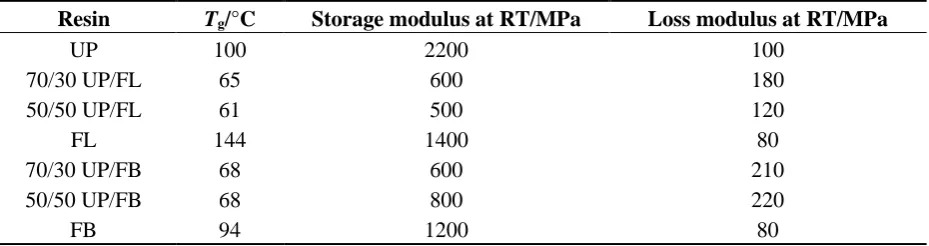
Plots of tanδ for cured samples of UP, FL, FB and blends of UP with FL and FB are given in Figure 3a,b. For all samples, including the blends, single tanδ maxima are observed, indicating that all samples are homogeneous materials displaying single α transitions (Tg). The values of Tg obtained
from the figures are given in Table 1. Also included in the table are values of the loss and storage moduli at RT (i.e., below Tg) The notable feature is that Tgs of the cured blends are lower than those of
the separately cured components, as are the storage moduli below Tg, whereas the loss moduli of the
blends are greater than those of either of the pure components below Tg. This finding is disappointing
in that it provides no evidence of mutual reinforcement of the networks formed by the two resins in the blends, but rather that network formation is less complete (looser) in both the components in the cured blends than it is in the cured pure components. The significance of this is that high temperature mechanical properties of the cured blends are likely to be poorer than those of the cured individual resins.
Figure 3. Tanδ vs. T for (a) cured UP, FL and UP/FL blends and (b) for cured UP, FB and UP/FB blends.
Table 1. Tg and moduli for cured resins and resin blends.
Resin Tg/°C Storage modulus at RT/MPa Loss modulus at RT/MPa
UP 100 2200 100
70/30 UP/FL 65 600 180
50/50 UP/FL 61 500 120
FL 144 1400 80
70/30 UP/FB 68 600 210
50/50 UP/FB 68 800 220
FB 94 1200 80
Note: RT = room temperature.
3.4. Thermal Degradation of Cured Resins and Resin Blends Studied by TGA
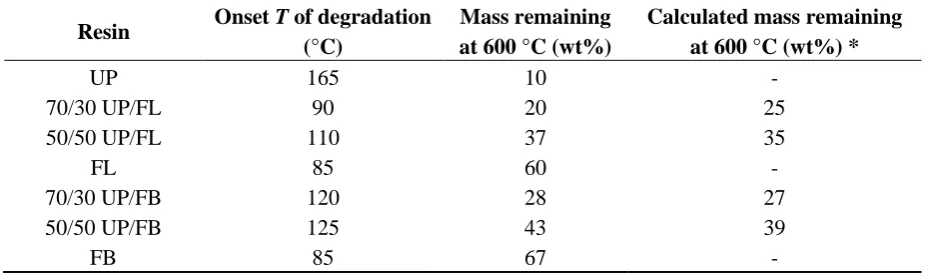
behaviours of FL and FB are rather more complex with probably more than two stages involved, although for these resins too, there appear to be initial stages corresponding to pyrolysis followed by a char oxidation stage. In all significant respects, the TGA traces for the UP/FL and UP/FB blends are intermediate in character between those of the pure resin components in that, like FL, UP/FL blends are initially less thermally stable than UP, whereas above about 400 °C, the blends are more thermally stable than UP. The same pattern of behaviour is observed also for the UP/FB blends. Salient details of degradation behaviour extracted for the TGA traces are listed in Table 2.
Figure 4. TGA traces for (a) cured UP, FL and UP/FL blends and (b) cured UP, FB and UP/FBblends.
Table 2. Some parameters of degradation extracted from the TGA data plotted in Figure 4.
Resin Onset T of degradation
(°C)
Mass remaining at 600 °C (wt%)
Calculated mass remaining at 600 °C (wt%) *
UP 165 10 -
70/30 UP/FL 90 20 25
50/50 UP/FL 110 37 35
FL 85 60 -
70/30 UP/FB 120 28 27
50/50 UP/FB 125 43 39
FB 85 67 -
* Calculated assuming that char yields in blends are mass averages of those of component resins.
view, both blends behave very much like simple mixtures of UP and FL or FB and that there is probably no chemical interaction between them leading to changes in pyrolysis mechanism.
3.5. Limiting Oxygen Index (LOI) of Cured Resins and Resin Blends
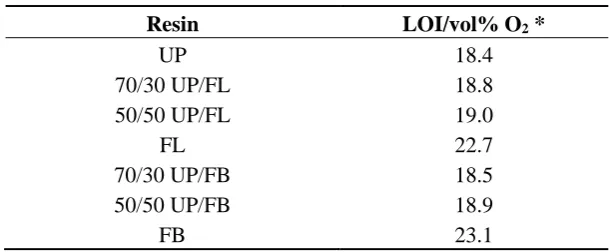
Measurements of LOI for the various resins and resin blends are given in Table 3. LOI is a rather crude measure of flammability (more a measure of ignitability) but can be a useful guide to likely performance in more sophisticated fire tests and in real-world fire performance. As expected, given the greater char-forming potential of FL and FB than UP, the LOIs of FL and FB are both greater than that of UP. Also, the LOIs of the blends are intermediate between those of the resin components and increase as the amount of FL or FB is increased, as would be expected.
Table 3. LOIs of cured resin and resin blends.
Resin LOI/vol% O2 *
UP 18.4
70/30 UP/FL 18.8
50/50 UP/FL 19.0
FL 22.7
70/30 UP/FB 18.5
50/50 UP/FB 18.9
FB 23.1
* Probable error in LOI = ± 0.1.
3.6. Cone Calorimetry
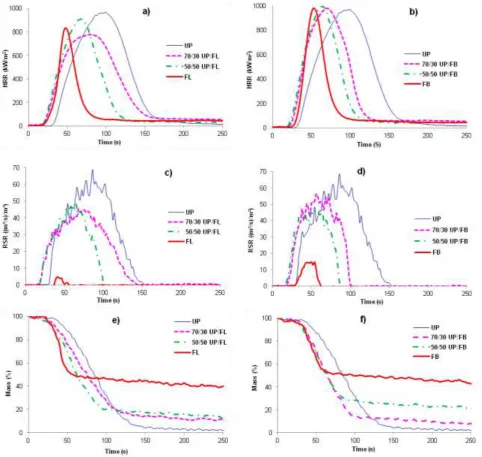
Plots of heat release rate (HRR) vs. time (t) for the various cured resins and resin blends are given in Figure 5a,b, whilst Figure 5c,d show plots of rate of smoke release (RSR) vs. t, and Figure 5e,f plots of mass vs. t.
Figure 5. HRR vs. time for (a) UP/FL cured resins and resin blends and (b) for UP/FB cured resins and resin blends. (c) and (d) are RSR vs. time plots for the same systems and (e) and (f) plots of mass vs. time plots obtained by cone calorimetry.
Table 4. Cone calorimetric data for cured resins and resin blends *.
Resin TTI/s FO/s PHRR
(kW m−2)
THR (MJ m−2)
EHC (MJ kg−1)
TSR (m2 m−2)
Char (wt%)
UP 28 148 967 78 19.3 4,660 0.8
70/30 UP/FL 17 142 796 71 19.4 3,525 9.8
50/50 UP/FL 16 117 911 57 16.8 2,520 13.6
FL 19 103 854 32 16.0 95 38.0
70/30 UP/FB 19 101 979 67 18.9 3,140 7.0
50/50 UP/FB 18 102 993 39 18.1 2,330 20.2
FB 25 118 981 39 17.3 290 44.2
It is clear from these data that whilst not as flame retardant as cured FL and cured FB, cured blends of UP with both FL and FB are significantly more flame retardant than UP alone. Of particular note is that although times to ignition for the blends are shorter than for UP, duration of flaming combustion (FO–TTI) is also shorter, whilst although PHR is little altered, both THR and EHC are significantly reduced. The increased char yields for the blends together with no increase in smoke (in fact smoke output is reduced), indicate that the effects of FL and FB in increasing the flame retardance of UP/FL and UP/FB blends compared with UP alone arise from a condensed phase mechanism in which both FL and FB contribute to significantly increased char formation. The structures of these chars have not been investigated in detail but appear to be largely carbonaceous.
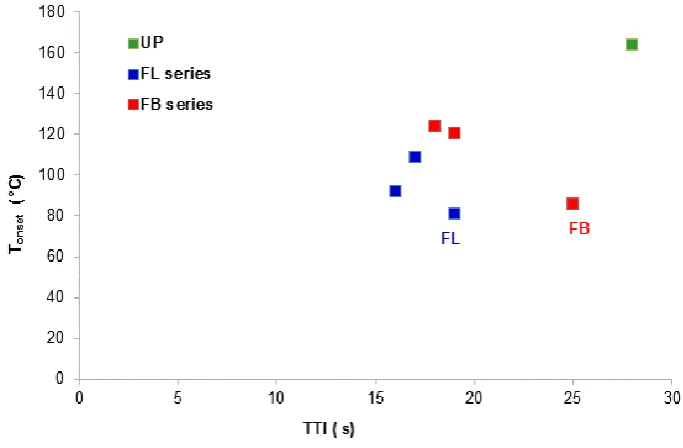
It is interesting to investigate to what extent the thermal degradation behaviors of these polymers (i.e., the TGA data) are consistent with the fire performance as assessed by cone calorimetry. For example, one would expect the temperature of onset of thermal degradation, Tonset (i.e., temperature at
which volatiles begin to be released) to have a bearing on the time to ignition, TTI. These data are plotted in Figure 6.
Figure 6. Plot of Tonset from TGA data vs. TTI from cone calorimetric data for cured resins
and resin blends.
With the exception of the data for FL and FB, it can be seen from Figure 7 that the correlation between Tonset and TTI is reasonable, with those resins that have low Tonset having low TTI and
vice versa. It is possible that both Tonset and TTI are low for FL and FB owing to the presence of some
Figure 7. THR vs. mass loss below 600 °C for cured resins and resin blends.
The correlation between THR and TGA mass loss below 600 °C is a good indication that the majority of the gases released during the pyrolysis of the polymers are flammable fragments and not non-combustible species such as CO and CO2. In future work these gases will be quantitatively
characterized by TGA-FTIR and Pyrolysis-GCMS. Although no plots are shown here, it is worth noting that, as expected, there is a reasonable correlation between char yields obtained in the TGA experiments (i.e., mass remaining at 600 °C) and final char yields in the cone calorimetric tests (see Tables 2 and 4).
4. Conclusions
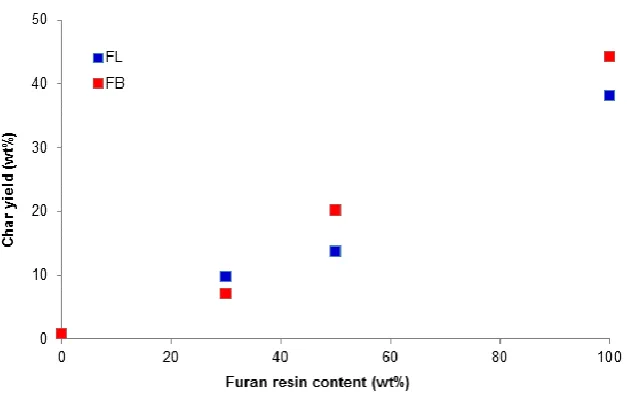
The addition of both FL and FB to UP leads to a significant increase in flame retardance in the resulting cured blends compared with that of cured UP alone. There is little to choose between the UP/FL and UP/FB systems in terms of their fire performance, with parameters such as LOI, PHRR, THR, RSR and char yield being similar for blends of equivalent composition. The mechanism of flame retardance is a condensed phase one in which the introduction of the furan resin leads to increased char formation. However, this char almost certainly arises from the furan component alone, with no increased contribution from UP, as can be seen from the near linear plots of char yield from the cone calorimetric experiments vs. resin composition for both the UP/FL and UP/FB systems (see Figure 8).
Although the cured blended resins appear to have single Tgs, it is doubtful that they are completely
homogeneous or that network formation is complete, especially for the furanic component, given that Tgs are lower than for the pure cured components and that storage moduli below Tg are poor.
Figure 8. Plots of char yield from cone calorimetric experiments vs. resin composition for UP/FL resins () and UP/FB resins ().
Acknowledgements
We thank the UK Engineering and Physical Sciences Research Council (EPSRC) for their financial support of this work (Grant No. EP/H020675/1), Scott-Bader and TransFurans Chemicals for the provision of materials, and Dean Bugg and Hans Hoydonckx of the aforementioned companies for technical advice.
Author Contributions
Kawser Parveen Chowdhury performed the experimental work, Baljinder Kandola directed and supervised the research, and John Ebdon analyzed and interpreted much of the data.
Conflicts of Interest
The authors declare no conflict of interest.
References
1. Kandola, B.K.; Kandare, E. Composites having improved fire resistance. In Advances in Fire Retardant Materials; Horrocks, A.R., Price, D., Eds.; Woodhead Publishing: Cambridge, UK, 2008; Chapter 5, pp. 398–442.
2. Feldman, D. Composites, thermosetting polymers. In Polymeric Materials Encyclopedia; Salamone, J.C., Ed.; CRC Press: Boca Raton, FL, USA, 1996; pp. 277–278.
3. Irvine, D.J.; McCluskey, J.A.; Robinson, I.M. Fire hazards and some common polymers. Polym. Deg. Stab. 2000, 67, 383–396.
5. Zhang, C.; Huang, J.Y.; Liu, S.M.; Zhao, J.Q. The synthesis and properties of a reactive flame-retardant unsaturated polyester resin from a phosphorus-containing diacid. Polym. Adv. Tech. 2011, 22, 1768–1777.
6. Froehling, P.E. Crosslinking of unsaturated polyester resins by combinations of vinyl esters and methacrylates. J. Appl. Polym. Sci. 1982, 27, 3577–3584.
7. La Scala, J.J.; Sands, J.M.; Orlicki, J.A.; Robinette, E.J.; Palmese, G.R. Fatty acid-based monomers as styrene replacements for liquid molding resins. Polymer 2004, 45, 7729–7737. 8. Kandola, B.K.; Deli, D.; Ebdon, J.R. Compatibilised polymer blends, UK Patent Application,
GB1222468.9, 21 August 2013.
9. Van Krevelen, D.W. Some basic aspects of flame resistance of polymeric materials. Polymer. 1975, 16, 615–620.
10. Kandola, B.K.; Horrocks, A.R.; Myler, P.; Blair, D. Thermal Characterisation of Thermoset Matrix Resins, In Fire and Polymers; Nelson, G.L., Wilkie, C.A. ACS Symposium Series; American Chemical Society: Washington, DC, USA, 2001; pp. 344–360.
11. Deli, D.; Kandola, B.K.; Ebdon, J.R.; Krishnan, L. Blends of unsaturated polyester and phenolic resins for application as fire-resistant matrices in fibre-reinforced composites. Part 1: Identifying compatible, co-curable resins. J. Mater. Sci. 2013, 48, 6929–6942.
12. Kandola, B.K.; Krishnan, L. Fire Performance Evaluation of Different Resins for Potential Application in Fire Resistant Structural Marine Composites. Proceedings of the 11th International Symposium on Fire Safety Science (IAFSS), Christchurch, New Zealand, February 10–14, 2014. 13. Kandola, B.K.; Krishnan, L.; Deli, D.; Ebdon, J.R. Blends of unsaturated polyester and phenolic
resins for application as fire-resistant matrices in fibre-reinforced composites: Effects of added flame retardants. Polym. Deg. Stab. 2014, 106, 129–137.
14. Rivero, G.; Pettarin, V.; Vázquez, A.; Manfredi, L.B. Curing kinetics of a furan resin and its nanocomposites. Thermochim. Acta 2011, 516, 79–87.
15. De Vergara, U.L.; Sarrionandia, M.; Gondra, K.; Aurrekoetxea, J. Impact behaviour of basalt fibre reinforced furan composites cured under microwave and thermal conditions. Comp. Part. B 2014, 66, 156–161.
16. Guigo, N.; Mija, A.; Vincent, L.; Sbirrazzuoli, N. Eco-friendly composite resins based on renewable biomass resources: Polyfurfuryl alcohol/lignin thermosets. Eur. Polym. J. 2010, 46, 1016–1023.
17. Zeitsch, K.J. The Chemistry and Technology of Furfural and Its Many By-products; Elsevier: Amsterdam, The Netherlands, 2000.
18. Thomas, C.R. Essentials of Carbon-Carbon Composites; Royal Society of Chemistry: Cambridge, UK, 1993.
19. Biswas, B.; Kandola, B.K. The combined effect of epoxy nanocomposites and phosphorus flame retardant additives on thermal and fire reaction properties of fibre-reinforced composites. Polym Adv Tech. 2011, 22, 1192–1204.
20. Feldman, D.; Barbalata, A. Synthetic Polymers: Technology, Properties, Applications; Chapman and Hall: London, UK, 1996; pp. 202–211.
22. Dunlop, A.P.; Peters, F.N. The Furans; Reinhold Publishing Co.: New York, NY, USA, 1953. 23. Choura, M.; Belgacem, N.M.; Gandini, A. Acid-catalyzed polycondensation of furfuryl alcohol:
Mechanisms of chromophore formation and cross-linking. Macromolecules 1996, 29, 3839–3850. 24. Chuang, I.S.; Maciel, G.E.; Meyers, G.E. Carbon-13 NMR study of curing in furfuryl alcohol
resins. Macromolecules 1984, 17, 1087–1090.
25. Principe, M.; Ortiz, P.; Martinez, R. An NMR study of poly(furfuryl alcohol) prepared with p-toluenesulphonic acid. Polym. Int. 1999, 48, 637–641.
26. Gonzalez, R.; Figueroa, J.M.; Gonzalez, H. Furfuryl alcohol polymerisation by iodine in methylene chloride. Eur. Polym. J. 2002, 38, 287–297.