IJE TRANSACTIONS C: Aspects, Vol. 28, No. 12, (December 2015) 1765-1773
Please cite this article as: A. Alfi, Bilateral Teleoperation Systems Using Backtracking Search optimization Algorithm Based Iterative Learning Control, International Journal of Engineering (IJE), TRANSACTIONS C: Aspects, Vol. 28, No. 12, (December 2015) 1765-1773
International Journal of Engineering
J o u r n a l H o m e p a g e : w w w . i j e . i rBilateral Teleoperation Systems Using Backtracking Search optimization Algorithm
Based Iterative Learning Control
A. Alfi*
Faculty of Electrical and Robotic Engineering, Shahrood University of Technology, Shahrood 36199-95161, Iran
P A P E R I N F O
Paper history:
Received 11 March 2015
Received in revised form 26 October 2015 Accepted 19 November 2015
Keywords:
Telerobotic Transparency
Iterative Learning Control Smith Predictor Optimization
A B S T R A C T
This paper deals with the application of iterative learning control (ILC) to further improve performance of bilateral telerobotic systems based on Smith predictor. The aim is to achieve robust stability and optimal transparency for these systems simultaneously. The proposed control structure makes the slave manipulator follow the master in spite of uncertainties in time delays appeared in communication channel and model parameters of master-slave robots, called model mismatch. The time delays are considered to be large, unknown and asymmetric, but the upper bound of the delay is assumed to be known. The main aspect of the proposed controller is that a designer can use the classical controller like proportional-integrator-derivative (PID). However, one of its main difficulties is how to assign proper parameter values for the controller. In other words, the parameters of the controller are not unique and are chosen only to satisfy the stability condition. To solve this problem, in this paper, the local controller is also optimized by backtracking search optimization algorithm (BSA), which is a novel heuristic algorithm with a simple construction. Simulation results illustrate the appropriate performance of the proposed controller.
doi: 10.5829/idosi.ije.2015.28.12c.09
1. INTRODUCTION1
The remote control of telerobotic systems has gained considerable attention during two past decades. Telerobotic systems are widely utilized to perform complex tasks in hazardous environments [1].
A telerobotic system is generally composed of the following interconnected parts: a human operator, a dual robot allocated in local and remote sites namely master and slave robots, an environment and a communication channel. In a bilateral telerobotic system, the master robot is directly handled by a human operator in order to manipulate the slave robot in a task environment. It has been shown that the performance improvement is accomplished by providing feedback of the interaction force of the slave robot with the environment to the human operator, which is called force reflection [2].
The communication channel and interactions between the task environment and the slave are of important matters. When the distance between the
1*Corresponding Author’s Email: [email protected] (A. Alfi)
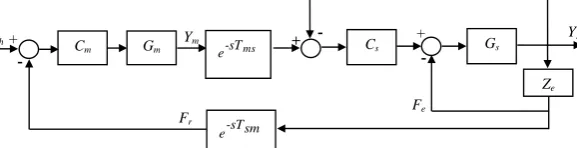
Figure 1. The general framework for bilateral telerobotic system
Due to existence of model uncertainty, obtaining the good performance is normally challenging [15]. In telerobotic systems, the model of master and slave robots and time delay in communication channel usually are uncertain, which is called model mismatch. These problems conduce to instability and bad performance.
Based on aforementioned researches, this paper addresses issues of stability and transparency in bilateral telerobotic systems against model mismatch using ILC based on smith predictor. It is assumed that the time delay in communication channel be unknown and asymmetric, but the upper bound of delay is supposed to be known. Since the time delay of the practical systems are often bounded, it is reasonable to assume the upper bound on the time delay. In the core of controller structure, Smith predictor is employed to improve the closed-loop stability for the system. According to our knowledge, this is the first application of Smith predictor-based ILC for controlling of telerobotic systems.
In addition, when applying the local controller into the system, we face with choosing an arbitrary set of the gains for the controller. It is unclear how the parameters of the controller are properly chosen, since these parameters are directly related to the controller performance. That is, the parameters of the local controller values are not unique and are opted only to satisfy the stability condition. The manual tuning is a time-consuming task and depends considerably on knowledge of the plant and experience of an operator. From this viewpoint, it is required to develop an optimal tuning strategy of the controllers, which can determine a set of controller gains simultaneously by solving an optimization problem. To this reason, the problem in hand can be considered as an optimization problem. Thus, in the proposed strategy, a novel heuristic algorithm, namely Backtracking Search Optimization Algorithm (BSA), is also used to achieve optimal performance of the system.
The rest of this paper is organized as follows. Section 2 describes a general framework of telerobotic systems. In Section 3, the design of the controllers is discussed in detail. Stability analysis is given Section 4. Section 5 represents the explanation of BSA. Section 6 illustrates simulation results. Finally, Section 7 draws conclusions and future works.
2. GENERAL FRAMEWORK
The control framework for telerobotic systems used in this paper is adopted from [6], as shown in Figure 1. In this figure,
G
mandC
mare the transfer function of the master robot and the corresponding controller namely local controller, respectively,G
sandC
s the transfer function of the slave robot and corresponding controller namely remote controller,T
msandT
smare the forward and backward time delays in communication channel, respectively,fhis the force exerted on the master by human operator,fe is the environmental reaction force which is measurable, fr the reflection force after being passed through a backward delay, and Ze the impedance of the task environment. In the control structure, the compliance control and direct-force measurement-force reflecting control has been combined.Stability and transparency are two main purposes of the control structure shown in Figure 1. To achieve these goals, the local and remote controllers (i.e.
C
mand
C
s) are designed. The aim of designing Csis to guarantee the motion tracking, whereasC
mis designed to ensure the stability of the closed-loop system as well as force tracking simultaneously. In the following, we explain the designing of the local and remote controllers in detail.3. DESIGN OF CONTROLLERS
3. 1. Remote Controller Consider the output of master and slave robots is position, then from Figure 1, we have
( ) ( ) ( )
( ) 1 ( ) ( ) ( )
ms
T
s
s s s
m e s s s
X s C s G s
e X s Z G s C s G s
(1)
Since the denominator of the transfer function given in Equation (1) is free of the time delay, the design of remote controller is then independent of the time delay. Accordingly, we can use the classical control methods
- +
Cm Gm e-sTms Cs Gs
-sTsm e
Ze
+
+
-
-Fe
Fr
1767 A. Alfi / IJE TRANSACTIONS C: Aspects..Vol. 28, No. 12, (December 2015) 1765-1773
like proportional-derivative (PD) to design a local controller Csfor the remote site such that system in Equation (1) is stable. This means that the poles of the transfer function are in the left-hand side of the S-Plane. Based on this, the position of the slave robot will follow the position of the master robot in such a way that the tracking error for position is satisfactory.
3. 2. Local Controller For simplicity, we define the following new variables.
(2) ( ) ( )
ˆ ( )
1 ( ) ( ) ( )
e s s
s
e s s s
Z C s G s G s
Z G s C s G s
(3)
ˆ
( ) = s( ) m( )
G s G s G s
(4) ms sm
TT T
(5)
( ) ( ) sT
r e
sm
F s F s e
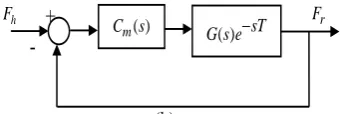
Using these variables, the control scheme shown in Figure 1 can be simplified as Figure 2(a). Considering the force tracking, a new output Fr can be defined in Figure 2(a). As a result, the system shown in Figure 2(a) can be simplified as the system in Figure 2(b). From Figure 2(b), the transfer function of the closed-loop system can be written as
(6)
( ) ( ) ( )
1 ( ) ( )
Ts m
Ts m
C s G s e M s
C s G s e
Form Equation (6), the roles of M(s) are the stability of the overall system as well as force tracking. It can be seen that the time delay can make system unstable and degrade the performance of the whole system. To solve this problem, different approaches have been introduced. Smith predictor is an effective method to eliminate the time delay from the characteristic equation [16]. Figure 3 represents the structure of Smith predictor. In this Figure, P s( )G s e( ) sT is the transfer function of the real model, in whichG is the model delay-free part transfer function and T 0is the time delay. Also, P sm( ) G s e( ) sT
is the transfer function of the nominal model.
(a)
(b)
Figure 2. The simplified shematic of general framework
Figure 3. Smith predictor scheme
Referring to Figure 3, the closed-loop transfer function is
( ) ( ) ( )
1 ( ) ( ) ( ) ( )
T
T T
s m
s s
m m
C s G s e
M s
C s G s C s G s e e
(7)
If there is no model mismatch, then the closed-loop system is stable. In other words, if G s( )G s( )and
T T, then Equation (7) can be rewritten as:
( ) ( ) ( )
1 ( ) ( )
T
s m
m
C s G s
M s e
C s G s
(8)
Here, the stability of the closed-loop becomes delay-independent and the local controller Cmis designed somehow for the delay-free system. Thus, one can use the classical control methods for designing local controller Cm like Proportional-Integrator-Derivative (PID). Unfortunately, the main problems is that: (1) it is hard to get the precise model of master and slave robots, and (2) the time delay is not constant. These will lead to instability of the system.
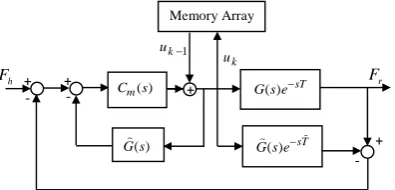
To handle this problem, in this paper, ILC strategy is applied in the closed-loop system. Figure 4 represents the general schematic ILC-based Smith predictor for controlling bilateral telerobotic system [17]. The goal of this structure is to achieve progressively force tracking as:
lim f( ) lim h( ) r( ) 0
te t tf t T f t (9)
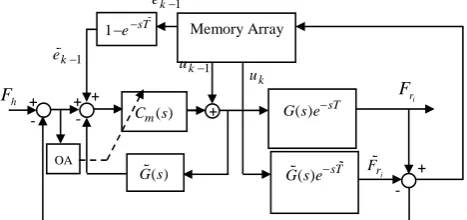
where T is the summarizing time delay defined in Equation (4). Assuming knowledge of the upper bound of time delay (T Tmax), Figure 4 should be modified as Figure 5 [18]. In the next part, we provide conditions for stability of the overall closed-loop system.
e F
sm sT e ( )
m G s +
- ms
sT e ( )
m C s
r F
h
F
ˆ ( )s G s
( ) m
C s
+
h F
-
G s e( ) sTr
F
( ) R s
-+
-( ) sT
G s e
( ) m
C s
( )
G s +
-( ) Y s
+
( ) sT
Figure 4. General schematic of ILC-based Smith predictor
Figure 5. Structure of Smith predictor-based ILC for designing local controller
4. STABILTY ANALYSIS
Assuming the worst case for the time delay (i.e.,
max
T T ), form Figure 5, the updating law of the control signal can be obtained as:
1 1 ( ) ( ) ( ) i i sT sT i i U UC R G s e G s e G s U E
(10) where
1
i i
sT
i r r
E F F e (11)
Substituting Equation (11) into Equation (10) and further simplifications, it yields
max ( ) 11 ( ) ( ) ( ) ( )
1 ( ) ( ) ( )
1 ( )
1 ( ) ( ) ( )
12 i
i
s T T
sT sT
m
r sT sT
m
sT m
r sT sT h
m
C G s e G s e G s G s e
F
C G s e G s e G s
C G s e
F F
C G s e G s e G s
By defining i sT i r
E Re F (13)
the recursion equation with respect to force tracking error can be written as:
1
( )
i i
E
Q s E
(14)where
max
( )
1 ( ) ( ) ( ) ( )
( )
1 ( ) ( ) ( )
s T T
sT sT
m
sT sT
m
C G s e G s e G s G s e
Q s
C G s e G s e G s
(15)
The sensitivity (S ) and complementary sensitivity (H ) functions associated with the nominal model are as follows:
1 1 ( ) ( ) S
C s G s
(16)
( ) ( ) ( )
1 ( ) ( ) C s G s H s
C s G s
(17)
Using Equation (16) and Equation (17), we obtain
1
( ) 1
sT sT
S WH e Q s WH e (18) in which ( )
( ) G s T T 1
W s e
G
(19)
( )
W s is a bounded function including all the uncertainties called the ignorance function [19].
( ) ( )
W j
j
(20)Theorem [17]: A sufficient condition for the convergence of the force tracking error is
3 1
S H (21)
5. BSA
As mentioned in section 3.2, a designer can utilize the classical controller like PID for the local controller. The problem is that appropriate values are assigned to the parameters of the controller. Then, an arbitrary set of gains can be chosen by the designer for the controller. One of its main difficulties is how to select suitable parameter values for the controller. The manual tuning is a time-consuming task. So, we need to develop an optimal tuning strategy of the controller, which can determine a set of controller gains simultaneously by solving an optimization problem. To this end, the problem in hand can be considered as an optimization problem. Traditional methods like gradient descents and dynamic programming often fail or trapped at local optima depending on the initial guess of solution while solving multimodal problems having large number of variables and non-linear objective functions. To overcome this shortage, various heuristic algorithms have been successfully applied in different areas [20-28]. To achieve the optimal performance of the system, BSA [29] is employed, which is a novel heuristic algorithm. Figure 6 illustrates the structure of the Smith-based ILC using BSA. BSA has a simple
+ +
-+
( ) sT G s e
( ) sT G s e
h
F Fr
( ) m C s ( ) G s Memory Array 1 k u k u + + + + -+
( ) sT G s e
( ) sT G s e
h
F Fri
( ) m C s ( ) G s Memory Array 1 k u k u + i r F 1esT
1769 A. Alfi / IJE TRANSACTIONS C: Aspects..Vol. 28, No. 12, (December 2015) 1765-1773
construction that is effective, fast and capable of solving multimodal optimization problems. Furthermore, the performance of BSA is not over sensitive to the initial value of this parameter. Unlike many population-based algorithms, BSA requires only one parameter that affects the performance of the algorithm [29]. Here, this optimization algorithm will be discussed briefly.
BSA’s strategy for generating a trial population includes two new crossover and mutation operators.
BSA’s strategies for generating trial populations and controlling the amplitude of the search-direction matrix and search-space boundaries give it very powerful exploration and exploitation capabilities. In particular, BSA possesses a memory in which it stores a population from a randomly chosen previous generation for use in generating the search-direction matrix. Thus, BSA’s memory allows it to take advantage of experiences gained from previous generations when it generates a trial preparation. BSA can be explained by dividing its functions into five processes as is done in other EAs: initialization, selection-I, mutation, crossover and selection-II.
5. 1. Initialization BSA initializes the population
P as:
, ( , )
i j j j
P U low up (22)
for i = 1,2,3,. . .,N and j = 1,2,3,. . .,D, where N and D
are the population size and the problem dimension, respectively, U is the uniform distribution and each Pi is a target individual in the population P.
Figure 6. The structure of Smith-based ILC using BSA
5. 2. Selection-I BSA’s Selection-I stage determines the historical population oldP to be used for calculating the search direction. The initial historical population is determined using Equation (23).
, ( , )
i j j j
oldP U low up (23)
BSA has the option of redefining oldP at the beginning of each iteration through the ‘if-then’ rule given in Equation (24).
: , (0,1)
if ab then oldP P a bU (24)
where := is the update operation.
Equation (24) ensures that BSA designates a population belonging to a randomly selected previous generation and remembers this historical population until it is changed. After oldP is determined, Equation (25) is used to randomly change the order of the individuals in oldP:
: ( )
oldP permuting oldP (25)
The permuting function used in Equation (25) is a random shuffling function.
5. 3. Mutation BSA’s mutation process generates the initial form of the trial population Mutant using Equation (26).
.( )
Mutant P F oldPP (26)
In Equation (26), F controls the amplitude of the search-direction matrix(oldPP). Because the historical population is used in the calculation of the search-direction matrix, BSA generates a trial population, taking partial advantage of its experiences from previous generations. Here, we use the value
3. , where (0,1)
F rand rndnN (N is the standard
normal distribution).
5. 4. Crossover BSA’s crossover process generates the final form of the trial populationT. BSA’s crossover process has two steps. The first step calculates a binary integer-valued matrix (map) of size N D. that indicates the individuals of T to be manipulated by using the relevant individuals of P. If mapn m, 1,where
1, 2,3,...,
n N and m
1, 2,3,...,D
, T is updated withTn m, :Pn m, .6. SIMULATION
6. 1. Modeling of Master and Slave Robots In this paper, similar to many papers in this field, a one-degree-of-freedom robot is used for the master and slave systems [5-7, 30]. García-Valdovinos, 2007 #208].
The system dynamics will be then represented by the following equations.
( m m) m m h
s M sB x
,( s s) s s e
s M sB x
(27)where B is the viscose friction coefficient, M the manipulators inertia,
x
the position and the input force; indicesm
and s are for the master and the slave+
+ +
-+
( ) sT
G s e
( ) sT
G s e
h
F Fri
( )
m
C s
( )
G s
Memory Array
1 k
u
k u
+
i r F
1esT 1 k
e
1 k
e
systems, respectively;
h the force applied to the master by human operator and
e the force exerted on the slave from the environment. The nominal models of masterand slave robots are ( ) 0.5
(0.4 3)
m
G s
s s
,
10 ( )
(0.5 0.2)
s
G s
s s
,respectively and the nominal values of the time delays existed in backward and forward, i.e., T 1. The real models of master and
slave robots are ( ) 1
(0.4 3)
m
G s
s s
,
1 ( )
( 0.2)
s
G s s s
,
respectively. Furthermore, the maximum values of the time delays are considered 2sec. It is worth to mention that to assess the performance of the proposed control method, we consider the worst case by choosing
max
T T .
6. 2. Results Simulation results are carried out in two cases: (1) Smith predictor-based ILC, and (2) optimal Smith predictor-based ILC. In each case, two different conventional controllers are designed. The first one is the remote controller Csand the second one the local controller Cm. Here, the classical PD and PID controllers are designed for the remote and local sites, respectively . To obtain optimal performance in case 2, the BSA is employed to obtain the parameters of PID local controller. Before proceeding with the optimization operations, a performance criterion should be first defined. In this paper, the following cost function
J
is considered.2 0
e
f ( )t dtJ
(28)where
e
f ( )t is given in Equation (9).To minimize the above cost function, BSA is applied to this problem 12 independent times. These results are compared in terms of cost value over 15 runs independently. The corresponding search spaces for the control gains are chosen as , d, [0 2]
I
p k k
k . The
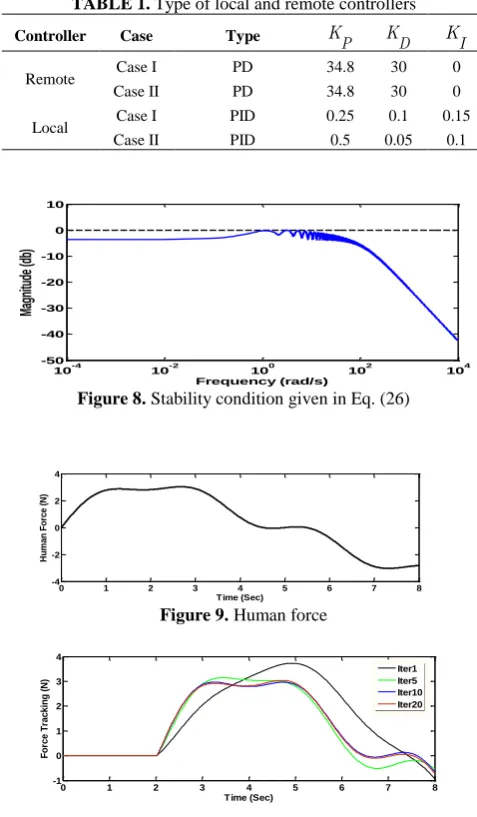
obtained controllers are listed in Table 1. The dashed line in the former Figure shows the right-hand side of Equation (21) (i.e., 20log(1)= 0 db). Referring to Figure 8, it can be seen that the convergence condition is satisfied. The upper bound of ignorance function W( )s
is also obtained as ( ) 2.1 1 0.75 2
s s
s
. For BSA, the control parametermixrateis set to 1 [29].
Figure 9 illustrates the human force. Figures 10-18 demonstrate the transparency response for both two cases. The results show that the system is robust stable whereas the slave robot can track the master effectively.
As these figures show, the proposed method has effectively controlled the system by considering transient and steady-state responses, in order to achieve transparency and stability of telerobotic system. In addition, it is evident that the performance of the system obtained in case 2 is better than case 1 as shown Figure 18.
TABLE 1.Type of local and remote controllers
Controller Case Type KP KD KI
Remote Case I PD 34.8 30 0
Case II PD 34.8 30 0
Local Case I PID 0.25 0.1 0.15
Case II PID 0.5 0.05 0.1
Figure 8. Stability condition given in Eq. (26)
Figure 9. Human force
Figure 10. Force tracking for iteration 1, 5, 10 and 20 (case 1)
Figure 11. Force error for iteration 1,5,10 and 20 (case 1)
10-4 10-2 100 102 104
-50 -40 -30 -20 -10 0 10
Frequency (rad/s)
M
ag
ni
tu
de
(d
b)
0 1 2 3 4 5 6 7 8
-4 -2 0 2 4
Time (Sec)
H
u
m
a
n
F
o
rc
e
(
N
)
0 1 2 3 4 5 6 7 8
-1 0 1 2 3 4
Time (Sec)
F
o
rc
e
T
ra
c
k
in
g
(
N
)
Iter1 Iter5 Iter10 Iter20
0 1 2 3 4 5 6 7 8
-2 -1.5 -1 -0.5 0 0.5 1
Time (Sec)
F
o
rc
e
E
rr
o
r
(N
)
1771 A. Alfi / IJE TRANSACTIONS C: Aspects..Vol. 28, No. 12, (December 2015) 1765-1773
Figure 12. Position tracking for iteration 1, 5, 10 and 20 (case 1)
Figure 13. Position error for iteration 1,5,10 and 20 (case 1)
Figure 14. Position tracking for iteration 1,5,10 and 20 (case 2)
Figure 15. Position error for iteration 1,5,10 and 20 (case 2)
Figure 16. Force tracking for iteration 1,5,10 and 20 (case 2)
Figure 17. Force error for iteration 1,5,10 and 20 (case 2)
Figure 18. Force tracking error for iteration 20
0 1 2 3 4 5 6 7 8
-1 -0.5 0 0.5 1 Time (Sec) P o s it io n T ra c k in g ( m
) Iter1 Master
Iter1 Slave
0 1 2 3 4 5 6 7 8
-0.4 -0.2 0 0.2 0.4 0.6 Time (Sec) P o s it io n T ra c k in g ( m
) Iter5 Master
Iter5 Slave
0 1 2 3 4 5 6 7 8
-0.5 0 0.5 Time (Sec) P o s it io n T ra c k in g ( m
) Iter10 Master
Iter10 slave
0 1 2 3 4 5 6 7 8
-0.5 0 0.5 Time (Sec) P o s it io n T ra c k in g ( m
) Iter20 Master
Iter20 Slave
0 1 2 3 4 5 6 7 8
-0.05 0 0.05 0.1 Time (Sec) P o s it io n E rr o r (m
) Iter 1Iter5
Iter10 Iter20
0 1 2 3 4 5 6 7 8
-1 -0.5 0 0.5 1 Time (Sec) P o s it io n T ra c k in g ( m
) Iter1 Master
Iter1 Slave
0 1 2 3 4 5 6 7 8
-0.4 -0.2 0 0.2 0.4 0.6 Time (Sec) P o s it io n T r a c k in g ( m
) Iter5 Master
Iter5 Slave
0 1 2 3 4 5 6 7 8
-0.5 0 0.5 Time (Sec) P o s it io n T r a c k in g ( m
) Iter10 Master
Iter10 Slave
0 1 2 3 4 5 6 7 8
-0.5 0 0.5 Time (Sec) P o s ti o n T ra c k in g ( m
) Iter20 Master
Iter20 Slave
0 1 2 3 4 5 6 7 8
-0.1 -0.05 0 0.05 0.1 0.15 Time (Sec) P o s it io n E r r o r ( m ) Iter1 Iter5 Iter10 Iter20
0 1 2 3 4 5 6 7 8
-1 0 1 2 3 4 Time (Sec) F o rc e T ra c k in g ( N ) Iter1 Iter5 Iter10 Iter20
0 1 2 3 4 5 6 7 8
-2 -1 0 1 Time (Sec) F o rc e E rr o r (N ) Iter1 Iter5 Iter10 Iter20
0 1 2 3 4 5 6 7 8
7. CONCLUSION
To obtain transparency and robust stability, a novel control structure of bilateral telerobotic systems was proposed using ILC-based smith predictor, in presence of model mismatch. To this end, two controllers, namely local and remote controllers, were designed. The main advantage of the structure is the simplicity of the controllers design such that one can use classical controllers such as PD, PI or PID controller. In addition, to acquire optimal performance of the system, BSA was utilized. Simulation results indicated that the proposed control scheme is a viable choice for telerobotic systems with model mismatch. Future works in this area is to consider practical experiments.
8. REFERENCES
1. Vertut, J. and Coiffet, P., Teleoperation and robotics evolution and development, Robot Technology, Vol. 3a. (1985), 102-136. 2. Sheridan, T.B., "Telerobotics, automation, and human
supervisory control, MIT press, (1992), 457-520.
3. Ferrell, W.R., "Remote manipulation with transmission delay", Human Factors in Electronics, IEEE Transactions on, Vol., No. 1, (1965), 24-32.
4. Sheridan, T.B., "Space teleoperation through time delay: Review and prognosis", Robotics and Automation, IEEE Transactions on, Vol. 9, No. 5, (1993), 592-606.
5. Alfi, A. and Farrokhi, M., "A simple structure for bilateral transparent teleoperation systems with time delay", Journal of Dynamic Systems, Measurement, and Control, Vol. 130, No. 4, (2008), 445-452.
6. Alfi, A. and Farrokhi, M., "Force reflecting bilateral control of master–slave systems in teleoperation", Journal of Intelligent and Robotic Systems, Vol. 52, No. 2, (2008), 209-232. 7. Alfi, A., Khosravi, A. and Lari, A., "Swarm-based
structure-specified controller design for bilateral transparent teleoperation systems via μ synthesis", IMA Journal of Mathematical Control and Information, Vol., No., (2013), 1005-1016.
8. Aracil, R., Azorín, J.M., Ferre, M. and Peña, C., "Bilateral control by state convergence based on transparency for systems with time delay", Robotics and Autonomous Systems, Vol. 61, No. 2, (2013), 86-94.
9. Khosravi, A., Alfi, A. and Roshandel, A., "Delay-dependent stability for transparent bilateral teleoperation system: An lmi approach", Journal of AI and Data Mining, Vol. 1, No. 2, (2013), 75-87.
10. Liu, X., Tao, R. and Tavakoli, M., "Adaptive control of uncertain nonlinear teleoperation systems", Mechatronics, Vol. 24, No. 1, (2014), 66-78.
11. Nuño, E., Ortega, R. and Basañez, L., "An adaptive controller for nonlinear teleoperators", Automatica, Vol. 46, No. 1, (2010), 155-159.
12. Bouakrifa F., Boukhetalab D. and Boudjema F., "Velocity observer-based iterative learning control for robot manipulators", International Journal of Systems Science, Vol. 44, No. 2, (2013), 214-222.
13. Bouakrif, F., Boukhetala, D. and Boudjema, F., "Velocity observer-based iterative learning control for robot
manipulators", International Journal of Systems Science, Vol. 44, No. 2, (2013), 214-222.
14. Kawamura, S. and Sakagami, N., "Analysis on dynamics of underwater robot manipulators based on iterative learning control and time-scale transformation", in Robotics and Automation, 2002. Proceedings. ICRA'02. IEEE International Conference on, IEEE. Vol. 2, (2002), 1088-1094.
15. Wang, W., Chen, J. and Mao, L., "Two-wheeled mobile robot tracking based on iterative learning control", in Advanced Materials Research, Trans Tech Publ. Vol. 433, (2012), 5866-5870.
16. Smith, O., "Closer control of loops with dead time", MIT press, (1957) 47-59.
17. Hu, Q., Xu, J.-X. and Lee, T.H., "Iterative learning control design for smith predictor", Systems & Control Letters, Vol. 44, No. 3, (2001), 201-210.
18. Xu, J.-X., Panda, S.K. and Lee, T.H., "Real-time iterative learning control: Design and applications, Springer Science & Business Media, (2008).
19. Palmor, Z., "Stability properties of smith dead-time compensator controllers", International Journal of Control, Vol. 32, No. 6, (1980), 937-949.
20. Alfi, A., "Chaos suppression on a class of uncertain nonlinear chaotic systems using an optimal h∞ adaptive PID controller", Chaos, Solitons & Fractals, Vol. 45, No. 3, (2012), 351-357.
21. Alfi, A. and Fateh, M.-M., "Intelligent identification and control using improved fuzzy particle swarm optimization", Expert Systems with Applications, Vol. 38, No. 10, (2011), 12312-12317.
22. Alfi, A. and Fateh, M.M., "Identification of nonlinear systems using modified particle swarm optimisation: A hydraulic suspension system", Vehicle System Dynamics, Vol. 49, No. 6, (2011), 871-887.
23. Alfi, A., Kalat, A.A. and Khooban, M.H., "Adaptive fuzzy sliding mode control for synchronization of uncertain non-identical chaotic systems using bacterial foraging optimization", Journal of Intelligent and Fuzzy Systems, Vol. 26, No. 5, (2014), 2567-2576.
24. Alfi, A., "PSO with adaptive mutation and inertia weight and its application in parameter estimation of dynamic systems", Acta Automatica Sinica, Vol. 37, No. 5, (2011), 541-549.
25. Arab, A. and Alfi, A., "An adaptive gradient descent-based local search in memetic algorithm applied to optimal controller design", Information Sciences, Vol. 299, (2015), 117-142.
26. Mousavi, Y. and Alfi, A., "A memetic algorithm applied to trajectory control by tuning of fractional order proportional-integral-derivative controllers", Applied Soft Computing, Vol. 36, No., (2015), 599-617.
27. Shokri-Ghaleh, H. and Alfi, A., "A comparison between optimization algorithms applied to synchronization of bilateral teleoperation systems against time delay and modeling uncertainties", Applied Soft Computing, Vol. 24, No., (2014), 447-456.
28. Shokri-Ghaleh, H. and Alfi, A., "Optimal synchronization of teleoperation systems via cuckoo optimization algorithm", Nonlinear Dynamics, Vol. 78, No. 4, (2014), 2359-2376.
29. Civicioglu, P., "Backtracking search optimization algorithm for numerical optimization problems", Applied Mathematics and Computation, Vol. 219, No. 15, (2013), 8121-8144.
1773 A. Alfi / IJE TRANSACTIONS C: Aspects..Vol. 28, No. 12, (December 2015) 1765-1773
Bilateral Teleoperation Systems Using Backtracking Search optimization Algorithm
Based Iterative Learning Control
A. Alfi
Faculty of Electrical and Robotic Engineering Shahrood University of Technology, Shahrood 36199-95161, Iran
P A P E R I N F O
Paper history:
Received 11 March 2015
Received in revised form 26 October 2015 Accepted 19 November 2015
Keywords:
Telerobotic Transparency
Iterative Learning Control Smith Predictor Optimization
ديكچ ه
متسيس درکلمع رتشيب دوبهب يارب يرارکت يريگداي لرتنک دربراک هب هلاقم نيا ساسا رب هفرطود رود هار زا يتکرح ياه
شيپ يم ثيمسا نيب تسد فده .دزادرپ
يداهنشيپ يلرتنک راتخاس .تسا هنيهب درکلمع و مواقم يرادياپ هب نامزمه يباي
يم ببس نامرف متسيس هک ددرگ سيس زا رب
لدم ياهرتماراپ و يطابترا لاناک ريخات نامز رد ينيعمان روضح رد هدنامرف مت
متسيس نامز .دنک تيعبت ربنامرف و هدنامرف ياه دودحم ييلااب دح اب رباربان و صخشمان ،گرزب يطابترا لاناک رد ريخات ياه
يم ضرف لرتنک يلصا يگژيو .دوش يم حارط هک تسا نآ يداهنشيپ هدننک
زا دناوت لرتنک هدننک يبسانت دننام کيسلاک ياه
-يلارگتنا ريگ -قتشم لرتنک ياهرتماراپ بسانم ريداقم نييعت يساسا لکشم دنچره .دنک هدافتسا ريگ ،رگيد ينايب هب .تسا هدننک
لرتنک ياهرتماراپ ،هلاسم نيا لح يارب .دنزاس هدروآرب ار يرادياپ طرش يتسياب اهنت و هدوبن درف هب رصحنم هدننک
نيا رد
لرتنک هلاقم هنيهب متيروگلا طسوت يلحم هدننک تسا هداس و ديدج يفاشتکا متيروگلا کي هک يتشگزاب يوجتسج يزاس
زين
يم هنيهب هيبش جياتن .دوش لرتنک بسانم درکلمع يزاس
يم ناشن ار يداهنشيپ هدننک .دهد