Please cite this article as: Md. S. Alam and M. A. H. Khan, Analysis of MHD Jeffery-Hamel Flow with Nanoparticles by Hermite-Pade Approximation, International Journal of Engineering (IJE), IJE TRANSACTIONS A: Basics Vol. 28, No. 4, (April 2015) 599-607
International Journal of Engineering
J o u r n a l H o m e p a g e : w w w . i j e . i rAnalysis of Magneto-hydrodynamics Jeffery-Hamel Flow with Nanoparticles by
Hermite-Padé Approximation
Md. S. Alam a*, M. A. H. Khanb
a Department of Mathematics, Jagannath University, Dhaka-1100, Bangladesh
b Department of Mathematics, Bangladesh University of Engineering and Technology, Dhaka-1000, Bangladesh
P A P E R I N F O
Paper history:
Received 05January 2014
Received in revised form 27 November2014 Accepted 13March2015
Keywords:
Jeffery-Hamel Flow Magneto-hydrodynamic Nanofluid
Dominating Singularity Hermite- Pade Approximation
A B S T R A C T
The combined effects of nanoparticles and magnetic field on the nonlinear Jeffery-Hamel flow are analyzed in the present study. The basic governing equations are solved into series solution using a semi-numerical analytical technique called Hermite- Padé approximation. The velocity profiles are presented in divergent channel for various values of nanoparticles solid volume fraction, Hartmann number, Reynolds number and channel angle. The dominating singularity behavior of the problem is analysed numerically and graphically. The critical relationship between the parameters is studied to observe the instability of the problem for nanofluid.
doi: 10.5829/idosi.ije.2015.28.04a.15
1. INTRODUCTION1
The study of flows in convergent-divergent channel is very important due to its industrial, aerospace, chemical, civil, environmental, mechanical and biomechanical engineering applications. Various applications of this type of mathematical model are to understand the flow of rivers and canals and the blood flow in the human body. Jeffery [1] and Hamel [2] first studied the two-dimensional steady motion of a viscous fluid through convergent-divergent channels which is called classical Jeffery-Hamel flow in fluid dynamics. Later, this problem has been extensively studied by various researchers. A survey of information on this problem can be found in [3]. The theory of Magneto-hydrodynamics (MHD) is inducing current in a moving conductive fluid in the presence of magnetic field; such induced current results force on ions of the conductive fluid. The theoretical study of MHD channel has been a subject of great interest due to its extensive applications in designing cooling systems with liquid metals, MHD generators, accelerators, pumps, and flow meters [4, 5].
1*Corresponding Author’s Email: [email protected] (M. S. Alam)
The small disturbance stability of MHD plane-Poiseuille flow was investigated by Makinde and Motsa [6] and Makinde [7]. Their results showed that magnetic field had stabilizing effects on the flow. Damping and controlling of electrically conducting fluid can be achieved by means of an electromagnetic body force (Lorentz force) produced by interaction of an applied magnetic field and an electric current that usually is externally supplied. Anwari et al. [8] studied the fundamental characteristics of linear Faraday MHD theoretically and numerically, for various loading configurations. Homsy et al. [9] emphasized on the idea that in such problems, the moving ions drag the bulk fluid with themselves, and such MHD system induces continued pumping of conductive fluid without any moving part.Apart from using numerical methods, the Jeffery-Hamel flow problem was solved by other techniques including the Homotopy analytical method (HAM),the Homotopy perturbation method (HPM), the Adomain decomposition method (ADM) and the spectral-Homotopy analysis method. Recently, the three analytical methods such as Homotopy analysis method, Homotopy perturbation method and Differential transformation method (DTM) were used by Joneidi et al. [10] to find the analytical
solution of Jeffery-Hamel flow. Moreover, the models on classical semi-analytical methods have experienced a revival, in connection with the scheme of new hybrid numerical-analytical techniques for nonlinear differential equations, such as Hermite– Padé approximation method, which demonstrated itself as a powerful benchmarking tool and a prospective substitute to traditional numerical techniques in various applications in science and engineering.
The classical Jeffery-Hamel problem was extended in Axford [11] to include the effects of external magnetic field on conducting fluid. Motsa et al. [12] found the solution of the nonlinear equation for the MHD Jeffery-Hamel problem by using novel hybrid spectral-homotopy analysis method. Moghimi et al. [13] also solved the Jeffery-Hamel flow problem by using the homotopy perturbation method. Taking into account the rising demands of modern technology, including
chemical production, power station, and
microelectronics, there is a need to develop new types of fluids that will be more effective in terms of heat exchange performance. The term ‘nanofluid’ was envisioned to describe a fluid in which nanometer-sized particles were suspended in conventional heat transfer basic fluids [14]. Rahmannezhad et al. [15] investigated the effects of a magnetic field on mixed convection of Al2O3-water nanofluid in a square lid-driven cavity. An
experimental investigation was carried out to study mixed convection heat transfer from Al2O3-water
nanofluid inside a vertical, W-shaped, copper-tube with uniform wall temperature in Rostamzadeh et al. [16]. The role of a convective surface in modelling with nanofluids has been investigated over a wedge by Rahman et al. [17]. They found that the surface convection significantly controls the rate of heat transfer in nanofluid and increasing volume fraction of nanoparticles to the base-fluid may not always increase the rate of heat transfer. Rahman et al. [18] investigated numerically the steady boundary layer flow and heat transfer characteristics of nanofluids using Buongiorno’s model past a permeable exponentially shrinking/stretching surface with second order slip velocity.
Figure 1. Geometry of the problem
Sheikholeslami et al. [19] studied the laminar nanofluid flow in a semi-porous channel using Homotopy Perturbation Method. Moreover, the effects of magnetic field and nanoparticles on the Jeffery-Hamel flow using a powerful analytical method called the Adomian decomposition method were studied by Sheikholeslami et al. [20].
The aim of this work is to apply the power series along with algebraic programming language MAPLE to find the approximate solutions into series of nonlinear differential equations governing the MHD Jeffery-Hamel flow with nanofluid. The series is analyzed to show a comparison between the Hermite–Padé approximation (HPA) and ADM results. The series is also investigated to show the velocity profiles with effect of nanoparticles volume fraction f and Hartmann number Ha. The change in singularity graphs for channel angle a and flow Reynolds number Re by the effect off with the help of approximation method is an extension of Sheikholeslami et al. [20]. The critical relationship between the parameters in the flow using HPA is not addressed yet.
2. MATHEMATICAL FORMULATION
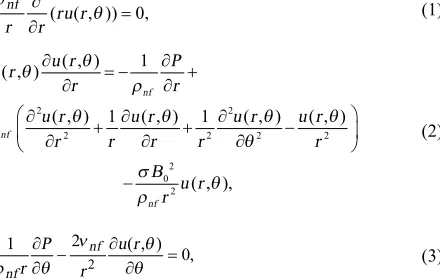
Consider a steady two-dimensional laminar incompressible flow of conducting viscous nanofluid from a source or sink between two channel walls intersect at an angle 2ain the axis of z. A cylindrical coordinate system(r,q,z)is used and assume that the velocity is purely radial and depends on rand q, so that there is no change in the flow parameter along the z-direction. It is presumed that there is a magnetic field acting in the vertical downward direction. The continuity equation, the Navier-Stokes equation and Maxwell’s equation in reduced polar coordinates are [13].
, 0 )) , (
( =
¶ 
q r
r ru r r
nf (1)
2 2
2 2 2 2
2 0
2
( , ) 1 ( , )
( , ) 1 ( , ) 1 ( , ) ( , )
( , ), nf
nf
nf
u r P
u r
r r
u r u r u r u r
r r r r r
B u r r
q q
r
q q q q
n
q
s q
r
¶ = - ¶ +
¶ 
æ¶ ¶ ¶ ö
+ +
-ç ¶ ¶ ¶ ÷
è ø
-(2)
, 0 ) , ( 2 1
2 ¶ =
¶ -¶ 
q q n q r
r u r P r
nf
nf (3)
whereB0is the electromagnetic induction, s the conductivity of the fluid, u(r,q) the velocity along radial direction, P the fluid pressure. The effective
r
q
0
B
densityrnf , the effective dynamic viscositymnf , and the kinematic viscosity nnfof the nanofluid are given as [21]:
2.5
(1 ) , , ,
(1 )
f nf
nf f s nf nf
nf
m m
r r f r f m n
f r
= - + = =
- (4)
Here,fis the solid volume fraction. The boundary conditions are as follows:
At the centerline of the channel: ( , ) =0. ¶ ¶ q q r u
At the boundary of the channel: u(r,q)=0.
Considering purely radial flow, the continuity Equation (1) implies that
) , ( )
(q ru r q
f = (5)
The dimensionless form of the velocity parameter can be obtained according to [2]:
max ) ( ) ( f f
f h = q , where
a q
h= (6)
whereais the channel angle andqis any angle.
Substituting (5) into (2) and (3) and eliminating the pressure term P, the nonlinear ordinary differential equation can be written as [20]:
, 0 ) ( ) ) 1 ( 4 ( ) ( ) ( ) 1 ( Re 2 ) ( 2 25 . 1 5 . 2 = ¢ -+ ¢ -+ ¢¢¢ * h a f h h f a h f Ha f f A f (7) , , ) 1 ( 2 0 f f f
s Ha B
A n r s f r r
f + =
-= * (8) max max max max Re
: 0, 0
: 0, 0
f f
f U r
divergent channel f
convergent channel f
a a n n a a = = > > æ ö
ç < < ÷
è ø
(9)
whereA* is a parameter, Ha Hartmann number, Re
Reynolds number and
a
channel angle. The boundary conditions are reduced to the following form:. 0 ) 1 ( , 0 ) 0 ( , 1 ) 0
( = f¢ = f =
f (10)
Physically, these boundary conditions mean that maximum values of velocity are observed at centerline
0 =
h as shown in Figure 1. Also, the rate of velocity is zero at h=0 and at the solid boundary, the no-slip condition is considered.
3. SERIES ANALYSIS
The following power series expansion is considered in terms of the parameter a as Equation (7) is non-linear for velocity field
, ) ( ) ( 0 i i i f
f h
å
¥ ha=
= (11)
We then find that f(h)has a singularity at a=acof
the form c
c C
f(h)~ (a -a)d with the critical exponent
c
d .The non-dimensional governing equation is then solved into series solution by substituting the series(11) into Equation (7) and the boundary conditions (10) and equating the coefficients of powers of a.With the help of MAPLE, we have computed the first 42 coefficients for the series of the velocity f(h) in terms ofa,Ha ,Re, f, A*. The first few coefficients of the series for
) (h
f are as follows:
2 2
2.5 2
1.25 2 2 4 2
2.5 1.25 3 4
1
( , , , Re, , ) 1 ( 1)( 1) 30
1
( 2)( 2) Re (1 ) ( 1)( 1)
12 1
(4 (1 ) ) ( 1)( 1)(5 9
5040
9) Re(1 ) (4 (1 ) ) ( )
f Ha A
A
Ha
A Ha O
h a f h h h h
h h f a h h h
f a h h h h h
f f a a
* * * = - - - + - + - + - + - - + - + -- - - - + (12)
Applying differential and algebraic approximate methods to the series, we determine the comparison between HPA and ADM solution and the convergence of critical values and the change in singularity graph for the channel angle and flow Reynolds number by the positive effect of nanoparticles volume fraction. The critical relationship between the parametersis also shown graphically using differential approximate method. The utility of the series solution has widened using Hermite-Pade' approximants method described below.
4. COMPUTATIONAL PROCEDURE
In the present analysis, we shall employ a very efficient solution method, known as Hermite-Padé approximants, which was first introduced by Padé [22] and Hermite [23]. We say that a function is an approximant for the series
n
n n
s
S
å
¥ a= =
0
(13)
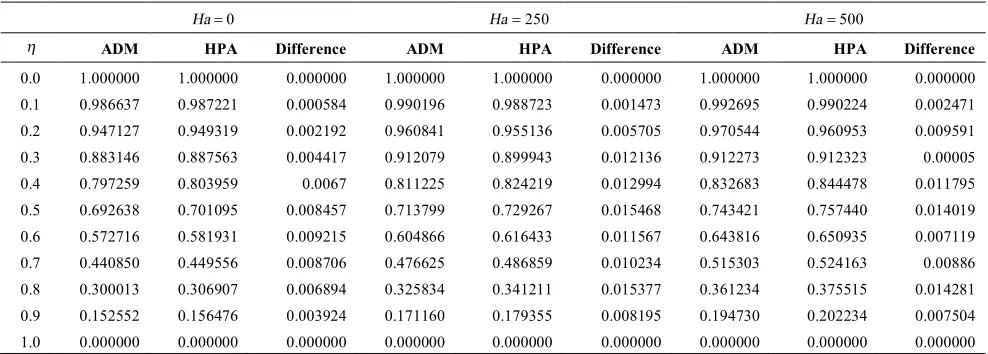
TABLE 1. Comparison between ADM solution and HPA solution for velocity whenf=0, Re=25,anda=5o 0
=
Ha Ha=250 Ha=500
h ADM HPA Difference ADM HPA Difference ADM HPA Difference
0.0 1.000000 1.000000 0.000000 1.000000 1.000000 0.000000 1.000000 1.000000 0.000000
0.1 0.986637 0.987221 0.000584 0.990196 0.988723 0.001473 0.992695 0.990224 0.002471
0.2 0.947127 0.949319 0.002192 0.960841 0.955136 0.005705 0.970544 0.960953 0.009591
0.3 0.883146 0.887563 0.004417 0.912079 0.899943 0.012136 0.912273 0.912323 0.00005
0.4 0.797259 0.803959 0.0067 0.811225 0.824219 0.012994 0.832683 0.844478 0.011795
0.5 0.692638 0.701095 0.008457 0.713799 0.729267 0.015468 0.743421 0.757440 0.014019
0.6 0.572716 0.581931 0.009215 0.604866 0.616433 0.011567 0.643816 0.650935 0.007119
0.7 0.440850 0.449556 0.008706 0.476625 0.486859 0.010234 0.515303 0.524163 0.00886
0.8 0.300013 0.306907 0.006894 0.325834 0.341211 0.015377 0.361234 0.375515 0.014281
0.9 0.152552 0.156476 0.003924 0.171160 0.179355 0.008195 0.194730 0.202234 0.007504
1.0 0.000000 0.000000 0.000000 0.000000 0.000000 0.000000 0.000000 0.000000 0.000000
The dominating behavior of the function S
( )
a represented by a series (13) may be written as( )
ï ï ï î ïï ï
í ì
=
-÷÷ ø ö çç è æ
-+
¹ ÷÷
ø ö çç è æ
-+
,., 2 , 1 , 0 when 1
ln 1
,..., 2 , 1 , 0 when 1
~
c c
c
c c
c c
A B
A B S
d a
a a
a
d a
a
a
d d
(14)
asa®ac,whereAandBare some constants and acis the critical point with the critical exponentdc. Drazin –Tourigney [24] Approximants is a particular kind of algebraic approximants and Khan [25] introduced High-order differential approximant (HODA) as a special type of differential approximants. More information about the above mentioned approximants can be found in the respective references.
5. RESULTS AND DISCUSSION
The main objective of the current work is to analyze the effect of nanoparticles and high magnetic field on Jeffery-Hamel flow of viscous incompressible conducting fluid by using Hermite-Pade' approximants. Although there are four parameters of interest in the present problem the effects of nanoparticles volume fractionf, channel anglea, Reynolds number Re and Hartman number Ha. The series (12) is analyzed by differential approximation method to show the variations in the critical value acand Re with critical c exponentbcfor various values of fsignificantly. The results of the numerical computations of velocity profiles for different values of the aforementioned parameters are displayed graphically in Figures. (2)- (5) and the comparison between ADM and HPA solutions
is shown in table by analyzing the series in (12) using Hermite- Padé approximation (HPA) method. The values by HPA and ADM method are compared in Table 1 when f=0, Re=25and a=5o. Table1 shows that there is a good agreement between the HPA and ADM results. Hence, such results confirm the accuracy of Hermite- Padé approximation method. In this table, difference is defined as follows:
HPA
ADM ( )
) (
Differece = f h -f h .
Table 2 displays the convergence of acup to 15 decimal places at d=7using N=42terms with
0 , 286
Re= Ha = , f=0.2and the values of bc
confirm that ac »0.08730158»5o is a simple pole using HODA.Moreover, it is seen from Table 3 that the critical channel semi-angle acdecreases uniformly for the nanoparticles volume fractionf with Ha=0 at
7
=
d taking N=42.It is observed from Table 4 that the critical Reynolds number converges to 12 decimal places and Re is a pole verified by the values ofc bc. Table 5 represents that Re almost identical forc f with
0
=
Ha at d=7 taking N=42.
TABLE 2. Convergence of critical angles ac and corresponding exponent dcatRe=286, Ha=0,f =0.2
d N ac dc
2 7 0.087791814807783 -0.81857308585
3 12 0.087301495423310 -1.00000278437
4 18 0.087301579020751 -1.00000000000
5 25 0.087301587301587 -1.00000000000
6 33 0.087301587301587 -1.00000000000
TABLE 3. Numerical values of critical angles ac and corresponding exponent dcat Re=286,Ha=0.
f ac dc
0 0.129532298313616 -1.000000000000
0.05 0.105332830881605 -0.999999999999
0.1 0.093857368991825 -1.000000000000
0.15 0.088633460885129 -0.999999999999
0.2 0.087301587301587 -1.00000000000
TABLE 4. Convergence of critical Reynolds number Rec and corresponding exponent dcat a=0.0873,Ha=0,f=0.2.
d N Re c dc
2 7 288.957669152957 -0.6379425782386
3 12 286.941934247595 -0.9995797263022
4 18 286.939323918124 -0.9999999999996
5 25 286.939323918119 -1.0000000000000
6 33 286.939323918121 -1.0000000000000
7 42 286.939323918121 -1.0000000000000
TABLE 5. Numerical values of critical Rec and corresponding exponent dc at a =0.0873,Ha=0.
f Re c dc
0 286.939323918122 -1.00000000000
0.05 286.939323918121 -1.00000000000
0.1 286.939323918120 -0.99999999999
0.15 286.939323918120 -0.99999999999
0.2 286.939323918121 -1.000000000000
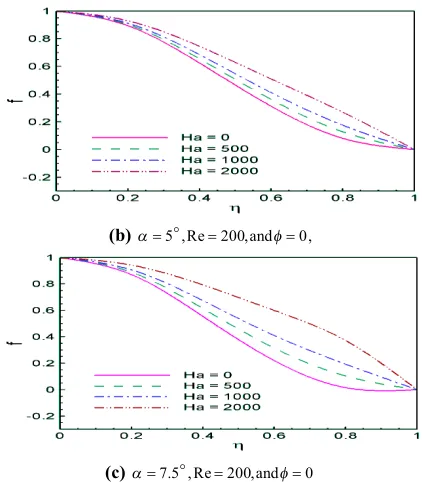
Figures 2 and 3 show the effect of magnetic field and channel angle on the velocity profiles for divergent channels. The velocity curves show that the rate of alteration is significantly reduced with increase of Hartmann number.The transverse magnetic field opposes the alteration phenomena clearly. Because the variation of Ha leads to the variation of the Lorentz force due to magnetic field and the Lorentz force produces more resistance to the alternation phenomena.
(a)a=2.5o,Re=200,andf=0
(b) a=5o,Re=200,andf=0,
(c) a=7.5o,Re=200,andf=0
Figure 2. Velocity profiles in divergent channel with different values of Ha and a.
(a) a=5o,Re=75,andf=0
(b) a=5o,Re=150,andf=0,
(d)a=5o,Re=300,andf=0.
Figure 3. Velocity profiles in divergent channel with different values of Ha and Re.
(a) a=5o,Re=100,andHa=0
(b)a =5o,Re=200,andHa =0,
(c) a=2o,Re=200,andHa=0
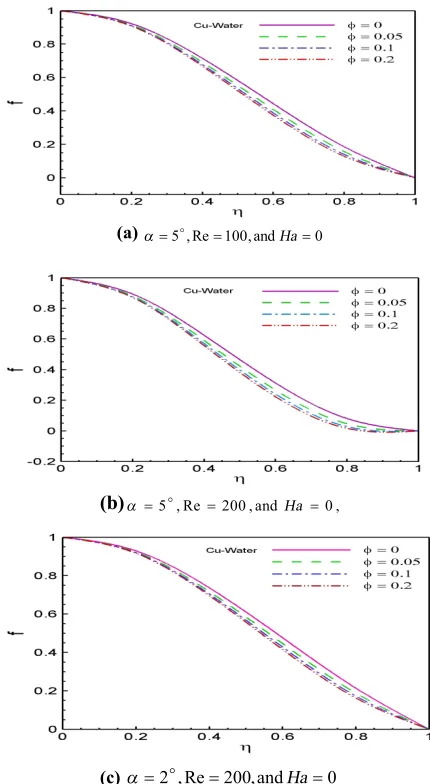
Figure 4. Effects of nanoparticle volume fraction on velocity profiles for Cu-Water.
It is seen from Figure 2 that the velocity increases moderately with rising Ha at a small anglea=2.5o, but
the differences between velocity profiles are more
noticeable at larger angles. However, the backflow does not occur in converging channel but it is detected in diverging channel for higher values of aat a critical Reynolds number whenHa =0. However, to diminish the backflow an increased Ha is essential. It can be concluded from Figure 2 that as channel angle increases, the variation of velocity is observed more due to Ha. Figure 3 represents the consequences of magnetic field on velocity profiles ata=5owith different Reynolds numbers. In Figure 3(a) ata=5o,Re=75as Hartmann number increases the velocity increases and no backflow is observed.
It can be seen from Figure 3(b) that ata=5o,Re=150 backflow starts when magnetic field is absent, these properties are abolished with rising Hartmann number. The backflow enlarges at high Reynolds number, hence larger magnetic field is required to abolish it. Moreover, it is detected from Figure 3(c) ata=5o,Re=225that backflow is abolished at Ha=2000,whereas there occurs backflow for each values of Hartmann number in Figure 3(d) ata=5o,Re=300.Furthermore, a Cu-Water nanofluid flow is considered and the effect of nanoparticles volume fraction is analyzed. It is assumed that the base fluid and the nanoparticles are in thermal equilibrium and no slip occurs between them. The
densities of water and Cu are
8933 and
1 .
998 =
= s
f r
r respectively. Figure 4
implies that as volume fraction of nanoparticles increases, the boundary layer thickness increases. It is also observed that at higher values of Reynolds number and channel angle, backflow starts with rising values of nanoparticles volume fraction.
However, as the solid volume fraction increases, the velocity deceases which is consistent with physical phenomenon.Figure 5 predicts the combined effects of magnetic field and nanoparticles volume fraction on the velocity for divergent channel with fixed Reynolds number. The figure represents sensible increases in the velocity with rising Hartmann number for both viscous and nanofluid that coincide with those results of [20]. It is also observed that for all Hartmann numbers there is no backflow in the viscous fluidf=0, nevertheless backflow starts for nanofluid with Ha=0at
50 Re ,
5 =
= o
a and this phenomenon vanishes with the
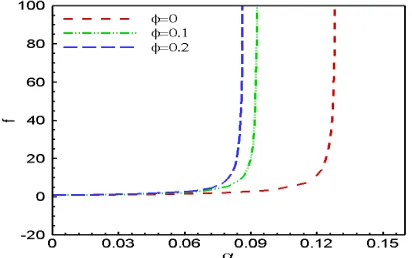
rising values of Hartmann number. Employing the algebraic approximation method to the series (12) we have obtained the singularity graphs ofa and Re. Figure 6 shows the effect of nanoparticles on the singularity diagram of a.It is interesting to note that the curve turns at ac,and as the values of f increase, the singular points as simple poles change from
o
7.5 0.12953229» »
then to a»0.08730158»5o respectively. Moreover, from Figure 7 it is observed that the solution diagram of
Re also turns at Re .The singular points remain almost c similar and the three curves coincide for different values off. The conjecture of Figures 6 and 7 is consistent with the results shown in Tables 3 and 5 using differential approximation. The High-order Differential Approximant [25] is applied to the series (12) in order to determine the critical relationship between the parametersa andRe. Figure 8 displays the critical relation between the channel angular width aand Reynolds numberRefor various values off. It is found that as a increases, then Re decreases and conversely Reincreases whenadecreases. This implies that both channel angle and Reynolds number are inversely proportional to each other which is in excellent agreement with classical Jeffery-Hamel flow when
0 =
f . There is a notable difference in the curves at 1
. 0 =
f and f=0.2 than in the curve atf=0. Therefore, nanofluid has a significant impact on stability of Jeffery-Hamel flow.
Figure 5. Velocity profiles for several values of Hartmann number and solid volume fraction ata=5o,Re=50.
Figure 6. Approximate singularity diagram of ain the ))
5 . 0 (
(a- f h= plane at Ha=0,Re=286.93with different
f obtained by Drazin-Tourigny method for d=7
Figure 7. Approximate singularity diagram of Rein the ))
5 . 0 (
(Re- f h= plane at Ha=0,a =0.0873with different
f obtained by Drazin-Tourigny method for d=7.
Figure 8. Critical relation betweena and Re for different values off at Ha=1 obtained by HODA ford=7.
6. CONCLUSION
The magneto-hydrodynamic Jeffry-Hamel flow problem with nanofluid is investigated using a special type of Hermite-Padé approximation technique. A comparison is made between the available results obtained by Adomian decomposition method and the present approximate solutions.The accurate numerical approximation of the critical parameters of the flow is obtained. The numerical study indicates that HPA is a powerful approach for solving this problem. The influence of various physical parameters on the velocity field is discussed in detail. The basic conclusions are as follows:
Increasing Reynolds number leads to backflow near the walls in the channel.
Increasing Hartmann number produces to backflow reduction. High Hartmann number is required to decline of backflow in larger angles or Reynolds numbers.
The velocity decreases as nanoparticles volume fraction increases.
analyzed with the effect of nanoparticles volume fraction. The critical relationship between the parameters with the effect of nanoparticles coincides with the conjecture of classical Jeffery-Hamel flow. Moreover, we provide a basis for guidance about new approximants idea for summing power series that should be chosen for many problems in fluid mechanics and similar subjects.
7. ACKNOWLEDGEMENTS
This work is done within the framework of the PhD program of the corresponding author under Department of Mathematics, Bangladesh University of Engineering and Technology, Dhaka. Financial support from the Bangabandhu Fellowship on Science and ICT project is acknowledged.
8. REFERENCES
1. Jeffery, G.B., “The two-dimensional steady motion of a viscous fluid”, Philosophical Magazine, Vol. 6, (1915), 455-465. 2. Hamel, G., “spiralförmige bewgungen zäher flüssigkeiten”,
Jahresbericht Der Deutschen Math. Vereinigung, Vol. 25, (1916), 34-60.
3. Esmaili, Q., Ramiar, A., Alizadeh, E. and Ganji, D.D., “An approximation of the analytical solution of the Jeffery–Hamel flow by decomposition method”, Physics Letters A, Vol. 372, (2008), 3434–3439.
4. Cha, J.E., Ahn, Y.C. and Kim, M.H., “Flow measurement with an electromagnetic flow meter in two-phase bubbly and slug flow regimes”, Flow Measurement and Instrumentation, Vol. 12(5-6), (2002), 329–339.
5. Tendler, M., “Confinement and related transport in extrap geometry”, Nuclear Instruments and Methods in Physics Research, Vol. 207, No.(1-2), (1983), 233–240.
6. Makinde, O.D. and Motsa, S.S., “Hydromagnetic stability of plane Poiseuille flow using Chebyshev spectral collocation method”, Journal Instruments Mathematics ComputerScience, Vol. 12, No.(2), (2001), 175–183.
7. Makinde, O.D., “Magneto-hydrodynamic stability of plane-Poiseuille flow using multi-deck asymptotic technique”,
Mathematical and Computer Modelling, Vol. 37, No. (3-4), (2003), 251–259.
8. Anwari, M., Harada, N. and Takahashi, S., “Performance of a magnetohydrodynamic accelerator using air-plasma as working gas”, Energy Conversion Management, Vol. 4, (2005), 2605–
2613.
9. Homsy, A., Koster, S., Eijkel, J.C.T., Ven der Berg, A., Lucklum, F., Verpoorte, E. and De Rooij, N. F., “A high current density DC magnetohydrodynamic (MHD) micropump”, Royal Society of Chemistry’s Lab on a Chip, Vol. 5, (2005), 466–471. 10. Joneidi, A.A., Domairry, G. and Babaelahi, M., “Three
analytical methods applied to Jeffery–Hamel flow”,
Communications in Nonlinear Science and Numerical Simulation, Vol. 15, (2010), 3423–3434.
11. Axford, W.I., “The Magnetohydrodynamic Jeffrey–Hamel problem for aweakly conducting fluid”, Quarterly Journal of Mechanics and Applied Mathematics, Vol. 14, (1961), 335–
351.
12. Motsa, S.S., Sibanda, P., Awad, F.G. and Shateyi, S., “A new spectral-homotopy analysis method for the MHD Jeffery–Hamel problem”, Computers & Fluids, Vol. 39, (2010), 1219–1225. 13. Moghimia, S.M., Ganji, D.D., Bararnia, H., Hosseini, M. and
Jalaal, M., “Homotopy perturbation method for nonlinear MHD Jeffery–Hamel Problem”,Computers and Mathematics with Applications, Vol. 61, (2011), 2213–2216.
14. Kakac, S. and Pramuanjaroenkij, A., “Review of convective heat transfer enhancement with nanofluids”, International Journal of Communications in Heat and Mass Transfer, Vol. 52, No.(13-14), (2009), 3187–3196.
15. Rahmannezhad,J., Ramezani, A.and Kalteh, M., “Numerical investigation of magnetic field effects on Mixed convection flow in a nanofluid-filled lid-driven cavity”, International Journal of Engineering Transactions A, Vol. 26, No. 10, (2013), 1213-1224.
16. Rostamzadeh,A., Jafarpur, K., Goshtasbirad,E and Doroodmand, M.M., “Experimental investigation of Mixed convection heat transfer in vertical tubes by nanofluid: effects of Reynolds number and fluid temperature”, International Journal of Engineering Transactions B, Vol. 27, No. 8, (2014), 1251-1258.
17. Rahman,M.M., Al-Mazroui, W.A., Al-Hatmi, F.S., Al-Lawatia, M.A. and Eltayeb, I.A., “The role of a convective surface in models of the radiative heat transfer in nanofluids”, Nuclear Engineering and Design, Vol. 27, No.5, (2014), 282-392. 18. Rahman,M.M., Rosca, A.V. and Pop, I., “Boundary layer flow
of a nanofluid past a permeable exponentially shrinking surface with second order slip using Buongiorno’s model”,
International Journal of Heat and Mass Transfer, Vol. 77, (2014),1133-1143.
19. Sheikholeslami, M., Ganji, D.D. and Rokni, H.B., “Nanofluid Flow in a Semi-porous Channel in the Presence of Uniform Magnetic Field”, International Journal of Engineering Transactions C, Vol.26, No.6, (2013), 653–662.
20. Sheikholeslami, M., Ganji, D.D., Ashorynejad, H.R. and Rokni, H.B., “Analytical investigation of Jeffery-Hamel flow with high magnetic field and nanoparticle by Adomian decomposition method”, Applied Mathematics and Mechanics (English Edition)Vol.33, (2012), 25–36.
21. Aminossadati, S.M. and Ghasemi, B., “Natural convection cooling of a localized heat source at the bottom of a nanofl
uid-filled enclosure”, European Journal of Mechanics - B/Fluids , Vol. 28, (2009), 630–640.
22. Padé, H.,“Sur la représentation approchée d'une fonction pour des fractions rationnelles”, Ann. Sci. École Norm. Sup. Suppl., Vol. 9, (1892), 1-93.
23. Hermite, C., “Sur la généralisation des fractions continues algébriques”, Annali di Mathematica Pura e Applicata, Vol. 21(2), (1893), 289-308.
24. Drazin, P.G. and Tourigny, Y., “Numerically study of bifurcation by analytic continuation of a function defined by a power series”, SIAM Journal ofApplied Mathematics, Vol. 56, (1996), 1-18.
25. Khan, M.A.H., “High-Order Differential Approximants”,
Analysis of Magneto-hydrodynamics Jeffery-Hamel Flow with Nanoparticles by
Hermite-Padé Approximation
Md. S. Alam a, M.A.H. Khanb
a Department of Mathematics, Jagannath University, Dhaka-1100, Bangladesh
b Department of Mathematics, Bangladesh University of Engineering and Technology, Dhaka-1000, Bangladesh
P A P E R I N F O
Paper history:
Received 05 January 2014
Received in revised form 27 November 2014 Accepted 13 March 2015
Keywords:
Jeffery-Hamel Flow Magneto-hydrodynamic Nanofluid
Dominating Singularity Hermite- Pade Approximation
هﺪﯿﮑﭼ
ﮐﺮﺗتاﺮﺛا
ﯽﺒﯿ
ﻣوتارذﻮﻧﺎﻧ
ناﺪﯿ ﻃﺎﻨﻐﻣ ﯽﺴﯿ رد رﺎﺘﻓر ﻏ ﺮﯿ ﻄﺧ ﯽ ﺮﺟ نﺎﯾ ﺮﻔﺟ ي
-ﻠﺤﺗﺮﺿﺎﺣﻪﻌﻟﺎﻄﻣردﻞﻣﺎﻫ
ﻞﯿ
ﺖﺳاهﺪﺷ
.
ﻣﻮﻤﻋﻢﮐﺎﺣتﻻدﺎﻌﻣ
ﯽ
ﺮﺳﻞﺣهارﻪﺑ
ي
زاهدﺎﻔﺘﺳاﺎﺑ
ﮏﯾ
ﻠﺤﺗشور
ﯽﻠﯿ ﻧ ﻪﻤﯿ دﺪﻋ ي
ﺮﻘﺗمﺎﻧﻪﺑ
ﺐﯾ
Hermite- Padé
ﻞﺣ
ﺖﺳاهﺪﺷ
.
ﺎﻓوﺮﭘ ﻞﯾ
لﺎﻧﺎﮐردﺖﻋﺮﺳ
اﺮﮔاو اﺮﺑ ي دﺎﻘﻣ ﺮﯾ ﺨﻣ ﻒﻠﺘ
ﻤﺠﺣﺮﺴﮐ
ﯽ
ردﺪﻋ،ﻦﻤﺗرﺎﻫداﺪﻌﺗ،ﺪﻣﺎﺟتارذﻮﻧﺎﻧ
زﺪﻟﻮﻨﯾ
وازو
ﻪﯾ
ﻓﺮﻌﻣلﺎﻧﺎﮐ
ﯽ
ﺪﻧاهﺪﺷ
.
رﺎﺘﻓر ﻪﮑﯾ
ترﻮﺻﻪﺑﻪﻟﺎﺴﻣﺐﻟﺎﻏي
دﺪﻋ ي
ﻓاﺮﮔو
ﯽﮑﯿ
ﺖﺳاهﺪﺷﻞﯿﻠﺤﺗ
.
طﺎﺒﺗرا
هﺪﻨﻨﮐﻦﯿﯿﻌﺗ
ﺑ ﻦﯿ ﺎﻫﺮﺘﻣارﺎﭘ
رﻮﻈﻨﻣﻪﺑ
ﻪﻌﻟﺎﻄﻣ
يراﺪﯾﺎﭘﺎﻧي
ﺳﻮﻧﺎﻧ
ﯽﺳرﺮﺑلﺎﯿ
ﺖﺳاهﺪﺷ
.