A Monthly Double-Blind Peer Reviewed (Refereed/Juried) Open Access International e-Journal - Included in the International Serial Directories Indexed & Listed at:
VOLUME NO.3(2013),ISSUE NO.07(JULY) ISSN 2231-5756
INTERNATIONAL JOURNAL OF RESEARCH IN COMMERCE, IT & MANAGEMENT
A Monthly Double-Blind Peer Reviewed (Refereed/Juried) Open Access International e-Journal - Included in the International Serial Directorieshttp://ijrcm.org.in/
ii
CONTENTS
CONTENTS
CONTENTS
CONTENTS
Sr.No.
TITLE & NAME OF THE AUTHOR (S)
Page No.
1. STANDARDIZING GOVERNMENT HOSPITAL LIBRARIES: WHERE ARE WE NOW?
DR. MA. LINDIE D. MASALINTO, DR. ESTRELLA ALMEDA SAN JUAN & DR. LAZARO E. AVELINO
1
2. CHALLENGES IN APPLICATION OF SIX SIGMA TECHNIQUES IN HR DOMAIN NAGARAJ SHENOY & DR. KALYANI RANGARAJAN
6
3. COMPETITIVENESS IN NIGERIAN TELECOMMUNICATION INDUSTRY: MARKETING STRATEGY FALANO, TOLULOPE & POPOOLA F. CORNELIUS
9
4. MANPOWER PLANNING IN HIGHER EDUCATION: A CASE STUDY IN DAKSHINA KANNADA DISTRICT IN KARNATAKA DR. WAJEEDA BANO
15
5. IP TRACEBACK OF DOS ATTACKS S.THILAGAVATHI. & DR. A. SARADHA
21
6. BEHAVIOURAL CONSEQUENCES OF FACEBOOK USAGE AMONGST GENERATION Y OF MUMBAI CITY DR. ANKUSH SHARMA & KRATIKA SHRIVASTAVA
24
7. COMPARATIVE STUDY OF CRM (PUBLIC SECTOR BANKS Vs. PRIVATE SECTOR BANKS) IN DELHI REGION R. C. BHATNAGAR, RAJESH VERMA & ADITI GOEL
33
8. FIRM, FINANCIAL SYSTEMS AND FINANCIAL DEREGULATIONS: A SURVEY OF LITERATURE NEMIRAJA JADIYAPPA & DR. V. NAGI REDDY
39
9. PREFERENCES AND SIGNIFICANCE OF DEMOGRAPHICS ON THE FACTORS INFLUENCING INVESTMENT DECISIONS: A STUDY OF INVESTORS IN THANE CITY, MAHARASHTRA, INDIA
DINESH GABHANE & DR. S. B. KISHOR
44
10. DETERMINANTS OF LEVERAGE: AN EMPIRICAL STUDY ON INDIAN TEXTILE SECTOR D. VIJAYALAKSHMI & DR. PADMAJA MANOHARAN
49
11. CUSTOMER SATISFACTION & AWARENESS REGARDING INSURANCE POLICIES DR. MEGHA SHARMA
53
12. RISK-ADJUSTED PERFORMANCE EVALUATION OF INFRASTRUCTURE FUNDS IN INDIA G. ARUNA
59
13. EMPOWERMENT OF RURAL WOMEN THROUGH ENTREPRENEURSHIP IN SMALL BUSINESS: A EMPIRICAL STUDY IN KHAMMAM DISTRICT OF A.P
DR. S. RADHAKRISHNA & DR. T. GOPI
63
14. THE ETERNAL FIGHT: SMALL TRADITIONAL STORES Vs. SUPERMARKETS DR. FAYAZ AHMAD NIKA & ARIF HASAN
68
15. A STUDY ON CUSTOMER SATISFACTION TOWARDS MARKETING STRATEGY OF BANKING LOANS ADOPTED BY SCHEDULED COMMERCIAL BANKS WITH SPECIAL REFERENCE TO COIMBATORE DISTRICT
G. SANGEETHA & DR. R. UMARANI
72
16. KNOWLEDGE CAPTURE SYSTEMS IN SOFTWARE MAINTENANCE PROJECTS SARFARAZ NAWAZ
79
17. SELF-MANAGING COMPUTING
K. M. PARTHIBAN, M. UDHAYAMOORTHI, A. SANTHOSH KUMAR & KONSAM CHANU BARSANI
82
18. A STUDY ON PERFORMANCE OF DISTRICT CONSUMER DISPUTES REDRESSAL FORUMS IN INDIA GURLEEN KAUR
87
19. TEA INDUSTRY IN INDIA: STATE WISE ANALYSIS DR. R. SIVANESAN
89
20. THE ROLE OF INFORMATION AND COMMUNICATION TECHNOLOGY (ICT) IN ENHANCING THE QUALITY EDUCATION OF ETHIOPIAN UNIVERSITIES: A REVIEW OF LITERATURE
DR. BIRHANU MOGES
94
21. PROBLEMS & PROSPECTS OF WOMEN ENTREPRENEURS IN INDIA JAINENDRA KUMAR VERMA
102
22. CAPITAL STRUCTURE AND PROFITABILITY: A STUDY ON SELECTED CEMENT COMPANIES DR. BRAJABALLAV PAL & SILPI GUHA
105
23. MUTUAL FUND INDUSTRY IN INDIA: RECENT TRENDS AND PROGRESS BHARGAV PANDYA
114
24. CHALLENGE OF ATTRITION: A CASE STUDY OF BPO INDUSTRY IN CHANDIGARH REGION MANJIT KOUR
120
25. GOOD GOVERNANCE IN INDIA: NEED FOR INNOVATIVE APPROACHES PARDEEP KUMAR CHAUHAN
122
26. RESPONSE OF PEASANT FARMERS TO SUPPLY INCENTIVES: AN INTER-REGIONAL ANALYSIS OF COTTON CROP IN SINDH, PAKISTAN DR. MOHAMMAD PERVEZ WASIM
126
27. EFFECTS OF INTEREST RATE DEREGULATION ON DEPOSIT MOBILIZATION IN THE NIGERIAN BANKING INDUSTRY SAMUEL, KEHINDE OLUWATOYIN & OKE, MARGARET ADEBIPE
137
28. AN E-3 VALUE MODEL FOR ASSESSING e-COMMERCE PARTNERSHIP PROFITABILITY TO SMEs IN GHANA AMANKWA, ERIC & KEVOR MARK-OLIVER
147
29. A STUDY ON PERFORMANCE OF CONSUMER DISPUTES REDRESSAL AGENCIES IN STATE OF HIMACHAL PRADESH GURLEEN KAUR
154
30. A STUDY OF SELECTED ENTREPRENEURIAL DIMENSIONS IN INDIA: AN EXPLORATORY STUDY JAINENDRA KUMAR VERMA
156
CHIEF PATRON
CHIEF PATRON
CHIEF PATRON
CHIEF PATRON
PROF. K. K. AGGARWAL
Chairman, Malaviya National Institute of Technology, Jaipur
(An institute of National Importance & fully funded by Ministry of Human Resource Development, Government of India)
Chancellor, K. R. Mangalam University, Gurgaon
Chancellor, Lingaya’s University, Faridabad
Founder Vice-Chancellor (1998-2008), Guru Gobind Singh Indraprastha University, Delhi
Ex. Pro Vice-Chancellor, Guru Jambheshwar University, Hisar
FOUNDER
FOUNDER
FOUNDER
FOUNDER PATRON
PATRON
PATRON
PATRON
LATE SH. RAM BHAJAN AGGARWAL
Former State Minister for Home & Tourism, Government of Haryana
Former Vice-President, Dadri Education Society, Charkhi Dadri
Former President, Chinar Syntex Ltd. (Textile Mills), Bhiwani
CO
CO
CO
CO----ORDINATOR
ORDINATOR
ORDINATOR
ORDINATOR
AMITA
Faculty, Government M. S., Mohali
ADVISORS
ADVISORS
ADVISORS
ADVISORS
DR. PRIYA RANJAN TRIVEDI
Chancellor, The Global Open University, Nagaland
PROF. M. S. SENAM RAJU
Director A. C. D., School of Management Studies, I.G.N.O.U., New Delhi
PROF. M. N. SHARMA
Chairman, M.B.A., Haryana College of Technology & Management, Kaithal
PROF. S. L. MAHANDRU
Principal (Retd.), Maharaja Agrasen College, Jagadhri
EDITOR
EDITOR
EDITOR
EDITOR
PROF. R. K. SHARMA
Professor, Bharti Vidyapeeth University Institute of Management & Research, New Delhi
CO
CO
CO
CO----EDITOR
EDITOR
EDITOR
EDITOR
DR. BHAVET
Faculty, Shree Ram Institute of Business & Management, Urjani
EDITORIAL ADVISORY BOARD
EDITORIAL ADVISORY BOARD
EDITORIAL ADVISORY BOARD
EDITORIAL ADVISORY BOARD
DR. RAJESH MODI
Faculty, Yanbu Industrial College, Kingdom of Saudi Arabia
PROF. SANJIV MITTAL
University School of Management Studies, Guru Gobind Singh I. P. University, Delhi
PROF. ANIL K. SAINI
VOLUME NO.3(2013),ISSUE NO.07(JULY) ISSN 2231-5756
INTERNATIONAL JOURNAL OF RESEARCH IN COMMERCE, IT & MANAGEMENT
A Monthly Double-Blind Peer Reviewed (Refereed/Juried) Open Access International e-Journal - Included in the International Serial Directorieshttp://ijrcm.org.in/
iv
DR. SAMBHAVNA
Faculty, I.I.T.M., Delhi
DR. MOHENDER KUMAR GUPTA
Associate Professor, P. J. L. N. Government College, Faridabad
DR. SHIVAKUMAR DEENE
Asst. Professor, Dept. of Commerce, School of Business Studies, Central University of Karnataka, Gulbarga
ASSOCIATE EDITORS
ASSOCIATE EDITORS
ASSOCIATE EDITORS
ASSOCIATE EDITORS
PROF. NAWAB ALI KHAN
Department of Commerce, Aligarh Muslim University, Aligarh, U.P.
PROF. ABHAY BANSAL
Head, Department of Information Technology, Amity School of Engineering & Technology, Amity
University, Noida
PROF. A. SURYANARAYANA
Department of Business Management, Osmania University, Hyderabad
DR. SAMBHAV GARG
Faculty, Shree Ram Institute of Business & Management, Urjani
PROF. V. SELVAM
SSL, VIT University, Vellore
DR. PARDEEP AHLAWAT
Associate Professor, Institute of Management Studies & Research, Maharshi Dayanand University, Rohtak
DR. S. TABASSUM SULTANA
Associate Professor, Department of Business Management, Matrusri Institute of P.G. Studies, Hyderabad
SURJEET SINGH
Asst. Professor, Department of Computer Science, G. M. N. (P.G.) College, Ambala Cantt.
TECHNICAL ADVISOR
TECHNICAL ADVISOR
TECHNICAL ADVISOR
TECHNICAL ADVISOR
AMITA
Faculty, Government M. S., Mohali
FINANCIAL ADVISORS
FINANCIAL ADVISORS
FINANCIAL ADVISORS
FINANCIAL ADVISORS
DICKIN GOYAL
Advocate & Tax Adviser, Panchkula
NEENA
Investment Consultant, Chambaghat, Solan, Himachal Pradesh
LEGAL ADVISORS
LEGAL ADVISORS
LEGAL ADVISORS
LEGAL ADVISORS
JITENDER S. CHAHAL
Advocate, Punjab & Haryana High Court, Chandigarh U.T.
CHANDER BHUSHAN SHARMA
Advocate & Consultant, District Courts, Yamunanagar at Jagadhri
SUPERINTENDENT
SUPERINTENDENT
SUPERINTENDENT
SUPERINTENDENT
CALL
CALL
CALL
CALL FOR MANUSCRIPTS
FOR MANUSCRIPTS
FOR MANUSCRIPTS
FOR MANUSCRIPTS
We invite unpublished novel, original, empirical and high quality research work pertaining to recent developments & practices in the areas of Computer Science & Applications; Commerce; Business; Finance; Marketing; Human Resource Management; General Management; Banking; Economics; Tourism Administration & Management; Education; Law; Library & Information Science; Defence & Strategic Studies; Electronic Science; Corporate Governance; Industrial Relations; and emerging paradigms in allied subjects like Accounting; Accounting Information Systems; Accounting Theory & Practice; Auditing; Behavioral Accounting; Behavioral Economics; Corporate Finance; Cost Accounting; Econometrics; Economic Development; Economic History; Financial Institutions & Markets; Financial Services; Fiscal Policy; Government & Non Profit Accounting; Industrial Organization; International Economics & Trade; International Finance; Macro Economics; Micro Economics; Rural Economics; Co-operation; Demography: Development Planning; Development Studies; Applied Economics; Development Economics; Business Economics; Monetary Policy; Public Policy Economics; Real Estate; Regional Economics; Political Science; Continuing Education; Labour Welfare; Philosophy; Psychology; Sociology; Tax Accounting; Advertising & Promotion Management; Management Information Systems (MIS); Business Law; Public Responsibility & Ethics; Communication; Direct Marketing; E-Commerce; Global Business; Health Care Administration; Labour Relations & Human Resource Management; Marketing Research; Marketing Theory & Applications; Non-Profit Organizations; Office Administration/Management; Operations Research/Statistics; Organizational Behavior & Theory; Organizational Development; Production/Operations; International Relations; Human Rights & Duties; Public Administration; Population Studies; Purchasing/Materials Management; Retailing; Sales/Selling; Services; Small Business Entrepreneurship; Strategic Management Policy; Technology/Innovation; Tourism & Hospitality; Transportation Distribution; Algorithms; Artificial Intelligence; Compilers & Translation; Computer Aided Design (CAD); Computer Aided Manufacturing; Computer Graphics; Computer Organization & Architecture; Database Structures & Systems; Discrete Structures; Internet; Management Information Systems; Modeling & Simulation; Neural Systems/Neural Networks; Numerical Analysis/Scientific Computing; Object Oriented Programming; Operating Systems; Programming Languages; Robotics; Symbolic & Formal Logic; Web Design and emerging paradigms in allied subjects.
Anybody can submit the soft copy of unpublished novel; original; empirical and high quality research work/manuscriptanytime in M.S. Word format after preparing the same as per our GUIDELINES FOR SUBMISSION; at our email address i.e. [email protected] or online by clicking the link online submission as given on our website (FOR ONLINE SUBMISSION, CLICK HERE).
GUIDELINES FOR SUBMISSION OF MANUSCRIPT
GUIDELINES FOR SUBMISSION OF MANUSCRIPT
GUIDELINES FOR SUBMISSION OF MANUSCRIPT
GUIDELINES FOR SUBMISSION OF MANUSCRIPT
1. COVERING LETTER FOR SUBMISSION:
DATED: _____________ THE EDITOR
IJRCM
Subject: SUBMISSION OF MANUSCRIPT IN THE AREA OF.
(e.g. Finance/Marketing/HRM/General Management/Economics/Psychology/Law/Computer/IT/Engineering/Mathematics/other, please specify)
DEAR SIR/MADAM
Please find my submission of manuscript entitled ‘___________________________________________’ for possible publication in your journals.
I hereby affirm that the contents of this manuscript are original. Furthermore, it has neither been published elsewhere in any language fully or partly, nor is it under review for publication elsewhere.
I affirm that all the author (s) have seen and agreed to the submitted version of the manuscript and their inclusion of name (s) as co-author (s).
Also, if my/our manuscript is accepted, I/We agree to comply with the formalities as given on the website of the journal & you are free to publish our contribution in any of your journals.
NAME OF CORRESPONDING AUTHOR: Designation:
Affiliation with full address, contact numbers & Pin Code: Residential address with Pin Code:
Mobile Number (s): Landline Number (s): E-mail Address: Alternate E-mail Address:
NOTES:
a) The whole manuscript is required to be in ONE MS WORD FILE only (pdf. version is liable to be rejected without any consideration), which will start from
the covering letter, inside the manuscript.
b) The sender is required to mentionthe following in the SUBJECT COLUMN of the mail:
New Manuscript for Review in the area of (Finance/Marketing/HRM/General Management/Economics/Psychology/Law/Computer/IT/ Engineering/Mathematics/other, please specify)
c) There is no need to give any text in the body of mail, except the cases where the author wishes to give any specific message w.r.t. to the manuscript. d) The total size of the file containing the manuscript is required to be below 500 KB.
e) Abstract alone will not be considered for review, and the author is required to submit the complete manuscript in the first instance.
f) The journal gives acknowledgement w.r.t. the receipt of every email and in case of non-receipt of acknowledgment from the journal, w.r.t. the submission
of manuscript, within two days of submission, the corresponding author is required to demand for the same by sending separate mail to the journal.
2. MANUSCRIPT TITLE: The title of the paper should be in a 12 point Calibri Font. It should be bold typed, centered and fully capitalised.
3. AUTHOR NAME (S) & AFFILIATIONS: The author (s) full name, designation, affiliation (s), address, mobile/landline numbers, and email/alternate email address should be in italic & 11-point Calibri Font. It must be centered underneath the title.
VOLUME NO.3(2013),ISSUE NO.07(JULY) ISSN 2231-5756
INTERNATIONAL JOURNAL OF RESEARCH IN COMMERCE, IT & MANAGEMENT
A Monthly Double-Blind Peer Reviewed (Refereed/Juried) Open Access International e-Journal - Included in the International Serial Directorieshttp://ijrcm.org.in/
vi
5. KEYWORDS: Abstract must be followed by a list of keywords, subject to the maximum of five. These should be arranged in alphabetic order separated bycommas and full stops at the end.
6. MANUSCRIPT: Manuscript must be in BRITISH ENGLISH prepared on a standard A4 size PORTRAIT SETTING PAPER. It must be prepared on a single space and single column with 1” margin set for top, bottom, left and right. It should be typed in 8 point Calibri Font with page numbers at the bottom and centre of every page. It should be free from grammatical, spelling and punctuation errors and must be thoroughly edited.
7. HEADINGS: All the headings should be in a 10 point Calibri Font. These must be bold-faced, aligned left and fully capitalised. Leave a blank line before each heading.
8. SUB-HEADINGS: All the sub-headings should be in a 8 point Calibri Font. These must be bold-faced, aligned left and fully capitalised.
9. MAIN TEXT: The main text should follow the following sequence:
INTRODUCTION
REVIEW OF LITERATURE
NEED/IMPORTANCE OF THE STUDY
STATEMENT OF THE PROBLEM
OBJECTIVES
HYPOTHESES
RESEARCH METHODOLOGY
RESULTS & DISCUSSION
FINDINGS
RECOMMENDATIONS/SUGGESTIONS
CONCLUSIONS
SCOPE FOR FURTHER RESEARCH
ACKNOWLEDGMENTS
REFERENCES
APPENDIX/ANNEXURE
It should be in a 8 point Calibri Font, single spaced and justified. The manuscript should preferably not exceed 5000 WORDS.
10. FIGURES &TABLES: These should be simple, crystal clear, centered, separately numbered & self explained, and titles must be above the table/figure. Sources of data should be mentioned below the table/figure. It should be ensured that the tables/figures are referred to from the main text.
11. EQUATIONS:These should be consecutively numbered in parentheses, horizontally centered with equation number placed at the right.
12. REFERENCES: The list of all references should be alphabetically arranged. The author (s) should mention only the actually utilised references in the preparation of manuscript and they are supposed to follow Harvard Style of Referencing. The author (s) are supposed to follow the references as per the following:
•
All works cited in the text (including sources for tables and figures) should be listed alphabetically.•
Use (ed.) for one editor, and (ed.s) for multiple editors.•
When listing two or more works by one author, use --- (20xx), such as after Kohl (1997), use --- (2001), etc, in chronologically ascending order.•
Indicate (opening and closing) page numbers for articles in journals and for chapters in books.•
The title of books and journals should be in italics. Double quotation marks are used for titles of journal articles, book chapters, dissertations, reports, workingpapers, unpublished material, etc.
•
For titles in a language other than English, provide an English translation in parentheses.•
The location of endnotes within the text should be indicated by superscript numbers.PLEASE USE THE FOLLOWING FOR STYLE AND PUNCTUATION IN REFERENCES: BOOKS
•
Bowersox, Donald J., Closs, David J., (1996), "Logistical Management." Tata McGraw, Hill, New Delhi.•
Hunker, H.L. and A.J. Wright (1963), "Factors of Industrial Location in Ohio" Ohio State University, Nigeria.CONTRIBUTIONS TO BOOKS
•
Sharma T., Kwatra, G. (2008) Effectiveness of Social Advertising: A Study of Selected Campaigns, Corporate Social Responsibility, Edited by David Crowther &Nicholas Capaldi, Ashgate Research Companion to Corporate Social Responsibility, Chapter 15, pp 287-303.
JOURNAL AND OTHER ARTICLES
•
Schemenner, R.W., Huber, J.C. and Cook, R.L. (1987), "Geographic Differences and the Location of New Manufacturing Facilities," Journal of Urban Economics,Vol. 21, No. 1, pp. 83-104.
CONFERENCE PAPERS
•
Garg, Sambhav (2011): "Business Ethics" Paper presented at the Annual International Conference for the All India Management Association, New Delhi, India,19–22 June.
UNPUBLISHED DISSERTATIONS AND THESES
•
Kumar S. (2011): "Customer Value: A Comparative Study of Rural and Urban Customers," Thesis, Kurukshetra University, Kurukshetra.ONLINE RESOURCES
•
Always indicate the date that the source was accessed, as online resources are frequently updated or removed.WEBSITES
SELF-MANAGING COMPUTING
K. M. PARTHIBAN
HEAD
DEPARTMENT OF INFORMATION TECHNOLOGY
SASURIE ACADEMY OF ENGINEERING
COIMBATORE
M. UDHAYAMOORTHI
ASST. PROFESSOR
DEPARTMENT OF INFORMATION TECHNOLOGY
SASURIE ACADEMY OF ENGINEERING
COIMBATORE
A. SANTHOSH KUMAR
STUDENT
DEPARTMENT OF INFORMATION TECHNOLOGY
SASURIE ACADEMY OF ENGINEERING
COIMBATORE
KONSAM CHANU BARSANI
STUDENT
DEPARTMENT OF INFORMATION TECHNOLOGY
SASURIE ACADEMY OF ENGINEERING
COIMBATORE
ABSTRACT
The increasing scale complexity, heterogeneity and dynamism of networks, systems and applications have made our computational and information infrastructure brittle, unmanageable and insecure. Most software is fragile: even the slightest error, such as changing a single bit, can make it crash. Complexity is increasing rapidly as a result of two factors: the increasing use of distributed systems and the increasing scale of these systems as a result of the addition of many new computers to the Internet.To manage this new complexity, we propose an approach based on self- managing systems. The goal of autonomic computing is to realize computer and software systems and applications that can manage themselves in accordance with high-level guidance from humans. This paper motivates about its principles, challenges and related discussions about autonomic computing with hackers.
KEYWORDS
heterogeneity, dynamism, unmanageable, complexity, managing, hackers.
1. INTRODUCTION
elf managing computing helps to address the complexity issues by using technology to manage technology. The idea is not new many of the major players in the industry have developed and delivered products based on this concept. Self managing computing is also known as autonomic computing. Autonomic Computing is an initiative started by IBM in 2001. Autonomic computing refers to the self-managing characteristics of distributed computing resources, adapting to unpredictable changes while hiding intrinsic complexity to operators and users. The term autonomic is derived from the autonomic nervous system of the human biology. The autonomic nervous system monitors the heartbeat, checks the blood sugar level and keeps the body temperature close to 98.6°F, without one’s conscious awareness. In much the same way, self managing computing components anticipate computer system needs and resolve problems with minimal human intervention.
Self managing computing systems have the ability to manage themselves and dynamically adapt to change in accordance with business policies and objectives. Self managing systems handle more and more tasks on their own, without the need for intervention on the part of the IT staff. It can perform management activities based on situations they observe or sense in the IT environment. Rather than IT professionals initiating management activities, the system observes something about itself and acts accordingly. This allows the IT professional to focus on high-value tasks while the technology manages the more mundane operations. Self managing computing can result in a significant improvement in system management efficiency, when the disparate technologies that manage the environment work together to deliver performance results system wide.
2. OBJECTIVES OF THE STUDY
The goal of autonomic computing is to create systems that run themselves, capable of high-level functioning while keeping the system's complexity invisible to the user.
To create autonomic systems researchers must address key challenges with varying levels of complexity.
Self-managing systems can perform management activities based on situations they observe or sense in the IT environment. Rather than IT professionals initiating management activities, the system observes something about itself and acts accordingly.
3. AUTONOMIC COMPUTING
Self-Management is the process by which computer systems shall manage their own operation without human intervention.
The increasing heterogeneity of big corporate computer systems, the inclusion of mobile computing devices, and the combination of different networking technologies like WLAN, cellular phone networks, and mobile ad hoc networks make the conventional, manual management very difficult, time-consuming, and error-prone.
VOLUME NO.3(2013),ISSUE NO.07(JULY)
INTERNATIONAL JOURNAL OF RESEARCH IN COMMERCE
A Monthly Double-Blind Peer Reviewed (RefereedAn autonomic system makes decisions on its own, using high
changing conditions. An autonomic computing framework is composed of Autonomic Components (AC) int Driven by such vision, a variety of architectural frameworks based on “self
has recently characterized significant research in the area of
Autonomy-oriented computation is a paradigm proposed in 2001 that uses artificial systems imitating computational problems. For example, ant colony optimization
4. CONCEPTUAL MODEL
A fundamental building block of an autonomic system is the sensing capability ( Inherent to an autonomic system is the knowledge of the
interpretation of sensory data, etc.) without external intervention. The actual operation of the autonomic system is dictated by the for making the right decisions to serve its Purpose, and influence by the observation of the operational context (based
This model highlights the fact that the operation of an autonomic system is purpose policies (e.g., that define the basic behavior), and the “survival
heuristically assisted system as an algorithm combined with set of heuristics bounding its operational space.
5. LEVELS OF AUTONOMIC MATURITY
Products, systems, and IT environments can be classified in the following five levels of maturity that show how a business is evolving its u capabilities and supporting processes and skills:
Level 1-Basic:At the basic level, IT professionals manage each
Level 2-Managed:At the managed level, systems management technologies can be used to collect information from disparate systems onto fewer co helping to reduce the time it takes to collect and synthesize information.
Level 3-Predictive:At the predictive level, analysis capabilities are introduced in the system to monitor situations that arise in the environme situations to provide possible courses of actions. The IT professional makes a determination on what course of action to take.
Level 4-Adaptive:At the adaptive level, the IT environment can automatically take actions based on the available information and the knowledge happening in the environment. As analysis and algorithmic technologies improve and as people become more comfortable with the advi
of such technologies, systems can progress to the adaptive level.
Level 5-Autonomic:At the autonomic level, business policies and objectives govern the IT infrastructure operation. IT professionals interact with the autonomic technology tools to monitor business processes, alter the objectives, or both.
6. AUTONOMIC COMPUTING REFERENCE ARCHITECTURE
The autonomic concepts presented in this section form the basis for a common approach and the base set of terminology needed in archite computing systems in a heterogeneous environment.
Control loop
The autonomic computing reference architecture start
loop collects information from the system, makes decisions and then adjusts the system as necessary. An intelligent control l the self-configuring, self-healing, self-optimizing, and self
The architecture describes three types of system components, autonomic managers, managed resources, and managed resource touc manager is a component that implements a particular control loop. A touch point is a component that delivers access to the ma resource is what the autonomic manager is controlling. Figure 1 illustrates the relationship between th
FIG. 2
INTERNATIONAL JOURNAL OF RESEARCH IN COMMERCE, IT
Refereed/Juried) Open Access International e-Journal - Included in the International Serial Directories
http://ijrcm.org.in/
An autonomic system makes decisions on its own, using high-level policies; it will constantly check and optimize its status and automatically adapt itself to changing conditions. An autonomic computing framework is composed of Autonomic Components (AC) interacting with each other.
Driven by such vision, a variety of architectural frameworks based on “self-regulating” autonomic components has been recently proposed. A very similar trend has recently characterized significant research in the area of multi-agent systems.
is a paradigm proposed in 2001 that uses artificial systems imitating social animals ant colony optimization could be studied in this paradigm.
FIG. 1: COPNCEPTUAL MODEL
A fundamental building block of an autonomic system is the sensing capability (Sensors Si), which enables the system to observe its external operational context.
Inherent to an autonomic system is the knowledge of the Purpose (intention) and the Know-how to operate itself (e.g., bootstrapping, configuration knowledge, data, etc.) without external intervention. The actual operation of the autonomic system is dictated by the
, and influence by the observation of the operational context (based on the sensor input).
This model highlights the fact that the operation of an autonomic system is purpose-driven. This includes its mission (e.g., the service it is supposed to offer), the policies (e.g., that define the basic behavior), and the “survival instinct”. If seen as a control system this would be encoded as a feedback error function or in a heuristically assisted system as an algorithm combined with set of heuristics bounding its operational space.
ms, and IT environments can be classified in the following five levels of maturity that show how a business is evolving its u
At the basic level, IT professionals manage each infrastructure element independently and set it up, monitor it, and eventually replace it. At the managed level, systems management technologies can be used to collect information from disparate systems onto fewer co ce the time it takes to collect and synthesize information.
At the predictive level, analysis capabilities are introduced in the system to monitor situations that arise in the environme courses of actions. The IT professional makes a determination on what course of action to take.
At the adaptive level, the IT environment can automatically take actions based on the available information and the knowledge ning in the environment. As analysis and algorithmic technologies improve and as people become more comfortable with the advi
of such technologies, systems can progress to the adaptive level.
, business policies and objectives govern the IT infrastructure operation. IT professionals interact with the autonomic technology tools to monitor business processes, alter the objectives, or both.
6. AUTONOMIC COMPUTING REFERENCE ARCHITECTURE
mic concepts presented in this section form the basis for a common approach and the base set of terminology needed in archite
The autonomic computing reference architecture starts from the premise that implementing self-managing attributes involves an intelligent control loop. This loop collects information from the system, makes decisions and then adjusts the system as necessary. An intelligent control l
optimizing, and self-protecting attributes described before.
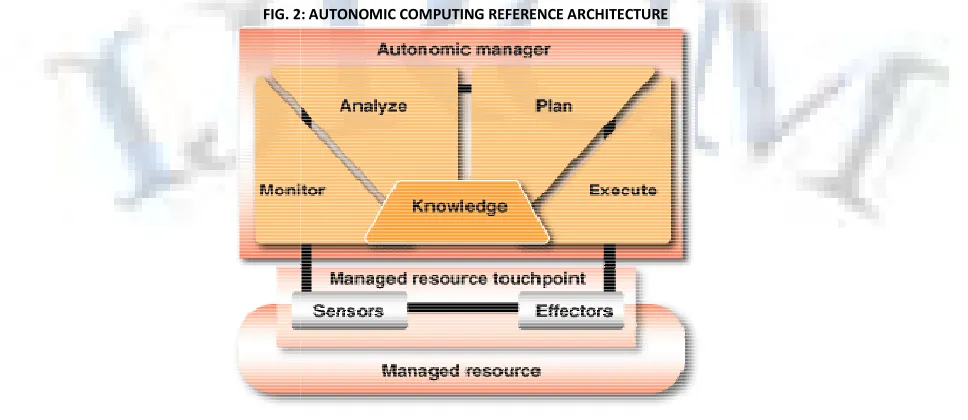
The architecture describes three types of system components, autonomic managers, managed resources, and managed resource touc manager is a component that implements a particular control loop. A touch point is a component that delivers access to the ma resource is what the autonomic manager is controlling. Figure 1 illustrates the relationship between the different components.
2: AUTONOMIC COMPUTING REFERENCE ARCHITECTURE
ISSN 2231-5756
, IT & MANAGEMENT
Included in the International Serial Directories83
level policies; it will constantly check and optimize its status and automatically adapt itself toeracting with each other.
regulating” autonomic components has been recently proposed. A very similar trend
social animals' collective behaviors to solve difficult
), which enables the system to observe its external operational context. to operate itself (e.g., bootstrapping, configuration knowledge, data, etc.) without external intervention. The actual operation of the autonomic system is dictated by the Logic, which is responsible
on the sensor input).
driven. This includes its mission (e.g., the service it is supposed to offer), the instinct”. If seen as a control system this would be encoded as a feedback error function or in a
ms, and IT environments can be classified in the following five levels of maturity that show how a business is evolving its use of autonomic
infrastructure element independently and set it up, monitor it, and eventually replace it.
At the managed level, systems management technologies can be used to collect information from disparate systems onto fewer consoles,
At the predictive level, analysis capabilities are introduced in the system to monitor situations that arise in the environment, and analyze the courses of actions. The IT professional makes a determination on what course of action to take.
At the adaptive level, the IT environment can automatically take actions based on the available information and the knowledge of what is ning in the environment. As analysis and algorithmic technologies improve and as people become more comfortable with the advice and predictive power
, business policies and objectives govern the IT infrastructure operation. IT professionals interact with the autonomic
mic concepts presented in this section form the basis for a common approach and the base set of terminology needed in architecting autonomic
managing attributes involves an intelligent control loop. This loop collects information from the system, makes decisions and then adjusts the system as necessary. An intelligent control loop can enable the system to have
The architecture describes three types of system components, autonomic managers, managed resources, and managed resource touch points. An autonomic manager is a component that implements a particular control loop. A touch point is a component that delivers access to the managed resource. A managed
Autonomic manager:The autonomic manager is a component that implements the control loop. The architecture splits the loop into four parts that share knowledge. They are:
• Monitor-provides the mechanisms that collect, aggregate, filter, manage, and report details collected from a managed resource.
• Analyze-provides the mechanisms to correlate and model complex situations that allow the autonomic manager to learn about the IT environment and help predict future situations.
• Plan-provides the mechanisms that construct the action needed to achieve goals and objectives.
• Execute-provides mechanisms that control the execution of a plan with considerations for dynamic updates.
The four parts work together to provide the control loop functionality. They consume and generate knowledge. The knowledge is continuously shared among the four parts, leading to more informed decisions being made by the parts. Figure 1 shows a structural arrangement of the parts, not a control flow. The bold line that connects the four parts should be thought of as a common messaging bus rather than a strict control flow.
Managed resource:The managed resource is a controlled system component. There can be a single managed resource (a server, database server, or router) or a collection of resources.
An autonomic manager communicates with a managed resource through the manageability interface. A touch point is the implementation of the manageability interface by a specific managed resource. For example, a database server might implement a touch point for communicating with an autonomic manager.
Managed Resource Touch point:The touch point, one of the three main elements of the autonomic computing architecture, delivers the manageability interface to the autonomic manager.
In the simplest terms, sensor operations are typically used to transmit events or properties to an autonomic manager, whereas effecter operations are typically used to cause some sort of change in a managed resource, such as altering state data or setting property values.
Sensor and effecter operations each can have two interaction styles:
• Sensor retrieve-state
• Sensor receive-notification
• Effecter perform-operation
• Effectors call-out-request
In both the sensor retrieve-state interaction style and the effectors perform-operation interaction style, the autonomic manager makes first contact. In the sensor receive-notification and effectors call-out-request interaction styles, it is the managed resource that makes contact first.
The combination of sensor and effectors operations forms the manageability interface that is available to an autonomic manager. For example, a configuration change that occurs through effectors should be reflected as a configuration change notification through the sensor interface.
7. SYSTEM OVERVIEW
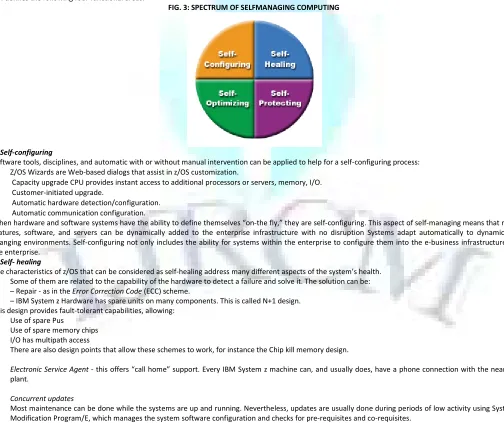
Currently, the most important industrial initiative towards realizing self-management is the Autonomic Computing Initiative (ACI) started by IBM in 2001. The ACI defines the following four functional areas:
FIG. 3: SPECTRUM OF SELFMANAGING COMPUTING
1. Self-configuring
Software tools, disciplines, and automatic with or without manual intervention can be applied to help for a self-configuring process:
• Z/OS Wizards are Web-based dialogs that assist in z/OS customization.
• Capacity upgrade CPU provides instant access to additional processors or servers, memory, I/O.
• Customer-initiated upgrade.
• Automatic hardware detection/configuration.
• Automatic communication configuration.
When hardware and software systems have the ability to define themselves “on-the fly,” they are self-configuring. This aspect of self-managing means that new features, software, and servers can be dynamically added to the enterprise infrastructure with no disruption Systems adapt automatically to dynamically changing environments. Self-configuring not only includes the ability for systems within the enterprise to configure them into the e-business infrastructure of the enterprise.
2. Self- healing
The characteristics of z/OS that can be considered as self-healing address many different aspects of the system’s health. 1. Some of them are related to the capability of the hardware to detect a failure and solve it. The solution can be:
– Repair - as in the Error Correction Code (ECC) scheme.
– IBM System z Hardware has spare units on many components. This is called N+1 design. This design provides fault-tolerant capabilities, allowing:
Use of spare Pus
Use of spare memory chips I/O has multipath access
2. There are also design points that allow these schemes to work, for instance the Chip kill memory design.
3. Electronic Service Agent - this offers “call home” support. Every IBM System z machine can, and usually does, have a phone connection with the nearest plant.
4. Concurrent updates
Most maintenance can be done while the systems are up and running. Nevertheless, updates are usually done during periods of low activity using System Modification Program/E, which manages the system software configuration and checks for pre-requisites and co-requisites.
VOLUME NO.3(2013),ISSUE NO.07(JULY) ISSN 2231-5756
INTERNATIONAL JOURNAL OF RESEARCH IN COMMERCE, IT & MANAGEMENT
A Monthly Double-Blind Peer Reviewed (Refereed/Juried) Open Access International e-Journal - Included in the International Serial Directorieshttp://ijrcm.org.in/
85
5. System softwareThere are self-healing capacities in system software, as well. These capacities fall into three main areas, dealing with data replication, automation tools, and virtualization techniques:
Data replication
Coupling Facility (CF) structure duplexing Synchronous copy
– Automation engines System automation for z/OS
Geographically Dispersed Parallel Sysplex – Virtualization
Dynamic Virtual IP takeover and take back Dynamic disk balancing
3. Self-optimizing
Self-optimizing features include:
• Intelligent Resource Director (IRD) extensions (non-z/OS partitions - CPU(Linux), I/O, server-wide) - allows dynamic resource allocation on IBM System z servers
• Dynamic LPAR, WLM LPAR extensions for Linux
• Parallel Sysplex Extensions - Sysplex Distributor, CP Coupling
• BIND9 DNS-DNS BIND Version 9.0 on z/OS
• z/OS Workload Manager (CPU, memory, I/O, TCP/IP QOS, Web request management, and batch initiator balancing)
Self-optimization requires hardware and software systems to efficiently maximize resource utilization to meet end-user needs without human intervention. 4. Self-protecting
Self-protecting features include:
• LPAR
• Intrusion detection IDS, PKI
• Hardware cryptographic (coprocessors, accelerators and CP assist) adapters
• Digital certificates providing identity authentication
• SSL and TLS (manages Internet transmission security), Kerberos (authenticates requests for service in a network), VPN, encryption
• Tivoli Policy Director
• LDAP (aids in the location of network resources)
Self-protecting systems must have the ability to define and manage user access to all computing resources within the enterprise, to protect against unauthorized resource access, to detect intrusions and report and prevent these activities as they occur, and to provide backup and recovery capabilities.
8. AUTONOMIC COMPUTING RESEARCH ISSUES AND CHALLENGES
Key research issues and challenges are presented below.
Conceptual Challenges:Conceptual research issues and challenges include (1) defining appropriate abstractions and models for specifying, understanding, controlling, and implementing autonomic behaviours; (2) adapting classical models and theories for machine learning, optimization and control to dynamic and multi agent system; (3) providing effective models for negotiation that autonomic elements can use to establish multilateral relationships among themselves.
Architecture Challenges:Autonomic applications and systems will be constructed from autonomic elements that manage their internal behaviour and their relationships with other autonomic elements in accordance with policies that humans or other elements have established. As a result, system/application level self-managing behaviours will arise from the self-managing behaviours of constituent autonomic elements and their interactions.
Middleware Challenges:The primary middleware level research challenge is providing the core services required to realize autonomic behaviours in a robust, reliable and scalable manner. These include discovery, messaging, security, privacy, trust, etc. Autonomic systems/applications will require autonomic elements to identify themselves, discover and verify the identities of other entities of interest, dynamically establish relationships with these entities, and to interact in a secure manner.
Application Challenges:The key challenges at the application level is the formulation and development of systems and applications that are capable of managing (i.e., configuring, adapting, optimizing, protecting, healing) themselves. This includes programming models, frameworks and middleware services that support the definition of autonomic elements, the development of autonomic applications as the dynamic and opportunistic composition of these autonomic elements, and the policy, content and context driven definition, execution and management of these applications.
9. PROPOSED IDEA: AUTONOMIC COMPUTING WITH HACKERS
The principles and concepts of autonomic computing have led to the creation of autonomic computing framework where management and computing elements are joined together to observe and act directly on the computer resources to enhance their performance. Autonomic computing allows system to adapt dynamically to the changing environment using policies provide by the IT professionals. It can detect malfunctions and create policies without disrupting the IT environment.
Using autonomic computing, we can anticipate, detect, identify and protect against threads from anywhere like hostile behaviors such as unauthorized access and use, virus infections, denial of service attacks etc. Moreover using the principle of self optimizing, the system can monitor and manage the resources automatically, such that the needs of end users or business needs are met properly and avoids the probability of scarcity of resources. But after this all still we are facing numerous illegal attacks from hackers.
A Hacker is a person who is interested in the working of any computer operating system and breaks into other people systems, with malicious intentions. Hackers gain unauthorized access, destroy important data, stop services provided by the server, or basically cause problems for their targets. Hackers can easily be identified because their actions are malicious. Many malicious Hackers are electronic thieves. Just like anyone can become a thief, or a robber, anyone can become a Hacker, regardless of age, gender, or religion. Technical skill of Hackers varies from one to another. Some Hackers barely know how to surf the Internet, whereas others write software that other Hackers depend upon.
Information security research teams and detection systems exist to try to find these holes and notify vendors before they are exploited and to track attacking hackers while the attacking hackers develop by-passing techniques which are eventually resulted in bigger and better detecting and tracking systems respectively. The Ethical Hacking with the intent to discover vulnerabilities from a Hacker’s viewpoint so systems can be better secured. Ethical Hacking is part of an overall information Risk Management program that allows for ongoing security improvements.
10. CONCLUSIONS
Autonomic computing is about shifting the burden of managing systems from people to technologies. When the Self-Managing Autonomic Technology and self-management capabilities delivered by IBM and other vendors can collaborate, the elements of a complex IT system can work together and manage themselves based on a shared view of system wide policy and objectives. Autonomic computing architecture is a range of software technologies that enable you to build an information infrastructure that can, to lesser and greater degrees, manage itself, saving countless hours (and dollars) in human management and all this without giving up control of the system.
The future of autonomic computing is heavily dependent on the developments and successes in several other technology arenas that provide an infrastructure for autonomic computing systems including Web and grid services, architecture platforms such as service-oriented architecture (SOA), Open Grid Services Architecture (OGSA), and pervasive and ubiquitous computing. Even if autonomic computing technology is readily available and taught in computer science and engineering curricula, it will take another decade for the proliferation of automaticity in existing systems.
REFERENCES
1. Agarwala S, Chen Y, Milojicic D, and Schwan K 2006 QMON: QoS- and Utilityaware monitoring in enterprise systems in Proceedings of the 3rd IEEE International Conference on Autonomic Computing (ICAC), Dublin, Ireland.
2. Anthony R. 2006: Emergent graph colouring in Engineering Emergence for Autonomic Systems (EEAS), First Annual International Workshop, at the third International Conference on Autonomic Computing (ICAC).
3. Boca Raton, Ann Arbor, 2006 by CRC Press LLC: Autonomic Computing: Concepts, Infrastructure, and Applications 4. D. M. Chess, C. C. Palmer and S. R. White: Security in an autonomic computing environment
5. Daniel Worden, Nicholas Chase: A quick tour of Autonomic Computing
6. Hausi A. Müller, Liam O’Brien, Mark Klein, Bill Wood, April 2006, Software Architecture Technology: Autonomic Computing. 7. IBM Corporation: An architectural blueprint for autonomic computing, June 2005, Third Edition
8. Jia Bai, Sherif Abdelwahed: A Model Integrated Framework for Designing Self-managing Computing Systems 9. Manish Parashar and Salim Hariri: Autonomic Computing: An Overview
10. Markus C. Huebscher, Julie A. McCann, Imperial College London: A survey of Autonomic Computing — degrees, models and applications
11. Mike Ebbers, Frank Byrne, Pilar Gonzalez Adrados, Rodney Martin, Jon Veilleux: Introduction to the New Mainframe: Large-Scale Commercial Computing, ibm.com/redbooks
12. Mohamed N. Bennani and Daniel A. Menasc´e, George Mason University: Assessing the Robustness of Self-Managing Computer Systems under Highly Variable Workloads
13. Nick Antonopoulour, Ashiq Anjum and Lee Gillam, Journal of Cloud Computing 2012: Intelligent Techniques and Architectures for Autonomic Clouds: Introduction to the itaac Special Issue.
14. Ozalp Babaoglu, M´ark Jelasity, and Alberto Montresor, Department of Computer Science, University of Bologna, Italy: Grassroots Approach to Self-management in Large-Scale Distributed Systems.
15. P. Horn. Autonomic Computing: IBM’s perspective on the State of Information Technology. http://www.research.ibm.com/autonomic/, Oct 2001. IBM Corp.
16. Peter Van Roy: Self Management and the Future of Software Design
17. R.K. Sahoo, I. Rish, A. J. Oliner, M. Gupta, J.E. Moreira, S. Ma, R. Vilalta, A. Sivasubramaniam: Autonomic Computing Features for Large-scale Server Management and Control.
18. S. Hariri, L. Xue, H. Chen, M. Zhang, S. Pavuluri, and S. Rao.: Autonomia: an autonomic computing environment, in Performance, Computing, and Communications Conference, 2003. Conference Proceedings of the 2003 IEEE International, April 9-11 2003.
19. Sherif Abdelwahed, Nagarajan Kandasamy and Sandeep Neema, Institute for Software Integrated Systems, Vanderbilt University: Online Control for Self-Management in Computing Systems.
VOLUME NO.3(2013),ISSUE NO.07(JULY) ISSN 2231-5756
INTERNATIONAL JOURNAL OF RESEARCH IN COMMERCE, IT & MANAGEMENT
A Monthly Double-Blind Peer Reviewed (Refereed/Juried) Open Access International e-Journal - Included in the International Serial Directorieshttp://ijrcm.org.in/
87
REQUEST FOR FEEDBACK
Dear Readers
At the very outset, International Journal of Research in Commerce, IT and Management (IJRCM)
acknowledges & appreciates your efforts in showing interest in our present issue under your kind perusal.
I would like to request you to supply your critical comments and suggestions about the material published
in this issue as well as on the journal as a whole, on our E-mail i.e.
for further
improvements in the interest of research.
If you have any queries please feel free to contact us on our E-mail
.
I am sure that your feedback and deliberations would make future issues better – a result of our joint
effort.
Looking forward an appropriate consideration.
With sincere regards
Thanking you profoundly
Academically yours
Sd/-