Vol. 11 No. 12 211 Leon Heron
Public Health Officer
South Western Sydney Public Health Unit
Sue Campbell-Lloyd
Manager, Immunisation Section NSW Department of Health
This article reviews the current literature regarding HBV epidemiology, locally and internationally, and outlines current vaccination policies and immunisation procedures. The World Health Organization (WHO) estimates that about two billion people have been infected with the hepatitis B virus (HBV) worldwide, and about 350 million of them are chronic carriers.1 About 0.5 per cent of people with acute symptomatic HBV infection will die of fulminant hepatitis, and about 20 per cent of people with chronic HBV infection will die from its long-term sequelae (chronic active hepatitis, cirrhosis and hepatocellular carcinoma).1
The risk of becoming a chronic carrier of HBV is inversely related to the age at which infection occurs. Infected neonates have approximately 90 per cent risk of becoming chronic carriers, children aged less than seven years have about 25 per cent risk, while persons aged more than seven years have a risk of approximately five per cent.2–4 Immunocompromised persons are more likely than persons with normal immune function to become chronic carriers.4
EPIDEMIOLOGY: AUSTRALIA AND NSW
The epidemiological pattern of hepatitis B (HB) in Australia is similar to that of other low prevalence countries where most of the cases of acute HB notified to health authorities are people aged 14–40 years belonging to well-recognised risk groups:
•
injecting drug users•
prisoners• men who have sex with men
•
people working in the sex industry • health care workers.Each year Australian health departments are notified of approximately 7,000 persons who are hepatitis B surface antigen (HBsAg) positive, with approximately half of them from New South Wales (NSW).5 Nationally, about 250 of these notifications are known to be the result of acute infection. However, there is considerable under reporting of incident cases due to inconsistent data collection. In 1996, Kaldor et al. estimated that each year in Australia approximately 100 adults and between 108 and 1,080 infants—depending on the success of the neonatal hepatitis B immunoglobulin (HBIg) and immunisation program—become chronic carriers of HBV.6
HEPATITIS B: WHERE ARE WE NOW?
HEPATITIS B VACCINATION POLICY IN AUSTRALIA
HB vaccines have been available in Australia since the early 1980s and were initially recommended for risk groups only. However, persons belonging to risk groups defined by risk behaviours cannot be identified as ‘at risk’ until after exposure to the risk behaviour. Even then, the ‘at risk’ individual will need to admit the risk behaviour to a vaccine provider before immunisation against HB can be offered. The proportion of each risk group vaccinated has not been sufficient to achieve control of HB. Continuing difficulties in ensuring the identification and immunisation of ‘at risk’ individuals lead the National Health and Medical Research Council (NHMRC) to add universal infant and pre-adolescent immunisation to its recommendations for HB prevention in 1996.7 This recommendation followed the 1991 recommendation of WHO that HB immunisation be integrated into national immunisation programs.8 By 1998, national or regional programs for universal infant and/or adolescent HB immunisation had been adopted in more than 100 countries.9
RESPONSE TO HEPATITIS B IMMUNISATION
HB vaccines derived from HBsAg positive plasma and from recombinant DNA technology are equally effective.10 As age increases, the immune response (seroconversion rate and geometric mean titre) to HB vaccine decreases.4 More than 95 per cent of healthy individuals aged less than 30 years seroconvert following administration of three doses of HB vaccine in the standard 0, 1, 6 month dosing schedule. Children and infants make the strongest responses, while only 50 per cent of vaccinees aged more than 60 years seroconvert. Predictors of poor anti-HBs response include:
• advancing age • immunosuppression
• human immunodeficiency virus (HIV) infection • liver disease
• renal failure • type 1 diabetes • injecting drug use • smoking
• male gender • obesity • HLA type
•
administration of the vaccine in the buttocks instead of the arm or leg.4,11–15V
ol.
11 No
212 TABLE 3
Funding source Free vaccine* Current NHMRC recommendations for hepatitis B immunisation32 & date funding available
initiated through:
Funding source Free vaccine* Current NHMRC recommendations for hepatitis B immunisation32 & date funding available
initiated through:
NHMRC HEPATITIS B IMMUNISATION RECOMMENDATIONS AND PROGRAMS SPECIFICALLY FUNDED BY NSW HEALTH
Infants of HBsAg positive mothers.
(All pregnant women should be tested for HBsAg). Give HBIg 100 IU intramuscularly (when infant is physiologically stable—preferably <12 hours after birth—efficacy decreases markedly if HBIg is delayed >48 hours). Give the first dose of vaccine as soon as possible (and <7 days) after birth in opposite thigh to HBIg. Three further doses of hepatitis B vaccine should be given in accordance with the schedule of the universal infant immunisation program (see below).
All other infants (universal infant immunisation program)
A dose of hepatitis B vaccine at birth followed by doses given in multivalent vaccines at 2, 4, and either 6 or 12 months is now recommended for all children. If the monovalent dose at birth is missed, vaccination against hepatitis B should continue with a multivalent vaccine, following the routine schedule. Preterm babies (<32 weeks gestation) should either be vaccinated at birth and given an extra booster (using a 0, 2, 4, 6, 12 month schedule) or hepatitis B vaccine should be delayed until the baby is 2 months old and a 2, 4, 6, 12 month schedule used. Until a thimerosal-free monovalent hepatitis B vaccine is available, the latter option is preferred for pre-term babies whose mothers are HBsAg negative. For prepre-term or term babies of carrier mothers, a birth dose of vaccine and hepatitis B immunoglobulin must be given.
All pre-adolescent children
Immunisation recommended. Pre-immunisation testing for HBV markers is not recommended.
Household contacts of acute or chronic hepatitis B cases
Investigate the HBV marker status of each household member. Immunisation is recommended for those who are HBV naïve.
Sexual contacts of acute or chronic hepatitis B cases
Investigate the HBV marker status of each sexual contact. Immunisation is recommended for those who are HBV naïve. If sexual contact with a case of acute HB occurred within the last 14 days administer HBIg 400 IU and a course of HB immunisation to HBV naïve sexual contacts (treatment should be initiated as soon as possible)
Attendees at sexual health clinics
Immunisation recommended.
HIV positive individuals should receive double the normal volume of vaccine at each vaccination
Sexually active men who have sex with men
Immunisation recommended.
HIV positive individuals should receive double the normal volume of vaccine at each vaccination.
The combined hepatitis A and B vaccine may be appropriate for those not immune to either disease.
Injecting drug users
Immunisation recommended for those who are HBV naïve. HIV positive individuals should receive double the normal volume of
Haemodialysis patients
Immunisation recommended.
Haemodialysis patients should receive double the normal volume of vaccine at each vaccination.
Recipients of certain blood products (blood product concentrates for clotting disorders)
Immunisation recommended from the time the clotting disorder is identified.
Persons in facilities for persons with intellectual disabilities
Immunisation recommended for HBV naïve intellectually impaired persons in residential and non-residential care.
Staff of facilities for persons with intellectual disabilities
Immunisation recommended for staff involved in the care of intellectually impaired persons in residential and non-residential care.
Inmates of correctional institutions and Juvenile Justice Centres
Offer screening and immunisation.
Staff of correctional institutions and Juvenile Justice Centres
Immunisation recommended.
Health Care Workers and embalmers
Immunisation recommended for all staff directly involved in patient care, embalming or handling of human blood or tissue.
Persons adopting children from overseas
These children should be tested for hepatitis B, and if HBsAg positive members of the adoptive family should be vaccinated.
Police, armed forces, Emergency Services personnel.
Offer immunisation to those whose duties put them at increased risk.
Travellers to areas with a high prevalence of hepatitis B infection.
Offer immunisation to those who will reside in high prevalence areas for prolonged periods and those who do not wish to avoid sexual contact, injecting drug use, tattooing or body piercing while in high prevalence areas.
Contact sports
Although the risk is very low, immunisation should not be discouraged.
Accelerated schedule
In circumstances where more rapid protection is required (for example, contacts of hepatitis B carriers and vaccination of travellers), only one product, Engerix B, is registered for use in an accelerated schedule. The accelerated schedule for adults using Engerix B is 0, 7, and 21 days with a booster at 12 months.
NSW Health Since 1987
NSW Health Since May 2000
NSW Health Children aged 10 Since June 1999 NSW Health Since 1987 Not specifically funded NSW Health Since 1999 NSW Health Since 1999 NSW Health Since 1999 Not specifically funded Not specifically funded Not specifically funded Not specifically funded NSW Health Since 1992 Not specifically funded Not specifically funded Not funded Not funded Not funded Not funded Maternity Units
(HBIg plus vaccine dose 1). GPs, Councils or Community Health Centres (remaining vaccine doses)
Maternity Units (vaccine dose 1). GPs, Councils or Community Health Centres (remaining vaccine doses)
GPs, Councils or Community Health Centres Sexual Health Clinics Sexual Health Clinics Sexual Health Clinics Sexual Health Clinics Sexual Health Clinics
AHSU treating the individual†
AHSU treating the individual†
Institution†, AHSU treating the patient† Employer† (OH&S requirement)40
Corrections Health Services Juvenile Justice Centres Employer†(OH&S requirement)40
Employer† (OH&S requirement)40
Employer† (OH&S requirement)40
NHMRC32 recommends the combined hepatitis A–hepatitis B vaccines should be considered for those at risk of acquiring both infections including:
• Expatriates and long term visitors to developing countries • Men who have sex with men
• At-risk health care workers and medical and nursing students • Injecting drug users
NHMRC32 recommends post-vaccination anti-HBs testing three months after the third dose of vaccine for:
Vol. 11 No. 12 213
MANAGEMENT OF NON-RESPONDERS
In general, of those adults who make no anti-HBs response at all following the three-dose vaccination, only 10 per cent will respond to an extra dose of vaccine. While, of those who make a poor response in which anti-HBs does not rise above 10 mIU/mL, approximately 40 to 50 per cent will produce an anti-HBs response of more than 100 mIU/mL in response to a fourth dose of vaccine.17–20 Administration of two or three additional doses to initial non-responder adults fails to produce an adequate anti-HBs response in up to 40 per cent.17–20 Between 68 per cent and 94 per cent of non- or poor-responder babies develop adequate anti-HBs levels in response to one or two additional doses of HB vaccine.21,22
DURATION OF PROTECTION
The duration of anti-HBs following immunisation depends on the peak level of anti-HBs attained.10,23,24 Approximately 90 per cent of anti-HBs is lost in the first 12 months following immunisation and thereafter anti-HBs levels halve every 14 months.24
Questions remain about the duration of protection afforded by immunisation and the need for booster doses. Based on the information available in August 1999 a committee of European HB experts concluded that, as yet, there is no need to recommend booster doses for immunocompetent individuals who have responded to the primary immunisation course.25 The available evidence shows that immunological memory permits a protective anamnestic anti-HBs response to antigen challenge. When re-exposure to HBsAg occurs, clones of HBsAg-responsive memory B lymphocytes remaining after primary HB immunisation can expand to produce increased levels of anti-HBs as quickly as within 3–5 days, even in individuals whose anti-HBs is no longer detectable.26–28 It is this ability to respond rapidly to HBsAg re-exposure that is thought to provide protection against clinically apparent infection. Certainly, the breakthrough infections observed to date have not produced recognised clinical hepatitis. The most common event that indicates breakthrough infection with HBV is an anamnestic rise in anti-HBs levels.10, 29–31 This has been seen in 3.5 per cent to 20 per cent of vaccinees who belonged to populations in which HB is common and who were followed five to 12 years.10,29–31 Some individuals may have multiple anamnestic response episodes.10 The frequency of these ‘natural boosts’ of anti-HBs did not correlate with initial post-immunisation anti-HBs levels in one study.29
Breakthrough infections may also be shown by detection of HBsAg or by anti-HBc seroconversion. Breakthrough infection rates as determined by HBsAg detection or anti-HBc seroconversion are inversely related to initial post-immunisation anti-HBs levels.23,31
A study of Taiwanese children vaccinated at birth showed that lower post-immunisation anti-HBs levels were correlated with early loss of anti-HBs and increased rate of breakthrough infection.23 Children whose anti-HBs declined to undetectable levels by age five years were more than twice as likely to become infected by age 10 years (RR 2.42, 95% CI 1.22–4.81, p=0.02) than those who retained anti-HBs.23 In agreement with other studies, none of the breakthrough infections caused clinical manifestations. To date, this is the only study to show HBsAg carriage following breakthrough infection: three cases of HBsAg carriage occurred in children aged 1–2 years among the 113 breakthrough infections that occurred during 10 years of follow-up.23 The authors did not report if the chronic infections were caused by vaccine escape variants of HBV. Currently, booster immunisations are not recommended for immunocompetent individuals who have lost anti-HBs.25,32
Immunosuppressed persons, such as those with chronic renal failure or HIV infection produce poorer anti-HBs responses than do immunocompetent individuals. 8,15 Little data are available on the duration of immunological memory in immunocompromised persons. However, there are reports of clinically significant HBsAg positive breakthrough infections in dialysis patients who have lost anti-HBs. Booster immunisations are recommended for immunocompromised persons whose anti-HBs declines to <10mIU/mL.25,32
PENETRATION OF VACCINE INTO IDENTIFIED RISK GROUPS, AUSTRALIA AND NSW
The best-vaccinated risk groups in Australia are:
•
health care workers (HCWs)•
babies of HBsAg positive mothers•
babies of mothers who belong to ethnic groups recognised to have high HBV infection rates.In 1997, 86 per cent of HCWs were anti-HBs positive at the time of an occupational exposure to blood or body fluids.33 A limited number of studies show that during the 1990s almost all babies of HBsAg positive women in some areas of NSW received HBIg and the first dose of vaccine, and 70 per cent to 98 per cent completed the three dose vaccination (South Western Sydney and Hunter Public Health Units unpublished data, 1999).34,35 However, in the early 1990s, possibly as few as 77 per cent of pregnant women may be tested for HBsAg.36,37 In NSW, a limited number of studies showed that poorly vaccinated risk groups include:
•
men who have sex with men (28 per cent)•
people working in the sex industry (28 per cent)38•
injecting drug users (7–10 per cent)38•
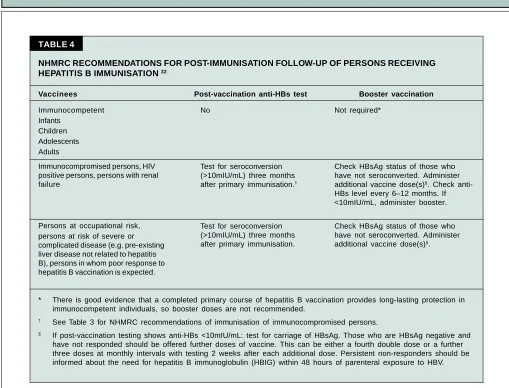
prisoners (nine per cent).39TABLE 4
NHMRC RECOMMENDATIONS FOR POST-IMMUNISATION FOLLOW-UP OF PERSONS RECEIVING
HEPATITIS B IMMUNISATION 32
Vaccinees Post-vaccination anti-HBs test Booster vaccination
* There is good evidence that a completed primary course of hepatitis B vaccination provides long-lasting protection in immunocompetent individuals, so booster doses are not recommended.
† See Table 3 for NHMRC recommendations of immunisation of immunocompromised persons.
§ If post-vaccination testing shows anti-HBs <10mIU/mL: test for carriage of HBsAg. Those who are HBsAg negative and have not responded should be offered further doses of vaccine. This can be either a fourth double dose or a further three doses at monthly intervals with testing 2 weeks after each additional dose. Persistent non-responders should be informed about the need for hepatitis B immunoglobulin (HBIG) within 48 hours of parenteral exposure to HBV. Immunocompetent
Infants Children Adolescents Adults
Immunocompromised persons, HIV positive persons, persons with renal failure
Persons at occupational risk, persons at risk of severe or complicated disease (e.g. pre-existing liver disease not related to hepatitis B), persons in whom poor response to hepatitis B vaccination is expected.
No
Test for seroconversion (>10mIU/mL) three months after primary immunisation.†
Test for seroconversion (>10mIU/mL) three months after primary immunisation.
Not required*
Check HBsAg status of those who have not seroconverted. Administer additional vaccine dose(s)§. Check anti-HBs level every 6–12 months. If <10mIU/mL, administer booster.
Check HBsAg status of those who have not seroconverted. Administer additional vaccine dose(s)§.
CURRENT IMMUNISATION RECOMMENDATIONS
Given the failure to date of the selective HB immunisation programs to control the transmission of the virus, the NHMRC has recommended the pursuit of universal infant and pre-adolescent immunisation in addition to strengthening the current selective immunisation programs that target specific at-risk groups.7,32 In 1999 the NSW Department of Health introduced funding for HB immunisation of all children aged 10 years and persons attending sexual health clinics and, now that suitable multi-valent vaccines that include HBsAg are available, universal immunisation of infants against HBV commenced in May 2000.
The current NHMRC recommendations for HB immunisation and the programs specifically funded by the NSW Department of Health are listed in Table 3. Recommendations for limited follow-up of vaccinees are listed in Table 4.
FUTURE DIRECTIONS
The poor penetration of hepatitis B vaccination into
at-risk groups in which at-risk of exposure is determined by risk-behaviours, for example:
•
injecting drug users•
men who have sex with men•
sex workersVol. 11 No. 12 215
ACKNOWLEDGEMENTS
We are grateful to Christine Carr, Immunisation Coordinator, Hunter Public Health Unit, for valuable criticism of a draft of this article.
REFERENCES
1. Kane M. Global program for control of hepatitis B infection. Vaccine 1995;13 (Suppl 1):S47–S49.
2. McMahon BJ, Alward WL, Hall DB, Heyward WL, Bender TR, Francis DP, Maynard JE. Acute hepatitis B virus infection: relation of age to the clinical expression of disease and subsequent development of the carrier state. J Infect Dis 1985; 151: 599–603.
3. Edmunds WJ, Medley GF, Nokes DJ, Hall AJ, Whittle HC. The influence of age on the development of the hepatitis B carrier state. Proceedings of the Royal Society of London— Series B: Biological Sciences. 1993; 253:197–201. 4. Robinson WS. Hepadnaviridae: hepatitis B virus and hepatitis
D virus. Mandell GL, Bennett JE and Dolin R (editors). Principles and Practices of Infectious Diseases (4th Edition). New York: Churchill Livingstone, 1995.
5. Thomson J, Lin M, Halliday L, Preston G, McIntyre P, Gidding H, Amin J, Roberts L, Higgins K, Brooke F, Milton A, O’Brien E, Witteveen D, Crerar S. Australia’s notifiable diseases status 1998. Annual report of the National Notifiable Diseases Surveillance System. Comm Dis Intell 1999; 23: 277–305.
6. Kaldor JM, Plant AJ, Thompson SC, Longbottom H, Rowbottom J. The incidence of hepatitis B infection in Australia: an epidemiological review. Med J Aust 1996; 165: 322–326. 7. National Health and Medical Research Council.
Recommendations on hepatitis B immunisation. Canberra: Australian Government Publishing Service, 1996.
8. World Health Organization. WHO expanded program on immunisation. Report of 14th Global Advisory Group, Antalya, Turkey, Oct 14–18, 1991. Geneva: WHO, 1991. 9. Kane M. Status of hepatitis B immunization programs in
1998. Vaccine 1998; 16 (suppl): S104–S108.
10. Yuen MF, Lim WL, Cheng CC, Lam SK, Lai CL. Twelve-year follow-up of a prospective randomised trial of hepatitis B recombinant DNA yeast vaccine versus plasma-derived vaccine without booster doses in children. Hepatology 1999; 29: 924–927.
11. Lugoboni F, Migliozzi S, Schiesari F, Pauletto N, Bovo GL, Stefano C, Mezzelani. Immunoresponsiveness to hepatitis B vaccination and adherence campaign among injecting drug users. Vaccine 1997; 15: 1014–1016.
12. Descombere I, Willems A, Leroux-Roels G. Response to hepatitis B vaccine: multiple HLA genes are involved. Tissue Antigens 1998; 51: 593–604.
13. Ficicioglu C, Mikla S, Midilli K, Aydin A, Cam H, Ergin S. Reduced immune response to hepatitis B vaccine in children with insulin dependent diabetes. Acta Paediatr Jpn 1995; 37: 687–690.
14. Horlander JC, Boyle N, Manam R, Schenk M, Herring S, Kwo PY, Lumeng L, Chalasani N. Vaccination against hepatitis B in patients with chronic liver disease awaiting transplantation. Am J Med Sci 1999; 318: 304–307.
15. Bruguera M, Cremades M, Salinas R, Costa J, Grau M, Sans J. Impaired response to recombinant hepatitis B vaccine in HIV-infected persons. J Clin Gastroenterol 1992; 14: 27–30. 16. Ostrow DG, Goldsmith J, Kalish SB, Chmiel JS, Hadler SC, Phair JP. Nonresponse to hepatitis B vaccine in homosexual men. Sex Transm Dis 1987; 14: 92–97.
17. Clemens R, Sanger R, Kruppenbacher J, Hobel W, Stanbury W, Bock HL, Jilg W. Booster immunization of low- and non-responders after a standard three dose hepatitis B vaccine schedule—results of post-marketing surveillance. Vaccine 1997; 15: 349–352.
18. Struve J, Aronsson B, Frenning B, Forsgren M, Weiland O. Seroconversion after additional vaccine doses to non-responders to three doses of intradermally or intramuscularly administered recombinant hepatitis B vaccine. Scand J Infect Dis. 1994; 26: 468–470.
19. Jilg W, Schmidt M, Deinhardt F. Inoculation failure following hepatitis B vaccination. The effect of additional vaccinations. Dtsch Med Wochenschr 1990; 115: 1545–1548.
20. Wismans P, van Hattum J, Stelling T, Poel J, de Gast GC. Effect of supplementary vaccination in healthy non-responders to hepatitis B vaccination. Hepatogastroenterology 1988; 35: 78–79.
21. Belloni C, Tinelli C, Orsolini P, Avanzini A, Moretta A, Gulminetti R, Bogliolo O, Chirico G, Rondini G. Revaccination against hepatitis B virus of non-responding infants immunised at birth. Parallel evaluation of rubella and tetanus vaccine. Vaccine 1988; 16: 399–402.
22. Shokri F, Amani A. High rate of seroconversion following administration of a single supplementary dose of recombinant hepatitis B vaccine in Iranian healthy nonresponder neonates. Med Microbiol Immunol (Berl) 1997; 185: 231–235. 23. Wu JS, Hwang LY, Goodman KJ, Beasley RP. Hepatitis B
vaccination in high-risk infants: 10-year follow-up. J Infect Dis 1999; 179: 1319–1325.
24. Jilg W, Schmidt M, Deinhardt F. Persistence of specific antibodies after hepatitis B vaccination. J Hepatol 1988; 6: 201–207.
25. European Consensus Group on Hepatitis B Immunity. Are booster immunisations needed for lifelong hepatitis B immunity? Lancet 2000; 355: 561–565.
26. Jilg W, Schmidt M, Deinhardt F. Immune response to hepatitis B revaccination. J Med Virol 1988; 24: 377–384.
27. Wismans PJ, van Hattum J, Mudde GC, Endeman HJ, Poel J, de Gast GC. Is booster injection with hepatitis B vaccine necessary in healthy responders? A study of the immune response. J Hepatol 1989; 8: 236–240.
28. Shih HH, Chang MH, Hsu HY, Lee PI, Ni YH, Chen DS. Long term immune response of universal hepatitis B vaccination in infancy: a community-based study in Taiwan. Pediatr Infect Dis J 1999; 18: 427–432.
PROGRAM FOR ENHANCED POPULATION HEALTH INFOSTRUCTURE (PEPHI)
•
How healthy are the people in my local area?•
What are the main health problems that send people to hospital in my local area?•
What are the most common preventable diseases in my local area?The Epidemiology and Surveillance Branch of the NSW Department of Health is currently
planning the Program for Enhanced Population Health Infostructure (PEPHI). The program will comprise a series of projects and initiatives designed to expand the available information on the health of the population of NSW and make that information more easily accessible. Useful and meaningful information about the health of people living in the community is central to providing health services and other public health interventions that meet community needs. The health information referred to here includes statistical data describing the health and disease status of people living in the community, the health services used by these people, and the health outcomes of those services.
PEPHI is aimed at better meeting the information needs of:
•
health professionals working outside the public health system, administrators, planners and policy analysts working in non-health sectors, students, and the general public;•
public health system staff at all levels;•
population health data analysts and researchers.A discussion paper on PEPHI has been produced. Comments on the discussion paper are welcome as they will ensure that PEPHI projects and initiatives are designed to meet health information needs.
Copies of the discussion paper are available from David Muscatello, and can be obtained by phoning (02) 9391 9408; by faxing 9391 9232; or by emailing [email protected]. The discussion paper is also available from the Department of Health’s Web site at
www.health.nsw.gov.au/public-health/pephi. 31. Hadler SC, Francis DP, Maynard JE, Thompson SE, Judson
FN, Echenberg DF, Ostrow DG, O’Malley PM, Penley KA, Altman NL, Braff E, Shipman GF, Coleman PJ, Mandel EJ. Long-term immunogenicity and efficacy of hepatitis B vaccine in homosexual men. New Engl J Med 1986; 315: 209–214. 32. National Health and Medical Research Council. The
Australian Immunisation Handbook 7th Edition. Canberra: Commonwealth of Australia, March 2000.
33. MacDonald M, Watt P. National monitoring of occupational exposure to blood and body fluid among health care workers. Summary of results 1 January to 30 June 1997. Sydney: National Centre in HIV Epidemiology and Clinical Research, 1997. 34. Riley R, Maher C, Kolbe A. Hepatitis B vaccination of
high-risk neonates in the South West Region of New South Wales: evaluation of program coverage. Aust J Public Health 1993; 17: 171–173.
35. Reznik RB. A hepatitis B vaccination programme for inner metropolitan Sydney neonates. Med J Aust 1991; 155: 153–156.
36. Rushworth RL, Bell SM, Rob MI, Taylor PT. Diagnostic tests during pregnancy: a descriptive analysis of utilisation data. Aust J Public Health 1994; 18: 401–406.
37. National Health and Medical Research Council. Antenatal care—Report of the 106th session. Canberra, November 1988. Canberra: NHMRC, 1989.
38. Anderson B, Bodsworth NJ, Rohrsheim RA, Donovan B. Hepatitis B virus infection and vaccination status of high-risk people in Sydney: 1982 and 1991. Med J Aust 1994; 161: 368–371.
39. Butler TG, Dolan KA, Ferson MJ, McGuinness LM, Brown PR, Robertson PW. Hepatitis B and C in New South Wales prisons: prevalence and risk factors. Med J Aust 1997; 166: 127–130.