VOLUME NO.6(2016),ISSUE NO.10(OCTOBER) ISSN2231-5756
A Monthly Double-Blind Peer Reviewed (Refereed/Juried) Open Access International e-Journal - Included in the International Serial Directories
Indexed & Listed at:
Ulrich's Periodicals Directory ©, ProQuest, U.S.A., EBSCO Publishing, U.S.A., Cabell’s Directories of Publishing Opportunities, U.S.A., Google Scholar, Open J-Gage, India [link of the same is duly available at Inflibnet of University Grants Commission (U.G.C.)],
Index Copernicus Publishers Panel, Poland with IC Value of 5.09 & number of libraries all around the world.
Circulated all over the world & Google has verified that scholars of more than 5000 Cities in 187 countries/territories are visiting our journal on regular basis.
VOLUME NO.6(2016),ISSUE NO.10(OCTOBER) ISSN2231-5756
INTERNATIONAL JOURNAL OF RESEARCH IN COMMERCE, IT & MANAGEMENT
CONTENTS
Sr.
No.
TITLE & NAME OF THE AUTHOR (S)
Page
No.
1.
A STUDY ON THE JOB SATISFACTION OF THE EMPLOYEES OF BPO SECTOR
V. SAVITHA & DR. E. VIJILA
1
2.
A PRODUCTIVE ANALYSIS OF REGIONAL INEQUALITY IN AGRICULTURAL DEVELOPMENT: STUDY OF
HARYANA INTER-DISTRICT EMPIRIC
DR. INDERJIT
5
3.
THE STUDY OF KEY SUCCESS FACTORS IN NEW PRODUCT DEVELOPMENT PROCESS IN TEXTILE
INDUSTRY WITH SPECIAL REFERENCE TO SURAT REGION
RASHVIN TAILOR & DR. MANISHA PANWALA
9
4.
AN EMPIRICAL STUDY ON MARKETING INFORMATION SYSTEM
DEEPAK S & DR. S. J. MANJUNATH
12
5.
MOMPRENEURSHIP: A NEW TREND OF ENTREPRENEURSHIP
B. N. LALITHCHANDRA & T. LAVANYA KUMARI
16
6.
RELATIONSHIP BETWEEN JOB SATISFACTION AND OTHER PSYCHOSOCIAL VARIABLES: A
COMPARATIVE STUDY OF MALE AND FEMALE EMPLOYEES OF BUSINESS PROCESSING OUTSOURCING
(BPO) SECTOR
PRIYANKAR SINGHA & DR. SOUVIK RAYCHAUDHURI
20
7.
YOGA AND MEDICAL SCIENCE
PRADEEP H. TAWADE
24
8.
A STUDY ON AN ANALYSIS OF SHORT-TERM LIQUIDITY POSITION OF TATA STEEL LIMITED
R. SATHISHKUMAR
26
9.
RULES AND VALUES OF CO-OPERATIVE BANKS
DR. SAKSHI TEWARI
30
10.
CUSTOMERS BUYING BEHAVIOUR IN ASHOK LEYLAND, CHENNAI
DR. R. AMUDHA & K. SRILAKSHMI
34
11.
IMPACT OF ENGLISH INVASION ON INDIAN CULTURE
SANGEETHA. J
39
12.
BEST PRACTICES FOR ENHANCING USE OF LIBRARY COLLECTION AND OTHER LIBRARY SERVICES
AJIT VASANTRAO JANUGADE
41
13.
ENTREPRENEURSHIP DEVELOPMENT EFFORTS AND THE CHALLENGE OF QUALITY EDUCATION AND
HUMAN RESOURCE DEVELOPMENT IN NIGERIA
DR. S.O. ONIMOLE
44
14.
FACTORS INFLUENCING THE DECISION OF ADOPTING COMPUTERIZED ACCOUNTING SYSTEM (CAS)
BY SMALL AND MEDIUM ENTERPRISES (SMEs) IN KURUNEGALA URBAN AREA IN SRI LANKA
PATHMINI MGS & KARUNADASA MKGPSK
49
15.
ASSESSMENT OF CUSTOMERS’ ATTITUDE AND BANKS’ GROWTH TOWARDS E- BANKING IN NIGERIA
FAITH ERINMA ONYEBUENYI
55
16.
IMPLEMENTATION MECHANISM OF MGNREGA IN HIMACHAL PRADESH
KHEM RAJ
60
17.
EFFECTS OF FDI IN RETAIL SECTOR IN INDIA
NAZEEFA BEGUM MAKANDAR
67
18.
AN ANALYSIS OF SERVQUAL AND SERVPERF IN INDIAN BANKING CONTEXT
SUDESHNA DUTTA
72
19.
EFFECT OF MOBILE PHONES ON HUMAN BODY
SUNIL KUMAR TRIVEDI
78
20.
SELF EFFICACY AND OTHER PERSONAL RESOURCES AS ANTECEDENTS OF EMPLOYEE ENGAGEMENT:
A CRITICAL LITERATURE REVIEW
HARSH VARDHAN KOTHARI
82
VOLUME NO.6(2016),ISSUE NO.10(OCTOBER) ISSN2231-5756
INTERNATIONAL JOURNAL OF RESEARCH IN COMMERCE, IT & MANAGEMENT
CHIEF PATRON
PROF. K. K. AGGARWAL
Chairman, Malaviya National Institute of Technology, Jaipur
(An institute of National Importance & fully funded by Ministry of Human Resource Development, Government of India)
Chancellor, K. R. Mangalam University, Gurgaon
Chancellor, Lingaya’s University, Faridabad
Founder Vice-Chancellor (1998-2008), Guru Gobind Singh Indraprastha University, Delhi
Ex. Pro Vice-Chancellor, Guru Jambheshwar University, Hisar
FOUNDER PATRON
LATE SH. RAM BHAJAN AGGARWAL
Former State Minister for Home & Tourism, Government of Haryana
Former Vice-President, Dadri Education Society, Charkhi Dadri
Former President, Chinar Syntex Ltd. (Textile Mills), Bhiwani
FORMER CO-ORDINATOR
DR. S. GARG
Faculty, Shree Ram Institute of Business & Management, Urjani
ADVISORS
PROF. M. S. SENAM RAJU
Director A. C. D., School of Management Studies, I.G.N.O.U., New Delhi
PROF. M. N. SHARMA
Chairman, M.B.A., Haryana College of Technology & Management, Kaithal
PROF. S. L. MAHANDRU
Principal (Retd.), Maharaja Agrasen College, Jagadhri
EDITOR
PROF. R. K. SHARMA
Professor, Bharti Vidyapeeth University Institute of Management & Research, New Delhi
CO-EDITOR
DR. BHAVET
Faculty, Shree Ram Institute of Engineering & Technology, Urjani
EDITORIAL ADVISORY BOARD
DR. RAJESH MODI
Faculty, Yanbu Industrial College, Kingdom of Saudi Arabia
PROF. SANJIV MITTAL
University School of Management Studies, Guru Gobind Singh I. P. University, Delhi
PROF. ANIL K. SAINI
Chairperson (CRC), Guru Gobind Singh I. P. University, Delhi
DR. SAMBHAVNA
VOLUME NO.6(2016),ISSUE NO.10(OCTOBER) ISSN2231-5756
INTERNATIONAL JOURNAL OF RESEARCH IN COMMERCE, IT & MANAGEMENT
DR. MOHENDER KUMAR GUPTA
Associate Professor, P. J. L. N. Government College, Faridabad
DR. SHIVAKUMAR DEENE
Asst. Professor, Dept. of Commerce, School of Business Studies, Central University of Karnataka, Gulbarga
ASSOCIATE EDITORS
PROF. NAWAB ALI KHAN
Department of Commerce, Aligarh Muslim University, Aligarh, U.P.
PROF. ABHAY BANSAL
Head, Department of I.T., Amity School of Engineering & Technology, Amity University, Noida
PROF. A. SURYANARAYANA
Department of Business Management, Osmania University, Hyderabad
PROF. V. SELVAM
SSL, VIT University, Vellore
DR. PARDEEP AHLAWAT
Associate Professor, Institute of Management Studies & Research, Maharshi Dayanand University, Rohtak
DR. S. TABASSUM SULTANA
Associate Professor, Department of Business Management, Matrusri Institute of P.G. Studies, Hyderabad
SURJEET SINGH
Asst. Professor, Department of Computer Science, G. M. N. (P.G.) College, Ambala Cantt.
FORMER TECHNICAL ADVISOR
AMITA
Faculty, Government M. S., Mohali
FINANCIAL ADVISORS
DICKIN GOYAL
Advocate & Tax Adviser, Panchkula
NEENA
Investment Consultant, Chambaghat, Solan, Himachal Pradesh
LEGAL ADVISORS
JITENDER S. CHAHAL
Advocate, Punjab & Haryana High Court, Chandigarh U.T.
CHANDER BHUSHAN SHARMA
Advocate & Consultant, District Courts, Yamunanagar at Jagadhri
SUPERINTENDENT
VOLUME NO.6(2016),ISSUE NO.10(OCTOBER) ISSN2231-5756
INTERNATIONAL JOURNAL OF RESEARCH IN COMMERCE, IT & MANAGEMENT
CALL FOR MANUSCRIPTS
We invite unpublished novel, original, empirical and high quality research work pertaining to the recent developments & practices in the areas of Com-puter Science & Applications; Commerce; Business; Finance; Marketing; Human Resource Management; General Management; Banking; Economics; Tourism Administration & Management; Education; Law; Library & Information Science; Defence & Strategic Studies; Electronic Science; Corporate Gov-ernance; Industrial Relations; and emerging paradigms in allied subjects like Accounting; Accounting Information Systems; Accounting Theory & Practice; Auditing; Behavioral Accounting; Behavioral Economics; Corporate Finance; Cost Accounting; Econometrics; Economic Development; Economic History; Financial Institutions & Markets; Financial Services; Fiscal Policy; Government & Non Profit Accounting; Industrial Organization; International Economics & Trade; International Finance; Macro Economics; Micro Economics; Rural Economics; Co-operation; Demography: Development Planning; Development Studies; Applied Economics; Development Economics; Business Economics; Monetary Policy; Public Policy Economics; Real Estate; Regional Economics; Political Science; Continuing Education; Labour Welfare; Philosophy; Psychology; Sociology; Tax Accounting; Advertising & Promotion Management; Management Information Systems (MIS); Business Law; Public Responsibility & Ethics; Communication; Direct Marketing; E-Commerce; Global Business; Health Care Administration; Labour Relations & Human Resource Management; Marketing Research; Marketing Theory & Applications; Non-Profit Or-ganizations; Office Administration/Management; Operations Research/Statistics; Organizational Behavior & Theory; Organizational Development; Pro-duction/Operations; International Relations; Human Rights & Duties; Public Administration; Population Studies; Purchasing/Materials Management; Re-tailing; Sales/Selling; Services; Small Business Entrepreneurship; Strategic Management Policy; Technology/Innovation; Tourism & Hospitality; Transpor-tation Distribution; Algorithms; Artificial Intelligence; Compilers & Translation; Computer Aided Design (CAD); Computer Aided Manufacturing; Computer Graphics; Computer Organization & Architecture; Database Structures & Systems; Discrete Structures; Internet; Management Information Systems; Mod-eling & Simulation; Neural Systems/Neural Networks; Numerical Analysis/Scientific Computing; Object Oriented Programming; Operating Systems; Pro-gramming Languages; Robotics; Symbolic & Formal Logic; Web Design and emerging paradigms in allied subjects.
Anybody can submit the soft copy of unpublished novel; original; empirical and high quality research work/manuscriptanytime in M.S. Word format after preparing the same as per our GUIDELINES FOR SUBMISSION; at our email address i.e. [email protected] or online by clicking the link online submission as given on our website (FOR ONLINE SUBMISSION, CLICK HERE).
GUIDELINES FOR SUBMISSION OF MANUSCRIPT
1. COVERING LETTER FOR SUBMISSION:
DATED: _____________
THE EDITOR
IJRCM
Subject: SUBMISSION OF MANUSCRIPT IN THE AREA OF .
(e.g. Finance/Mkt./HRM/General Mgt./Engineering/Economics/Computer/IT/ Education/Psychology/Law/Math/other, please specify)
DEAR SIR/MADAM
Please find my submission of manuscript titled ‘___________________________________________’ for likely publication in one of your journals.
I hereby affirm that the contents of this manuscript are original. Furthermore, it has neither been published anywhere in any language fully or partly, nor it is under review for publication elsewhere.
I affirm that all the co-authors of this manuscript have seen the submitted version of the manuscript and have agreed to inclusion of their names as co-authors.
Also, if my/our manuscript is accepted, I agree to comply with the formalities as given on the website of the journal. The Journal has discretion to publish our contribution in any of its journals.
NAME OF CORRESPONDING AUTHOR :
Designation/Post* :
Institution/College/University with full address & Pin Code : Residential address with Pin Code : Mobile Number (s) with country ISD code : Is WhatsApp or Viber active on your above noted Mobile Number (Yes/No) : Landline Number (s) with country ISD code :
E-mail Address :
Alternate E-mail Address :
Nationality :
* i.e. Alumnus (Male Alumni), Alumna (Female Alumni), Student, Research Scholar (M. Phil), Research Scholar (Ph. D.), JRF, Research Assistant, Assistant
Lecturer, Lecturer, Senior Lecturer, Junior Assistant Professor, Assistant Professor, Senior Assistant Professor, Co-ordinator, Reader, Associate
Profes-sor, ProfesProfes-sor, Head, Vice-Principal, Dy. Director, Principal, Director, Dean, President, Vice Chancellor, Industry Designation etc. The qualification of
VOLUME NO.6(2016),ISSUE NO.10(OCTOBER) ISSN2231-5756
INTERNATIONAL JOURNAL OF RESEARCH IN COMMERCE, IT & MANAGEMENT
NOTES:
a) The whole manuscript has to be in ONE MS WORD FILE only, which will start from the covering letter, inside the manuscript. pdf. version is liable to be rejected without any consideration.
b) The sender is required to mention the following in the SUBJECT COLUMNof the mail:
New Manuscript for Review in the area of (e.g. Finance/Marketing/HRM/General Mgt./Engineering/Economics/Computer/IT/ Education/Psychology/Law/Math/other, please specify)
c) There is no need to give any text in the body of the mail, except the cases where the author wishes to give any specific message w.r.t. to the manuscript.
d) The total size of the file containing the manuscript is expected to be below 1000 KB.
e) Only the Abstract will not be considered for review and the author is required to submit the complete manuscript in the first instance.
f) The journal gives acknowledgement w.r.t. the receipt of every email within twenty-four hours and in case of non-receipt of acknowledgment from the journal, w.r.t. the submission of the manuscript, within two days of its submission, the corresponding author is required to demand for the same by sending a separate mail to the journal.
g) The author (s) name or details should not appear anywhere on the body of the manuscript, except on the covering letter and the cover page of the manuscript, in the manner as mentioned in the guidelines.
2. MANUSCRIPT TITLE: The title of the paper should be typed in bold letters, centeredand fully capitalised.
3. AUTHOR NAME (S) & AFFILIATIONS: Author (s) name, designation, affiliation (s), address, mobile/landline number (s), and email/al-ternate email address should be given underneath the title.
4. ACKNOWLEDGMENTS: Acknowledgements can be given to reviewers, guides, funding institutions, etc., if any.
5. ABSTRACT: Abstract should be in fully Italic printing, ranging between 150 to 300 words. The abstract must be informative and eluci-dating the background, aims, methods, results & conclusion in a SINGLE PARA. Abbreviations must be mentioned in full.
6. KEYWORDS: Abstract must be followed by a list of keywords, subject to the maximum of five. These should be arranged in alphabetic order separated by commas and full stop at the end. All words of the keywords, including the first one should be in small letters, except special words e.g. name of the Countries, abbreviations etc.
7. JEL CODE: Provide the appropriate Journal of Economic Literature Classification System code (s). JEL codes are available at www.aea-web.org/econlit/jelCodes.php. However, mentioning of JEL Code is not mandatory.
8. MANUSCRIPT: Manuscript must be in BRITISH ENGLISH prepared on a standard A4 size PORTRAIT SETTING PAPER. It should be free from any errors i.e. grammatical, spelling or punctuation. It must be thoroughly edited at your end.
9. HEADINGS: All the headings must be bold-faced, aligned left and fully capitalised. Leave a blank line before each heading.
10. SUB-HEADINGS: All the sub-headings must be bold-faced, aligned left and fully capitalised.
11. MAIN TEXT:
THE MAIN TEXT SHOULD FOLLOW THE FOLLOWING SEQUENCE:
INTRODUCTION
REVIEW OF LITERATURE
NEED/IMPORTANCE OF THE STUDY
STATEMENT OF THE PROBLEM
OBJECTIVES
HYPOTHESIS (ES)
RESEARCH METHODOLOGY
RESULTS & DISCUSSION
FINDINGS
RECOMMENDATIONS/SUGGESTIONS
CONCLUSIONS
LIMITATIONS
SCOPE FOR FURTHER RESEARCH
REFERENCES
APPENDIX/ANNEXURE
VOLUME NO.6(2016),ISSUE NO.10(OCTOBER) ISSN2231-5756
INTERNATIONAL JOURNAL OF RESEARCH IN COMMERCE, IT & MANAGEMENT
12. FIGURES & TABLES: These should be simple, crystal CLEAR, centered, separately numbered & self-explained, and the titles must be above the table/figure. Sources of data should be mentioned below the table/figure. It should be ensured that the tables/figures are referred to from the main text.
13. EQUATIONS/FORMULAE: These should be consecutively numbered in parenthesis, left aligned with equation/formulae number placed at the right. The equation editor provided with standard versions of Microsoft Word may be utilised. If any other equation editor is utilised, author must confirm that these equations may be viewed and edited in versions of Microsoft Office that does not have the editor.
14. ACRONYMS: These should not be used in the abstract. The use of acronyms is elsewhere is acceptable. Acronyms should be defined on its first use in each section e.g. Reserve Bank of India (RBI). Acronyms should be redefined on first use in subsequent sections.
15. REFERENCES: The list of all references should be alphabetically arranged. The author (s) should mention only the actually utilised references in the preparation of manuscript and they may follow Harvard Style of Referencing. Also check to ensure that everything that you are including in the reference section is duly cited in the paper. The author (s) are supposed to follow the references as per the following:
•
All works cited in the text (including sources for tables and figures) should be listed alphabetically.•
Use (ed.) for one editor, and (ed.s) for multiple editors.•
When listing two or more works by one author, use --- (20xx), such as after Kohl (1997), use --- (2001), etc., in chronologically ascending order.•
Indicate (opening and closing) page numbers for articles in journals and for chapters in books.•
The title of books and journals should be in italic printing. Double quotation marks are used for titles of journal articles, book chapters, dissertations, reports, working papers, unpublished material, etc.•
For titles in a language other than English, provide an English translation in parenthesis.•
Headers, footers, endnotes and footnotes should not be used in the document. However, you can mention short notes to elucidate some specific point, which may be placed in number orders before the references.PLEASE USE THE FOLLOWING FOR STYLE AND PUNCTUATION IN REFERENCES:
BOOKS
•
Bowersox, Donald J., Closs, David J., (1996), "Logistical Management." Tata McGraw, Hill, New Delhi.•
Hunker, H.L. and A.J. Wright (1963), "Factors of Industrial Location in Ohio" Ohio State University, Nigeria. CONTRIBUTIONS TO BOOKS•
Sharma T., Kwatra, G. (2008) Effectiveness of Social Advertising: A Study of Selected Campaigns, Corporate Social Responsibility, Edited by David Crowther & Nicholas Capaldi, Ashgate Research Companion to Corporate Social Responsibility, Chapter 15, pp 287-303.JOURNAL AND OTHER ARTICLES
•
Schemenner, R.W., Huber, J.C. and Cook, R.L. (1987), "Geographic Differences and the Location of New Manufacturing Facilities," Jour-nal of Urban Economics, Vol. 21, No. 1, pp. 83-104.CONFERENCE PAPERS
•
Garg, Sambhav (2011): "Business Ethics" Paper presented at the Annual International Conference for the All India Management Asso-ciation, New Delhi, India, 19–23UNPUBLISHED DISSERTATIONS
•
Kumar S. (2011): "Customer Value: A Comparative Study of Rural and Urban Customers," Thesis, Kurukshetra University, Kurukshetra. ONLINE RESOURCES•
Always indicate the date that the source was accessed, as online resources are frequently updated or removed. WEBSITESVOLUME NO.6(2016),ISSUE NO.10(OCTOBER) ISSN2231-5756
INTERNATIONAL JOURNAL OF RESEARCH IN COMMERCE, IT & MANAGEMENT
AN ANALYSIS OF SERVQUAL AND SERVPERF IN INDIAN BANKING CONTEXT
SUDESHNA DUTTA
RESEARCH SCHOLAR
CENTURION UNIVERSITY OF TECHNOLOGY & MANAGEMENT
RAMCHANDRAPUR P.O.
ABSTRACT
“Services sector is the largest sector of India. Services sector accounts for 52.97% of total India’s Gross Value Added (GVA) of 115.50 lakh crore Indian rupees.” (Planning commission, Government of India, 2015). Banking plays a very significant role here. After liberalization Indian banking scenario has changed drastically. Cut throat competition, high customer expectation and dynamic technological changes have forced bank to thrive on service quality. While most of the products in Banks are not much different from each other, as they governed by governing body the only scope of success comes from providing service quality. Service quality is defined as global judgment or attitude relating to the superiority of the service. SERVQUAL and SERVPERF are the most frequently used measuring scale to assess service quality. This paper evaluates the most frequently used measuring scale SERVQUAL and SERVPERF from the existing literatures and understands both the scales comprehensively. Many literary works have been done applying both the scales; primarily electronic search was conducted, then manual assessment and thorough analysis of the articles identified from the computer-based searches were conducted. Finally, Indian banking context has been considered and the rationale for their usage of scale is reviewed. The present paper also tries to give direction to researchers / marketing team regarding the usage of the two scales in practice. It also provides a contrast between the two scales. Though both SERVQUAL and SERVPERF are widely used scales, but SERVPERF scale is found to be superior from the review (Indian banking context).
KEYWORDS
banks, servperf, servqual, service quality.
INTRODUCTION
fter liberation banking sector has shown tremendous growth. The customers have more choices in choosing their banks. A competition has been established between the banks operating in India.
With stiff competition and advancement of technology, the services provided by banks have become more easy and convenient. None could have imagined anytime banking 50 years back, services such as the paying of bills or the transfer of money from one account to the other are fast and have become very easy process as well.
New verticals of banking have been developed due to huge transactions and to provide quick service to customers as well. Concepts like wholesale banking, retail banking, merchant banking, were born for the continuous innovation of services and products by banks. Wholesale banking are services that are provided between merchant banks and other types of financial institutions.
Whereas typical mass-market banking in which individual customers use local branches of larger commercial banks is retail banking. Wholesale banking is different from retail banking because it focuses more on corporate-style entities and high-value transactions, and retail banking focuses on providing financial services to individual consumers. Many banks typically engage in both wholesale and retail banking. Today, retail bankers have to cope with numerous challenges as a result of the ever-changing economy. They must keep abreast of the latest retail banking technology and respond to customers with alacrity. It provides different kind of solutions like core Banking, payments, wealth management, mobile banking.
The scenario is fully changed now. Banks are now customer centric. Every campaign, every promotion is showcasing the service aspect of respective Banks. The number of players being large, customers has a good range of choice. Customer mostly chooses a bank which provides maximum satisfaction and better service. Oliver (1980) adds satisfaction increases while the ratio between performance and expectations increased as well. Customer satisfaction is increasingly becoming a corporate goal as more and more companies strive for quality in their products or services (Bitner and Hubbert, 1994) In this context customer satisfaction becomes the major contributor for profit. As Indian banks are regulated by regulatory bodies (mainly RBI), the products of the banks remain similar to each other. Thus the service aspect of banks has become significant.
Service quality has been variously defined as focusing on meeting needs and requirements, and how well the service delivered matches customer’s expectation.
Perceived service quality is a global consumer judgment or attitude, relating to service and results from comparisons by consumers of expectations of service with their perceptions of actual service performance (Berry, Zeithaml and Parasuraman1985, Grönroos, 1984). Many authors have narrated the importance of service quality and its contribution to organization. (Crosby, 1991; Reichfeld and Sasser, 1990; Edvardsson and Gustavsson, 1991; Adil, 2012; Adil, 2013a, Adil,2013b). Parasuraman et al. (1985) opine that service quality is the function of customers' expectation and service providers' performance. The concept of service quality was defined by Parasuraman et al. as "a form of attitude, related but not equivalent to satisfaction that results from a comparison of expectations with perceptions of performance. Expectations are viewed as desires or wants of consumers i.e. what they feel a service provider should offer rather than what the service provider would offer."
During 1980 and 1990 research were carried out to measure service quality. But Parasuraman et al. (1980) developed an instrument to measure service quality. By using five dimensions of service quality, namely, tangibles, reliability, responsiveness, assurance and empathy and used these as the basis for their service quality measurement instrument, SERVQUAL.
However, Cronin and Taylor (1992) argued that the conceptualization of service quality as a gap between expectations and performance is inadequate. Cronin and Taylor (1992) were the first to provide a theoretical justification for discarding the expectations part of SERVQUAL in favor of mere performance measures included in the scale. The authors named their scale SERVEPERF.
The present study evaluates and compare the most frequently used scales both SEVQUAL and SERVPERF. Here review of literary work is prime focus and thus it had been presented as the main division afterward.
RATIONALE FOR THE STUDY
Even though a lot of studies had been done using both the scale. There are many comparisons drawn between the two scales in the developed countries, the similar studies in the context of a rapidly developing country like in India are limited. The research highlight the service quality in Banking in total, comparative analysis on SERVQUAL and SERVPERF scores in different kinds of bank, in different states and formats in banking industry. The present paper is a deep analyze of better applicability and enhance the understanding of SERVQUAL and SERVPERF in banking industry, however, has not been explicitly demonstrated in the past. This research focuses not only on the issue of measuring of service quality but also banking sector in different states of India. While carrying out a research it becomes very difficult to choose scales, to understand the applicability of scales, and their respective qualities and limitations. This paper will definitely provide guideline for choosing scales in future research.
OBJECTIVES
1. The primary objective of this paper is to analyse the most frequently used measuring scale SERVQUAL and SERVPERF from extant literature and the rationale
for their usage in the context of Indian Banking System.
2. To understand both the scales comprehensively.
VOLUME NO.6(2016),ISSUE NO.10(OCTOBER) ISSN2231-5756
INTERNATIONAL JOURNAL OF RESEARCH IN COMMERCE, IT & MANAGEMENT
ASSUMPTION
In this paper, researcher had considered service quality measuring tools after SERVQUAL, and particularly two scales have been considered only. (SERVQUAL and SERVPERF)
LITERATURE REVIEW
I. SERVICE QUALITY
As Indian Banking industry is mainly governed by Reserve Bank of India, as per the rule and compliance of regulations the products of the Banks are more or less similar to each other. The only way to create identity and survive is customer satisfaction.
Satisfaction is a function of an initial standard and some perceived discrepancy from the initial reference point (Andrews and Withey 1976; Campbell, Converse, and Rodgers 1976; Ilgen 1971; Locke 1969; Locker and Dunt 1978; Shrauger 1975; Spector 1956; Watts 1968; Weaver and Brickman 1974.) Although many re-searchers choose to measure discrepancies objectively, reviewers of the early dissonance studies (e.g., Watts 1968; Weaver and Brickman 1974) were among the first to argue that individuals implicitly make summary comparative judgments apart from and as an input to their feelings of satisfaction. Oliver (1980) adds satisfaction increases while the ratio between performance and expectations increased as well. Customer satisfaction is increasingly becoming a corporate goal as more and more companies strive for quality in their products or services (Bitner and Hubbert, 1994). It is a feeling or attitude of a customer towards a product or services after it has been used and is generally described as a full meeting of one’s expectation (Oliver R.L, 1980). East, R (1977) defines customer satisfaction is a major outcome of marketing activity whereby it serves as a link between the various stages of buying behavior.
Availability of quality services has become need of the hour Here service quality becomes the base for the customer satisfaction. Many authors have discussed the importance of service quality for the business firm. (Shaw 1978; and Normann, 1984) and demonstrated its positive relationship with profits, increased market share, return on investment, customer satisfaction, and future purchase intentions.
Measuring product quality becomes easy, because of its tangibility in nature.” While quality in tangible goods has been described and measured by marketers, quality in services is largely undefined and unresearched.” Parasuraman, Zeithmal and Berry. 1985. The complexity of service quality, unlike product quality, is more abstract and elusive, because of features unique to services: intangibility, inseparability, heterogeneity (Parasuraman, Zeithaml and Berry, 1985) and perish ability (Kasper and Lemmink, 1989) and is therefore difficult to measure. Now, at this juncture it becomes important to measure service quality. The solution to this problem was the “gap model” established by, Parasuraman, Zeithaml and Berry (1985)
II. SERVQUAL
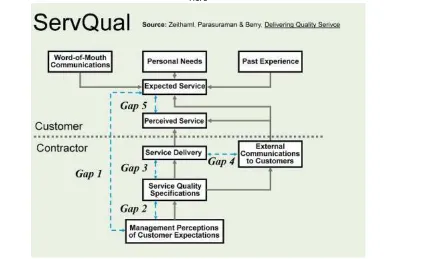
Many models have been developed to assess the determinants of service quality. The works of Parasuraman, Zeithaml and Berry (1985, 1988, 1991, and 1994) led to the development of a service quality model--SERVQUAL, which compares expectations and perceptions of customers regarding a particular service. SERVQUAL provides a technique for assessing and managing service quality (Buttle,1996). For eight years Parasuraman et al. had been working consistently on this model. Since at that time research in service quality was not enough an exploratory research was done by Parasuraman 1985, Ziethemal 1981, Berry 1980). Executive interview and focus group interview were conducted. “A set of key discrepancies or gaps exists regarding executive perceptions of service quality and the tasks associated with service delivery to consumers. These gaps can be major hurdles in attempting to deliver a service which consumers would perceive as being of high quality.” (Parasuraman et al.1985).
The first gap is the consumer expectations-management perceptions gap.
“The gap between consumer expectations and management perceptions of those expectations will have an impact on the consumer's evaluation of service qual-ity.” Parasuraman et al 1985. The first gap is due to the difference between the perceptions of executives and the perceptions of consumers on security issues. In essence, it suggests that service marketers may not always understand what consumers expect in a service. This lack of understanding lead to second gap. The second gap is called Management perception-service quality specification gap by Parasuraman et al. The service quality specifications do not agree with manage-ment perceptions of quality expectations.
Service quality specifications-service delivery gap is the third gap. It implies that disparity between quality specifications of the promised service and the final service delivered. Management recognizes that a service firm's employees exert a strong influence on the service quality perceived by consumers and that em-ployee performance cannot always be standardized. Gap four is Service delivery-external communications gap. External communication and advertisement by firms can influence consumer’s expectation. According to Parasuraman et al. (1985)” Promising more than can be delivered will raise initial expectations but lower perceptions of quality when the promises are not fulfilled. In short, external communications can affect not only consumer expectations about a service but also consumer perceptions of the delivered service.” This problem creates gap five expected service-perceived service gap. Difference between the expectations of what firms should provide in the industry and their perceptions of how a given service provider performs. Parasuraman, Zeithaml and Berry (1988) attempted to measure this fifth gap by developing the SERVQUAL instrument.
VOLUME NO.6(2016),ISSUE NO.10(OCTOBER) ISSN2231-5756
INTERNATIONAL JOURNAL OF RESEARCH IN COMMERCE, IT & MANAGEMENT
SERVQUAL comprises 22 items (Likert-type) with five dimensions namely- tangibles, reliability, responsiveness, assurance and empathy. Initially Parasuraman et al. had developed ten dimensions and further they merged them into five dimensions. These five dimensions are basically five components of service quality.
TABLE 1: DETERMINANTS OF SERVICE QUALITY
1. RELIABILITY It means that the firm performs the service right the first time.
2. RESPONSIVENESS It is concern with the willingness or readiness of employees to provide service. It involves timeliness of service
3. ASSURANCE It involves trustworthiness, believability, honesty. It involves having the customer’s best interests at heart.
4. TANGIBLE It include the physical evidence of the service: physical facilities; appearance of personnel; tools or equipment used to provide the
service
5. EMPATHY It involves making the effort to understand the customer's needs.
Adopted from A Conceptua Model of Service Quality and Its Implications for Future Research (Parasuraman, Zeithaml and Berry 1985) Table 1, explains different determinants and these 5 determinants are the essential structure for measuring service quality.
Though SERVQUAL has been generally robust as a measure of service quality, the instrument has been criticised on conceptual and methodological grounds. The main criticism of SERVQUAL has focused on the use of expectation as a comparison standard. It has been argued that expectation is dynamic in nature, and that it can therefore change according to customers’ experiences and consumption situations.(Halil Nadiri and Kashif Hussain (2005)One of the main problems mentioned in the literature is the applicability of the five SERVQUAL dimensions to different service settings and replication studies done by other investigators failed to support the five-dimensional factor structure The debate was majorly enhanced by Cronin and Taylor (1992) when they argued that the conceptualization of service quality as a gap between expectations and performance is inadequate
III. SERVPERF
Cronin and Taylor (1992) pointed out the perplexity in literature regarding the relationship between service quality and customer satisfaction. As per them, the concept of service quality should be the customers’ attitude towards the service, since the concept of satisfaction is defined as a gap between expectations and performance or disconfirmation of expectations. An attitude-based conceptualization would argue for either an importance-weighted evaluation of specific service attributes or even just an evaluation of performance on specific service attributes (Cronin and Taylor, 1992). They provided empirical evidence across four indus-tries namely fast food, pest control, dry cleaning and banking to substantiate the superiority of their ‘performance only’ instrument over disconfirmation-based on SERVQUAL Scale. In equation form, it can be expressed as:
FIG 1
Source: Performance Only Model (SERVPERF)
IV. ANALYSIS OF LITERARY WORK
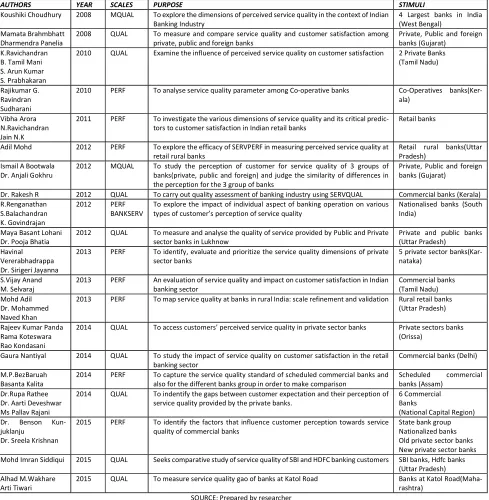
There are ample of studies conducted internationally and nationally using SERVQUAL and SERVPERF. These are the most commonly used tools to measure service quality. The strategy used for this particular research is funnel approach. Though for initial procedure and deeper understanding international literary work were
considered, but here Indian context has been taken into account. The following procedure was used to obtain sufficient collection of studies reporting the use of
both SERVQUAL and SERVPERF scales. Primarily, an electronic search of the following databases was conducted: Global Journals, IJRCM, Research gate, Interna-tional journals of business and management etc. Eventually a manual examination and thorough analysis of the articles identified from the computer-based searches were conducted. While there are many work done applying SERVQUAL and SERVPERF, and particularly in the context of financial sector, but thorough
manual search and study was carried out. Finally banking context was taken into consideration. Since it is difficult to cite all the work, few most pertinent works
VOLUME NO.6(2016),ISSUE NO.10(OCTOBER) ISSN2231-5756
INTERNATIONAL JOURNAL OF RESEARCH IN COMMERCE, IT & MANAGEMENT
TABLE 2
AUTHORS YEAR SCALES PURPOSE STIMULI
Koushiki Choudhury 2008 MQUAL To explore the dimensions of perceived service quality in the context of Indian
Banking Industry
4 Largest banks in India (West Bengal)
Mamata Brahmbhatt Dharmendra Panelia
2008 QUAL To measure and compare service quality and customer satisfaction among
private, public and foreign banks
Private, Public and foreign banks (Gujarat)
K.Ravichandran B. Tamil Mani S. Arun Kumar S. Prabhakaran
2010 QUAL Examine the influence of perceived service quality on customer satisfaction 2 Private Banks
(Tamil Nadu)
Rajikumar G. Ravindran Sudharani
2010 PERF To analyse service quality parameter among Co-operative banks Co-Operatives
banks(Ker-ala)
Vibha Arora N.Ravichandran Jain N.K
2011 PERF To investigate the various dimensions of service quality and its critical
predic-tors to customer satisfaction in Indian retail banks
Retail banks
Adil Mohd 2012 PERF To explore the efficacy of SERVPERF in measuring perceived service quality at
retail rural banks
Retail rural banks(Uttar Pradesh)
Ismail A Bootwala Dr. Anjali Gokhru
2012 MQUAL To study the perception of customer for service quality of 3 groups of
banks(private, public and foreign) and judge the similarity of differences in the perception for the 3 group of banks
Private, Public and foreign banks (Gujarat)
Dr. Rakesh R 2012 QUAL To carry out quality assessment of banking industry using SERVQUAL Commercial banks (Kerala)
R.Renganathan S.Balachandran K. Govindrajan
2012 PERF
BANKSERV
To explore the impact of individual aspect of banking operation on various types of customer’s perception of service quality
Nationalised banks (South India)
Maya Basant Lohani Dr. Pooja Bhatia
2012 QUAL To measure and analyse the quality of service provided by Public and Private
sector banks in Lukhnow
Private and public banks (Uttar Pradesh)
Havinal Vererabhadrappa Dr. Sirigeri Jayanna
2013 PERF To identify, evaluate and prioritize the service quality dimensions of private
sector banks
5 private sector banks(Kar-nataka)
S.Vijay Anand M. Selvaraj
2013 PERF An evaluation of service quality and impact on customer satisfaction in Indian
banking sector Commercial banks (Tamil Nadu) Mohd Adil Dr. Mohammed Naved Khan
2013 PERF To map service quality at banks in rural India: scale refinement and validation Rural retail banks
(Uttar Pradesh)
Rajeev Kumar Panda Rama Koteswara Rao Kondasani
2014 QUAL To access customers’ perceived service quality in private sector banks Private sectors banks
(Orissa)
Gaura Nantiyal 2014 QUAL To study the impact of service quality on customer satisfaction in the retail
banking sector
Commercial banks (Delhi)
M.P.BezBaruah Basanta Kalita
2014 PERF To capture the service quality standard of scheduled commercial banks and
also for the different banks group in order to make comparison
Scheduled commercial
banks (Assam) Dr.Rupa Rathee
Dr. Aarti Deveshwar Ms Pallav Rajani
2014 QUAL To indentify the gaps between customer expectation and their perception of
service quality provided by the private banks.
6 Commercial Banks
(National Capital Region)
Dr. Benson
Kun-juklanju
Dr. Sreela Krishnan
2015 PERF To identify the factors that influence customer perception towards service
quality of commercial banks
State bank group Nationalized banks Old private sector banks New private sector banks
Mohd Imran Siddiqui 2015 QUAL Seeks comparative study of service quality of SBI and HDFC banking customers SBI banks, Hdfc banks
(Uttar Pradesh) Alhad M.Wakhare
Arti Tiwari
2015 QUAL To measure service quality gao of banks at Katol Road Banks at Katol
Road(Maha-rashtra) SOURCE: Prepared by researcher
Note: QUAL- SERVQUAL, MQUAL – Modified SERVQUAL, PERF- SERVPERF
FINDINGS
From the detailed analysis and evaluation of literary work, it was found that both SERVQUAL and SERV PERF are the most commonly used tools to measure service quality, specifically in Indian context. Although SERVQUAL is the basic skeleton for measuring service quality the but many researchers have proved that the SERVPERF model is better suited to measure the service quality in banking (Cronin and Taylor 1992, Boulding, 1993; Brown et al., 1993; Teas, 1994; and Brady et al., 2002) and execute better in assessing service quality in banking industry in developing countries such as India (Jain & Gupta, 2004; Adil, 2012; Adil & Ansari, 2012; Adil, 2013a; Adil, 2013b; Benson Kunjuklanju & Sreela Krishnan 2015). Cronin and Taylor 1992 questioned the conceptual basis of the SERVQUAL scale and found it confusing with service satisfaction. They, therefore, opined that expectation (E) component of SERVQUAL be discarded and instead performance (P) component alone be used. This not only cleared vague confusions but also reduced the number of items to be measured by half viz. 22 items in contrast to SERVQUAL’s 44 items. Prior to that it became very difficult to hold on to customers as the respondents have to fill two questionnaires one prior using the services (i.e. expectations) and another post using the service (i.e perceptions). SERVPERF not only captures the true customer’s perceived service quality but also more effective in reducing the number of items to be measured by half (Hartline and Ferrell, 1996; Babakus and Boller, 1992; Bolton and Drew,1991). Thus in country like India, it becomes easy to get rejoinder from respondent to carry research smoothly.
CONCLUSION
VOLUME NO.6(2016),ISSUE NO.10(OCTOBER) ISSN2231-5756
INTERNATIONAL JOURNAL OF RESEARCH IN COMMERCE, IT & MANAGEMENT
instruments and tools are to be considered, which are efficient to capture customer’s perception. It certainly should be simple and easily applicable. To carry out the research it is important that questionnaire should be easily understood and less time consuming. Thus SERVPERF scale is found to be superior in possessing all these characteristics.
REFERENCES
1. Adil, M. (2012), “Customer tradeoffs between perceived service quality and satisfaction: A SEM approach towards Indian rural retail banks”, In Rahela Farooqi
and Saiyed Wajid Ali (Ed.) Emerging Paradigms in Marketing, Wisdom Publications: New Delhi. pp. 3-16.
2. Adil, M. (2013a). “Efficacy of SERVPERF in measuring perceived service quality at rural retail banks: Empirical evidences from India”, International Journal of
Business Insights and Transformation, Vol. 6, No. 1, pp. 52-63.
3. Adil, M. (2013b). “Modelling effect of perceived service quality dimensions on customer satisfaction in Indian bank settings”, International Journal of Services
and Operations Management, Vol. 15, No.3, pp. 358-373.
4. Alhad M. Wakhar and ArtiTiwari (2015) “A study on measuring service quality gap of bank at katol road, Nagpur using servqual model”, International Journal
for Administration in management, commerce and economics
5. Andrew,F.M ;Whithey S.B (1976)” Social indicators of wellbeing” New York
6. Angus Cambell, Philip E. Converse and Willards L. Rodgers (1976), “The Quality of American Life: Perceptions, Evaluations, and Satisfactions “Russell Sage
Foundation, pp – 308-433
7. Berry, Leonard L., Zeithaml, Valarie A. and Parasuraman, A. (1985), “Quality counts in services too”, Business Horizons, Vol. 28, No.3, pp. 44-52.
8. Bitner, M.J. and Hubbert, A.R. (1994), “Encounter satisfaction versus overall satisfaction versus service quality: the consumer’s voice”, in Rust, R.T. and Oliver,
R.L. (Eds),
9. Bitner, Mary J., Booms, B.H. and Tetreault, M.S. (1990), “The service encounter: diagnosing favourable and unfavourable incidents”, Journal of Marketing,
10. Choudhury Koushiki (2007), “Service quality dimensionality: A study of the Indian banking sector”, Journal of Asia-Pacific Business, Vol. 8, No. 4, pp. 21-38.
11. Cronin J J and Taylor S A (1992), “Measuring Service Quality: A Reexamination and Extension”, Journal of Marketing, Vol. 56, No. 3, pp. 55-58.
12. Cronin J J and Taylor S A (1994), “SERVPERF Versus SERVQUAL: Reconciling Performance-Based and Perceptions-Minus-Expectations Measurement of Service
Quality”, The Journal of Marketing, Vol. 58, No. 1, pp. 125-131
13. Crosby, L.A. (1991), “Building and Maintaining Quality in the Service Relationships”, in Brown, S.W., Gummesson, E., Edvardsson, B. and Gustavsson, B. (Eds),
Service Quality: Multi-disciplinary and Multi-National Perspectives, Lexington Books, Lexington, MA.
14. Edvardsson, B., Gustavsson, B. and Riddle, D. (1991), “An expanded model of the service encounter with emphasis on cultural context”, Working Paper 89:
4, CTF Services Research Centre, University of Karlstad, Sweden.
15. Grönroos, Christian (1984), “A service quality model and its marketing implications‖”, European Journal of Marketing, Vol. 18, No. 1, pp. 36-44.
16. Havinal Veerabhadrappa and Sirigeri Jayanna (2013) “Prioritizing service quality dimensions in private sector banks”, International Journal of Marketing,
Financial Services & Management Research, Vol 2, N0 6
17. Ismail A Bootwala and Anjali Gokhru “A Study on Customers' Perception on Services Provided by Banks in the City of Ahmedabad”, Pacific Business Review
International, Vol 5, Issue 5, pp- 109-121
18. K. Ravichandran,B. Tamil Mani,S. Arun Kumar and S. Prabhakaran “Influence of Service Quality on Customer Satisfaction Application of Servqual Model“,
International Journal of Business and Management Vol. 5, No. 4
19. Kasper Hans, Piet van Helsdingen and Wouter de Vries, Jr. (1999), Services Marketing Management: An International Perspective, West Sussex, John Wiley
& Sons, England.
20. Locker, David and David Dunt (1978), "Theoretical and Methodological Issues in Sociological Studies of Consumer Satisfaction with Medical Care," Social
Science & Medicine, 12 (July), pp-283-92.
21. M.P.BezBaruah and Basanta Kalita (2014) “Measuring Service Quality of Commercial Banks in an Underdeveloped Economy: A Study in Assam of North East
India “ IGI Global, PP 256- 314
22. Mamata Brahmbhatt and Dharmendra Panelia (2008) “An Assessment of Service Quality in Banks” Global Management Review, Vol. 2, Issue 4, pp- 37-41
23. Maya Basant Lohani and Pooja Bhatia (2012) “Assessment of Service Quality in Public and Private Sector Banks of India with Special Reference to Lucknow
City”, International Journal of Scientific and Research Publications, Volume 2, Issue 10
24. Mohd Adil and Mohammed Naved Khan (2013) “Mapping service quality at banks in rural India: scale refinement and validation “, Prabhandgyan:
Interna-tional Journal of Management
25. Mohd Imran Siddiquei (2015), “Comparative service quality assessment of SBI & HDFC using servqual model “, International Journal in Management and
Social Science, Vol 3, NO 6, PP 377- 395
26. Normann R (1984), Service Management, Wiley, New York.
27. Oliver, R. (1980). “Theoretical Bases of Consumer Satisfaction Research: Review, critique, and future direction. In C. Lamb & P. Dunne (Eds), Theoretical
Developments in Marketing(pp.206-210). Chicago: American Marketing Association.
28. Parasuraman, A. Zeithaml, Valarie. A. and Berry, L. Leonard (1994), “Alternative scales for measuring service quality: A comparative assessment based on
psychometric and diagnostic criteria”, Journal of Retailing, Vol. 70, No.3, pp. 201-30.
29. Parasuraman, A., Zeithaml, Valarie. A. and Berry, L. Leonard (1991), “Refinement and reassessment of the SERVQUAL scale”, Journal of Retailing, Vol. 67, No.
4, pp. 420-450.
30. R. Renganathan, S. Balachandran and K. Govindarajan (2012) “Customer perception towards banking sector: Structural equation modeling approach “, African
Journal of Business Management Vol. 6 (46), pp. 11426-11436
31. Reichfeld, Frederick F. and Sasser, W. Earl (1990), “Zero defections: Quality comes to services”, Harvard Business Review, Vol. 65, No. 8, pp. 104-11.
32. Rupa Rathee, Aarti Deveshwar and Ms Pallav Rajani (2014) “To Identify Service Quality Gaps in Banking Sector: A Study of Private Banks”, International
Journal of Emerging Research in Management &Technology, Vol 3, Issue 5, PP 101 – 106
33. S. Vijay Anand and M. Selvaraj (2013),” Evaluation of Service Quality and its Impact on Customer Satisfaction in Indian Banking Sector – A Comparative study
using SERVPERF” Life Science Journal, VOL 10, pp 3267-3274
34. Service Quality: New Directions in Theory and Practice, Sage Publications, Thousand Oaks, CA.
35. Shaw J (1978), The Quality-Productivity Connection, Van Nostrand, New York.
36. Vibha Arora, N.Ravichandran and Jain N. K (2011) “Dimensionality of service quality and its critical predictors to customer satisfaction in Indian retail banking”,
International Journal of Multidisciplinary Research, Vol.1 Issue 5
37. Vol. 54, pp. 71-84.
38. Watts, William A. (1968), "Predictability and Pleasure: Reactions to the Disconfirmation of Expectancies," in Theories of Cognitive Consistency: Chicago:
Rand-McNally.
39. Weaver, Donald and Philip Brickman (1974), "Expectancy, Feedback and Disconfirmation as Independent Factors in Outcome Satisfaction," Journal of
Per-sonality and Social Psychology, 30 (March), pp -420-8.
40. Zeithaml, Valarie. A., Leonard L. Berry and A. Parasuraman, (1985), “Problems and strategies in services marketing”, Journal of marketing, Vol. 49, No. 2,
pp.33-46.
41. Zeithaml, Valarie. A., Leonard L. Berry and A. Parasuraman, (1988), “Communication and control processes in the delivery of service quality”, Journal of
VOLUME NO.6(2016),ISSUE NO.10(OCTOBER) ISSN2231-5756
INTERNATIONAL JOURNAL OF RESEARCH IN COMMERCE, IT & MANAGEMENT
WEBSITES
42. http://statisticstimes.com/economy/sectorwise-gdp-contribution-of-india.php
43. www.reasearchgate.net
44. www. jermt.com
45. http://ijrcm.org.in/
46. http://www.jstor.org
VOLUME NO.6(2016),ISSUE NO.10(OCTOBER) ISSN2231-5756
INTERNATIONAL JOURNAL OF RESEARCH IN COMMERCE, IT & MANAGEMENT
REQUEST FOR FEEDBACK
Dear Readers
At the very outset, International Journal of Research in Commerce, IT & Management (IJRCM) acknowledges
& appreciates your efforts in showing interest in our present issue under your kind perusal.
I would like to request you to supply your critical comments and suggestions about the material published
in this issue, as well as on the journal as a whole, on our e-mail
for further
improve-ments in the interest of research.
If you have any queries, please feel free to contact us on our e-mail
.
I am sure that your feedback and deliberations would make future issues better – a result of our joint effort.
Looking forward to an appropriate consideration.
With sincere regards
Thanking you profoundly
Academically yours
Sd/-
Co-ordinator
DISCLAIMER
VOLUME NO.6(2016),ISSUE NO.10(OCTOBER) ISSN2231-5756