I
I
I
N
N
N
T
T
T
E
E
E
R
R
R
N
N
N
A
A
A
T
T
T
I
I
I
O
O
O
N
N
N
A
A
A
L
L
L
J
J
J
O
O
O
U
U
U
R
R
R
N
N
N
A
A
A
L
L
L
O
O
O
F
F
F
R
R
R
E
E
E
S
S
S
E
E
E
A
A
A
R
R
R
C
C
C
H
H
H
I
I
I
N
N
N
C
C
C
O
O
O
M
M
M
M
M
M
E
E
E
R
R
R
C
C
C
E
E
E
,
,
,
I
I
I
T
T
T
A
A
A
N
N
N
D
D
D
M
M
M
A
A
A
N
N
N
A
A
A
G
G
G
E
E
E
M
M
M
E
E
E
N
N
N
T
T
T
A Monthly Double-Blind Peer Reviewed Refereed Open Access International e-Journal - Included in the International Serial Directories
C
C
C
CONTENTS
ONTENTS
ONTENTS
ONTENTS
Sr.
No.
TITLE & NAME OF THE AUTHOR (S)
Page No.
1
.
IMPACT OF EMPLOYEES’ EDUCATING ON PRODUCTIVITY IN BANKING SECTORHAMID REZA QASEMI
1
2
.
ASSESSING THE EFFECTIVENESS OF FRONTLINE MANAGERS IN PUBLIC SECTOR COLLEGES OF PAKISTANANSAR MAHMOOD & DR. WAHEED AKHTER
6
3
.
DOES EMPOWERMENT MODERATE OF THE RELATIONSHIP BETWEEN PERCEIVED OVERQUALIFICATION AND JOB ATTITUDES?KENGATHARAN. N
14
4
.
LINKING THE ‘BIG FIVE’ PERSONALITY DOMAINS TO ORGANIZATIONAL COMMITMENTJYOTI KUMAR CHANDEL, DR. SUJEET KUMAR SHARMA & DR. S.P. BANSAL
19
5
.
A STUDY ON DEVELOPMENT AND PROCESSING IN MYSORE MILK UNION LIMITEDDR. HARISH.M
25
6
.
USE OF INTERNET FOR ELECTRONIC GADGETS PURCHASING – IMPACT OF CIRCUMSTANTIAL ELEMENTSASMATARA KHAN & DR. MOHD. ZAFAR SHAIKH
31
7
.
QUALITY MANAGEMENT INITIATIVES AND COMPETITIVENESS - CASE STUDIES ON SMALL AND MEDIUM ENTERPRISESDR. S. R. ASHOK, DR. C. S. VENKATESHA & DR. B. T. ACHYUTHA
37
8
.
RELATIONSHIP BETWEEN EMPLOYEE ENGAGEMENT AND COMMITMENT: A STUDY AT IVRCLSURESH KANDULAPATI & DR. G. MANCHALA
44
9
.
PERCEPTION AND RECEPTIVITY OF BRANDING BY BANKS BY CUSTOMERS OF SMALL SCALE INDUSTRIES IN BANGALORE: AN EMPIRICAL EVIDENCEDR. S. JOHN MANOHAR & N. S. RAVINDRA
48
10
.
EXPECTATIONS AND PERCEPTIONS OF STUDENTS IN ENGINEERING EDUCATION - A STUDYDR. KANAGALURU SAI KUMAR
55
11
.
CONSUMER BEHAVIORAL PATTERNS OF PASSENGER CARSBALAKRISHNAN MENON & DR. JAGATHY RAJ V. P.
61
12
.
REPATRIATION PROGRAM AS A PROCESS FOR RETAINING REPATRIATES - ISSUES SURROUNDING INTERNATIONAL HUMAN RESOURCEB. R. SANTOSH & DR. KRISHNAVENI MUTHIAH
69
13
.
ROLE OF TRAINERS IN IMPROVING TRAINING EFFECTIVENESS: A CASE STUDY OF INSURANCE SECTOR IN ARID INDIARICHA DIXIT & DR. HARSH PUROHIT
73
14
.
A STUDY ON WORK INTERFERENCE WITH FAMILY (WIF) AND FAMILY INTERFERENCE WITH WORK (FIW) AMONG MARRIED FEMALE MANAGEMENT FACULTIESSMRUTI R PATRE & DR. ANANT DESHMUKH
78
15
.
WORK-LIFE BALANCE: A CROSS SECTIONAL STUDY OF BANKING & INSURANCE SECTORPRERNA PATWA
85
16
.
THE CHALLENGING JOB DESIGN OF GLOBAL MANAGERPAYAL JOHARI
92
17
.
CULTURAL INTELLIGENCE (CQ): LEVERAGING EFFECTIVENESS OF INDIAN BPO SECTORSHIKHA BHARDWAJ
95
18
.
GLOBAL FOREX MARKET VIS-A-VIS INDIAN CURRENCY– A STUDYT. CHANDRABAI, SRIVALLI. J & T. BHARATHI
100
19
.
RANKING MFIS IN INDIA: USING TOPSISSANTANU DUTTA & PINKY DUTTA
103
20
.
SERVICE QUALITY EVALUATION: AN APPLICATION OF THE SERVQUAL MODEL WITH SPECIAL REFERENCE TO TWO WHEELER SERVICE STATIONS IN NANGAL DAMABHAY TIWARI & NITIN CHAUDHARY
108
21
.
A STUDY OF PROBLEMS & PROSPECTS OF INTERNET RETAILING IN INDIADR. HEMANT J. KATOLE
114
22
.
ORGANISATIONAL OUTCOMES OF EFFECTIVE RELATIONSHIP MARKETING IN INDIAN INSURANCE COMPANIESDR. M. DHANABHAKYAM & K. VIMALADEVI
117
23
.
E – GOVERNANCE: AN INITIATIVE TO PUBLIC DEVELOPMENT IN INDIA WITH SPECIAL REFERENCE TO ODISHADEVI PRASAD DASH
121
24
.
TO STUDY THE FACTORS AFFECTING JOB SATISFACTION LEVEL IN THE SELECTED BPO COMPANIES IN NCR REGIONSURENDER SARIN & VIJENDER PAL SAINI
125
25
.
JOB SATISFACTION AMONG EMPLOYEES IN SMALL SCALE INDUSTRIES, VISAKHAPATNAMDR. M. RAMESH
130
CHIEF PATRON
CHIEF PATRON
CHIEF PATRON
CHIEF PATRON
PROF. K. K. AGGARWAL
Chancellor, Lingaya’s University, Delhi
Founder Vice-Chancellor, Guru Gobind Singh Indraprastha University, Delhi
Ex. Pro Vice-Chancellor, Guru Jambheshwar University, Hisar
PATRO
PATRO
PATRO
PATRON
N
N
N
SH. RAM BHAJAN AGGARWAL
Ex. State Minister for Home & Tourism, Government of Haryana
Vice-President, Dadri Education Society, Charkhi Dadri
President, Chinar Syntex Ltd. (Textile Mills), Bhiwani
CO
CO
CO
CO----ORDINATOR
ORDINATOR
ORDINATOR
ORDINATOR
AMITA
Faculty, E.C.C., Safidon, Jind
ADVISOR
ADVISOR
ADVISOR
ADVISORSSSS
PROF. M. S. SENAM RAJU
Director A. C. D., School of Management Studies, I.G.N.O.U., New Delhi
PROF. M. N. SHARMA
Chairman, M.B.A., Haryana College of Technology & Management, Kaithal
PROF. S. L. MAHANDRU
Principal (Retd.), Maharaja Agrasen College, Jagadhri
EDITOR
EDITOR
EDITOR
EDITOR
PROF. R. K. SHARMA
Dean (Academics), Tecnia Institute of Advanced Studies, Delhi
CO
CO
CO
CO----EDITOR
EDITOR
EDITOR
EDITOR
DR. BHAVET
Faculty, M. M. Institute of Management, Maharishi Markandeshwar University, Mullana, Ambala, Haryana
EDITORIAL ADVISORY BOARD
EDITORIAL ADVISORY BOARD
EDITORIAL ADVISORY BOARD
EDITORIAL ADVISORY BOARD
DR. AMBIKA ZUTSHI
Faculty, School of Management & Marketing, Deakin University, Australia
DR. VIVEK NATRAJAN
Faculty, Lomar University, U.S.A.
DR. RAJESH MODI
Faculty, Yanbu Industrial College, Kingdom of Saudi Arabia
PROF. SANJIV MITTAL
University School of Management Studies, Guru Gobind Singh I. P. University, Delhi
PROF. ANIL K. SAINI
Chairperson (CRC), Guru Gobind Singh I. P. University, Delhi
DR. KULBHUSHAN CHANDEL
DR. SAMBHAVNA
Faculty, I.I.T.M., Delhi
DR. MOHENDER KUMAR GUPTA
Associate Professor, P. J. L. N. Government College, Faridabad
DR. SHIVAKUMAR DEENE
Asst. Professor, Government F. G. College Chitguppa, Bidar, Karnataka
MOHITA
Faculty, Yamuna Institute of Engineering & Technology, Village Gadholi, P. O. Gadhola, Yamunanagar
ASSOCIATE EDITORS
ASSOCIATE EDITORS
ASSOCIATE EDITORS
ASSOCIATE EDITORS
PROF. NAWAB ALI KHAN
Department of Commerce, Aligarh Muslim University, Aligarh, U.P.
PROF. ABHAY BANSAL
Head, Department of Information Technology, Amity School of Engineering & Technology, Amity University, Noida
PROF. A. SURYANARAYANA
Department of Business Management, Osmania University, Hyderabad
DR. ASHOK KUMAR
Head, Department of Electronics, D. A. V. College (Lahore), Ambala City
DR. JATINDERKUMAR R. SAINI
Head, Department of Computer Science, S. P. College of Engineering, Visnagar, Mehsana, Gujrat
DR. V. SELVAM
Divisional Leader – Commerce SSL, VIT University, Vellore
DR. PARDEEP AHLAWAT
Reader, Institute of Management Studies & Research, Maharshi Dayanand University, Rohtak
S. TABASSUM SULTANA
Asst. Professor, Department of Business Management, Matrusri Institute of P.G. Studies, Hyderabad
TECHNICAL ADVISOR
TECHNICAL ADVISOR
TECHNICAL ADVISOR
TECHNICAL ADVISOR
AMITA
Faculty, E.C.C., Safidon, Jind
MOHITA
Faculty, Yamuna Institute of Engineering & Technology, Village Gadholi, P. O. Gadhola, Yamunanagar
FINANCIAL ADVISORS
FINANCIAL ADVISORS
FINANCIAL ADVISORS
FINANCIAL ADVISORS
DICKIN GOYAL
Advocate & Tax Adviser, Panchkula
NEENA
Investment Consultant, Chambaghat, Solan, Himachal Pradesh
LEGAL ADVISORS
LEGAL ADVISORS
LEGAL ADVISORS
LEGAL ADVISORS
JITENDER S. CHAHAL
Advocate, Punjab & Haryana High Court, Chandigarh U.T.
CHANDER BHUSHAN SHARMA
Advocate & Consultant, District Courts, Yamunanagar at Jagadhri
SUPERINTENDENT
SUPERINTENDENT
SUPERINTENDENT
CALL FOR MANUSCRIPTS
CALL FOR MANUSCRIPTS
CALL FOR MANUSCRIPTS
CALL FOR MANUSCRIPTS
We
invite unpublished novel, original, empirical and high quality research work pertaining to recent developments & practices in
the area of Computer, Business, Finance, Marketing, Human Resource Management, General Management, Banking, Insurance,
Corporate Governance and emerging paradigms in allied subjects like Accounting Education; Accounting Information Systems;
Accounting Theory & Practice; Auditing; Behavioral Accounting; Behavioral Economics; Corporate Finance; Cost Accounting;
Econometrics; Economic Development; Economic History; Financial Institutions & Markets; Financial Services; Fiscal Policy;
Government & Non Profit Accounting; Industrial Organization; International Economics & Trade; International Finance; Macro
Economics; Micro Economics; Monetary Policy; Portfolio & Security Analysis; Public Policy Economics; Real Estate; Regional
Economics; Tax Accounting; Advertising & Promotion Management; Business Education; Business Information Systems (MIS);
Business Law, Public Responsibility & Ethics; Communication; Direct Marketing; E-Commerce; Global Business; Health Care
Administration; Labor Relations & Human Resource Management; Marketing Research; Marketing Theory & Applications;
Non-Profit Organizations; Office Administration/Management; Operations Research/Statistics; Organizational Behavior & Theory;
Organizational Development; Production/Operations; Public Administration; Purchasing/Materials Management; Retailing;
Sales/Selling; Services; Small Business Entrepreneurship; Strategic Management Policy; Technology/Innovation; Tourism,
Hospitality & Leisure; Transportation/Physical Distribution; Algorithms; Artificial Intelligence; Compilers & Translation; Computer
Aided Design (CAD); Computer Aided Manufacturing; Computer Graphics; Computer Organization & Architecture; Database
Structures & Systems; Digital Logic; Discrete Structures; Internet; Management Information Systems; Modeling & Simulation;
Multimedia; Neural Systems/Neural Networks; Numerical Analysis/Scientific Computing; Object Oriented Programming;
Operating Systems; Programming Languages; Robotics; Symbolic & Formal Logic; Web Design. The above mentioned tracks are
only indicative, and not exhaustive.
Anybody can submit the soft copy of his/her manuscript
anytime
in M.S. Word format after preparing the same as per our
submission guidelines duly available on our website under the heading guidelines for submission, at the email addresses,
or
.
GUIDELINES FOR SUBMISSION OF MANUSCRIPT
GUIDELINES FOR SUBMISSION OF MANUSCRIPT
GUIDELINES FOR SUBMISSION OF MANUSCRIPT
GUIDELINES FOR SUBMISSION OF MANUSCRIPT
1. COVERING LETTER FOR SUBMISSION:
DATED: _____________
THE EDITOR
IJRCM
Subject:
SUBMISSION OF MANUSCRIPT IN THE AREA OF .
(e.g. Computer/IT/Finance/Marketing/HRM/General Management/other, please specify)
.
DEAR SIR/MADAM
Please find my submission of manuscript titled ‘___________________________________________’ for possible publication in your journal.
I hereby affirm that the contents of this manuscript are original. Furthermore it has neither been published elsewhere in any language fully or partly, nor is it under review for publication anywhere.
I affirm that all author (s) have seen and agreed to the submitted version of the manuscript and their inclusion of name (s) as co-author (s).
Also, if our/my manuscript is accepted, I/We agree to comply with the formalities as given on the website of journal & you are free to publish our contribution to any of your journals.
NAME OF CORRESPONDING AUTHOR:
Designation:
Residential address with Pin Code:
Mobile Number (s):
Landline Number (s):
E-mail Address:
Alternate E-mail Address:
2. INTRODUCTION: Manuscript must be in British English prepared on a standard A4 size paper setting. It must be prepared on a single space and single column with 1” margin set for top, bottom, left and right. It should be typed in 8 point Calibri Font with page numbers at the bottom and centre of the every page.
3. MANUSCRIPT TITLE: The title of the paper should be in a 12 point Calibri Font. It should be bold typed, centered and fully capitalised.
4. AUTHOR NAME(S) & AFFILIATIONS: The author (s) full name, designation, affiliation (s), address, mobile/landline numbers, and email/alternate email address should be in italic & 11-point Calibri Font. It must be centered underneath the title.
5. ABSTRACT: Abstract should be in fully italicized text, not exceeding 250 words. The abstract must be informative and explain the background, aims, methods, results & conclusion in a single para.
6. KEYWORDS: Abstract must be followed by list of keywords, subject to the maximum of five. These should be arranged in alphabetic order separated by commas and full stops at the end.
7. HEADINGS: All the headings should be in a 10 point Calibri Font. These must be bold-faced, aligned left and fully capitalised. Leave a blank line before each heading.
8. SUB-HEADINGS: All the sub-headings should be in a 8 point Calibri Font. These must be bold-faced, aligned left and fully capitalised.
9. MAIN TEXT: The main text should be in a 8 point Calibri Font, single spaced and justified.
10. FIGURES &TABLES: These should be simple, centered, separately numbered & self explained, and titles must be above the tables/figures. Sources of data should be mentioned below the table/figure. It should be ensured that the tables/figures are referred to from the main text.
11. EQUATIONS: These should be consecutively numbered in parentheses, horizontally centered with equation number placed at the right.
12. REFERENCES: The list of all references should be alphabetically arranged. It must be single spaced, and at the end of the manuscript. The author (s)
should mention only the actually utilised references in the preparation of manuscript and they are supposed to follow Harvard Style of Referencing.
The author (s) are supposed to follow the references as per following:
•
All works cited in the text (including sources for tables and figures) should be listed alphabetically.•
Use (ed.) for one editor, and (ed.s) for multiple editors.•
When listing two or more works by one author, use --- (20xx), such as after Kohl (1997), use --- (2001), etc, in chronologically ascending order.•
Indicate (opening and closing) page numbers for articles in journals and for chapters in books.•
The title of books and journals should be in italics. Double quotation marks are used for titles of journal articles, book chapters, dissertations, reports,working papers, unpublished material, etc.
•
For titles in a language other than English, provide an English translation in parentheses.•
The location of endnotes within the text should be indicated by superscript numbers.PLEASE USE THE FOLLOWING FOR STYLE AND PUNCTUATION IN REFERENCES:
BOOKS
•
Bowersox, Donald J., Closs, David J., (1996), "Logistical Management." Tata McGraw, Hill, New Delhi.•
Hunker, H.L. and A.J. Wright (1963), "Factors of Industrial Location in Ohio," Ohio State University.CONTRIBUTIONS TO BOOKS
•
Sharma T., Kwatra, G. (2008) Effectiveness of Social Advertising: A Study of Selected Campaigns, Corporate Social Responsibility, Edited by DavidCrowther & Nicholas Capaldi, Ashgate Research Companion to Corporate Social Responsibility, Chapter 15, pp 287-303.
JOURNAL AND OTHER ARTICLES
•
Schemenner, R.W., Huber, J.C. and Cook, R.L. (1987), "Geographic Differences and the Location of New Manufacturing Facilities," Journal of UrbanEconomics, Vol. 21, No. 1, pp. 83-104.
CONFERENCE PAPERS
•
Garg Sambhav (2011): "Business Ethics" Paper presented at the Annual International Conference for the All India Management Association, NewDelhi, India, 19–22 June.
UNPUBLISHED DISSERTATIONS AND THESES
•
Kumar S. (2011): "Customer Value: A Comparative Study of Rural and Urban Customers," Thesis, Kurukshetra University, Kurukshetra.ONLINE RESOURCES
•
Always indicate the date that the source was accessed, as online resources are frequently updated or removed.WEBSITE
RELATIONSHIP BETWEEN EMPLOYEE ENGAGEMENT AND COMMITMENT: A STUDY AT IVRCL
SURESH KANDULAPATI
ASST. PROFESSOR
DEPARTMENT OF MANAGEMENT STUDIES
PADMASRI DR. B. V. RAJU INSTITUTE OF TECHNOLOGY
NARSAPUR – 501 313
DR. G. MANCHALA
PROFESSOR & HEAD
DEPARTMENT OF MANAGEMENT STUDIES
MAHAVEER INSTITUTE OF SCIENCE AND TECHNOLOGY
BANDLAGUDA
ABSTRACT
Employee engagement is the level of commitment and involvement of an employee towards organization and its values. The organization must work to develop and nurture engagement which requires a two-way relationship between employer and employee. Thus employee engagement is barometer that determines the association of a person with the organization. IVRCL Infrastructures & Projects Limited is an established player in the infrastructure sector, headquartered in Hyderabad. It was incorporated in 1987 and commenced operations in 1990. IVRCL commenced operations with building construction and later on forayed into various social infrastructure sectors like water transmission & treatment, solid waste management, roads & highways, power transmission lines and bridges. The Main purpose of the study is to determine the degree of employee engagement by position and gender and to study the employee commitment towards long-term career at IVRCL. Employees belonging to the IVRCL constituted the respondents of the study. A structured questionnaire is administered to 77 respondents of junior, middle and top level employees by adopting a random sampling technique. The data analysis is based on the scoring scale for employee engagement and Analysis of variance (ANOVA) is applied to test the hypothesis. Karl Pearson’s Coefficient of Correlation applied to test relationship between employee engagement and employee commitment. The degree of employee engagement at IVRCL is very high i.e., 85.7 percent. All top level employees are fully committed towards long term career at the company. There is high correlation between employee engagement and commitment.
KEYWORDS
Engagement, commitment, IVRCL.
INTRODUCTION
ngagement at work was conceptualized by Khan, (1990) as the ‘harnessing of organizational members’ selves to their work roles. In engagement, people employ and express themselves physically, cognitively, and emotionally during role performances. The second related construct to engagement in organizational behavior is the notion of flow advanced by Csikszentmihalyi (1975, 1990). He defines flow as the ‘holistic sensation’ that, people feel when they act with total involvement. Flow is the state in which there is little distinction between the self and environment. When individuals are in flow state little conscious control is necessary for their actions. Employee engagement is the level of commitment and involvement of an employee towards organization and its values. An engagement employee is aware of business context, and works with colleagues to improve performance within the job for the benefit of the organization. It is a positive attitude held by the employees towards the organization and its values. The organization must work to develop and nurture engagement which requires a two-way relationship between employer and employee. Thus employee engagement is barometer that determines the association of a person with the organization.
DEFINITION OF EMPLOYEE ENGAGEMENT
The term ‘employee engagement’ is widely used by human resource practitioners, consultants and academics. Set out below are a number of definitions in current use.
Institute of Employment Studies, UK defined as engagement is a positive attitude held by employees towards the organization and its values. An engaged employee is aware of business context and works with colleagues to improve performance within the job for the benefit of the organization.
According to Gallup Organization, USA, the engaged employee is someone who is 100 percent psychologically committed to their role. They thrill to the challenge of their work everyday. They are in a role that uses their talents, they know the scope of their job, and they are always looking for new and different ways of achieving the outcomes of their role.
International Survey Research (ISR) defined Employee engagement as ‘the bond or attachment to the organization, support of its strategy and values, and level of motivation to work hard toward its success.’
The various definitions suggest a number of objectives organizations are trying to achieve by seeking to engage their employees, the most predominant being the encouragement of the discretionary effort of the employee to achieve and exceed the outcomes expected of the role and to find better ways of working. Each of the definitions listed above appear to indicate that an increase in employee engagement supports improved productivity, continuous improvement, better staff retention and a commitment to the organization’s success.
A number of conditions must be in place in order to secure employee engagement. In order to achieve employee engagement the following parameters should be considered:
• There must be a strong emphasis on the role and the challenges it provides;
• Each employee must have a good understanding of their role and their place in the business;
• The company must try to align the requirements of the role and the skills of the individual; and
• Each employee must be informed about the business context and changes to it which affect their work and the organization.
These conditions involve the structure of the organization, the design of roles within that structure and the capability required of employees to understand and perform the work of the role. It also requires the creation of a workplace environment by the leadership of the organization where employees feel their work is valued and that they will be developed in current and future roles in the organization.
KEY DRIVERS OF EMPLOYEE ENGAGEMENT
strategies. There are number of recognized models for structuring employee engagement surveys but all are broadly based around common themes as shown in the following figure.
FIGURE NO. 1: DRIVERS OF EMPLOYEE ENGAGEMENT
Source: Robinson, Perryman and Hayday, IES Report, 408 (2004)
It is clear that the organization has a responsibility to lead engagement, and there are several key areas the organization can address to encourage engagement among its employees. Leadership, effective management, open, two-way communication, pay and benefits, fair and equal treatment, employing the ‘right’ workforce, career development and training, working hours, and health and safety are all aspects of the work environment that organizations can control and influence and have been found to impact upon engagement levels. However, there is no ‘one size fits all’ model of engagement, and different employees will place different emphases on the extent to which they value each of these elements in return for ‘going the extra mile’.
OBJECTIVES OF THE STUDY
• To determine the degree of employee engagement by position and gender at IVRCL.
• To study the relationship between employee engagement and employee commitment.
SIGNIFICANCE OF THE STUDY
A shrinking global economy, cost pressures, changing consumer patterns and service expectations are just some of the challenges to many organizations to its survival. One of the most effective ways of addressing these challenges is to have a workforce that is ready, engaged and able to go the extra mile as well as stay with the organization and benefit from career and leadership development opportunities where they exist. Researches shows that an organization wants to sustain in the long run then it’s really essential for it to have an engaged workforce. Employees feel engaged when they find personal meaning and motivation in their work, receive positive interpersonal support, and operate in an efficient work environment. All efforts are made on maximizing employee output and making the most of organizational resources. An engaged workforce takes an organization to great heights. So, the study is significant for IVRCL Infrastructures & Projects Limited to know how employees are engagement and committed towards long term career.
SCOPE OF THE STUDY
The study aims at understanding employee engagement. It is designed to study employee commitment toward long term career at IVRCL in terms of proud to work, recommend the company and prepared to go extra mile. The study focused to determine the degree of employee engagement at IVRCL Infrastructures & Projects Ltd.
HYPOTHESES
• There is significant difference between the degree of employee engagement by position and gender at IVRCL.
• There is significant relationship between employee engagement and employee commitment.
RESEARCH METHODOLOGY
The primary data is collected from IVRCL Infrastructures & Projects Limited employees working in various positions. A structured questionnaire is administered to 77 respondents of junior, middle and top level employees by adopting a simple random sampling technique. Linkert five point scales are used to convert qualitative data into quantitative terms. The secondary data is collected form various journals and books. The data analysis is based on the following scoring scale for employee engagement and Analysis of variance (ANOVA) is applied to test the hypothesis. Karl Pearson’s coefficient of correlation is applied to test the relationship between employee engagement and commitment.
SCORING SCALE FOR EMPLOYEE ENGAGEMENT
The following is the scoring scale to assess the level of employee engagement that may currently exist in an organization based on the results of the engagement questions.
41-50 points Employees in the organization highly engaged
31-40 points Employees are engaged
21-30 points Employees are moderately engaged
11-20 points Employees are disengaged
0-10 points Employees are highly disengaged
LIMITATIONS OF THE STUDY
• This study confined to determine the degree of employee engagement and employee commitment to wards long term career at IVRCL.
• The size of the sample is only 77 and it may not represent entire population in selected company.
• The study focused only a few key factors that influence employee engagement.
• The time period and financial support made to limit the scope of the study.
DATA ANALYSIS
the characteristic are averaged together. The overall engagement scores for IVRCL Infrastructures and Projects Limited is calculated by using employee engagement scoring scale. Karl Pearson’s correlation coefficient of correlation (r) assessed the relationship between employee engagement and commitment scores. A two-way analysis of variance (ANOVA) is used to determine the statistical difference in scores between the three types of engagement groups (junior, middle and top level). Statistical significance for ANOVA test is based on the 0.05 probability level of significance.
EMPLOYEE ENGAGEMENT BY POSITION
The analysis is done based on the responses of the sampled employees working in IVRCL. In order to find out the degree of employee engagement at IVRCL, 10 factors are considered for the study as shown in the table 1. The values shown in the table are mean scores of these factors on five-point scale. Number of respondents is 38, 34 and 05 in junior level, Middle level and Top level respectively. Weighted average of all key factors is 4.49 out of 5; hence the degree of employee engagement is very high at IVRCL Infrastructures & Projects Limited. Employees in the organization feel in their jobs and are proud of the organization and its values.
TABLE 1: EMPLOYEE ENGAGEMENT BY POSITION
Key factor Junior Level Middle Level Top Level Weighted Average
Control over job 4.03 4.88 4.8 4.57
Availability of tools and resources 3.97 4.82 4.8 4.53
Recognition for performance 4.00 4.71 4.6 4.44
Provision of fair rewards for work 3.82 4.53 4.2 4.18
Recognition for ideas and suggestions 3.63 4.71 4.6 4.31
Importance to the individual needs 3.89 4.59 4.2 4.23
Employee commitment for the next 3 years 4.11 4.71 5 4.60
Recommend the company to a friend 4.21 4.82 5 4.68
Image of the company in the Industry 4.47 4.76 5 4.75
Image of the company in the community 4.26 4.44 5 4.57
Total 4.04 4.70 4.72 4.49
Source: Primary data
HYPOTHESIS TESTING
There is significant difference between the degree of employee engagement by position and gender at IVRCL.
TABLE 2: EMPLOYEE ENGAGEMENT BY POSITION AND GENDER Job Position Male Female Average Junior Level 40.62 40.44 40.53
Middle Level 42.94 45 43.97
Top level 45.4 - 45.4
Total 42.98 42.72 42.85
Source: Primary data
By applying Analysis of Variance Two-Way Classification for the above table, the following values (shown in table 3) can be drawn.
TABLE 3: ANOVA TABLE
Source of Variation Sum of Squares Degrees of Freedom Mean Sum of Squares
Between Gender 918.072513 1 918.072513
Between Position 2512.58048 2 1256.29024
Residual 5478.70819 2 2739.3541
Total 8909.36118 5 -
Source: Primary data
For υ1 = 1, υ2 = 2 F0.05 (Gender) = 0.34 and For υ1 = 2, υ2 = 2 F0.05 (Position) = 0.46, the calculated values of F [F0.05 (Gender) = 918.07 and F0.05 (Position) = 1256.29] are more than the table values at 5% level of significance. The hypothesis is accepted. Hence, it is proved that there is significant difference in the degree of employee engagement by gender and position at IVRCL.
EMPLOYEE COMMITMENT
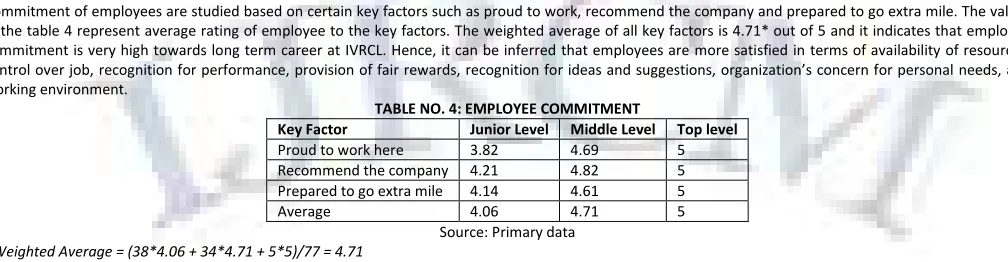
Commitment of employees are studied based on certain key factors such as proud to work, recommend the company and prepared to go extra mile. The values in the table 4 represent average rating of employee to the key factors. The weighted average of all key factors is 4.71* out of 5 and it indicates that employee commitment is very high towards long term career at IVRCL. Hence, it can be inferred that employees are more satisfied in terms of availability of resources, control over job, recognition for performance, provision of fair rewards, recognition for ideas and suggestions, organization’s concern for personal needs, and working environment.
TABLE NO. 4: EMPLOYEE COMMITMENT
Key Factor Junior Level Middle Level Top level
Proud to work here 3.82 4.69 5
Recommend the company 4.21 4.82 5
Prepared to go extra mile 4.14 4.61 5
Average 4.06 4.71 5
Source: Primary data
*Weighted Average = (38*4.06 + 34*4.71 + 5*5)/77 = 4.71
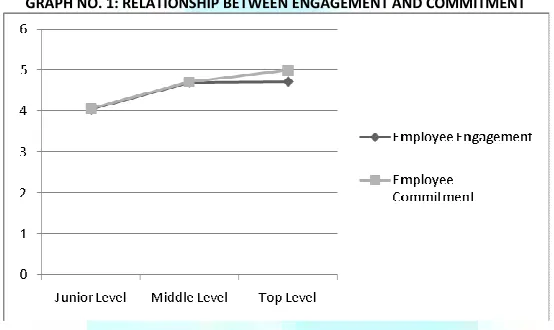
RELATIONSHIP BETWEEN EMPLOYEE ENGAGEMENT AND COMMITMENT
Hypothesis: There is significant relationship between employee engagement and commitment.
TABLE NO. 5: CORRELATION BETWEEN EMPLOYEE ENGAGEMENT AND COMMITMENT Job Position Employee Engagement Employee Commitment
Junior Level 4.04 4.06
Middle Level 4.70 4.71
Top Level 4.72 5
Source: primary data
TABLE NO. 6: CALCULATION OF KARL PEARSON’S COEFFICIENT OF CORRELATION Engagement
(X)
Commitment (Y)
x y x2 y2 xy
4.04 4.06 -0.45 -0.53 0.2025 0.2809 0.2385
4.7 4.71 +.21 +0.12 0.0441 0.0144 0.0252
4.72 4.72 +0.23 +0.41 0.0529 0.1681 0.0943
4.49 4.59 -0.01 0 0.2995 0.4634 0.358
Source: Primary data
By applying Karl Pearson’s Coefficient of correlation, r = 0.96. Therefore, the correlation between engagement and commitment is high. So, the hypothesis is accepted. Hence, it is proved that there is significant relationship between employee engagement and commitment.
GRAPH NO. 1: RELATIONSHIP BETWEEN ENGAGEMENT AND COMMITMENT
FINDINGS
• Employees at all positions in the organization irrespective of gender feel engaged in their jobs and are proud of the organization and its values.
• In junior level male employees are more engaged than female; in middle level female employees are more engaged than male.
• The degree of the employee engagement by junior level is 81.06%, middle level 87.94% and by top level is 90.8%.
• Employee job satisfaction is very high at IVRCL.
• All top level employees are fully committed towards long term career at IVRCL.
• Approximately 87% of the employees are committed to long term career at IVRCL.
• IVRCL Infrastructures and Projects Limited employees’ commitment is very high in terms of proud to work, recommends the company and prepared to go
extra mile for organizational success.
• There is a strong positive correlation between employee engagement and commitment among top level employees than the middle and junior level.
CONCLUSION
Employees at all levels in the organization irrespective of gender feel engaged in their jobs and are proud of the organization and its values i.e., employee engagement is high at IVRCL. The correlation between employee engagement and commitment is very high (r = 0.96). Hence, there is a strong positive relationship between employee engagement and commitment.
REFERENCES
• Deepak D.L. and Siva Prasad B, Configuring Higher Performance through Employee Engagement, The IASMS Journal of Business Spectrum, 2, 53-61.
• Csikszentmihalyi, Mihaly (1975). Beyond Boredom and Anxiety: Experiencing Flow in Work and Play, San Francisco: Jossey-Bass. ISBN 0-87589-261-2.
• Csikszentmihalyi, Mihaly (1990). Flow: The Psychology of Optimal Experience. New York: Harper and Row. ISBN 0-06-092043-2.
• Gallup Organization, Building a Stronger Workplace: Managers Workbook, 1992-1998, 15.
• Hyun Jeong Kim, Kang Hyun Shin and Nancy Swanger (2009), Burnout and Engagement: A comparative analysis using the big five personality dimensions,
International Journal of Hospitality Management 28, 96-104.
• Khan, W.A. (1990). “Psychological Conditions of Personal Engagement and Disengagement at Work”. Academy of Management Journal, Vol. 33, No. 4,
1990, p 692-794.
• Peter R. Garber, 50 Activities for Employee Engagement, HRD press, 2007.
• Robinson, Perryman and Hayday, IES Report, 408 (2004). The IES is an independent centre for research and consultancy on human resource issues
REQUEST FOR FEEDBACK
Dear Readers
At the very outset, International Journal of Research in Commerce, IT and Management (IJRCM)
acknowledges & appreciates your efforts in showing interest in our present issue under your kind perusal.
I would like to request you to supply your critical comments and suggestions about the material published
in this issue as well as on the journal as a whole, on our E-mails i.e.
or
for further improvements in the interest of research.
If you have any queries please feel free to contact us on our E-mail
.
I am sure that your feedback and deliberations would make future issues better – a result of our joint
effort.
Looking forward an appropriate consideration.
With sincere regards
Thanking you profoundly
Academically yours
Sd/-