VOLUME NO. 1 (2011), ISSUE NO. 6 (NOVEMBER) ISSN2231-5756
I
I
I
N
N
N
T
T
T
E
E
E
R
R
R
N
N
N
A
A
A
T
T
T
I
I
I
O
O
O
N
N
N
A
A
A
L
L
L
J
J
J
O
O
O
U
U
U
R
R
R
N
N
N
A
A
A
L
L
L
O
O
O
F
F
F
R
R
R
E
E
E
S
S
S
E
E
E
A
A
A
R
R
R
C
C
C
H
H
H
I
I
I
N
N
N
C
C
C
O
O
O
M
M
M
M
M
M
E
E
E
R
R
R
C
C
C
E
E
E
,
,
,
I
I
I
T
T
T
A
A
A
N
N
N
D
D
D
M
M
M
A
A
A
N
N
N
A
A
A
G
G
G
E
E
E
M
M
M
E
E
E
N
N
N
T
T
T
A Monthly Double-Blind Peer Reviewed Refereed Open Access International e-Journal - Included in the International Serial Directories
Indexed & Listed at: Ulrich's Periodicals Directory ©, ProQuest, U.S.A., Index Copernicus Publishers Panel, Poland, Open J-Gage, India
C
C
C
CONTENTS
ONTENTS
ONTENTS
ONTENTS
Sr.
No.
TITLE & NAME OF THE AUTHOR (S)
Page No.
1
.
A POLICY FRAMEWORK FOR MANAGING DIVERSITY IN THE DEPARTMENT OF THE PREMIER OF THE WESTERN CAPE PROVINCIAL GOVERNMENTDESMOND VAN DER WESTHUIZEN, DR. SHAUN PEKEUR & MOHAMED SAYEED BAYAT
1
2
.
OPPORTUNITIES OF TOURISM SECTOR IN BANGLADESHMD. ZAHIR UDDIN ARIF, MD. NAZRUL ISLAM & MD. SHAFIQUL ISLAM
10
3
.
AN EMPIRICAL BIVARIATE CASE STUDY ON ASSOCIATIONS BETWEEN SELECT FACTORS CONCERNING POST GRADUATE STUDENTS AND THEIR ACADEMIC PERFORMANCENIRAJ MISHRA & PREETI SHRIVASTAVA
18
4
.
A STUDY ON THE RELATIONSHIP BETWEEN CORPORATE FINANCIAL PERFORMANCE AND CORPORATE SOCIAL RESPONSIBILITY (CSR)ALIYAR MOHAMED SHEHAM & DR. ATHAMBAWA JAHFER
25
5
.
FACTORS RELATED TO THE PERFORMANCE OF LOW COST ELECTRONIC PRODUCTS IN BANGLADESHMD. RIFAYAT ISLAM
32
6
.
EMPLOYEE SATISFACTION: A CASE STUDY OF A LEADING MULTINATIONAL TELECOMMUNICATION COMPANY IN BANGLADESHDR. TAIMUR SHARIF & SELINA AKTER
36
7
.
EFFECT OF FAMILY CONTROL AND INTERNAL AUDITOR ON ACCURAL ITEMS OF OPERATIONAL ACCOUNTING (GIULI AND HIN CCONSERVATIVE MODEL)MOHAMADREZA ABDOLI
45
8
.
THE EFFECT OF INTELLECTUAL CAPITAL ON THE ORGANIZATIONAL PERFORMANCEDR. AMIR HOSSEIN AMIRKHANI, SAYD MEHDI VEISEH, MEYSAM ERTEGHAEI & HAMIDEH SHEKARI
49
9
.
TEACHER STRESS: THE SOURCES OF TEACHER STRESS AND THEIR CONSEQUENCESRABIA MUSHTAQ
54
10
.
RETAILING IN INDIA: OPPORTUNITIES & CHALLENGESANIL KUMAR .S. HAGARGI & DR. RAJNALKAR LAXMAN
60
11
.
GROWTH AND SUSTAINABILITY OF INDIAN BANKING SECTORDR. M. L. GUPTA & DR. REKHA GARG
64
12
.
A STUDY ON LOCUS OF CONTROL OF EMPLOYEES IN TEXTILE COMPANIES AT SALEM DISTRICT, TAMILNADUM. GURUSAMY, A. VELSAMY & DR. N. RAJASEKAR
67
13
.
ORGANIZATIONAL EFFECTIVENESS AND SERVICE EFFICIENCY: A COMPARATIVE STUDY SELECT INDIAN BANKSDR. ASHOK AIMA & NAVEEDA SEHER
73
14
.
EMPLOYEE WELFARE ACTIVITIES WITH RESPECTIVE MEASURES IN INDUSTRIAL SECTOR - A STUDY ON INDUSTRIAL CLUSTER AT CHITTOR DISTRICTDR. P. VENUGOPAL, T. BHASKAR & P. USHA
78
15
.
MOTIVATORS AND INHIBITORS OF ONLINE SHOPPING IN HYDERABADMOHD LAYAQ AHAMAD & SHAIKH MOHD ZAFAR
84
16
.
A STUDY ABOUT HEALTH PROBLEMS OF EMPLOYEES WORKING IN IT AND ITES INDUSTRY IN THE ASPECTS OF ERGONOMICSDR. C. S. RAMANI GOPAL & DR. G. PALANIAPPAN
88
17
.
A STUDY ON THE USAGE OF KNOWLEDGE MANAGEMENT PRACTICE IN AVASARALA TECHNOLOGIES LIMITED (ATL)A. MANI MARAN, S. SUNDARAMURTHY REDDY & P. SELVA KUMAR
94
18
.
OUTSOURCING OF HR SERVICES AT ITC MAURYA SHERATON HOTEL & TOWERSRISHI DOGRA & COL K. S. MADAAN
101
19
.
ANALYTICAL STUDY OF ICT SERVICES AND SKILLS IN THE MODERN EDUCATION SYSTEMDHANANJAY MANDLIK, MADHUWANTI SATHE & DR. PARAG KALKAR
106
20
.
A COMPARATIVE STUDY OF ORGANISATIONAL CLIMATE: INDIAN MULTINATIONAL COMPANIES IT EXECUTIVES VS. FOREIGN MULTINATIONALS COMPANIES IT EXECUTIVESANURAG SINGH
110
21
.
FAMILY VS. WORK CONFLICT AMONG WORKING WOMEN IN INDIA WITH SPECIAL REFERENCE TO IT, EDUCATION AND BANKING SECTORA. VANITHA & DR. S. MEENAKUMARI
113
22
.
BANKING PROFESSIONALS AND ATTITUDINAL DIMENSION OF JOB SATISFACTION: A DESCRIPTIVE STUDYS.M. SHARIQ ABBAS
119
23
.
USE OF ICT IN LEARNING OF ENGLISH PRONUNCIATION, GRAMMAR AND VOCABULARY OF SECONDARY SCHOOL STUDENTSRANJIT SINGH
125
24
.
MANAGING CONFLICT THROUGH CONFRONTATION: AN OD INTERVENTIONDR. ARPITA SARANGI
131
25
.
SPONSORSHIP IN CULTURAL AFFAIRS: A NEW ARENATRINANKUR DEY
135
VOLUME NO. 1 (2011), ISSUE NO. 6 (NOVEMBER) ISSN2231-5756
CHIEF PATRON
CHIEF PATRON
CHIEF PATRON
CHIEF PATRON
PROF. K. K. AGGARWAL
Chancellor, Lingaya’s University, Delhi
Founder Vice-Chancellor, Guru Gobind Singh Indraprastha University, Delhi
Ex. Pro Vice-Chancellor, Guru Jambheshwar University, Hisar
PATRON
PATRON
PATRON
PATRON
SH. RAM BHAJAN AGGARWAL
Ex. State Minister for Home & Tourism, Government of Haryana
Vice-President, Dadri Education Society, Charkhi Dadri
President, Chinar Syntex Ltd. (Textile Mills), Bhiwani
CO
CO
CO
CO----ORDINATOR
ORDINATOR
ORDINATOR
ORDINATOR
AMITA
Faculty, E.C.C., Safidon, Jind
ADVISORS
ADVISORS
ADVISORS
ADVISORS
PROF. M. S. SENAM RAJU
Director A. C. D., School of Management Studies, I.G.N.O.U., New Delhi
PROF. M. N. SHARMA
Chairman, M.B.A., Haryana College of Technology & Management, Kaithal
PROF. S. L. MAHANDRU
Principal (Retd.), Maharaja Agrasen College, Jagadhri
EDITOR
EDITOR
EDITOR
EDITOR
PROF. R. K. SHARMA
Dean (Academics), Tecnia Institute of Advanced Studies, Delhi
CO
CO
CO
CO----EDITOR
EDITOR
EDITOR
EDITOR
DR. BHAVET
Faculty, M. M. Institute of Management, Maharishi Markandeshwar University, Mullana, Ambala, Haryana
EDITORIAL ADVI
EDITORIAL ADVI
EDITORIAL ADVI
EDITORIAL ADVISORY BOARD
SORY BOARD
SORY BOARD
SORY BOARD
DR. AMBIKA ZUTSHI
Faculty, School of Management & Marketing, Deakin University, Australia
DR. VIVEK NATRAJAN
Faculty, Lomar University, U.S.A.
DR. RAJESH MODI
Faculty, Yanbu Industrial College, Kingdom of Saudi Arabia
PROF. SANJIV MITTAL
University School of Management Studies, Guru Gobind Singh I. P. University, Delhi
PROF. ANIL K. SAINI
Chairperson (CRC), Guru Gobind Singh I. P. University, Delhi
DR. KULBHUSHAN CHANDEL
Reader, Himachal Pradesh University, Shimla
DR. TEJINDER SHARMA
VOLUME NO. 1 (2011), ISSUE NO. 6 (NOVEMBER) ISSN2231-5756
DR. SAMBHAVNA
Faculty, I.I.T.M., Delhi
DR. MOHENDER KUMAR GUPTA
Associate Professor, P. J. L. N. Government College, Faridabad
DR. SHIVAKUMAR DEENE
Asst. Professor, Government F. G. College Chitguppa, Bidar, Karnataka
MOHITA
Faculty, Yamuna Institute of Engineering & Technology, Village Gadholi, P. O. Gadhola, Yamunanagar
ASSOCIATE EDITORS
ASSOCIATE EDITORS
ASSOCIATE EDITORS
ASSOCIATE EDITORS
PROF. NAWAB ALI KHAN
Department of Commerce, Aligarh Muslim University, Aligarh, U.P.
PROF. ABHAY BANSAL
Head, Department of Information Technology, Amity School of Engineering & Technology, Amity University, Noida
PROF. A. SURYANARAYANA
Department of Business Management, Osmania University, Hyderabad
DR. ASHOK KUMAR
Head, Department of Electronics, D. A. V. College (Lahore), Ambala City
DR. SAMBHAV GARG
Faculty, M. M. Institute of Management, Maharishi Markandeshwar University, Mullana, Ambala, Haryana
DR. V. SELVAM
Divisional Leader – Commerce SSL, VIT University, Vellore
DR. PARDEEP AHLAWAT
Reader, Institute of Management Studies & Research, Maharshi Dayanand University, Rohtak
S. TABASSUM SULTANA
Asst. Professor, Department of Business Management, Matrusri Institute of P.G. Studies, Hyderabad
SURJEET SINGH
Asst. Professor, Department of Computer Science, G. M. N. (P.G.) College, Ambala Cantt.
TECHNICAL ADVISOR
TECHNICAL ADVISOR
TECHNICAL ADVISOR
TECHNICAL ADVISOR
AMITA
Faculty, E.C.C., Safidon, Jind
MOHITA
Faculty, Yamuna Institute of Engineering & Technology, Village Gadholi, P. O. Gadhola, Yamunanagar
FINANCIAL ADVISORS
FINANCIAL ADVISORS
FINANCIAL ADVISORS
FINANCIAL ADVISORS
DICKIN GOYAL
Advocate & Tax Adviser, Panchkula
NEENA
Investment Consultant, Chambaghat, Solan, Himachal Pradesh
LEGAL ADVISORS
LEGAL ADVISORS
LEGAL ADVISORS
LEGAL ADVISORS
JITENDER S. CHAHAL
Advocate, Punjab & Haryana High Court, Chandigarh U.T.
CHANDER BHUSHAN SHARMA
Advocate & Consultant, District Courts, Yamunanagar at Jagadhri
SUPERINTENDENT
SUPERINTENDENT
SUPERINTENDENT
SUPERINTENDENT
VOLUME NO. 1 (2011), ISSUE NO. 6 (NOVEMBER) ISSN2231-5756
CALL FOR MANUSCRIPTS
CALL FOR MANUSCRIPTS
CALL FOR MANUSCRIPTS
CALL FOR MANUSCRIPTS
We
invite unpublished novel, original, empirical and high quality research work pertaining to recent developments & practices in
the area of Computer, Business, Finance, Marketing, Human Resource Management, General Management, Banking, Insurance,
Corporate Governance and emerging paradigms in allied subjects like Accounting Education; Accounting Information Systems;
Accounting Theory & Practice; Auditing; Behavioral Accounting; Behavioral Economics; Corporate Finance; Cost Accounting;
Econometrics; Economic Development; Economic History; Financial Institutions & Markets; Financial Services; Fiscal Policy;
Government & Non Profit Accounting; Industrial Organization; International Economics & Trade; International Finance; Macro
Economics; Micro Economics; Monetary Policy; Portfolio & Security Analysis; Public Policy Economics; Real Estate; Regional
Economics; Tax Accounting; Advertising & Promotion Management; Business Education; Business Information Systems (MIS);
Business Law, Public Responsibility & Ethics; Communication; Direct Marketing; E-Commerce; Global Business; Health Care
Administration; Labor Relations & Human Resource Management; Marketing Research; Marketing Theory & Applications;
Non-Profit Organizations; Office Administration/Management; Operations Research/Statistics; Organizational Behavior & Theory;
Organizational Development; Production/Operations; Public Administration; Purchasing/Materials Management; Retailing;
Sales/Selling; Services; Small Business Entrepreneurship; Strategic Management Policy; Technology/Innovation; Tourism,
Hospitality & Leisure; Transportation/Physical Distribution; Algorithms; Artificial Intelligence; Compilers & Translation; Computer
Aided Design (CAD); Computer Aided Manufacturing; Computer Graphics; Computer Organization & Architecture; Database
Structures & Systems; Digital Logic; Discrete Structures; Internet; Management Information Systems; Modeling & Simulation;
Multimedia; Neural Systems/Neural Networks; Numerical Analysis/Scientific Computing; Object Oriented Programming;
Operating Systems; Programming Languages; Robotics; Symbolic & Formal Logic and Web Design. The above mentioned tracks
are only indicative, and not exhaustive.
Anybody can submit the soft copy of his/her manuscript
anytime
in M.S. Word format after preparing the same as per our
submission guidelines duly available on our website under the heading guidelines for submission, at the email addresses:
or
.
GUIDELINES FOR SUBMISSION OF MANUSCRIPT
GUIDELINES FOR SUBMISSION OF MANUSCRIPT
GUIDELINES FOR SUBMISSION OF MANUSCRIPT
GUIDELINES FOR SUBMISSION OF MANUSCRIPT
1. COVERING LETTER FOR SUBMISSION:
DATED: _____________
THE EDITOR
IJRCM
Subject:
SUBMISSION OF MANUSCRIPT IN THE AREA OF .
(e.g. Computer/IT/Finance/Marketing/HRM/General Management/other, please specify)
.
DEAR SIR/MADAM
Please find my submission of manuscript titled ‘___________________________________________’ for possible publication in your journal.
I hereby affirm that the contents of this manuscript are original. Furthermore, it has neither been published elsewhere in any language fully or partly, nor is it under review for publication anywhere.
I affirm that all author (s) have seen and agreed to the submitted version of the manuscript and their inclusion of name (s) as co-author (s).
Also, if our/my manuscript is accepted, I/We agree to comply with the formalities as given on the website of journal & you are free to publish our contribution to any of your journals.
NAME OF CORRESPONDING AUTHOR:
Designation:
VOLUME NO. 1 (2011), ISSUE NO. 6 (NOVEMBER) ISSN2231-5756
Residential address with Pin Code:
Mobile Number (s):
Landline Number (s):
E-mail Address:
Alternate E-mail Address:
2. INTRODUCTION: Manuscript must be in British English prepared on a standard A4 size paper setting. It must be prepared on a single space and single column with 1” margin set for top, bottom, left and right. It should be typed in 8 point Calibri Font with page numbers at the bottom and centre of the every page.
3. MANUSCRIPT TITLE: The title of the paper should be in a 12 point Calibri Font. It should be bold typed, centered and fully capitalised.
4. AUTHOR NAME(S) & AFFILIATIONS: The author (s) full name, designation, affiliation (s), address, mobile/landline numbers, and email/alternate email address should be in italic & 11-point Calibri Font. It must be centered underneath the title.
5. ABSTRACT: Abstract should be in fully italicized text, not exceeding 250 words. The abstract must be informative and explain the background, aims, methods, results & conclusion in a single para.
6. KEYWORDS: Abstract must be followed by list of keywords, subject to the maximum of five. These should be arranged in alphabetic order separated by commas and full stops at the end.
7. HEADINGS: All the headings should be in a 10 point Calibri Font. These must be bold-faced, aligned left and fully capitalised. Leave a blank line before each heading.
8. SUB-HEADINGS: All the sub-headings should be in a 8 point Calibri Font. These must be bold-faced, aligned left and fully capitalised.
9. MAIN TEXT: The main text should be in a 8 point Calibri Font, single spaced and justified.
10. FIGURES &TABLES: These should be simple, centered, separately numbered & self explained, and titles must be above the tables/figures. Sources of data should be mentioned below the table/figure. It should be ensured that the tables/figures are referred to from the main text.
11. EQUATIONS: These should be consecutively numbered in parentheses, horizontally centered with equation number placed at the right.
12. REFERENCES: The list of all references should be alphabetically arranged. It must be single spaced, and at the end of the manuscript. The author (s) should mention only the actually utilised references in the preparation of manuscript and they are supposed to follow Harvard Style of Referencing. The author (s) are supposed to follow the references as per following:
•
All works cited in the text (including sources for tables and figures) should be listed alphabetically.•
Use (ed.) for one editor, and (ed.s) for multiple editors.•
When listing two or more works by one author, use --- (20xx), such as after Kohl (1997), use --- (2001), etc, in chronologically ascending order.•
Indicate (opening and closing) page numbers for articles in journals and for chapters in books.•
The title of books and journals should be in italics. Double quotation marks are used for titles of journal articles, book chapters, dissertations, reports, working papers, unpublished material, etc.•
For titles in a language other than English, provide an English translation in parentheses.•
The location of endnotes within the text should be indicated by superscript numbers.PLEASE USE THE FOLLOWING FOR STYLE AND PUNCTUATION IN REFERENCES:
BOOKS
•
Bowersox, Donald J., Closs, David J., (1996), "Logistical Management." Tata McGraw, Hill, New Delhi.•
Hunker, H.L. and A.J. Wright (1963), "Factors of Industrial Location in Ohio," Ohio State University.CONTRIBUTIONS TO BOOKS
•
Sharma T., Kwatra, G. (2008) Effectiveness of Social Advertising: A Study of Selected Campaigns, Corporate Social Responsibility, Edited by David Crowther & Nicholas Capaldi, Ashgate Research Companion to Corporate Social Responsibility, Chapter 15, pp 287-303.JOURNAL AND OTHER ARTICLES
•
Schemenner, R.W., Huber, J.C. and Cook, R.L. (1987), "Geographic Differences and the Location of New Manufacturing Facilities," Journal of Urban Economics, Vol. 21, No. 1, pp. 83-104.CONFERENCE PAPERS
•
Garg Sambhav (2011): "Business Ethics" Paper presented at the Annual International Conference for the All India Management Association, New Delhi, India, 19–22 June.UNPUBLISHED DISSERTATIONS AND THESES
•
Kumar S. (2011): "Customer Value: A Comparative Study of Rural and Urban Customers," Thesis, Kurukshetra University, Kurukshetra.ONLINE RESOURCES
•
Always indicate the date that the source was accessed, as online resources are frequently updated or removed.WEBSITE
VOLUME NO. 1 (2011), ISSUE NO. 6 (NOVEMBER) ISSN2231-5756
A STUDY ON THE USAGE OF KNOWLEDGE MANAGEMENT PRACTICE IN AVASARALA TECHNOLOGIES
LIMITED (ATL)
A. MANI MARAN
LECTURER
DEPARTMENT OF BIO-MEDICAL ENGINEERING
RAJIV GANDHI COLLEGE OF ENGINEERING & TECHNOLOGY
PUDUCHERRY
S. SUNDARAMURTHY REDDY
PROFESSOR
DEPARTMENT OF MANAGEMENT STUDIES
RAJIV GANDHI COLLEGE OF ENGINEERING & TECHNOLOGY
PUDUCHERRY
P. SELVA KUMAR
DEPUTY MANAGER
DIVISION OF HEALTH CARE
AVASARALA TECHNOLOGIES LIMITED
PUDUCHERRY
ABSTRACT
This project deals with the “A Study on the Usage of Knowledge Management” in Avasarala Technologies Limited (ATL). The method adopted for collecting the data for this project is primary data. The data mainly deals with the Usage of Knowledge Management towards employees in the organization. This explains two fundamental approaches to knowledge management. The tacit knowledge approach emphasizes understanding the kinds of knowledge that individuals in an organization have, moving people to transfer knowledge within an organization, and managing key individuals as knowledge creators and carriers. By contrast, the explicit knowledge approach emphasizes processes for articulating knowledge held by individuals, the design of organizational approaches for creating new knowledge, and the development of systems (including information systems) to disseminate articulated knowledge within an organization. The relative advantages and disadvantages of both approaches to knowledge management are summarized. A synthesis of tacit and knowledge management approaches is recommended to create a hybrid design for the knowledge management practices in a given organization. We have represented the collected data in the form of tables and diagrammatic representation. The analysis part carried out in this project by using Chi-square test and Correlation through the statistical package SPSS.
KEYWORDS
Chi-square test, Knowledge Management, Tacit Knowledge.
INTRODUCTION
anagers concerned with implementing knowledge management in their organizations today face a number of challenges in developing sound methods for this still emerging area of management practice. Both the growing literature on knowledge management and the advice offered by various knowledge management consultants; however, seem to advocate forms of knowledge management practice that often appear incomplete, inconsistent, and even contradictory. This paper suggests that the current lack of coherence in the diverse recommendations for knowledge management practice results from the fact that the development of both theory and practice in this emerging field is being driven by two fundamentally different approaches to identifying and managing knowledge in organizations.
COMPANY PROFILE
Avasarala was started as a project consultancy company in 1985 to lend technical expertise to the Indian machinery manufacturing industry. In a hope to capitalize the latent potential in this segment, the company forayed into manufacturing in 1986. It began indigenous design, development and fabrication of Special Purpose Process Machinery and Automation Systems for diverse client needs in the global arena.
An in-depth understanding of client needs and aligning processes to meet changing demands enabled Avasarala to emerge as a reliable technical partner to a variety of industries. Leveraging its capabilities as a technically versatile company, it diversified its business interests to allied areas. Today, Avasarala has grown into a diverse corporate entity with an established lead position in niche categories including Engineering Design, Process Machinery, Conveyors & Automation Systems, Electron Guns for picture tubes and CDT, Tungsten Rod, Wire and Powder products, Health Care. Alliances with world leaders in different fields enabled Avasarala to deliver high quality solutions and consistently update its processes to meet evolving demands. In Healthcare, the technical alliance with Ulco Medical helped it stay at the forefront of medical equipment manufacture. Identifying new opportunities for growth has been one of the strong points of Avasarala. Backed by the strength of its in-house R & D capabilities, it set up a non-sag tungsten manufacturing facility in Mysore in 1993. Today, it is the undisputed leader in the category, and its products are exported to USA, Europe and other world markets. Recognitions for the Avasarala’s technical excellence have come from different quarters including. The Govt. of India CSIR award in process industry category. Avasarala's commitment to customer delight is endorsed by its highly energized and motivated employees
VISION & VALUES
VISION
To be a globally recognized organization providing competitive solutions, quality products and services through innovative capabilities.
CORE VALUES & BELIEFS
Abide by fair business practices and customer-satisfaction, Empower employees by encouraging pro-active learning and care for their welfare, Foster continuous improvement, innovation and creativity in products and services through aligned thinking, team spirit and a partnering approach, Lead through inspiration and
VOLUME NO. 1 (2011), ISSUE NO. 6 (NOVEMBER) ISSN2231-5756
thereby deliver consistent quality, Fulfill commitments by always willing to walk the extra mile, Protect and conserve the company's resources with the same zeal, as one would do with personal resources, Attend to any matter pertaining to customers on an immediate basis ,Recognize problems and respond in a positive manner
QUALITY
All the divisions are ISO 9001 - 2000 certified, Healthcare division has CE marking for few of its products, Good House Keeping, Records maintaining & Retrievably of records are supported by practicing 5S, Continuous improvement encouraged by KAIZEN, Machine capability enhanced through TPM, Product Quality ensured by FEM & FMEA, Resonance enhancement & Review methodology for upkeep of QMS, Each of the division is ISO certified and also abides by industry specific norms
QUALITY POLICY OF AVASARALA
The Avasarala Group ensures building customer confidence by providing consistently good quality products and excellence in service through continual improvement of its practices and processes.
QUALITY OBJECTIVE
Continued training of personnel to imbibe quality as a culture among its people, Strictly adhering to the quality manual in all its operations, To be abreast of the latest technology to become innovative, To be a bench mark in customer services and support, To create an excellent work environment and maintain good house keeping
REVIEW OF LITERATURE
KNOWLEDGE MANAGEMENT (KM)
Truthfully, KM doesn’t have one meaning. Everyone defines it differently. But all the varied opinions seem to agree on one thing-KM is capturing what everyone in your department knows. And capturing what everyone in a legal department knows can make the difference between winning and losing a case, or at the very least between spending thousands of dollars and spending millions.
What KM boils down to is finding ways to minimize redundancy, in turn saving time and cutting costs. How a legal department decides to follow through with this initiative depends on a number of factors. But there are some clear steps you must execute well to build a successful process. - BY KEITH ECKER Defining the concept of KM is difficult, since different perspectives of KM can yield different dimensions and meaning. A good KM definition is given by Swan, Scarborough & Preston (1999), who defined it as "any process or practices of creating, acquiring, capturing, sharing and using knowledge, wherever it resides, to enhance learning and Performance in organization."
There are two types of KM 1. Explicit
2. Implicit
Explicit - also referred to as information, this is tangible knowledge.
Example: E-Mails, Status and case updates, Contract and policy templates, Audio content.
Implicit – also referred to as tacit knowledge, this is information stored inside people’s heads.
Example: Expertise in a certain practice area, knowledge about a specific law, knowledge about a specific case.
Knowledge management brings to mind many things to many people. But in a business setting, a practical definition prevails. The basic definition of knowledge management is discussed, as well as those concepts critical to its effective deployment.
This section examines:
The effect of knowledge management, how knowledge management is different from information management, types of knowledge, the knowledge chain and its role in measuring the success of knowledge practice and the basic knowledge management applications.
THE GENERAL KNOWLEDGE MODEL
Knowledge Creation. This comprises activities associated with the entry of new knowledge into the system, and includes knowledge development, discovery and capture.
Knowledge Retention. This includes all activities that preserve knowledge and allow it to remain in the system once introduced. It also includes those activities that maintain the viability of knowledge within the system.
Knowledge Transfer. This refers to activities associated with the flow of knowledge from one party to another. This includes communication, translation, conversion, filtering and rendering.
Transfer of Knowledge improves system quality by providing quick feedback, a variety of alternatives, predictable screen changes, and enhanced customer support.
Knowledge Utilization. This includes the activities and events connected with the application of knowledge to business processes.
KNOWLEDGE AND LEARNING WITHIN A PROJECT
Knowledge has a long established role in theories designed to explain organizations and their performance. In earlier theories it appeared under the guise of "technology." Lately, theorists have given knowledge a more explicit role of its own.
This focus on knowledge derives from several key insights:
• Environmental turbulence (e.g., regulatory and technology changes) has forced many organizations to innovate faster and to operate more efficiently. This pressure requires a focus on continual learning and renewal.
VOLUME NO. 1 (2011), ISSUE NO. 6 (NOVEMBER) ISSN2231-5756
• The means by which organization is effected (lines of authority, integrating committees, etc.) can be conceptualized in terms of knowledge and information processing.
• Knowledge and information have characteristics that distinguish them from other organizational resources, e.g., persistence, negligible cost of duplication, low visibility, and intangibility.
PROTECTION PROCESSES USING KNOWLEDGE MANAGEMENT
Security-oriented knowledge management processes are those designed to protect the knowledge within an organization from illegal or inappropriate use or theft. For a firm to generate and preserve a competitive advantage, it is vital that its knowledge be protected. Similar to application-oriented processes, this has also received little attention in the literature. Many may assume that a firm can protect its knowledge via patents, trademarks, copyrights, and so on. However, not all knowledge can be defined according to property laws and property rights. Because protecting knowledge is inherently difficult, it should not be abandoned or marginalized. Steps can be taken to protect the asset, such as incentive alignment, employee conduct rules, or job designs. In addition, an organization can develop technology that restricts or tracks access to vital knowledge. Irrespective of the difficulty in protecting knowledge, it is a process that is important for an organization. For an asset to be the source of a competitive advantage, it needs to be rare and inimitable. Without security-oriented processes, knowledge loses these important qualities.
KNOWLEDGE MANAGEMENT APPLICATIONS
The four key applications of knowledge management are based on a model that regards knowledge management’s primary role as the sharing of knowledge throughout the organization in a way that each individual or group understands the knowledge with sufficient depth and in sufficient context as to apply it effectively in decision making and innovation.
INTERMEDIATION
Intermediation is the connection between knowledge and people. Intermediation refers to the brokerage function of bringing together those who seek a certain piece of knowledge with those who are able to provide that piece of knowledge. It is a fundamental step in internal and external responsiveness. Its role is to ‘‘match’’ a knowledge seeker with the optimal personal source(s) of knowledge for that seeker. Two types of intermediation are common, asynchronous and synchronous.
Asynchronous intermediation occurs when externalization and internalization do not occur simultaneously. In this case, an external knowledge repository stores the knowledge while it is in transit. Knowledge is captured in the knowledge base, often before a specific need for that knowledge elsewhere in the organization has arisen. When a knowledge seeker requires that knowledge, the knowledge base can be searched and the relevant knowledge extracted. This approach is typically best suited to explicit knowledge.
Synchronous intermediationoccurs when externalization and internalization occur simultaneously. Knowledge is not stored while being transferred. Knowledge provider and knowledge seeker engage in direct communication. The challenge is to match knowledge providers with knowledge seekers intuitively and in a timely manner. This approach is far more common in tacit knowledge transfer.
EXTERNALIZATION
Externalization is the connection of knowledge to knowledge. It refers to the process of capturing knowledge in an external repository and organizing the knowledge according to some classification framework or ontology. A map or structure of the knowledge collection is provided as a facilitator to knowledge discovery. It is focused on bringing order to internal and external awareness.
INTERNALIZATION
Internalization is the connection of knowledge to query. It is the extraction of knowledge from an externalized repository, and filtering it to provide personal relevance to the knowledge seeker. Closely tied to an externalized knowledge base, internalization reshapes the knowledge base specifically to address the focal point of the query issuer.
COGNITION
Cognition is the linking of knowledge to process. It is the process of making or mapping decisions based on available knowledge. Cognition is the application of knowledge that has been exchanged through the preceding three functions. It is a highly proactive form of internal and external responsiveness. In its simplest form, cognition is achieved by applying experience to determine the most suitable outcome to an unprecedented event, opportunity or challenge.
OBJECTIVES & LIMITATIONS
OBJECTIVES OF THE PROJECT
1. To study the best HR practices of Knowledge Management in ATL. 2. Understand the present status of Knowledge Management in ATL. 3. Identify the strengths and weaknesses of Knowledge Management in ATL and also suggest for converting the weaknesses in to strength. 1. To study the employee satisfaction about the supervision in ATL. 2. To create awareness about Knowledge Management and its policies.
LIMITATIONS OF THE PROJECT:
Most of the respondents were uncomfortable in answering many questions in the questionnaire as they were not aware of Knowledge Management.
RESEARCH METHODOLOGY
COLLECTION OF DATA
Collection means the assembling, for the purpose of particular investigation of entirely new data, presumably not already available in published sources. The task of data collection begins after a research problem has been defined and research design plan chalked out. While deciding about the method of data collection to be used for the study, the researcher should keep in mind two types of data viz., Primary data and Secondary data.
The primary data are those, which are collected afresh, and the first time. And thus happen to be original in character.
The secondary data, on the other hand, are those which have already been collected by someone else and which have already been passed through the statistical process.
The method of collecting primary data and secondary data differs, since primary data are collected originally while in case of secondary data the nature of collection work is merely that of compilation.
According to Prof.J.Medhi, “Data is termed primary when the data collected for the first time by the investigation and is termed secondary when the data are taken from records or data already available”.
SOURCES OF PRIMARY DATA
There are several methods of collecting primary data particularly in surveys and descriptive researches. Important ones are: 1. Observation method
2. Interview method 3. Through questionnaires 4. Through schedules
VOLUME NO. 1 (2011), ISSUE NO. 6 (NOVEMBER) ISSN2231-5756
ADVANTAGES OF PRIMARY DATA
1. It addresses the research question. 2. The collection method is known. 3. The exact data needed are collected.
DISADVANTAGES OF PRIMARY DATA
1. Collecting and analysing data can be expensive.
2. Researcher must have the necessary skills to conduct primary research.
SAMPLING METHOD
There are many methods sampling, In that the most widely used method is Convenient Sampling Method. CONVENIENT SAMPLING METHOD
Convenience or opportunistic sampling is the crudest type of non-random sampling. This involves selecting the most convenient group available.
EXAMPLE
Using the first 20 colleagues you see at work.
TABULATION
Tabulation is the process of representing the data collected through survey, experiments, etc in rows and columns so that it can be more easily understood and can be used for further analysis.
A table is a systematic arrangement of statistical data in rows and columns. Rows are horizontal arrangement, whereas columns are vertical ones.
he purpose of a table is to simply the presentation and to facilitate comparisons. The simplification results from the clear cut and systematic arrangements, which enables the reader to quickly locate desired information. Comparison is facilitated by bringing related items of information lose together.
There are number of parts of a table may vary from case to case depending upon the given data. They are number table, title of the table, caption, and body of the table, head note, and footnote. There are two types of table. They are simple, complex tables and general, special purpose tables.
BAR DIAGRAMS
Bar diagram is a popular form of diagrammatic representation. This diagram consists of a series of rectangular bars standing on a common base. The bars are all of equal width and equi spaced. The lengths of the bars are proportional to their magnitude. The comparison among the bars is based only on lengths. This type of diagrams is called one-dimensional diagram. Bar diagrams are of two types:
1. Vertical bar diagrams 2. Horizontal bar diagrams. The bar diagrams can be classified as: 1. Simple bar diagram
2. Multiple bar diagram
3. Component or sub-divided bar diagram 4. Percentage bar diagram
PIE DIAGRAM
A pie diagram is pictorial representation of a statistical data with several sub-divisions in a circular form. Component bar diagrams can also be drawn for such a data. But pie diagram is more appealing to eyes for comparison.
FOR EXAMPLE
The distribution of the revenue (cost, sales, profit, reserve, etc.) of a company can be represented in a pie diagram.
A pie diagram consists of a circle sub-divided into several sectors by radius. The area of the sectors is proportional to the values of the components. In order to draw a pie diagram the different values of the components are expressed in degrees taking the whole value as 3600. A circle is drawn with convenient radius and different sectors are drawn with these angles at the centre. A look at the diagram will be more appealing if different colours are given to different sectors.
TESTING OF HYPOTHESIS
A hypothesis, or more specifically a statistical hypothesis, is some statement about Population parameter or about a population parameter or about a population distribution. If the population is large, there is no way of analyzing the population or of testing the Hypothesis directly. Instead, the hypothesis is tested on the basis of the outcome of a Random sample.
Hypothesis is usually considered as the principal instrument in research its main function is to suggest new experiments and observation. In fact may experiments are carried out with the deliberate object of testing hypothesis. Decision - makers often face situations where in they are interested in testing hypotheses on the basis of available information and then take decisions on the basis of such testing.
The basic concepts in the context of testing of hypothesis need to be explained.
• Null hypothesis &
• Alternative hypothesis
The null hypothesis is generally symbolized as H0 and alternative hypothesis as Ha. The alternative and null hypothesis is chosen before the sample is drawn. Alternative hypothesis is usually the one which one wishes to prove and the null hypothesis is the one which one wishes to disprove. Thus a null hypothesis represents the hypothesis we are trying to reject , and Alternative hypothesis represents all other possibilities . Null hypothesis should always be specific hypothesis. That is, it should not state about or approximately a certain value.
To test a hypothesis means to tell whether or not the hypothesis seems to be valid. In Hypothesis testing the main question is : Weather to accept the null hypothesis or not to Accept the null hypothesis . Procedure for hypothesis testing refers to all those steps that We undertake for making a choice between the two actions . That is, rejection and Acceptance of a null hypothesis. The various steps involved In hypothesis testing can be depicted in the form of a flow chart.
A statistical hypothesis is some statement or assertion about a population or equivalently about the probability distribution characterizing a population, which we want to verify on the basis of information vailable from a sample. If the statistical hypothesis specifies the population completely then it is termed as a simple statistical hypothesis otherwise it is called a composite statistical hypothesis.
CHI-SQUARE DISTRIBUTION
The chi-square test is an important test amongst the several tests of significance developed by Prof. Pearson. Chi-square symbolically written as χ2 is a statistical measure used in the context of sampling analysis for comparing a variance to a theoretical variance. As a non-parametric test, it can be used to determine if categorical data shows dependency or the two classifications are independent. It can also be used to make comparisons between theoretical populations and actual data when categories are used. Thus, the chi-square test is applicable in large number of problems. The square of standard normal varieties is known as chi-square varieties with 1 degree of freedom
Thus if X~N (μ, σ2) then Z=X-μ/σ ~ N (0, 1) and Z2=(X- μ/σ)2 is a chi-square variate with n degrees of freedom. In general if Xi (i=1, 2….n) are n independent normal varieties with mean μ and variance σi2 (i=1, 2….n) then χ2 = Σ (X
i-μi/σi) 2 is a chi-square varieties with n degrees of freedom.
χ2 tests are also used to test of goodness of fit and also as a test of independence in which case it is a non-parametric test.
CHI-SQUARE TEST OF GOODNESS OF FIT
VOLUME NO. 1 (2011), ISSUE NO. 6 (NOVEMBER) ISSN2231-5756
C
o
u
n
t
40
30
20
10
current_status
introduction growth stage
0
not in existence
35
12 3
2
8
34 6
others something that could be beneficial for the organisation it is strategy part of thier business never heard of it
think
It enables us to find if the deviation if the experiment from theory is just by chance. If Oi (i=1,2….n) in set of observed frequencies and Ei is the corresponding set of expected frequencies, then Karl Pearson χ2 is given by
χ2= Σ [(Oi-Ei) 2/Ei] follows chi-square with (n-1) degrees of freedom.
CHI-SQUARE TEST OF INDEPENDENCE
χ2 tests enable us to explain whether or not two attributes are associated. In order that we may apply the chi-square test either as a test of goodness of fit or as a test to judge the significance of association between attributes. It is necessary that the observed as well as theoretical or expected frequencies must be grouped in the same way and the theoretical distribution must be adjusted to give the same total frequency as we find in case of observed distribution χ2 is the calculated as follows:
χ2 = Σ (Oij-Eij)2/Eij where,
Oij- observed frequency of the cell in the i th
row and jth column. Eij- expected frequency of the cell in the ith row and jth column.
If two distribution (Observed and theoretical) are exactly alike, χ2=0; but generally due to sampling error, χ2 is not to zero and as we must know the sampling. Whether or not a calculated value of χ2 is equal to or exceeds the table value, the different between the observed and expected frequencies is taken as significant, but if the table value is more than the calculated value of χ2. Then the difference is considered as not significant.
DATA ANALYSIS & INTERPRETATION
CHART 6.1: CURRENT STATUS OF KNOWLEDGE MANAGEMENT IN ATL
INFERENCE
From the above bar diagram, we interpret that the current status of the knowledge management of ATL is in introduction stage.
CHART 6.2: ROLE OF KNOWLEDGE MANAGEMENT IN ATL
INFERENCE
From the above pie chart, we infer that 34 out of 50 employees are feeling that knowledge management is a strategy part of their business.
CHART 6.3: AGE VS. TIME TAKE FOR AN EMPLOYEE TO GET THE RELEVANT KNOWLEDGE IN ATL
45 and above 36-45
26-35 20-25
Age
14
12
10
8
6
4
2
0
Co
un
t
0 3
10 14
1 3
4 15
week or more a few days
VOLUME NO. 1 (2011), ISSUE NO. 6 (NOVEMBER) ISSN2231-5756
INFERENCE
From the above bar diagram, we infer that the employee gets the relevant knowledge in a week or more in the age group 20-25
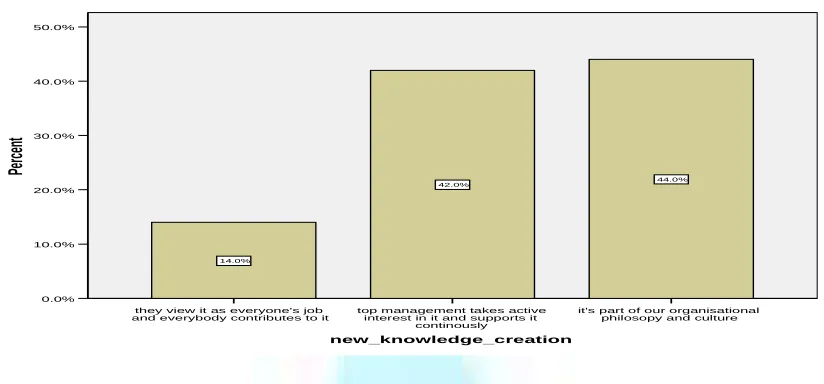
CHART 6.4: ATL WITH RESPECT TO NEW KNOWLEDGE CREATION
it's part of our organisational philosopy and culture top management takes active
interest in it and supports it continously they view it as everyone's job
and everybody contributes to it
new_knowledge_creation
50.0%
40.0%
30.0%
20.0%
10.0%
0.0%
Pe
rc
en
t
44.0% 42.0%
14.0%
INFERENCE
From the above bar diagram, we infer that 44% of the employee thinks that the new knowledge creation is a part of the organizational philosophy and culture.
TABLE 6.5 FREQUENCY TABLE OF HOW EMPLOYEES CAN BE MOTIVATED USING KNOWLEDGE MANAGEMENT
INFERENCE
From the above frequency table, we infer that the employees are motivated good using knowledge management
FINDINGS OF THE STUDY
FINDINGS
There are more male (82%) workers when compared to female (18%), Most of the workers belong to the age group 20-25(58%), The current status of the knowledge management of ATL is in introduction stage, 68% of the employees are feeling that knowledge management is astrategy part of their business, Employees getting relevant knowledge in a week or more in the age group 20-25,Most of the employees are don’t want to leave organization,44% of the employee thinks that the new knowledge creation is a part of the organizational philosophy and culture, In ATL, Gender is independent of facing difficulties in the company, In ATL, Employees are motivated good using knowledge management
CONCLUSION & SUGGESTION
CONCLUSION
Current status of the knowledge management of ATL is in introduction stage, In ATL they think knowledge management as a strategic part of their business, In ATL using knowledge management they satisfy their employees by Providing all necessary facilities, In ATL, employees are motivated good using knowledge management, In ATL, the new knowledge creation is a part of the organizational philosophy and culture. Organizations that have not implemented systematic knowledge management approaches should in most cases begin with tacit knowledge management practices of the type discussed in this chapter. Such practices are relatively inexpensive, fast to implement, and less challenging organizationally than full-blown explicit knowledge management practices, and they often create surprising organizational interest in and energy for developing more extensive knowledge management practices. In any event, implementation of tacit knowledge management practices should be seen and communicated within the organization as only the first step in an evolving management process that will eventually include more formal and systematic explicit knowledge management practices. Achieving some initial organizational successes through use of tacit knowledge practices also helps to build confidence that the much greater organizational demands involved in implementing explicit knowledge management practices will be worth the effort.
SUGGESTION
VOLUME NO. 1 (2011), ISSUE NO. 6 (NOVEMBER) ISSN2231-5756
and implement hybrid knowledge management practices in which explicit knowledge management practices complement and significantly extend their initial tacit knowledge practices.
SCOPE FOR THE STUDY
Since the study is general one, it can be adopted by many organizations, The Suggestion of the study can also be applied to similar project or situation, the study paves a way as a reference for the further study.
REFERENCES
1. Human Resource Management”, Dipak Kumar Bhattacharyya, 2nd edition 2. 2006, Anurag, Gain Publishers, New Delhi.
3. “Statistical methods”,S.P.Gupta, 1998, Sultan Chand & Sons Educational Publishers
4. ”Fundamental of Mathematical Statistics”, S.C.Gupta and V.K.Kapoor, 2003, Sultan Chand & Sons Educational Publishers.
VOLUME NO. 1 (2011), ISSUE NO. 6 (NOVEMBER) ISSN2231-5756
REQUEST FOR FEEDBACK
Dear Readers
At the very outset, International Journal of Research in Commerce, IT and Management (IJRCM)
acknowledges & appreciates your efforts in showing interest in our present issue under your kind perusal.
I would like to request you to supply your critical comments and suggestions about the material published
in this issue as well as on the journal as a whole, on our E-mails i.e.
or
for further improvements in the interest of research.
If you have any queries please feel free to contact us on our E-mail
.
I am sure that your feedback and deliberations would make future issues better – a result of our joint
effort.
Looking forward an appropriate consideration.
With sincere regards
Thanking you profoundly
Academically yours
Sd/-