International Journal of Engineering
J o u r n a l H o m e p a g e : w w w . i j e . i rHydrogen and Ethanol as Potential Alternative Fuels Compared to Gasoline under
Improved Exhaust Gas Recirculation
M. Mardi kolur * a, Sh. Khalilarya a, S. Jafarmadar a, A. Nemati b
a Department of Mechanical Engineering, University of Urmia, Iran
b Department of Mechanical Engineering, Islamic Azad University, Miyaneh Branch, Iran
P A P E R I N F O
Paper history: Received 02 July 2013
Received in revised form 10 September 2013 Accepted 14 September 2013
Keywords: SI Engine Hydrogen Alternative Fuels EGR
Supercharging Emission
A B S T R A C T
In the present study, a computational fluid dynamics (CFD) method has been utilized to investigate the effects of exhaust gas recirculation (EGR) and initial charge pressure using a supercharger on the emissions and performance of a SI engine. This engine is fueled separately by gasoline and two potential alternative fuels, hydrogen and ethanol. The results of simulation are compared to the experimental data. There is a good agreement among the results. The calculations are carried out for EGR ratios between 0%
and 20% and four cases of initial pressure have been mentioned: Pin= 1, 1.2, 1.4, 1.6 bar. The effect of
EGR on NOx emission of hydrogen is more than others while its effect on IMEP of hydrogen is less than
others. From the viewpoints of emission and power, 10% of EGR seems to be the most desirable amount. The most noticeable effect of supercharging is on gasoline unlike hydrogen that seems to be affected the least. The comparison of results shows that hydrogen due to its high heating value and burning without
producing any carbon-based compounds such as HC, CO and CO2 is an ideal alternative fuel compared to
other fuels.
doi:10.5829/idosi.ije.2014.27.03c.13
1. INTRODUCTION1
The strict regulation of environmental laws and the price of oil and its restricted resources, has made the engine manufacturers use other energy resources instead of oil and its products. Alternative fuels are very important since they can be extracted from renewable resources, and their emission levels can be lower than those of traditional fossil-based fuels. Although alternative fuels are not currently widely used in vehicular applications, use of these kinds of fuels is more likely inevitable in the future. The strict environmental laws, the cost of oil and its limited resources, have made the engine manufacturers to think of other energy resources rather than oil and its products. Alternative fuels are obtained from resources other than petroleum. The advantage of these fuels is that they emit less air pollutants in comparison with gasoline and most of them are more economically
1*Corresponding Author Email: [email protected] (M.
Mardi k.)
favorable compared to oil and also they are renewable [1-3].
Ethanol is alcohol fuel produced from fermenting and distilling starch crops, like corn. Ethanol discharges less emission than gasoline [3]. In Brazil, ethanol is widely known as a clean, economic and easily accessible fuel for cars. But engines working with alcohol fuels will undergo a reduction in brake torque and power in comparison with gasoline [3].
Hydrogen (H2) is an appealing alternative energy carrier. Hydrogen is being studied extensively as a fuel for passenger cars. It has the ability to charge fuel cells to power electric motors or be burned in engines. Since hydrogen produces no air pollutants or greenhouse gases in fuel cells and it discharges only nitrogen oxides when burned in engines, it is an ideal replacement for conventional fuels [4, 5]. The potential role of hydrogen in global warming, which nowadays is a hot topic, is insignificant in comparison to hydrocarbon-based fuels. The reason is that combustion of hydrogen produces no carbon-based compounds such as HC, CO, and CO2.
Limited numbers of earlier studies have worked on engine simulation with alternative fuels. A two-zone quasi-dimensional engine model for calculating power and NOx emission was presented by Fagelson et al. [6]. In their work, laminar burning velocity is calculated from a second order reaction with estimated activation energy. Kumar et al. [7] used the same model in order to foretell the performance of a supercharged hydrogen engine. They report an overestimation of the rate of pressure rise that can be a consequence of an overestimation in burning velocity. Ma et al. [8] used Wiebe’s law in a zero-dimensional model. For a varying compression ratio and ignition timing, the optimum cylinder diameter for a fixed equivalence ratio was calculated. The result was that while the portion of fuel in the mixture is large, the cylinder pressure will increase quickly and the thermal efficiency will decline. Verhelst et al. [4] preferred quasi-dimensional model to multi-dimensional one because of a reasonable accuracy and fast computation on PC system. They developed a complete cycle simulation code for SI engine and they looked thoroughly at the turbulent combustion in a hydrogen-fuelled engine. A few comparative studies have been done to show the importance of alternative fuels in comparison with currently used fuels. Nieminen et al. [9] studied he comparative characteristics of gasoline and hydrogen fuelled ICEs. It was found that a hydrogen fuelled ICE had a higher thermal efficiency compared to gasoline fuelled ICE due to less heat rejection during the exhaust stroke, less blow down during the exhaust stroke, combustion taking place closer to TDC and combustion taking place in an closer to isochoric environment and thus, closer to an actual Otto cycle. Intake-air pressure-boosting (supercharging or turbocharging) is an effective and proven strategy for increasing peak engine power in conventional petroleum-fueled IC engines. For hydrogen engines, pressure-boosting is likely necessary to achieve power densities comparable to petroleum-fueled IC engines. Nagalingam et al. [10] worked with a single-cylinder research engine and simulated turbocharged operation by pressurizing inlet air to 2.6 bar. Researchers at the Musashi Institute of Technology turbocharged a liquid-hydrogen, two-stroke diesel engine and tested its performance on the bench and in a vehicle [11]. In early tests of turbocharged hydrogen engines in commercial vehicles, Lynch converted gasoline and diesel engines to spark-ignited hydrogen operation at maximum inlet pressures of 1.5 bar [12]. In another study, substantial development has been brought about by research efforts from BMW. Berckmuller et al. [13] have reported results from a single-cylinder engine supercharged to 1.8 bar that achieves a 30% increase in specific power output compared to a naturally aspirated gasoline
engine. More recently Roy et al. [14] investigated the engine performance and emissions of a supercharged engine fueled by H2 and three other hydrogen-containing gaseous fuels. Maximum thermal efficiency of the engine increased with the increase in H2 content in the fuels, especially in leaner operations, and neat H2 -operation produced the highest thermal efficiency, about 13% higher than other fuels. The emission of CO and HC in neat H2-operation was a few ppm only, which satisfies present, even the future stricter emissions regulations. The maximum NOx emissions with neat H2 -operation were 85-90% lower than other fuels, and the level was 200 ppm or less.
Because of the importance of alternative fuels especially hydrogen as future energy carriers, more studies seem to be required to fully develop these fuels. In this study, the effects of exhaust gas recirculation (EGR) and initial pressure on performance and emission characteristics of a naturally aspirated SI engine fueled separately with gasoline, hydrogen and ethanol have been compared and discussed. In order to do that the engine has been simulated with a three dimensional computational fluid dynamics (CFD) code. The validation results prove that the code has the ability to evaluate performance and emission characteristics of this engine. This model analyzes the engine in a closed cycle through compression, combustion and expansion processes of the engine cycle.
2. NUMERICAL APPROACH
2. 1. Model Description The specifications of a
four cylinder spark ignited Mazda B2000i engine listed on Tables 1, and 2 lists the basic experimental data of exhaust emissions (CO and NOx) [12]. Figure 1 shows the combustion chamber volume designed by Autodesk Inventor v2012 and the numerical grid which its meshing progress has been done by AVL Fire v2010.1, designed in order to model the combustion chamber of the engine and contains a maximum of 70505 cells at IVC. The present resolution was found to give adequately grid independent results. Calculations are carried out on the closed system from intake valve closing (IVC) to exhaust valve opening (EVO).
reaction rate with solving a balanced transport equation for the sub-grid flame surface density. This model clarifies the turbulent combustion problem by detaching the combustion modeling from the analysis of the turbulent flow field. NOx formation model is derived by systematic reduction of multi-step chemistry, which is based on the partial equilibrium assumption of the considered elementary reactions using the extended Zeldovich mechanism [15] describing the thermal nitrous oxide formation.
2. 2. Model Validation In this study a four cylinder
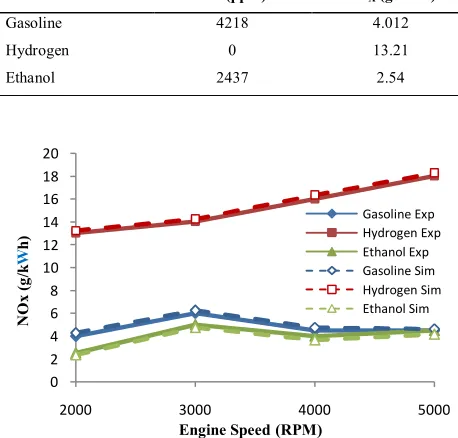
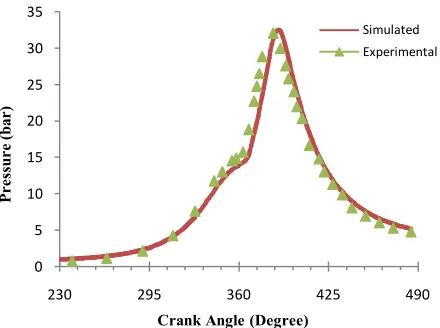
spark ignited Mazda B2000i engine has been simulated with an AVL Fire 3D CFD code and the results have been compared with the corresponding experimental data [12]. Emission comparisons between experimental and simulated results are shown in Figures 2 and 3. Several diagrams for in-cylinder pressure (P) versus crank shaft position (crank angle) were achieved for each one of the fuels. In Figures 4 to 6 the in-cylinder pressure versus crank shaft position are shown for gasoline, hydrogen and ethanol, respectively. The good agreement between measured and predicted data especially during the compression and expansion strokes verifies the results of model. The peak pressures discrepancy between experiment and computation is less than 3%. This verification demonstrates that multidimensional modeling can now be used to gain insight into the combustion process and to provide direction for exploring new engine concepts.
TABLE 1. Engine specifications
Engine type 4 Stroke spark ignition
Induction Naturally aspirated
Number of cylinders Four in line
Bore (mm) 86
Stroke (mm) 86
Compression ratio 8.6
Valves per cylinder 3
Figure 1. 3D moving mesh
3. RESULTS AND DISCUSSIONS
One method of regulating the engine load and decreasing the exhaust nitrogen oxides (NOx) is the use of exhaust gas recirculation (EGR). EGR is a well known in-cylinder method to reduce NOx emissions and offers the possibility to decrease temperature during combustion. The decrease in NOx emissions with the increase of EGR rate is the result of thermal dilution and chemical effects [17]. While in diesel and HCCI engines the use of large quantities of EGR is a common practice [18, 19], in spark-ignition (SI) engines significantly lower EGR rates are used. This is due to the severe decrease of flame speed in these engines.
TABLE 2. Basic experimental emissions data
Fuel\Emission CO (ppm) NOX (g/kWh)
Gasoline 4218 4.012
Hydrogen 0 13.21
Ethanol 2437 2.54
Figure 2. NOx emission comparisons between experimental and simulated results
Figure 3. CO emission comparisons between experimental and simulated results
0 2 4 6 8 10 12 14 16 18 20
2000 3000 4000 5000
Gasoline Exp Hydrogen Exp Ethanol Exp Gasoline Sim Hydrogen Sim Ethanol Sim
Engine Speed (RPM)
N
Ox
(g
/k
W
h)
0 1000 2000 3000 4000 5000 6000 7000
2000 3000 4000 5000
Gasoline Exp Hydrogen Exp Ethanol Exp Gasoline Sim Ethanol Sim
Engine Speed (RPM)
C
O
(pp
Figure 4. Comparison between experimental and simulated data. Fuel: Gasoline, Engine speed: 2000rpm, Fuel/Air equivalence ratio: 0.856, Spark advance: 12 BTDC.
Figure 5. Comparison between experimental and simulated data. Fuel: Hydrogen, Engine speed: 2830rpm, Fuel/Air equivalence ratio: 1.06, Spark advance: 4 BTDC.
Figure 6. Comparison between experimental and simulated data. Fuel: Ethanol, Engine speed: 2500rpm, Fuel/Air equivalence ratio: 1, Spark advance: 28 BTDC.
In this section, the effect of various EGR ratios on performance and emission characteristics of a SI engine fueled with gasoline, hydrogen and ethanol has been studied. In order to do that, the effect of EGR on indicated mean effective pressure (IMEP) and also NOx and CO emissions in a rational range of EGR between 0 to 20% has been investigated.
Figure 7 shows the effect of EGR on NOx emission for different fuels. As can be seen NOx emission for hydrogen fuel is more than the others. This is because of higher combustion temperatures of hydrogen. Also, ethanol form less NOx emissions than the others due to its lower heating value and lower combustion temperature. There are three important parameters for NOx formation: in-cylinder oxygen concentration, the energy that leads to thermal decomposition of oxygen and nitrogen molecules and at last the time needed for reaction of nitrogen and oxygen atoms depending on engine speed. By increasing the EGR rate, the oxygen concentration decreases. Because of increasing the CO2 concentration in the inlet air, the amount of energy consumption for CO2 decomposition increases and less energy remains for thermal decomposition of O2 and N2 molecules. Therefore, by increasing the EGR rate, two important parameters for NOx formation decrease that leads to reduction of NOx formation, as can be seen in Figure 7. Also increasing EGR rate seems to have a similar reducing effect on NOx levels for all fuels. By increasing the EGR rate more than 10%, NOx emission remains approximately constant.
Figure 8 shows the CO emission under various EGR ratios. Carbon to hydrogen ratio of fuel (C/H ratio) is one of the most important parameters which affects the formation of CO. According to Table 3, C/H ratio for gasoline and ethanol is 7.65/15.5 and 1/3, respectively. CO concentration for these fuels as shown in Figure 8 follows from C/H ratio arrangement. As can be seen, as more exhaust gases get re-circulated, CO emission in many cases shows a slight decrease up to 10% of EGR when it hits a turnaround and starts an upward trend that in 15% turns to a substantial surge. This can be explained by the following interpretations. By increasing exhaust gases in the combustion chamber, there will not be adequate amount of oxygen to oxidize CO and form CO2 compounds. Hydrogen though, due to its carbon-free formation produces no carbon-based emissions such as CO, CO2 and HC. But in fact, there is a lubricant oil film on cylinder walls that interact with the flame and produces a negligible amount of CO even with hydrogen fueled engine.
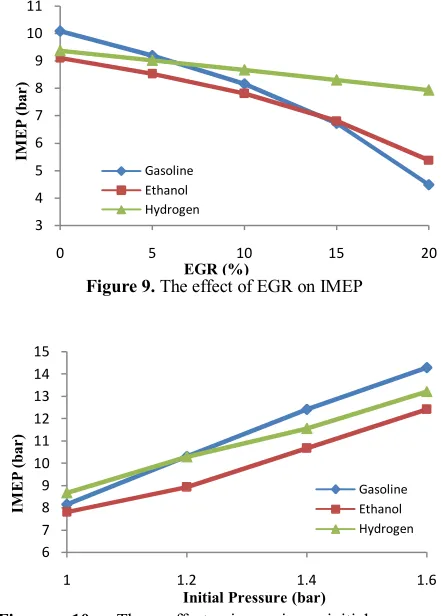
Figure 9 illustrates that an increase in the EGR rates leads to a significant decrease in IMEP. By increasing re-circulated gases, the EGR replaces some of the inlet air and decreases in-cylinder trapped oxygen. This lack
0 5 10 15 20 25 30 35
230 295 360 425 490
P
re
ss
ure
(b
ar)
Simulated Experimental
Crank Angle (Degree)
0 10 20 30 40 50 60
230 295 360 425 490
Simulated Experimental
Crank Angle (Degree)
P
re
ss
ure
(b
ar)
0 5 10 15 20 25 30 35
230 295 360 425 490
P
re
ss
ure
(b
ar)
Simulated Experimental
of oxygen also affects the flame speed and penetration and slows down the combustion rate causing a low in-cylinder pressure at high levels of EGR. Hydrogen even though, because of its higher flame speed and heating value shows the least overall decrease in comparison with the other fuels. According to the results and figures, 10% of EGR seems to be the most desirable amount from the viewpoints of emission and power.
As mentioned before 10% of EGR decreases NOx emission significantly, and CO emission approximately remains constant. This percentage of EGR decreases IMEP and power for all the fuels. The amount of this reduction is different in every case. In this section initial pressure increased to avoid power loss and four cases of initial pressure have been investigated (Pin= 1, 1.2, 1.4, 1.6 bar ) using a supercharger simultaneously with 10% of EGR.
TABLE 3. Fuel properties
Figure 7. The effect of EGR on NOx emission
Figure 8. The effect of EGR on CO emissions
Figure 9. The effect of EGR on IMEP
Figure 10. The effect increasing initial pressure simultaneously with 10% of EGR on IMEP
Supercharging is a straightforward way to increase the power output of SI engines. Figure 10 illustrates that increasing initial pressure has a steadily growing effect on IMEP levels but there is a limiting point for this pressure increase in every engine which after that point unavoidable knocks will occur [20].
In this engine the proper pressure range in which alternative fuels reach their best performance without causing backfire and knocking has been considered between 1.4 to 1.6 bar. The increase of the initial pressure boosts the inlet air and fuel flow rates. Consequently, engine power and IMEP rises significantly. In Figure 11 it is declared that increase of the initial pressure results in growth of the NOx emission. Higher pressure in combustion chamber leads to higher density that results an increase in combustion temperature which leads to a raise in NOx levels. On the other hand, supercharging leads to an increase in oxygen concentration that has a significant effect in NOx formation. Increasing initial pressure means that there will be more oxygen in the combustion chamber. This is the proper condition to form CO2 compounds and avoid forming much more toxic CO compounds (Figure 12).
0 2 4 6 8 10 12 14
0 5 10 15 20
Gasoline Ethanol Hydrogen
EGR (%)
N
Ox
(k
g/k
W
h)
0 1000 2000 3000 4000 5000 6000 7000 8000 9000
0 5 10 15 20
Gasoline Ethanol Hydrogen
EGR (%)
C
O
(pp
m)
3 4 5 6 7 8 9 10 11
0 5 10 15 20
Gasoline Ethanol Hydrogen
EGR (%)
IM
E
P
(b
ar)
6 7 8 9 10 11 12 13 14 15
1 1.2 1.4 1.6
Gasoline Ethanol Hydrogen
Initial Pressure (bar)
IM
E
P
(b
ar)
Fuel Formula LHV (kJ/kg)
Gasoline C7.56H15.5 44.0
Hydrogen H2 120.0
Figure 11. The effect of increasing initial pressure simultaneously with 10% of EGR on NOx emissions
Figure 12. The effect of increasing initial pressure simultaneously with 10% of EGR on CO emissions
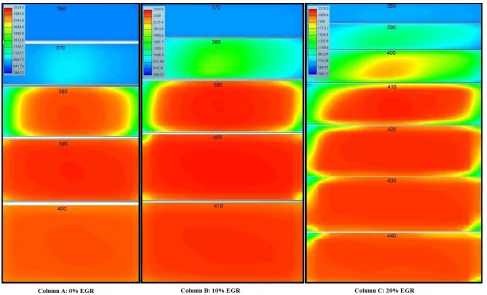
Figure 13.Temperature contours in different crank angles for hydrogen fuel with: (A) 0% EGR, (B) 10% EGR, (C) 20% EGR.
Temperature contours in different crank angles for hydrogen fuel with various percentages of EGR are illustrated in Figure 13. This figure is simply presented to illustrate the decreases in maximum combustion temperatures and flame penetration ranges inside the combustion chamber in different EGR percentages. As
it can be seen, increasing EGR percentage although reduces emission levels but it also decreases flame speed and temperature that leads to a lower IMEP. This circumstance causes a notable shortening in flame penetration radius. The result will appear as more cold areas on cylinder circumference that is one of the important reasons of forming CO compounds.
0 0.5 1 1.5 2 2.5 3 3.5
1 1.2 1.4 1.6
Gasoline Ethanol Hydrogen
Initial Pressure (bar)
N
O
x
(k
g/k
W
h)
0 500 1000 1500 2000 2500 3000 3500 4000
1 1.2 1.4 1.6
Gasoline Ethanol Hydrogen
Initial Pressure (bar)
C
O
(pp
4. CONCLUSION
A numerical investigation utilizing a three dimensional CFD code was applied to study the influence of EGR and initial charge pressure on performance and emissions of a SI engine fueled with two alternative fuels, hydrogen and ethanol. Then, the results were compared with gasoline as the most commonly used fuel in SI engines. The following general conclusions have been drawn from the results of the study:
v By increasing the EGR rate from 0% to 20%, NOx emission decreased significantly but the amount of this decrease between 0% and 10% is more than the amount between 10% and 20% for all fuels. Decreasing effect of the EGR on ethanol fuel’s NOx emission is more than the others.
v In atmospheric initial conditions the effect of EGR between 0% and 10% on the CO emission is negligible, but with further increase in EGR up to 15% and particularly to 20%, CO emission increased sharply. The amount of CO emission in 20% of EGR was approximately twice as much as the case without EGR.
v The results show that an increase in the EGR ratio causes a decline in the indicated mean effective pressure due to lower flame speed and penetration and slower combustion rate. The reduction of IMEP for hydrogen fuel is less than others.
v 10% of EGR has been selected as a proper percentage of EGR because of its excessive reduction in NOx emission and reasonable effect on CO emission and IMEP.
v Supercharging the inlet air led to a significant rise in IMEP because of increased inlet air and fuel flow rates. The growth of IMEP for gasoline fuel is more than others.
v By increasing the initial pressure, NOx emission increased and CO emission decreased. Supercharging has the most noticeable effect on gasoline fuel and the least on hydrogen fuel. v Utilizing EGR and supercharging leads to an
operation that is better than baseline operation condition for all the fuels from the viewpoint of emissions and performance. Undoubtedly this is not the best operation condition. To reach the best operation condition the effect of all of the important parameters such as spark timing, equivalence ratio, compression ratio and etc. must be investigated and an optimized range of operation condition should be found by optimization algorithms such as genetic algorithm. This could be the aim of the future researches.
5. REFERENCES
1. Heywood, J. B., "Internal combustion engine fundamentals",
McGraw-Hill New York, Vol. 930, (1988).
2. A., S., Khtibzade N. and H., S. A., "Performance and emissions
characteristics of a bifuel si engine fueled by cng and gasoline",
ASME paper ICES, (2006).
3. Cordeiro de Melo, T., Machado, G., Machado, R. and Pereira
Belchior, C., "Thermodynamic modeling of compression, combustion and expansion processes of gasoline, ethanol and natural gas with experimental validation on a flexible fuel
engine", Training, (2006), 01-25.
4. Verhelst, S., Sierens, R. and Verstraeten, S., "Development of a
simulation code for hydrogen fuelled si engines", ASME, (2006).
5. Schoenung, S. M., "Hydrogen vehicle fueling alternatives: An
analysis developed for the international energy agency", (2001).
6. Fagelson, J., McLean, W. and De Boer, P., "Performance and
nox emissions of spark ignited combustion engines using
alternative fuels—quasi one-dimensional modeling i. Hydrogen
fueled engines", Combustion Science and Technology, Vol. 18,
No. 1-2, (1978), 47-57.
7. Prabhu Kumar, G., Nagalingam, B. and Gopalakrishnan, K.,
"Theoretical studies of a spark-ignited supercharged hydrogen
engine", International Journal of Hydrogen Energy, Vol. 10,
No. 6, (1985), 389-397.
8. Ma, J., Su, Y., Zhou, Y. and Zhang, Z., "Simulation and
prediction on the performance of a vehicle's hydrogen engine",
International Journal of Hydrogen Energy, Vol. 28, No. 1,
(2003), 77-83.
9. Nieminen, J., D'Souza, N. and Dincer, I., "Comparative
combustion characteristics of gasoline and hydrogen fuelled
ices", International Journal of Hydrogen Energy, Vol. 35, No.
10, (2010), 5114-5123.
10. Nagalingam, B., Dubel, M. and Schmillen, K., Performance of the supercharged spark ignition hydrogen engine., Indian Institute of Technology, Madras. (1983)
11. Furuhama, S. and Fukuma, T., "High output power hydrogen engine with high pressure fuel injection, hot surface ignition and
turbocharging", International Journal of Hydrogen Energy,
Vol. 11, No. 6, (1986), 399-407.
12. Lynch, F., "Parallel induction: A simple fuel control method for
hydrogen engines", International Journal of Hydrogen Energy,
Vol. 8, No. 9, (1983), 721-730.
13. Berckmuller, M., Rottengneber, H. and Eder, A., Potentials of a charged si-hydrogen engine. SAE Paper, (2003), 01-3210. 14. Roy, M. M., Tomita, E., Kawahara, N., Harada, Y. and Sakane,
A., "Comparison of performance and emissions of a supercharged dual-fuel engine fueled by hydrogen and
hydrogen-containing gaseous fuels", International Journal of
Hydrogen Energy, Vol. 36, No. 12, (2011), 7339-7352.
15. Zeldovich, Y., Frank-Kamenetskii, D. and Sadovnikov, P., "Oxidation of nitrogen in combustion", Publishing House of the Acad of Sciences of USSR, (1947).
16. Richard, S., Colin, O., Vermorel, O., Benkenida, A., Angelberger, C., and Veynante, D., "Towards large eddy simulation of combustion in spark ignition engines",
Proceedings of the Combustion Institute, Vol. 31, No. 2,
(2007), 3059-3066.
17. A., M., S., J., J., P. and M., S., "Experimental studying of the effect of egr distribution on the combustion, emissions and
Journal of Engineering Transactions A: Basics, Vol. 26, No. 1, (2013), 73-82.
18. Hountalas, D., Mavropoulos, G. and Binder, K., "Effect of exhaust gas recirculation (egr) temperature for various egr rates on heavy duty di diesel engine performance and emissions",
Energy, Vol. 33, No. 2, (2008), 272-283.
19. Komninos, N. and Rakopoulos, C., "Modeling hcci combustion
of biofuels: A review", Renewable and Sustainable Energy
Reviews, Vol. 16, No. 3, (2012), 1588-1610.
20. Boretti, A. A. and Watson, H. C., "Enhanced combustion by jet ignition in a turbocharged cryogenic port fuel injected hydrogen
engine", International Journal of Hydrogen Energy, Vol. 34,
No. 5, (2009), 2511-2516.
Hydrogen and Ethanol as Potential Alternative Fuels Compared to Gasoline under
Improved Exhaust Gas Recirculation
M. Mardi kolur a, Sh. Khalilarya a, S. Jafarmadar a, A. Nemati b
a Department of Mechanical Engineering, University of Urmia, Iran
b Department of Mechanical Engineering, Islamic Azad University, Miyaneh Branch, Iran
P A P E R I N F O
Paper history: Received 02 July 2013
Received in revised form 10 September 2013 Accepted 14 September 2013
Keywords: SI Engine Hydrogen Alternative Fuels EGR
Supercharging Emission
هﺪﯿﮑﭼ
ﯽﺟوﺮﺧيﺎﻫزﺎﮔﯽﻧارﻮﺧزﺎﺑﺮﺛاﻞﯿﻠﺤﺗياﺮﺑﯽﺗﺎﺒﺳﺎﺤﻣتﻻﺎﯿﺳﮏﯿﻣﺎﻨﯾدﺪﮐﮏﯾزاﻪﻌﻟﺎﻄﻣﻦﯾارد
(EGR)
ﻦﯿﻨﭽﻤﻫو
ﻪﻗﺮﺟلﺎﻌﺘﺷارﻮﺗﻮﻣﮏﯾﯽﮔﺪﻨﯾﻻآودﺮﮑﻠﻤﻋيورﺮﺑرژرﺎﺷﺮﭘﻮﺳﮏﯾﻂﺳﻮﺗرﺪﻨﻠﯿﺳﻪﺑيدوروﻪﯿﻟوارﺎﺸﻓﺮﯿﯿﻐﺗ
هدﺎﻔﺘﺳايا
ﺖﺳاهﺪﺷ
.
هﺪﺷيﺮﯿﮕﺘﺧﻮﺳلﻮﻧﺎﺗاونژورﺪﯿﻫﯽﻨﻌﯾهﻮﻘﻟﺎﺑﻦﯾﺰﮕﯾﺎﺟﺖﺧﻮﺳودوﻦﯾﺰﻨﺑﺎﺑﻪﻧﺎﮔاﺪﺟرﻮﻃﻪﺑرﻮﺗﻮﻣﻦﯾا
ﺖﺳا
.
ﯽﮔﺪﻨﯾﻻآورﺪﻨﻠﯿﺳﻞﺧادرﺎﺸﻓياﺮﺑهﺪﻣآﺖﺳﺪﺑﺞﯾﺎﺘﻧلﺪﻣﯽﺠﻨﺳرﺎﺒﺘﻋارﻮﻈﻨﻣﻪﺑ
هدادﺎﺑﺎﻫ
هﺪﺷﻪﺴﯾﺎﻘﻣﯽﺑﺮﺠﺗيﺎﻫ
ﯽﻣنﺎﺸﻧارﯽﺒﺳﺎﻨﻣﻖﯿﺒﻄﺗﻪﮐ
ﺪﻫد
.
ﻪﻨﻣادياﺮﺑتﺎﺒﺳﺎﺤﻣ
EGR
زا
0 %
ﺎﺗ
20 %
رﺎﺸﻓياﺮﺑﺖﻟﺎﺣرﺎﻬﭼوﺖﺳاهﺪﺷمﺎﺠﻧا
ﺖﺳاهﺪﺷﻪﺘﻓﺮﮔﺮﻈﻧردﻪﯿﻟوا
: Pin= 1, 1.2, 1.4, 1.6 bar
.
ﺮﺛا
EGR
هﺪﻨﯾﻻآﺮﺑ
NOx
ﺖﺧﻮﺳﻪﯿﻘﺑزاﺶﯿﺑنژورﺪﯿﻫ
ﺎﻫ
ﺮﺑنآﺮﺛاﻪﮐﯽﻟﺎﺣردهدﻮﺑ
IMEP
ﺖﺳاﻪﯿﻘﺑزاﺮﺘﻤﮐنژورﺪﯿﻫ
.
،ترﺪﻗوﯽﮔﺪﻨﯾﻻآهﺎﮔﺪﯾدزا
10 %
EGR
ﻮﻠﻄﻣ ب ﻦﯾﺮﺗ
ﯽﻣراﺪﻘﻣ
ﺪﺷﺎﺑ
.
ﯽﻣﻦﯾﺰﻨﺑيورﺮﺑندﺮﮐژرﺎﺷﺮﭘﻮﺳﻪﺟﻮﺗﻞﺑﺎﻗﺮﺛاﻦﯾﺮﺘﺸﯿﺑ
ﻪﺘﺷادﺮﺑارﺮﺛاﻦﯾﺮﺘﻤﮐﻪﮐنژورﺪﯿﻫفﻼﺧﺮﺑﺪﺷﺎﺑ
ﺖﺳا
.
ﯽﻣنﺎﺸﻧﺞﯾﺎﺘﻧﻪﺴﯾﺎﻘﻣ
ﺪﯿﻟﻮﺗنوﺪﺑقاﺮﺘﺣاوﻻﺎﺑﯽﺗراﺮﺣشزراﺎﺑكﺎﭘيژﺮﻧاﻞﻣﺎﺣﮏﯾناﻮﻨﻋﻪﺑنژورﺪﯿﻫﻪﮐﺪﻫد
ﺪﻨﻧﺎﻣﻦﺑﺮﮐﺎﺸﻨﻣزاﯽﺗﻻﻮﺼﺤﻣ
CO2
،
CO
و
HC
ﺖﺧﻮﺳﺎﺑنﺪﺷﻦﯾﺰﮕﯾﺎﺟﯽﯾﺎﻧاﻮﺗ
درادارلواﺪﺘﻣيﺎﻫ
.