Effect of
β
-blockade on lung function,
exercise performance and dynamic
hyperin
fl
ation in people with arterial
vascular disease with and without
COPD
Angela Key,1,2Matthew Parry,1,2Malcolm A West,2,3,4 Rebecca Asher,5 Sandy Jack,2,6,7Nick Duffy,1,2 Francesco Torella,3,8Paul P Walker1,2,3
To cite:Key A, Parry M,
West MA,et al. Effect ofβ -blockade on lung function, exercise performance and dynamic hyperinflation in people with arterial vascular disease with and without COPD.BMJ Open Resp Res 2017;4:e000164.
doi:10.1136/bmjresp-2016-000164
Received 21 September 2016 Accepted 31 January 2017
For numbered affiliations see end of article.
Correspondence to Dr Paul P Walker; ppwalker@ liv.ac.uk
ABSTRACT
Introduction:βBlockers are important treatment for ischaemic heart disease and heart failure; however, there has long been concern about their use in people with chronic obstructive pulmonary disease (COPD) due to fear of symptomatic worsening of
breathlessness. Despite growing evidence of safety and efficacy, they remain underused. We examined the effect ofβ-blockade on lung function, exercise performance and dynamic hyperinflation in a group of vascular surgical patients, a high proportion of who were expected to have COPD.
Methods:People undergoing routine abdominal aortic aneurysm (AAA) surveillance were sequentially recruited from vascular surgery clinic. They completed plethysmographically measured lung function and incremental cardiopulmonary exercise testing with dynamic measurement of inspiratory capacity while taking and not takingβblocker.
Results:48 participants completed tests while taking and not takingβblockers with 38 completing all assessments successfully. 15 participants (39%) were found to have, predominantly mild and undiagnosed, COPD. People with COPD had airflow obstruction, increased airway resistance (Raw) and specific conductance (sGaw), static hyperinflation and dynamically hyperinflated during exercise. In the whole group,β-blockade led to a small fall in FEV1 (0.1 L/ 2.8% predicted) but did not affect Raw, sGaw, static or dynamic hyperinflation. No difference in response to
β-blockade was seen in those with and without COPD.
Conclusions:In people with AAA,β-blockade has little effect on lung function and dynamic hyperinflation in those with and without COPD. In this population, the prevalence of COPD is high and consideration should be given to case finding with spirometry.
Trial registration number:NCT02106286.
INTRODUCTION
β Blockers represent an important treatment for heart failure and have been shown to reduce mortality and symptoms.1In addition,
β blockers are an important part of treat-ment postmyocardial infarction (MI) where again they are associated with reduced mor-tality including in people with chronic obstructive pulmonary disease (COPD).2 However, there has long been concern that β blockers may worsen lung function3 and could be associated with increased mortality in people with severe COPD.4 Heart failure guidelines recommend their use stating that COPD is not a contraindication to β-blockade5 and a body of evidence now exists suggesting that cardioselective β block-ers are not detrimental to people with COPD rather their prescription is associated with a survival benefit post-MI,6 in chronic heart failure7 and overall.8 There is also a sug-gestion that the use of β blockers is asso-ciated with fewer disease exacerbations.8–11 However, it is clear thatβblockers are still un-derused in people with COPD12 because of fears of worsening lung function, associated with increased symptoms, secondary to para-sympathetic bronchoconstriction.
A number of studies, using a variety of car-dioselective and non-carcar-dioselective β block-ers, have assessed the short-term effect of β-blockade on FEV1 and meta-analyses show no effect or small, but relatively insig-nificant, falls in FEV1.13 14 However, most studies report the effect ofβblockers on spir-ometry only and there is a lack of data on other lung function measures, in particular body plethysmographic data. To the best of our knowledge, only one prospective study has examined the effect of β blockers on dynamic hyperinflation and peak exercise capacity.15 This is important because there is a relatively weak relationship between FEV1, symptoms and exercise capacity, in people
copyright.
on September 18, 2020 by guest. Protected by
with COPD, which may explain the reluctance to pre-scribe. Moreover, it is recognised that COPD is under-diagnosed16 and this may contribute to reluctance to useβblockers in long-term cigarette smokers.
We have recently published a study examining the effect of perioperative β-blockade on cardiopulmonary exercise performance in people with abdominal aortic aneurysm (AAA) awaiting surgery.17We showed improve-ment in exercise performance when people were taking β blockers. As a‘real life’study, a significant number of participants had (mainly undiagnosed and relatively mild) COPD. As part of this study, we examined the effect of β-blockade on lung function, including body plethysmography and dynamic hyperinflation, during exercise testing. We hypothesised that β-blockade would have little effect on these parameters in the overall group, but there would be a greater effect on airway resistance, specific conductance and dynamic hyperinfl a-tion in those participants with COPD.
METHODS Participants
Between April 2012 and August 2013, participants were recruited from a cohort attending our vascular labora-tory for routine AAA surveillance (<5.5 cm aneurysm). We approached all patients >18 years who were able to perform a cardiopulmonary exercise test (CPET) and excluded patients who had a known contraindication to β blockers, severe ischaemic heart disease, stage IV–V chronic kidney disease, uncontrolled hypertension, those unable to consent and absolute contraindications to CPET based on the ATS/ACCP guidelines.18 Participants were neither selected for the presence or absence of COPD nor use of β blockers. Written informed consent was obtained from all patients.
Study design
Patients were divided into two groups based on whether they were normally taking β blockers (chronic β block-ade) or not (acute β blockade). All patients completed the study protocol both ‘on’ and ‘off’ β blockers. Patients already takingβblockers completed tests at visit 1 taking their usual prescription and repeated tests at visit 2 having stopped β blocker for at least 7 days. Patients not normally taking β blockers completed tests at visit 1 ‘off’ β blockers and then started bisoprolol, a cardioselective β blocker, once daily—1.25 mg if weight 50–75 kg, 2.5 mg if 76–100 kg and 3.75 mg if 101 kg or heavier. Doses were not titrated to achieve a target heart rate. Participants then repeated tests at visit 2 at least 48 hours after starting bisoprolol. All participants were advised of the potential risks of alteration of their medical therapy at the time of consent.
Demographics details and health and medication information was collected. At each visit, participants completed lung function measurements, including spir-ometry, lung volumes, gas transfer and airway resistance
using body plethysmography (Zan Messgerate, nSpire Health 530). The small number of participants already diagnosed with airway disease were asked to omit short-acting bronchodilators for 6 hours and long-short-acting bronchodilators (β-agonists and antimuscarinics) for 12 or 24 hours, according to the bronchodilator taken nor-mally. All measurements were performed according to ERS/ATS guidelines.19 Study participants performed incremental CPET, following a standard protocol, and these results have been published previously.17 Inspiratory capacity (IC) was measured before exercise and then every minute during exercise with a final IC measurement at peak exercise.20Isotime IC was used for analysis. Borg score of breathlessness and leg fatigue was also measured at rest and then every minute during exercise and recovery.21
Assessment of the impact ofβ-blockade on lung func-tion parameters and dynamic hyperinflation (dynamic IC measurements) was a predefined study outcome. Subgroup analysis according to the presence or absence of COPD was performed post hoc when it was estab-lished that a significant number of study participants had ( predominantly undiagnosed) COPD.
In the absence of postbronchodilator measures of lung function and to avoid overdiagnosis of COPD in older participants ( particularly men), the diagnosis of COPD was based on a minimum 10 pack years cigarette smoking and a prebronchodilator FEV1/FVC ratio exceeding the lower limit of normal using GLI-2012 equations.22 Airflow obstruction was defined as a stand-ard residual z-score of below−1.64.
Statistical methods
Patient demographics have been summarised as mean (SD) for continuous variables or median (IQR) if non-normal and as frequency (%) for categorical variables. Pair plots were produced for each variable to graphically visualise the difference between on and off measure-ments for each patient and to identify any relationship between the outcome variables and being on/off β blockers for those with normal lung function and those with COPD. Variables were summarised by β blocker status (on/off ) and for normal lung function compared with COPD and a comparison performed using a paired t-test or a Mann-Whitney U-test when non-normal and for categorical variables using aχ2test or a Fisher’s exact test when cell frequencies were insufficient. A p value of <0.05 was considered significant.
Study power was based on change in VO2 peak at anaerobic threshold (AT) which was the primary outcome in our previous publication17 where we esti-mated that 32 patients were required to detect a 10% difference in VO2 at AT with 90% power and allowing for 25% drop out. Separate study power was not calcu-lated for the outcomes described here. All statistical ana-lyses were performed using Stata V.13 (StataCorp., 2013. Stata Statistical Software: release 13.College Station).
copyright.
on September 18, 2020 by guest. Protected by
RESULTS
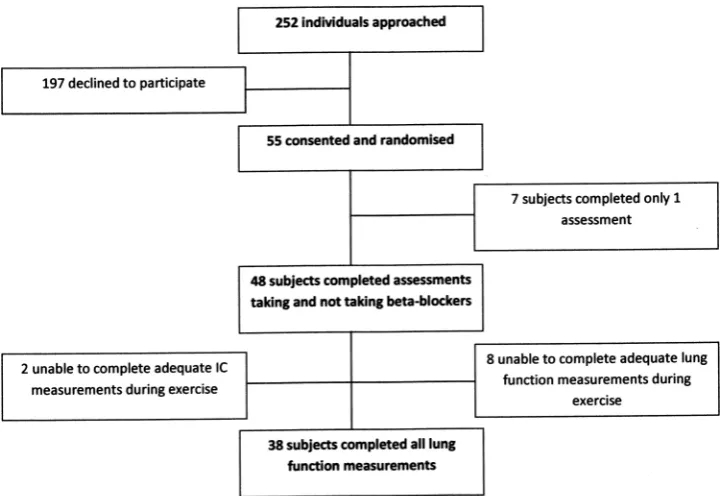
We screened 252 participants, 55 completed the first assessment but 7 people then dropped out leaving 48 who completed both visits. No participant dropped out due to symptoms possibly or likely related toβ-blockade —five performed the first test taking β blockers but all were taking them long term and two performed thefirst test not takingβblockers. From these 48 patients, 2 were unable to perform IC at peak exercise reliably and a further 8 did not produce guideline defined lung func-tion tests, so were excluded from this analysis leaving 38 participants. This is shown in figure 1. Six participants already had a diagnosis of COPD.
From the 38 patients that completed all study methods, 16 patients were already taking β blockers (chronic group) and 22 were not taking β blockers (acute group). Patients in the chronic group were taking bisoprolol (8 participants), atenolol (5), propranolol (1), carvedilol (1) and metoprolol (1) for hypertension (9 participants), ischaemic heart disease (5) and atrial
fibrillation (1) with the indication being unclear in one participant. The CPET results have been published previously.17
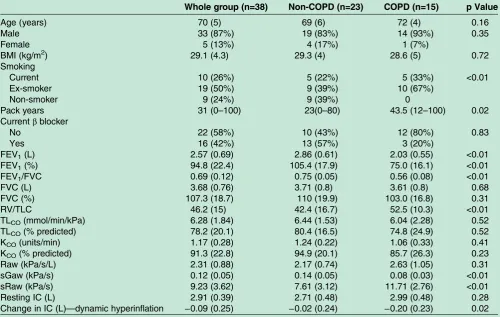
Baseline characteristics of the whole group (n=38) and split into those with (n=15) and without (n=23) COPD are shown in table 1. The lung function para-meters presented were recorded at the visit off β block-ers. There were no significant differences between the COPD group and non-COPD group in age, gender, height, weight or BMI. As expected, there were signifi -cant differences in smoking and pack years. People with COPD not only had a lower FEV1 and greater airflow obstruction but were also more hyperinflated, had lower airway specific conductance and showed dynamic
hyperinflation with exercise (a significant fall in IC at peak exercise).
Effect ofβblocker
Significantβ blockade was achieved with a fall in heart rate by 18 bpm.
The effect of β-blockade on cardiorespiratory para-meters is shown intable 2.β-Blockade led to a small but significant fall in FEV1 in the whole group by a mean 100 mL (2.8% of predicted value), but there was no further significant change in any other lung function measure.
There was no difference in the effect of β-blockade according to whether the β blocker was already pre-scribed (chronic group) or not normally prepre-scribed (acute group).
Effect ofβblocker according to COPD status
In this unselected group, we found 15 people had COPD. Six were previously diagnosed (3 already treated with a β blocker) and 9 newly diagnosed (3 already treated with aβblocker).
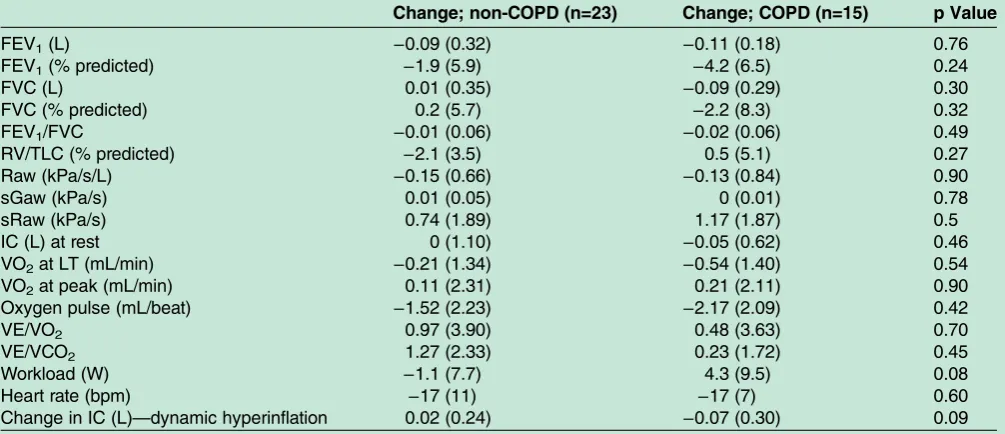
There was no difference in the effect ofβ-blockade on lung function or dynamic hyperinflation when patients with COPD were compared with those without COPD as shown intable 3. In particular, the small change seen in FEV1 was seen in people with and without COPD. Only the COPD participants showed a fall in IC with exercise (dynamic hyperinflation) and β-blockade had no signifi -cant impact on this.
No significant difference was seen in peak exercise measures when the COPD and non-COPD groups were compared.
Figure 1 Consort diagram describing study flow.
copyright.
on September 18, 2020 by guest. Protected by
DISCUSSION
We have shown that β-blockade has a minimal effect on lung function and dynamic hyperinflation, in vascular surgical patients, regardless of the presence of mild to moderate COPD. Combined with our published cardio-pulmonary exercise testing results,17 this provides further reassurance that the use of β blockers remains safe in people with COPD. The high prevalence of COPD suggests that vascular surgical clinics may repre-sent a good place for COPD case finding using spirometry.
It is known that bronchodilators, including β-agonists, produce relatively rapid relaxation of airway smooth muscle and improve expiratory flow rate, but it is ques-tionable whether this is the mechanism by which they act in people with COPD where the prominent abnor-malities are increased peripheral resistance and loss of lung elastic recoil.23 In COPD patients, β-agonists have been shown to reduce tidal inspiratory resistance,24 but their main effect is by reducing end-expiratory lung volume which allows the individual to exercise for longer before they reach a critical and exercise limiting inspiratory reserve volume.25Hence, drugs that antagon-ise airway β receptors and consequently reduce airway
calibre through their effect on airway smooth muscle may have little effect on measures of airway function in COPD patients as this is not predominantly determined by airway smooth muscle. Our results are consistent with this. There was a small effect on expiratory flow mea-sured by FEV1, which is consistent with previous studies,14 but no effect on airflow assessed by FEV1/ FVC. Airway resistance and specific conductance were unchanged, something which has not been published previously, and β-blockade did not lead to a significant change in end-expiratory lung volume and magnitude of dynamic hyperinflation during exercise. These results are consistent with the minimal impact of perioperative β-blockade on cardiopulmonary exercise parameters, despite the high proportion of people with COPD in the study.17
The study was designed, and powered, to establish the effect of β-blockade on exercise parameters at AT and peak ventilation.17 Participants were not selected because they had COPD. The high prevalence of COPD was higher than expected and exceeded 50% if only current or ex-smokers were considered, so provided an opportunity to compare the response to β-blockade of people with COPD compared with a non-COPD Table 1 Patient demographics and lung function recorded when they were not takingβblockers in the 38 participants and split according to the presence or absence of chronic obstructive pulmonary disease
Whole group (n=38) Non-COPD (n=23) COPD (n=15) p Value
Age (years) 70 (5) 69 (6) 72 (4) 0.16
Male 33 (87%) 19 (83%) 14 (93%) 0.35
Female 5 (13%) 4 (17%) 1 (7%)
BMI (kg/m2) 29.1 (4.3) 29.3 (4) 28.6 (5) 0.72
Smoking
Current 10 (26%) 5 (22%) 5 (33%) <0.01
Ex-smoker 19 (50%) 9 (39%) 10 (67%)
Non-smoker 9 (24%) 9 (39%) 0
Pack years 31 (0–100) 23(0–80) 43.5 (12–100) 0.02
Currentβblocker
No 22 (58%) 10 (43%) 12 (80%) 0.83
Yes 16 (42%) 13 (57%) 3 (20%)
FEV1(L) 2.57 (0.69) 2.86 (0.61) 2.03 (0.55) <0.01
FEV1(%) 94.8 (22.4) 105.4 (17.9) 75.0 (16.1) <0.01
FEV1/FVC 0.69 (0.12) 0.75 (0.05) 0.56 (0.08) <0.01
FVC (L) 3.68 (0.76) 3.71 (0.8) 3.61 (0.8) 0.68
FVC (%) 107.3 (18.7) 110 (19.9) 103.0 (16.8) 0.31
RV/TLC 46.2 (15) 42.4 (16.7) 52.5 (10.3) <0.01
TLCO(mmol/min/kPa) 6.28 (1.84) 6.44 (1.53) 6.04 (2.28) 0.52
TLCO(% predicted) 78.2 (20.1) 80.4 (16.5) 74.8 (24.9) 0.52
KCO(units/min) 1.17 (0.28) 1.24 (0.22) 1.06 (0.33) 0.41
KCO(% predicted) 91.3 (22.8) 94.9 (20.1) 85.7 (26.3) 0.23
Raw (kPa/s/L) 2.31 (0.88) 2.17 (0.74) 2.63 (1.05) 0.31
sGaw (kPa/s) 0.12 (0.05) 0.14 (0.05) 0.08 (0.03) <0.01
sRaw (kPa/s) 9.23 (3.62) 7.61 (3.12) 11.71 (2.76) <0.01
Resting IC (L) 2.91 (0.39) 2.71 (0.48) 2.99 (0.48) 0.28
Change in IC (L)—dynamic hyperinflation −0.09 (0.25) −0.02 (0.24) −0.20 (0.23) 0.02 Results are shown as mean±SD with the exception of pack years which is presented as mean (range).
FEV1, forced expiratory volume in 1 s; FVC, forced vital capacity; IC, inspiratory capacity; KCO, transfer coefficient for carbon monoxide; Raw, airway resistance; RV, residual volume; sGaw, specific airway conductance; sRaw, specific airway resistance; TLC, total lung capacity; TLCO, diffusing capacity for carbon monoxide.
copyright.
on September 18, 2020 by guest. Protected by
population. It is striking that no difference in group response was seen in any measure of lung function. The majority of people had mild COPD, but it has been shown previously these individuals have significant venti-latory impairment and gas exchange abnormalities during exercise.26 Our results are consistent with this work and our participants with generally mild COPD showed significant dynamic hyperinflation (IC fell by an average of about 200 mL at peak exercise) and poorer ventilatory function at AT and peak exercise before β-blockade. However, β-blockade did not significantly
worsen this. Ours is only the second study to examine the effect of β-blockade on dynamic hyperinflation in COPD patients and, along with the previous study, has shown no significant impact.15 However, our partici-pants had less severe COPD (FEV1 75% vs 52% pre-dicted) and fall in IC was greater in the previous study probably due to greater disease severity and measure-ment during endurance rather than incremeasure-mental testing. Consequently, although β-blockade did not lead to a significant difference in change in dynamic IC, when comparing participants with and without COPD, we cannot exclude this being apparent in a population with more severe airway disease.
AAA is a recognised comorbidity in people with COPD as is peripheral vascular disease with a prevalence of 7% aged 55 years or younger increasing to 17% in those 65 years or older.27 Six people were diagnosed with COPD but after spirometry, a further nine current or ex-smokers had significant airflow obstruction; a COPD prevalence of 39%. Although we were unable to present full lung function results from a further 10 parti-cipants, they all completed resting spirometry and 21 of the 48 participants in this larger group had airflow obstruction; a COPD prevalence of 44%. This is >50% of only current or ex-smokers are considered. Although our sample size is modest, this figure is higher than many screening studies of high-risk individuals who had chronic respiratory symptoms28 and spirometry screen-ing in our local population29 and provides an oppor-tunity for COPD casefinding.
The study has a number of weaknesses, the foremost of which being that participants were not selected because they had COPD (or cardiac disease including Table 2 Change in lung function and heart rate on and
offβblockers in the whole group of 38 participants
Lung function or heart rate
measurement Change p Value
FEV1(L) −0.10 (0.23) 0.01
FEV1(% predicted) −2.8 (5.9) <0.01
FVC (L) −0.10 (0.28) 0.98
FVC (% predicted) −0.8 (6.7) 0.45 FEV1/FVC −0.01 (0.05) 0.12
RV/TLC (% pred.) −0.8 (9) 0.63 Raw (kPa/s/L) 0.15 (0.67) 0.17
sGaw (kPa/s) 0 (0.03) 0.73
sRaw (kPa/s) 0.91 (1.89) <0.01 Resting IC (L) −0.01 (0.79) 0.96 Change in IC (L)—dynamic
hyperinflation
−0.03 (0.29) 0.5
Heart rate (bpm) −18 (19) <0.01 FEV1, forced expiratory volume in 1 s; FVC, forced vital capacity; IC, inspiratory capacity; Raw, airway resistance; RV, residual volume; sGaw, specific airway conductance; sRaw, specific airway resistance; TLC, total lung capacity.
Table 3 The effect ofβ-blockade on change in lung function, dynamic hyperinflation and peak exercise according to whether the individual had chronic obstructive pulmonary disease
Change; non-COPD (n=23) Change; COPD (n=15) p Value
FEV1(L) −0.09 (0.32) −0.11 (0.18) 0.76
FEV1(% predicted) −1.9 (5.9) −4.2 (6.5) 0.24
FVC (L) 0.01 (0.35) −0.09 (0.29) 0.30
FVC (% predicted) 0.2 (5.7) −2.2 (8.3) 0.32
FEV1/FVC −0.01 (0.06) −0.02 (0.06) 0.49
RV/TLC (% predicted) −2.1 (3.5) 0.5 (5.1) 0.27
Raw (kPa/s/L) −0.15 (0.66) −0.13 (0.84) 0.90
sGaw (kPa/s) 0.01 (0.05) 0 (0.01) 0.78
sRaw (kPa/s) 0.74 (1.89) 1.17 (1.87) 0.5
IC (L) at rest 0 (1.10) −0.05 (0.62) 0.46
VO2at LT (mL/min) −0.21 (1.34) −0.54 (1.40) 0.54
VO2at peak (mL/min) 0.11 (2.31) 0.21 (2.11) 0.90
Oxygen pulse (mL/beat) −1.52 (2.23) −2.17 (2.09) 0.42
VE/VO2 0.97 (3.90) 0.48 (3.63) 0.70
VE/VCO2 1.27 (2.33) 0.23 (1.72) 0.45
Workload (W) −1.1 (7.7) 4.3 (9.5) 0.08
Heart rate (bpm) −17 (11) −17 (7) 0.60
Change in IC (L)—dynamic hyperinflation 0.02 (0.24) −0.07 (0.30) 0.09 FEV1, forced expiratory volume in 1 s; FVC, forced vital capacity; IC, inspiratory capacity; LT, lactate threshold; Raw, airway resistance; RV, residual volume; sGaw, specific airway conductance; sRaw, specific airway resistance; TLC, total lung capacity; VCO2, maximal carbon dioxide output; VE, minute ventilation; VO2, maximal oxygen uptake.
copyright.
on September 18, 2020 by guest. Protected by
heart failure) and the study was powered to assess a difference in VO2at AT in the whole group rather than the outcomes we present. Hence, this is a post hoc analysis and worthy of prospective confirmation. Notwithstanding, the results add to the evidence base supporting the use ofβ blockers in people with COPD, present data on plethysmographic lung function for the
first time and add to the only previous publication looking at the effect ofβ-blockade on dynamic
hyperin-flation because our population had only modest spiro-metric impairment.15 The other core limitation is we cannot exclude more significant dynamic hyperinflation if the participants had more severe COPD and more complete β blockade. We achieved significant β-blockade with a mean fall in resting pulse of 18 bpm, but the protocol was pragmatic and the aim was not to reduce heart rate to a level of 60–70 bpm promoted in clinical cardiology practice.30 This is also reflected in the modest fall in whole group systolic blood pressure of 3 and 1 mm Hg diastolic. However, it seems unlikely this would significantly impact other lung function par-ameter considering the lack of effect shown. The time that the participant was taking β blockers was often relatively short (excepting those individuals taking β blockers chronically) but is consistent with many pre-vious studies addressing the impact of β-blockade in COPD patients. We did not switch individuals normally taking β blockers from their usual therapy to bisoprolol in order to mirror perioperative practice and to reduce the time that β blockers were withdrawn from people taking them chronically. This meant that partici-pants were not all taking a cardioselective β blocker, but we do not believe there was a significant impact on study results as 30/38 participants were taking bisoprolol.
In summary, perioperative β blockade in people un-dergoing vascular surgery appears safe generally and more specifically in patients with coexistent mild to moderate COPD. The impact on lung function is minimal and there is no change in airway resistance, spe-cific conductance or dynamic hyperinflation. However, the prevalence of undiagnosed COPD is high and consid-eration should be made to spirometric case finding screening in this population.
Author affiliations
1Respiratory Department, Aintree University Hospitals NHS Foundation Trust,
Liverpool, UK
2Respiratory Research Group, Aintree University Hospitals NHS Foundation
Trust, Liverpool, UK
3Faculty of Health and Life Sciences, School of Physical Sciences, University
of Liverpool, Liverpool, UK
4Academic Unit of Cancer Sciences, Faculty of Medicine, University of
Southampton, Southampton, UK
5Cancer Research UK Liverpool Cancer Trials Unit, University of Liverpool,
Liverpool, UK
6Anaesthesia and Critical Care Research Unit, University Hospital
Southampton NHS Foundation Trust, Southampton, UK
7Integrative Physiology and Critical Illness Group, Faculty of Medicine,
University of Southampton, Southampton, UK
8Liverpool Vascular and Endovascular Service, Aintree University Hospitals
NHS Foundation Trust, Liverpool, UK
Contributors MAW, SJ, ND and FT contributed to study conception and design. AK, MP and MAW contributed to data acquisition. AK, MAW, RA, SJ, ND, FT and PPW contributed to data analysis and interpretation. AK and PPW contributed to manuscript drafting. AK, MP, MAW, RA, SJ, ND, FT and PPW contributed to critical manuscript revision and final manuscript approval. PPW has overall responsibility for the manuscript and is the guarantor
Competing interests None declared.
Patient consent Obtained.
Ethics approval North West—Liverpool East Research and Ethics Committee (11/NW/0810).
Provenance and peer review Not commissioned; externally peer reviewed.
Open Access This is an Open Access article distributed in accordance with the Creative Commons Attribution Non Commercial (CC BY-NC 4.0) license, which permits others to distribute, remix, adapt, build upon this work non-commercially, and license their derivative works on different terms, provided the original work is properly cited and the use is non-commercial. See: http:// creativecommons.org/licenses/by-nc/4.0/
REFERENCES
1. NICE, August 2010. Chronic heart failure in adults: management. NICE guidelines [CG108]. https://www.nice.org.uk/guidance/CG108 (accessed 27 Jul 2016).
2. Gottlieb SS, McCarter RJ, Vogel RA. Effect of beta-blockade on mortality among high-risk and low-risk patients after myocardial infarction.N Engl J Med1998;339:489–97.
3. van der Woude HJ, Zaagsma J, Postma DS,et al. Detrimental effects of beta-blockers in COPD: a concern for nonselective beta-blockers.Chest2005;127:818–24.
4. Ekström MP, Hermansson AB, Ström KE. Effects of cardiovascular drugs on mortality in severe chronic obstructive pulmonary disease.
Am J Respir Crit Care Med2013;187:715–20.
5. Dickstein K, Cohen-Solal A, Filippatos G,et al. ESC Committee for Practice Guidelines (CPG). ESC Guidelines for the diagnosis and treatment of acute and chronic heart failure 2008: the Task Force for the Diagnosis and Treatment of Acute and Chronic Heart Failure 2008 of the European Society of Cardiology. Developed in collaboration with the Heart Failure Association of the ESC (HFA) and endorsed by the European Society of Intensive Care Medicine (ESICM).Eur Heart J
2008;29:2388–442.
6. Quint K, Herrett E, Bhaskaran K,et al. Effect ofβblockers on mortality after myocardial infarction in adults with COPD: population based cohort study of UK electronic healthcare records.BMJ
2013;347:f6650.
7. Mentz RJ, Wojdyla D, Fiuzat M,et al. Association of beta-blocker use and selectivity with outcomes in patients with heart failure and chronic obstructive pulmonary disease (from OPTIMIZE-HF).
Am J Cardiol2013;111:582–7.
8. Short PM, Lipworth SI, Elder DH,et al. Effect of beta blockers in treatment of chronic obstructive pulmonary disease: a retrospective cohort study.BMJ2011;342:d2549.
9. Farland MZ, Peters CJ, Williams JD,et al.β-Blocker use and incidence of chronic obstructive pulmonary disease exacerbations.
Ann Pharmacother2013;47:651–6.
10. Rutten FH, Zuithoff NP, Hak E,et al. Beta-blockers may reduce mortality and risk of exacerbations in patients with chronic obstructive pulmonary disease.Arch Intern Med2010;170:880–7. 11. Bhatt SP, Wells JM, Kinney GL,et al. COPD Gene Investigators.
β-Blockers are associated with a reduction in COPD exacerbations.
Thorax2016;71:8–14.
12. Puente-Maestu L, Calle M, Ortega-González A,et al. GEMEPOC Group. Multicentric study on the beta-blocker use and relation with exacerbations in COPD.Respir Med2014;108:737–44.
13. Hawkins NM, MacDonald MR, Petrie MC,et al. Bisoprolol in patients with heart failure and moderate to severe chronic obstructive pulmonary disease: a randomized controlled trial.Eur J Heart Fail
2009;11:684–90.
14. Salpeter S, Ormiston T, Salpeter E. Cardioselective beta-blockers for chronic obstructive pulmonary disease.Cochrane Database Syst Rev2005;4:CD003566.
copyright.
on September 18, 2020 by guest. Protected by
15. Mainguy V, Girard D, Maltais F,et al. Effect of bisoprolol on respiratory function and exercise capacity in chronic obstructive pulmonary disease.Am J Cardiol2012;110:258–63.
16. British Thoracic Society, 2006.The burden of lung disease. 2nd edn, 2006. http://www.brit-thoracic.org.uk/delivery-of-respiratory-care/ burden-of-lung-disease-reports (accessed 26 Jul 2016). 17. West MA, Parry M, Asher R,et al. The effect of beta-blockade on
objectively measured physical fitness in patients with abdominal aortic aneurysms—a blinded interventional study.Br J Anaesth
2015;114:878–85.
18. Weisman IM, Marciniuk D, Martinez FJ,et al. ATS/ACCP statement on cardiopulmonary exercise testing.Am J Respir Crit Care Med
2003;167:211–77.
19. Brusasco V, Crapo R, Viegi G. Coming together: the ATS/ERS consensus on clinical pulmonary function testing.Eur Respir J
2005;26:1–2.
20. Dolmage TE, Goldstein RS. Repeatability of inspiratory capacity during incremental exercise in patients with severe COPD.Chest 2002;121:708–14.
21. Borg GA. Psychophysical bases of perceived exertion.Med Sci Sports Exerc1982;14:377.
22. Quanjer PH, Stanojevic S, Cole TJ,et al., ERS Global Lung Function Initiative. Multi-ethnic reference values for spirometry for the 3–95-yr age range: the global lung function 2012 equations.
Eur Respir J2012;40:1324–43.
23. Calverley PM, Albert P, Walker PP. Bronchodilator reversibility in chronic obstructive pulmonary disease: use and limitations.
Lancet Respir Med2013;1:564–73.
24. Dellaca RL, Pompilio PP, Walker PP,et al. Effect of bronchodilation on expiratory flow limitation and resting lung mechanics in COPD.
Eur Respir J2009;33:1329–37.
25. O’Donnell DE, Voduc N, Fitzpatrick M,et al. Effect of salmeterol on the ventilatory response to exercise in chronic obstructive pulmonary disease.Eur Respir J2004;24:86–94.
26. Elbehairy AF, Ciavaglia CE, Webb KA,et al., Canadian Respiratory Research Network. Pulmonary gas exchange abnormalities in mild chronic obstructive pulmonary disease. Implications for dyspnea and exercise intolerance.Am J Respir Crit Care Med2015;191:1384–94.
27. Divo MJ, Casanova C, Marin JM,et al., BODE Collaborative Group. COPD comorbidities network.Eur Respir J2015;46:640–50. 28. Van Schayck CP, Loozen JM, Wagena E,et al. Detecting patients at a
high risk of developing chronic obstructive pulmonary disease in general practice: cross sectional case finding study.BMJ2002;324:1370. 29. Walker PP, Mitchell P, Diamantea F,et al. Effect of primary-care
spirometry on the diagnosis and management of COPD.
Eur Respir J2006;28:945–52.
30. Swedberg K, Komajda M, Böhm M,et al., SHIFT Investigators. Ivabradine and outcomes in chronic heart failure (SHIFT): a randomised placebo-controlled study.Lancet2010;376:875–85.
copyright.
on September 18, 2020 by guest. Protected by