R E S E A R C H A R T I C L E
Open Access
Emergency nurses´ knowledge, attitude
and perceived barriers regarding pain
Management in Resource-Limited Settings:
cross-sectional study
Desale Tewelde Kahsay
1*and Marianne Pitkäjärvi
2Abstract
Background:Pain is a common phenomenon among emergency patients which may lead to chronic pain
conditions and alteration of physiological function. However, it is widely reported that proper pain assessment and management, which is often accomplished by adequately trained nurses reduce the suffering of patients. Therefore, the aim of this study was to assess the emergency nurses´ knowledge, attitude and perceived barriers regarding pain management.
Methods:A cross-sectional quantitative study design was applied to determine the nurses´ knowledge level, attitude and the perceived barriers related to pain management. Hundred twenty-six nurses from the emergency departments of seven referral hospitals of Eritrea participated in the study. Data were collected in August and September 2017. Both descriptive and inferential statistics were used to summarize and elaborate on the results.
Result:In general, the knowledge level and attitude of the emergency nurses was poor. The participants’correct mean score was 49.5%. Nurses with Bachelor’s Degree had significantly higher knowledge and attitude level compared to the nurses at the Diploma and Certificate level of professional preparation (95% CI = 7.1–16.7 and 9.4– 19.1;p< 0.001) respectively. Similarly, nurses who had previous training regarding pain scored significantly higher knowledge level compared to those without training (95% CI =1.82–8.99;p= 0.003). The highest perceived barriers to adequate pain management in emergency departments were measured to be overcrowding of the emergency department (2.57 ± 1.25), lack of protocols for pain assessment (2.45 ± 1.52), nursing workload (2.44 ± 1.29) and lack of pain assessment tools (2.43 ± 1.43). There was no significant difference in perceived barriers among nurses with different demographic characteristics.
Conclusion:The emergency nurses’knowledge and attitude regarding pain management were poor. Nurses with higher educational level and nurses with previous training scored significantly higher knowledge level. This indicates the need for nursing schools and the ministry of health to work together to educate nurses to a higher level of preparation for pain assessment and management.
Keywords:Pain management, Knowledge and attitude, Emergency department, Emergency nurses, Perceived barriers
© The Author(s). 2019Open AccessThis article is distributed under the terms of the Creative Commons Attribution 4.0 International License (http://creativecommons.org/licenses/by/4.0/), which permits unrestricted use, distribution, and reproduction in any medium, provided you give appropriate credit to the original author(s) and the source, provide a link to the Creative Commons license, and indicate if changes were made. The Creative Commons Public Domain Dedication waiver (http://creativecommons.org/publicdomain/zero/1.0/) applies to the data made available in this article, unless otherwise stated.
* Correspondence:[email protected]
1Department of Anaesthesia and Critical Care, Asmara College of Health
Sciences, Mai Bela Ave, Asmara, Eritrea
Background
Pain has been the most commonly reported complaint in Emergency Departments (ED) in developed and devel-oping countries alike [1, 2]. Researches show that once the primary causes of pain are diagnosed or identified, the main reason for which patients seek professional help is forgotten [1]. As a result, many of the patients admitted to the ED are discharged unrelieved from their pain [1,2]. Inadequately managed pain has many conse-quences for the patient, family, health professionals, and society [3, 4]. Patients may have emotional reactions related to pain such as sleeplessness, anxiety and hope-lessness. These reactions can be followed by unusual behaviours expressed by the patient in response to the unpleasant life experience [4]. Untreated pain has add-itional risks such as prolonged hospital stay, delayed re-covery, and the development of chronic and persistent pain [3]. It is also known that poor analgesia leads to immobility and might also increase cardiovascular, re-spiratory, and gastrointestinal complications [5].
It is widely accepted that pain is a significant part of the ED nurses’ workload [6, 7]. However, literature has shown that acute pain is inadequately managed, both be-cause of delayed administration of painkillers and under-treatment [6, 7]. In addition, it has been reported that patients in the ED might not be assessed for pain be-cause the priority is given to the primary disease [6]. Consequently, emergency patients with low oxygen sat-uration and blood pressure were less likely to be consid-ered for pain assessment [8].
The level of knowledge, along with the attitude of the ED nurses influenced the quality of care that patients re-ceive [9]. Nurses’foundational knowledge regarding pain has been shown to be correlated with better overall pa-tient outcomes and satisfaction [10]. In contrast, defi-ciencies in the management of pain have been directly related to the passive participation of nurses in assessing and managing patients in pain [11]. Nurses tend to underestimate patients’degree of suffering believing that patients self-reports about pain are exaggerated [12,13]. In this regard, to reduce the suffering of patients, as pri-mary caregiver, nurses must have adequate knowledge and proper attitude towards pain management [14]. Nevertheless, studies conducted in critical care, oncol-ogy, medical and postoperative care demonstrated nurses’lack of adequate knowledge and inappropriate at-titude as one of the significant barriers towards effective pain management [9,15–17].
Although literature regarding patients´ experience of pain in ED [6.7], and their dissatisfaction with its manage-ment [18, 19] is abundant, little is known about how health professionals, particularly emergency nurses, con-tribute in decision making regarding pain management. As a result, evidence about emergency nurses’knowledge
and attitude with respect to pain and its management is lacking. Moreover, nurses may want to put all the neces-sary efforts to treat pain adequately but might be obstructed by barriers beyond their competence. In most cases, emergency nurses are dependent on orders from the physician as well as the availability of proper assess-ment tools and other resources to manage pain efficiently [12]. Even when some nurses have a high level of know-ledge and a more appropriate attitude regarding patient pain, patients may still suffer from pain attributed to many other barriers unrelated to the scope of nursing practice.
In Eritrea, nurses have a huge responsibility in caring for emergency patients. Because physicians are not always available, nurses are the first health care profes-sionals to face the challenge of patients pain in the ED. Therefore, in most cases, Eritrean emergency nurses ini-tiate the management of pain even without a written order from a physician. In fact, unlike in many other countries, in most of the Eritrean hospitals, nurses who have achieved a Bachelor’s Degree and above are entitled to prescribe analgesic drugs including parenteral opioids. Despite this fact, no study has been found that has evaluated the Eritrean emergency nurses` knowledge and attitude regarding pain management. Moreover, in resource-limited settings, nurses are encountered with enormous challenges to keep their knowledge updated and only a few highly motivated and resolute individuals manage to achieve new knowledge [20]. Furthermore, Eritrean nurses’ engagement in continuous learning ac-tivities such as attending continuing education programs regarding pain assessment and management is limited due to the fact that such continuous training is seldom available.
Therefore, this study reports findings regarding the emergency nurses’ knowledge and attitude regarding pain management as well as the perceived barriers that hinder nurses from taking necessary measures to resolve patients’suffering.
Methods
Research design
A non-experimental, descriptive, cross-sectional design was applied to determine the level of knowledge, attitude and the perceived barriers of nurses´ regarding pain management. A convenience sampling technique was used to recruit participants.
Setting and sampling
from all health care services of the country, nurses work-ing in these hospitals were expected to provide care for patients with intense pain. Therefore, with the limited resources and time the researchers had they target nurses working in the emergency departments of these referral hospitals in order to provide baseline evidence for further study.
The population of the current study was all 150 nurses working in the seven emergency departments of the na-tional and regional referral hospital of Eritrea. Due to the small population size, all nurses working in the emergency departments who fulfilled the inclusion cri-teria were conveniently targeted to be studied. There-fore, from the 150 distributed questionnaires, hundred thirty were returned from which four were incomplete and were discarded to avoid participants with missed data. In the end, 126 (84%) questionnaires were found to be correctly filled and were entered for analysis.
Inclusion and exclusion criteria
All nurses who were actively engaged in clinical work during the data collection period and who agreed to par-ticipate were included in the study. However, nurses who were not doing clinical work and those who were not present during the data collection period due to any reason were excluded from the study.
Data collection
With the ethics clearance paper and data collection authorization letter from the Research and Human Resources Development, Ministry of Health, the re-searchers visited each hospital and explained the pur-pose of the study and its clinical significance to the hospital directors. After that, permission to conduct the study was obtained from each hospital director. A repre-sentative data collector from each ED was trained and had a detailed understanding of the purpose of the study. The representative data collector distributed the questionnaire to the emergency nurses who were willing to participate. Data were collected in August and September 2017. The participants returned the completed questionnaires in a sealed envelope to the representative of each hospital. Finally, the researchers collected them from each representative and opened them alone to check for completeness.
Data collection instruments
A self-administered questionnaire consisting of three parts was used in this study. The first part asked about the demographic characteristics of the participants (seven items). The second part of the questionnaire con-tained thirty-five questions related to knowledge and at-titude of nurses regarding pain management. The third part of the questionnaire asked the participants about
the perceived barriers to pain management in EDs (twenty items).
The nursing knowledge and attitude survey regarding pain (NKASRP) tool
NKASRP tool, developed in 1987 by Betty Ferrell and Margo McCafferty, and revised in 2014 by the same au-thors was used to assess emergency nurses’ knowledge and attitude regarding pain management [21]. In the current study, the NKASRP tool consisted of twenty-one true-false questions, ten multiple-choice questions and two case discussions of which each had two questions under it. NKASRP tool content validity has been estab-lished by the review of a panel of pain experts. The content of the tool is extracted from the World Health Organization, the present standard of the American Pain Society, and the National Comprehensive Cancer Net-work Pain Guidelines [21]. Its construct validity has been established by comparing scores of nurses at different levels of expertise [21], such as students, oncology nurses, graduate students and senior pain experts. Test-retest reliability has been set to be r > 0.80 by repeat test-ing, and internal consistency reliability was set at alpha r > 0.70 with items reflecting both knowledge and atti-tude domains. This tool has been extensively used in different languages both in developing and developed countries in other clinical contexts [16, 22–24]. Since the language of instruction in Eritrea higher institutions is English, the English version of the tool was used to collect data from the emergency nurses.
To calculate the mean score regarding knowledge and attitude, correctly answered items were given a score of one while incorrectly responded questions were scored as zero. The total score was the sum of all correctly responded questions. In the end, to compare the result with the acceptable passing mark of 80%, the sum score for each participant was computed to 100 using SPSS version 20 as ´´sum score × 100 divided by 35″.
Even though the NKASRP tool validity and reliabil-ity has been established in previous studies [21], we also determined the validity and reliability of the modified instrument in the present study. As a result, test-retest reliability of the current study for 20 nurses in two weeks interval was 0.89 whereas the Spearman-Brown Prophecy as a measure of internal consistency was found to be 0.76 in which both were acceptable parameters [25].
When the NKASRP tool was developed in 1987, there was not a predetermined passing mark. However, in later studies, a target of 80% was set as a minimum require-ment in which a score above this has been accepted as adequate knowledge and attitude regarding pain man-agement. Therefore, referring to the recommendation of previous studies [26], nurses who scored 28 (80%) and above from the 35 knowledge and attitude questions were considered to have adequate knowledge and atti-tude regarding pain management.
Tool for the perceived barriers
A standardized instrument for the collection of informa-tion regarding the perceived barriers to pain manage-ment was primarily developed in Canada and was used to collect data from the Intensive Care Unit (ICU) nurses [27]. Because the original tool was used in a different context, the researchers in the current study developed a panel of five experts (one physician. Two senior nurses from ED, and two clinical nursing instruc-tors) to revise and establish the content validity of the modified tool. More items were added in this study to reflect specific barriers to the emergency department in an Eritrean context. The instrument was refined and re-evaluated by the five-panel of experts until a consensus was researched. Lastly, the tool was reviewed and rated by the panel of experts for content validity. In addition, the internal consistency reliability of the instrument in this study was established to be acceptable (Cronbach’s alpha = 0.81) [25].
During analysis, responses from participants were clas-sified into 5-point scales, in which scale of 0% indicated “never,” scale of 1–25% indicated“seldom”, scale of 26– 50% indicated ´´sometimes,” scale of 51–75 indicated “often,” and scale > 75% indicated “routinely.” For this study, during statistical analysis a scale of 0% was graded as 0, the scale of 1–25% as 1, the scale of 26–50% as 2,
the scale of 51–75 as 3 and scale > 75% as 4. Therefore, one barrier had a possible maximum average score of four and a possible minimum score of zero while the possible total average score was expected to range from zero to 80.
Data analysis
Each collected questionnaire was given an identification number to facilitate the capturing process of the raw data and was entered into Statistical Package for Social Sciences (SPSS) version 20 by the researchers and checked twice to assure accuracy. Data analysis was carried out using both descriptive and inferential statis-tics. After confirming the accuracy of the entered data, continuous variables were presented as mean, standard deviation, minimum and maximum value while nominal and categorical variables were presented as numbers and percentage.
Student T-test, analysis of variance (ANOVA), Pear-son’s correlation coefficients and confidence interval were used to examine if relationship and association exist between the different demographic characteristics of the participant and their score in knowledge and perceived barriers. The significance of the difference be-tween the two means was examined using student t-test while differences between more than two means were tested using one-way ANOVA. If statistically significant differences between groups were found when performing one-way ANOVA, Scheffee’s post hoc test was used to determine which of the groups were different from the other. Pearson’s correlation coefficient was used to de-termine an association between the mean score of the participants perceived barriers and their knowledge. All statistical calculations were performed using SPSS ver-sion 20 and p-value < 0.05 was accepted as statistically significant. To adhere to the recommendation of Ferrell and McCafferty [21], the entered data were analyzed using the percentages of total scores rather than categor-ising them into knowledge and attitude.
Results
Demographic characteristics of the participant
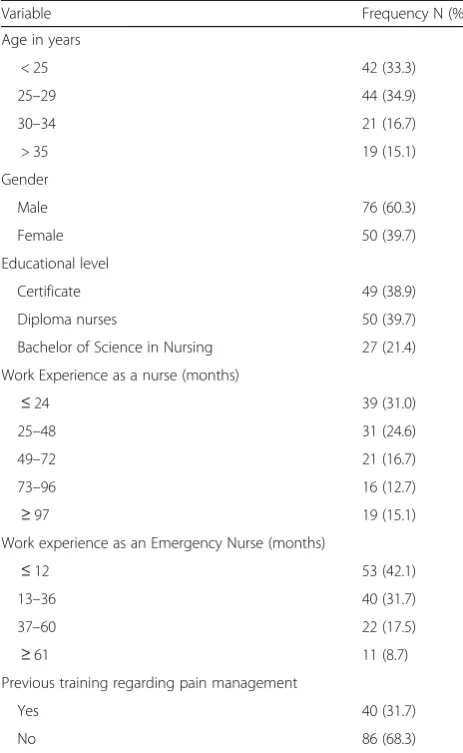
had 36 months (3 years) and less work experience as an emergency nurse. Finally, only 40 (31.7%) of the nurses caring for emergency patients had prior training regard-ing pain assessment and management.
Emergency nurses’knowledge and attitude regarding pain management
To calculate the mean score, correctly answered items were given a score of one while incorrectly responded questions were scored as zero. The total score was the sum of all correctly responded questions. In the end, to compare the result with the acceptable passing mark of 80%, the sum score for each participant was computed to 100 using SPSS version 20 as ´´sum score × 100 di-vided by 35″. The mean scores and standard deviations for the total scores and percentage with the minimum and maximum score are displayed in Table2.
In this research, the mean total score for the knowledge-attitude survey was 49.5% in which the
maximum and the minimum scores ranged from 28.6 to 77.1%, with a standard deviation of 9.76. A mean score of 80% or higher, was not achieved by any of the partici-pants in which 57.9% of the nurses received a score of less than 50%.
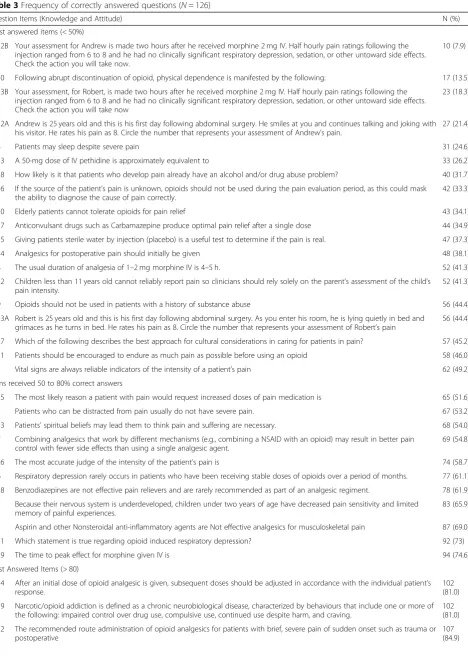
Table 3shows the number and percentages of partici-pants correctly responded to each question. The correct response rates of each question ranged from 10 (7.9%) to 112 (88.9%). In total, only five questions had accurate response rates higher than 80% while 19 items had ac-curate response rates less than 50% of which six of them had response rates less than 30%. As it is indicated in Table3, among the six least answered questions (< 30%), three of them were from the case discussions related to the assessment and management of pain in patients with the same age, surgery and level of pain but with a differ-ent way of communication and facial expression (Q 33B, 32A and,32B). Two of the six least answered questions were related to the opioids side effect in which item ´30′ was related to physical independence while item ´31′ was about opioid-associated respiratory depression.
Level of knowledge and attitude in relation to selected demographic characteristics
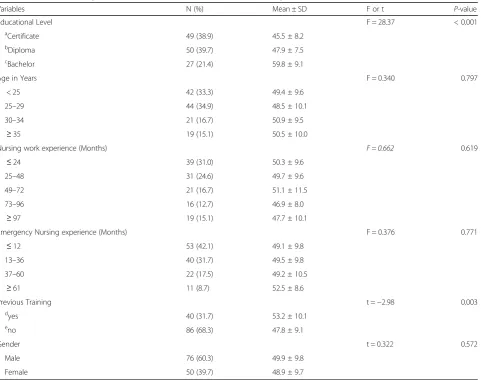
The researchers conducted an independent t-test and one-way ANOVA to identify if differences exist between the mean score of the nurses with different demographic characteristics (Table 4). One-way ANOVA showed a significant difference in knowledge score among nurses with various educational levels; p< 0.001. Similarly, an independent t-test showed a significantly higher mean score of nurses who had previous training regarding pain management compared to those who had no previous training (95% CI = 1.82–8.99; p= 0.003). No significant differences in knowledge and attitude were found among the nurses for the other demographic characteristics such as sex, work experience, and age in which, in all cases, thep-value was greater than 0.05.
To determine if one, or any, of the three groups (nurses with certificate, diploma and/or bachelor degree) is significantly different from the other, a Post Hoc pair-wise test was conducted. As it is showing in Table 5, there were differences between the pairs of groups, nurses with bachelor’s degree being significantly differ-ent from nurses holding certificate and diploma (95% CI = 9.42–19.08 and 7.089–16.72;p< 0.001) respectively.
Table 1Demographic characteristics of nurses participated in the study (N= 126)
Variable Frequency N (%)
Age in years
< 25 42 (33.3)
25–29 44 (34.9)
30–34 21 (16.7)
> 35 19 (15.1)
Gender
Male 76 (60.3)
Female 50 (39.7)
Educational level
Certificate 49 (38.9)
Diploma nurses 50 (39.7)
Bachelor of Science in Nursing 27 (21.4)
Work Experience as a nurse (months)
≤24 39 (31.0)
25–48 31 (24.6)
49–72 21 (16.7)
73–96 16 (12.7)
≥97 19 (15.1)
Work experience as an Emergency Nurse (months)
≤12 53 (42.1)
13–36 40 (31.7)
37–60 22 (17.5)
≥61 11 (8.7)
Previous training regarding pain management
Yes 40 (31.7)
No 86 (68.3)
Table 2Means and standard deviation of the computed variable
N mean SD Minimum Maximum
Score from 35 126 17.33 3.42 10 27
Table 3Frequency of correctly answered questions (N= 126)
Question Items (Knowledge and Attitude) N (%)
Least answered items (< 50%)
32B Your assessment for Andrew is made two hours after he received morphine 2 mg IV. Half hourly pain ratings following the injection ranged from 6 to 8 and he had no clinically significant respiratory depression, sedation, or other untoward side effects. Check the action you will take now.
10 (7.9)
30 Following abrupt discontinuation of opioid, physical dependence is manifested by the following: 17 (13.5)
33B Your assessment, for Robert, is made two hours after he received morphine 2 mg IV. Half hourly pain ratings following the injection ranged from 6 to 8 and he had no clinically significant respiratory depression, sedation, or other untoward side effects. Check the action you will take now
23 (18.3)
32A Andrew is 25 years old and this is his first day following abdominal surgery. He smiles at you and continues talking and joking with his visitor. He rates his pain as 8. Circle the number that represents your assessment of Andrew’s pain.
27 (21.4)
4 Patients may sleep despite severe pain 31 (24.6)
23 A 50-mg dose of IV pethidine is approximately equivalent to 33 (26.2)
28 How likely is it that patients who develop pain already have an alcohol and/or drug abuse problem? 40 (31.7)
16 If the source of the patient’s pain is unknown, opioids should not be used during the pain evaluation period, as this could mask the ability to diagnose the cause of pain correctly.
42 (33.3)
10 Elderly patients cannot tolerate opioids for pain relief 43 (34.1)
17 Anticonvulsant drugs such as Carbamazepine produce optimal pain relief after a single dose 44 (34.9)
15 Giving patients sterile water by injection (placebo) is a useful test to determine if the pain is real. 47 (37.3)
24 Analgesics for postoperative pain should initially be given 48 (38.1)
8 The usual duration of analgesia of 1–2 mg morphine IV is 4–5 h. 52 (41.3)
12 Children less than 11 years old cannot reliably report pain so clinicians should rely solely on the parent’s assessment of the child’s pain intensity.
52 (41.3)
9 Opioids should not be used in patients with a history of substance abuse 56 (44.4)
33A Robert is 25 years old and this is his first day following abdominal surgery. As you enter his room, he is lying quietly in bed and grimaces as he turns in bed. He rates his pain as 8. Circle the number that represents your assessment of Robert’s pain
56 (44.4)
27 Which of the following describes the best approach for cultural considerations in caring for patients in pain? 57 (45.2)
11 Patients should be encouraged to endure as much pain as possible before using an opioid 58 (46.0)
1 Vital signs are always reliable indicators of the intensity of a patient’s pain 62 (49.2)
Items received 50 to 80% correct answers
25 The most likely reason a patient with pain would request increased doses of pain medication is 65 (51.6)
3 Patients who can be distracted from pain usually do not have severe pain. 67 (53.2)
13 Patients’spiritual beliefs may lead them to think pain and suffering are necessary. 68 (54.0)
7 Combining analgesics that work by different mechanisms (e.g., combining a NSAID with an opioid) may result in better pain control with fewer side effects than using a single analgesic agent.
69 (54.8)
26 The most accurate judge of the intensity of the patient’s pain is 74 (58.7)
6 Respiratory depression rarely occurs in patients who have been receiving stable doses of opioids over a period of months. 77 (61.1)
18 Benzodiazepines are not effective pain relievers and are rarely recommended as part of an analgesic regiment. 78 (61.9)
2 Because their nervous system is underdeveloped, children under two years of age have decreased pain sensitivity and limited memory of painful experiences.
83 (65.9)
5 Aspirin and other Nonsteroidal anti-inflammatory agents are Not effective analgesics for musculoskeletal pain 87 (69.0)
31 Which statement is true regarding opioid induced respiratory depression? 92 (73)
29 The time to peak effect for morphine given IV is 94 (74.6)
Most Answered Items (> 80)
14 After an initial dose of opioid analgesic is given, subsequent doses should be adjusted in accordance with the individual patient’s response.
102 (81.0)
19 Narcotic/opioid addiction is defined as a chronic neurobiological disease, characterized by behaviours that include one or more of the following: impaired control over drug use, compulsive use, continued use despite harm, and craving.
102 (81.0)
22 The recommended route administration of opioid analgesics for patients with brief, severe pain of sudden onset such as trauma or postoperative
Perceived barriers to effective pain management
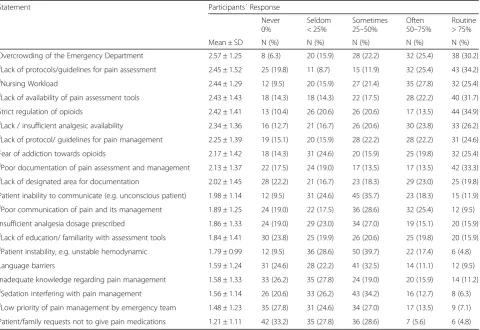
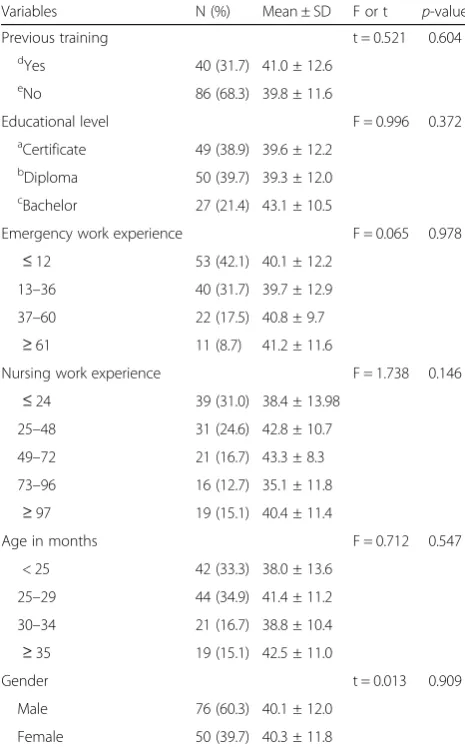
The highest four reported perceived barriers were: over-crowding of the emergency departments 2.57 ± 1.25, lack of protocols/guidelines for pain assessment 2.45 ± 1.52, nursing workload 2.44 ± 1.29, and lack of pain assess-ment tools 2.42 ± 1.41 (Table6).
To explore the relationship between the nurses’ per-ceived barriers and their demographic characteristics, in-dependent t-test (for two means) and one-way ANOVA (for greater than two means) were used. The comparable analysis revealed that emergency nurses’average score of
the perceived barriers to pain management not to be sig-nificantly associated with their age, gender, work experi-ence, educational level, and previous training regarding pain management (Table 7). However, Pearson’s correl-ation analysis revealed that emergency nurses’perceived barriers are significantly and positively correlated with their knowledge level (r= 0.257,p= 0.004).
Discussion
In general, the performance of the participants on the selected aspect of knowledge and attitude was poor. Table 3Frequency of correctly answered questions (N= 126)(Continued)
Question Items (Knowledge and Attitude) N (%)
21 Sedation assessment is recommended during opioid pain management because excessive sedation precedes opioid-induced respiratory depression.
108 (85.7)
20 The term‘equianalgesia’means approximately equal analgesia and is used when referring to the doses of various analgesics that provide approximately the same amount of pain relief.
112 (88.9)
These items were adopted from Ferrell et al [21] with permission from the owners
Table 4Level of knowledge and attitude in relation to selected nurses’demographic characteristics (N= 126)
Variables N (%) Mean ± SD F or t P-value
Educational Level F = 28.37 < 0.001
aCertificate 49 (38.9) 45.5 ± 8.2
bDiploma 50 (39.7) 47.9 ± 7.5
cBachelor 27 (21.4) 59.8 ± 9.1
Age in Years F = 0.340 0.797
< 25 42 (33.3) 49.4 ± 9.6
25–29 44 (34.9) 48.5 ± 10.1
30–34 21 (16.7) 50.9 ± 9.5
≥35 19 (15.1) 50.5 ± 10.0
Nursing work experience (Months) F = 0.662 0.619
≤24 39 (31.0) 50.3 ± 9.6
25–48 31 (24.6) 49.7 ± 9.6
49–72 21 (16.7) 51.1 ± 11.5
73–96 16 (12.7) 46.9 ± 8.0
≥97 19 (15.1) 47.7 ± 10.1
Emergency Nursing experience (Months) F = 0.376 0.771
≤12 53 (42.1) 49.1 ± 9.8
13–36 40 (31.7) 49.5 ± 9.8
37–60 22 (17.5) 49.2 ± 10.5
≥61 11 (8.7) 52.5 ± 8.6
Previous Training t =−2.98 0.003
dyes 40 (31.7) 53.2 ± 10.1
e
no 86 (68.3) 47.8 ± 9.1
Gender t = 0.322 0.572
Male 76 (60.3) 49.9 ± 9.8
Female 50 (39.7) 48.9 ± 9.7
a
Nurse assistants with 1–2 years of training,b
Registered nurses with three years of training,c
Nurse practitioners with four years of training,d
Mean score of 80% or higher, which has been accepted as adequate knowledge and attitude regarding pain man-agement [26], was not achieved by any of the
partici-pants. Nurses with a higher level of education
(bachelor’s degree) scored significantly higher knowledge score than the those at the diploma and certificate level. Similarly, nurses who reportedly had previous training regarding pain scored significantly higher knowledge level than those without previous training. Findings from this study also revealed that the most commonly per-ceived barriers for adequate pain management in emer-gency departments were system related.
Emergency Nurses’knowledge regarding pain management
Similar to the other studies [16, 17, 23], findings from the current study revealed a severe deficit in knowledge and attitude regarding pain management.
This severe deficit in knowledge and attitude of Eritrean nurses might have arisen from the lack of atten-tion given to pain assessment and management courses in the nursing schools. This is noticeable from the lack of sessions dedicated to pain assessment and manage-ment in most nursing school curriculums as well as the insufficient and disintegrated pain topics listed in differ-ent nursing courses. Previous studies that assessed the knowledge and attitude of the undergraduate nursing student on pain management reported a very low level of knowledge and attitude in all aspects of pain manage-ment [28–30]. The findings suggested that pain-related content of the curricula had not been enough to prepare these undergraduate nursing students to practice effi-ciently. Nurses who had frequent contact with patients had a higher level of knowledge and attitude regarding pain management [28]. Similarly, Aagaard et al. sug-gested that a curriculum with specific pain component
Table 5Post hoc paired tests
Education Level Mean Difference 95% CI p-value b
Diploma vsaCertificate 2.34 −1.71- 6.39 0.361 c
Bachelor vsaCertificate 14.25 9.42–19.08 < 0.001 c
Bachelor vsbDiploma 11.90 7.09–16.72 < 0.001 a
Nurse assistants with 1–2 years of training,b
Registered nurses with three years of training
c
Nurse practitioners with four years of training, CI = Confidence interval Mean difference is significant atp-value < 0.001,
Table 6Perceived barriers to pain management in an emergency setting (N= 126)
Statement Participants´ Response
Never 0%
Seldom < 25%
Sometimes 25–50%
Often 50–75%
Routine > 75%
Mean ± SD N (%) N (%) N (%) N (%) N (%)
Overcrowding of the Emergency Department 2.57 ± 1.25 8 (6.3) 20 (15.9) 28 (22.2) 32 (25.4) 38 (30.2) R
Lack of protocols/guidelines for pain assessment 2.45 ± 1.52 25 (19.8) 11 (8.7) 15 (11.9) 32 (25.4) 43 (34.2) R
Nursing Workload 2.44 ± 1.29 12 (9.5) 20 (15.9) 27 (21.4) 35 (27.8) 32 (25.4)
R
Lack of availability of pain assessment tools 2.43 ± 1.43 18 (14.3) 18 (14.3) 22 (17.5) 28 (22.2) 40 (31.7)
Strict regulation of opioids 2.42 ± 1.41 13 (10.4) 26 (20.6) 26 (20.6) 17 (13.5) 44 (34.9)
R
Lack / insufficient analgesic availability 2.34 ± 1.36 16 (12.7) 21 (16.7) 26 (20.6) 30 (23.8) 33 (26.2) R
Lack of protocol/ guidelines for pain management 2.25 ± 1.39 19 (15.1) 20 (15.9) 28 (22.2) 28 (22.2) 31 (24.6)
Fear of addiction towards opioids 2.17 ± 1.42 18 (14.3) 31 (24.6) 20 (15.9) 25 (19.8) 32 (25.4) R
Poor documentation of pain assessment and management 2.13 ± 1.37 22 (17.5) 24 (19.0) 17 (13.5) 17 (13.5) 42 (33.3) R
Lack of designated area for documentation 2.02 ± 1.45 28 (22.2) 21 (16.7) 23 (18.3) 29 (23.0) 25 (19.8)
Patient inability to communicate (e.g. unconscious patient) 1.98 ± 1.14 12 (9.5) 31 (24.6) 45 (35.7) 23 (18.3) 15 (11.9) R
Poor communication of pain and its management 1.89 ± 1.25 24 (19.0) 22 (17.5) 36 (28.6) 32 (25.4) 12 (9.5)
Insufficient analgesia dosage prescribed 1.86 ± 1.33 24 (19.0) 29 (23.0) 34 (27.0) 19 (15.1) 20 (15.9) R
Lack of education/ familiarity with assessment tools 1.84 ± 1.41 30 (23.8) 25 (19.9) 26 (20.6) 25 (19.8) 20 (15.9) R
Patient instability, e.g. unstable hemodynamic 1.79 ± 0.99 12 (9.5) 36 (28.6) 50 (39.7) 22 (17.4) 6 (4.8)
Language barriers 1.59 ± 1.24 31 (24.6) 28 (22.2) 41 (32.5) 14 (11.1) 12 (9.5)
Inadequate knowledge regarding pain management 1.58 ± 1.33 33 (26.2) 35 (27.8) 24 (19.0) 20 (15.9) 14 (11.2) R
Sedation interfering with pain management 1.56 ± 1.14 26 (20.6) 33 (26.2) 43 (34.2) 16 (12.7) 8 (6.3) R
Low priority of pain management by emergency team 1.48 ± 1.23 35 (27.8) 31 (24.6) 34 (27.0) 17 (13.5) 9 (7.1)
Patient/family requests not to give pain medications 1.21 ± 1.11 42 (33.2) 35 (27.8) 36 (28.6) 7 (5.6) 6 (4.8) R
that includes a particular model of clinical reasoning might have an influence on the development of positive attitude and belief of health care professionals towards pain [31]. Despite its worldwide high prevalence and its burden to the public, pain education has been given less priority including in medical schools. For example, a study conducted in Europe reported that only 30% of the medical schools from the representative countries had dedicated pain model in their curricula and it was compulsory only in 18% of them [32].
Another possible reason for the low scores is that pain management issues may not be a priority of policy-makers in the Eritrean ministry of health. Previous researchers showed a lack of multimodal approach to pain management [33, 34], poor pain documentation, unavailability of the essential analgesic drugs, and lack of
continuous medical education after graduation as the main reasons of inadequate main management after sur-gery [34]. In fact, in all the emergency departments, written protocols for pain assessment and management were not available during the study period; that can un-deniably adversely affect pain management in the hospi-tals. Even though it seems to be overlooked in Eritrean hospitals, experimental studies reported that uninter-rupted pain education is one of the most efficient ways to increase the knowledge, attitude and practice of nurses in assessing and managing pain [35,36].
Therefore, revision of the school of nursing curricu-lums by given an emphasis on pain education, introdu-cing continuous pain management programs [35, 36], and implementing evidence-based protocols and guide-lines are suggested as a means of improving nurses knowledge and attitude and apparently improve pain management practice [37].
Similar to the finding by Bernardi et al. and Ya va et al. [17,22], the least answered items in our study were questions related to the two case discussions. The two cases had the same age, surgery and pain intensity, but one was smiling while the other was grimacing. These issues are practical and evaluate nurses ability to proper pain assessment and management. Although 58.7% of the nurses believed that the best judge in evaluating pain should be the patient, their attitude clashed in their re-sponses to the two cases. Similar to the previous studies, nurses’ response was influenced more by the patients’ behaviour rather than the level of pain scored. This is true because 44.4% of the nurses agreed to the level of pain the grimacing patient had while only around half of them (21.4%) agree with the level of pain the smiling pa-tient had. Moreover, the case discussion question (32B) that asked the amount of morphine that should be administered to a smiling patient was the item that re-ceived the lowest correct responses (7.9%) while the question for a grimacing patient received 18.3% right an-swers. Studies conducted by Bernardi et al and Yava et al. revealed similar results in which the correct re-sponse rates for the administration of morphine for the smiling patients were 10.6 and 9.8% while for the grim-acing patient were 19.1% and 23. 7% respectively.
From these case discussions we can conclude that, even though patients were identified to have severe pain, they did not receive the required amount of analgesics. In the case of the grimacing patient, 44.4% of the partici-pants agreed that the patient was suffering from severe pain (8/10). However, despite their belief, only 18.3% of the nurses increased the dose of morphine to 3 mg which is higher than the amount of morphine adminis-tered previously. This shows that nurses had a severe knowledge deficit regarding the pharmacology of opioid analgesics. As was reported by previous studies, some of
Table 7Perceived Barriers to Pain Management in relation to Selected Nurses’Demographic Characteristics (n= 126)
Variables N (%) Mean ± SD F or t p-value
Previous training t = 0.521 0.604
dYes 40 (31.7) 41.0 ± 12.6
eNo 86 (68.3) 39.8 ± 11.6
Educational level F = 0.996 0.372
aCertificate 49 (38.9) 39.6 ± 12.2
bDiploma 50 (39.7) 39.3 ± 12.0
cBachelor 27 (21.4) 43.1 ± 10.5
Emergency work experience F = 0.065 0.978
≤12 53 (42.1) 40.1 ± 12.2
13–36 40 (31.7) 39.7 ± 12.9
37–60 22 (17.5) 40.8 ± 9.7
≥61 11 (8.7) 41.2 ± 11.6
Nursing work experience F = 1.738 0.146
≤24 39 (31.0) 38.4 ± 13.98
25–48 31 (24.6) 42.8 ± 10.7
49–72 21 (16.7) 43.3 ± 8.3
73–96 16 (12.7) 35.1 ± 11.8
≥97 19 (15.1) 40.4 ± 11.4
Age in months F = 0.712 0.547
< 25 42 (33.3) 38.0 ± 13.6
25–29 44 (34.9) 41.4 ± 11.2
30–34 21 (16.7) 38.8 ± 10.4
≥35 19 (15.1) 42.5 ± 11.0
Gender t = 0.013 0.909
Male 76 (60.3) 40.1 ± 12.0
Female 50 (39.7) 40.3 ± 11.8
a
Nurse assistants with 1–2 years of training,b
Registered nurses with three years of training,cNurse practitioners with four years of training,dThey had short term or long-term training regards pain either in a college or in a hospital,e
the possible reasons why nurses are hesitant to deliver a higher dose of opioids are an exaggerated fear of causing respiratory depression [26], unrealistic fear of addiction and lack of knowledge in distinguishing between de-pendence and tolerance [26]. One reason for the lack of knowledge about analgesic pharmacology could be the incorrect belief that analgesic drugs are in the domains of physicians’ practice and nurses have no professional duty and rights to influence physicians’prescription [26]. But, the fact is even though the narcotic prescription is not the scope of nursing practice, nurses are responsible for determining the intervals and the amount of the opi-oid dose to be administered depending on the patient’s response. Therefore, without a nurses’sound knowledge of the pharmacodynamics and pharmacokinetics of anal-gesics, optimal pain control seems to be impractical.
A question regarding ´´ manifestations of physical de-pendence following abrupt opioid discontinuation ´´ was one of the least answered (13.5%) items in this study. In Eritrea, most of the postoperative patients with pain, re-ceive non-steroidal anti-inflammatory drugs in which the routine drug is diclofenac 75 mg intramuscular (IM) pro re nata (PRN) [34,35]. Unarguably, this is also com-mon practice in emergency departments. During the study period, opioid analgesics especially morphine IV/ IM was often reserved for only some cases such as patients with pain secondary to myocardial infarction. Also, except for IV and IM opioids, aiming for short-term pain control, other alternatives such as the slow release opioids were unavailable. Additionally, it was re-ported that there were heavy regulation and strict con-trol of opioids in all emergency departments, which was witnessed as one of the commonly occurring barriers to pain management in this study. Because of the above-detailed reasons, a manifestation of physical dependence following opioid discontinuation is not likely to be seen in the emergency departments of Eritrea. As a result, it is not a surprise that nurses had an absence of know-ledge about a topic that might not have existed in the practice area.
Level of knowledge in relation to nurses´ demographic characteristics
The present study revealed that nurses who reportedly had prior training regarding pain management had sig-nificantly higher knowledge level than nurses without previous training. In line with the present study, other previously conducted descriptive studies also reported a similar finding in which nurses who participated in any pain training program had a significantly higher mean score [17, 38]. These findings have been confirmed in other experimental studies as well. Quasi-experimental studies conducted in Iranian and Jordanian postopera-tive nurses demonstrated that pain management training
program significantly increased both the knowledge and attitude of the participated nurses regarding pain assess-ment and manageassess-ment [35,36].
Findings from the present study revealed that the mean knowledge score of nurses with Bachelor’s Degree was significantly higher than the nurses who had Certifi-cates and Diplomas. This information was compatible with previous related studies [16, 17] in which nurses with higher educational background had a better know-ledge related to pain management. In most Eritrean hospitals nurses who have achieved a Bachelor’s Degree work as nursing practitioners and carry considerable re-sponsibility in emergency departments, including the prescription of analgesics for patients with pain. Despite the huge gap in the nursing school’s curriculum and lack of training in the hospitals regarding pain, it is likely that they are more motivated to read books and other sources of information. This initiative shown by the nurses might have contributed to their superior scores in knowledge and attitude towards pain management in the emergency departments. Therefore, to minimize patients suffering, effort should be made to upgrade the Certificate and Diploma nurses at to the Bachelor’s level. In the current study, there are no significant differ-ences found between the work experience, age, gender, knowledge and attitude of nurses regarding pain management. However, conflicting results have been re-ported in the literature [16, 22], yet, the majority have failed to find a meaningful association.
Perceived barriers to effective pain management
Lack of availability of pain assessment tools, lack of protocol/ guidelines for pain management and lack of protocols/guidelines for pain assessment, where the other frequently perceived barriers reported by nurses in the current study. Since pain assessment is an integral part of adequate pain management, every emergency department must have at least one of the many validated pain assessment tools. However, it is not uncommon the intensity of pain to be judged solely by the nurses´ and other health professionals´ subjective interpretation with-out valid pain assessment tools. In a study that assessed the perception of pain in the emergency department demonstrated that both physicians and nurses reported significantly lower pain ratings, compared to the patients´ real report and no pain assessment tools were employed while evaluating patients´ charts [42].
Additionally, evidence-based protocols and guidelines are essential for proper evaluation and management of pain. For instance, in previous studies, introducing a new pain management protocol for patients with chronic pain was immensely helpful in reducing both the number of emergency department visits and prescription of opioids [43,44]. A similar study evaluated the effect of a protocol-based pain therapy on time to initiation of painkillers among trauma patients [45]. Finding demonstrated that implementation of the protocol resulted in a statistically significant decrease in the average time to the starting of analgesia. However, in line with our finding, lack of proto-cols and guidelines on pain assessment and management have been reported as common barriers to pain assess-ment and manageassess-ment in the developing world [46,47].
Because most of the top perceived barriers are system re-lated, the ministry of health policymakers should work with each responsible institution to develop evidence-based pro-tocols and guidelines regarding the assessment, documenta-tion and management of pain in emergency situadocumenta-tions, given the emphasis on regulations and appropriate use of narcotics. Finally, efforts should be made to increase the ra-tio of nurses to emergency patients so that the time allotted to each patient would increase and patients suffering in emergency departments could be minimized.
Perceived barriers in relation to selected demographic characteristics
No statistically significant difference was found between the demographic characteristics of the nurses and the per-ceived barriers. However, inline to the finding by Craig and in contrast to the finding by Wang the results of the current research revealed a significant positive correlation between the average score in knowledge and the perceived barriers regarding pain management [16, 48]. The result showed that nurses with higher knowledge level regarding pain management were more barriers cautious than those who scored lower knowledge level. In general, participants
in this study had an incorrect perception of their know-ledge level regarding pain management. Even though they scored a very low level of knowledge and attitude, only 14 and 20% of the nurses perceived lack of knowledge regard-ing pain management and familiarity with pain assessment tools as a routine barrier for proper pain management re-spectively. However, in line with their relatively higher knowledge level regarding pain management, nurses with bachelor’s degree seemed to have a better understanding of their knowledge deficit than the nurses with lower qual-ifications. For instance, only 18.5% of nurses with a bache-lor’s degree denied that lack of knowledge was a barrier to pain management while 30 and 26.5% of the diploma and certificate holders believed that lack of knowledge has never been a barrier to pain management.
Like many other studies, this study also has limita-tions. Data for this research were collected from the re-ferral and regional hospitals of the country: which are expected to have better analgesic supplies, better oppor-tunity for learning, and more qualified nurses with specialised physicians. Therefore, this result may not represent the smaller hospitals and other health facilities of the country, in which the knowledge deficit and the perceived barriers over there might be even worse. Additionally, knowledge doesn’t always lead to proper practice, especially if the necessary resources for ad-equate practice are not available. However, this study focused on the knowledge and attitude of emergency nurses regarding pain management while the valuable methods of data gathering to evaluate how nurses’ prac-tice such as observational checklist and reviewing documents were missed.
Conclusion
The current study showed inadequate knowledge and attitude regarding pain management. Nurses with higher educational levels and nurses with previous training regard-ing pain management had significantly higher knowledge level scores than those without. This gives a signal for the nursing schools to review their curriculum to increase the number of contact hours regarding pain and the hospitals to introduce a continuous pain education program to main-tain the already acquired knowledge and gain new evidence regarding the modern way of pain management.
Supplementary information
Supplementary informationaccompanies this paper athttps://doi.org/10.
1186/s12912-019-0380-9.
Additional file 1.Questionnaire.
Abbreviations
ANOVA:Analysis of Variance; ED: Emergency departments; ICU: Intensive care unit; IM: Intravascular; IV: intravenous; NKASRP: Nurses knowledge and attitudes survey regarding pain; PRN: Pro re nata; SPSS: Statistical package for the social sciences
Acknowledgements
The authors are pleased to acknowledge the European Commission for
sponsoring the Erasmus Mundus Master’s Program in Emergency and Critical
Care Nursing. The authors would also like to appreciate Mr. Terry English from John Hopkins Hospital and Dr. Pamela Chambers, DNP, EJD, CRNA practices clinical anaesthesia in a private practice group in Texas and a Health Law Consultant working with attorney and health care provider clients for revising the English part of the manuscript. Finally, we are grateful to acknowledge Dr. Louise Rose RN, PhD, FAAN TD Nursing Professor in Critical Care Research, Sunnybrook Health Sciences Centre and the City of Hope Pain and Palliative Care Resources Centre for allowing us to use their tools.
Authors’contributions
DTK Wrote the proposal, collected the raw data, performed a literature search, analysis and wrote the thesis. MP Participated in conceptualizing and designing the study, supervised the development of the proposal and thesis writing. Both authors contributed in the review and final write-up of the manuscript and approved the final draft.
Funding
This was a Master’s Degree project and the European Commission
sponsored the Master’s Program. Otherwise, there were no specific funding
resources aimed for this study.
Availability of data and materials
The questionnaire used in this study is available in the article Additional file1.
The other datasets generated and analysed during the current study are not publicly available because the ethical approval and consent of participants prohibit sharing of the raw data publicly. However, when deemed necessary, the corresponding author is available to discuss any issues regarding the data requests.
Ethics approval and consent to participate
First, the proposal of the study and consent procedure was evaluated by the Health Research Proposal Review and Ethics Committee of the Ministry of Health Eritrea for its research relevance and ethical soundness and was approved on 4th of August 2017. Depending on the ethics clearance paper, a support letter of authorisation to conduct the research was written to the respective hospitals by the Research and Human Resources Development Ministry of Health (No: 15,08/3586/17). With the ethics clearance paper and letter of authorization at hand, permission to conduct the research was obtained from each respective hospital. Finally, after a thorough explanation of the aim and potential outcomes of the study, written informed consent bearing the signature of the participants was obtained. The anonymity of the respondents was assured by not recording names and the affiliated institution of the respondents in the consent form. Participants received a written document with detailed information on the types of data to be collected and on how their information will be kept confidential. The researchers also explained that participation was voluntary and failure to participate would not result in any punishment or loss of benefit from the institutions or the researchers.
Consent for publication Not applicable
Competing interests
The authors declare that they have no competing interests.
Author details
1Department of Anaesthesia and Critical Care, Asmara College of Health
Sciences, Mai Bela Ave, Asmara, Eritrea.2Metropolia University of Applied Sciences, Myllypurontie 1, PO BOX 4000, 00079 Helsinki, Metropolia, Finland.
Received: 27 May 2019 Accepted: 28 October 2019
References
1. Olateju AO, Adekunle DO, Saliu AO, Layiwola AM. Oluyimika yebamiji E,
Adebayo OO. Oligoanalgesia in emergency department: economical use of
analgesia a cause for concern. Int J Recent Sci Res. 2016;7(5):11180–4.
2. Todd KH, Ducharme J, Choiniere M, et al. Pain in the emergency
department: results of the pain and emergency medicine initiative (PEMI)
multicenter study. J Pain. 2007;8(6):460–6.https://doi.org/10.1016/j.jpain.
2006.12.005.
3. Macrae WA. Chronic post-surgical pain: 10 years on. Br J Anaesth. 2008;
101(1):77–86.https://doi.org/10.1093/bja/aen099.
4. Vadivelu N, Urman RD, Hines RL, editors. Essentials of pain management.
New York, NY: Springer New York; 2011.
https://doi.org/10.1007/978-0-387-87579-8.
5. Australian and New Zealand College of Anaesthetists. Acute Pain
Management: Scientific Evidence. Canberra, ACT: NHMRC; 2010.
6. De Berardinis B, Magrini L, Calcinaro S, et al. Emergency department pain
management and its impact on patients’short term outcome. Open Emerg
Med J. 2013;5:1–7.https://doi.org/10.2174/1876542420130729001.
7. Keating L, Smith S. Acute pain in the emergency department: the
challenges. Rev Pain. 2011;5(3):13–7.https://doi.org/10.1177/
204946371100500304.
8. Dale J, Bjørnsen LP. Assessment of pain in a Norwegian emergency
department. Scand J Trauma Resusc Emerg Med. 2015;23(1):1–5.https://doi.
org/10.1186/s13049-015-0166-3.
9. Yaqoob SH, Nasaif HA. Nurses’knowledge and attitudes toward pain
assessment and management for adult sickle cell disease patients
during sickling crisis. Clin Nurs Stud. 2015;3(4):36–43.https://doi.org/10.
5430/cns.v3n4p36.
10. Ayasrah SM, O’Neill TM, Abdalrahim MS, Sutary MM, Kharabsheh MS. Pain
assessment and Management in Critically ill intubated patients in Jordan: a
prospective study. Int J Health Sci. 2014;8(3):287–98 Available fromhttps://
www.ncbi.nlm.nih.gov/pmc/articles/PMC4257364/pdf/ijhs-8-3-287.pdf.
11. Alm AK, Norbergh K-G. Nurses? Opinions of pain and the assessed need for
pain medication for the elderly. Pain Manag Nurs. 2013;14(2):e31–8.https://
doi.org/10.1016/j.pmn.2010.07.007.
12. Duignan M, Dunn V. Barriers to pain management in emergency
departments. Emerg Nurse. 2008;15(9):30–4.https://doi.org/10.7748/en2008.
02.15.9.30.c8179.
13. Latina R, Mauro L, Mitello L, et al. Attitude and knowledge of pain
management among Italian nurses in hospital settings. Pain Manag Nurs.
2015;16(6):959–67.https://doi.org/10.1016/j.pmn.2015.10.002.
14. Omran S, Al Qadire M, Ali NA, Al Hayek MF. Knowledge and attitudes
about pain management: a comparison of oncology and non-oncology
Jordanian nurses. Nurs Health. 2014;2(4):73–80.https://doi.org/10.13189/
nh.2014.020401.
15. Badr MN, Morsy WY, Ali NS. Critical care Nurses’Knowledge and Practices
regarding Pain assessment and management at Cairo University Hospitals.
Egypt J Nurs. 2015;10(1).http://erepository.cu.edu.eg/index.php/EJN/article/
view/4223. Accessed 11 June 2017.
16. Wang H-L, Tsai Y-F. Nurses’knowledge and barriers regarding pain
management in intensive care units: ICU nurses and pain management.
J Clin Nurs. 2010;19(21–22):3188–96.https://doi.org/10.1111/j.1365-2702.
2010.03226.x.
17. Yava A, Çicek H, Tosun N, Özcan C, Yildiz D, Dizer B. Knowledge and
attitudes of nurses about pain management in Turkey. Int J Caring Sci. 2013;
6(3):494–505http://www.internationaljournalofcaringsciences.org/
docs/23.%20Yava.pdf.
18. Deasey D, Kable A, Jeong S. Emergency nurses attitudes towards older
people in the emergency department: a cross-sectional study. Contemp
Nurse. 2016;52(2–3):369–80.https://doi.org/10.1080/10376178.2016.1224122.
19. Krzyszycha R, Goniewicz M, Goniewicz K, Pawłowski W, Wańkowicz P.
Meta-analysis of pain and stress in emergency department patients. Pol J Public
20. Khomeiran RT, Yekta ZP, Kiger AM, Ahmadi F. Professional competence: factors described by nurses as influencing their development. Int Nurs Rev.
2006;53(1):66–72.https://doi.org/10.1111/j.1466-7657.2006.00432.x.
21. Ferrell BR, McCaffery M. Knowledge and Attitudes Survey Regarding Pain.
Revised 2014. Available fromhttp://prc.coh.org.
22. Bernardi M, Catania G, Lambert A, Tridello G, Luzzani M. Knowledge and
attitudes about cancer pain management: a national survey of Italian
oncology nurses. Eur J Oncol Nurs. 2007;11(3):272–9.https://doi.org/10.
1016/j.ejon.2006.09.003.
23. D’emeh WM, Yacoub MI, Darawad MW, Al-Badawi TH, Shahwan B.
Pain-Related Knowledge and Barriers among Jordanian Nurses: A National
Study. Health (N Y). 2016;08(06):548–58.https://doi.org/10.4236/health.
2016.86058.
24. Tsai F-C, Tsai Y-F, Chien C-C, Lin C-C. Emergency nurses’knowledge of
perceived barriers in pain management in Taiwan. J Clin Nurs. 2007;16(11): 2088–95.https://doi.org/10.1111/j.1365-2702.2006.01646.x.
25. Polit DF, Beck CT. Nursing Research: Principles and Methods. Lippincott
Williams & Wilkins; 2004.
26. McCAFFERY M, Robinson ES. Your patient is in pain—here’s how you
respond. Nursing (Lond). 2002;32(10):36–45 Available fromhttps://journals.
lww.com/nursing/Fulltext/2002/10000/Your_Patient_Is_in_Pain___Here_s_ How_You_Respond.42.aspx#pdf-link.
27. Rose L, Haslam L, Dale C, et al. Survey of assessment and management of
pain for critically ill adults. Intensive Crit Care Nurs. 2011;27(3):121–8.https://
doi.org/10.1016/j.iccn.2011.02.001.
28. Gadallah MAE-A, Hassan AMH, Shargawy SAE-H. Undergraduate nursing
students’knowledge and attitude regarding pain management of children
in upper Egypt. J Nurs Educ Pract. 2017;7(6):100–7.https://doi.org/10.5430/
jnep.v7n6p100.
29. Latchman J. Improving pain Management at the Nursing Education Level:
evaluating knowledge and attitudes. J Adv Pract Oncol. 2014;5(1):10-16.
Avialable fromhttps://www.ncbi.nlm.nih.gov/pmc/articles/PMC4093457/
30. Ortiz MI, Ponce-Monter HA, Rangel-Flores E, et al. Nurses’and nursing
students’knowledge and attitudes regarding pediatric pain. Nurs Res Pract.
2015;2015:1–8.https://doi.org/10.1155/2015/210860.
31. Augeard N, Tennant J, Carroll SP, Seenan C. The effect of undergraduate
education on pain-related attitudes and beliefs in healthcare students: an
observational, cross sectional study. Physiotherapy. 2019;105:e54–e212.
https://doi.org/10.1016/j.physio.2018.11.155.
32. Briggs EV, Battelli D, Gordon D, et al. Current pain education within
undergraduate medical studies across Europe: advancing the provision of pain education and learning (APPEAL) study. BMJ Open. 2015;5(8):e006984. https://doi.org/10.1136/bmjopen-2014-006984.
33. Kahsay DT, Elsholz W, Bahta HZ. Transversus abdominis plane block after
caesarean section in an area with limited resources. South Afr J Anaesth
Analg. 2017;23(4):90–5.https://doi.org/10.1080/22201181.2017.1349361.
34. Kidane TW. Patterns for acute postoperative pain management in the
national referral hospitals in Asmara, Eritrea. In: Health Care: Current
Reviews. 2016:27.https://doi.org/10.4172/2375-4273.C1.032.
35. Abdalrahim MS, Majali SA, Stomberg MW, Bergbom I. The effect of
postoperative pain management program on improving nurses’knowledge
and attitudes toward pain. Nurse Educ Pract. 2011;11(4):250–5.https://doi.
org/10.1016/j.nepr.2010.11.016.
36. Arab M, Shirzadi F, Sabzvari S, et al. Effects of Training Programs on
Knowledge and Attitudes of Nurses about Postoperative Pain 2016;8(4):
108–111. Available fromhttps://pdfs.semanticscholar.org/79aa/16dc5906b02
b2fa0675051eee4dafa461da3.pdf
37. Madenski AD. Improving Nurses’Pain Management in the Post Anaesthesia
Care Unit (PACU). 2014.Avialable fromhttps://scholarworks.umass.edu/cgi/
viewcontent.cgi?article=1034&context=nursing_dnp_capston
38. Moceri JT, Drevdahl DJ. Nurses? Knowledge and attitudes toward pain in
the emergency department. J Emerg Nurs. 2014;40(1):6–12.https://doi.org/
10.1016/j.jen.2012.04.014.
39. Bergman CL. Emergency nurses’perceived barriers to demonstrating caring
when managing adult patients’pain. J Emerg Nurs. 2012;38(3):218–25.
https://doi.org/10.1016/j.jen.2010.09.017.
40. Pines JM, Hollander JE. Emergency department crowding is associated with
poor Care for Patients with Severe Pain. Ann Emerg Med. 2008;51(1):1–5.
https://doi.org/10.1016/j.annemergmed.2007.07.008.
41. Mills AM, Shofer FS, Chen EH, Hollander JE, Pines JM. The association
between emergency department crowding and analgesia Administration in
Acute Abdominal Pain Patients. Acad Emerg Med. 2009;16(7):603–8.https://
doi.org/10.1111/j.1553-2712.2009.00441.x.
42. Baharuddin KA, Mohamad N, Rahman NHNA, Ahmad R, Him NASN.
Assessing patient pain scores in the emergency department. Malays J Med
Sci MJMS. 2010;17(1):17–22 Available from:https://www.ncbi.nlm.nih.gov/
pmc/articles/PMC3216146/pdf/mjms-17-1-017.pdf.
43. Olsen JC, Ogarek JL, Goldenberg EJ, Sulo S. Impact of a chronic pain
protocol on emergency department utilization. Bird SB, ed. Acad Emerg
Med. 2016;23(4):424–32.https://doi.org/10.1111/acem.12942.
44. Schwartz TM, Tai M, Babu KM, Merchant RC. Lack of association
between press Ganey emergency department patient satisfaction scores and emergency Department Administration of Analgesic Medications.
Ann Emerg Med. 2014;64(5):469–81.https://doi.org/10.1016/j.
annemergmed.2014.02.010.
45. Curtis KM, Henriques HF, Fanciullo G, Reynolds CM, Suber F. A
Fentanyl-Based Pain Management Protocol Provides Early Analgesia For Adult
Trauma Patients. J Trauma Inj Infect Crit Care. 2007;63(4):819–26.https://doi.
org/10.1097/01.ta.0000240979.31046.98.
46. Kituyi WP, Imbaya KK, Wambani JO, Sisenda TM, Kuremu RT. Postoperative
pain management: clinicians’knowledge and practices on assessment and
measurement at Moi teaching and referral hospital. East Cent Afr J Surg.
2011;16(2):20–4 Available from:http://www.ajol.info/index.php/ecajs/article/
view/72502.
47. Kizza IB. Nurses’knowledge and practices related to pain assessment in
critically ill patients at Mulago hospital, Uganda. 2012.http://ihi.eprints.org/
id/eprint/1598. Accessed 28 Apr 2017.
48. Craig JA. Nursing knowledge and attitudes toward pain management.
Gardner-Webb University; 2014. .https://digitalcommons.gardner-webb.edu/
nursing_etd/8
Publisher’s Note