RESEARCH ARTICLE
Sleep and behavioural problems
associate with low mood in Finnish children
aged 4–12 years: an epidemiological study
K. Maasalo
1*, T. Fontell
2, J. Wessman
3and E. T. Aronen
4Abstract
Background: Few studies have examined the associations between sleep, mood and behaviour in young children in the early stages of developing psychopathology. The purpose here was to examine the association of emotional problems, especially mood, with family and child characteristics, sleep and behavioural problems in 4–12 year-old children.
Methods: The sample was population-based and included 1714 children. Parents filled in the Strengths and Difficul-ties Questionnaire and a background questionnaire on child and family characteristics. The associations between (a) emotional symptoms/mood and background variables, (b) emotional problems and conduct problems/hyperactivity and (c) mood and conduct problems/hyperactivity were examined with ordinal regression in univariate and multivari-ate models.
Results: Of the background variables, child’s sleeping problems had the most powerful association with emotional symptoms and mood. Abnormal emotional problems score and emotional symptoms were associated with abnormal conduct problems and hyperactivity scores. Of the emotional symptoms, low mood was the one associated most strongly with conduct problems and hyperactivity after controlling for all significant background variables and other emotional symptoms.
Conclusions: We conclude that in young children sleep problems associate with low mood. Low mood associates with behavioural problems. When a child presents with low mood or behavioural problems, a comprehensive assess-ment of their psychiatric symptoms, as well as their sleep problems, is recommended.
Keywords: Mood, Behaviour problems, Sleep, Child development, Risk factors
© 2016 The Author(s). This article is distributed under the terms of the Creative Commons Attribution 4.0 International License (http://creativecommons.org/licenses/by/4.0/), which permits unrestricted use, distribution, and reproduction in any medium, provided you give appropriate credit to the original author(s) and the source, provide a link to the Creative Commons license, and indicate if changes were made. The Creative Commons Public Domain Dedication waiver (http://creativecommons.org/ publicdomain/zero/1.0/) applies to the data made available in this article, unless otherwise stated.
Background
In children, emotional/internalizing problems (e.g. anxi-ety and fears, low mood) are prevalent [1–3] and pre-cede psychiatric disorders of childhood, adolescence and adulthood [4–6]. Depressive symptoms not meeting the diagnostic criteria of clinical depression have been shown to affect current quality of life and achievements and to predict depression and other psychiatric disorders later
in life [2, 7–9]. Approximately half of the young adults disabled due to depression reveal that their psychiatric symptoms emerged already in childhood [10]. Family psychopathology and breakdown, child’s illness and poor socio-economic status have been reported as risk factors for childhood depression [11–14]. Not much is known about the risk factors for specific emotional symptoms, e.g. low mood. In adults, sleep problems predict depres-sive symptoms and depression [15]. Earlier studies have reported that sleep problems are associated with inter-nalizing and exterinter-nalizing symptoms in school-aged chil-dren [16, 17]. Less is known about the relation between sleep and mood in children [18, 19].
Open Access
*Correspondence: [email protected]
1 Laboratory of Developmental Psychopathology, Helsinki Pediatric Research Center, Children’s Hospital, Child Psychiatry, University of Helsinki and Helsinki University Hospital, Tukholmankatu 8 C 613, 00290 Helsinki, Finland
In children, emotional/internalizing symptoms are often associated with behavioural problems in clinical and population-based samples [20–23]. Especially, low or irritated mood is associated with disruptive behaviour [24, 25], raising the question of emerging bipolar disor-der in children [26]. The marked increase in diagnosing bipolar disorder in childhood has raised concern about the appropriate classification and treatment of children with persistent irritability. To address this concern, a new diagnostic class of disruptive mood dysregulation dis-order has been introduced in the DSM-5 [27]. This new diagnostic entity calls for further research on how mood and behaviour are linked in children in different popula-tions [28]. Population-based studies on the associations between mood and behaviour are especially important as they provide knowledge of these associations at an early stage when confounding factors are limited.
Earlier studies on associations between emotional and behavioural symptoms have mainly examined co-morbidities between disorders meeting the criteria for a distinct diagnosis [20, 22, 29] or assessed the co-morbid problems in larger entities (as internalizing problems, including anxiety and mood and somatic complaints) [21, 30, 31]. Little interest has been paid to individual emotional symptoms and their co-occurrence with conduct problems and hyperactivity, leaving the unan-swered question which specific symptoms on the symptom clusters associate the most with behavioural problems. To understand how to better prevent the disorders we need to examine the early stages of these disturbances.
Our main interests in the present study were to exam-ine the child and family characteristics of 4–12 year-old children with emotional problems and low mood in a Finnish population-based sample, and how the emotional problems were associated with sleep, conduct problems and hyperactivity. We were especially interested in how mood was related to conduct problems and hyperactivity in these children.
Methods
Sample and procedure
This study is a part of a population-based study on psy-chiatric problems in children. Statics Finland formed an initial random sample of 5000 Finnish-speaking children covering representative variety of rural and city areas and equal numbers of children from every age group in between 4 and 12 years.
Contact letters were sent to the mothers, except in cases where the civil register knew only information on the father or another caretaker, the contact letter was sent to them.
One parent of each participant filled in a background questionnaire and the Strengths and Difficulties Question-naire, using either interned-based individual password-protected interface (Digium) or asked for a mailed paper version to fill in. One reminder was sent. The final sample (34.3 %) consisted of 869 girls and 845 boys. Of the chil-dren, 668 (39 %) were under school age (4–6 years) and 1046 attended primary school (7–12 years). The sample represented well the original sample with respect to gender distribution and place of residence.
Questionnaires
The Strengths and Difficulties Questionnaire (SDQ) is a brief 25-item instrument to screen the emotional and behavioural problems of children and adolescents [32]. The items are categorized into five subscales (subscores ranging from 0 to 10): emotional problems, conduct problems, hyperactivity, peer problems and prosocial scale. The SDQ has been shown in epidemiological studies [33] to be applicable to Finnish children. Of the items screening for emotional problems, “often unhappy, down-hearted or tearful” is the one directly describing mood, while the others describe anxiety symptoms and somatic complaints. The mood item (no. 13) was used as a measure for mood in the sample.
Background information was collected from parents with a questionnaire covering child’s age, gender, number and ages of siblings, parents’ marital status, people living with child, parents’ job, parents’ education level, health issues of the child and whether the child needs any sup-port in day care or school. A brief question of current sleeping problems was also included (“Does child have a sleeping problem: yes/no”).
Statistical analyses
For statistical purposes, new variables were formed from the background information collected to avoid overlapping and high correlations between the vari-ables. The information on parents’ marital status and people living with child were combined to form a vari-able “biological parents living with child” with catego-ries “both” (82.5 %), “only mother” (16.0 %) and “only father” (1.3 %). The variable describing family’s socio-economic status (higher SES of the parents living with child) was combined from the parents’ jobs (retired and students excluded due to their small numbers; cor-relation between mothers’ and fathers’ jobs rs = 0.399,
N = 1639, p < 0.001, 2-tailed)). Educational level was excluded due to its correlation with parents’ jobs (moth-ers: rs = 0.427, N 1663, p < 0.001, 2-tailed, fathers:
rs = 0.498, N = 1675, p < 0.001, 2-tailed). Child’s
with a child having an illness or disability (rs = 0.306,
N = 1696, p < 0.001, 2-tailed).
The SDQ subscores were categorized as “normal”, “bor-derline” or “abnormal” using the cut-off points defined in the official SDQ website [34] (0–3; 4; 5–10 for emo-tional problems, 0–2; 3; 4–10 for conduct problems and 0–5; 6; 7–10 for hyperactive problems, respectively). The “somewhat true” and “certainly true” categories of the emotional symptoms were collapsed into a “somewhat or certainly true” category in order to achieve more statisti-cal power.
The associations between (a) background variables and emotional symptoms/mood, (b) emotional problems scores and conduct problems/hyperactivity scores and (c) emotional symptoms and conduct problem/hyperactivity scores were examined with ordinal regression in univari-ate and multivariunivari-ate models.
Analyses were carried out using IBM SPSS Statistics 22.
Results
Descriptive statistics and family and child characteristics related to emotional problems and mood
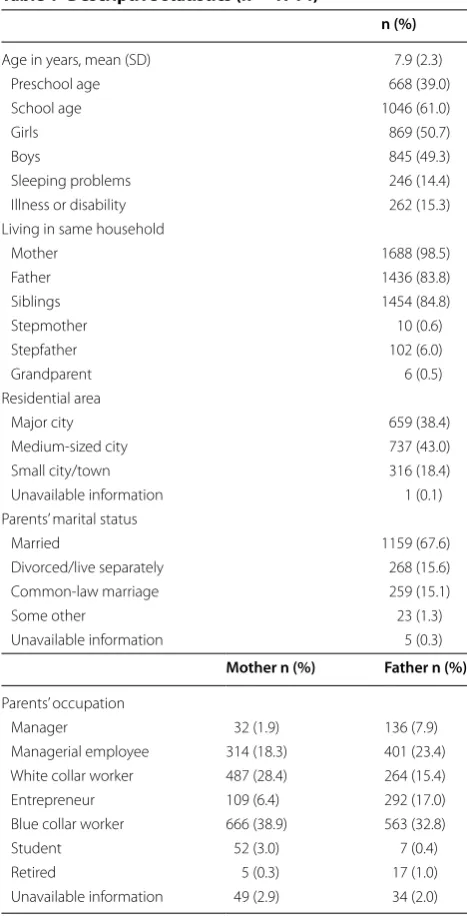
The characteristics of the children and their families are presented in Table 1. In the SDQ, boys had higher total difficulties scores and all other problem subscale scores than girls, except the emotional problems subscale score, where no difference existed between the genders. The emotional problems score increased with increasing age, while the other problem scores decreased (ordi-nal regression, problem scores and age as continuous variables, p’s 0.000–0.006). Table 2 presents the propor-tions of children scoring normal/borderline/abnormal on SDQ subscale scores and not true/somewhat true/ certainly true on emotional symptoms subscale items. Emotional problems score was abnormal in 5.8 % of the children, and low mood (defined as SDQ item 13 being somewhat or certainly true) was reported in 16.0 % of the children.
Table 3 presents the results of univariate and multi-variate ordinal regression on how the family and child characteristics relate to emotional problems and mood. Having sleeping problems had the strongest association with emotional problems and low mood.
Relationship between emotional problems/mood and conduct problems
A significant association emerged between scores for emotional problems and conduct problems. Children with a borderline emotional problems score had over three-fold odds for having a conduct problems score within the abnormal range (OR 3.25, 95 % CI 2.10–5.04). Children with an emotional problems score within the abnormal range had nearly eight-fold odds for scoring
within the abnormal range on conduct problems than those with an emotional problems score within the nor-mal range (OR 7.86, 95 % CI 5.20–11.88). We controlled for age, gender and family SES.
In univariate analysis, after controlling for age, gender and family SES, all emotional symptoms were associ-ated with conduct problems. The results are presented in Table 4. The strongest association was found between mood and conduct problems. We also looked at the model including an interaction term for mood and sleep, but no statistically significant interaction was found (data not shown). In multivariate analysis, low mood remained
Table 1 Descriptive statistics (n = 1714)
n (%)
Age in years, mean (SD) 7.9 (2.3)
Preschool age 668 (39.0)
School age 1046 (61.0)
Girls 869 (50.7)
Boys 845 (49.3)
Sleeping problems 246 (14.4)
Illness or disability 262 (15.3) Living in same household
Mother 1688 (98.5)
Father 1436 (83.8)
Siblings 1454 (84.8)
Stepmother 10 (0.6)
Stepfather 102 (6.0)
Grandparent 6 (0.5)
Residential area
Major city 659 (38.4)
Medium-sized city 737 (43.0)
Small city/town 316 (18.4)
Unavailable information 1 (0.1) Parents’ marital status
Married 1159 (67.6)
Divorced/live separately 268 (15.6) Common-law marriage 259 (15.1)
Some other 23 (1.3)
Unavailable information 5 (0.3)
Mother n (%) Father n (%)
Parents’ occupation
Manager 32 (1.9) 136 (7.9)
Managerial employee 314 (18.3) 401 (23.4) White collar worker 487 (28.4) 264 (15.4) Entrepreneur 109 (6.4) 292 (17.0) Blue collar worker 666 (38.9) 563 (32.8)
Student 52 (3.0) 7 (0.4)
Retired 5 (0.3) 17 (1.0)
as the most powerful association with conduct problems. After adding all of the other child and family character-istics related to problems (in addition to age, gender and SES, also illness/disability and sleep problem of the child and absence of the other biological parent in the family) to the multivariate analysis, mood, somatic complaints and worrying remained significantly associated with con-duct problems (OR 1.51–3.19), mood remaining as the
strongest association with conduct problems (OR 3.19, 95 % CI 2.26–4.49).
Relationship between emotional problems/mood and hyperactivity
A significant association was present between emo-tional problems scores and hyperactivity scores. Chil-dren with borderline emotional problems scores had
Table 2 Proportions of scores on SDQ subscales and on emotional problems subscale items
SDQ scores Normal n (%) Borderline n (%) Abnormal n (%)
Total difficulties score 1529 (89.2) 70 (4.1) 115 (6.7)
Emotional problems score 1517 (88.5) 97 (5.7) 100 (5.8)
Conduct problems score 1334 (77.8) 184 (10.7) 196 (11.4)
Hyperactivity score 1534 (89.5) 69 (4.0) 111 (6.5)
Peer problems score 1334 (77.8) 193 (11.3) 187 (10.9)
Prosocial score 1429 (83.4) 178 (10.4) 107 (6.2)
Items in emotional problems subscale Not true n (%) Somewhat true n (%) Certainly true n (%)
Often complains of headaches, stomach aches or sickness 1109 (6.7) 518 (30.2) 87 (5.1) Many worries, often seems worried 1351 (78.8) 325 (19.0) 38 (2.2) Often unhappy, down-hearted or tearful 1441 (84.1) 253 (14.8) 20 (1.2) Nervous or clingy in new situations, easily loses confidence 940 (54.8) 657 (38.3) 117 (6.8)
Many fears, easily scared 1470 (85.8) 215 (12.5) 29 (1.7)
Table 3 Relationships between child and family characteristics, emotional problems score and mood
Regression analysis examining emotional problems and mood as outcome variables and child and family characteristics as predictor variables. The emotional problems score was categorized as normal, borderline or abnormal (0–3; 4; 5–10 respectively) and the mood item dichotomized as “not true” and “somewhat/certainly true”
OR odds ratio; CI confidence interval * p < 0.05, ** p < 0.01, *** p < 0.001
Emotional problems score Often unhappy, down-hearted or tearful Univariate Multivariate Univariate Multivariate OR (95 % CI) OR (95 % CI) OR (95 % CI) OR (95 % CI)
Age in years 1.11 (1.04–1.19)* 1.08 (1.01–1.15)* 1.09 (1.03–1.15)** 1.06 (1.00–1.12) Gender: girl 1.12 (0.83–1.50) 1.28 (0.94–1.76) 0.98 (0.75–1.26) 1.04 (0.79–1.36) Biological parents living with child
Both 0 0 0 0
Mother only 2.61 (1.86–3.67)*** 1.99 (1.37–2.89)*** 2.26 (1.66–3.07)*** 1.88 (1.36–2.60)*** Father only 2.86 (1.11–7.34)* 2.77 (1.01–7.65)* 2.98 (1.27–7.00)** 3.00 (1.23–7.29)* Child has siblings 0.71 (0.48–1.03) 0.84 (0.55–1.26) 0.81 (0.57–1.14) –
Higher SES of parents living with child
Manager 0 – 0 –
Managerial employee 0.75 (0.42–1.33) – 0.96 (0.56–1.65) – White collar worker 0.82 (0.46–1.46) – 1.19 (0.69–2.03) –
Entrepreneur 0.67 (0.32–1.37) – 1.20 (0.64–2.22) –
Blue collar worker 1.27 (0.72–2.22) – 1.53 (0.90–2.61) –
almost three-fold odds for having a hyperactivity score within the abnormal range (OR 2.90, 95 % CI 1.66–5.01) than those with an emotional problems score within the normal range. Children with an emotional problems score within the abnormal range had nearly eight-fold odds for scoring within the abnormal range on hyper-activity (OR 7.73, 95 % CI 4.86–12.28) than those with a normal-range emotional problems score. We controlled for age, gender and family SES.
As with conduct problems, in univariate analysis, all of the emotional symptoms were associated with hyper-activity, after controlling for age, gender and family SES. The results are presented in Table 4. The strongest asso-ciation between single emotional symptoms and hyper-activity was found for mood and hyperhyper-activity. Again, we looked at the model including an interaction term for mood and sleep, but no statistically significant interac-tion was found (data not shown). In multivariate analy-sis, mood remained as the most powerful association with hyperactivity. Again, after adding all of the other child and family characteristics related to problems to the multivariate analysis, only mood remained signifi-cantly associated with hyperactivity (OR 2.50, 95 % CI 1.60–3.91).
Associations between mood, conduct problems and hyperactivity
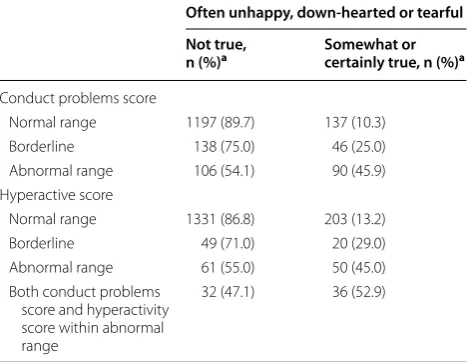
Of all the children with low mood (n = 273), 13.1 % scored within the abnormal range on both conduct prob-lems and hyperactivity scales, compared to 2.2 % of the children without low mood. Of the 68 children (4.0 % of the whole sample) scoring within the abnormal range in both conduct problems and hyperactivity scales, slightly over half also showed low mood (n = 36, 2.1 % of the whole sample). See also Table 5.
Discussion
We aimed to examine the characteristics of 4–12 year-old children with emotional problems and low mood in a Finnish population-based sample. Our main inter-est was in evaluating how emotional problems, espe-cially mood, were associated with conduct problems and hyperactivity.
In our sample, 5.8 % of the children scored within the abnormal range on emotional problems in the parent-rated SDQ. This proportion is in line with an earlier Finnish study investigating the frequencies of psychi-atric symptoms in 8–9 year-old children using differ-ent methods, which reported that 5.5 % of the children had a probable emotional disturbance [35], or a Danish study in a community sample of 12–14 year-old children
Table 4 Emotional symptoms, conduct problems and hyperactivity
Regression analysis examining the problem scores as explained variables and the emotional symptoms as predictor variables. The problem scores were categorized as normal, borderline or abnormal (0–2; 3; 4–10 for conduct problems and 0–5; 6; 7–10 for hyperactive problems, respectively) and the emotional symptoms dichotomized in “not true” and “somewhat/certainly true”
* p < 0.05, ** p < 0.01, *** p < 0.001
OR odds ratio; CI confidence interval
Conduct problems score Hyperactive score
Univariate Multivariate Univariate Multivariate OR (95 % CI) OR (95 % CI) OR (95 % CI) OR (95 % CI)
Often unhappy, down-hearted or tearful 5.64 (4.26–7.45)*** 3.33 (2.38–4.67)*** 4.42 (3.13–6.24)*** 2.78 (1.80–4.28)*** Often complains of headaches, stomach aches or sickness 2.36 (1.85–3.03)*** 1.61 (1.23–2.10)*** 2.01 (1.45–2.79)*** 1.33 (0.93–1.90) Many worries, often seems worried 3.86 (2.95–5.05)*** 1.70 (1.22–2.37)** 3.03 (2.15–4.27)*** 1.32 (0.85–2.05) Nervous or clingy in new situations, easily loses confidence 1.43 (1.13–1.81)** 1.05 (0.81–1.36) 1.54 (1.12–2.12)** 1.10 (0.78–1.55) Many fears, easily scared 3.06 (2.29–4.10)*** 1.43 (1.01–2.02)* 3.42 (2.38–4.90)*** 1.88 (1.23–2.88)*
Table 5 Mood and conduct problems/hyperactivity
a % of children within the same range of conduct problems/hyperactivity
scores
Often unhappy, down-hearted or tearful Not true,
n (%)a Somewhat or certainly true, n (%)a
Conduct problems score
Normal range 1197 (89.7) 137 (10.3) Borderline 138 (75.0) 46 (25.0) Abnormal range 106 (54.1) 90 (45.9) Hyperactive score
Normal range 1331 (86.8) 203 (13.2) Borderline 49 (71.0) 20 (29.0) Abnormal range 61 (55.0) 50 (45.0) Both conduct problems
score and hyperactivity score within abnormal range
reporting a frequency of 6.6 % having an abnormal emo-tional subscale score in the SDQ [31]. Much higher fre-quencies have also been reported [30, 36]. The frequency of low mood in our study was 16.0 and 1.2 % of the children were reported as being often unhappy, down-hearted or tearful. Low mood is not the same as depres-sion, but since persistent low mood is one of the core symptoms of depression, comparing the two may be jus-tified. The prevalence of major depression in children is estimated to be 2 %, and subthreshold depressive symp-toms are found in 10 % of children and adolescents [37] (point prevalence estimates ranging from 0.03 to 7 % for major depression and from 0.24 to 14 % for subthreshold depression [2]).
Characteristics associated with both emotional problems and low mood in our sample were not living with both bio-logical parents, having an illness or disability and having sleeping problems. Interestingly, sleeping problems were an even stronger associate of emotional problems and low mood than family structure or child’s illness. After con-trolling for other risk factors, sleeping problems remained the strongest associate of low mood. Earlier studies have reported strong associations between sleep problems and internalizing and externalizing symptoms in school-aged children [16, 17]. Our study adds to this knowledge by showing a strong association between sleep problems and low mood in a population-based sample of children. Because of the cross-sectional nature of the study, the causal direction cannot be determined. However, based on earlier studies there is more support for the pattern that sleep disruption precedes and possibly causes depression [38, 39]. Earlier data also suggest that the association of children’s sleep problems with mental health issues could be mediated by disruptions of daily mood [19]. These suggestions and the results of our study highlight the importance of recognizing and treating sleep problems in children. Somatic illness has earlier been shown to be associated with psychosocial problems, especially emo-tional symptoms [12, 40, 41]. Our result supports these findings and stresses the need to pay attention to the emo-tional well-being of small children with illness or disability. Scores on the emotional symptoms scale were associ-ated with conduct problems and hyperactivity. Similar associations have been reported in studies with differ-ing methods [14, 21, 22]. Interestingly, we found that of the single emotional/internalizing symptoms, low mood was the strongest associate of conduct problems and hyperactivity. Even after controlling for the other emo-tional symptoms and all significant background variables, the mood item remained highly significantly associated with conduct problems and hyperactivity scores. This may suggest that there is a common underlying fac-tor in mood and behavioural problems. Children with
simultaneous problems with mood and behavioural con-trol might be the ones at risk of developing bipolar disor-der (Uchida et al. [26]).
Previous studies in population-based and clinical samples of children have mainly investigated co-mor-bidities of diagnosed disorders; we found no studies of comparable data of associations at symptom level. Our findings are, however, in line with the established facts that depression and disruptive behaviour are often co-morbid [20, 29, 42]. Angold and colleagues (1999) published a meta-analysis of 21 community-based studies examining psychiatric co-morbidities, reporting increased odds for co-morbid depression and conduct disorder, depression and attention-deficit/hyperac-tivity disorder (ADHD), and ADHD and conduct dis-order. Only one included study was on children aged 7–11 years, while the majority of samples consisted of pre-adolescents or adolescents. Thus, our study with 4–12 year-old children complements the existing data and provides valuable information on the early stages of psychopathology.
Of the children in the present study, 2.1 % were reported as simultaneously having low mood, conduct problems and hyperactivity. In view of what has been published on the effect of subsyndromal depressive symptoms and co-morbid depression, conduct disorder and ADHD, this is a notable subgroup of children in a population sample, as this combination of symptoms is likely to affect how these children cope in everyday life and to predict future psychopathology [2, 23, 43].
One of the most intriguing findings of our study was mood standing out from the other emotional symptoms associating with both conduct problems and hyperactiv-ity. Our finding might suggest that low mood accounts for the associations between emotional symptoms and conduct problems/hyperactivity more than other emo-tional symptoms. Longitudinally, depression is suggested to usually be the consequence of another psychiatric disorder, with the exception of conduct disorder, which might in fact result from depression [37, 44]. Our finding may suggest that among children with emotional prob-lems, children presenting with low mood are at special risk for conduct problems and hyperactivity.
known to be reported less by parents than by children [33, 45]. It is thus possible that the prevalence of emo-tional problems is actually higher than presented here. Using only a single rater, the observed associations may in part reflect the fact that a single rater might be prone to report co-occurrence of problems. How-ever, as about half of the children were under school age, it was not possible for them to fill in the question-naires. In many population-based studies, the parental report remains the only information source on a child’s symptoms.
Conclusions
This study adds to the research suggesting inter-play between sleep problems, mood and behaviour in 4–12 year-old children. The findings highlight the asso-ciations between sleep problems and mood and between mood and problematic behaviour. When a child presents with low mood or behavioural problems, a comprehen-sive assessment of their psychiatric symptoms, as well as their sleep problems, is recommended. Follow-up studies are needed to examine the causal relationship.
Abbreviations
ADHD: attention-deficit/hyperactivity disorder; SDQ: Strengths and Difficulties Questionnaire; SES: socio-economic status.
Authors’ contributions
All authors participated in the drafting or the revision of the manuscript, and read and approved the final manuscript. In addition, KM participated in the design of the study and performed the statistical analysis. JW participated in the interpretation of data. TF collected the data. EA supervised and led the design of the study. All authors read and approved the final manuscript.
Author details
1 Laboratory of Developmental Psychopathology, Helsinki Pediatric Research Center, Children’s Hospital, Child Psychiatry, University of Helsinki and Hel-sinki University Hospital, Tukholmankatu 8 C 613, 00290 HelHel-sinki, Finland. 2 Children’s Hospital, Child Psychiatry, Helsinki University Hospital, PL 355, 00029 HUS Helsinki, Finland. 3 Laboratory of Developmental Psychopathology, Helsinki Pediatric Research Center, Children’s Hospital, Child Psychiatry, Uni-versity of Helsinki and Helsinki UniUni-versity Hospital, PL 353, 00029 HUS Helsinki, Finland. 4 Laboratory of Developmental Psychopathology, Helsinki Pediatric Research Center, Children’s Hospital, Child Psychiatry, University of Helsinki and Helsinki University Hospital, Lastenlinnantie 2, 00250 Helsinki, Finland.
Acknowledgements
We wish to thank our statistical advisor Mitja Lääperi.
Competing interests
The authors declare that they have no competing interests.
Availability of data and materials
Data presented in this paper is available for academic researchers by contact-ing the authors (Katri Maasalo or Eeva Aronen). Our permission from the Ethics Review Board and the consent obtained from participants does not include a permission to share the data online.
Ethics approval and consent to participate
The Ethics Committee of the Helsinki University Central Hospital approved the study protocol. Informed consent was obtained from the study participants.
Funding
This study was supported by the non-profit organizations: Foundation for Children’s Diseases and Helsinki University Central Hospital grant (evo-TYH).
Received: 3 May 2016 Accepted: 27 September 2016
References
1. Zahn-Waxler C, Klimes-Dougan B, Slattery MJ. Internalizing problems of childhood and adolescence: prospects, pitfalls, and progress in under-standing the development of anxiety and depression. Dev Psychopathol. 2000;12(3):443–66.
2. Wesselhoeft R, Sørensen MJ, Heiervang ER, Bilenberg N. Subthreshold depression in children and adolescents—a systematic review. J Affect Disord. 2013;151(1):7–22.
3. Polanczyk GV, Salum GA, Sugaya LS, Caye A, Rohde LA. Annual research review: a meta-analysis of the worldwide prevalence of mental disorders in children and adolescents. J Child Psychol Psychiatry. 2015;56(3):345–65. 4. Fergusson DM, Woodward LJ. Mental health, educational, and social
role outcomes of adolescents with depression. Arch Gen Psychiatry. 2002;59(3):225–31.
5. Copeland WE, Shanahan L, Costello EJ, Angold A. Childhood and adoles-cent psychiatric disorders as predictors of young adult disorders. Arch Gen Psychiatry. 2009;66(7):764–72.
6. Luby JL, Gaffrey MS, Tillman R, April LM, Belden AC. Trajectories of preschool disorders to full DSM depression at school age and early adolescence: continuity of preschool depression. Am J Psychiatry. 2014;171(7):768–76.
7. Haavisto A, Sourander A, Multimäki P, Parkkola K, Santalahti P, Hele-nius H, et al. Factors associated with depressive symptoms among 18 year-old boys: a prospective 10 year follow-up study. J Affect Disord. 2004;83(2–3):143–54.
8. Keenan K, Hipwell A, Feng X, Babinski D, Hinze A, Rischall M, et al. Sub-threshold symptoms of depression in preadolescent girls are stable and predictive of depressive disorders. J Am Acad Child Adolesc Psychiatry. 2008;47(12):1433–42.
9. Bertha EA, Balázs J. Subthreshold depression in adolescence: a systematic review. Eur Child Adolesc Psychiatry. 2013;22(10):589–603.
10. Ahola K, Joensuu M, Mattila-Holappa P, Tuisku K, Vahtera J, Virtanen M. Mielenterveyssyistä työkyvyttömien nuorten aikuisten tausta. Suom Laakaril. 2014;69(50–52):3441–8.
11. Gilman SE, Kawachi I, Fitzmaurice GM, Buka SL. Socio-economic status, family disruption and residential stability in childhood: relation to onset, recurrence and remission of major depression. Psychol Med. 2003;33(8):1341–55.
12. Hysing M, Elgen I, Gillberg C, Lie SA, Lundervold AJ. Chronic physical ill-ness and mental health in children. Results from a large-scale population study. J Child Psychol Psychiatry. 2007;48(8):785–92.
13. Ravens-Sieberer U, Wille N, Erhart M, Bettge S, Wittchen HU, Rothenberger A, et al. Prevalence of mental health problems among children and adolescents in Germany: results of the BELLA study within the National Health Interview and Examination Survey. Eur Child Adolesc Psychiatry. 2008;17(Suppl 1):22–33.
14. Elberling H, Linneberg A, Olsen EM, Goodman R, Skovgaard AM. The prev-alence of SDQ-measured mental health problems at age 5–7 years and identification of predictors from birth to preschool age in a Danish birth cohort: the Copenhagen Child Cohort 2000. Eur Child Adolesc Psychiatry. 2010;19(9):725–35.
15. Tsuno N, Besset A, Ritchie K. Sleep and depression. J Clin Psychiatry. 2005;66(10):1254–69.
16. Aronen ET, Paavonen EJ, Fjallberg M, Soininen M, Törrönen J. Sleep and psychiatric symptoms in school-age children. J Am Acad Child Adolesc Psychiatry. 2000;39(4):502–8.
• We accept pre-submission inquiries
• Our selector tool helps you to find the most relevant journal • We provide round the clock customer support
• Convenient online submission • Thorough peer review
• Inclusion in PubMed and all major indexing services • Maximum visibility for your research
Submit your manuscript at www.biomedcentral.com/submit
Submit your next manuscript to BioMed Central
and we will help you at every step:
18. Conroy DA, Usoro A, Hoffmann RF, Brower KJ, Armitage R. The influence of emerging low mood symptoms on sleep in children: a pilot study. Nat Sci Sleep. 2012;4:133–42.
19. Kouros CD, El-Sheikh M. Daily mood and sleep: reciprocal relations and links with adjustment problems. J Sleep Res. 2015;24(1):24–31. 20. Angold A, Costello EJ, Erkanli A. Comorbidity. J Child Psychol Psychiatry.
1999;40(1):57–87.
21. Heiervang E, Stormark KM, Lundervold AJ, Heimann M, Goodman R, Pos-serud MB, et al. Psychiatric disorders in Norwegian 8- to 10 year-olds: an epidemiological survey of prevalence, risk factors, and service use. J Am Acad Child Adolesc Psychiatry. 2007;46(4):438–47.
22. Wichstrøm L, Berg-Nielsen TS, Angold A, Egger HL, Solheim E, Sveen TH. Prevalence of psychiatric disorders in preschoolers. J Child Psychol Psychiatry. 2012;53(6):695–705.
23. Boylan K, MacPherson HA, Fristad MA. Examination of disruptive behavior outcomes and moderation in a randomized psychotherapy trial for mood disorders. J Am Acad Child Adolesc Psychiatry. 2013;52(7):699–708. 24. Connor DF, Doerfler LA. Characteristics of children with juvenile
bipolar disorder or disruptive behavior disorders and negative mood: can they be distinguished in the clinical setting? Ann Clin Psychiatry. 2012;24(4):261–70.
25. Stringaris A, Maughan B, Copeland WS, Costello EJ, Angold A. Irritable mood as a symptom of depression in youth: prevalence, developmental, and clinical correlates in the Great Smoky Mountains Study. J Am Acad Child Adolesc Psychiatry. 2013;52(8):831–40.
26. Uchida M, Serra G, Zayas L, Kenworthy T, Faraone SV, Biederman J. Can unipolar and bipolar pediatric major depression be differentiated from each other? A systematic review of cross-sectional studies examining dif-ferences in unipolar and bipolar depression. J Affect Disord. 2015;176:1–7. 27. American Psychiatric Association. Diagnostic and statistical manual of
mental disorders. 5th ed. Washington, DC: American Psychiatric Publish-ing; 2013.
28. Copeland WE, Angold A, Costello EJ, Egger H. Prevalence, comorbidity, and correlates of DSM-5 proposed disruptive mood dysregulation disor-der. Am J Psychiatry. 2013;170(2):173–9.
29. Ford T, Goodman R, Meltzer H. The British child and adolescent mental health survey 1999: the prevalence of DSM-IV disorders. J Am Acad Child Adolesc Psychiatry. 2003;42(10):1203–11.
30. Cury CR, Golfeto JH. Strengths and difficulties questionnaire (SDQ): a study of school children in Ribeirao Preto. Revista Brasileira De Psiquiatria. 2003;25(3):139–45.
31. Reinholdt-Dunne ML, Esbjørn BH, Høyer M, Dahl S, Boesen AJ, Hansen SG, et al. Emotional difficulties in seventh grade children in Denmark. Scand J Psychol. 2011;52(5):433–9.
32. Goodman R. The Strengths and Difficulties Questionnaire: a research note. J Child Psychol Psychiatry. 1997;38(5):581–6.
33. Koskelainen M, Sourander A, Kaljonen A. The Strengths and Difficulties Questionnaire among Finnish school-aged children and adolescents. Eur Child Adolesc Psychiatry. 2000;9(4):277–84.
34. Goodman R. Information for researchers and professionals about the Strengths and Difficulties Questionnaires 2014. http://www.sdqinfo.org. Accessed 08 Aug 2016.
35. Almqvist F, Kumpulainen K, Ikäheimo K, Linna SL, Henttonen I, Huikko E, et al. Behavioural and emotional symptoms in 8–9 year-old children. Eur Child Adolesc Psychiatry. 1999;8(Suppl 4):7–16.
36. Elhamid AA, Howe A, Reading R. Prevalence of emotional and behav-ioural problems among 6–12 year old children in Egypt. Soc Psychiatry Psychiatr Epidemiol. 2009;44(1):8–14.
37. Birmaher B, Brent D, Bernet W, Bukstein O, Walter H, Benson RS, et al. Practice parameter for the assessment and treatment of children and adolescents with depressive disorders. J Am Acad Child Adolesc Psychia-try. 2007;46(11):1503–26.
38. Gregory AM, Rijsdijk FV, Lau JYF, Dahl RE, Eley TC. The direction of longitu-dinal associations between sleep problems and depression symptoms: a study of twins aged 8 and 10 years. Sleep. 2009;32(2):189–99.
39. Urrila AS, Paunio T, Palomäki E, Marttunen M. Sleep in adolescent depres-sion: physiological perspectives. Acta Physiol (Oxf ). 2015;213(4):758–77. 40. Alfstad KÅ, Clench-Aas J, Van Roy B, Mowinckel P, Gjerstad L, Lossius
MI. Psychiatric symptoms in Norwegian children with epilepsy aged 8–13 years: effects of age and gender? Epilepsia. 2011;52(7):1231–8. 41. Pirinen T, Kolho KL, Ashorn M, Aronen ET. Sleep and emotional and
behavioral symptoms in adolescents with inflammatory bowel disease. Sleep Disorders. 2014;2014:379450.
42. Kovacs M. The Children’s Depression, Inventory (CDI). Psychopharmacol Bull. 1985;21(4):995–8.
43. Rudolph KD, Hammen C, Burge D. Interpersonal functioning and depres-sive symptoms in childhood: addressing the issues of specificity and comorbidity. J Abnorm Child Psychol. 1994;22(3):355–71.
44. Kessler RC, Avenevoli S, Ries Merikangas K. Mood disorders in chil-dren and adolescents: an epidemiologic perspective. Biol Psychiatry. 2001;49(12):1002–14.