Open Access
Review
Reducing stigma and discrimination: Candidate interventions
Graham Thornicroft*, Elaine Brohan, Aliya Kassam and Elanor
Lewis-Holmes
Address: Health Service and Population Research Department, Institute of Psychiatry, King's College London, De Crespigny Park, London, UK
Email: Graham Thornicroft* - [email protected]; Elaine Brohan - [email protected]; Aliya Kassam - [email protected]; Elanor Lewis-Holmes - [email protected]
* Corresponding author
Abstract
This paper proposes that stigma in relation to people with mental illness can be understood as a combination of problems of knowledge (ignorance), attitudes (prejudice) and behaviour (discrimination). From a literature review, a series of candidate interventions are identified which may be effective in reducing stigmatisation and discrimination at the following levels: individuals with mental illness and their family members; the workplace; and local, national and international. The strongest evidence for effective interventions at present is for (i) direct social contact with people with mental illness at the individual level, and (ii) social marketing at the population level.
Introduction
Widespread discrimination adds to the disability of peo-ple with mental illness [1-4]. The basic problem is this: many people with mental illness are subjected to system-atic disadvantages in most areas of their lives [5,6]. These forms of social exclusion occur at home, at work, in per-sonal life, in social activities, in healthcare and in the media [7,8].
From stigma to ignorance, prejudice and discrimination
What is stigma? The concept of stigma is necessary to develop an understanding of experiences of social exclu-sion, but it is not sufficient to grasp the whole picture, nor to identify what practical steps need to be taken to pro-mote social inclusion. Stigma consists of three related problems:
• The problem of knowledge: Ignorance
• The problem of attitudes: Prejudice
• The problem of behaviour: Discrimination
Ignorance
At a time when there is an unprecedented volume of infor-mation in the public domain, the level of accurate knowl-edge about mental illnesses (sometimes called 'mental health literacy') is meagre [9]. A population survey in Eng-land, for example, found that most people (55%) believe that the statement 'someone who cannot be held respon-sible for his or her own actions' describes a person who is mentally ill [10]. Most (63%) thought that fewer than 10% of the population would experience a mental illness at some time in their lives. This ignorance needs to be redressed by conveying more factual knowledge to the general public and also to specific groups such as teenag-ers, including useful information such as how to recognise the features of mental illness and where to get help [11].
Prejudice
Fear, anxiety and avoidance are common feelings both for people who do not have mental illness (when reacting to
Published: 13 April 2008
International Journal of Mental Health Systems 2008, 2:3 doi:10.1186/1752-4458-2-3
Received: 28 June 2007 Accepted: 13 April 2008
This article is available from: http://www.ijmhs.com/content/2/1/3
© 2008 Thornicroft et al; licensee BioMed Central Ltd.
those who have) and for people with mental illness who anticipate rejection and discrimination and therefore impose upon themselves a form of 'self-stigma' [4]. Although the term 'prejudice' is used to refer to many social groups that experience disadvantage, for example minority ethnic groups, it is employed rarely in relation to people with mental illness. The reactions of a host major-ity to act with prejudice in rejecting a minormajor-ity group usu-ally involve not just negative thoughts but also emotions such as anxiety, anger, resentment, hostility, distaste or disgust. Prejudice may more strongly predict discrimina-tion than do stereotypes. A recent study of terms used for mental illness by 14 year old school students in England, for example, found that they used 250 words and phrases, none of which are positive [12].
Discrimination
The scientific evidence and the strong message from serv-ice users and their advocates indicate that discrimination blights the lives of many people with mental illness, mak-ing marriage, childcare, work and a normal social life much more difficult. Actions are needed to specifically redress the social exclusion of people with mental illness and to use the legal measures intended to support all dis-abled people for physical and mental disabilities on the basis of parity [13]. The evidence from scientific enquiry and consultation with service users is unequivocal: dis-crimination means that it is harder for people with a men-tal illness to marry, have children, work or have a social life. This crippling social exclusion needs to be actively addressed. Laws already exist to ensure equality for all people with disabilities.
Action to support people with mental illness
Empowerment has been described as the opposite of self-stigmatisation [14]. Policy makers can provide specific financial support for ways in which individuals with men-tal illness can empower themselves or be empowered. Such specific support might include:
• Promoting participation in formulating care plans and crisis plans for people with mental illness.
• Providing cognitive-behavioural therapy for people with mental illness to reverse negative self-stigma.
• Running regular assessments of consumer satisfaction with services.
• Creating user-led and user-run services.
• Developing peer-support worker roles in mainstream mental health care.
• Encouraging employers to give positive credit for experi-ence of mental illness
• Enabling people with mental illness to take part in treat-ment and service evaluation and research.
Action to support people with mental illness at work
For some people with mental illness, allowance needs to be made at work for their personal requirements. In par-allel with the modifications made for people with physi-cal disabilities, people with mental illness-related disabilities may need what are called 'reasonable adjust-ments' in relation to the anti-discrimination laws. In prac-tice this can include the following measures:
• Having a quieter work place with fewer distractions for people with concentration problems, rather than, for example, a noisy open plan office, as well as a rest area for breaks.
• Giving more or more frequent supervision than usual to give feedback and guidance on job performance.
• Allowing a person to use headphones to block out dis-tracting noise.
• Creating flexibility in work hours so that they can attend their healthcare appointments or work when not impaired by medication.
• Funding an external job coach for counselling and sup-port and to mediate between employee and employer.
• Providing a buddy/mentor scheme to provide on-site orientation and assistance.
• Writing clear personal specifications, job descriptions and task assignments to assist people who find ambiguity or uncertainty hard to cope with.
• Making contract modifications to specifically allow whatever sickness leave is required by people likely to become unwell for prolonged periods.
• Providing a more gradual induction phase, for example with more time to complete tasks, for those who return to work after a prolonged absence or who may have some cognitive impairment.
• Improving disability awareness in the workplace to reduce stigma and to underpin all other accommodations.
• Allowing use of accrued paid and unpaid leave for peri-ods of illness.
Further, community bodies need to act to promote the social inclusion of people with mental illness. The follow-ing initiatives would address discrimination in the work-place and misinformation about mental health issues:
• Employers' federations need to inform employers of their legal obligations under existing disability laws regarding people with mental illness.
• Employers in the health and social care sector, when recruiting, need to make explicit that a history of mental illness is a valuable attribute for many roles.
• Mental health services need to work with employers and business confederations to ensure that reasonable accom-modations and adjustments in the workplace are made for people with mental illness.
• The education, health and police authorities need to provide well evaluated interventions to increase integra-tion with, and understanding of, people with mental ill-ness to targeted groups such as schoolchildren, police and healthcare staff.
• Professional training and accreditation organisations need to ensure that mental health practitioners are fully aware of the actual recovery rates for mental illnesses.
Actions needed at the local level
In local communities or health and social care economies initiatives are needed to promote social inclusion of peo-ple with mental illness. These are outlined in Table 1.
Actions needed at the national level
In national policy a series of changes is necessary that spans government ministries, the non-government and independent sector and service user and professional groups. This is a vision of a long-term attack upon individ-ual and systemic/structural discrimination [6] through a co-ordinated, multi-sectoral programme of action to pro-mote the social inclusion of people with mental illness. Further social marketing approaches, the adaptation of advertising methods for a social good rather than for the consumptions of a commodity, are increasingly often being used [15-17].
In terms of change needed in mental health systems, sev-eral elements are necessary. An example is the develop-ment of psychological services designed to support people in or seeking work. Many people with mental illness expe-rience demoralisation, reduced self-esteem, loss of confi-dence, and sometimes depression [18-22]. It is therefore likely that support programmes assisting people with mental illness to gain employment will need to assess whether structured psychological treatment is also needed [23-25]. Second, mental health staff may increasingly see the need to widen their remit from direct treatment provi-sion to also intervening for local populations. Mental health awareness campaigns toward local programmes can be targeted to specific groups [26-28]. In the anti-stigma network of the World Psychiatric Association (called 'Open the Doors'), for example, such interventions have most often been applied to medical staff, journalists, school children, police, employers and church leaders [29-33].
Another key target group is healthcare professionals. Con-sumers surprisingly often relate that their experiences of general healthcare and mental healthcare staff reveal lev-els of ignorance, prejudice and discrimination that they
Table 1: Actions at local level
Action By
• Introduction supported work schemes • Mental health services with specialist independent sector provider • Psychological treatments to improve cognition, self-esteem and
confidence
• Mental health and general health service
• Health and social care explicitly give credit to applicants with a history of mental illness when hiring staff
• Health and social care agencies
• Provision of reasonable adjustments/accommodations at work • Mental health providers engaging with employers and business confederation
• Inform employers of their legal obligations under disability laws • Employers' confederation • Deliver and evaluate the widespread implementation of targeted
interventions with targeted groups, including school children, police and healthcare staff
• Education, police and health commissioning and provider authorities
• Provide accurate data on mental illness recovery rates to mental health practitioners
• Professional training and accreditation organisations
• Implementation of measures to support care plans negotiated between staff and consumers
find deeply distressing. This has been confirmed by stud-ies in Australia, Brazil, Canada, Croatia, England, Malay-sia, Spain and Turkey [34-42]. Based on the principle 'catch them young', several programmes have given anti-stigma interventions to medical students [39,43-46]. As is usual in the field of stigma and discrimination, there is more research describing stigma than assessing which interventions are effective. In Japan, one study found that the traditional medical curriculum led to mixed results: students became more accepting of mentally ill people and mental health services, and more optimistic about the outlook with treatment, but there was no impact on their views about how far people with mental illness should have their human rights fully observed [47]. Positive changes in all of these domains were achieved with a one-hour supplementary educational programme [48].
Interestingly, it seems that psychiatrists may not be in the best position to lead such educational programmes. Stud-ies in Switzerland found no overall differences between the general public and psychiatrists in terms of social dis-tance to mentally ill people [49]. Psychiatry itself tries to walk the narrow tightrope between the physical/pharma-cological and psychological/social poles [50]. Clinicians who keep contact with people who are unwell, and who selectively stop seeing people who have recovered, may therefore develop a pessimistic view of the outlook for people with mental illnesses [51]. On balance, there is mixed evidence about whether psychiatrists can be seen as stigmatisers or destigmatisers [52]. Mental health nurses have also been found to have both more and less favour-able views about people with mental illness than the gen-eral public [36]. Interestingly, nurses, like the gengen-eral population, tend to be more favourable if they have a friend who is mentally ill, i.e. if there is a perceived simi-larity and equality with the person affected [53].
What, then, should mental health staff do? Direct involve-ment in the media is a vital route that professionals can use more often, with proper preparation and training. They also need to set their own house in order by promot-ing information within their trainpromot-ing curricula, continu-ing professional development (continucontinu-ing medical education) and relicensing/revalidation procedures which ensures that they have accurate information, for example, on recovery [54].
Further, practitioners need in future to pay greater atten-tion to what consumers and family members say about their experiences of discrimination, for example in rela-tion to work or housing. Staff can also work directly with consumers to combat social exclusion, for example by opposing repressive or regressive mental health laws [55]. Third, it is clear that consumer groups increasingly seek to change to the terms of engagement between mental
health professionals and consumers, and to move from paternalism to negotiation [14]. Vehicles to support shared decision-making include: crisis plans [56] which seem able to reduce the frequency of compulsory treat-ment [57], advance directives [58], shared care agree-ments [59] and consumer-held records [60]. The key fact is that many consumers want direct participation in their own care plans [61].
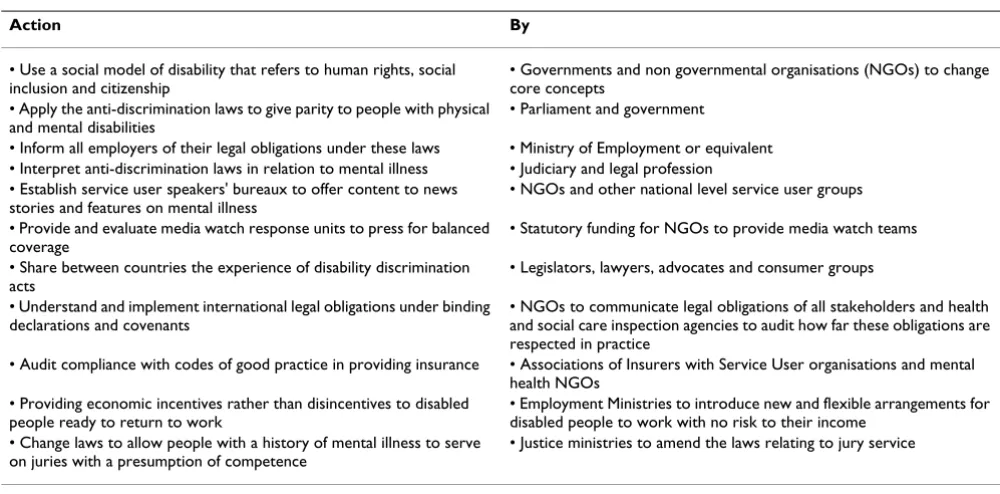
Going into the public advocacy domain, staff in mental health systems may well develop in future a direct cam-paigning role. A practical approach is for local and national agencies to set aside their differences and to find common cause. In various areas, such co-ordinating groups are called forums, peak bodies, alliances or consor-tia. What they have in common is a recognition that what they can achieve together, in political terms, is greater that their individual impact. Core issues able to unite such coalitions are likely to include parity in funding, the use of disability discrimination laws for people with mental illness-related disabilities, and the recognition of interna-tional human rights conventions in practice [62-65]. The actions needed at a national level are summarised in Table 2.
Action at the international level
What action is necessary at the international level? Such contributions, so far removed from the everyday lives of people, may be hardly noticeable unless they are very sharply focussed and coherent. Setting international standards for national polices could be one useful inter-vention. For example the World Health Organisation (WHO) has published standards to guide countries in producing and revising mental health laws [66]. The standards cover advice on:
• access to care
• confidentiality
• assessments of competence and capacity
• involuntary treatment
• consent
• physical treatments
• seclusion
• restraint
• privacy of communications
• review procedures for compulsory detention [66]
At present, 25% of countries worldwide do not have men-tal health legislation and half of those that do enacted their laws over 15 years ago. Generally, lower income countries are more likely to have older legislation [67].
In the European Union, for example, anti discrimination laws are now mandatory under the Article 13 Directive [68]. Such laws must make illegal all discrimination in the workplace on grounds that include disability, and also set up institutions to enforce these laws. The time is therefore right is share experiences between different countries on how successful such laws have been to reduce discrimina-tion against people with mental illness and to understand more clearly what is required both for new legislation elsewhere and for amendments to existing laws that fall short of their original intentions.
International organisations such as the WHO can also contribute towards better care and less discrimination by indicating the need for national mental health policies and by giving guidance on their content. In 2005, for example, only 62% of countries in the world had a mental health policy [67]. In Europe, health ministers have signed a Mental Health Declaration and Action Plan which sets the following priorities:
• foster awareness of mental illness
• tackle stigma, discrimination and inequality
• provide comprehensive, integrated care systems
• support a competent, effective workforce
• recognise the experience and knowledge of services users and carers [65,69,70].
Conclusion
The strongest evidence at present for active ingredients to reduce stigma pertains to direct social contact with people with mental illness, which has been shown to be effective in relation to police officers, school students, journalists and the clergy [33,71-73]. At the national level, there is emerging evidence that a carefully co-ordinated approach based on using social marketing techniques, namely advertising and promotional methods designed to achieve a social good rather than sales of a commodity, have produced benefits in Australia, New Zealand and Scotland [16,17,74]. The challenge in the coming years will be to identify which interventions (whether directed towards knowledge, attitudes or behaviour) are most cost-effective in reducing the social exclusion of people with mental illness.
Acknowledgements
This study was funded in relation to an National Institute for Health Research (NIHR) Applied Programme grant awarded to the South London and Maudsley NHS Foundation Trust (AK and EB), and in relation to the NIHR Specialist Mental Health Biomedical Research Centre at the Institute of Psychiatry, King's College London and the South London and Maudsley NHS Foundation Trust (GT).
Table 2: Actions at national level
Action By
• Use a social model of disability that refers to human rights, social inclusion and citizenship
• Governments and non governmental organisations (NGOs) to change core concepts
• Apply the anti-discrimination laws to give parity to people with physical and mental disabilities
• Parliament and government
• Inform all employers of their legal obligations under these laws • Ministry of Employment or equivalent • Interpret anti-discrimination laws in relation to mental illness • Judiciary and legal profession • Establish service user speakers' bureaux to offer content to news
stories and features on mental illness
• NGOs and other national level service user groups
• Provide and evaluate media watch response units to press for balanced coverage
• Statutory funding for NGOs to provide media watch teams
• Share between countries the experience of disability discrimination acts
• Legislators, lawyers, advocates and consumer groups
• Understand and implement international legal obligations under binding declarations and covenants
• NGOs to communicate legal obligations of all stakeholders and health and social care inspection agencies to audit how far these obligations are respected in practice
• Audit compliance with codes of good practice in providing insurance • Associations of Insurers with Service User organisations and mental health NGOs
• Providing economic incentives rather than disincentives to disabled people ready to return to work
• Employment Ministries to introduce new and flexible arrangements for disabled people to work with no risk to their income
• Change laws to allow people with a history of mental illness to serve on juries with a presumption of competence
References
1. Thornicroft G: Shunned: Discrimination against People with Mental Illness
Oxford, Oxford University Press; 2006.
2. Hinshaw SP, Cicchetti D: Stigma and mental disorder: concep-tions of illness, public attitudes, personal disclosure, and social policy. Dev Psychopathol 2000, 12:555-598.
3. Hinshaw SP, Cicchetti D, S.L T: The Mark of Shame: Stigma of Mental Illness and an Agenda for Change New York, Oxford University Press; 2007.
4. Link BG, Yang LH, Phelan JC, Collins PY: Measuring mental illness stigma. Schizophr Bull 2004, 30:511-541.
5. Corrigan P: On the Stigma of Mental Illness Washington,D.C., American Psychological Association; 2005.
6. Corrigan PW, Markowitz FE, Watson AC: Structural levels of mental illness stigma and discrimination. Schizophr Bull 2004,
30:481-491.
7. Wahl OF: Media Madness: Public Images of Mental Illness New Bruns-wick, New Jersey, Rutgers University Press; 1995.
8. Link BG, Struening EL, Neese-Todd S, Asmussen S, Phelan JC: On describing and seeking to change the experience of stigma.
Psychiatric Rehabilitation Skills 2002, 6:201-231.
9. Crisp A, Gelder MG, Goddard E, Meltzer H: Stigmatization of people with mental illnesses: a follow-up study within the Changing Minds campaign of the Royal College of Psychia-trists. World Psychiatry 2005, 4:106-113.
10. Health D: Attitudes to Mental Illness 2003 Report London, Department of Health; 2003.
11. Wright A, McGorry PD, Harris MG, Jorm AF, Pennell K: Develop-ment and evaluation of a youth Develop-mental health community awareness campaign - The Compass Strategy. BMC Public Health 2006, 6:215.
12. Rose D, G T, Pinfold V, Kassam A: 250 labels used to stigmatise people with mental illness. BMC Health Services Research 2007, In press:.
13. Peterson D, Pere L, Sheehan N, Surgenor G: Experiences of men-tal health discrimination in New Zealand. Health Soc Care Com-munity 2007, 15:18-25.
14. Chamberlin J: User/consumer involvement in mental health service delivery. Epidemiologica e Psichiatria Sociale 2005,
14(1):10-14.
15. Sullivan M, Hamilton T, Allen H: Changing stigma through the media. On the Stigma of Mental Illness. Practical Strategies for Research and Social Change 2005:297-312.
16. Vaughn G: Like Minds, Like Mine. In Mental Health Promotion: Case Studies from Countries Edited by: Saxena S and Garrison P. Geneva, World Health Organisation; 2004:62-66.
17. Dunion L, Gordon L: Tackling the attitude problem. The achievements to date of Scotland's 'see me' anti-stigma campaign. Ment Health Today 2005:22-25.
18. Camp DL, Finlay WM, Lyons E: Is low self-esteem an inevitable consequence of stigma? An example from women with chronic mental health problems. Soc Sci Med 2002, 55:823-834. 19. Hayward P, Wong G, Bright JA, Lam D: Stigma and self-esteem in manic depression: an exploratory study. J Affect Disord 2002,
69:61-67.
20. Link BG, Struening EL, Neese-Todd S, Asmussen S, Phelan JC:
Stigma as a barrier to recovery: The consequences of stigma for the self-esteem of people with mental illnesses. Psychiatr Serv 2001, 52:1621-1626.
21. Wright ER, Gronfein WP, Owens TJ: Deinstitutionalization, social rejection, and the self-esteem of former mental patients. J Health Soc Behav 2000, 41:68-90.
22. Crocker J, Quinn DM: Social stigma and the self: meanings, sit-uations, and self-esteem. In The Social Psychology of Stigma Edited by: T.F. H, Kleck RE, Hebl MR and J.G. H. New York, Guilford; 2000:153-183.
23. Proudfoot J, Gray J, Carson J, Guest D, Dunn G: Psychological training improves mental health and job-finding among unemployed people. Int Arch Occup Environ Health 1999, 72 Suppl:S40-S42.
24. Brown JS, Elliott SA, Boardman J, Ferns J, Morrison J: Meeting the unmet need for depression services with psycho-educational self-confidence workshops: preliminary report. Br J Psychiatry
2004, 185:511-515.
25. Hall PL, Tarrier N: The cognitive-behavioural treatment of low self-esteem in psychotic patients: a pilot study. Behav Res Ther
2003, 41:317-332.
26. Corrigan PW: Target-specific stigma change: a strategy for impacting mental illness stigma. Psychiatr Rehabil J 2004,
28:113-121.
27. Estroff SE, Penn DL, Toporek JR: From stigma to discrimination: an analysis of community efforts to reduce the negative con-sequences of having a psychiatric disorder and label. Schizophr Bull 2004, 30:493-509.
28. Holmes EP, Corrigan PW, Williams P, Canar J, Kubiak MA: Changing attitudes about schizophrenia. Schizophr Bull 1999, 25:447-456. 29. Gaebel W, Baumann AE: ["Open the doors"--the antistigma
program of the World Psychiatric Association]. MMW Fort-schr Med 2003, 145:34-37.
30. Pickenhagen A, Sartorius N: The WPA Global Programme to Reduce Stigma and Discrimination because of Schizophrenia Geneva, World Psy-chiatric Association; 2002.
31. Thompson AH, Stuart H, Bland RC, Arboleda-Florez J, Warner R, Dickson RA: Attitudes about schizophrenia from the pilot site of the WPA worldwide campaign against the stigma of schiz-ophrenia. Soc Psychiatry Psychiatr Epidemiol 2002, 37:475-482. 32. Warner R: Local projects of the world psychiatric association
programme to reduce stigma and discrimination. Psychiatr Serv 2005, 56:570-575.
33. Sartorius N, Schulze H: Reducing the Stigma of Mental Illness. A Report from a Global Programme of the World Psychiatric Association Cambridge, Cambridge University Press; 2005.
34. Lawrie SM, Martin K, McNeill G, Drife J, Chrystie P, Reid A, Wu P, Nammary S, Ball J: General practitioners' attitudes to psychiat-ric and medical illness. Psychol Med 1998, 28:1463-1467. 35. Caldwell TM, Jorm AF: Mental health nurses' beliefs about
interventions for schizophrenia and depression: a compari-son with psychiatrists and the public. Aust N Z J Psychiatry 2000,
34:602-611.
36. Caldwell TM, Jorm AF: Mental health nurses' beliefs about likely outcomes for people with schizophrenia or depression: a comparison with the public and other healthcare profession-als. Aust N Z J Ment Health Nurs 2001, 10:42-54.
37. Filipcic I, Pavicic D, Filipcic A, Hotujac L, Begic D, Grubisin J, Dordevic V: Attitudes of medical staff towards the psychiatric label "schizophrenic patient" tested by an anti-stigma question-naire. Coll Antropol 2003, 27:301-307.
38. Mas A, Hatim A: Stigma in mental illness: attitudes of medical students towards mental illness. Med J Malaysia 2002,
57:433-444.
39. Mukherjee R, Fialho A, Wijetunge A, Checinski K, Surgenor T: The stigmatisation of psychiatric illness: The attitudes of medical students and doctors in a London teaching hospital. Psychiatr Bull 2002, 26:178-181.
40. Rodrigues CR: [Comparison of the attitudes of Brazilian and Spanish medical students towards mental disease]. Actas Luso Esp Neurol Psiquiatr Cienc Afines 1992, 20:30-41.
41. Roth D, Antony MM, Kerr KL, Downie F: Attitudes toward men-tal illness in medical students: does personal and professional experience with mental illness make a difference? Med Educ
2000, 34:234-236.
42. White R: Stigmatisation of mentally ill medical students. In
Every Family in the Land Edited by: Crisp A. London, Royal Society of Medicine; 2004:365-366.
43. Hasui C, Sakamoto S, Suguira B, Kitamura T: Stigmatization of mental illness in Japan: Images and frequency of encounters with diagnostic categories of mental illness among medical and non-medical university students. Journal of Psychiatry & Law
2000, 28:253-266.
44. Arkar H, Eker D: Influence of a 3-week psychiatric training pro-gramme on attitudes toward mental illness in medical stu-dents. Soc Psychiatry Psychiatr Epidemiol 1997, 32:171-176. 45. Chew-Graham CA, Rogers A, Yassin N: 'I wouldn't want it on my
CV or their records': medical students' experiences of help-seeking for mental health problems. Med Educ 2003,
37:873-880.
Publish with BioMed Central and every scientist can read your work free of charge
"BioMed Central will be the most significant development for disseminating the results of biomedical researc h in our lifetime."
Sir Paul Nurse, Cancer Research UK
Your research papers will be:
available free of charge to the entire biomedical community
peer reviewed and published immediately upon acceptance
cited in PubMed and archived on PubMed Central
yours — you keep the copyright
Submit your manuscript here:
http://www.biomedcentral.com/info/publishing_adv.asp
BioMedcentral
47. Mino Y, Yasuda N, Kanazawa S, Inoue S: Effects of medical educa-tion on attitudes towards mental illness among medical stu-dents: a five-year follow-up study. Acta Med Okayama 2000,
54:127-132.
48. Mino Y, Yasuda N, Tsuda T, Shimodera S: Effects of a one-hour educational program on medical students' attitudes to men-tal illness. Psychiatry Clin Neurosci 2001, 55:501-7.
49. Lauber C, Anthony M, jdacic-Gross V, Rossler W: What about psy-chiatrists' attitude to mentally ill people? Eur Psychiatry 2004,
19:423-427.
50. Luhrmann TM: Of Two Minds New York, Vintage Books; 2000. 51. Burti L, Mosher LR: Attitudes, values and beliefs of mental
health workers. Epidemiol Psichiatr Soc 2003, 12:227-231. 52. Schlosberg A: Psychiatric stigma and mental health
profes-sionals (stigmatizers and destigmatizers). Med Law 1993,
12:409-416.
53. Sadow D, Ryder M, Webster D: Is education of health profes-sionals encouraging stigma towards the mentally ill? Journal of Mental Health 2002, 11:657-665.
54. Crisp A: Every Family in the Land: Understanding Prejudice and Discrimi-nation Against People with Mental Illness London, Royal Society of Med-icine Press; 2004.
55. Sartorius N: Stigma: what can psychiatrists do about it? Lancet
1998, 352:1058-1059.
56. Sutherby K, Szmukler GI, Halpern A, Alexander M, Thornicroft G, Johnson C, Wright S: A study of 'crisis cards' in a community psychiatric service. Acta Psychiatr Scand 1999, 100:56-61. 57. Henderson C, Flood C, Leese M, Thornicroft G, Sutherby K,
Szmuk-ler G: Effect of joint crisis plans on use of compulsory treat-ment in psychiatry: single blind randomised controlled trial.
BMJ 2004, 329:136-138.
58. Swanson J, Swartz M, Ferron J, Elbogen EB, Van Dom R: Psychiatric advance directives among public mental health consumers in five U.S. cities: prevalence, demand, and correlates. Jour-nal of the American Academy of Psychiatry and the Law 2005, (in press):. 59. Byng R, Jones R, Leese M, Hamilton B, McCrone P, Craig T: Explor-atory cluster randomised controlled trial of shared care development for long-term mental illness. Br J Gen Pract 2004,
54:259-266.
60. Lester H, Allan T, Wilson S, Jowett S, Roberts L: A cluster ran-domised controlled trial of patient-held medical records for people with schizophrenia receiving shared care. Br J Gen Pract
2003, 53:197-203.
61. Allen MH, Carpenter D, Sheets JL, Miccio S, Ross R: What do con-sumers say they want and need during a psychiatric emer-gency? J Psychiatr Pract 2003, 9:39-58.
62. Mercer S, Dieppe P, Chambers R, MacDonald R: Equality for peo-ple with disabilities in medicine. BMJ 2003, 327:882-883. 63. Hanson KW: Public opinion and the mental health parity
debate: lessons from the survey literature. Psychiatr Serv 1998,
49:1059-1066.
64. Frank RG, Goldman HH, McGuire TG: Will parity in coverage result in better mental health care? N Engl J Med 2001,
345:1701-1704.
65. Thornicroft G, Rose D: Mental health in Europe. BMJ 2005,
330:613-614.
66. Organisation WH: WHO Resource Book on Mental Health, Human Rights and Legislation Geneva, World Health Organisation; 2005. 67. Organisation WH: Mental Health Atlas 2005 Geneva, World Health
Organisation; 2005.
68. Bartlett P, Lewis O, Thorold O: Mental Disability and the European Con-vention on Human Rights Leiden, Martinus Nijhoff; 2006.
69. Organisation WH: Mental Health Declaration for Europe Copenhagen, World Health Organisation; 2005.
70. Organisation WH: Mental Health Action Plan for Europe Copenhagen, World Health Organisation; 2005.
71. Pinfold V, Thornicroft G, Huxley P, Farmer P: Active ingredients in anti-stigma programmes in mental health. International Review of Pwsychiatry 2005, 17(2):123-131.
72. Pinfold V, Huxley P, Thornicroft G, Farmer P, Toulmin H, Graham T:
Reducing psychiatric stigma and discrimination--evaluating an educational intervention with the police force in England.
Soc Psychiatry Psychiatr Epidemiol 2003, 38:337-344.
73. Pinfold V, Toulmin H, Thornicroft G, Huxley P, Farmer P, Graham T:
Reducing psychiatric stigma and discrimination: evaluation
of educational interventions in UK secondary schools. Br J Psy-chiatry 2003, 182:342-6.