R E S E A R C H
Open Access
Assessment of the scope and practice of
evaluation among medical donation
programs
Alisa M. Jenny
1*, Meng Li
2, Elizabeth Ashbourne
3, Myron Aldrink
4, Christine Funk
5and Andy Stergachis
1,2Abstract
Background:Medical donation programs for drugs, other medical products, training and other supportive services can improve access to essential medicines in low- and middle-income countries (LMICs) and provide emergency and disaster relief. The scope and extent to which medical donation programs evaluate their impact on recipients and health systems is not well documented.
Methods:We conducted a survey of the member organizations of the Partnership for Quality Medical Donations
(PQMD), a global alliance of non-profit and corporate organizations, to identify evaluations conducted in conjunction with donation programs.
Results:Twenty-five out of the 36 PQMD organizations that were members at the time of the survey participated in the study, for a response rate of 69 %. PQMD members provided information on 34 of their major medical donation programs. Half of the donation programs reported conducting trainings as a part of their donation program. Twenty-six (76 %) programs reported that they conduct routine monitoring of their donation programs. Less than 30 % of donation programs were evaluated for their impact on health. Lack of technical staff and lack of funding were reported as key barriers to conducting impact evaluations.
Conclusions:Member organizations of PQMD provide a broad range of medical donations, targeting a wide range
of public health issues and events. While some level of monitoring and evaluation was conducted in nearly 80 % of the donation programs, a program’s impact was infrequently evaluated. Opportunities exist to develop consistent metrics for medical donation programs, develop a common framework for impact evaluations, and advocate for data collection and analysis plans that collect meaningful metrics.
Keywords:Medical Donations, Low- and Middle-Income Countries, Neglected Tropical Diseases, Monitoring,
Evaluation, Impact
Background
Global access to quality medicines and other medical products is fundamental to maintaining and improving the health of people. Maintaining a reliable supply chain of essential medicines and other medical products can save lives, reduce morbidity, and improve quality of life. Unfortunately, poor availability of medicines and other medical products in many low- and middle-income coun-tries (LMICs) where health systems, including supply
chains, are commonly suboptimal. Numerous studies have described a lack of availability of essential medicines in LMICs [1–5]. Moreover, poor quality medicines are a global health problem, particularly in LMICs, resulting in the potential for treatment failure, development of anti-microbial resistance, and serious adverse drug reactions, increasing healthcare costs and undermining the public’s confidence in healthcare systems [6, 7].
The situation of poor access to medicines and other medical products in LMICs is further compounded when those countries are struck by natural disasters, such as typhoons, hurricanes, tsunamis or earthquakes, which put an even greater strain on their weak health
* Correspondence:[email protected]
1Department of Global Health, Global Medicines Program, University of
Washington, Harris Hydraulics Building, Room 321, 1705 NE Pacific St., Box 357965, Seattle, WA 98195-7965, USA
Full list of author information is available at the end of the article
systems. Among the top 10 countries in terms of disas-ter mortality in 2014, seven countries are classified as low income or lower-middle income countries [8]. In response to these needs and concerns, nongovernmental organizations (NGOs) and pharmaceutical and medical supply manufacturers are involved in performing various aspects of donations, including delivery and/or distribu-tion of medical products and devices, and in-country training and coordination activities [9, 10].
Donations of medicines and other medical products are a key component of medical relief efforts, and repre-sent a global response to countries and regions affected by human and natural disasters [11]. Previously, there was a widespread belief that any medicine is better than none. However, reports of many unannounced, inappro-priate, and unused donations to Bosnia-Herzegovina and Croatia during war lead the World Health Organization (WHO) to issue guidelines for international drug dona-tions in 1996 [12–16]. The WHO guidelines were subse-quently updated in 1999 and 2010, including adding a section on monitoring and evaluation of drug donation programs that focuses on evaluating the appropriateness of medicine donations [12]. This section notes the import-ance of“assessments of the administrative process used by the donor agency, the adequacy of selection and forecast-ing, appropriateness of the medicines, timeliness of deliv-ery and changes in treatment guidelines.” The guidelines also recommended using cost-benefit analysis to help determine the donation’s “usefulness” to the donor and the recipient.
However, a search of peer-reviewed literature yielded few studies that evaluated the impact of medical dona-tions. In a review of Medline (1946-May 2015) and EMBASE (1996-May 2015), the authors found only five impact evaluations of specific donations, all focusing on large donation programs [17–21]. One of the best known examples is the Mectizan® Donation Program by Merck for treatment of river blindness and lymphatic filariasis [22, 23]. There are also a few reports of the effects of drug donation programs in the form of monographs [24, 25]. Additionally, there are a few published economic evalua-tions of medical donation programs [26–29]. Given the size and scale of global donation programs, there is a need for more impact assessments and greater consistency and transparency in reporting performance metrics.
The Partnership for Quality Medical Donations (PQMD) is a global alliance of non-governmental organizations and leading pharmaceutical companies, seeking to enhance access to healthcare in underserved communities and areas affected by disaster. Data collected from PQMD in 2015–16 estimated that over $3 billion in medical dona-tions were provided as part of regular donation programs, as well as donations in response to the earthquake in Nepal, and the outbreaks of Ebola, and Zika [30]. PQMD
has published guidelines for medical donation programs, which include the need for monitoring and evaluation of donations to measure the effects, both long- and short-term, and to learn from successes and challenges [31]. Given the lack of published data on the impact of global medical donations, the goal of our study was to under-stand the scope of medical donation programs and assess how monitoring and evaluation and impact evaluations have been carried out among PQMD members.
Methods
We conducted a survey of PQMD member organiza-tions to better understand the scope of their donation programs and the types of data currently being collected as part of routine monitoring and evaluation activities, as well as any impact evaluations that have been con-ducted as part of a medical donation program. The survey asked respondents to describe up to three major donation programs offered by their organizations. Questions about donation programs included when each program was initiated, types of events targeted by the donation, types of products donated and the geo-graphical regions served. Respondents were then asked to describe prior and ongoing monitoring and evalu-ation activities, including any impact evaluevalu-ations conducted by the organizations.
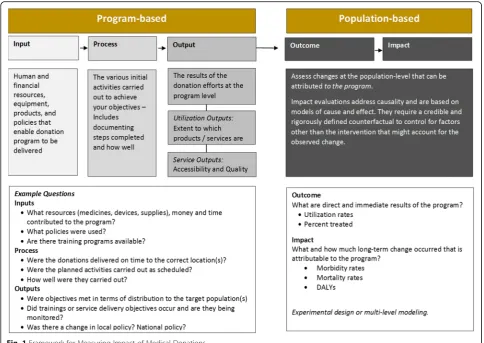
To guide the design of the survey, we developed a con-ceptual framework for assessing the impact of medical donations (Fig. 1). Data collected as part of a medical do-nation program can be classified based on whether they describe the resources used, the outcome observed at the program level, or the impact observed at the population level. Examples of input indicators at the program level include data on human and financial resources, quantity of products distributed, and policies identified to initiate the program. Examples of process indicators include whether the donations were delivered on time, whether other planned related activities were carried out as intended, and how well planned activities were carried out. Examples for output measures at the program level include utilization, accessibility, and quality. Outcome, or impact, is defined as changes in population health that can be attributed to the program. Examples of impact measures include mortality, morbidity, and disability-adjusted life-years. Unlike other indicators, evaluation of impact is typically based on models of cause and effect and requires a counterfactual to control for factors other than the intervention that might account for the observed change in population health.
Results
that completed the survey, 12 were corporations and 13 were non-governmental organizations. Twenty-one out of 25 organizations reported having been involved in provid-ing medical donations for over 20 years. Similarly, 21 orga-nizations reported having a person dedicated to managing medical donations. Eighty-eight percent of organizations reported having an internal policy on medical donations. Thirty-six percent of organizations reported having a publicly available external policy on medical donations.
Respondent organizations provided information on a total of 34 donation programs. Characteristics of these donation programs are summarized in Table 1. Thirty-three out of 34 donation programs were ongoing as of the date of the survey. Forty-four percent of donation programs have been operating for over a decade, while 29 % were initiated within the past five years. These pro-grams were reportedly described by respondents because they meet a major unmet need, have the most units do-nated, are of strategic importance to the organization, are the longest or are most costly. The reported goals of these donation programs included donating medicines, equipment, and funding; providing direct care to pa-tients; addressing rare diseases; educating healthcare
professionals, volunteers, technicians, and patients; and managing supply chains. Sub-Saharan Africa and Latin America were the two regions most frequently targeted by the donation programs. Thirteen out of 34 donation programs targeted less than or equal to five different countries. Seven targeted over 50 countries. Recipient country coordination of donations was usually through local hospitals and medical professionals, host-nation Ministry of Health, regional or country office of the organization, and host-nation NGOs.
Donations consisted of a wide range of medical products and services (Table 1). Medical devices, anti-infectives, analgesics, and medical supplies were among the most fre-quently donated products. The estimated fair market value (FMV) for the donated products for these programs ranged from under one million to over 50 million US dollars (USD). Nine programs donated products that were reportedly valued at more than 50 million USD. The most common estimation method for the FMV was the whole-sale acquisition cost (WAC), with 16 programs reporting having used this estimation method. Some organizations also reported using internal formulas or list prices to calculate the FMVs for donated products.
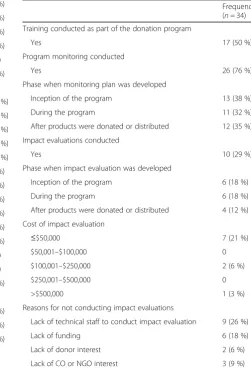
Seventeen out of 34 (50 %) donation programs re-ported conducting training as a part of their donation program (Table 2). Trainings were provided in the topic areas of disease diagnosis and treatment, nursing skills, maternal and neonatal care, pharmaceutical products usage, mass drug administration, waste management,
Table 1Donation program characteristics by whether an impact evaluation was reported
Total (n= 34) Year program was initiated
2005 and before 15 (44 %)
2006–2010 7 (21 %)
2011–2015 10 (29 %)
Don’t know 2 (7 %)
Reasons considered a major donation program
Addresses a major unmet need 26 (76 %) Has the most units donated 18 (53 %)
Of strategic importance to the organization 18 (53 %)
One of the longest 14 (41 %)
One of the most costly 8 (24 %)
Has the most employees work on it 7 (21 %)
Othera
5 (15 %)
Types of events targeted by donation
Ongoing unmet needs in low-resource settings 23 (68 %)
Strengthening or rebuilding healthcare infrastructures 14 (41 %)
Natural disaster 9 (26 %)
Epidemics 8 (24 %)
Complex emergencies, conflict, war 6 (18 %)
Displaced populations, refugee support 6 (18 %)
Famine, food insecurity 2 (7 %)
Otherb 7 (21 %)
Types of products donated
Medical devices, medical equipment 23 (68 %)
Anti-infectives 14 (41 %)
Medical supplies 13 (38 %)
Analgesics 11 (32 %)
Nutritional 10 (29 %)
Respiratory 9 (26 %)
Skin 9 (26 %)
Gastrointestinal 7 (21 %)
Vaccines 7 (21 %)
Oncology medications 6 (18 %)
Oral health 5 (15 %)
Diabetes medications 3 (9 %)
Vector control 2 (6 %)
Otherc
4 (12 %)
Estimated fair market value (FMV) of donationsd
≥$50,000,000 9 (26 %)
$25,000,000–$49,999,999 6 (18 %)
$5,000,000–$24,999,999 5 (15 %)
Table 1Donation program characteristics by whether an impact evaluation was reported(Continued)
$1,000,000–$4,999,999 7 (21 %)
<$1,000,000 3 (9 %)
Don’t know 4 (12 %)
a
Other reasons that were mentioned in the responses included combining equipment and clinical training; maintaining customer relations; strengthening healthcare system; historical involvement with the disease; and involving a reliable, capacity building partner
b
Other types of events included continuing education; support to frontline health workers; rare diseases; and breast cancer
c
Other types of donated products included anesthetics; medicines for cardiovascular diseases; medicines for mental illnesses; ophthalmic medicines; and enzyme replacement therapies for rare diseases
d
Some organizations used internal formulas or list prices to calculate the FMVs for donated products
Table 2Training, monitoring, and impact evaluations
Frequency (n= 34) Training conducted as part of the donation program
Yes 17 (50 %)
Program monitoring conducted
Yes 26 (76 %)
Phase when monitoring plan was developed
Inception of the program 13 (38 %)
During the program 11 (32 %)
After products were donated or distributed 12 (35 %)
Impact evaluations conducted
Yes 10 (29 %)
Phase when impact evaluation was developed
Inception of the program 6 (18 %)
During the program 6 (18 %)
After products were donated or distributed 4 (12 %)
Cost of impact evaluation
≤$50,000 7 (21 %)
$50,001–$100,000 0
$100,001–$250,000 2 (6 %)
$250,001–$500,000 0
>$500,000 1 (3 %)
Reasons for not conducting impact evaluations
Lack of technical staff to conduct impact evaluation 9 (26 %)
Lack of funding 6 (18 %)
Lack of donor interest 2 (6 %)
healthcare facility management, supply chain manage-ment, health worker safety, application for drug donations, and program monitoring and evaluation. The format of trainings usually consisted of classroom training, mentor-ships, or virtual training. External groups involved in pro-viding the training included donor partners, local and international universities, US-based medical research groups, host-nation ministries of health, international organizations, and external NGOs.
Of the 34 donation programs, 10 (29 %) were reported to have been evaluated for their impact Each of the orga-nizations that reported conducting an impact evaluation worked in the area of medication donation for more than two decades and reported key staff were devoted to managing medical donations. The longer an organization was engaged in medical donation programs, the greater likelihood that a rigorous evaluation was conducted, as was having staff dedicated to the medical donations program. Two key barriers to conducting impact evalua-tions for medical donation programs reported by the respondents were lack of technical staff and lack of funding. Impact evaluations that met stakeholders’needs were often reported to be“very costly”, and some orga-nizations indicated they could not afford such impact evaluations. Seven out of the 10 impact evaluations in this survey were reported to cost less than or equal to 50,000 USD. Impact evaluations were conducted by internal evaluation departments, local and international universities, recipient health facilities, and external NGOs. Similar to monitoring plans, impact evaluations were developed at various phases of the program.
Metrics chosen for impact evaluations depended on the nature of the medical donations. Some examples of reported metrics were quantity of donations; number of patients receiving and benefiting from the treatment; improvement in knowledge and skills; usefulness of train-ing; deficits in budgets of the ministry of health; and participating health facilities.
Findings from impact evaluations were reported to have been disseminated to key stakeholders and the general public through periodic reports, end-user reports, periodic meetings, presentations at forums and conferences, web-sites and other social media, and scientific publications. Findings were reportedly used to improve the donation program, set the stage for establishing future partnerships, demonstrate continual improvement of internal process and commitment to patients and healthcare, and improve donor-recipient relationships and encourage increased quantity and improved quality medical donations.
Discussion
Findings from this survey demonstrate that responding organizations provide a broad range of medical donations, targeting a wide range of public health issues and events.
Nearly 80 % of the donation programs in this study re-ported having conducted some level of monitoring and evaluation. However, the types of metrics used in reported evaluations varied greatly. Units of donation and number of patients receiving the donation were often reported to be tracked in an ongoing fashion since they are generally more readily available. However, a program’s impact at the population level was infrequently evaluated. When a pro-gram was evaluated, metrics chosen depended on the nature of the medical donations, and some epidemio-logical and economic outcomes were reported to have been used by a few member organizations.
Most of the impact evaluations reported in this study were relatively small in scale, costing under $50,000. Some organizations indicated that with limited resources, they could only afford small-scale evaluations of the donation programs, although these evaluations may not fully meet stakeholders’ needs. Lack of technical staff and lack of funding were cited as key barriers to conducting a rigor-ous impact evaluation, despite of a considerable amount of interest in it among PQMD member organizations.
While the survey provides a baseline assessment of past and current evaluations, there were some limita-tions to this survey. The donation programs described in this study are not representative of the full range of do-nation programs among the organizations surveyed, nor do they represent the totality of medical donation pro-grams in general, and thus should not be generalized as such. The survey was limited to asking about major donation programs, and the judgment of whether a do-nation program can be considered a major one was left to the respondents. While the purpose of this survey was to provide insights into the breadth and depth of medical donation programs and evaluations by PQMD members, the survey was not tailored to a specific type of donation or organization. As a result, some respon-dents may have found some questions not applicable to their organizations or their donation programs. Finally, while a 69 % response rate is generally recognized as acceptable, a higher response rate would have provided more confidence in the generalizability of our results and reduced the likelihood of non-response bias.
Conclusions
and policies, and would benefit both donors and recipients of medical donation programs.
Acknowledgements
We thank the respondents for their time and insights without which this study would not have been possible.
Funding
This study was funded by the Partnership for Quality Medical Donations (PQMD). The contents are the responsibility of the authors and do not necessarily reflect the views of PQMD member organizations.
Availability of data and materials See supporting file.
Authors’contributions
EJ, MA, CF, and AS conceived of the design and methods. AJ and ML created the survey instrument. ML and AJ analyzed and interpreted the survey data. AJ drafted the manuscript. All authors read and approved the final manuscript.
Competing interests
EA is employed by the Partnership for Quality Medical Donations (PQMD). None of the authors have a competing interest in the manuscript.
Consent for publication Not applicable.
Ethics approval and consent to participate
This study was determined to be exempt from institutional review by the University of Washington (UW) Human Subjects Division.
Author details
1
Department of Global Health, Global Medicines Program, University of Washington, Harris Hydraulics Building, Room 321, 1705 NE Pacific St., Box 357965, Seattle, WA 98195-7965, USA.2Department of Pharmacy, Pharmaceutical Outcomes Research and Policy Program, University of Washington, Seattle, WA, USA.3Partnership for Quality Medical Donations, Annapolis, MD, USA.4Pacific Links LLC, Grand Rapids, MI, USA.5Merck,
Kenilworth, NJ, USA.
Received: 18 July 2016 Accepted: 20 October 2016
References
1. Cameron A, Ewen M, Ross-Degnan D, et al. Medicine prices, availability, and affordability in 36 developing and middle-income countries: A secondary analysis. Lancet. 2009;373:240–9.
2. Cameron A, Roubos I, Ewen M, et al. Differences in the availability of medicines for chronic and acute conditions in the public and private sectors of developing countries. Bull World Health Organ. 2011;89:412–21. 3. van Mourik MS, Cameron A, Ewen M, et al. Availability, price and
affordability of cardiovascular medicines: A comparison across 36 countries using WHO/HAI data. BMC Cardiovasc Disord. 2010;10:25.
4. Babar ZU, Lessing C, Mace C, et al. The availability, pricing and affordability of three essential asthma medicines in 52 low- and middle-income countries. Pharmacoeconomics. 2013;31(11):1063–82.
5. Cameron A, Bansal A, Dua T, et al. Mapping the availability, price, and affordability of antiepileptic drugs in 46 countries. Epilepsia. 2012;53(6):962–9. 6. World Health Organization. Substandard, spurious, falsely labelled, falsified and counterfeit (SSFFC) medical products. http://www.who.int/mediacentre/ factsheets/fs275/en/. Accessed 25 July 2014. (Updated January 2016). 7. Institute of Medicine. Countering the problem of falsified and substandard
drugs. National Academies Press, 2013. www.nap.edu/catalog.php?record_ id=18272. Accessed 25 July 2014.
8. Reliefweb. Annual Disaster Statistical Review 2014: The numbers and trends. http://reliefweb.int/report/world/annual-disaster-statistical-review-2014-numbers-and-trends. Accessed 5 July 2016.
9. Hanson C, Weaver A, Zoerhoff KL, et al. Integrated implementation of programs targeting neglected tropical diseases through preventive
chemotherapy: identifying best practices to roll Out programs at national scale. Am J Trop Med Hyg. 2012;86(3):508–13.
10. Hudson Institute. The Pharmaceutical Industry’s Contributions to The United Nation’s Millennium Development Goals. Washington, DC, May 2013. http:// dev.hudson.org/content/researchattachments/attachment/1260/the_ pharmaceutical_industry_s_contibutions_to_the_un_millennium_ development_goals.pdf. Accessed 4 Apr 2015.
11. Mahmood M, Riley K, Bennett D, et al. The supply of pharmaceuticals in humanitarian assistance missions: implications for military operations. Mil Med. 2011;176(8):852–7.
12. World Health Organization. http://www.who.int/selection_medicines/ emergencies/guidelines_medicine_donations/en. Accessed 6 Jun 2016. 13. Autier P, Govindaraj R, Gray R, et al. Drug Donations in Post-Emergency
Situations. Health, Nutrition and Population Discussion Paper. Washington, DC: The International Bank for Reconstruction and Development / The World Bank; 2002.
14. Berckmans P, Dawans V, Schmets G, et al. Inappropriate drug donation practices in Bosnia and Herzegovina, 1992–1996. N Eng J Med. 1997; 337:1842–45.
15. Bonati M, Forte GB, de Joncheere K, et al. Drug donations to Bosnia-Hercegovina are often inappropriate. BMJ. 1996;313(7063):1011.
16. Saunders P. Donations of useless medicines to Kosovo contributes to chaos. BMJ. 1999;319(7201):11.
17. Ladner J, Besson MH, Rodrigues M, et al. Prevention of mother-to-child HIV transmission in resource-limited settings: assessment of 99 Viramune Donation Programmes in 34 countries, 2000–2011. BMC Public Health. 2013;13:470. 18. Tekinturhan E, Audureau E, Tavolacci MP, et al. Improving access to care in
low and middle-income countries: institutional factors related to enrollment and patient outcome in a cancer drug access program. BMC Health Serv Res. 2013;13:304.
19. Gustavsen KM, Bradley MH, Wright AL. GlaxoSmithKline and Merck: private-sector collaboration for the elimination of lymphatic filariasis. Ann Trop Med Parasitol. 2009;103 Suppl 1:S11–5.
20. Boatin B. The Onchocerciasis Control Programme in West Africa (OCP). Ann Trop Med Parasitol. 2008;102 Suppl 1:13–7.
21. Wertheimer AI, Santella TM, Lauver HJ. Successful public/private donation programs: a review of the Diflucan Partnership Program in South Africa. J Int Assoc Physicians AIDS Care (JIAPAC). 2004;3(3):74–9. 84–5.
22. Peters D, Phillips T. Mectizan donation program: evaluation of a public-private partnership. Tropical Med International Health. 2004;9:4–15. 23. Burnham G, Mebrahtu T. The delivery of ivermectin (Mectizan). Tropical Med
Int Health. 2004;9:26–44.
24. Paluzzi JE.“Dualities of interest”: the inter-organizational relationships between disease-specific nonprofits and the pharmaceutical industry. Int J Health Serv. 2012;42(2):323–39.
25. Bero L, Carson B, Moller H, et al. To give is better than to receive: compliance with WHO guidelines for drug donations during 2000–2008. Bull World Health Organ. 2010;88(12):922–9.
26. Turner HC, Walker M, Churcher TS, et al. Reaching the London declaration on neglected tropical diseases goals for onchocerciasis: an economic evaluation of increasing the frequency of ivermectin treatment in Africa. Clin Infect Dis. 2014;59(7):923–32.
27. Turner HC, Walker M, Churcher TS, et al. Modelling the impact of ivermectin on River Blindness and its burden of morbidity and mortality in African Savannah: EpiOncho projections. Parasit Vectors. 2014;7:241. 28. Waters HR, Rehwinkel JA, Burnham G, et al. Economic evaluation of
Mectizan distribution. Trop Med Int Health. 2004;9(4):A16–25.
29. Coffeng LE, Stolk WA, Hoerauf A, et al. Elimination of African onchocerciasis: modeling the impact of increasing the frequency of ivermectin mass treatment. PLoS One. 2014;9(12):e115886.
30. PQMD. www.pqmd.org. Accessed 6 July 2016.