University of Trento
Doctoral School in Psychological Sciences and
Education
(XXIII cycle)
PhD Thesis
Uniqueness in Cognition
by
Barbara Bazzanella
ADVISOR:
Prof. Paolo Bouquet
University of Trento
SCHOOL COORDINATOR:
Prof. Nicolao Bonini
“To me, you are still nothing more than a little boy who is just like a hundred thousand other little boys. And I have no need of you. And you, on your part, have no need of me. To you, I am nothing more than a fox like a hundred thousand other foxes. But if you tame me, then we shall need each other. To me, you will be unique in all the world. To you, I shall be unique in all the world...”
Abstract
A fundamental aspect of human cognition is that we construe the environ-ment as including unique individuals that belong to various categories. An individual dog, for example, could simultaneously be a living being, a mammal or a poodle, but when it comes to things that are important to us - our dog Fido, our favorite restaurant, our spouse - we also represent the individuals themselves, not just the categories they belong to. Cognitive psychologists have made an extensive study of categories of objects but have had less to say con-cerning conceptions of individuals, i.e. singular concepts, and how they support our ability to uniquely identify individual entities in different situations.
The primary goal of this work is to investigate the nature and the functioning dynamics ofsingular concepts and explore how these concepts underliesingular cognition, i.e. the ability to identify a known entity, through perceptual or epistemic access to its memorial representation, and trace it as the sameunique
entity over time and change.
To perform such a process the cognitive system is confronted with a unique-ness problem. It needs to pick an individual entity out, secure a unique mental referential link with the entity and maintain that link over time and change.
We argue that singular concepts are the cognitive devices that are special-ized for this function and we propose a model of singular cognition that has the notion of singular concept at its core. The main assumption of this model is that conceptual representations about individuals (i.e. singular concepts) rep-resent a networks of unique files in memory which mediate the direct access to individual-specific knowledge and provide a unique mechanism of identification and reference for unique individuals. According to our model, the access to this system is not mediated by higher level representations (i.e. general concepts), neither is internally organized by these representations. On the contrary, it is subjected to its own functioning dynamics and it is organized through associa-tive links which connect different individual concepts and causal links which maintain the conceptual history of an entity, by linking different states of the same singular concept, across time and change.
We can distinguish four main phases of our investigation about singular concepts which led to the proposed model of singular cognition.
1) In the first phase we investigated what is the preferential level of ab-straction at which an individual entity is first identified (i.e. the entry point of recognition). Since any individual object can be identified at multiple levels of abstraction (e.g. a dog can be identified as a “dog”, more generally as “animal” or more specifically as “poodle” or “Fido”), the aim was to test the hypothesis that the singular concept of an object acts as the access node to the knowledge that the agent has about the object and this access is direct and not mediated by higher level concepts. Results from three experiments on visual recognition provided evidences in favor of this hypothesis, indicating that the entry level of identification of unique individuals is shifted to the most subordinate level of abstraction, i.e. the level of unique identity.
a priming experiment which provided evidence in favor of a model in which singular concepts are organized by means of horizontal associative links instead of by vertical links with higher level representations.
3) In the third phase of our investigation we looked inside a singular concept and we explored which attributes people consider more relevant to uniquely identify entities belonging to different categories and determine the cognitive importance that individual attributes have in identifying these entities. We also explored which are the most relevant attributes that people use to identify entities in a specific task, i.e. the search for information about individual entities by means of keyword queries on the Web.
4) The last phase of the investigation concerned with the problem of how people judge the identity of entities over time and change. An experiment was conducted which explored how people evaluate the identity of entities over changes in their descriptions. The results of the study have been interpreted in the light of a causal model of the functioning of singular concepts in keeping the unique referential link with the entity across change.
Beyond the cognitive issues, this work is also motivated by the recent devel-opment of technological approaches to the problem of entity identification.
Since many identification problems which are addressed by a cognitive sys-tem have a counterpart in information syssys-tems which manage information about individual entities (e.g. to represent or extract information about unique indi-viduals and manage individual-specific knowledge across time and change), the last goal of our work is to make an investigation of possible contributions that a cognitive study on the problem of individual identification can provide to technological applications. In particular we focused on the problem of entity identification in search systems. A model and an application for a specific tech-nological problem, i.e. entity type disambiguation in Web-search queries, is described and its beneficial impact is evaluated.
Contents
1 Introduction 1
1.1 Mission Statement . . . 7
2 Singular Concepts and Singular Cognition 9 2.1 Singular Concepts: what they are and what they are not . . . 9
2.2 Functional Dynamics of Singular Concepts . . . 14
2.3 The problem of Singular Cognition . . . 17
I
Background and State of the Art
19
3 Uniqueness in Cognitive Models 21 3.1 Singular Representations and Reference in Psychology of Vision and Attention . . . 213.1.1 Object Files . . . 22
3.1.2 Visual Indexes . . . 25
3.1.3 Object Indexes and Object Concepts . . . 29
3.2 Singular Representations in Models of Face Recognition and Nam-ing . . . 31
3.3 Cognitive Theories of Object Identity . . . 41
3.3.1 Sortalist Approaches to the Problem of Singular Cognition 41 3.3.2 Non-sortalist Approaches to the Problem of Singular Cog-nition . . . 52
3.4 Proper Names as Index of Individual Identity . . . 57
4 Neural Basis of Singular Concepts 63 4.1 Neuropsychological Evidences . . . 64
4.2 Neuroimaging Evidences . . . 68
5 The Problem of Identity in Information Systems 75 5.1 Entity-level Information Integration . . . 76
5.2 Identity and Reference on the Semantic Web . . . 79
II
Novel Contributions
85
6 The Entry Point in the Identification of Individuals 87
6.1 Introduction . . . 88
6.2 Objectives and Rationale of the Study . . . 92
6.3 Methodology . . . 95
6.4 Experiment 1: Entity Naming . . . 97
6.4.1 Method . . . 98
6.4.2 Results . . . 99
6.5 Experiment 2: Category-Verification Task . . . 104
6.5.1 Method . . . 105
6.5.2 Results . . . 107
6.6 Experiment 3: Identity Matching Task . . . 112
6.6.1 Method . . . 113
6.6.2 Results . . . 115
6.7 General Discussion . . . 117
7 Associative and Semantic Priming in Recognition of Individu-als 121 7.1 Introduction . . . 121
7.2 Categorical and associative relatedness between entities and prim-ing effects . . . 123
7.3 Objectives and Rationale of the Study . . . 131
7.4 An Entity Recognition Experiment . . . 133
7.4.1 Pilot Study: stimulus selection . . . 133
7.4.2 Method . . . 135
7.4.3 Results . . . 137
7.5 Discussion . . . 143
7.6 Implications for a Model of Entity Representation . . . 146
8 Identification Relevance in Entity Representation 151 8.1 Semantic Feature Norms Production for Individual Entities . . . 152
8.1.1 Method . . . 153
8.1.2 Results . . . 163
8.2 An Entity Search Experiment . . . 176
8.2.1 Method . . . 180
8.2.2 A Naive Bayes Model of Attribute Relevance . . . 182
8.2.3 Results . . . 183
8.2.4 Discussion . . . 196
9 Tracing the Identity of Individual Entities 199 9.1 Experiment 1: Mutability and Causal Distance Norms Production 204 9.1.1 Method . . . 206
9.1.2 Results . . . 208
9.2 Experiment 2: Identity Decisions across Change . . . 209
9.2.1 Method . . . 211
9.2.2 Results . . . 213
10 An Application for Entity Type Disambiguation in Queries
us-ing RDF Triples as Knowledge-Base 225
10.1 Related Works . . . 228
10.2 The Entity Type Disambiguation Problem . . . 232
10.2.1 A simplified version of The Entity Type Disambiguation Problem . . . 233
10.3 A new approach for Entity Type Disambiguation . . . 235
10.4 PropLit: an application based on a index of RDF predicates . . . 238
10.5 Index Evaluation . . . 244
10.6 Conclusion . . . 251
11 Conclusions and Future Work 255 A Experimental Materials used in the Entry Point Experiments 271 A.1 Entry Point Experiment 2 . . . 271
A.2 Entry Point Experiment 3 . . . 273
B Experimental Materials used in the Entity Recognition Exper-iment 275 B.1 Entity Recognition Experiment . . . 275
C Relevance Measures 277 C.1 Feature Norms for Individual Entities . . . 277
C.2 Entity Search Experiment . . . 293
C.2.1 Attribute frequencies for the entity types of the entity search experiment . . . 293
C.2.2 Bayesian relevance measures for low-level entity types . . 298
C.2.3 Position Distribution of Attribute Types . . . 301
D Mutability and Causality Ratings: Stimuli and Measures 304 D.1 Entity profiles used to collect mutability and causality ratings . . 304
D.2 Mutability and Causality Ratings . . . 308
D.3 Entity Profiles used in Experiment 2 . . . 310
D.4 Response Distribution in Experiment 2 . . . 315
D.4.1 Causal Continuer Model Fit . . . 315
D.4.2 Naive Causal Model Fit . . . 325
E PropLit Index 335 E.1 Predicate-Entity Type Mapping used in the RDF index . . . 335
E.2 Top-50 RDF Predicates and their frequency . . . 337
List of Figures
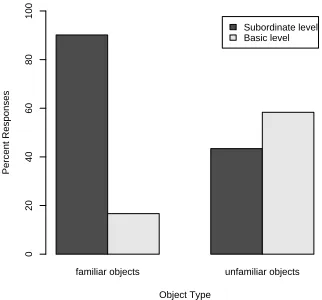
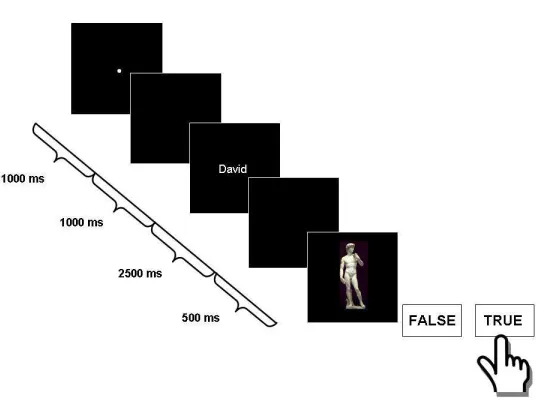
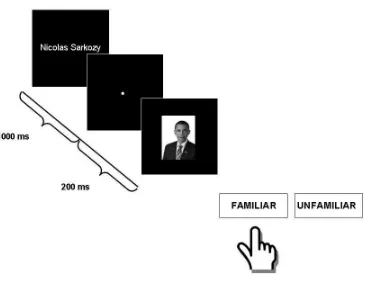
6.1 Percentage of basic level and subordinate level labels used in the naming task. . . 102 6.2 Category×Level of Categorization interaction. . . 103 6.3 Trial presentation sequence in the category verification task. . . . 106 6.4 Mean Reaction Times for the three categories of familiar entities,
at the superordinate, basic and subordinate levels in the true condition. . . 108 6.5 Mean Reaction Times for the three categories of unfamiliar
en-tities, at the superordinate, basic and subordinate levels in the true condition. . . 109 6.6 Mean Reaction Times for categorizing familiar and unfamiliar
en-tities at superordinate, basic and subordinate levels in the TRUE condition. . . 110 6.7 Mean Reaction Times for categorizing familiar and unfamiliar
en-tities at superordinate, basic and subordinate levels in the FALSE condition. . . 112 6.8 Trial presentation sequence in the identity matching task. . . 114 6.9 Results of the Experiment 3. . . 117
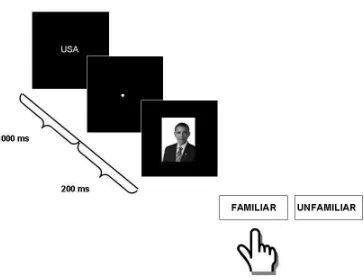
7.1 Trial presentation sequence in the entity recognition task (asso-ciative priming). . . 136 7.2 Trial presentation sequence in the entity recognition task
(cate-gorical priming). . . 137 7.3 Mean response times for the category Person Across by prime
condition. . . 138 7.4 Mean response times for the Person Within category by prime
condition. . . 139 7.5 Mean response times for the Artwork category by prime condition.139 7.6 Mean response times for the Building category by prime condition.140 7.7 Mean response time for the Product category by prime condition. 141 7.8 Mean response times for the Person Across and Person Within
categories by prime condition. . . 141 7.9 Mean response times for the three object categories by prime
condition. . . 142 7.10 Mean reaction times for face recognition and object recognition
at the three levels of priming condition . . . 143 7.11 Associative and Categorical links between singular concepts . . . 147
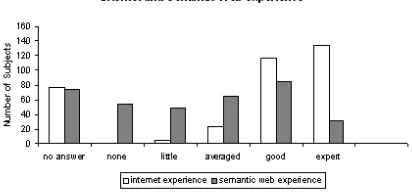
8.2 Self-evaluation of the participants regarding Internet and Seman-tic Web Experience . . . 163 8.3 Geographical provenance of participants of the entity search
ex-periment. . . 180 8.4 Search interface used in the experiment to collect the
partici-pants’queries. In figure is shown the trial about a person search. 182 8.5 First five Google results for the query Q1=Silvio Berlusconi
Me-diaset. . . 190 8.6 First five Google results for the query Q2=Mediaset Silvio
Berlus-coni. . . 191 8.7 Probability distribution of attribute types for the first four
posi-tions in queries about Person. . . 192 8.8 Probability distribution of attribute types for the first four
posi-tions in queries about Organization. . . 192
9.1 Response frequencies of the response strategies used by partici-pants (question 1) in the two experimental groups. . . 209 9.2 Response frequencies of the response strategies used by
partici-pants (question 2) in the two experimental groups. . . 210 9.3 Distribution of the causal distance differences between the
con-tinuers in the person tasks used in experiment 2. . . 212 9.4 Person tasks 1-8. Percentage of responses that the continuer 1,
continuer 2, both continuers, or neither continuers refers to the same entity as the original description. Lines with square points are predictions from the causal continuer model. . . 217 9.5 Person tasks 9-15. Percentage of responses that the continuer 1,
continuer 2, both continuers, or neither continuers refers to the same entity as the original description. Lines with square points are predictions from the causal continuer model. . . 218
10.1 Graphical representation of an RDF statement. . . 236 10.2 Snapshot of the list of ranked predicates returned by the basic
search of the PropLit Index for the term “Barack”. . . 241 10.3 Snapshot of the list of ranked predicates returned by the basic
search of the PropLit Index for the term “San Salvador”. . . 242 10.4 Snapshot of the output returned by the advanced search of the
PropLit Index for the term “Barack”. . . 242 10.5 Output of the basic (a) and advanced (b) modules for the query
“Carlo Bonatti” . . . 245 10.6 Output of the advanced search module for the query “New York
USA” . . . 246 10.7 Percentage of correct disambiguations (true positives) on single
term queries. . . 247
C.1 Probability distribution of attribute types for the first four posi-tions in queries about Person. . . 301 C.2 Probability distribution of attribute types for the first four
posi-tions in queries about Organization. . . 301 C.3 Probability distribution of attribute types for the first four
C.4 Probability distribution of attribute types for the first four posi-tions in queries about Artifact. . . 302 C.5 Probability distribution of attribute types for the first four
posi-tions in queries about Location. . . 303
D.1 Percentage of responses and fit of the Causal Continuer Model (person tasks 1-8). . . 315 D.2 Percentage of responses and fit of the Causal Continuer Model
(person tasks 9-15). . . 316 D.3 Percentage of responses and fit of the Causal Continuer Model
(organization tasks 1-8). . . 317 D.4 Percentage of responses and fit of the Causal Continuer Model
(organization tasks 9-15). . . 318 D.5 Percentage of responses and fit of the Causal Continuer Model
(event tasks 1-8). . . 319 D.6 Percentage of responses and fit of the Causal Continuer Model
(event tasks 9-15). . . 320 D.7 Percentage of responses and fit of the Causal Continuer Model
(artifact tasks 1-8). . . 321 D.8 Percentage of responses and fit of the Causal Continuer Model
(artifact tasks 9-15). . . 322 D.9 Percentage of responses and fit of the Causal Continuer Model
(location tasks 1-8). . . 323 D.10 Percentage of responses and fit of the Causal Continuer Model
(location tasks 9-15). . . 324 D.11 Percentage of responses and fit of the Naive Causal Model (person
tasks 1-8). . . 325 D.12 Percentage of responses and fit of the Naive Causal Model (person
tasks 9-15). . . 326 D.13 Percentage of responses and fit of the Naive Causal Model
(orga-nization tasks 1-8). . . 327 D.14 Percentage of responses and fit of the Naive Causal Model
(orga-nization tasks 9-15). . . 328 D.15 Percentage of responses and fit of the Naive Causal Model (event
tasks 1-8). . . 329 D.16 Percentage of responses and fit of the Naive Causal Model (event
tasks 9-15). . . 330 D.17 Percentage of responses and fit of the Naive Causal Model
(arti-fact tasks 1-8). . . 331 D.18 Percentage of responses and fit of the Naive Causal Model
(arti-fact tasks 9-15). . . 332 D.19 Percentage of responses and fit of the Naive Causal Model
(loca-tion tasks 1-8). . . 333 D.20 Percentage of responses and fit of the Naive Causal Model
List of Tables
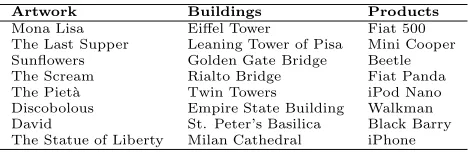
6.1 List of familiar artifacts used in Experiment 1 . . . 98
6.2 List of unfamiliar artifacts used in Experiment 1 . . . 99
6.3 Percentage Frequencies by Object category and Level of abstraction101 6.4 Percentage Frequencies by Object category and Level of abstrac-tion: aggregated responses . . . 101
6.5 Percentage of correct TRUE (CT) and correct FALSE (CF) re-sponses by category. . . 107
6.6 Mean Reaction Times for the TRUE responses as a function of Category (familiar vs. unfamiliar) and Category Level (superor-dinate, basic and subordinate. . . 108
6.7 Mean Reaction Times for the FALSE responses as a function of Category (familiar vs. unfamiliar) and Category Level (superor-dinate, basic and subordinate. . . 111
6.8 Mean RTs in milliseconds (and standard errors of the mean) by Object Category and Prime Type . . . 115
7.1 Mean Reaction Times (RT) in milliseconds (and Standard Errors (SE)) and Accuracies (AC) for Conditions of the Entity Recog-nition Experiment . . . 137
8.1 Categories and Subcategories used in the experiment. . . 161
8.2 Geographical provenance of participants. . . 162
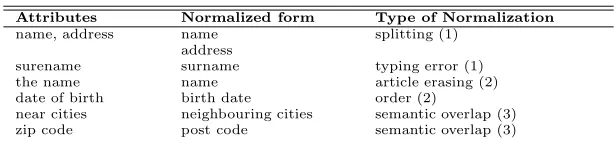
8.3 Normalization examples. 1=structural normalization; 2= mor-phological normalization; 3=semantic normalization . . . 164
8.4 Features and production frequencies for the categoryPerson . . 165
8.5 Features and production frequencies for categoryPerson: aggre-gated data (i.e. English and Italian). . . 166
8.6 Local Dominance for selected top-level categories. We marked with an * the attributes that appear in the first 5 positions of dominance also in the analysis which considered only the neutral categories. . . 171
8.7 Entity types and subtypes used in the entity search experiment. . 182
8.8 Two-step Preprocessing . . . 183
8.9 Bayesian Relevance: top-level entity types . . . 186
8.10 Attribute Types: examples . . . 186
8.11 Bayesian Relevance: Person . . . 187
8.12 Confusion matrix: learning set. . . 188
8.13 Learning set evaluation. TP=true positive; FP=false positive . . 189
8.15 Test-set Evaluation of the NBM. . . 193
8.16 Test-set Evaluation of the EBM . . . 193
8.17 Performance Measures . . . 195
8.18 Relative performance . . . 196
9.1 Causal Continuer Model Fit . . . 215
9.2 Naive Causal Model Fit . . . 219
10.1 Entity Type Disambiguation example . . . 247
10.2 Performance of the advanced search module on single term queries.248 10.3 Detection and Disambiguation Effectiveness . . . 249
10.4 Baseline performance . . . 250
A.1 Stimuli and categories words used in experiment 2 . . . 272
A.2 Stimuli and categories words used in experiment 3 . . . 274
B.1 Prime words and Stimuli used in the entity recognition experiment276 C.1 Features and production frequencies forPerson . . . 278
C.2 Features and production frequencies for Person: aggregated data (i.e. English and Italian). . . 279
C.3 Features and production frequencies forOrganization . . . 280
C.4 Features and production frequencies forOrganization: aggre-gated data (i.e. English and Italian) . . . 281
C.5 Features and production frequencies forEvent . . . 282
C.6 Features and production frequencies forEvent: aggregated data (i.e. English and Italian) . . . 283
C.7 Features and production frequencies forArtifact . . . 284
C.8 Features and production frequencies forArtifact: aggregated data (i.e. English and Italian) . . . 285
C.9 Features and production frequencies forLocation . . . 286
C.10 Features and production frequencies for Location: aggregated data (i.e. English and Italian) . . . 287
C.11 Relevance Measure forPerson . . . 288
C.12 Relevance forOrganization . . . 289
C.13 Relevance forEvent. . . 290
C.14 Relevance forArtifact . . . 291
C.15 Relevance forLocation . . . 292
C.16 Attribute frequencies inPersonqueries. . . 293
C.17 Attribute frequencies inOrganization queries. . . 294
C.18 Attribute frequencies inEventqueries. . . 295
C.19 Attribute frequencies inArtifactqueries. . . 296
C.20 Attribute frequencies inLocationqueries. . . 297
C.21 Bayesian Relevance: Person . . . 298
C.22 Bayesian Relevance: Organization . . . 298
C.23 Bayesian Relevance: Event . . . 299
C.24 Bayesian Relevance: Artifact . . . 299
C.25 Bayesian Relevance: Location . . . 300
D.2 Person Profiles used in the experiment2 . . . 311
D.3 Organization Profiles used in the experiment2 . . . 312
D.4 Event Profiles used in the experiment2 . . . 313
D.5 Artifact Profiles used in the experiment2 . . . 314
D.6 Location Profiles used in the experiment2 . . . 315
E.1 Predicate-Entity Type mapping schema . . . 337
Acknowledgements
This thesis is about unique individuals but it also the product of the support and collaborative input of many “unique” people. It is my pleasure to have the opportunity to express my gratitude to many of them here.
First and foremost I want to thank my PhD supervisor prof. Paolo Bouquet for his trust and support. I would like to thank him for advising me during the course of this work, but also for giving me the freedom to find my own way. His guidance and truly scientist intuition helped me in all the time of research and writing of this thesis and contributed significantly to my growth as a student, as a researcher and as a person.
Special gratitude goes to prof. Lance Rips for the opportunity to carry out part of this project in his Higher-Level Cognition Lab at the Northwest-ern University of Chicago (USA). He was always open for precious suggestions and scientific discussions and accepted me as a full member of his group. In particular, many thanks go to Winston Chang. My work at the Northwestern University would not have been possible without his assistance and support, as well as his friendship and good advice.
I would like also to express my sincere gratitude to Dr. Giovanni Tummarello for giving me the opportunity to work in his group at the Digital Enterprise Research Institute (Galway, Ireland). The group has been a source of friendships as well as good advice and collaboration. In this context, a very special thanks to Michele Catasta for his help and support during the realization of the PropLit index.
I would also like to thank my colleagues in the Okkam Lab, particularly Heiko Stoermer, Angela Fogarolli, Stefano Bortoli, Massimiliano Vignolo, Daniel Gia-comuzzi, Sven Buschbeck, Xin Liu and George Giannakopoulos for our debates, exchanges of knowledge, skills, and venting of frustration during my PhD pro-gram, which helped enrich the experience. Thanks all of you for the great time I had in our group, as well as for the many coffees, sandwiches, teas, and funny conversations we’ve had over the last years.
For this work, data were essential. I collected a lot of data. Many people helped with this, for which I would like to thank them wholeheartedly. Hundreds of people participated to my experiments. Without their generosity there would be nothing to work with.
I also thank my friends (too many to list here but you know who you are!) for their understanding, endless patience and encouragement during these years. Among them, I would like to thank a very special person, Matteo, because he taught me a very important thing in life: we cannot change the cards we are dealt, just how we play the hand.
Chapter 1
Introduction
A fundamental aspect of human cognition is that we conceptualize the reality as including unique entities - such as specific places, persons, objects - that belong to various categories. An individual dog, for example, could simultaneously be a living being, a mammal or a poodle, but when we identify a specific dog as our dog “Fido” we access the mental representation of the individual itself not just the categories it belongs to. The processes involved in identifying an object at these two levels of abstraction (as a member of a general category or as a unique individual) are indeed quite different, as they are, we assume, their underlying memory representations. When classifying an object as a member of a category, we need to ignore the very information that is required to distinguish individual exemplars of the category and we need to connect the object with a general conceptual representation which cluster features largely shared by the members of the category. On the contrary, when we identify an object as a unique individual we activate unique semantic associations that are distinctive of that particular object compared to the other category members. We refer to the cluster of unique semantic associations linked to an entity as asingular concept, while we namesingular cognition the complex of cognitive processes that allow a cognitive agent to identify a known entity, through perceptual or epistemic access to its memorial representation, and trace it as the same unique entity perceived or known at successive moments in time. To perform such a process the cognitive system is confronted with a uniqueness problem. It needs to pick an individual entity out, secure a unique mental referential link with the entity and maintain that link over time and change. We argue that singular concepts are the cognitive devices that are specialized for this function, providing a unique referential link between the entity and its memorial representation.
put less effort studying how people represent unique individuals and how these representations (i.e. singular concepts) support our ability to identify these entities in different situations. Nonetheless, the identification process is crucial to daily life. We need to correctly recognize and identify all the individual entities relevant to our own existence (people, pets, places, objects and so on) and successfully track those individuals over time and change. When these abilities are compromised, the consequences may be devastating and a complex array of neuropsychological deficits have been documented at various stages of the identification process (a stirring example is described by Oliver Sacks in his famous book “The Man Who Mistook His Wife for a Hat” [205]).
The identification process has often been treated in a perceptual context (e.g. face recognition), since perceptual factors play a fundamental role in identifying objects. For example, I can recognize a person as familiar at a crowded party by her perceptual appearance (e.g. her face, voice, clothing) and then fully identify the person by retrieving semantic information about her, including her name.
However, there are contexts in which perceptual information is scarce or in-sufficient to ensure correct identifications. If I see the same friend after a long time, the stock of perceptual informations which are part of my representation of her may be too dated to support the identification process and the full iden-tification can be obtained only by acquiring extra information, e.g. during the conversation. In other cases perceptual information can be completely absent. For example, while reading a news item about a traffic accident, I can suspect that the person involved in the accident is a classmate whom I lost touch with a long time ago. In this situation, I have to decide about the identity of this indi-vidual using only the information reported in the article. In these cases, we can only rely on conceptual histories and higher level knowledge about individuals must come into play to allow the identification process.
We argue that this knowledge is stored in specialized mental files, which we refer to as singular concepts, which bind together our information about the individuals they are about and individuate our cognitive perspective on those individuals. However, singular concepts are not only vehicles for storing information about a particular individual, but they serve as mental identifiers which create the unique referential link between an object in the world and its mental representation in the cognitive system.
epistemic or top-down.
A mental file can be accessed via abottom-upway by a perceptual stimulus. In this case the individual is present in a sensory field of the agent’s perceptual systems and the perceptual input activates the corresponding mental represen-tation, through a direct match with the perceptual information stored in the concept. Alternatively, a mental file can be accessed via atop-downway in cases in which the target individual cannot be perceived, but can be identified on the basis of indirect information gathered by such sources as memory, reasoning or communication.
Even though many cognitive models of human knowledge assume the ex-istence of mental representations of unique individuals 1, the nature of these representations has been less investigated or has been considered less relevant to understand the identification process compared to higher level conceptual representations (as assumed, for example, by sortalist approaches to identity [268]).
The first aim of the present work is to provide a contribution to fill this gap, by proposing a general model of singular cognition based on a system of mental unique representations which ensure the agent’s individuation of unique objects through different contexts, time and change. In other words the focus is on the mechanisms and the cognitive devices of singular cognition.
We can distinguish four main phases of our investigation about singular concepts. We start with the study of how an individual entity first makes contact with its underlying memorial representation through a bottom-up way (i.e. from a perceptual stimulus to a singular concept); then, we investigate how singular concepts are organized and interrelated each other in the conceptual system; we then pass to explore some aspects of the internal organization of the knowledge stored in a singular concept and we consider the top-down access to singular concepts in a specific identification task; we finally investigate how singular concepts underlie the mechanism of tracing entities through time and change. More precisely:
1. The first phase of our research aims to investigate what is the preferential level of abstraction at which an individual entity is first identified (i.e. the
1
entry point). In particular, since any individual object can be identified at multiple levels of abstraction (e.g. a dog can be identified as a “dog”, more generally as “animal” or more specifically as “poodle” or “Fido”), the aim is to test the hypothesis that the singular concept of an object acts as the access node to the knowledge that the agent has about the object and this access is direct and not mediated by higher level concepts.
2. The second phase of this work explores how our semantic representations of individual things are organized and accessed and how these representa-tions are inter-linked with those of other individual things. In particular we test two alternative views about the organization of singular concepts in semantic memory. Acategorical view which holds that memory repre-sentations of unique entities are interconnected by belonging to common categories and anassociative view which holds that relationships between entities can be represented by networks of associative links but not by membership of a common category.
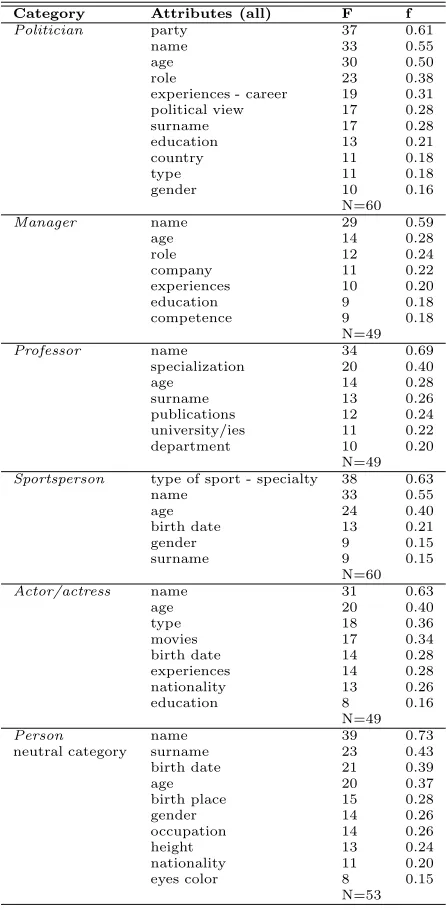
3. In the third phase of our investigation we look inside a singular concept and we explore which attributes people consider more relevant to uniquely identify entities belonging to different categories and determine the cogni-tive importance, or weight, that individual attributes have in identifying these entities. We also explore which are the most relevant attributes that people use to identify entities in a specific task, i.e. the search for information about individual entities by means of keyword queries on the Web. In this phase we explore the hypothesis that information within a singular concept is organized in terms of identification relevance and that the notion of relevance is, at least in part, contextual dependent.
4. Finally, the last phase of the research concerns with the problem of how people judge the identity of entities over time and change. Because indi-viduals can change some of their properties while persisting as the same individuals, the singular cognition system needs a function of tracking a changing entity by performing specialized updating operations, which maintain the referential link with its singular concept. In this phase of our research we explore how causal mechanisms come into play to connect the possible states of a singular concept at successive moments in time.
and provide a unique mechanism of identification and reference through time. According to our model, the access to this system is not mediated by higher level representations (i.e. general concepts), neither is internally organized by these representations, but it is subjected to own functioning dynamics based on asso-ciative links which connect different individual concepts and causal links which connect different states of the same singular concept across time and change.
Beyond the cognitive issues, this work is also motivated by the recent devel-opment of technological approaches to the problem of entity identification.
Much of information in current decentralized network-based systems - includ-ing the Web and its evolvinclud-ing extension, the Semantic Web2- is about individual entities and recently we are assisting to the transition from the centrality of doc-uments to that of entities as atomic objects of information. This transition has been recently marked in research on knowledge representation and integration by the passage from approaches more focused on high level representations - i.e. ontologies with special focus on the T-Box part of the ontology, which defines concepts and its relations - to the emergence of entity-centric approaches which focus on the instances which populate ontologies, realizing what has been re-cently called the “A-Box revenge” [235]. However it is worth to note that this is just a recent phenomenon and for years research on knowledge representation and integration was research on general categories and their relations, as well as nearly all the research on concepts in cognitive psychology was research on general categories of objects.
Contrary to the traditional trend, today, a big effort is made to allow the information integration across multiple heterogeneous sources and the idea that identifying entities is at the core of this effort is increasingly diffuse, representing also one of the main pillars of the Semantic Web.
Ideally, the information integration could be obtained by uniquely identifying entities in all the local nodes of a distributed system. However, the solution proposed by the Semantic Web to extend the use of a URI (Uniform Resource Identifier) to identify not just web pages, but any resource on the Web [20, 19], does not ensure that the same entity is consistently assigned the same URI across different sources.
Several theoretical and technological solutions to the problem of identifi-cation in the Semantic Web - referred as “identity crisis” by [44] - have been
2
recently proposed [101, 26].
A possible solution to the entity identification problem can be found within the OKKAM project [28, 29]. The goal of OKKAM is to develop an Entity Name System (ENS) for the (Semantic) Web, a web-scale infrastructure which can make sure that the same web entity is referred to through the same URI across any type of content, format, application. The ENS has a repository for storing entity identifiers along with some small amount of descriptive information for each entity. When a request for an entity is submitted, the ENS decides if a URI for this entity is already available in the repository; if it is, then the ENS will return its URI, otherwise it will issue a new URI which will be stored in the repository.
The development of an ENS leads inevitably to issues of entity representation and identification that are common to any systems that represent and manage information about entities.
The problem to define what counts as an entity is a fundamental issue. Which are the atomic objects that needs to be referenced and distinguished from other objects in an information system?
To identify something, it is necessary to distinguish it from other things, which leads to the question how an entity is supposed to be described in a way that sufficiently distinguishes it from all the other entities. Which is the most important information that allows to identify an entity?
Identity decisions, i.e. the decision if two entity descriptions refer to the same entity, are performed mainly on the information about the entity stored in the system. However the information about an entity can change across time. Which is the information more likely to change over time? What is the influence of entity change on identity?
These questions show that many cognitive issues mentioned above are rele-vant also from a technological perspective.
There is a strong parallelism between the identification needs in a cognitive system and those in a entity-centric system. Moreover many of the dynamics which govern the functioning of singular concept have a counterpart in the func-tioning of entity-centric systems. In both cases, the system stores, accumulates and updates information about individual entities creating singular representa-tion of them. A special kind of referential mechanism between singular repre-sentations in the system and the corresponding token elements in the world is required to recognize an entity as a familiar one, to access to its entity specific information (in a bottom-up or top-down way) and to fully identify the entity across successive moments in time.
these systems people are more and more faced with identifying and searching in-formation about individual entities. Therefore, the success of these interactions strongly depends on the ability for the automatic system to correctly interpret the singular cognition act, i.e. the identification act, of the user and return the information about the intended target.
Therefore, the second aim of the present work is to provide evidence of how a cognitive study on the identification problem can contribute to answer analogous questions in a technological context and inspire possible solutions to some of the most crucial issues about entity identification in entity-based systems, such as entity representation or entity resolution3.
5. The fifth and last phase of the present work aims to map some of the main cognitive issues about entity identification into corresponding technologi-cal issues, with the aim to show how the solutions adopted by the cognitive system can inspire and improve models and algorithms for identification which can be adopted in information systems. A practical example of this is reported in Chapter 10 where we describe a model and an application for entity type disambiguation of keywords in entity search.
1.1
Mission Statement
In this work we argue that a model of how individual entities are analyzed and represented by the cognitive system for the identification process will have to provide a system that does more than construct a conceptual representation of these entities. Such a model, which we might call a model of singular cognition, will also have to provide a special kind of referential connection between the elements of the mental representation and certain token elements in the world, a connection that is unmediated by higher-level conceptual representations, i.e. general concepts. We argue that this connection is secured by special mental representations, which we refer to as “singular concepts”, that provide a system of unique mental identifiers for unique entities.
The main goal of this work is to explore the nature of this system and propose a model of how people identify individual entities and trace the identity of these entities through time and change. To this end, we will address the following objectives:
3
1. to explore the first point of access to entity-specific information, stored in singular concepts, during the (visual) recognition of unique entities;
2. to investigate how semantic representations of individual entities are or-ganized and how these representations are inter-linked with those of other individual entities;
3. to investigate the internal structure of singular concepts, showing how semantic features represented within a singular concept may have differ-ent importance in concept represdiffer-entation and provide evidence of which features people consider most important to uniquely identify individual entities in different tasks;
4. to study how causal factors are involved in shaping concepts of individuals and explore how people make use of causal information to identify objects across time and change.
5. to explore the parallelism between identification problem in a cognitive system and the same problem in an information system and provide ev-idence for possible applications and benefits in developing methods for automatic entity identity management.
Chapter 2
Singular Concepts and
Singular Cognition
Many models of human cognition assume the existence of mental representations of unique individuals1. However, the nature of these representations and their functioning dynamics have been poorly investigated in cognitive psychology, in particular with reference to the identification mechanisms involved in singular cognition. In this chapter we explain what is a singular concept (and what is not a singular concept), which are its properties, how it functions and why we need such a representation mechanism which identify and keeps track of individual objects in the world across time.
2.1
Singular Concepts: what they are and what
they are not
Our knowledge of the world is mediated by two kinds of activities: 1) percep-tual activities, providing us with information about the external world; and 2) conceptual activities, allowing us to have internal representations of various categories of objects.
1
Nearly all research on conceptual activities in cognitive psychology is re-search on categories of objects, e.g. categories as “dog”, “chair” or “car”. But when it comes to things that are important to us - people, works of art, build-ings, places - we understand that much of human knowledge is about “individu-als” and we have representations of these individuals, not just of the categories they belong to. This lead us to distinguish between two kinds of conceptual representations: singular concepts andgeneral concepts.
We use the term singular concept to denote a cognitive representation of a unique individual, and we contrast singular concepts with general concepts, which are representations of categories. A representation of The Leaning Tower of Pisa is a singular concept in these terms, but our representation of (the category of) buildings or towers is a general one. There are many important differences between general and singular concepts and these differences explain some of the most peculiar properties of singular concepts.
• First of all, every (individual) entity may be identified by more than a single general concept (e.g. my dog can be identified as an “animal”, as a “dog” or as a “poodle”) and several entities can be identified by the same general concept, even though some entities can be better exemplars than others [196], e.g. my dog and the dog of my neighbor are both identified as “dogs”. On the contrary, a unique singular concept is build in memory which represents a specific individual and an entity can be fully identified as that unique entity (e.g. Fido), only by activating the corresponding singular concept 2. This means that there is a one-to-one relationship between the individual in the world and its representation in memory. We refer this property of singular concepts asconceptual uniqueness.
• Many cognitive theories assume that concepts can be considered as orga-nized structures of semantic features [197, 226, 157] and models have been proposed to capture the relative importance of different semantic features to the meaning of a concept [207]. We argue that also singular concepts can be modeled adopting a feature-based approach. However, an impor-tant difference between general and singular concepts lies in the kinds of features which represent the core meaning of a concept, i.e. the most use-ful features in discriminating the concept from those similar to it. In case of a general concept the most relevant attributes are those highly shared by the members of the category, whereas in case of a singular concept the most relevant attributes are those highly distinctive of that particular individual. This means that when identifying an object by mens of a gen-eral concept we focus on properties shared by other members of the same
2
category, ignoring the very information that is required to distinguish the object from the other exemplars of the same category. On the contrary, when identifying an object by means of a singular concept we need to dis-card the information highly shared by the exemplars of the category and focus on the distinctive information of that particular object. We name this propertyconceptual distinctiveness.
• A third important aspect deals with the following question: why do we have singular representations for certain particulars and not for others? or in other words, why do we represent certain entities only as members of general categories, but we represent other entities as unique members of singular concepts? This question reminds a similar issue about proper names that - as noted by Robin Jeshion in her paper on the significance of proper names [115] - was addressed (among other philosophers) by John Locke that discussed the issue in his Essay Concerning Human Under-standing [139]. Locke wondered “why isn’t it the case that all things have proper names?” The Locke’s answer was that it is “psychologically” impossible for a human “to frame and retain distinct ideas of all the par-ticular things we meet with: every bird and beast men saw; every tree and plant that affected the senses, could not find a place in the most ca-pacious understanding” [139, book 4, ch 3,§2 ]. The same constrain can be applied to singular concepts. Since the cognitive system has limited resources, it would be cognitively impossible to manage singular concepts for all the unique entities which a cognitive agent can meet with.
Jeshion noted that the second answer suggested by Locke was that, “even if it were possible to name every particular, it would be useless for com-munication have a proper name for each of them” [115], because naming particulars never communicated about with others could not serve the end of communication, or to use the words of Locke “it would not serve to the chief end of language” . This second answer suggests a second reason of why we have singular representations for certain particulars and not for others. We represent unique entities by means of singular concepts if this is useful for a certain function. While the function of proper names is to fix the reference in communication, functioning as longterm, interpersonally available linguistic labels of their referents, singular concepts are concep-tual devices to uniquely identify individuals within the concepconcep-tual system of a human agent. Therefore, we argue that singular concepts are initiated for those entities we need to mark as “unique” in semantic memory. There are at least two reasons why we need to mark this uniqueness.
I need to distinguish my dog Fido from all the other golden retriever which I meet with. However, it is unlikely that I need to single out the dog that I saw playing in the park last evening from all the other dogs, unless there is a particular reason (e.g. I was bitten by him).
Second, as argued by Jeshion in the case of proper names [115], we need to mark the significance of an individual. According to the “relevance view” proposed by the author “proper names and their associated mental representations are” non only devices of direct reference but, “addition-ally, and by their nature, markers of their referents’ significance”. In the same way, it is likely that we possess singular representations for certain “special” particulars because we introduce singular representations espe-cially for those particulars we regard as having intrinsic value, beyond their value as an instance of a certain category, and we do so because we wish to signal that “uniqueness”. We note, however, that we can signal the uniqueness and the relevance of an individual by building a singular concept of it , without marking the concept with a proper name label. There are objects that are relevant for us but we do not refer to them by using proper names. My Iphone, for instance, is not just a member of the mobile phone category. I have a very distinct representation of it in my semantic memory that contains, for example, information about the nice applications that I installed on it, the color of the bumper, the picture that I’m using as wallpaper and so on. In this and many other cases is the initiation of a singular concept that marks the relevance of the object rather than the ”baptism” of the object (and of its concept) with a proper name.
According to this second meaning of uniqueness, I posses a singular con-cept of my dog Fido not only because I need to distinguish him from all the other similar dogs, but also because I want to remark the significance that this entity has to me. We refer to this property of singular concepts asconceptual relevance. Even though we noted that there are significant objects that we do not mark with proper names, there are many evidences that suggest that (at least for individuals of some kinds, like for example human beings) our distinguishing of entities according to significance is largely reflected linguistically in our practices of proper name-giving and name-use. We will discuss some of these evidences in section 3.4. Many relevant examples reported in section 3.4 have been suggested and exten-sively discussed by Jeshion in her paper about the significance of proper names [115] .
In the psychology of vision, several authors have hypothesized that the visual system uses temporary “object files” for tracking and identifying objects. For example, Kahneman and Treisman [120, 121] suggest that the main result of processing visually a particular scene is to construct a set of separate (visual) files, whose function is to store information about objects in the visible scene. An object file is responsible for the perceived continuity of the seen object. We will discuss in more details the characteristics of the object file system in section 3.1. Here, we simply contrast the notion of singular concept with that of object file to highlight the characteristics of the first kind of representation.
The main difference between the two kinds of representation can be un-derstood quoting Kahneman et al. [121]. “We proposed an account of object perception as the process of setting up and utilizing temporary “episodic” rep-resentations of real world objects, which we call object files. Object files are separate from the representations stored in a long-term recognition network, which are used in identifying and classifying objects” (p.176).
An object file is therefore ashort-term representation that allows the visual tracking of an individual in a perceptual field. It is a temporary representa-tion which is addressed by its locarepresenta-tion at a particular time, not by any feature or identifying label and within which successive states of an object are linked and integrated, on the basis of spatio-temporal information. On the contrary, a singular concept is a long-term representation that allows long-term identifica-tion and entity tracking across lapses of attenidentifica-tion, sleep, and other perceptual interruptions.
2.2
Functional Dynamics of Singular Concepts
Adopting a feature-based approach, singular concepts can be represented as or-ganized structures of semantic features which store our information about the individuals they are about. However, singular concepts are not mere long-term storages for entity-specific information but are indeed specialized structures for identifying and tracking unique individuals. Singular concepts are the core structures of singular cognition. We can characterize functionally singular con-cepts to serve two primary functions.
1. They constitute a cognitive system that allows an agent to identify and track unique entities across time and change. Adopting a term used by Jeshion in [116], we call this functionIdentity Function.
2. They serve as vehicles for bundling together an agent’s fund of information about a particular entity, providing an economical and efficient means of sorting, retrieving, and adding information on the particular individual. We refer to this function asStorage Function3.
We now describe in more details the functioning dynamics underlying these functions.
1) Identity Function.4 When identifying an entity we access stored in-formation (both perceptual and semantic) to decide which, if any, previously encountered entities corresponds to the entity presently encountered. Identifi-cation is a process across time. At the first encounter with an individual entity a singular representation, i.e. a singular concept in our framework, about that individual is initiated and different kinds of information are registered in it. For example, when I first meet a person I can register in my memorial rep-resentation structural aspects about her physical appearance (e.g. face, voice, body shape) and semantic information including biographical knowledge and her proper name. If I meet that person at a second time, visual, auditory or verbal inputs are processed, leading to the formation of a temporary description that is compared with all the representations stored in memory about known persons. If a match is found a singular concept is activated and the correspond-ing semantic information is available.
However, because individuals can change some of their properties while per-sisting as the same individuals, the cognitive system needs mechanisms to ensure
3
Jeshion in [116] named this function “Bundling- function” 4
the identification of an individual as the same unique individual perceived or known at successive moments in time and across change.
We argue that these mechanisms are partly captured by functioning dynam-ics of singular concepts: initiation, updating, merging and separation.
• Initiation: a new singular concept is created when a new entity is assumed to come on the scene. For example, the first time that I know a new person, I store all the information about her in a new singular concept. Note that singular concepts, differently from object files, are concepts on individuals that we may or may not have directly perceived. We can have a singular concept for Napoleon or Pegasus even though we have never been in perceptual contact with these individuals.
• Updating: a singular concept is continually updated. The updating pro-cess ensures that the representation maintains its internal coherence and avoids the dissonance with the other beliefs of the subject. There are two aspects in the updating function. The first consists in adding new infor-mation to the representation. For instance, if a friend tells me something new about a known person, I simply update the corresponding singular concept adding the new information. The second aspect deals with revis-ing information already stored about a known entity. If I come to know that a friend of mine moved to another city, I update the corresponding representation changing the specific information within the biographical knowledge about him.
• Merging: singular concepts are merged when the agent comes to identify two entities previously taken to be distinct. Imagine, for example, that you never met the sister of a friend. Nonetheless, you have a singular representation about her based on what you know from him. One day you met a girl at a party and a new singular concept is initiated about her in your memory. At a certain point during the conversation you understand that the person you have just met is in fact the sister of your friend. This means that now you have two singular representations about the same individual. In this case the two singular concepts need to be merged to create a unique representation which combines all the information stored in two original representations.
But if you discover that in fact he has two sisters, you need to revise your memorial representations and eventually distribute different pieces of information into two different concepts.
The identification process implies that a unique referential link is main-tain between an entity and its mental representation. It is important to note that there are two ways to activate directly a singular concept. The first is a bottom-up way. A perceptual stimulus activate several stages of processing that ultimately lead to activate the singular concept. The second is atop-down
mechanism and concerns all the cases in which the individual cannot be per-ceived (or perceptual information is insufficient to go through the first way), but can be located or identified on the basis of information gathered by such sources as reasoning or communication. We argue that two different referential links are in play in these cases.
The first is mediated by structural information stored in the concept which is directly matched with the temporary structural representation of the percep-tual stimulus. If the match is found the referential connection is established. Experimental evidence that we will describe in the course of this work shows that the bottom-up access to singular representations in memory is direct, that is, the initial point of contact between the perceptual stimulus of a unique dis-tinguishable object and its memory representation is not mediated by high-level conceptual structures (i.e. general concepts). This means that having an in-dividual representation of an object in memory (i.e. inin-dividual concept) shifts the entry point of recognition to the most subordinate level of the knowledge representation in memory, that is the unique level of identification.
Finally, there is an indirect way to activate a singular concept, i.e. by description. There are cases in which I have a singular representation of an individual, but I can not fix the reference of the representation by means of a unique label. I can have the singular concept for my sister’s friend even though I don’t know her name. As a consequence, the singular concept can not be labeled by means of a singular term. In this cases conceptual information can be used to fix the reference with a definite description (e.g. the sister of my friend Paolo) or with a set of attributes which can be used to single out the singular concept from others (e.g. the blond girl who lives in Trento and works at the post office). An interesting investigation about the different referential function of definite descriptions and proper names in initiating and merging singular representations in memory can be found in [3].
2) Storage Function. Insofar as singular concepts serve as vehicles for aggregating information that an agent has about a particular individual, they provide an economical and efficient means of sorting, retrieving, and adding information on a particular individual. This folder of information enables the agent to more easily access large units of information about particular objects and carry through inferences about such objects. We note that a proper storage function depends strictly by the same dynamics described above (i.e. initiation, update, merging and splitting) and therefore by a proper referential mechanism. Only If I identify the singular concept corresponding to the specific target entity which I’m processing, I can correctly manage the semantic information contained in it. In the present work our focus is mainly on the identity function of singular concept that is at the basis of a fundamental cognitive ability named Singular Cognition.
2.3
The problem of Singular Cognition
Singular cognition deals with two aspects of the functioning of singular concepts: identification and re-identification.
First, our conceptual system represents singular concepts and these concepts allow us toidentify specific individuals as unique instances of these representa-tions. Each singular concept corresponds to a specific individual and by means of a singular concept we can distinguish that specific individual from all others. If I am at the park with my dog Fido, my singular concept of Fido allows me to identify it as “my dog Fido” and distinguishes it from all other dogs. In this sense, singular concepts provide a means to guarantee the individuality or uniqueness of an entity.
unique referent of my singular concept about “Fido”) walked into a cabin, then a few minutes later, I again identify that Fido (as opposed to another dog) came out of the cabin. I ask myself: Was that my dog Fido going in and coming out, or was that two distinct dogs, one went in and the other came out? In this specific case, re-identification has consequences in whether our visual system interprets the event as having one or two specific dogs in the scene or whether I can use the same proper name, Fido, to call the dog which went in and came out of the cabin. However, in other cases re-identification may deal with long-lasting perceptual interruptions which may involve great changes in perceptual and non-perceptual facts about the entity which must be re-identified. Finally, there are cases in which re-identification may be performed exclusively on the basis of non-perceptual facts. In all these cases singular concepts provide a means to guarantee the identity of entities across time and change.
On the basis of this distinction, we define the problem of singular cognition as follows:
What are the conceptual capacities that are to be taken into consideration if one wants to explain how a cognitive agent can perform singular cognition, i.e. the identification and re-identification of an object as the same unique object at successive moments in time?
We believe that understanding the conceptual mechanisms underlying sin-gular cognition is of fundamental importance to understand how people interact effectively with the entities relevant for their own existence. In particular we can summarize three main aspects of this interaction which are mediated by singular cognition. Singular cognition of an objectois necessary for:
1. for the acquisition, the rapid access and retrieval of specific knowledge bearing strictly ono;
2. for maintaing a consistent representation ofo across time and change;
Part I
Background and State of
Chapter 3
Uniqueness in Cognitive
Models
Many cognitive models assume the existence of mechanisms which ensure the identity tracking of unique individuals across time and situations.
There are at least two distinct representational systems underlying this fun-damental aspect of human cognition. The first is perceptual and has been largely studied in the context of visual perception and infant cognition, exploring the principles by which the visual system segments the visual input in discrete ob-jects and bind individual views of obob-jects into dynamic representations which persist across time, motion, featural change, and interruptions.
The second system is conceptual and deals with higher level information that comes into play when an object is fully identified as an instance of a conceptual representation in memory. This system comes in play, for example, when an object is identified as a known individual both in presence and in absence of perceptual information.
In this chapter we review the cognitive models that have addressed the prob-lem of object identity from these two different perspectives.
3.1
Singular Representations and Reference in
Psychology of Vision and Attention
In the psychology of vision, several authors have hypothesized that the visual system uses direct mechanisms of individuation and reference which allow a cognitive agent to trace a perceptual stimulus in the visual field.
shape, size, and position of an object on the retina change every time the object moves or we move our eyes. Yet despite these constant stimulus changes, objects in motion maintain continuity; likewise, objects are seen as continuous when viewed across saccades or during temporary occlusions, even though much of their appearance may change.
The visual system is therefore endowed with mechanisms which guarantee the maintenance of the perceived continuity of objects as they move, change, or momentarily disappear, ensuring the maintenance of what we callperceptual identity. It is worth to contrastperceptual identity withconceptual identity.
Inperceptual identity, a stimulus retains its identity and continuity indepen-dently from the activation of its long-term representation in semantic memory. I can track an object in the visual field and perceive it as the same persisting object, even though I’m not able to identify it. Take the case of an observer who looks at an object moving slowly in the night sky. In the darkness of the night, the observer looking at the object may be not sure whether the object is an airplane or a falling star. Nonetheless, he is able to access the “perceptible sameness” of the object, without grasping the identity of the object. On the con-trary,conceptual identity depends on a succession of states of activation of units in semantic memory which leads to recognize and fully identify an individual as the same individual that has been identified at another time and situation. If I meet an old friend after a long time, I may be able to identify him as the same individual I last saw ten years before, in spite of substantial changes in perceptual appearance. I track my friend on the basis of non-perceptual facts because I’m able to access the “conceptual sameness” of that individual.
We argue that singular concepts are the critical representations to ensure conceptual identity.
In this section, we review the mechanisms which have been proposed in psychology of vision to support perceptual identity and we contrast these mech-anisms with those involved in conceptual identity through singular concepts.
3.1.1
Object Files
At present, it is unclear how the visual system preserves object continuity despite stimulus changes. One possible explanation, known as object file theory, has been proposed by Treisman and her colleagues [120, 121, 248].
Object files are defined as perceptual units into which a scene is parsed becoming the potential objects of attention. Apart from being vehicles to bind features on which the attention can be allocated, object files are thought to bind successive states of an object over time, updating their representations as the objects move and change. It is argued that this mechanism is at the basis of the capability of the visual system to restore continuity that has been briefly broken in the stream of sensory inputs (e.g. during saccadic eye movements or temporary occlusion).
Object continuity is maintained through a process that consists of three operations: correspondence,reviewing, andimpletion. 1) A correspondence op-eration determines, for each object in the visual scene whether it is “new” or whether it is an object recently perceived, now at a different location. This determination is based on low-frequency spatiotemporal information; features such as shape, color, or identity are irrelevant to the correspondence problem; 2) A reviewing process retrieves the content of the initial object and compares it with the characteristics of the object in the current scene. If there is a match, object continuity holds. If the appearance of the object in the current scene is inconsistent with the previous object file contents, however, the object file must either be modified, or discarded and replaced with a new object file. 3) Finally, impletion operations use current and reviewed information to establish a link between previous and current object files by creating the appearance of change or motion in the scene.
An interesting question about object files is what kind of information is included in an object file.
To answer this question Kahneman et al. [120] introduced an experimental paradigm known asobject-reviewing paradigm.
In the initial object-reviewing experiments [121], observers viewed a “pre-view” display that contained two or more objects with a different letter placed in each. The letters then disappeared and the objects moved to new locations. Once the objects stopped, a single “probe” letter then appeared in one of the objects, and the observers simply named it aloud. The probe could be one of the initial preview letters (on “match” trials) or it could be novel to the trial (on “no-match” trials). Further, on match trials, the probe letter could reappear on the same object in which it had been previewed (on “congruent” trials) or on a different object (on “incongruent” trials).
be included in an object file. In particular, Treisman and her colleagues have suggested that all information that defines an object is included in its object file, including identity and meaning. In particular to mediate recognition, the sensory description in the object file is compared to stored representations of known objects. If a match is found the identification of the object is entered in the file, together with information predicting other characteristics, its likely behavior and the responses it should appropriately evoke, both affective and cognitive.
Other researchers have used this basic paradigm to argue for the exclusion of certain object characteristics from object files. For example, Henderson [4] changed the type font of a single letter between successive displays and found that the change did not eliminate object-specific effects. This suggests that information about exact physical form may not be included in an object file.
Again, the results reported by Gordon et el. [89] suggested that information about the identity of objects is stored in object files, but at least three types of semantic information (related concepts, semantic features, and category mem-bership) are not. The same authors found in another study that a concept can be represented regardless of its medium (e.g. the abstract identity “fish” persists despite being previewed as a word and probed as a line drawing [88]).
These results seem indicate that object files include object identity and ab-stract information.
However, in a recent study Mitroff [163] performed a object-reviewing exper-iment with novel face images as stimuli and found that object files can store not only abstracted information about object types, but also specific visual features of individual object tokens.
From these premises we note some important differences between the object file system and that of singular concepts. First of all, object files are separate from the representations stored in long term memory which are used to classi-fying and identiclassi-fying objects, i.e. general and singular concepts respectively. In partic